

The DOI matches its Crossref record; 40 of the 40 references it cites were found in a registry or an index.
Primary sclerosing cholangitis is characterised by intestinal dysbiosis independent from IBD
Open accessAbstract
Objective: Primary sclerosing cholangitis (PSC) is a chronic cholestatic liver disease often leading to end-stage liver disease. Its pathogenesis remains largely unknown, although frequent concomitant IBD hints towards common factors underlying gut and bile duct inflammation. Considering the mounting evidence on the involvement of the intestinal microbiota in initiating and determining IBD phenotype, we investigated intestinal microbiota composition in patients with PSC. Design: Stool samples were collected from 147 individuals (52 patients with PSC, 52 age, gender and body mass index-matched healthy volunteers, 13 UC and 30 patients with Crohn's disease). An independent validation cohort of 14 PSC and 14 matched controls was recruited. 16S rDNA sequencing of faecal DNA was performed (Illumina MiSeq). Results: The microbiota of patients with PSC was characterised by decreased microbiota diversity, and a significant overrepresentation of Enterococcus (p=3.76e-05), Fusobacterium (p=3.76e-05) and Lactobacillus (p=0.0002) genera. This dysbiosis was present in patients with PSC with and without concomitant IBD and was distinct from IBD, and independent of treatment with ursodeoxycholic acid. A decision tree based on abundances of these three genera allowed reliable classification in the validation cohort. In particular, one operational taxonomic unit belonging to the Enterococcus genus was associated with increased levels of serum alkaline phosphatase (p=0.048), a marker of disease severity. Conclusions: We here present the first report of PSC-associated faecal dysbiosis, independent from IBD signatures, suggesting the intestinal microbiota could be a contributing factor in PSC pathogenesis. Further studies are needed to confirm these findings and assess causality.
Overview
The claims and statistics of this paper haven’t been checked yet.
Run the check — free, no account needed. It reads the open-access text and checks the sources it cites.
Integrity signals
Registry
Cites
Statistics
Figures
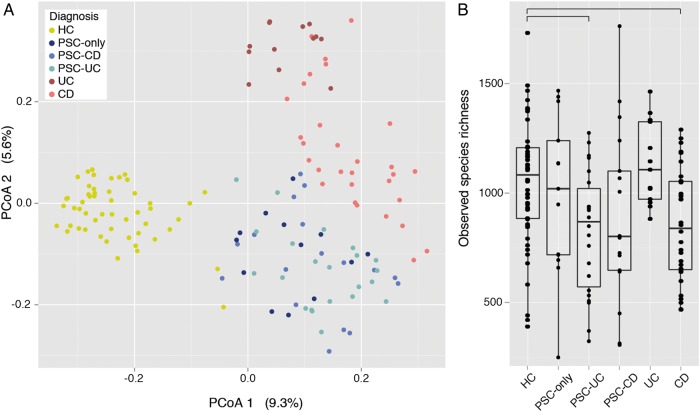
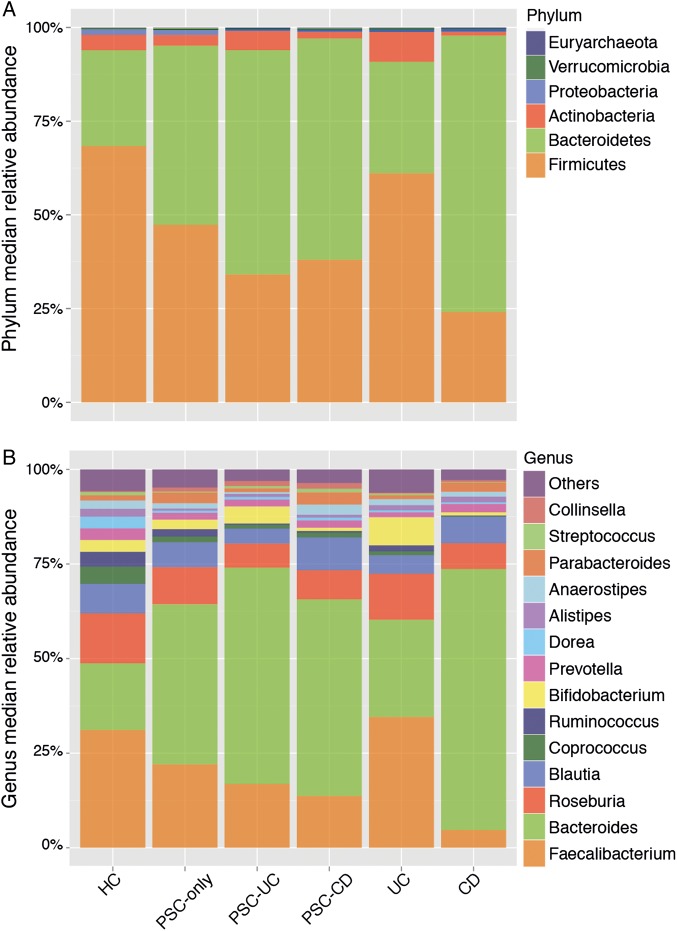
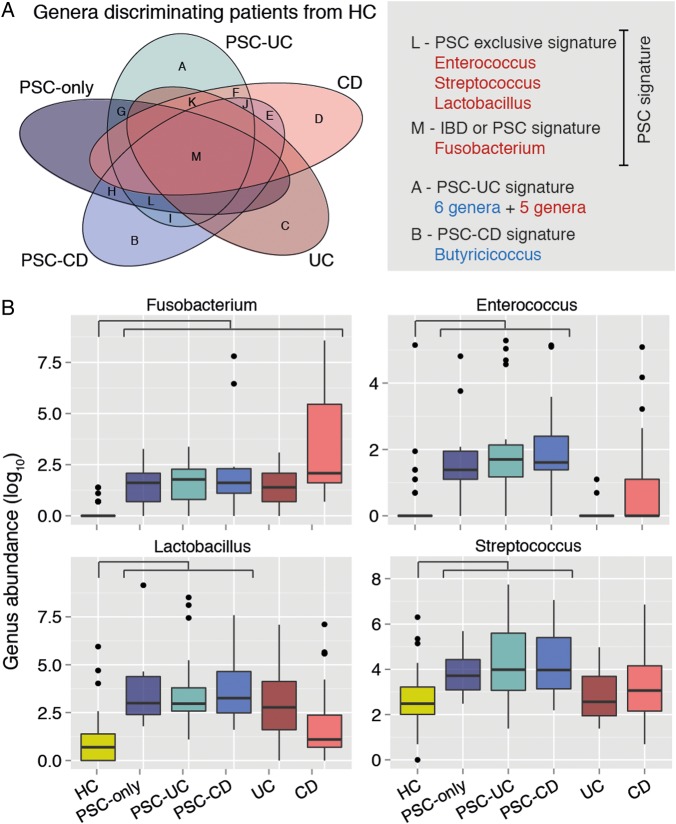
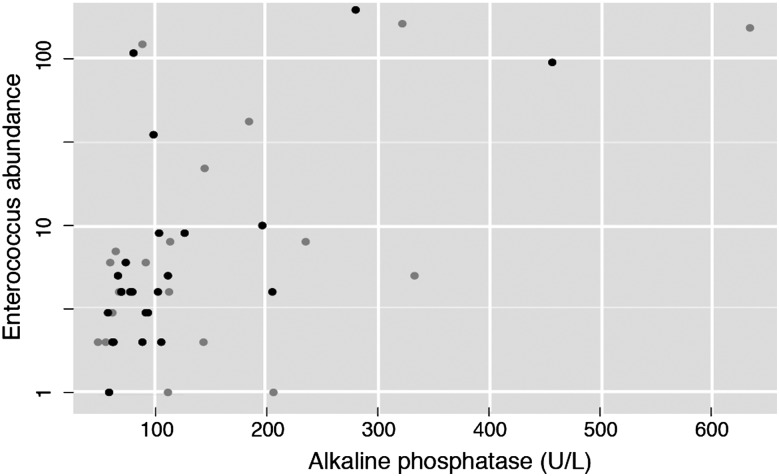
Verification
Claims the paper makes
The claims and statistics of this paper haven’t been checked yet.
Run the check — free, no account needed. It reads the open-access text and checks the sources it cites.
Claims other papers make about this one
Each is checked against this paper’s own text: does it say what the citing paper says it does?
In the citing paper
“Recent studies have further supported the association between changes in the microbiome and the progression of cholestatic liver disease in patients9–14.”
From Cholestasis induced by bile duct ligation promotes changes in the intestinal microbiome in mice (2019) · cites this paper as [11]
In the citing paper
“The changes described at genera level differ among studies9–12 and include the enrichment in Veillonella, Akkermansia, Ruminococcaceae (undefined genus) and Clostridium9 and the decrease in Prevotella10, overall supporting the association between changes in the microbiome and cholestatic disease.”
From Cholestasis induced by bile duct ligation promotes changes in the intestinal microbiome in mice (2019) · cites this paper as [11]
In the citing paper
“Recent studies described that cholestatic patients with PSC have an overall less diverse microbiome composition.”
From Cholestasis induced by bile duct ligation promotes changes in the intestinal microbiome in mice (2019) · cites this paper as [11]
Self-check
Percentages, sums and reported differences re-computed from the paper’s own numbers.
The self-check needs the paper’s full text.
Citations
Cites
phyloseq: An R Package for Reproducible Interactive Analysis and Graphics of Microbiome Census Data
McMurdie, P. J., & Holmes, S. (2013) · PLoS ONE · doi:10.1371/journal.pone.0061217 · Cited by 21,942
Search and clustering orders of magnitude faster than BLAST
Edgar, R. C. (2010) · Bioinformatics · doi:10.1093/bioinformatics/btq461 · Cited by 21,098
Naive Bayesian Classifier for Rapid Assignment of rRNA Sequences into the New Bacterial Taxonomy
Wang, Q., Garrity, G. M., Tiedje, J. M., & Cole, J. R. (2007) · Applied and Environmental Microbiology · doi:10.1128/aem.00062-07 · Cited by 20,145
The WEKA data mining software: an update
Hall, M., Frank, E., Holmes, G., Pfahringer, B., Reutemann, P., & Witten, I. H. (2009) · ACM SIGKDD Explorations Newsletter · doi:10.1145/1656274.1656278 · Cited by 17,750
FLASH: fast length adjustment of short reads to improve genome assemblies
Magoč, T., & Salzberg, S. L. (2011) · Bioinformatics · doi:10.1093/bioinformatics/btr507 · Cited by 15,366
UCHIME improves sensitivity and speed of chimera detection
Edgar, R. C., Haas, B. J., Clemente, J. C., Quince, C., & Knight, R. (2011) · Bioinformatics · doi:10.1093/bioinformatics/btr381 · Cited by 15,114
Kozich, J. J., Westcott, S. L., Baxter, N. T., Highlander, S. K., & Schloss, P. D. (2013) · Applied and Environmental Microbiology · doi:10.1128/aem.01043-13 · Cited by 7,246
Changes of Intestinal Functions in Liver Cirrhosis
Fukui, H., & Wiest, R. (2016) · Inflammatory Intestinal Diseases · doi:10.1159/000444436 · Cited by 6,820
Sokol, H., Pigneur, B., Watterlot, L., Lakhdari, O., Bermúdez-Humarán, L. G., Gratadoux, J.-J., Blugeon, S., Bridonneau, C., Furet, J.-P., Corthier, G., et al. (2008) · Proceedings of the National Academy of Sciences · doi:10.1073/pnas.0804812105 · Cited by 4,413
The Treatment-Naive Microbiome in New-Onset Crohn’s Disease
Gevers, D., Kugathasan, S., Denson, L. A., Vázquez-Baeza, Y., Van Treuren, W., Ren, B., Schwager, E., Knights, D., Song, S. J., Yassour, M., et al. (2014) · Cell Host & Microbe · doi:10.1016/j.chom.2014.02.005 · Cited by 3,220
Alterations of the human gut microbiome in liver cirrhosis
Qin, N., Yang, F., Li, A., Prifti, E., Chen, Y., Shao, L., Guo, J., Le Chatelier, E., Yao, J., Wu, L., et al. (2014) · Nature · doi:10.1038/nature13568 · Cited by 2,177
Genomic analysis identifies association of Fusobacterium with colorectal carcinoma
Kostic, A. D., Gevers, D., Pedamallu, C. S., Michaud, M., Duke, F., Earl, A. M., Ojesina, A. I., Jung, J., Bass, A. J., Tabernero, J., et al. (2012) · Genome Research · doi:10.1101/gr.126573.111 · Cited by 1,960
Machiels, K., Joossens, M., Sabino, J., De Preter, V., Arijs, I., Eeckhaut, V., Ballet, V., Claes, K., Van Immerseel, F., Verbeke, K., et al. (2014) · Gut · doi:10.1136/gutjnl-2013-304833 · Cited by 1,904
Self-citationThe Microbiome in Inflammatory Bowel Disease: Current Status and the Future Ahead
Kostic, A. D., Xavier, R. J., & Gevers, D. (2014) · Gastroenterology · doi:10.1053/j.gastro.2014.02.009 · Cited by 1,789
Assche, G. V., Dignass, A. U., Panés, J., Beaugerie, L., Karagiannis, J. A., Allez, M., Ochsenkühn, T., Orchard, T., Rogler, G., Louis, E. J., et al. (2010) · Journal of Crohn s and Colitis · doi:10.1016/j.crohns.2009.12.003 · Cited by 1,444
The ecology, epidemiology and virulence of Enterococcus
Fisher, K., & Phillips, C. A. (2009) · Microbiology · doi:10.1099/mic.0.026385-0 · Cited by 1,231
Dysbiosis of the faecal microbiota in patients with Crohn’s disease and their unaffected relatives
Joossens, M., Huys, G., Cnockaert, M., De Preter, V., Verbeke, K., Rutgeerts, P., Vandamme, P., & Vermeire, S. (2011) · Gut · doi:10.1136/gut.2010.223263 · Cited by 1,063
Self-citationCharacterization of fecal microbial communities in patients with liver cirrhosis
Chen, Y., Yang, F., Lu, H., Wang, B., Chen, Y., Lei, D., Wang, Y., Zhu, B., & Li, L. (2011) · Hepatology · doi:10.1002/hep.24423 · Cited by 1,038
Willing, B. P., Dicksved, J., Halfvarson, J., Andersson, A. F., Lucio, M., Zheng, Z., Järnerot, G., Tysk, C., Jansson, J. K., & Engstrand, L. (2010) · Gastroenterology · doi:10.1053/j.gastro.2010.08.049 · Cited by 1,032
Dignass, A. U., Eliakim, R., Magro, F., Maaser, C., Chowers, Y., Geboes, K., Mantzaris, G. J., Reinisch, W., Colombel, J., Vermeire, S., et al. (2012) · Journal of Crohn s and Colitis · doi:10.1016/j.crohns.2012.09.003 · Cited by 903
Self-citationBoonstra, K., Weersma, R. K., van Erpecum, K. J., Rauws, E. A., Spanier, B. W. M., Poen, A. C., van Nieuwkerk, K. M., Drenth, J. P., Witteman, B. J., Tuynman, H. A., et al. (2013) · Hepatology · doi:10.1002/hep.26565 · Cited by 725
Oligotyping: differentiating between closely related microbial taxa using 16S rRNA gene data
Eren, A. M., Maignien, L., Sul, W. J., Murphy, L. G., Grim, S. L., Morrison, H. G., & Sogin, M. L. (2013) · Methods in Ecology and Evolution · doi:10.1111/2041-210x.12114 · Cited by 639
Primary sclerosing cholangitis
Hirschfield, G. M., Karlsen, T. H., Lindor, K. D., & Adams, D. (2013) · The Lancet · doi:10.1016/s0140-6736(13)60096-3 · Cited by 612
Strauss, J., Kaplan, G. G., Beck, P. L., Rioux, K. P., Panaccione, R., DeVinney, R., Lynch, T., & Allen‐Vercoe, E. (2011) · Inflammatory Bowel Diseases · doi:10.1002/ibd.21606 · Cited by 578
ACG clinical guideline: primary sclerosing cholangitis
Lindor, K. D., Kowdley, K. V., & Harrison, E. M. (2015) · American Journal of Gastroenterology · doi:10.1038/ajg.2015.112 · Cited by 524
Kummen, M., Holm, K., Anmarkrud, J. A., Nygård, S., Vesterhus, M., Høivik, M. L., Trøseid, M., Marschall, H.-U., Schrumpf, E., Moum, B., et al. (2017) · Gut · doi:10.1136/gutjnl-2015-310500 · Cited by 426
The UK-PSCSC Consortium, Liu, J. Z., The International IBD Genetics Consortium, The International PSC Study Group, Hov, J. R., Folseraas, T., Ellinghaus, E., Rushbrook, S. M., Doncheva, N. T., Andreassen, O. A., et al. (2013) · Nature Genetics · doi:10.1038/ng.2616 · Cited by 391
Self-citationExtraintestinal manifestations and complications in IBD
Ott, C., & Schölmerich, J. (2013) · Nature Reviews Gastroenterology & Hepatology · doi:10.1038/nrgastro.2013.117 · Cited by 357
Steck, N., Hoffmann, M., Sava, I. G., Kim, S. C., Hahne, H., Tonkonogy, S. L., Mair, K., Krueger, D., Pruteanu, M., Shanahan, F., et al. (2011) · Gastroenterology · doi:10.1053/j.gastro.2011.05.035 · Cited by 343
Alabraba, E., Nightingale, P., Gunson, B., Hubscher, S., Olliff, S., Mirza, D., & Neuberger, J. (2009) · Liver Transplantation · doi:10.1002/lt.21679 · Cited by 298
Tabibian, J. H., O'Hara, S. P., Trussoni, C. E., Tietz, P. S., Splinter, P. L., Mounajjed, T., Hagey, L. R., & LaRusso, N. F. (2016) · Hepatology · doi:10.1002/hep.27927 · Cited by 223
Färkkilä, M., Karvonen, A., Nurmi, H., Nuutinen, H., Taavitsainen, M., Pikkarainen, P., & Kärkkäinen, P. (2004) · Hepatology · doi:10.1002/hep.20457 · Cited by 218
Mamari, S. A., Djordjevic, J., Halliday, J., & Chapman, R. W. (2012) · Journal of Hepatology · doi:10.1016/j.jhep.2012.10.013 · Cited by 208
Lindström, L., Hultcrantz, R. W., Boberg, K. M., Friis–Liby, I., & Bergquist, A. M. (2013) · Clinical Gastroenterology and Hepatology · doi:10.1016/j.cgh.2012.12.032 · Cited by 181
Wacklin, P., Tuimala, J., Nikkilä, J., Tims, S., Mäkivuokko, H., Alakulppi, N. S., Laine, P., Rajilić-Stojanović, M. D., Paulin, L. G., de Vos, W. M., et al. (2014) · PLoS ONE · doi:10.1371/journal.pone.0094863 · Cited by 162
Bile duct bacterial isolates in primary sclerosing cholangitis: a study of explanted livers
Olsson, R., Björnsson, E., Bäckman, L., Friman, S., Höckerstedt, K., Kaijser, B., & Olausson, M. (1998) · Journal of Hepatology · doi:10.1016/s0168-8278(98)80316-4 · Cited by 133
Rossen, N. G., Fuentes, S., Boonstra, K., D’Haens, G. R., Heilig, H. G., Zoetendal, E. G., de Vos, W. M., & Ponsioen, C. Y. (2015) · Journal of Crohn's and Colitis · doi:10.1093/ecco-jcc/jju023 · Cited by 129
Pohl, J., Ring, A., Stremmel, W., & Stiehl, A. (2006) · European Journal of Gastroenterology & Hepatology · doi:10.1097/00042737-200601000-00012 · Cited by 111
Changing trend in bile microbiology and antibiotic susceptibilities: over 12 years of experience
Kwon, W., Jang, J.-Y., Kim, E.-C., Park, J. W., Han, I. W., Kang, M. J., & Kim, S.-W. (2012) · Infection · doi:10.1007/s15010-012-0358-y · Cited by 52
CD8 T Cells Primed in the Gut-Associated Lymphoid Tissue Induce Immune-Mediated Cholangitis in Mice
Seidel, D., Eickmeier, I., Kühl, A. A., Hamann, A., Loddenkemper, C., & Schott, E. (2013) · Hepatology · doi:10.1002/hep.26702 · Cited by 50
Cited by
Sorted by citations
Quantitative microbiome profiling links gut community variation to microbial load
Vandeputte, D., Kathagen, G., D’hoe, K., Vieira-Silva, S., Valles-Colomer, M., Sabino, J., Wang, J., Tito, R. Y., De Commer, L., Darzi, Y., et al. (2017) · Nature · doi:10.1038/nature24460 · Cited by 1,218
Self-citationPrimary sclerosing cholangitis – a comprehensive review
Karlsen, T. H., Folseraas, T., Thorburn, D., & Vesterhus, M. (2017) · Journal of Hepatology · doi:10.1016/j.jhep.2017.07.022 · Cited by 868
Optimizing methods and dodging pitfalls in microbiome research
Kim, D. J., Hofstaedter, C. E., Zhao, C., Mattei, L. M., Tanes, C., Clarke, E., Lauder, A. P., Sherrill-Mix, S. A., Chehoud, C., Kelsen, J. R., et al. (2017) · Microbiome · doi:10.1186/s40168-017-0267-5 · Cited by 557
Gut microbiome and liver diseases
Tilg, H., Cani, P. D., & Mayer, E. A. (2016) · Gut · doi:10.1136/gutjnl-2016-312729 · Cited by 525
Gut microbiome, liver immunology, and liver diseases
Wang, R., Tang, R., Li, B., Ma, X., Schnabl, B., & Tilg, H. (2021) · Cellular & Molecular Immunology · doi:10.1038/s41423-020-00592-6 · Cited by 466
Metadata
- Authors
- Sabino, J., Vieira-Silva, S., Machiels, K., Joossens, M., Falony, G., Ballet, V., Ferrante, M., Van Assche, G., Van der Merwe, S., Vermeire, S., & Raes, J.
- Affiliations
- KU Leuven (BE)
- Department of Microbiology and Immunology, Laboratory of Molecular Bacteriology, KU Leuven—University of Leuven, Rega Institute for Medical Research, Leuven, Belgium
- Vrije Universiteit Brussel (BE)
- Rega Institute for Medical Research (BE)
- Translational Research Center for Gastrointestinal Disorders (TARGID), University of Leuven, Leuven, Belgium
- Department of Microbiology and Immunology, Center for the Biology of Disease, REGA institute, KU Leuven—VIB, Leuven, Belgium
- Corresponding author
- Raes, Jeroen
- Venue
- Gut
- Publisher
- BMJ
- Published
- 2016-05-20
- Volume
- 65
- Issue
- 10
- Pages
- 1681-1689
- ISSN
- 0017-5749 (ISSN-L)
- 1468-3288
- PMC
- PMC5036217
- OpenAlex
- W2408052000
- Cited by
- 413
- References
- 40
- Citations by year
- 2026: 28 · 2025: 28 · 2024: 46 · 2023: 46 · 2022: 42 · 2021: 52 · 2020: 44 · 2019: 45 · 2018: 33 · 2017: 34 · 2016: 13
- FWCI
- 21.65
- Type
- journal article
- Language
- en
- Open access
- hybrid
- doi.org
- Licence
- cc-by-nc
- Locations
- Gut (publishedVersion, cc-by-nc)
- Europe PMC (PubMed Central) (publishedVersion, cc-by-nc)
- PubMed Central (publishedVersion, cc-by-nc)
- PubMed (publishedVersion)
- Socio-Environmental Systems Modeling (acceptedVersion, cc-by-nc)
- Lirias (submittedVersion, cc-by-nc)
- Ghent University Academic Bibliography (Ghent University) (submittedVersion)
- Digital Access to Libraries (submittedVersion)
- HighWire Press Open Archive (submittedVersion)
- Funders
- Fonds Wetenschappelijk Onderzoek
- KU Leuven
- Vlaamse regering
- Topics
- Life Sciences › Biochemistry, Genetics and Molecular Biology › Molecular Biology › Gut microbiota and health
- Health Sciences › Medicine › Hepatology › Liver Diseases and Immunity
- Health Sciences › Medicine › Gastroenterology › Inflammatory Bowel Disease
- Keywords
- primary sclerosing cholangitis, gut dysbiosis, gut microbiota, inflammatory bowel disease, Enterococcus, Fusobacterium, Lactobacillus, microbiome diversity, Crohn's disease, ulcerative colitis, ursodeoxycholic acid, alkaline phosphatase, disease severity
- MeSH terms
- Gastrointestinal Microbiome, Adult, Aged, Alkaline Phosphatase, Biopsy, Cholagogues and Choleretics, Colonoscopy, Feces, Female, Humans, Male, Middle Aged, Severity of Illness Index, Statistics as Topic, Ursodeoxycholic Acid, Cholangitis, Sclerosing, Inflammatory Bowel Diseases, Enterococcus, Dysbiosis
About these checks
Registry, retraction, Cites and statistics results are computed, not judged, with one exception: a printed reference that no index lists is read once by a model before it counts as a citation error. Claims are extracted by a model and kept only when their quote appears verbatim in the text; each cited source is then checked, with a model’s help, for whether it says what the claim relies on. Those verdicts can be wrong — read the claim’s quote and the cited source before relying on one.
Statistics and arithmetic are recomputed, not judged.
Confidence bands are shown only for fields calibrated on our annotated test set. None is calibrated yet, so no band is shown.
What counts as a claim ›How we measure confidence ›How we check this ›
Are you an author, or do you see a problem with this page? Request a review
