

The DOI matches its Crossref record; 69 of the 70 references it cites were found in a registry or an index.
International Cancer Microbiome Consortium consensus statement on the role of the human microbiome in carcinogenesis
Open accessAbstract
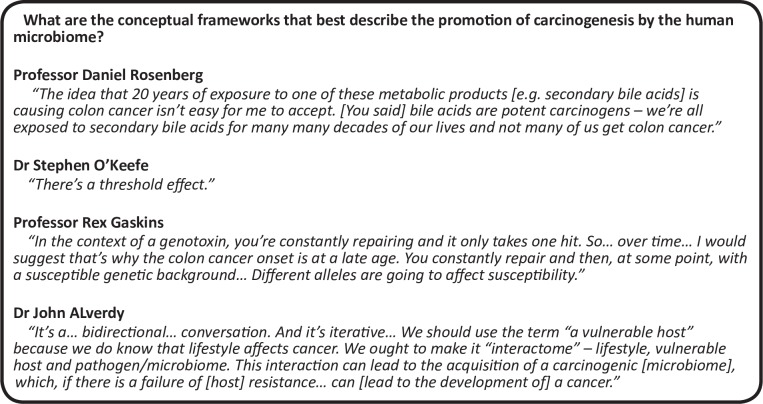
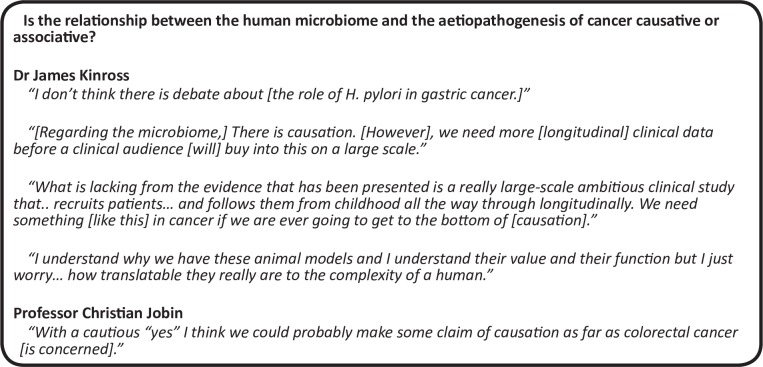
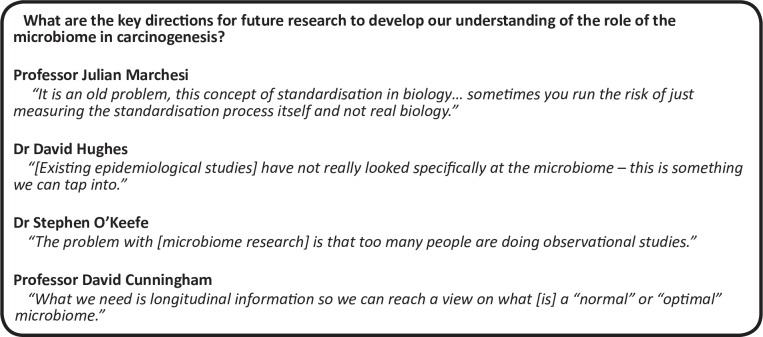
OBJECTIVE: In this consensus statement, an international panel of experts deliver their opinions on key questions regarding the contribution of the human microbiome to carcinogenesis. DESIGN: International experts in oncology and/or microbiome research were approached by personal communication to form a panel. A structured, iterative, methodology based around a 1-day roundtable discussion was employed to derive expert consensus on key questions in microbiome-oncology research. RESULTS: Some 18 experts convened for the roundtable discussion and five key questions were identified regarding: (1) the relevance of dysbiosis/an altered gut microbiome to carcinogenesis; (2) potential mechanisms of microbiota-induced carcinogenesis; (3) conceptual frameworks describing how the human microbiome may drive carcinogenesis; (4) causation versus association; and (5) future directions for research in the field.The panel considered that, despite mechanistic and supporting evidence from animal and human studies, there is currently no direct evidence that the human commensal microbiome is a key determinant in the aetiopathogenesis of cancer. The panel cited the lack of large longitudinal, cohort studies as a principal deciding factor and agreed that this should be a future research priority. However, while acknowledging gaps in the evidence, expert opinion was that the microbiome, alongside environmental factors and an epigenetically/genetically vulnerable host, represents one apex of a tripartite, multidirectional interactome that drives carcinogenesis. CONCLUSION: Data from longitudinal cohort studies are needed to confirm the role of the human microbiome as a key driver in the aetiopathogenesis of cancer.
Overview
The claims and statistics of this paper haven’t been checked yet.
Run the check — free, no account needed. It reads the open-access text and checks the sources it cites.
Integrity signals
Registry
Cites
Statistics
Figures
Verification
Claims the paper makes
The claims and statistics of this paper haven’t been checked yet.
Run the check — free, no account needed. It reads the open-access text and checks the sources it cites.
Claims other papers make about this one
Each is checked against this paper’s own text: does it say what the citing paper says it does?
In the citing paper
“Increasing data indicate that changes in the intestinal microbiome allow environmental risk factors to initiate and promote CRC.6, 7”
From Influence of the Gut Microbiome, Diet, and Environment on Risk of Colorectal Cancer (2020) · cites this paper as [7]
In the citing paper
“Researchers have discovered associations between elements of the intestinal microbiome (including specific microbes, signaling pathways, and microbiota-related metabolites) and risk of colorectal cancer (CRC).”
From Influence of the Gut Microbiome, Diet, and Environment on Risk of Colorectal Cancer (2020) · cites this paper as [7]
Self-check
Percentages, sums and reported differences re-computed from the paper’s own numbers.
The self-check needs the paper’s full text.
Citations
Cites
Coussens, L. M., & Werb, Z. (2002) · Nature · doi:10.1038/nature01322 · Cited by 15,111
Structure, function and diversity of the healthy human microbiome
The Human Microbiome Project Consortium (2012) · Nature · doi:10.1038/nature11234 · Cited by 11,726
Gut microbiome influences efficacy of PD-1-based immunotherapy against epithelial tumors
Routy, B., Le Chatelier, E., Derosa, L., Duong, C. P. M., Alou, M. T., Daillère, R., Fluckiger, A., Messaoudene, M., Rauber, C., Roberti, M. P., et al. (2018) · Science · doi:10.1126/science.aan3706 · Cited by 5,671
Diversity, stability and resilience of the human gut microbiota
Lozupone, C. A., Stombaugh, J. I., Gordon, J. I., Jansson, J. K., & Knight, R. (2012) · Nature · doi:10.1038/nature11550 · Cited by 5,533
Role of the microbiota in immunity and inflammation.
Belkaid, Y., & Hand, T. W. (2014) · Cell · doi:10.1016/j.cell.2014.03.011 · Cited by 5,385
Host-gut microbiota metabolic interactions
Nicholson, J. K., Holmes, E., Kinross, J., Burcelin, R., Gibson, G., Jia, W., & Pettersson, S. (2012) · Science · doi:10.1126/science.1223813 · Cited by 4,760
Self-citationHelicobacter pylori Infection and the Development of Gastric Cancer
Uemura, N., Okamoto, S., Yamamoto, S., Matsumura, N., Yamaguchi, S., Yamakido, M., Taniyama, K., Sasaki, N., & Schlemper, R. J. (2001) · New England Journal of Medicine · doi:10.1056/nejmoa001999 · Cited by 4,492
Interactions Between the Microbiota and the Immune System
Hooper, L. V., Littman, D. R., & Macpherson, A. J. (2012) · Science · doi:10.1126/science.1223490 · Cited by 4,173
Kostic, A. D., Chun, E., Robertson, L., Glickman, J. N., Gallini, C. A., Michaud, M., Clancy, T. E., Chung, D. C., Lochhead, P., Hold, G. L., et al. (2013) · Cell Host & Microbe · doi:10.1016/j.chom.2013.07.007 · Cited by 2,718
Rubinstein, M. R., Wang, X., Liu, W., Hao, Y., Cai, G., & Han, Y. W. (2013) · Cell Host & Microbe · doi:10.1016/j.chom.2013.07.012 · Cited by 2,476
Cited by
Sorted by citations
Gut microbiota in colorectal cancer: mechanisms of action and clinical applications
Wong, S. H., & Yu, J. (2019) · Nature Reviews Gastroenterology & Hepatology · doi:10.1038/s41575-019-0209-8 · Cited by 1,392
Self-citationInfluence of the Gut Microbiome, Diet, and Environment on Risk of Colorectal Cancer
Song, M., Chan, A. T., & Sun, J. (2020) · Gastroenterology · doi:10.1053/j.gastro.2019.06.048 · Cited by 752
Gut microbiota in colorectal cancer development and therapy
Wong, C. C., & Yu, J. (2023) · Nature Reviews Clinical Oncology · doi:10.1038/s41571-023-00766-x · Cited by 779
Self-citationGut microbiota modulation: a novel strategy for prevention and treatment of colorectal cancer
Fong, W., Li, Q., & Yu, J. Q. (2020) · Oncogene · doi:10.1038/s41388-020-1341-1 · Cited by 643
Self-citationClinical management of metastatic colorectal cancer in the era of precision medicine
Ciardiello, F., Ciardiello, D., Martini, G., Napolitano, S., Tabernero, J. M., & Cervantes, A. M. R. (2022) · CA A Cancer Journal for Clinicians · doi:10.3322/caac.21728 · Cited by 556
Metadata
- Authors
- Scott, A. J., Alexander, J. L., Merrifield, C. A., Cunningham, D., Jobin, C., Brown, R., Alverdy, J., O’Keefe, S. J., Gaskins, H. R., Teare, J., Yu, J., Hughes, D. J., Verstraelen, H., Burton, J., O’Toole, P. W., Rosenberg, D. W., Marchesi, J. R., & Kinross, J. M.
- Affiliations
- Imperial College London (GB)
- Royal Marsden Hospital (GB)
- University of Florida Health (US)
- University of Chicago (US)
- University of Pittsburgh (US)
- University of Illinois Urbana-Champaign (US)
- Chinese University of Hong Kong (HK)
- University College Dublin (IE)
- Ghent University Hospital (BE)
- Lawson Health Research Institute (CA)
- University College Cork (IE)
- University of Connecticut (US)
- Department of Surgery and Cancer, Imperial College London, London, UK
- Corresponding author
- Marchesi, Julian R
- ORCID
- Venue
- Gut
- Publisher
- BMJ
- Published
- 2019-05-15
- Volume
- 68
- Issue
- 9
- Pages
- 1624-1632
- ISSN
- 0017-5749 (ISSN-L)
- 1468-3288
- PMC
- PMC6709773
- OpenAlex
- W2945346908
- Cited by
- 288
- References
- 70
- Citations by year
- 2026: 29 · 2025: 43 · 2024: 34 · 2023: 37 · 2022: 49 · 2021: 50 · 2020: 38 · 2019: 8
- FWCI
- 11.93
- Type
- journal article
- Language
- en
- Open access
- hybrid
- doi.org
- Licence
- cc-by-nc
- Locations
- Gut (publishedVersion, cc-by-nc)
- Europe PMC (PubMed Central) (publishedVersion, cc-by-nc)
- PubMed Central (publishedVersion, cc-by-nc)
- PubMed (publishedVersion)
- ORCA Online Research @Cardiff (Cardiff University) (acceptedVersion)
- Ghent University Academic Bibliography (Ghent University) (submittedVersion, cc-by-nc)
- Arrow@dit (Dublin Institute of Technology) (submittedVersion, cc-by-nc)
- Cork Open Research Archive (University College Cork, Ireland) (submittedVersion, cc-by-nc)
- HighWire Press Open Archive (submittedVersion)
- Spiral (Imperial College London) (submittedVersion, cc-by-nc)
- Lenus, The Irish Health Repository (Dr Steevens Hospital Library) (submittedVersion, cc-by-nc)
- Funders
- Cancer Research UK
- Topics
- Life Sciences › Biochemistry, Genetics and Molecular Biology › Molecular Biology › Gut microbiota and health
- Health Sciences › Dentistry › Periodontics › Oral microbiology and periodontitis research
- Health Sciences › Medicine › Oncology › Cancer Risks and Factors
- Keywords
- human microbiome, carcinogenesis, gut dysbiosis, association versus causation, longitudinal cohort
- MeSH terms
- Gastrointestinal Microbiome, Animals, DNA Damage, Humans, Inflammation, Neoplasms, Colorectal Neoplasms, Biomedical Research, Carcinogenesis, Microbiota, Dysbiosis
About these checks
Registry, retraction, Cites and statistics results are computed, not judged, with one exception: a printed reference that no index lists is read once by a model before it counts as a citation error. Claims are extracted by a model and kept only when their quote appears verbatim in the text; each cited source is then checked, with a model’s help, for whether it says what the claim relies on. Those verdicts can be wrong — read the claim’s quote and the cited source before relying on one.
Statistics and arithmetic are recomputed, not judged.
Confidence bands are shown only for fields calibrated on our annotated test set. None is calibrated yet, so no band is shown.
What counts as a claim ›How we measure confidence ›How we check this ›
Are you an author, or do you see a problem with this page? Request a review
