

The DOI matches its Crossref record; 69 of the 70 references it cites were found in a registry or an index.
International Cancer Microbiome Consortium consensus statement on the role of the human microbiome in carcinogenesis
Open accessAbstract
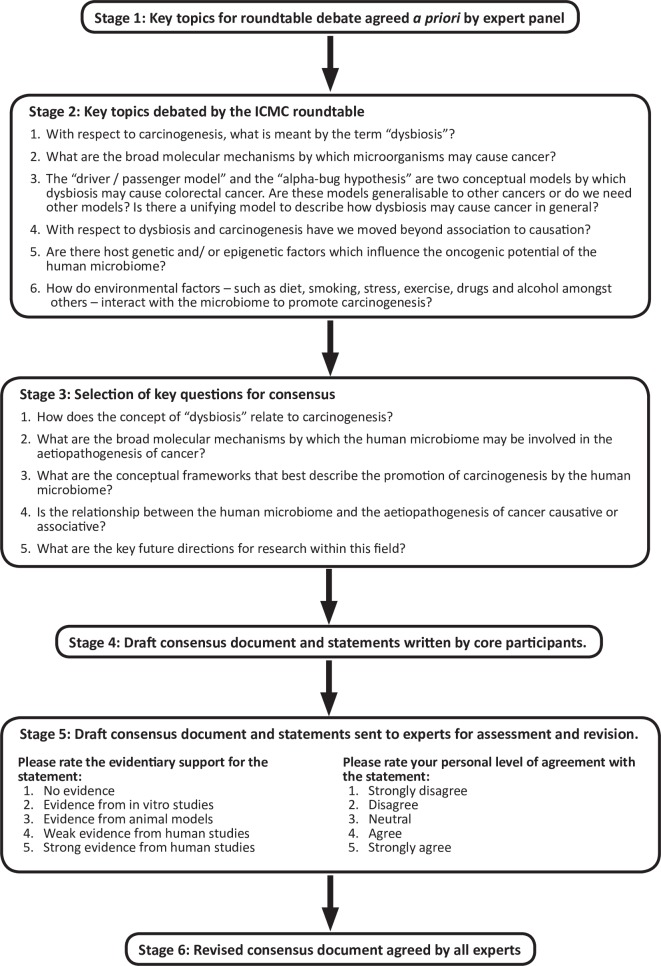
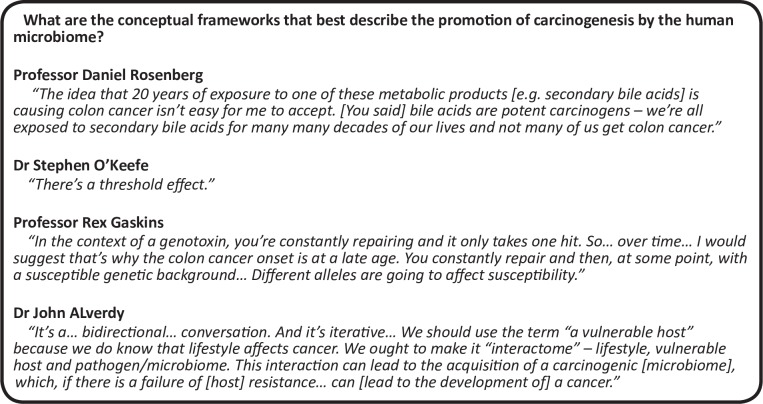
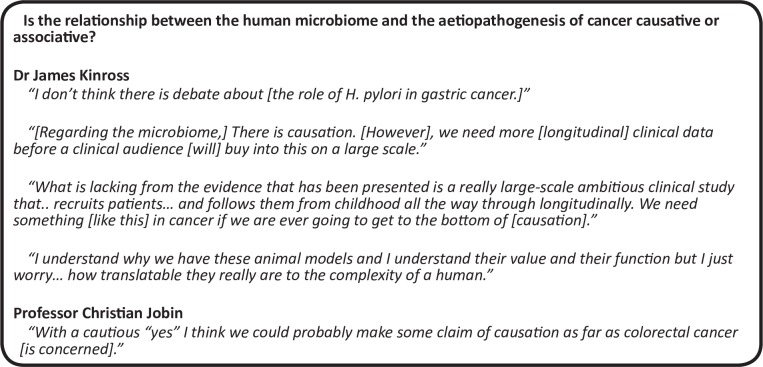
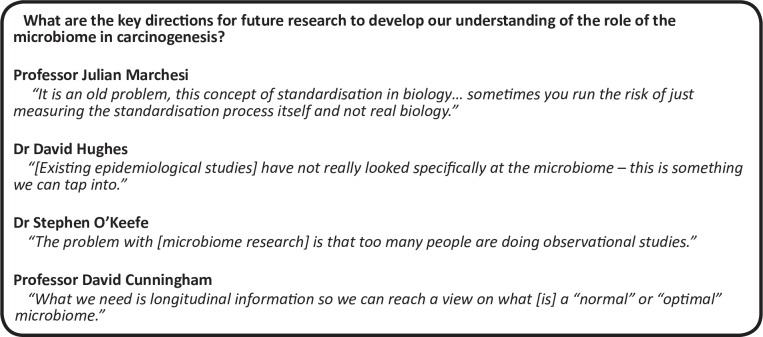
OBJECTIVE: In this consensus statement, an international panel of experts deliver their opinions on key questions regarding the contribution of the human microbiome to carcinogenesis. DESIGN: International experts in oncology and/or microbiome research were approached by personal communication to form a panel. A structured, iterative, methodology based around a 1-day roundtable discussion was employed to derive expert consensus on key questions in microbiome-oncology research. RESULTS: Some 18 experts convened for the roundtable discussion and five key questions were identified regarding: (1) the relevance of dysbiosis/an altered gut microbiome to carcinogenesis; (2) potential mechanisms of microbiota-induced carcinogenesis; (3) conceptual frameworks describing how the human microbiome may drive carcinogenesis; (4) causation versus association; and (5) future directions for research in the field.The panel considered that, despite mechanistic and supporting evidence from animal and human studies, there is currently no direct evidence that the human commensal microbiome is a key determinant in the aetiopathogenesis of cancer. The panel cited the lack of large longitudinal, cohort studies as a principal deciding factor and agreed that this should be a future research priority. However, while acknowledging gaps in the evidence, expert opinion was that the microbiome, alongside environmental factors and an epigenetically/genetically vulnerable host, represents one apex of a tripartite, multidirectional interactome that drives carcinogenesis. CONCLUSION: Data from longitudinal cohort studies are needed to confirm the role of the human microbiome as a key driver in the aetiopathogenesis of cancer.
Overview
The claims and statistics of this paper haven’t been checked yet.
Run the check — free, no account needed. It reads the open-access text and checks the sources it cites.
Integrity signals
Registry
Cites
Statistics
Figures
Verification
Claims the paper makes
The claims and statistics of this paper haven’t been checked yet.
Run the check — free, no account needed. It reads the open-access text and checks the sources it cites.
Claims other papers make about this one
Each is checked against this paper’s own text: does it say what the citing paper says it does?
In the citing paper
“Increasing data indicate that changes in the intestinal microbiome allow environmental risk factors to initiate and promote CRC.6, 7”
From Influence of the Gut Microbiome, Diet, and Environment on Risk of Colorectal Cancer (2020) · cites this paper as [7]
In the citing paper
“Researchers have discovered associations between elements of the intestinal microbiome (including specific microbes, signaling pathways, and microbiota-related metabolites) and risk of colorectal cancer (CRC).”
From Influence of the Gut Microbiome, Diet, and Environment on Risk of Colorectal Cancer (2020) · cites this paper as [7]
Self-check
Percentages, sums and reported differences re-computed from the paper’s own numbers.
The self-check needs the paper’s full text.
Citations
Cites
Coussens, L. M., & Werb, Z. (2002) · Nature · doi:10.1038/nature01322 · Cited by 15,111
Structure, function and diversity of the healthy human microbiome
The Human Microbiome Project Consortium (2012) · Nature · doi:10.1038/nature11234 · Cited by 11,726
Gut microbiome influences efficacy of PD-1-based immunotherapy against epithelial tumors
Routy, B., Le Chatelier, E., Derosa, L., Duong, C. P. M., Alou, M. T., Daillère, R., Fluckiger, A., Messaoudene, M., Rauber, C., Roberti, M. P., et al. (2018) · Science · doi:10.1126/science.aan3706 · Cited by 5,671
Diversity, stability and resilience of the human gut microbiota
Lozupone, C. A., Stombaugh, J. I., Gordon, J. I., Jansson, J. K., & Knight, R. (2012) · Nature · doi:10.1038/nature11550 · Cited by 5,533
Role of the microbiota in immunity and inflammation.
Belkaid, Y., & Hand, T. W. (2014) · Cell · doi:10.1016/j.cell.2014.03.011 · Cited by 5,385
Host-gut microbiota metabolic interactions
Nicholson, J. K., Holmes, E., Kinross, J., Burcelin, R., Gibson, G., Jia, W., & Pettersson, S. (2012) · Science · doi:10.1126/science.1223813 · Cited by 4,760
Self-citationHelicobacter pylori Infection and the Development of Gastric Cancer
Uemura, N., Okamoto, S., Yamamoto, S., Matsumura, N., Yamaguchi, S., Yamakido, M., Taniyama, K., Sasaki, N., & Schlemper, R. J. (2001) · New England Journal of Medicine · doi:10.1056/nejmoa001999 · Cited by 4,492
Interactions Between the Microbiota and the Immune System
Hooper, L. V., Littman, D. R., & Macpherson, A. J. (2012) · Science · doi:10.1126/science.1223490 · Cited by 4,173
Kostic, A. D., Chun, E., Robertson, L., Glickman, J. N., Gallini, C. A., Michaud, M., Clancy, T. E., Chung, D. C., Lochhead, P., Hold, G. L., et al. (2013) · Cell Host & Microbe · doi:10.1016/j.chom.2013.07.007 · Cited by 2,718
Rubinstein, M. R., Wang, X., Liu, W., Hao, Y., Cai, G., & Han, Y. W. (2013) · Cell Host & Microbe · doi:10.1016/j.chom.2013.07.012 · Cited by 2,476
Intestinal Short Chain Fatty Acids and their Link with Diet and Human Health
Ríos-Covián, D., Ruas‐Madiedo, P., Margollés, A., Gueimonde, M., Reyes‐Gavilán, C. G. D. L., & Salazar, N. (2016) · Frontiers in Microbiology · doi:10.3389/fmicb.2016.00185 · Cited by 2,300
Fusobacterium nucleatum infection is prevalent in human colorectal carcinoma
Castellarin, M., Warren, R. L., Freeman, J. D., Dreolini, L., Krzywinski, M., Strauss, J., Barnes, R., Watson, P., Allen-Vercoe, E., Moore, R. A., et al. (2012) · Genome Research · doi:10.1101/gr.126516.111 · Cited by 2,043
Genomic analysis identifies association of Fusobacterium with colorectal carcinoma
Kostic, A. D., Gevers, D., Pedamallu, C. S., Michaud, M., Duke, F., Earl, A. M., Ojesina, A. I., Jung, J., Bass, A. J., Tabernero, J., et al. (2012) · Genome Research · doi:10.1101/gr.126573.111 · Cited by 1,960
Wu, S., Rhee, K.-J., Albesiano, E., Rabizadeh, S., Wu, X., Yen, H.-R., Huso, D. L., Brancati, F. L., Wick, E., McAllister, F., et al. (2009) · Nature Medicine · doi:10.1038/nm.2015 · Cited by 1,812
Dysbiosis and the immune system
Levy, M., Kolodziejczyk, A. A., Thaiss, C. A., & Elinav, E. (2017) · Nature Reviews Immunology · doi:10.1038/nri.2017.7 · Cited by 1,769
Dysbiosis of the gut microbiota in disease
Carding, S., Verbeke, K., Vipond, D. T., Corfe, B. M., & Owen, L. J. (2015) · Microbial Ecology in Health & Disease · doi:10.3402/mehd.v26.26191 · Cited by 1,710
Schwabe, R. F., & Jobin, C. (2013) · Nature Reviews Cancer · doi:10.1038/nrc3610 · Cited by 1,689
Self-citationThe Framingham Heart Study and the epidemiology of cardiovascular disease: a historical perspective
Mahmood, S. S., Levy, D., Vasan, R. S., & Wang, T. J. (2014) · The Lancet · doi:10.1016/s0140-6736(13)61752-3 · Cited by 1,622
Gur, C., Ibrahim, Y., Isaacson, B., Yamin, R., Abed, J., Gamliel, M., Enk, J., Bar-On, Y., Stanietsky-Kaynan, N., Coppenhagen-Glazer, S., et al. (2015) · Immunity · doi:10.1016/j.immuni.2015.01.010 · Cited by 1,490
Promotion of Hepatocellular Carcinoma by the Intestinal Microbiota and TLR4
Dapito, D. H., Mencin, A., Gwak, G.-Y., Pradere, J.-P., Jang, M.-K., Mederacke, I., Caviglia, J. M., Khiabanian, H., Adeyemi, A., Bataller, R., et al. (2012) · Cancer Cell · doi:10.1016/j.ccr.2012.02.007 · Cited by 1,346
Yu, J. Q., Feng, Q., Wong, S. H., Zhang, D., Liang, Q. Y., Qin, Y., Tang, L., Zhao, H., Stenvang, J., Li, Y., et al. (2015) · Gut · doi:10.1136/gutjnl-2015-309800 · Cited by 1,273
Self-citationStrains, functions and dynamics in the expanded Human Microbiome Project
Lloyd-Price, J., Mahurkar, A., Rahnavard, G., Crabtree, J., Orvis, J., Hall, A. B., Brady, A., Creasy, H. H., McCracken, C., Giglio, M. G., et al. (2017) · Nature · doi:10.1038/nature23889 · Cited by 1,267
Molecular mechanisms of alcohol-mediated carcinogenesis
Seitz, H. K., & Stickel, F. (2007) · Nature reviews. Cancer · doi:10.1038/nrc2191 · Cited by 1,166
Stem cell divisions, somatic mutations, cancer etiology, and cancer prevention
Tomasetti, C., Li, L., & Vogelstein, B. (2017) · Science · doi:10.1126/science.aaf9011 · Cited by 1,143
Fusobacterium nucleatum in colorectal carcinoma tissue and patient prognosis
Mima, K., Nishihara, R., Qian, Z. R., Cao, Y., Sukawa, Y., Nowak, J. A., Yang, J., Dou, R., Masugi, Y., Song, M., et al. (2016) · Gut · doi:10.1136/gutjnl-2015-310101 · Cited by 1,080
Mechanisms of Human Papillomavirus-Induced Oncogenesis
Münger, K., Baldwin, A. E., Edwards, K. M., Hayakawa, H., Nguyen, C. L., Owens, M., Grace, M. R., & Huh, K.-W. (2004) · Journal of Virology · doi:10.1128/jvi.78.21.11451-11460.2004 · Cited by 1,050
Fat, fibre and cancer risk in African Americans and rural Africans
O’Keefe, S. J. D., Li, J. V., Lahti, L., Ou, J., Carbonero, F., Mohammed, K., Posma, J. M., Kinross, J., Wahl, E., Ruder, E., et al. (2015) · Nature Communications · doi:10.1038/ncomms7342 · Cited by 982
Self-citationSequence-based identification of microbial pathogens: a reconsideration of Koch's postulates
Fredericks, D. N., & Relman, D. A. (1996) · Clinical Microbiology Reviews · doi:10.1128/cmr.9.1.18 · Cited by 959
Ríboli, E. (1997) · International Journal of Epidemiology · doi:10.1093/ije/26.suppl_1.s6 · Cited by 957
A bacterial driver–passenger model for colorectal cancer: beyond the usual suspects
Tjalsma, H., Boleij, A., Marchesi, J. R., & Dutilh, B. E. (2012) · Nature Reviews Microbiology · doi:10.1038/nrmicro2819 · Cited by 903
Self-citationAbed, J., Emgård, J. E. M., Zamir, G., Faroja, M., Almogy, G., Grenov, A., Sol, A., Naor, R., Pikarsky, E., Atlan, K. A., et al. (2016) · Cell Host & Microbe · doi:10.1016/j.chom.2016.07.006 · Cited by 888
Tumour-associated and non-tumour-associated microbiota in colorectal cancer
Flemer, B., Lynch, D. B., Brown, J. M. R., Jeffery, I. B., Ryan, F. J., Claesson, M. J., O'Riordain, M., Shanahan, F., & O'Toole, P. W. (2017) · Gut · doi:10.1136/gutjnl-2015-309595 · Cited by 804
Self-citationThe microbiome in cancer immunotherapy: Diagnostic tools and therapeutic strategies
Zitvogel, L., Ma, Y., Raoult, D., Kroemer, G., & Gajewski, T. F. (2018) · Science · doi:10.1126/science.aar6918 · Cited by 777
The fecal metabolome as a functional readout of the gut microbiome
Zierer, J., Jackson, M. A., Kastenmüller, G., Mangino, M., Long, T., Telenti, A., Mohney, R. P., Small, K. S., Bell, J. T., Steves, C. J., et al. (2018) · Nature Genetics · doi:10.1038/s41588-018-0135-7 · Cited by 751
The role of the microbiome in cancer development and therapy
Bhatt, A. P., Redinbo, M. R., & Bultman, S. J. (2017) · CA A Cancer Journal for Clinicians · doi:10.3322/caac.21398 · Cited by 653
Gut microbiota modulation: a novel strategy for prevention and treatment of colorectal cancer
Fong, W., Li, Q., & Yu, J. Q. (2020) · Oncogene · doi:10.1038/s41388-020-1341-1 · Cited by 643
Self-citationWong, S. H., Zhao, L., Zhang, X., Nakatsu, G., Han, J., Xu, W., Xiao, X., Kwong, T. N. Y., Tsoi, H., Wu, W. K. K., et al. (2017) · Gastroenterology · doi:10.1053/j.gastro.2017.08.022 · Cited by 634
Self-citationAmino acid metabolism in intestinal bacteria: links between gut ecology and host health
Dai, Z. (2010) · Frontiers in bioscience · doi:10.2741/3820 · Cited by 580
Towards the Human Colorectal Cancer Microbiome
Marchesi, J. R., Dutilh, B. E., Hall, N., Peters, W. H. M., Roelofs, R., Boleij, A., & Tjalsma, H. (2011) · PLoS ONE · doi:10.1371/journal.pone.0020447 · Cited by 552
Self-citationHigh Prevalence of Mucosa-Associated E. coli Producing Cyclomodulin and Genotoxin in Colon Cancer
Buc, E., Dubois, D., Sauvanet, P., Raisch, J., Delmas, J., Darfeuille-Michaud, A., Pezet, D., & Bonnet, R. (2013) · PLoS ONE · doi:10.1371/journal.pone.0056964 · Cited by 535
Flanagan, L., Schmid, J., Ebert, M., Soucek, P., Kunicka, T., Liska, V., Bruha, J., Neary, P., Dezeeuw, N., Tommasino, M., et al. (2014) · European Journal of Clinical Microbiology & Infectious Diseases · doi:10.1007/s10096-014-2081-3 · Cited by 498
Self-citationMicrobiome and Anticancer Immunosurveillance
Zitvogel, L., Ayyoub, M., Routy, B., & Kroemer, G. (2016) · Cell · doi:10.1016/j.cell.2016.03.001 · Cited by 478
Gut microbial metabolism drives transformation of MSH2-deficient colon epithelial cells
Belcheva, A., Irrazabal, T., Robertson, S. J., Streutker, C., Maughan, H., Rubino, S., Moriyama, E. H., Copeland, J. K., Surendra, A., Kumar, S., et al. (2014) · Cell · doi:10.1016/j.cell.2014.04.051 · Cited by 473
Modulation of the Intestinal Microbiota Alters Colitis-Associated Colorectal Cancer Susceptibility
Uronis, J. M., Mühlbauer, M., Herfarth, H. H., Rubinas, T. C., Jones, G. S., & Jobin, C. (2009) · PLoS ONE · doi:10.1371/journal.pone.0006026 · Cited by 425
Self-citationHe, Z., Gharaibeh, R. Z., Newsome, R. C., Pope, J. L., Dougherty, M. W., Tomkovich, S., Pons, B., Mirey, G., Vignard, J., Hendrixson, D. R., et al. (2019) · Gut · doi:10.1136/gutjnl-2018-317200 · Cited by 409 · cited 1×
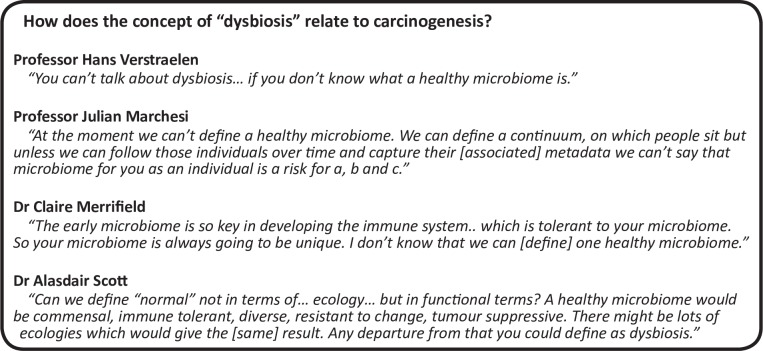
“Dysbiosis has been defined as an abnormality —in composition and/or function—of the host symbiotic microbial ecosystem that exceeds its restitutive capacity and has negative effects on the host.”
Self-citationHooks, K. B., & O’Malley, M. A. (2017) · mBio · doi:10.1128/mbio.01492-17 · Cited by 404
Evidence That Hydrogen Sulfide Is a Genotoxic Agent
Attene‐Ramos, M. S., Wagner, E. D., Plewa, M. J., & Gaskins, H. R. (2006) · Molecular Cancer Research · doi:10.1158/1541-7786.mcr-05-0126 · Cited by 367
Self-citationMeta-analysis: Can Helicobacter pylori Eradication Treatment Reduce the Risk for Gastric Cancer?
Fuccio, L., Zagari, R. M., Eusebi, L. H., Laterza, L., Cennamo, V., Ceroni, L., Grilli, D., & Bazzoli, F. (2009) · Annals of Internal Medicine · doi:10.7326/0003-4819-151-2-200907210-00009 · Cited by 358
Assembly and function of a bacterial genotoxin
Nes̆ić, D., Hsu, Y., & Stebbins, C. E. (2004) · Nature · doi:10.1038/nature02532 · Cited by 344
Infectious agents and cancer: criteria for a causal relation
Pagano, J. S., Blaser, M. J., Buendia, M., Damania, B., Khalili, K., Raab‐Traub, N., & Roizman, B. (2004) · Seminars in Cancer Biology · doi:10.1016/j.semcancer.2004.06.009 · Cited by 337
Microbiome, Inflammation, and Cancer
Francescone, R., Hou, V., & Grivennikov, S. I. (2014) · The Cancer Journal · doi:10.1097/ppo.0000000000000048 · Cited by 274
Wu, S., Rhee, K., Zhang, M., Franco, A. A., & Sears, C. L. (2007) · Journal of Cell Science · doi:10.1242/jcs.03455 · Cited by 263
Perspective: Alpha-Bugs, Their Microbial Partners, and the Link to Colon Cancer
Sears, C. L., & Pardoll, D. M. (2011) · The Journal of Infectious Diseases · doi:10.1093/jinfdis/jiq061 · Cited by 259
Commensal Bacteria, Redox Stress, and Colorectal Cancer: Mechanisms and Models
Huycke, M. M., & Gaskins, H. R. (2004) · Experimental Biology and Medicine · doi:10.1177/153537020422900702 · Cited by 244
Self-citationPractical considerations for large-scale gut microbiome studies
Vandeputte, D., Tito, R. Y., Vanleeuwen, R., Falony, G., & Raes, J. (2017) · FEMS Microbiology Reviews · doi:10.1093/femsre/fux027 · Cited by 243
Helicobacter pylori and gastric cancer: a state of the art review.
Ishaq, S., & Nunn, L. (2015) · Gastroenterology and hepatology from bed to bench. · Cited by 241
Purcell, R. V., Pearson, J., Aitchison, A., Dixon, L., Frizelle, F. A., & Keenan, J. I. (2017) · PLoS ONE · doi:10.1371/journal.pone.0171602 · Cited by 230
Howick, J., Glasziou, P., & Aronson, J. K. (2009) · Journal of the Royal Society of Medicine · doi:10.1258/jrsm.2009.090020 · Cited by 217
Race-dependent association of sulfidogenic bacteria with colorectal cancer
Yazici, C., Wolf, P. G., Kim, H., Cross, T.-W. L., Vermillion, K., Carroll, T., Augustus, G. J., Mutlu, E., Tussing-Humphreys, L., Braunschweig, C., et al. (2017) · Gut · doi:10.1136/gutjnl-2016-313321 · Cited by 215
Self-citationLong-term use of antibiotics and risk of colorectal adenoma
Cao, Y., Wu, K., Mehta, R. S., Drew, D. A., Song, M., Lochhead, P. J., Nguyen, L. H., Izard, J., Fuchs, C. S., Garrett, W. S., et al. (2017) · Gut · doi:10.1136/gutjnl-2016-313413 · Cited by 207
Microbiology: Microbiome science needs a healthy dose of scepticism
Hanage, W. P. (2014) · Nature · doi:10.1038/512247a · Cited by 200
KADO, S., Uchida, K., Funabashi, H., Iwata, S., Nagata, Y., Ando, M., Onoue, M., Matsuoka, Y., Ohwaki, M., & Morotomi, M. (2001) · PubMed · Cited by 150
Toxicomicrobiomics: The Human Microbiome vs. Pharmaceutical, Dietary, and Environmental Xenobiotics
Abdelsalam, N. A., Ramadan, A. T., ElRakaiby, M. T., & Aziz, R. K. (2020) · Frontiers in Pharmacology · doi:10.3389/fphar.2020.00390 · Cited by 125
Liu, X., Cheng, Y., Shao, L., & Ling, Z. (2020) · BioMed Research International · doi:10.1155/2020/2948282 · Cited by 71
Kinross, J. K., Mirnezami, R., Alexander, J. L., Brown, R. C. D., Scott, A. J., Galea, D., Veselkov, K., Goldin, R. D., Darzi, A. W., Nicholson, J. K., et al. (2017) · Scientific Reports · doi:10.1038/s41598-017-08150-3 · Cited by 50
Self-citationThe impact of HTLV-1 on the cellular genome
Cook, L. B. M., Melamed, A., Yaguchi, H., & Bangham, C. R. M. (2017) · Current Opinion in Virology · doi:10.1016/j.coviro.2017.07.013 · Cited by 40
Seven facts and five initiatives for gut microbiome research
Li, D., Gao, C., Zhang, F., Yang, R., Lan, C., Ma, Y., & Wang, J. (2020) · Protein & Cell · doi:10.1007/s13238-020-00697-8 · Cited by 36
Cortés‐Martín, A., Iglesias‐Aguirre, C. E., Meoro, A., Selma, M. V., & Espín, J. C. (2020) · Microorganisms · doi:10.3390/microorganisms8030416 · Cited by 27
Scott, A. J., Merrifield, C. A., Alexander, J. L., Marchesi, J. R., & Kinross, J. K. (2017) · ecancermedicalscience · doi:10.3332/ecancer.2017.791 · Cited by 5
Self-citation
Cited by
Sorted by citations
Gut microbiota in colorectal cancer: mechanisms of action and clinical applications
Wong, S. H., & Yu, J. (2019) · Nature Reviews Gastroenterology & Hepatology · doi:10.1038/s41575-019-0209-8 · Cited by 1,392
Self-citationInfluence of the Gut Microbiome, Diet, and Environment on Risk of Colorectal Cancer
Song, M., Chan, A. T., & Sun, J. (2020) · Gastroenterology · doi:10.1053/j.gastro.2019.06.048 · Cited by 752
Gut microbiota in colorectal cancer development and therapy
Wong, C. C., & Yu, J. (2023) · Nature Reviews Clinical Oncology · doi:10.1038/s41571-023-00766-x · Cited by 779
Self-citationGut microbiota modulation: a novel strategy for prevention and treatment of colorectal cancer
Fong, W., Li, Q., & Yu, J. Q. (2020) · Oncogene · doi:10.1038/s41388-020-1341-1 · Cited by 643
Self-citationClinical management of metastatic colorectal cancer in the era of precision medicine
Ciardiello, F., Ciardiello, D., Martini, G., Napolitano, S., Tabernero, J. M., & Cervantes, A. M. R. (2022) · CA A Cancer Journal for Clinicians · doi:10.3322/caac.21728 · Cited by 556
Metadata
- Authors
- Scott, A. J., Alexander, J. L., Merrifield, C. A., Cunningham, D., Jobin, C., Brown, R., Alverdy, J., O’Keefe, S. J., Gaskins, H. R., Teare, J., Yu, J., Hughes, D. J., Verstraelen, H., Burton, J., O’Toole, P. W., Rosenberg, D. W., Marchesi, J. R., & Kinross, J. M.
- Affiliations
- Imperial College London (GB)
- Royal Marsden Hospital (GB)
- University of Florida Health (US)
- University of Chicago (US)
- University of Pittsburgh (US)
- University of Illinois Urbana-Champaign (US)
- Chinese University of Hong Kong (HK)
- University College Dublin (IE)
- Ghent University Hospital (BE)
- Lawson Health Research Institute (CA)
- University College Cork (IE)
- University of Connecticut (US)
- Department of Surgery and Cancer, Imperial College London, London, UK
- Corresponding author
- Marchesi, Julian R
- ORCID
- Venue
- Gut
- Publisher
- BMJ
- Published
- 2019-05-15
- Volume
- 68
- Issue
- 9
- Pages
- 1624-1632
- ISSN
- 0017-5749 (ISSN-L)
- 1468-3288
- PMC
- PMC6709773
- OpenAlex
- W2945346908
- Cited by
- 288
- References
- 70
- Citations by year
- 2026: 29 · 2025: 43 · 2024: 34 · 2023: 37 · 2022: 49 · 2021: 50 · 2020: 38 · 2019: 8
- FWCI
- 11.93
- Type
- journal article
- Language
- en
- Open access
- hybrid
- doi.org
- Licence
- cc-by-nc
- Locations
- Gut (publishedVersion, cc-by-nc)
- Europe PMC (PubMed Central) (publishedVersion, cc-by-nc)
- PubMed Central (publishedVersion, cc-by-nc)
- PubMed (publishedVersion)
- ORCA Online Research @Cardiff (Cardiff University) (acceptedVersion)
- Ghent University Academic Bibliography (Ghent University) (submittedVersion, cc-by-nc)
- Arrow@dit (Dublin Institute of Technology) (submittedVersion, cc-by-nc)
- Cork Open Research Archive (University College Cork, Ireland) (submittedVersion, cc-by-nc)
- HighWire Press Open Archive (submittedVersion)
- Spiral (Imperial College London) (submittedVersion, cc-by-nc)
- Lenus, The Irish Health Repository (Dr Steevens Hospital Library) (submittedVersion, cc-by-nc)
- Funders
- Cancer Research UK
- Topics
- Life Sciences › Biochemistry, Genetics and Molecular Biology › Molecular Biology › Gut microbiota and health
- Health Sciences › Dentistry › Periodontics › Oral microbiology and periodontitis research
- Health Sciences › Medicine › Oncology › Cancer Risks and Factors
- Keywords
- human microbiome, carcinogenesis, gut dysbiosis, association versus causation, longitudinal cohort
- MeSH terms
- Gastrointestinal Microbiome, Animals, DNA Damage, Humans, Inflammation, Neoplasms, Colorectal Neoplasms, Biomedical Research, Carcinogenesis, Microbiota, Dysbiosis
About these checks
Registry, retraction, Cites and statistics results are computed, not judged, with one exception: a printed reference that no index lists is read once by a model before it counts as a citation error. Claims are extracted by a model and kept only when their quote appears verbatim in the text; each cited source is then checked, with a model’s help, for whether it says what the claim relies on. Those verdicts can be wrong — read the claim’s quote and the cited source before relying on one.
Statistics and arithmetic are recomputed, not judged.
Confidence bands are shown only for fields calibrated on our annotated test set. None is calibrated yet, so no band is shown.
What counts as a claim ›How we measure confidence ›How we check this ›
Are you an author, or do you see a problem with this page? Request a review
