

Reorganisation of faecal microbiota transplant services during the COVID-19 pandemic
Open accessThe DOI matches its Crossref record; 55 of the 55 references it cites were found in a registry or an index.
Abstract
The COVID-19 pandemic has led to an exponential increase in SARS-CoV-2 infections and associated deaths, and represents a significant challenge to healthcare professionals and facilities. Individual countries have taken several prevention and containment actions to control the spread of infection, including measures to guarantee safety of both healthcare professionals and patients who are at increased risk of infection from COVID-19. Faecal microbiota transplantation (FMT) has a well-established role in the treatment of Clostridioides difficile infection. In the time of the pandemic, FMT centres and stool banks are required to adopt a workflow that continues to ensure reliable patient access to FMT while maintaining safety and quality of procedures. In this position paper, based on the best available evidence, worldwide FMT experts provide guidance on issues relating to the impact of COVID-19 on FMT, including patient selection, donor recruitment and selection, stool manufacturing, FMT procedures, patient follow-up and research activities.
Overview
The claims and statistics of this paper haven’t been checked yet.
Free: it reads the open-access text and checks the first 5 claims that cite a source we can check. Create a free account to check every claim.
Integrity signals
Registry
Cites
Statistics
Figures
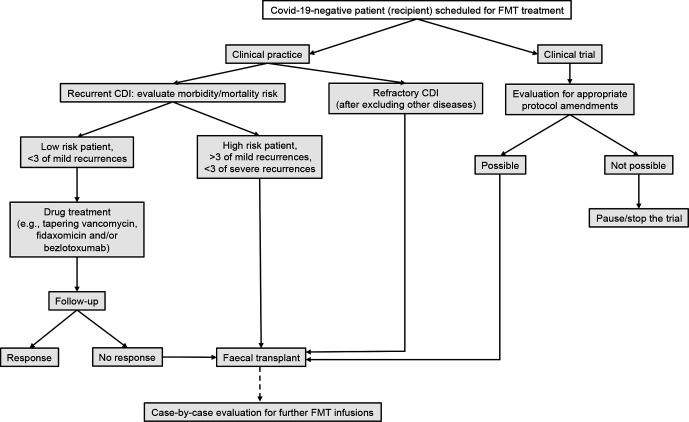
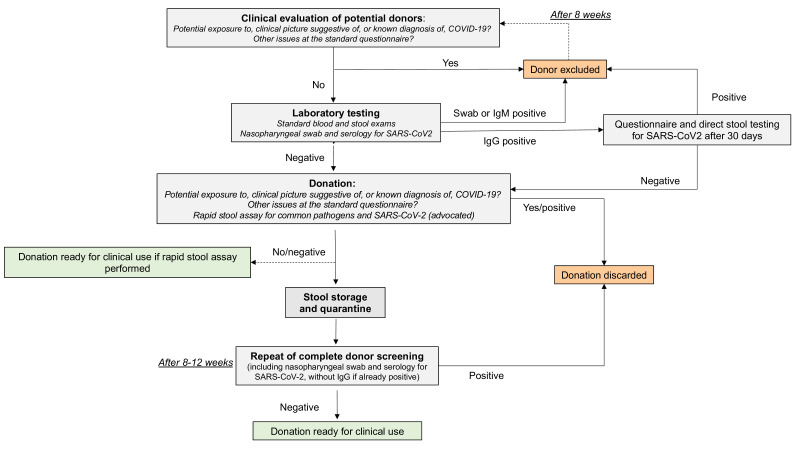
Verification
Claims the paper makes
The claims and statistics of this paper haven’t been checked yet.
Free: it reads the open-access text and checks the first 5 claims that cite a source we can check. Create a free account to check every claim.
Claims other papers make about this one
Each is checked against this paper’s own text: does it say what the citing paper says it does?
In the citing paper
“probiotics and fecal microbiota transplantation (FMT) could be used for the prevention and therapy of pulmonary diseases with widespread potential (33,34).”
From The Role of Gut Microbiota in Lung Cancer: From Carcinogenesis to Immunotherapy (2021) · doi:10.3389/fonc.2021.720842 · cites this paper as [34]
In the citing paper
“Morerecently, donor stool screening has been updated to prevent the theoretical risk of COVID-19, 20 with satisfactory safety outcomes. 21”
From Key determinants of success in fecal microbiota transplantation: From microbiome to clinic (2023) · cites this paper as [20]
In the citing paper
“More recently, the FDA released a similar alert after the start of the COVID-19 pandemic, 47 promptly followed by the definition of guidelines to prevent FMT-related transmission of SARS-CoV-2, 20 which has proved effective. 21”
From Key determinants of success in fecal microbiota transplantation: From microbiome to clinic (2023) · cites this paper as [20]
Self-check
Percentages, sums and reported differences re-computed from the paper’s own numbers.
The self-check needs the paper’s full text.
Citations
Cites
Virological assessment of hospitalized patients with COVID-2019
Wölfel, R., Corman, V. M., Guggemos, W., Seilmaier, M., Zange, S., Müller, M. A., Niemeyer, D., Jones, T. C., Vollmar, P., Rothe, C., et al. (2020) · Nature · doi:10.1038/s41586-020-2196-x · Cited by 6,661
Detection of SARS-CoV-2 in Different Types of Clinical Specimens
Wang, W., Xu, Y., Gao, R., Lu, R., Han, K., Wu, G., & Tan, W. (2020) · JAMA · doi:10.1001/jama.2020.3786 · Cited by 5,028
SARS-CoV-2 Viral Load in Upper Respiratory Specimens of Infected Patients
Zou, L., Ruan, F., Huang, M., Liang, L., Huang, H., Hong, Z., Yu, J., Kang, M., Song, Y., Xia, J., et al. (2020) · New England Journal of Medicine · doi:10.1056/nejmc2001737 · Cited by 4,810
To, K. K.-W., Tsang, O. T.-Y., Leung, W.-S., Tam, A. R., Wu, T.-C., Lung, D. C., Yip, C. C.-Y., Cai, J.-P., Chan, J. M.-C., Chik, T. S.-H., et al. (2020) · The Lancet Infectious Diseases · doi:10.1016/s1473-3099(20)30196-1 · Cited by 3,066
Evidence for gastrointestinal infection of SARS-CoV-2
Xiao, F., Tang, M., Zheng, X., Liu, Y., Li, X., & Shan, H. (2020) · Gastroenterology · doi:10.1053/j.gastro.2020.02.055 · Cited by 2,836
McDonald, L. C., Gerding, D. N., Johnson, S., Bakken, J. S., Carroll, K. C., Coffin, S. E., Dubberke, E. R., Garey, K. W., Gould, C. V., Kelly, C., et al. (2018) · Clinical Infectious Diseases · doi:10.1093/cid/cix1085 · Cited by 2,690
Self-citationBurden of Clostridium difficile Infection in the United States
Lessa, F. C., Mu, Y., Bamberg, W. M., Beldavs, Z. G., Dumyati, G. K., Dunn, J. R., Farley, M. M., Holzbauer, S. M., Meek, J. I., Phipps, E. C., et al. (2015) · New England Journal of Medicine · doi:10.1056/nejmoa1408913 · Cited by 2,641
Coronavirus Disease 2019–COVID-19
Dhama, K., Khan, S., Tiwari, R., Sircar, S., Bhat, S., Malik, Y. S., Singh, K. P., Chaicumpa, W., Bonilla-Aldana, D. K., & Rodriguez-Morales, A. J. (2020) · Clinical Microbiology Reviews · doi:10.1128/cmr.00028-20 · Cited by 1,876
Pan, L., Mu, M., Yang, P., Sun, Y., Wang, R., Yan, J., Li, P., Hu, B., Wang, J., Hu, C., et al. (2020) · American Journal of Gastroenterology · doi:10.14309/ajg.0000000000000620 · Cited by 1,823
Zhang, W., Du, R.-H., Li, B., Zheng, X.-S., Yang, X.-L., Hu, B., Wang, Y.-Y., Xiao, G.-F., Yan, B., Shi, Z.-L., et al. (2020) · Emerging Microbes & Infections · doi:10.1080/22221751.2020.1729071 · Cited by 1,799
Cited by
Items 101–151 of 151
Ding, X. L., Yang, X., & Wang, H. (2020) · Medicine in Microecology · doi:10.1016/j.medmic.2020.100028 · Cited by 10
Safety and Potential Risks with Fecal Microbiota Transplantation
Gaonkar, P. P. (2022) · IntechOpen eBooks · doi:10.5772/intechopen.95907 · Cited by 8
Manzoor, S. E., Zaman, S., Whalley, C., Inglis, D., Bosworth, A., Kidd, M., Shabir, S., Quraishi, M. N., Green, C., Iqbal, T. H., et al. (2021) · F1000Research · doi:10.12688/f1000research.52178.1 · Cited by 8
“A recent international consensus paper recommenced direct stool testing for the presence of SARS-CoV-2 would be needed for safe FMT supply in the COVID-19 era 2020 (11, 12).”
BackgroundSelf-citationReduction in SARS-CoV-2 Virus Infectivity in Human and Hamster Feces
Wurtzer, S., Lacôte, S., Murri, S., Marianneau, P., Monchâtre-Leroy, É., Boni, M., Ferraris, O., Maday, Y., Kébé, O., Dia, N., et al. (2022) · Viruses · doi:10.3390/v14081777 · Cited by 10
“To date, no case of SARS-CoV-2 transmission through FMT has been reported.”
Self-citationSARS-CoV-2 vaccines and donor recruitment for FMT
Ianiro, G., Mullish, B. H., Hvas, C. L., Segal, J. P., Kuijper, E. J., Costello, S. P., Kelly, C. R., Allegretti, J. R., Fischer, M., Iqbal, T. H., et al. (2021) · The Lancet. Gastroenterology & hepatology · doi:10.1016/s2468-1253(21)00032-7 · Cited by 7
“3 Reflecting the mismatch between high disease burden in specific populations and inadequate cancer-attenuating efforts, the norm in the USA is that gastric cancer is diagnosed in more advanced stages when symptoms prompt diagnostic investigations.”
Self-citationCho, Y. (2021) · Gut and Liver · doi:10.5009/gnl20368 · Cited by 7
“In addition, COVID-19 should be checked in donors and recipients and matched for infection status if pandemic continues.(8,9) Overall, this study(4) provides evidence that FMT is highly effective in CDI patients who was not completely resolved after appropriate antibiotics therapy.”
BackgroundInfluentialFortman, D. D., Avellan, M. G. P., Hurd, D. E., Schwartz, M. B., Dubner, H. M., Hewitt, C., Berton, S., Ernst, S. J., Rose, A. E., Wangd, H. Z. H., et al. (2023) · Melanoma Research · doi:10.1097/cmr.0000000000000871 · Cited by 6
Nagy, G., Tudlik, Z., Gergely, L., Kónya, J., Orosi, P., Rákóczi, É., Szabó, J., Várvölgyi, C., Vitális, E., & Paragh, G. (2020) · Orvosi Hetilap · doi:10.1556/650.2020.32023 · Cited by 6
“Nehezen megkérdőjelezhető, hogy mindez az eddigi gyakorlat átértékelésére fogja kényszeríteni az FMT-t végző szakembereket [28, 29].”
BackgroundInfluentialFecal Microbiota Transplantation for Inflammatory Bowel Disease: Where We Stand and What Is Next
Ishikawa, D., Zhang, X., Nomura, K., & Nagahara, A. (2025) · Inflammatory Intestinal Diseases · doi:10.1159/000549227 · Cited by 7
“During the coronavirus disease 2019 (COVID-19) pandemic, additional FDA guidelines were implemented to minimize the risk of severe acute respiratory syndrome coronavirus 2 (SARS-CoV-2) transmission through FMT [32].”
Fecal microbiota transplantation: from empirical remedy to precision medicine
Zhao, J., 樊翌明, Yang, K., & Gao, H. (2026) · Frontiers in Microbiomes · doi:10.3389/frmbi.2026.1863308 · Cited by 6
“…rigorous, multi-tiered donor screening protocols that encompass medical history, behavioral risk assessments, and extensive blood and stool testing for pathogens, including MDROs and viruses like SARS-CoV-2 (Cammarota et al., 2019; Haifer et al., 2020; Ianiro et al., 2020; Ghani et al., 2022).”
Therapeutic possibilities of gut microbiota modulation in acute decompensation of liver cirrhosis
Garbuzenko, D. V. (2023) · World Journal of Hepatology · doi:10.4254/wjh.v15.i4.525 · Cited by 5
Quraishi, M. N., Shabir, S., Manzoor, S. E., Green, C., Sharma, N., Beggs, A. D., & Iqbal, T. H. (2021) · The Lancet Microbe · doi:10.1016/s2666-5247(21)00036-7 · Cited by 5
Self-citationGîlcă-Blanariu, G.-E., Ștefănescu, G., Gîrleanu, I., Iqbal, T. H., Segal, J. P., Mullish, B. H., Quraishi, M. N., Keller, J. J., Molnár, T., Mégraud, F., et al. (2021) · Journal of Gastrointestinal and Liver Diseases · doi:10.15403/jgld-3297 · Cited by 6
“Moreover, follow-up appointments at different time points (between 1 and 8 weeks) should be conducted as much as possible, via internet if possible, or via phone calls, in order to assess signs of recurrence and identify potential symptoms of infection, excepting the situations where direct assessment is mandatory [83…”
BackgroundSelf-citationEvaluating Donor Microbiome Before Fecal Microbiota Transplantation
Ianiro, G., Gasbarrini, A., & Cammarota, G. (2021) · Gastroenterology · doi:10.1053/j.gastro.2021.07.003 · Cited by 5
Self-citationZhang, X., Ishikawa, D., & Nagahara, A. (2025) · International Immunology · doi:10.1093/intimm/dxaf038 · Cited by 4
Enhanced formulation of precision probiotics through active machine learning
Panda, A., Adhikari, M., Nasker, S. S., Nayak, A. K., Das, D., Nayak, S. K., DASH, S. K., & Nayak, S. (2026) · Biology Methods and Protocols · doi:10.1093/biomethods/bpag007 · Cited by 4
“In response to these findings, a new class of therapeutics, known as microbiome medicines, has been developed with probiotics as a key component to prevent and treat diseases by addressing the dysbiosis [7, 8].”
Swiss expert opinion: current approaches in faecal microbiota transplantation in daily practice
Rossier, L., Matter, C., Burri, E., Galpérine, T., Hruz, P. L., Juillerat, P., Schoepfer, A. M., Vavricka, S. R., Zahnd, N., Décosterd, N., et al. (2023) · Swiss Medical Weekly · doi:10.57187/smw.2023.40100 · Cited by 6
“As was the case when the SARS-CoV-2 pandemic began, it is important to continue adapting procedures with the arrival of new pathogens [74].”
BackgroundGroenewegen, B., van Lingen, E., Ooijevaar, R. E., Wessels, E., Feltkamp, M. C. W., Boeije‐Koppenol, E., Verspaget, H. W., Kuijper, E. J., van Prehn, J., Keller, J. J., et al. (2022) · PLoS ONE · doi:10.1371/journal.pone.0265426 · Cited by 5
“In the meantime, FMT experts described how stool banks and FMT facilities could adapt their donor screening procedure and workflow to prevent SARS-CoV-2 cross-transmission from donor to patient [11, 19].”
BackgroundResultSelf-citationMa, X., Chen, J., Chen, S., Lan, X., Wei, Z., Gao, H., & Hou, E. (2024) · Medicine · doi:10.1097/md.0000000000038991 · Cited by 4
“[77] Nanotechnology has enabled rapid advancements in biomedicine and improved cancer treatment effectiveness.”
BackgroundPilato, V. D., Morecchiato, F., Rizzato, C., Quaranta, G., Fais, R., Gandolfo, C., Antonelli, A., Cusi, M. G., Pistello, M., Rossolini, G. M., et al. (2022) · Microorganisms · doi:10.3390/microorganisms10020284 · Cited by 4
Self-citationThe levels and core delivery ways of gut microbial reconstruction
Lu, G., & Zhang, F. (2022) · Scientia Sinica Vitae · doi:10.1360/ssv-2021-0381 · Cited by 4
Self-citationAssuring safety of fecal microbiota transplantation in the COVID ‐19 era: A single‐center experience
Chang, T.-E., Lee, K., Lee, P., Wang, Y., Lin, Y.-T., Huang, H., Luo, J., Ho, H., Huang, Y., Hou, M., et al. (2023) · JGH Open · doi:10.1002/jgh3.12979 · Cited by 3
“28 Although the prolonged presence of SARS-CoV-2 in stool of infected individuals would eventually subside, 7,26,28 individuals who have recovered from COVID-19 may have an altered composition of gut microbiota and distorted metabolic status of bile acids and short-chain fatty acids.”
BackgroundZhu, C., Bai, Y., Yang, R. S., Zhang, B., Zhao, X., Xia, X., Zhang, H., Chen, S., Hu, J., Zhang, G., et al. (2024) · Animals and zoonoses. · doi:10.1016/j.azn.2024.05.002 · Cited by 3
Gut microbiome and lung cancer: mechanisms, interactions, and dietary interventions
Chakraborty, J., Singh, N. L., & Das, B. K. (2025) · Gut Microbes Reports · doi:10.1080/29933935.2025.2501313 · Cited by 3
Exploring the oncogenic potential of SARS-CoV-2 in the gastrointestinal tract
Miteva, D., Gulinac, M., Peruhova, M., & Velikova, T. V. (2025) · World Journal of Gastroenterology · doi:10.3748/wjg.v31.i31.105665 · Cited by 3
Olesen, S. W., Zaman, A., Osman, M., & Ramakrishna, B. (2020) · Open Forum Infectious Diseases · doi:10.1093/ofid/ofaa499 · Cited by 3
Széklettranszplantáció hatékonysága és feltételezhető hatásmechanizmusai
Péterfi, Z., & Vincze, Á. (2020) · Central European Journal of Gastroenterology and Hepatology · doi:10.33570/ceujgh.6.4.187 · Cited by 4
Garbuzenko, D. V. (2022) · Russian Journal of Evidence-Based Gastroenterology · doi:10.17116/dokgastro20221104165 · Cited by 3
UEG Week 2023 Moderated Posters
Deza, D. C., Alcedo, J., Blasco, M. L., Lorente, J. L., Pérez-Aísa, Á., Pavoni, M., Saracino, I. M., Tepeš, B., Jonaitis, L. V., Castro-Fernandez, M., et al. (2023) · United European Gastroenterology Journal · doi:10.1002/ueg2.12460 · Cited by 3
Self-citationKawuribi, V., Awere‐Duodu, A., Adjei, F. A., Osman, A.-H., Bomansaan, H., Madadi, M. M., Tampuri, J. U., & Adu‐Amankwaah, J. (2026) · Critical Reviews in Oncology/Hematology · doi:10.1016/j.critrevonc.2026.105280 · Cited by 2
A Guide to the Gut Microbiome and its Relevance to Critical Care
Alexander, J. L., & Mullish, B. H. (2020) · British Journal of Nursing · doi:10.12968/bjon.2020.29.19.1106 · Cited by 2
Self-citationHota, S. S., & Poutanen, S. M. (2023) · The Lancet Infectious Diseases · doi:10.1016/s1473-3099(23)00484-x · Cited by 2
Faecal microbiota transplantation associated adverse events
Patryn, R. K., Kaźmierczak-Wojtaś, N., Bułaś, L., Boretska, O., Szkultecka-Dębek, M., Drozd, M., & Blicharski, T. (2024) · Current Issues in Pharmacy and Medical Sciences · doi:10.2478/cipms-2024-0028 · Cited by 2
Wang, Z., Wu, X., Wang, Y., Wen, Q., Cui, B., & Zhang, F. (2024) · Therapeutic Advances in Gastroenterology · doi:10.1177/17562848241301574 · Cited by 2
Self-citationTucker, E. C., Angelica, B., Mathias, R. M., Edwards, L., Bryant, R. V., & Costello, S. P. (2025) · Open Forum Infectious Diseases · doi:10.1093/ofid/ofaf149 · Cited by 2
Self-citationSkladaný, Ľ., Kubánek, N., Selčanová, S. A., Žilinčanová, D., Šoltýs, K., Messingerová, L., Lichvár, M., Lafférs, L., Havaj, D. J., Sulejova, K. K., et al. (2024) · Research Square · doi:10.21203/rs.3.rs-3918795/v1 · Cited by 2
Kellingray, L., Savva, G. M., García-Gutiérrez, E., Snell, J., Romano, S., Yara, D. A., Altera, A., Martins, L. D. O., Hutchins, C., Baker, D., et al. (2025) · Microbiology Spectrum · doi:10.1128/spectrum.03195-24 · Cited by 1
Immunomodulatory Role of Milk on Gut Microbiota: Implications for Enhancing Oral Vaccine Efficacy
Asri, N. A. M., Bushra, S. M. R., Asri, A. A. M., Suppıan, R., & Norazmi, M. N. (2025) · Probiotics and Antimicrobial Proteins · doi:10.1007/s12602-025-10785-y · Cited by 1
“Antibiotics can reduce diversity, alter metabolism, and enrich antibiotic-resistant bacteria, and promote pathobiont overgrowth, like toxigenic Clostridium difficile [76, 77].”
Tarraf, A. A. (2021) · theses.fr (ABES) · doi:10.70675/545bd347z20bcz444cza534z622ac595baf9 · Cited by 3
The Old, The New and The Future in Fecal Microbiota Transplantation
Tiburcio, Á. Z. (2021) · Gastroenterology Medicine & Research · doi:10.31031/gmr.2021.06.000629
“Some of the following questions may be answered: Is Transplantation better than traditional treatments? How often should the transplant be repeated? How safe is the transplant? Will there be long-term, unexpected side effects? [57-59].”
BackgroundFecal Microbiota Transplantation for Microbiome Modulation: A Clinical View
Konturek, P. C., Hess, T., Dieterich, W., & Zopf, Y. (2022) · Wiley eBooks · doi:10.1002/9783527825462.ch8
Fecal microbiota transfer: Basic and clinical aspects, current applications, and future perspectives
Alonso, M. P., Fernández, S. G., Blanco, A. M., Aroco, C. L., Rodríguez-Jiménez, C., & del Campo, R. (2022) · Elsevier eBooks · doi:10.1016/b978-0-323-91313-3.00005-2
Garbuzenko, D. V. (2022) · The Russian Archives of Internal Medicine · doi:10.20514/2226-6704-2022-12-5-352-362
Gut Microbiota in Coronavirus Disease 2019
Lau, H. C.-H., & Yu, J. Q. (2023) · Springer eBooks · doi:10.1007/978-981-19-4492-5_18 · Cited by 1
Disputes and Challenges of Immune Checkpoint Inhibitors in Gastrointestinal Cancers
(2024) · Frontiers research topics · doi:10.3389/978-2-8325-4910-0
Abramson, M. H., Sathick, I. J., Knežević, A., Perales, M., & Jaimes, E. A. (2024) · Kidney360 · doi:10.34067/kid.0000000627
A Clostridioides difficile-fertőzés és kezelése
Dembrovszky, F. (2025) · Magyar Tudomány · doi:10.1556/2065.186.2025.4.19
Ardehali, S. H., Khodaei, H., Poor, M. M., Azimi, L., Rajabnejad, M., Rahimi, S., & Kazemi, A. D. (2025) · Archives of Pediatric Infectious Diseases · doi:10.5812/apid-161178
The Cure That Harms: How Bad Medication for Chronic Illness Fuels a Silent Epidemic of Superbugs
Abouelhag, H. (2025) · Ricos Biology · doi:10.33687/ricosbiol.03.010.84
Clostridioides difficile Infection: Harmonizing Patient Care
Allegretti, J. R., Amin, A. N., Hohmann, E. L., Dubberke, E. R., Feuerstadt, P., Fischer, M., Johnson, S., Ziporyn, T. D., & Kelly, C. R. (2026) · Gastro Hep Advances · doi:10.1016/j.gastha.2026.100896
“16 Given the complexities of CDI diagnosis and the few recurrent infections most clinicians see annually, tertiary referral or specialty centers will likely continue to provide most FMT.”
Self-citationGautier, T. (2023) · theses.fr (ABES) · doi:10.70675/8d2970d3z7a35z4c34z8065z8d529bfb5b18
Metadata
- Authors
- Ianiro, G., Mullish, B. H., Kelly, C. R., Kassam, Z., Kuijper, E. J., Ng, S. C., Iqbal, T. H., Allegretti, J. R., Bibbò, S., Sokol, H., Zhang, F., Fischer, M., Costello, S. P., Keller, J. J., Masucci, L., van Prehn, J., Quaranta, G., Quraishi, M. N., Segal, J., Kao, D., Satokari, R., Sanguinetti, M., Tilg, H., Gasbarrini, A., & Cammarota, G.
- Affiliations
- Università Cattolica del Sacro Cuore (IT)
- Imperial College London (GB)
- Brown University (US)
- Finch Therapeutics (United States) (US)
- Leiden University Medical Center (NL)
- Chinese University of Hong Kong (HK)
- University Hospitals Birmingham NHS Foundation Trust (GB)
- Brigham and Women's Hospital (US)
- Inserm (FR)
- Second Affiliated Hospital of Nanjing Medical University (CN)
- Indiana University Indianapolis (US)
- Queen Elizabeth Hospital (AU)
- Netherlands Donor Feces Bank, Leiden University Medical Center, Leiden, The Netherlands
- St Mark's Hospital (GB)
- University of Alberta (CA)
- University of Helsinki (FI)
- Innsbruck Medical University (AT)
- Corresponding author
- Cammarota, Giovanni
- ORCID
- Ianiro, Gianluca
- Mullish, Benjamin H
- Kelly, Colleen R
- Kassam, Zain
- Kuijper, Ed J
- Ng, Siew C
- Iqbal, Tariq H
- Allegretti, Jessica R
- Bibbò, Stefano
- Sokol, Harry
- Zhang, Faming
- Fischer, Monika
- Costello, Samuel Paul
- Keller, Josbert J
- Masucci, Luca
- Quaranta, Gianluca
- Quraishi, Mohammed Nabil
- Segal, Jonathan
- Kao, Dina
- Satokari, Reetta
- Sanguinetti, Maurizio
- Tilg, Herbert
- Gasbarrini, Antonio
- Cammarota, Giovanni
- Venue
- Gut
- Publisher
- BMJ
- Published
- 2020-07-03
- Volume
- 69
- Issue
- 9
- Pages
- 1555-1563
- ISSN
- 0017-5749 (ISSN-L)
- 1468-3288
- PMC
- PMC7456726
- OpenAlex
- W3038963949
- Semantic Scholar
- c9442ced3a20edaeb4395054472ff90b84e88a80
- Cited by
- 147
- References
- 55
- Citations by year
- 2026: 5 · 2025: 11 · 2024: 22 · 2023: 31 · 2022: 24 · 2021: 37 · 2020: 17
- FWCI
- 3.58
- Type
- journal article
- Language
- en
- Open access
- hybrid
- doi.org
- Licence
- Locations
- Gut (publishedVersion, cc-by-nc)
- PubMed Central (publishedVersion, cc-by-nc)
- PubMed (publishedVersion)
- Data Archiving and Networked Services (DANS) (submittedVersion, cc-by-nc)
- HAL (submittedVersion)
- Leiden Repository (Leiden University) (submittedVersion, cc-by-nc)
- Työväentutkimus Vuosikirja (submittedVersion)
- Minerva Access (University of Melbourne) (submittedVersion, cc-by-nc)
- HighWire Press Open Archive (submittedVersion)
- PubliCatt (Università Cattolica del Sacro Cuore) (submittedVersion, cc-by-nc-nd)
- University of Birmingham Research Portal (University of Birmingham) (submittedVersion)
- University of Birmingham Research Portal (University of Birmingham) (submittedVersion, cc-by-nc)
- IUScholarWorks (Indiana University) (submittedVersion, cc-by-nc)
- Spiral (Imperial College London) (submittedVersion, cc-by-nc)
- Funders
- The project was in part funded by the Catholic University of Rome, Line D-1 research funding. (Catholic University of Rome, Italy)
- Topics
- Health Sciences › Medicine › Infectious Diseases › Clostridium difficile and Clostridium perfringens research
- Life Sciences › Biochemistry, Genetics and Molecular Biology › Molecular Biology › Gut microbiota and health
- Health Sciences › Medicine › Gastroenterology › Inflammatory Bowel Disease
- Keywords
- fecal microbiota transplantation, COVID-19 pandemic, Clostridium difficile infection, stool bank, donor recruitment, donor selection, patient selection, patient follow-up
- MeSH terms
- Gastrointestinal Microbiome, Fecal Microbiota Transplantation, Betacoronavirus, Change Management, COVID-19, SARS-CoV-2, Clostridium Infections, Gastroenterology, Humans, Pneumonia, Viral, Infection Control, Coronavirus Infections, Patient Selection, Risk Adjustment, Donor Selection, Pandemics
About these checks
Registry, retraction, Cites and statistics results are computed, not judged, with one exception: a printed reference that no index lists is read once by a model before it counts as a citation error. Claims are extracted by a model and kept only when their quote appears verbatim in the text; each cited source is then checked, with a model’s help, for whether it says what the claim relies on. Those verdicts can be wrong — read the claim’s quote and the cited source before relying on one.
Statistics and arithmetic are recomputed, not judged.
Confidence bands are shown only for fields calibrated on our annotated test set. None is calibrated yet, so no band is shown.
What counts as a claim ›How we measure confidence ›How we check this ›
Are you an author, or do you see a problem with this page? Request a review
Data sources
Bibliographic data: Semantic Scholar, OpenAlex, Crossref.
Contains information from the Semantic Scholar Academic Graph Datasets, made available under the ODC Attribution License (ODC-BY 1.0).
Semantic Scholar’s data is described in: Kinney, R., et al. (2023). The Semantic Scholar Open Data Platform. arXiv:2301.10140.
