

The DOI matches its Crossref record; 40 of the 46 references it cites were found in a registry or an index; none of the 24 sources its claims cite is checked for support yet.
Estimating the burden of the COVID-19 pandemic on mortality, life expectancy and lifespan inequality in England and Wales: a population-level analysis
Open accessPublished version of a preprint
Abstract
Background: Deaths directly linked to COVID-19 infection may be misclassified, and the pandemic may have indirectly affected other causes of death. To overcome these measurement challenges, we estimate the impact of the COVID-19 pandemic on mortality, life expectancy and lifespan inequality from week 10 of 2020, when the first COVID-19 death was registered, to week 47 ending 20 November 2020 in England and Wales through an analysis of excess mortality. Methods: We estimated age and sex-specific excess mortality risk and deaths above a baseline adjusted for seasonality with a systematic comparison of four different models using data from the Office for National Statistics. We additionally provide estimates of life expectancy at birth and lifespan inequality defined as the SD in age at death. Results: There have been 57 419 (95% prediction interval: 54 197, 60 752) excess deaths in the first 47 weeks of 2020, 55% of which occurred in men. Excess deaths increased sharply with age and men experienced elevated risks of death in all age groups. Life expectancy at birth dropped 0.9 and 1.2 years for women and men relative to the 2019 levels, respectively. Lifespan inequality also fell over the same period by 5 months for both sexes. Conclusion: Quantifying excess deaths and their impact on life expectancy at birth provide a more comprehensive picture of the burden of COVID-19 on mortality. Whether mortality will return to—or even fall below—the baseline level remains to be seen as the pandemic continues to unfold and diverse interventions are put in place.
Overview
AI snapshot
Written from the paper’s full text.
TL;DR
Using ONS weekly death registrations for England and Wales, the study estimates 57,419 excess deaths from week 10 to week 47 of 2020 and finds life expectancy at birth fell 0.9 years for women and 1.2 years for men versus 2019. Lifespan inequality also declined by about 5 months for both sexes, a pattern the authors attribute to mortality being concentrated at older ages.
Key findings
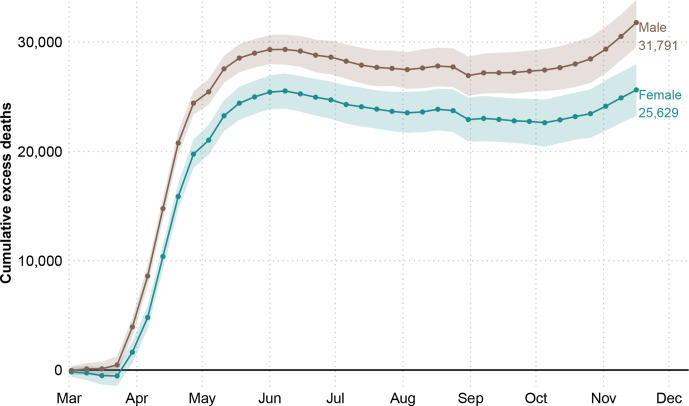
- There were 57,419 (95% prediction interval 54,197–60,752) excess deaths in weeks 10–47 of 2020, a 15.1% (14.2–16.2) increase above baseline; 55.4% (31,791) were male and 44.6% (25,629) female. Male deaths exceeded expectation by 16.8% (15.4–18.0) and female deaths by 13.6% (12.2–14.9).
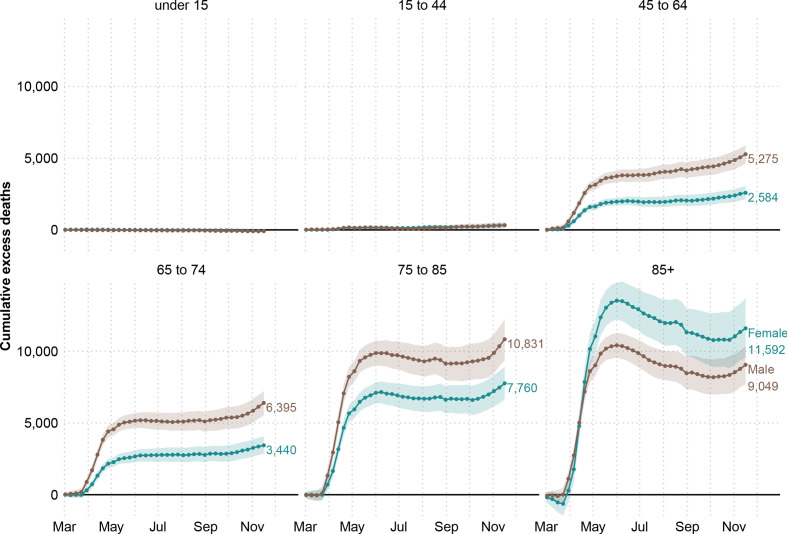
- Excess deaths rose sharply with age: none among those younger than 15; 652 (395–903) at ages 15–44; 7,859 (7,065–8,645) at 45–64; 9,835 (8,814–10,833) at 65–74; 18,591 (16,845–20,435) at 75–84; and 20,641 (18,271–22,916) at 85+.
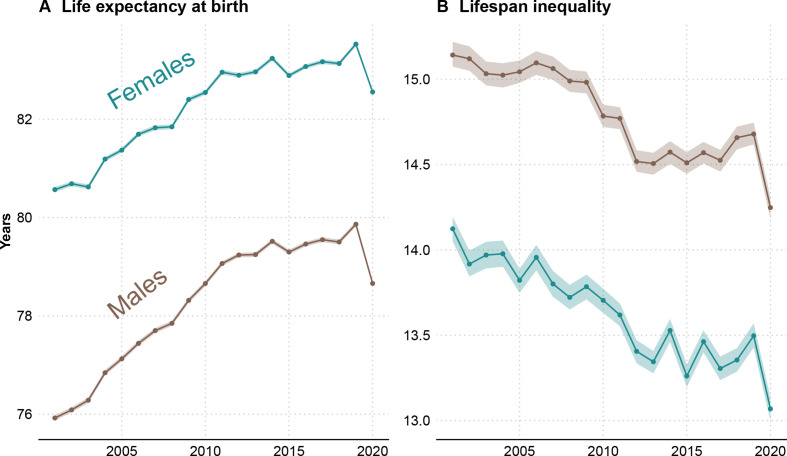
- Life expectancy at birth over the first 47 weeks of 2020 was 82.6 (82.5–82.6) years for women and 78.7 (78.6–78.7) for men, reductions of 0.9 and 1.2 years relative to 2019. Lifespan inequality fell to 13.1 (13.0–13.1) years for women and 14.2 (14.2–14.3) for men, a reduction of nearly 5 months for both sexes.
- Cumulative excess deaths at the end of the first wave (week 26) were 53,937 (53,092–54,746), followed by no excess mortality over summer months and an uptick from October 2020 as a second wave emerged.
Methods
- Data: Office for National Statistics all-cause weekly death counts by week and sex from 2010 to week 47 of 2020 for England and Wales, plus population estimates/projections; six age groups (0–14, 15–44, 45–64, 65–74, 75–84, 85+) were used for weekly modelling, and 5-year age intervals for life expectancy and lifespan inequality.
- Excess mortality: baseline deaths were estimated with four models—negative binomial generalised additive model, Poisson generalised additive model, extended Serfling generalised Poisson model, and an average of 2015–2019 weekly death rates; main estimates use the negative binomial model based on out-of-sample predictive performance. Excess deaths are observed weekly deaths minus baseline, summed from week 10 to week 47, with 95% prediction intervals.
- Demographic analysis: life expectancy and lifespan inequality (SD in age at death) by sex were estimated using standard demographic techniques; 2020 estimates use the first 47 weeks with a proportionally adjusted mid-year population.
Limitations
- The paper states that estimates are based on deaths registered so far, so registration delays may mean excess deaths and life expectancy losses are underestimated; no correction factors were applied because the extent of registration-delay bias is not properly understood. It also states that estimates do not account for weeks 48–52 of 2020 and that it is too early to clarify mortality displacement.
- The paper states that cause-of-death attribution is not disentangled: preliminary ONS cause analysis suggests some unexplained excess may be undiagnosed COVID-19, while indirect effects on other causes remain uncertain.
- Evident from the text: baseline model choice affects magnitude, with four models producing central excess-death estimates between 49,056 and 57,419, though the pattern of results did not substantively change; the analysis uses aggregated data and covers only through week 47, limiting inference beyond that period.
Model-written summary. Check it against the paper before relying on it.
Integrity signals
Registry
Cites
Statistics
Figures
Verification
Claims the paper makes
33 Own result · 17 Not checked yet · 8 Own interpretation · 4 Own method · 2 No basis given
A result the paper reports from its own data — it cites no other source for it, so there is none to check. The quote shows it is in the paper.
In the paper
“From that week until the end of week 47 on 20 November 2020, there were 436 102 registered deaths, from which an estimated 57 419 (54 197, 60 752) are excess mortality above the expected baseline (see figure 1).”
§ Estimating the burden of the COVID-19 pandemic on mortality, life expectancy and lifespan inequality in England and Wales: a population-level analysis > Results > Estimates of excess deaths
plain- Asserted: passes — The authors put it forward as true.
- Checkable: passes — It can be checked against evidence.
- Load-bearing: passes — The paper’s conclusions depend on it.
- Based: passes — The paper gives a reason why it holds.
A result the paper reports from its own data — it cites no other source for it, so there is none to check. The quote shows it is in the paper.
In the paper
“Between 2 March and 20 November, male deaths exceeded the expectation by 16.8% (15.4, 18.0) and female death counts by 13.6% (12.2, 14.9).”
§ Estimating the burden of the COVID-19 pandemic on mortality, life expectancy and lifespan inequality in England and Wales: a population-level analysis > Results > Estimates of excess deaths
plain- Asserted: passes — The authors put it forward as true.
- Checkable: passes — It can be checked against evidence.
- Load-bearing: passes — The paper’s conclusions depend on it.
- Based: passes — The paper gives a reason why it holds.
- Rests on an assumption: In the absence of the COVID-19 pandemic, weekly deaths in England and Wales from week 10 to week 47 of 2020 would have followed the mortality baseline estimated from pre-pandemic data by the fitted models.
A result the paper reports from its own data — it cites no other source for it, so there is none to check. The quote shows it is in the paper.
In the paper
“First, we refitted the seasonal baseline without including the first 9 weeks of 2020. This adjustment did not have major effects on our estimates, and by taking the first 9 weeks into account, we aligned our predictions with the observed trend at the beginning of the year.”
§ Estimating the burden of the COVID-19 pandemic on mortality, life expectancy and lifespan inequality in England and Wales: a population-level analysis > Results > Sensitivity analysis
plain- Asserted: passes — The authors put it forward as true.
- Checkable: passes — It can be checked against evidence.
- Load-bearing: unclear — It is unclear whether the paper’s conclusions depend on it.
- Based: passes — The paper gives a reason why it holds.
- Rests on an assumption: In the absence of the COVID-19 pandemic, weekly deaths in England and Wales from week 10 to week 47 of 2020 would have followed the mortality baseline estimated from pre-pandemic data by the fitted models.
A result the paper reports from its own data — it cites no other source for it, so there is none to check. The quote shows it is in the paper.
In the paper
“Similarly, male life expectancy increased from 77.1 (77.1, 77.2) to 79.9 (79.8, 79.9) years in the same period.”
§ Estimating the burden of the COVID-19 pandemic on mortality, life expectancy and lifespan inequality in England and Wales: a population-level analysis > Results > Estimates of life expectancy and lifespan inequality
plaindirect- Asserted: passes — The authors put it forward as true.
- Checkable: passes — It can be checked against evidence.
- Load-bearing: passes — The paper’s conclusions depend on it.
- Based: passes — The paper gives a reason why it holds.
A result the paper reports from its own data — it cites no other source for it, so there is none to check. The quote shows it is in the paper.
In the paper
“Using data from the first 47 weeks of 2020 yields an estimated life expectancy at birth of 82.6 (82.5, 82.6) and 78.7 (78.6, 78.7) for women and men, respectively, a reduction of 0.9 years for women and 1.2 years for men.”
§ Estimating the burden of the COVID-19 pandemic on mortality, life expectancy and lifespan inequality in England and Wales: a population-level analysis > Results > Estimates of life expectancy and lifespan inequality
hedged- Asserted: passes — The authors put it forward as true.
- Checkable: passes — It can be checked against evidence.
- Load-bearing: passes — The paper’s conclusions depend on it.
- Based: passes — The paper gives a reason why it holds.
A result the paper reports from its own data — it cites no other source for it, so there is none to check. The quote shows it is in the paper.
In the paper
“There have been 57 419 (95% prediction interval: 54 197, 60 752) excess deaths in the first 47 weeks of 2020, 55% of which occurred in men.”
- Also stated in: § Estimates of excess deaths · hedged
“From that week until the end of week 47 on 20 November 2020, there were 436 102 registered deaths, from which an estimated 57 419 (54 197, 60 752) are excess mortality above the expected baseline (see figure 1).”
- Also stated in: § Discussion · hedged
“We estimated 57 419 (54 197, 60 752) premature deaths due to the pandemic.”
§ Estimating the burden of the COVID-19 pandemic on mortality, life expectancy and lifespan inequality in England and Wales: a population-level analysis > Abstract > Results
plain- Asserted: passes — The authors put it forward as true.
- Checkable: passes — It can be checked against evidence.
- Load-bearing: passes — The paper’s conclusions depend on it.
- Based: passes — The paper gives a reason why it holds.
- Rests on an assumption: In the absence of the COVID-19 pandemic, weekly deaths in England and Wales from week 10 to week 47 of 2020 would have followed the mortality baseline estimated from pre-pandemic data by the fitted models.
- Also stated in: § Estimates of excess deaths · hedged
A result the paper reports from its own data — it cites no other source for it, so there is none to check. The quote shows it is in the paper.
In the paper
“Using data from the first 47 weeks of 2020 yields an estimated life expectancy at birth of 82.6 (82.5, 82.6) and 78.7 (78.6, 78.7) for women and men, respectively, a reduction of 0.9 years for women and 1.2 years for men.”
§ Estimating the burden of the COVID-19 pandemic on mortality, life expectancy and lifespan inequality in England and Wales: a population-level analysis > Results > Estimates of life expectancy and lifespan inequality
hedged- Asserted: passes — The authors put it forward as true.
- Checkable: passes — It can be checked against evidence.
- Load-bearing: passes — The paper’s conclusions depend on it.
- Based: passes — The paper gives a reason why it holds.
A result the paper reports from its own data — it cites no other source for it, so there is none to check. The quote shows it is in the paper.
In the paper
“Cumulative excess deaths at the end of the first wave (week 26 ending in June 29) were 53 937 (95% prediction interval: 53 092, 54 746) followed by no excess mortality over the summer months, before an uptick that started in October 2020 when a second wave emerged and excess deaths began to rise again.”
§ Estimating the burden of the COVID-19 pandemic on mortality, life expectancy and lifespan inequality in England and Wales: a population-level analysis > Results > Estimates of excess deaths
plain- Asserted: passes — The authors put it forward as true.
- Checkable: passes — It can be checked against evidence.
- Load-bearing: passes — The paper’s conclusions depend on it.
- Based: passes — The paper gives a reason why it holds.
- Rests on an assumption: In the absence of the COVID-19 pandemic, weekly deaths in England and Wales from week 10 to week 47 of 2020 would have followed the mortality baseline estimated from pre-pandemic data by the fitted models.
A result the paper reports from its own data — it cites no other source for it, so there is none to check. The quote shows it is in the paper.
In the paper
“Over the first 47 weeks of 2020, we estimate that lifespan inequality fell sharply to 13.1 (13.0, 13.1) and 14.2 (14.2, 14.3) years for women and men, respectively, corresponding to a reduction of nearly 5 months for both sexes.”
§ Estimating the burden of the COVID-19 pandemic on mortality, life expectancy and lifespan inequality in England and Wales: a population-level analysis > Results > Estimates of life expectancy and lifespan inequality
hedged- Asserted: passes — The authors put it forward as true.
- Checkable: passes — It can be checked against evidence.
- Load-bearing: passes — The paper’s conclusions depend on it.
- Based: passes — The paper gives a reason why it holds.
The paper states this without a source or data behind it here, so there is nothing to check it against. The quote shows it is in the paper.
In the paper
“The first death attributable to COVID-19 in England and Wales was registered in the week starting on 2 March 2020 (week 10).”
§ Estimating the burden of the COVID-19 pandemic on mortality, life expectancy and lifespan inequality in England and Wales: a population-level analysis > Results > Estimates of excess deaths
plain- Asserted: passes — The authors put it forward as true.
- Checkable: passes — It can be checked against evidence.
- Load-bearing: unclear — It is unclear whether the paper’s conclusions depend on it.
- Based: passes — The paper gives a reason why it holds.
- It may state two separate claims as one. 11
- The quote only partly states this claim. 9
- Probably not a substantial claim. 12
A result the paper reports from its own data — it cites no other source for it, so there is none to check. The quote shows it is in the paper.
In the paper
“The toll of the pandemic resulted in 7859 (7065, 8645) and 9835 (8814, 10 833) excess deaths among people between 45–64 and 64–74 years of age, respectively. These numbers are 17.6% (15.6, 19.7) and 16.0% (14.1, 17.9) above the baseline.”
§ Estimating the burden of the COVID-19 pandemic on mortality, life expectancy and lifespan inequality in England and Wales: a population-level analysis > Results > Estimates of excess deaths
plain- Asserted: passes — The authors put it forward as true.
- Checkable: passes — It can be checked against evidence.
- Load-bearing: unclear — It is unclear whether the paper’s conclusions depend on it.
- Based: passes — The paper gives a reason why it holds.
It may state two separate claims as one. The quote only partly states this claim.
- Rests on an assumption: In the absence of the COVID-19 pandemic, weekly deaths in England and Wales from week 10 to week 47 of 2020 would have followed the mortality baseline estimated from pre-pandemic data by the fitted models.
A result the paper reports from its own data — it cites no other source for it, so there is none to check. The quote shows it is in the paper.
In the paper
“Our four models produce central estimates of the number of excess deaths between 49 056 and 57 419 depending on the choice of the model and its assumptions, but do not substantively affect the pattern of our results.”
§ Estimating the burden of the COVID-19 pandemic on mortality, life expectancy and lifespan inequality in England and Wales: a population-level analysis > Results > Sensitivity analysis
plain- Asserted: passes — The authors put it forward as true.
- Checkable: passes — It can be checked against evidence.
- Load-bearing: unclear — It is unclear whether the paper’s conclusions depend on it.
- Based: passes — The paper gives a reason why it holds.
The quote only partly states this claim.
- Rests on an assumption: In the absence of the COVID-19 pandemic, weekly deaths in England and Wales from week 10 to week 47 of 2020 would have followed the mortality baseline estimated from pre-pandemic data by the fitted models.
A result the paper reports from its own data — it cites no other source for it, so there is none to check. The quote shows it is in the paper.
In the paper
“The largest numbers of lives lost were estimated among the groups 75–85 and 85 and older, with 17.2% (15.3, 19.2) and 13.7% (11.9, 15.4) more deaths than expected. Among the former, 18 591 (16 845, 20 435), excess deaths were estimated, while among the oldest age group, there were 20 641 (18 271, 22 916) deaths above the baseline.”
§ Estimating the burden of the COVID-19 pandemic on mortality, life expectancy and lifespan inequality in England and Wales: a population-level analysis > Results > Estimates of excess deaths
hedged- Asserted: passes — The authors put it forward as true.
- Checkable: passes — It can be checked against evidence.
- Load-bearing: unclear — It is unclear whether the paper’s conclusions depend on it.
- Based: passes — The paper gives a reason why it holds.
It may state two separate claims as one.
- Rests on an assumption: In the absence of the COVID-19 pandemic, weekly deaths in England and Wales from week 10 to week 47 of 2020 would have followed the mortality baseline estimated from pre-pandemic data by the fitted models.
A result the paper reports from its own data — it cites no other source for it, so there is none to check. The quote shows it is in the paper.
In the paper
“We note that excess deaths derived from the baselines estimated from both the generalised additive models and generalised linear models indicated a higher magnitude of excess deaths than those using average mortality rates from the preceding 5 years as the baseline.”
§ Estimating the burden of the COVID-19 pandemic on mortality, life expectancy and lifespan inequality in England and Wales: a population-level analysis > Results > Sensitivity analysis
hedgedcorrelational- Asserted: passes — The authors put it forward as true.
- Checkable: passes — It can be checked against evidence.
- Load-bearing: fails — The paper’s conclusions may not depend on it.
- Based: passes — The paper gives a reason why it holds.
Probably not a substantial claim. The paper’s conclusions may not depend on it.
- Rests on an assumption: In the absence of the COVID-19 pandemic, weekly deaths in England and Wales from week 10 to week 47 of 2020 would have followed the mortality baseline estimated from pre-pandemic data by the fitted models.
A result the paper reports from its own data — it cites no other source for it, so there is none to check. The quote shows it is in the paper.
In the paper
“Excess deaths increased sharply with age and men experienced elevated risks of death in all age groups.”
- Also stated in: § Estimates of excess deaths · plain
“For older age groups, excess deaths rose sharply (see figure 2).”
§ Estimating the burden of the COVID-19 pandemic on mortality, life expectancy and lifespan inequality in England and Wales: a population-level analysis > Abstract > Results
plaindirect- Asserted: passes — The authors put it forward as true.
- Checkable: passes — It can be checked against evidence.
- Load-bearing: unclear — It is unclear whether the paper’s conclusions depend on it.
- Based: passes — The paper gives a reason why it holds.
The quote only partly states this claim.
- Rests on an assumption: In the absence of the COVID-19 pandemic, weekly deaths in England and Wales from week 10 to week 47 of 2020 would have followed the mortality baseline estimated from pre-pandemic data by the fitted models.
- Also stated in: § Estimates of excess deaths · plain
A result the paper reports from its own data — it cites no other source for it, so there is none to check. The quote shows it is in the paper.
In the paper
“The toll of the pandemic resulted in 7859 (7065, 8645) and 9835 (8814, 10 833) excess deaths among people between 45–64 and 64–74 years of age, respectively. These numbers are 17.6% (15.6, 19.7) and 16.0% (14.1, 17.9) above the baseline.”
§ Estimating the burden of the COVID-19 pandemic on mortality, life expectancy and lifespan inequality in England and Wales: a population-level analysis > Results > Estimates of excess deaths
plain- Asserted: passes — The authors put it forward as true.
- Checkable: passes — It can be checked against evidence.
- Load-bearing: unclear — It is unclear whether the paper’s conclusions depend on it.
- Based: passes — The paper gives a reason why it holds.
The quote only partly states this claim.
- Rests on an assumption: In the absence of the COVID-19 pandemic, weekly deaths in England and Wales from week 10 to week 47 of 2020 would have followed the mortality baseline estimated from pre-pandemic data by the fitted models.
A result the paper reports from its own data — it cites no other source for it, so there is none to check. The quote shows it is in the paper.
In the paper
“Disaggregating by age, we estimate no excess deaths among those younger than 15 years.”
§ Estimating the burden of the COVID-19 pandemic on mortality, life expectancy and lifespan inequality in England and Wales: a population-level analysis > Results > Estimates of excess deaths
hedged- Asserted: passes — The authors put it forward as true.
- Checkable: passes — It can be checked against evidence.
- Load-bearing: unclear — It is unclear whether the paper’s conclusions depend on it.
- Based: passes — The paper gives a reason why it holds.
The quote only partly states this claim.
- Rests on an assumption: In the absence of the COVID-19 pandemic, weekly deaths in England and Wales from week 10 to week 47 of 2020 would have followed the mortality baseline estimated from pre-pandemic data by the fitted models.
A result the paper reports from its own data — it cites no other source for it, so there is none to check. The quote shows it is in the paper.
In the paper
“The 15–44-year-old age group accounted for 652 (395, 903) excess deaths (6.2% (3.6, 8.7) above the expected level).”
§ Estimating the burden of the COVID-19 pandemic on mortality, life expectancy and lifespan inequality in England and Wales: a population-level analysis > Results > Estimates of excess deaths
hedged- Asserted: passes — The authors put it forward as true.
- Checkable: passes — It can be checked against evidence.
- Load-bearing: unclear — It is unclear whether the paper’s conclusions depend on it.
- Based: passes — The paper gives a reason why it holds.
The quote only partly states this claim.
- Rests on an assumption: In the absence of the COVID-19 pandemic, weekly deaths in England and Wales from week 10 to week 47 of 2020 would have followed the mortality baseline estimated from pre-pandemic data by the fitted models.
In the paper
“Moreover, our estimates for life expectancy fall 0.7 and 1.1 years below the official projected life expectancy in 2020 for women and men,36 respectively.”
§ Estimating the burden of the COVID-19 pandemic on mortality, life expectancy and lifespan inequality in England and Wales: a population-level analysis > Discussion
What the sources say
- Not checked yetcites [36] ONS . Life tables, principal projection, England and Wales - Office for National Statistics. Available: https://www.ons.gov.uk/peoplepopulationandcommunity/birthsdeathsandmarriages/lifeexpectancies/datasets/lifetablesprincipalprojectionenglandandwales [Accessed 14 Jul 2020].
plain- Asserted: passes — The authors put it forward as true.
- Checkable: passes — It can be checked against evidence.
- Load-bearing: unclear — It is unclear whether the paper’s conclusions depend on it.
- Based: passes — The paper gives a reason why it holds.
It may state two separate claims as one.
A result the paper reports from its own data — it cites no other source for it, so there is none to check. The quote shows it is in the paper.
In the paper
“The largest numbers of lives lost were estimated among the groups 75–85 and 85 and older, with 17.2% (15.3, 19.2) and 13.7% (11.9, 15.4) more deaths than expected. Among the former, 18 591 (16 845, 20 435), excess deaths were estimated, while among the oldest age group, there were 20 641 (18 271, 22 916) deaths above the baseline.”
§ Estimating the burden of the COVID-19 pandemic on mortality, life expectancy and lifespan inequality in England and Wales: a population-level analysis > Results > Estimates of excess deaths
hedged- Asserted: passes — The authors put it forward as true.
- Checkable: passes — It can be checked against evidence.
- Load-bearing: unclear — It is unclear whether the paper’s conclusions depend on it.
- Based: passes — The paper gives a reason why it holds.
It may state two separate claims as one. The quote only partly states this claim.
- Rests on an assumption: In the absence of the COVID-19 pandemic, weekly deaths in England and Wales from week 10 to week 47 of 2020 would have followed the mortality baseline estimated from pre-pandemic data by the fitted models.
A result the paper reports from its own data — it cites no other source for it, so there is none to check. The quote shows it is in the paper.
In the paper
“In addition, we also estimated life expectancy using a piecewise constant hazard model and the results did not change.”
§ Estimating the burden of the COVID-19 pandemic on mortality, life expectancy and lifespan inequality in England and Wales: a population-level analysis > Results > Sensitivity analysis
plain- Asserted: passes — The authors put it forward as true.
- Checkable: passes — It can be checked against evidence.
- Load-bearing: fails — The paper’s conclusions may not depend on it.
- Based: passes — The paper gives a reason why it holds.
Probably not a substantial claim. The paper’s conclusions may not depend on it.
A result the paper reports from its own data — it cites no other source for it, so there is none to check. The quote shows it is in the paper.
In the paper
“Death rates during the pandemic were consistently higher among men in all groups compared with women (see online supplemental figure 3).”
§ Estimating the burden of the COVID-19 pandemic on mortality, life expectancy and lifespan inequality in England and Wales: a population-level analysis > Results > Estimates of excess deaths
plaincorrelational- Asserted: passes — The authors put it forward as true.
- Checkable: passes — It can be checked against evidence.
- Load-bearing: unclear — It is unclear whether the paper’s conclusions depend on it.
- Based: passes — The paper gives a reason why it holds.
The quote only partly states this claim.
- Rests on an assumption: In the absence of the COVID-19 pandemic, weekly deaths in England and Wales from week 10 to week 47 of 2020 would have followed the mortality baseline estimated from pre-pandemic data by the fitted models.
The paper states this without a source or data behind it here, so there is nothing to check it against. The quote shows it is in the paper.
In the paper
“Excess deaths increased sharply over age and male deaths were estimated to exceed women in all age groups, with the exception of those above age 85.”
§ Estimating the burden of the COVID-19 pandemic on mortality, life expectancy and lifespan inequality in England and Wales: a population-level analysis > Discussion
hedged- Asserted: passes — The authors put it forward as true.
- Checkable: passes — It can be checked against evidence.
- Load-bearing: unclear — It is unclear whether the paper’s conclusions depend on it.
- Based: passes — The paper gives a reason why it holds.
The quote only partly states this claim.
- Rests on an assumption: In the absence of the COVID-19 pandemic, weekly deaths in England and Wales from week 10 to week 47 of 2020 would have followed the mortality baseline estimated from pre-pandemic data by the fitted models.
A conclusion the paper draws from its own results — it cites no other source for it, so there is none to check. The quote shows it is in the paper.
In the paper
“Note the larger number of female excess deaths in the 85+ age group is due to there being 1.6 times more women in this age group compared with men.”
§ Estimating the burden of the COVID-19 pandemic on mortality, life expectancy and lifespan inequality in England and Wales: a population-level analysis > Results > Estimates of excess deaths
plaindirect- Asserted: passes — The authors put it forward as true.
- Checkable: passes — It can be checked against evidence.
- Load-bearing: fails — The paper’s conclusions may not depend on it.
- Based: passes — The paper gives a reason why it holds.
Probably not a substantial claim. The paper’s conclusions may not depend on it.
What the paper did — it cites no source for this, so there is none to check. The quote shows it is in the paper.
In the paper
“We performed several sensitivity analyses.”
§ Estimating the burden of the COVID-19 pandemic on mortality, life expectancy and lifespan inequality in England and Wales: a population-level analysis > Results > Sensitivity analysis
plain- Asserted: passes — The authors put it forward as true.
- Checkable: passes — It can be checked against evidence.
- Load-bearing: fails — The paper’s conclusions may not depend on it.
- Based: passes — The paper gives a reason why it holds.
Probably not a substantial claim. The paper’s conclusions may not depend on it.
A conclusion the paper draws from its own results — it cites no other source for it, so there is none to check. The quote shows it is in the paper.
In the paper
“Our estimates also do not account for excess mortality that occurred during weeks 48-52 of 2020, which are likely to further reduce life expectancy estimates for the full year.”
§ Estimating the burden of the COVID-19 pandemic on mortality, life expectancy and lifespan inequality in England and Wales: a population-level analysis > Discussion
hedgedconditional- Asserted: passes — The authors put it forward as true.
- Checkable: passes — It can be checked against evidence.
- Load-bearing: passes — The paper’s conclusions depend on it.
- Based: passes — The paper gives a reason why it holds.
It may state two separate claims as one.
None of the sources cited for this claim have been checked yet.
In the paper
“Life expectancy in England and Wales had been steadily improving for 50 years before stagnating in the past decade.34 35”
§ Estimating the burden of the COVID-19 pandemic on mortality, life expectancy and lifespan inequality in England and Wales: a population-level analysis > Discussion
What the sources say
- Not checked yetcites [34] source
- Not checked yetcites [35] JY H , Hendi AS . Recent trends in life expectancy across high income countries: retrospective observational study. BMJ 2018;362.
plain- Asserted: passes — The authors put it forward as true.
- Checkable: passes — It can be checked against evidence.
- Load-bearing: fails — The paper’s conclusions may not depend on it.
- Based: passes — The paper gives a reason why it holds.
Probably not a substantial claim. The paper’s conclusions may not depend on it. It may state two separate claims as one.
In the paper
“Trends over the 20th century from high-income countries, including England and Wales, show that as life expectancy and the modal age at death have increased, lifespan inequality has tended to decrease.16”
§ Estimating the burden of the COVID-19 pandemic on mortality, life expectancy and lifespan inequality in England and Wales: a population-level analysis > Introduction
What the sources say
- Not checked yetcites [16] source
hedgedcorrelational- Asserted: passes — The authors put it forward as true.
- Checkable: passes — It can be checked against evidence.
- Load-bearing: fails — The paper’s conclusions may not depend on it.
- Based: passes — The paper gives a reason why it holds.
Probably not a substantial claim. The paper’s conclusions may not depend on it.
In the paper
“Based on preliminary cause of death analysis of other (non-COVID) causes by the ONS, deaths occurring from Alzheimer disease and dementia, ischaemic heart disease, cerebrovascular diseases, influenza and pneumonia and ‘symptoms signs and ill-defined conditions’ category were all higher between March and May 2020.22”
§ Estimating the burden of the COVID-19 pandemic on mortality, life expectancy and lifespan inequality in England and Wales: a population-level analysis > Discussion
What the sources say
- Not checked yetcites [22] ONS . Analysis of death registrations not involving coronavirus (COVID-19), England and Wales - Office for National Statistics. Available: https://www.ons.gov.uk/peoplepopulationandcommunity/birthsdeathsandmarriages/deaths/articles/analysisofdeathregistrationsnotinvolvingcoronaviruscovid19englandandwales28december2019to1may2020/technicalannex [Accessed 14 Jul 2020].
plain- Asserted: passes — The authors put it forward as true.
- Checkable: passes — It can be checked against evidence.
- Load-bearing: passes — The paper’s conclusions depend on it.
- Based: passes — The paper gives a reason why it holds.
It may state two separate claims as one.
None of the sources cited for this claim have been checked yet.
In the paper
“Insufficient testing capacity for SARS-CoV-2, the causative pathogen of coronavirus disease, especially during the early phases of the pandemic, misclassification of causes of death and definitional inconsistencies in counting COVID-19 deaths across different sources make the true toll of COVID-19 infections hard to estimate.2 3”
§ Estimating the burden of the COVID-19 pandemic on mortality, life expectancy and lifespan inequality in England and Wales: a population-level analysis > Introduction
What the sources say
- Not checked yetcites [2] source
- Not checked yetcites [3] ONS . The different uses of figures on deaths related to COVID-19 published by DHSC and the ONS - Office for National Statistics. Available: https://www.ons.gov.uk/news/statementsandletters/thedifferentusesoffiguresondeathsfromcovid19publishedbydhscandtheons [Accessed 3 Dec 2020].
plaindirect- Asserted: passes — The authors put it forward as true.
- Checkable: passes — It can be checked against evidence.
- Load-bearing: unclear — It is unclear whether the paper’s conclusions depend on it.
- Based: passes — The paper gives a reason why it holds.
It may state two separate claims as one.
None of the sources cited for this claim have been checked yet.
In the paper
“The toll of the pandemic had unequal impacts by age and sex in Europe and other regions.31–33”
§ Estimating the burden of the COVID-19 pandemic on mortality, life expectancy and lifespan inequality in England and Wales: a population-level analysis > Discussion
What the sources say
plaincorrelational- Asserted: passes — The authors put it forward as true.
- Checkable: passes — It can be checked against evidence.
- Load-bearing: fails — The paper’s conclusions may not depend on it.
- Based: passes — The paper gives a reason why it holds.
Probably not a substantial claim. The paper’s conclusions may not depend on it.
In the paper
“Between March and May 2020, 81.1% of all deaths and 86.5% of deaths involving COVID-19 were registered within 1 week of occurrence.21”
§ Estimating the burden of the COVID-19 pandemic on mortality, life expectancy and lifespan inequality in England and Wales: a population-level analysis > Methods > Data
What the sources say
- Not checked yetcites [21] ONS . Deaths involving COVID-19, England and Wales - Office for National Statistics. Available: https://www.ons.gov.uk/peoplepopulationandcommunity/birthsdeathsandmarriages/deaths/bulletins/deathsinvolvingcovid19englandandwales/deathsoccurringinmay2020#time-taken-for-the-deaths-in-march-april-and-may-to-be-registered [Accessed 14 Jul 2020].
plain- Asserted: passes — The authors put it forward as true.
- Checkable: passes — It can be checked against evidence.
- Load-bearing: fails — The paper’s conclusions may not depend on it.
- Based: passes — The paper gives a reason why it holds.
Probably not a substantial claim. The paper’s conclusions may not depend on it. It may state two separate claims as one.
In the paper
“According to the ONS, between 1 March and 30 June 2020, there were 50 335 deaths involving COVID-19, 46 736 (93%) of which assigned COVID-19 as the underlying cause of death based on information noted on the death certificate.21”
§ Estimating the burden of the COVID-19 pandemic on mortality, life expectancy and lifespan inequality in England and Wales: a population-level analysis > Discussion
What the sources say
- Not checked yetcites [21] ONS . Deaths involving COVID-19, England and Wales - Office for National Statistics. Available: https://www.ons.gov.uk/peoplepopulationandcommunity/birthsdeathsandmarriages/deaths/bulletins/deathsinvolvingcovid19englandandwales/deathsoccurringinmay2020#time-taken-for-the-deaths-in-march-april-and-may-to-be-registered [Accessed 14 Jul 2020].
plain- Asserted: passes — The authors put it forward as true.
- Checkable: passes — It can be checked against evidence.
- Load-bearing: fails — The paper’s conclusions may not depend on it.
- Based: passes — The paper gives a reason why it holds.
Probably not a substantial claim. The paper’s conclusions may not depend on it. It may state two separate claims as one.
None of the sources cited for this claim have been checked yet.
In the paper
“This approach for estimating excess all-cause mortality has been widely used to quantify the mortality toll of previous epidemics such as influenza6 or HIV7 and has also begun to be applied for COVID-19.1 8”
§ Estimating the burden of the COVID-19 pandemic on mortality, life expectancy and lifespan inequality in England and Wales: a population-level analysis > Introduction
boosted- Asserted: passes — The authors put it forward as true.
- Checkable: passes — It can be checked against evidence.
- Load-bearing: fails — The paper’s conclusions may not depend on it.
- Based: passes — The paper gives a reason why it holds.
Probably not a substantial claim. The paper’s conclusions may not depend on it.
None of the sources cited for this claim have been checked yet.
In the paper
“While this metric provides an important measure of the burden of the pandemic on a society, simply counting total excess deaths does not provide an understanding of the substantial variation by age and sex over time in elevated mortality risks.10 11 nor does it allow for a comparison of current mortality conditions with past conditions due to changes in population age structure over the period.”
§ Estimating the burden of the COVID-19 pandemic on mortality, life expectancy and lifespan inequality in England and Wales: a population-level analysis > Introduction
plain- Asserted: passes — The authors put it forward as true.
- Checkable: passes — It can be checked against evidence.
- Load-bearing: passes — The paper’s conclusions depend on it.
- Based: passes — The paper gives a reason why it holds.
It may state two separate claims as one.
In the paper
“Historically, life expectancy increases have been accompanied by reductions in lifespan inequality due to mortality improvements at younger ages, although more recent studies have found that life expectancy improvements can occur even without accompanying reductions in lifespan inequality.13”
§ Estimating the burden of the COVID-19 pandemic on mortality, life expectancy and lifespan inequality in England and Wales: a population-level analysis > Discussion
What the sources say
- Not checked yetcites [13] source
plaindirect- Asserted: passes — The authors put it forward as true.
- Checkable: passes — It can be checked against evidence.
- Load-bearing: passes — The paper’s conclusions depend on it.
- Based: passes — The paper gives a reason why it holds.
Probably not a substantial claim.
In the paper
“Recent evidence suggests that reversals and stagnation in life expectancy among developed countries are usually a result of mid-life mortality crises.35”
§ Estimating the burden of the COVID-19 pandemic on mortality, life expectancy and lifespan inequality in England and Wales: a population-level analysis > Discussion
What the sources say
- Not checked yetcites [35] JY H , Hendi AS . Recent trends in life expectancy across high income countries: retrospective observational study. BMJ 2018;362.
hedgeddirect- Asserted: passes — The authors put it forward as true.
- Checkable: passes — It can be checked against evidence.
- Load-bearing: fails — The paper’s conclusions may not depend on it.
- Based: passes — The paper gives a reason why it holds.
Probably not a substantial claim. The paper’s conclusions may not depend on it.
The paper relies on this without support.
Vital registration in England and Wales has complete population coverage.
“The population coverage of vital registration in England and Wales is complete.”
The paper relies on this without support.
In the absence of the COVID-19 pandemic, weekly deaths in England and Wales from week 10 to week 47 of 2020 would have followed the mortality baseline estimated from pre-pandemic data by the fitted models.
“We estimated the baseline number of deaths in the absence of COVID-19 by fitting four different models.”
The paper relies on this without support.
Based on trends from past years, 92% of deaths in England and Wales are registered within 1 month of occurrence.
“Based on trends from past years, 92% of deaths are registered within 1 month of occurrence.”
Claims other papers make about this one
Each is checked against this paper’s own text: does it say what the citing paper says it does?
In the citing paper
“A decrease in the number of cancer-attributed deaths can be explained by mortality displacement (19, 20)”
From Socioeconomic status determines COVID-19 incidence and related mortality in Santiago, Chile (2021) · cites this paper as [20]
Self-check
Percentages, sums and reported differences re-computed from the paper’s own numbers.
Each contradiction between two passages listed here was confirmed by an independent check.
Rated minor: it would not touch a result — a value no result rests on, a p-value that stays on the same side of the significance level, or a conflict that is clerical, resolved elsewhere in the paper, or outside its own findings.
In the paper
§ Estimating the burden of the COVID-19 pandemic on mortality, life expectancy and lifespan inequality in England and Wales: a population-level analysis > Abstract > Background
“week 47 ending 20 November 2020”
§ Estimating the burden of the COVID-19 pandemic on mortality, life expectancy and lifespan inequality in England and Wales: a population-level analysis > Introduction
“week 10 (March 2–8)”
Rated minor: it would not touch a result — a value no result rests on, a p-value that stays on the same side of the significance level, or a conflict that is clerical, resolved elsewhere in the paper, or outside its own findings.
In the paper
§ Estimating the burden of the COVID-19 pandemic on mortality, life expectancy and lifespan inequality in England and Wales: a population-level analysis > Results > Estimates of excess deaths
“between 45–64 and 64–74 years of age, respectively”
§ Estimating the burden of the COVID-19 pandemic on mortality, life expectancy and lifespan inequality in England and Wales: a population-level analysis > Methods > Data
“six age-groups (0–14, 15–44, 45–64, 65–74, 75–84 and 85-older years of age)”
Rated minor: it would not touch a result — a value no result rests on, a p-value that stays on the same side of the significance level, or a conflict that is clerical, resolved elsewhere in the paper, or outside its own findings.
In the paper
§ Estimating the burden of the COVID-19 pandemic on mortality, life expectancy and lifespan inequality in England and Wales: a population-level analysis > Results > Estimates of excess deaths
“week 26 ending in June 29”
§ Estimating the burden of the COVID-19 pandemic on mortality, life expectancy and lifespan inequality in England and Wales: a population-level analysis > Introduction
“week 10 (March 2–8)”
Citations
Cites
R: A Language and Environment for Statistical Computing
R Core Team (2000) · doi:10.32614/r.manuals · Cited by 355,893
Generalized Additive Models: An Introduction with R
Wood, S. N. (2017) · doi:10.1201/9781315370279 · Cited by 13,852
Persistent Symptoms in Patients After Acute COVID-19
Carfì, A., Bernabei, R., Landi, F., & for the Gemelli Against COVID-19 Post-Acute Care Study Group (2020) · JAMA · doi:10.1001/jama.2020.12603 · Cited by 4,561
Estimates of the severity of coronavirus disease 2019: a model-based analysis
Verity, R., Okell, L. C., Dorigatti, I., Winskill, P., Whittaker, C., Imai, N., Cuomo-Dannenburg, G., Thompson, H., Walker, P. G. T., Fu, H., et al. (2020) · The Lancet Infectious Diseases · doi:10.1016/s1473-3099(20)30243-7 · Cited by 3,660
Li, R., Pei, S., Chen, B., Song, Y., Zhang, T., Yang, W., & Shaman, J. (2020) · Science · doi:10.1126/science.abb3221 · Cited by 3,633
The COVID-19 pandemic and health inequalities
Bambra, C., Riordan, R., Ford, J., & Matthews, F. (2020) · Journal of Epidemiology and Community Health · doi:10.1136/jech-2020-214401 · Cited by 2,118
Health equity in England: the Marmot review 10 years on
Marmot, M. (2020) · BMJ · doi:10.1136/bmj.m693 · Cited by 1,834
Mortality due to cancer treatment delay: systematic review and meta-analysis
Hanna, T. P., King, W. D., Thibodeau, S., Jalink, M., Paulin, G. A., Harvey-Jones, E., O’Sullivan, D. E., Booth, C. M., Sullivan, R., & Aggarwal, A. (2020) · BMJ · doi:10.1136/bmj.m4087 · Cited by 1,742
Demography, Measuring and Modeling Population Processes
Véron, J., Preston, S. H., Heuveline, P., & Guillot, M. (2002) · Population · doi:10.2307/1535065 · Cited by 1,709
Demographic science aids in understanding the spread and fatality rates of COVID-19
Dowd, J. B., Andriano, L., Brazel, D. M., Rotondi, V., Block, P., Ding, X., Liu, Y., & Mills, M. C. (2020) · Proceedings of the National Academy of Sciences · doi:10.1073/pnas.2004911117 · Cited by 905
Self-citation
Cited by
Sorted by citations
Socioeconomic status determines COVID-19 incidence and related mortality in Santiago, Chile
Mena, G. E., Martinez, P. P., Mahmud, A. S., Marquet, P. A., Buckee, C. O., & Santillana, M. (2021) · Science · doi:10.1126/science.abg5298 · Cited by 431
Aburto, J. M., Schöley, J., Kashnitsky, I., Zhang, L., Rahal, C., Missov, T. I., Mills, M. C., Dowd, J. B., & Kashyap, R. (2022) · International Journal of Epidemiology · doi:10.1093/ije/dyab207 · Cited by 531
“A widely-used approach to quantify the burden of the pandemic using all-cause mortality is through the analysis of excess mortality, defined as the number of deaths observed during the pandemic above a baseline of recent trends (Pifarr´e i Arolas et al., 2021; Aburto et al., 2021).”
Self-citationIslam, N., Jdanov, D. A., Школьников, В. М., Khunti, K., Kawachi, I. I., White, M. J., Lewington, S., & Lacey, B. (2021) · BMJ · doi:10.1136/bmj-2021-066768 · Cited by 268
“Country specific estimates of life expectancy, largely based on partial data in 2020, have been reported for the US, 27 28 England and Wales, 29 and Spain.”
InfluentialModig, K., Ahlbom, A., & Ebeling, M. (2020) · European Journal of Public Health · doi:10.1093/eurpub/ckaa218 · Cited by 127
Sensitivity Analysis of Excess Mortality due to the COVID‐19 Pandemic
Nepomuceno, M. R., Klimkin, I., Jdanov, D. A., Galarza, A. A., & Школьников, В. М. (2022) · Population and Development Review · doi:10.1111/padr.12475 · Cited by 114
Metadata
- Authors
- Aburto, J. M., Kashyap, R., Schöley, J., Angus, C., Ermisch, J., Mills, M. C., & Dowd, J. B.
- Affiliations
- Leverhulme Centre for Demographic Science, Department of Sociology and Nuffield College, University of Oxford, Oxford, UK
- University of Oxford (GB)
- University of Southern Denmark (DK)
- University of Sheffield (GB)
- Corresponding author
- Kashyap, Ridhi
- ORCID
- Venue
- Journal of Epidemiology and Community Health
- Publisher
- BMJ
- Published
- 2021-01-19
- Volume
- 75
- Issue
- 8
- Pages
- 735-740
- ISSN
- 0141-7681 (ISSN-L)
- 0143-005X
- 1470-2738
- PMC
- PMC7818788
- OpenAlex
- W3125353637
- Semantic Scholar
- d98ee91f8f166d87e8bdf8e20b864f13b4b11d74
- Cited by
- 159
- References
- 46
- Citations by year
- 2026: 9 · 2025: 11 · 2024: 20 · 2023: 30 · 2022: 44 · 2021: 42
- FWCI
- 13.12
- Type
- journal article
- Language
- en
- Open access
- hybrid
- doi.org
- Locations
- Journal of Epidemiology & Community Health (publishedVersion, cc-by)
- medRxiv (acceptedVersion, cc-by)
- PubMed Central (publishedVersion, cc-by)
- PubMed (publishedVersion)
- University of Southern Denmark Research Portal (University of Southern Denmark) (publishedVersion, cc-by)
- White Rose Research Online (University of Leeds, The University of Sheffield, University of York) (acceptedVersion)
- LSHTM Research Online (London School of Hygiene and Tropical Medicine) (acceptedVersion)
- Funders
- British Academy (NIFBA19190679)
- H2020 European Research Council (835079)
- Topics
- Physical Sciences › Mathematics › Modeling and Simulation › COVID-19 epidemiological studies
- Social Sciences › Demography › Insurance, Mortality, Demography, Risk Management
- Health Sciences › Medicine › Oncology › COVID-19 and healthcare impacts
- Keywords
- COVID-19 pandemic, excess mortality, life expectancy, lifespan inequality, age-specific mortality risk, sex differences in mortality, England and Wales
- MeSH terms
- COVID-19, SARS-CoV-2, Adolescent, Cause of Death, Child, Child, Preschool, England, Female, Humans, Infant, Infant, Newborn, Life Expectancy, Longevity, Male, Mortality, Wales, Cost of Illness, Pandemics
About these checks
Registry, retraction, Cites and statistics results are computed, not judged, with one exception: a printed reference that no index lists is read once by a model before it counts as a citation error. Claims are extracted by a model and kept only when their quote appears verbatim in the text; each cited source is then checked, with a model’s help, for whether it says what the claim relies on. Those verdicts can be wrong — read the claim’s quote and the cited source before relying on one.
A language model drew the claims from the paper on 2026-10-09, under version 3 of the claim definition (model deepseek-v4.1-flash, prompt extract-v3).
A second model labelled each claim on 2026-10-09 (model jev-1.13-20260917, definition revision gold-guideline-v0.2).
Statistics and arithmetic are recomputed, not judged.
Confidence bands are shown only for fields calibrated on our annotated test set. None is calibrated yet, so no band is shown.
What counts as a claim ›How we measure confidence ›How we check this ›
Are you an author, or do you see a problem with this page? Request a review
