

Brain-inspired computing systems: a systematic literature review
Open accessThe DOI matches its Crossref record; 201 of the 217 references it cites were found in a registry or an index; 13 of the 74 sources its claims cite were checked for support.
Abstract
Abstract Brain-inspired computing is a growing and interdisciplinary area of research that investigates how the computational principles of the biological brain can be translated into hardware design to achieve improved energy efficiency. Brain-inspired computing encompasses various subfields, including neuromorphic and in-memory computing, that have been shown to outperform traditional digital hardware in executing specific tasks. With the rising demand for more powerful yet energy-efficient hardware for large-scale artificial neural networks , brain-inspired computing is emerging as a promising solution for enabling energy-efficient computing and expanding AI to the edge. However, the vast scope of the field has made it challenging to compare and assess the effectiveness of the solutions compared to state-of-the-art digital counterparts. This systematic literature review provides a comprehensive overview of the latest advances in brain-inspired computing hardware. To ensure accessibility for researchers from diverse backgrounds, we begin by introducing key concepts and pointing out respective in-depth topical reviews. We continue with categorizing the dominant hardware platforms. We highlight various studies and potential applications that could greatly benefit from brain-inspired computing systems and compare their reported computational accuracy. Finally, to have a fair comparison of the performance of different approaches, we employ a standardized normalization approach for energy efficiency reports in the literature. Graphical abstract
Overview
CoChat Summary
TL;DR
This systematic literature review surveys brain-inspired computing publications from 2016–2023, focusing on hardware approaches, applications, and energy-efficiency trade-offs. It argues that in-memory computing currently offers the strongest energy-efficiency results overall, while photonic approaches show high throughput but are often limited by power and signal-conversion costs.
Key findings
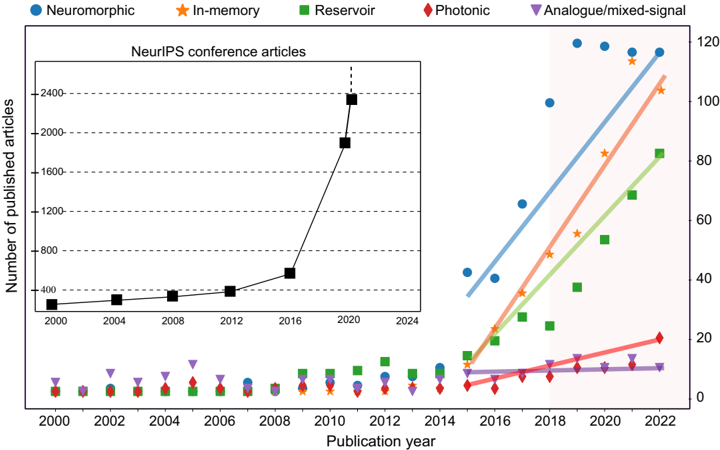
- The review found a sharp rise in publications since 2015, especially in neuromorphic, in-memory, and reservoir computing.
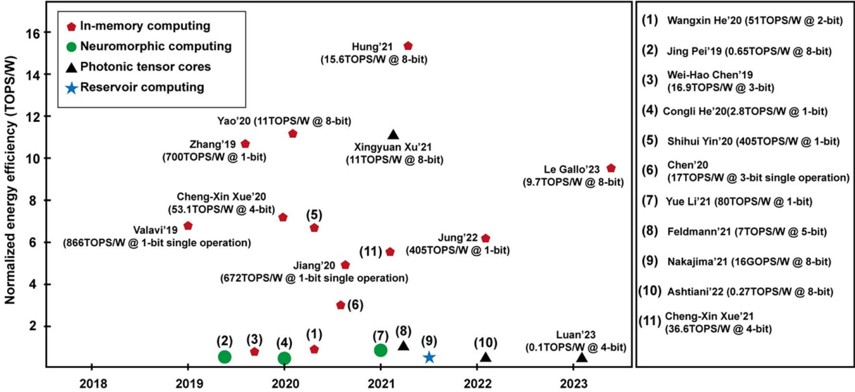
- The authors report that in-memory computing delivers the highest energy efficiency regardless of implementation type, whether using CMOS-based SRAM or non-volatile memristive devices.
- They conclude that, in a fair comparison using a normalized metric, brain-inspired/unconventional computing is still far from human brain efficiency, which they approximate as ~100 TOPS/W or 10 fJ/Op.
- A representative example cited for photonic tensor cores reports the highest energy efficiency in that category, but a 256 × 256 system also consumed ~1 kW, which the paper says is too high for most edge devices.
Methods
- Systematic literature review of brain-inspired computing papers published between 2016 and 2023.
- Literature search across Springer Nature, IEEE Xplore, HPCA/MICRO, and ACM digital libraries using keywords such as unconventional, reservoir, neuromorphic, in-memory, near-memory, photonic, and brain/bio-inspired.
- Articles were filtered by title, abstract, and full text; the synthesis included papers that scored 3 or higher out of 6 on the authors’ quality assessment rules.
- The paper combines descriptive, narrative, and quantitative synthesis, and normalizes reported efficiency to an 8-bit MAC standard for comparison.
Limitations
- The paper states that not many publications report efficiency metrics uniquely, making comparisons difficult.
- It also states that “operation” is not uniquely defined across fields, so naïve cross-paper comparisons are not fair; this is why the authors normalize metrics.
- Evident from the text: the review relies on reported experimental results and correspondence with original authors for data availability, so its comparisons depend on the completeness and consistency of prior studies.
Model-written summary. Check it against the paper before relying on it.
Integrity signals
Registry
Cites
Statistics
Figures

Verification
Claims the paper makes
10 Valid · 4 Not valid · 41 Not checked · 37 Own results and interpretations
Some cited sources support this claim and some don’t — read each source’s verdict below.
In the paper
“What further stands out in Fig. 8 is that photonic tensor cores, which accelerate matrix-by-vector multiplication (MVM), report modest energy efficiency despite their admirable throughput [36, 164, 237].”
§ 3 Synthesis and analysis of collected research articles > 3.3 Efficiency perspectives
What the sources say
- Disputedcites [36] F. Ashtiani, A.J. Geers, F. Aflatouni, Nature (2022). https://doi.org/10.1038/s41586-022-04714-0 Article Google Scholar sourceExperimental — accuracy not yet measured
Our copy of Ashtiani et al. (2022) supports the throughput half of the claim — the Discussion states sub-100 picosecond processing per neuron layer and end-to-end classification 'within a single clock cycle of a state-of-the-art GPU' — but it contradicts the 'modest energy efficiency' half: the Discussion summarizes the chip as enabling networks that are 'significantly faster and consume less power compared to the conventional all-electrical solutions' with 'low energy consumption', and the introduction frames photonics as a platform for 'fast and energy-efficient processing units'. The paper also never uses the terms 'photonic tensor core' or 'matrix-by-vector multiplication' (searched: energy efficiency/fJ per operation, wall-plug efficiency, tensor core/MVM); it reports an on-chip photonic DNN classifier, so the collective characterization 'report modest energy efficiency' is not what this source says. (LLM, conf=0.72)
Checked by a reasoning model — may be wrong.
- Supportedcites [164] J. Feldmann, N. Youngblood, M. Karpov, H. Gehring, X. Li, M. Stappers et al., Nature 589(7840), 52 (2021) source
The photonic tensor core section describes parallel matrix–vector multiplication. In “Projections to the future” (page unavailable), the paper reports throughput of 2 TMAC/s but energy efficiency of 0.4 TOPS/W in the experiments, with 7.0 TOPS/W projected after improvements. Those reported figures support the citing sentence’s characterization of high throughput alongside comparatively modest measured efficiency. (LLM, conf=0.86)
- Not checked — no full text of the sourcecites [237] J. Wang, Y. Long, Sci. Bull. 63(19), 1267 (2018) source
plainstates an association- Asserted: passes — The authors put it forward as true.
- Checkable: passes — It can be checked against evidence.
- Load-bearing: unclear — It is unclear whether the paper’s conclusions depend on it.
- Based: passes — The paper gives a reason why it holds.
- Disputed
The cited sources support only part of this claim — read each source’s verdict below.
In the paper
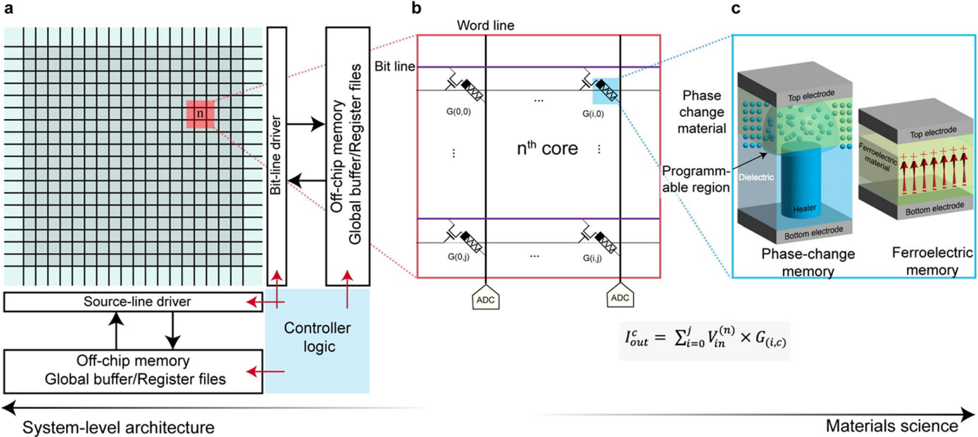
“However, it is worth mentioning that driving in-memory computing cores requires peripheral circuitry, such as analog-to-digital and digital-to-analog converters (ADC/DAC), global memory, and controller logic, which have a significant contribution to the total power consumption of the chip [49].”
§ 2 Background and other reviews > 2.1 In(near)-memory computing
What the sources say
- Partly supportedcites [49] A. Sebastian, M. Le Gallo, R. Khaddam-Aljameh, E. Eleftheriou, Nat. Nanotechnol. 15(7), 529 (2020) sourceExperimental — accuracy not yet measured
Split into 2 atoms — 0 confirmed, 2 partially supported, 0 disputed, 0 misattributed, 0 unverifiable. Expand the claim to see per-atom verdicts.
plainstates a cause- Asserted: passes — The authors put it forward as true.
- Checkable: passes — It can be checked against evidence.
- Load-bearing: unclear — It is unclear whether the paper’s conclusions depend on it.
- Based: passes — The paper gives a reason why it holds.
- Partly supported
The cited sources support only part of this claim — read each source’s verdict below.
In the paper
“Although photonic integration with in-memory computing has gained noticeable attention, optical power supply, signal conversions, and modulators are the dominant power consumers [164].”
§ 3 Synthesis and analysis of collected research articles > 3.3 Efficiency perspectives
What the sources say
- Partly supportedcites [164] J. Feldmann, N. Youngblood, M. Karpov, H. Gehring, X. Li, M. Stappers et al., Nature 589(7840), 52 (2021) sourceExperimental — accuracy not yet measured
In “Projections to the future” (page not provided), the paper estimates that optical power, ADCs and modulators dominate consumption in its actual experiments. The citing sentence turns that experiment-specific estimate into an unqualified statement about photonic in-memory computing generally. (LLM, conf=0.86)
plain- Asserted: passes — The authors put it forward as true.
- Checkable: passes — It can be checked against evidence.
- Load-bearing: unclear — It is unclear whether the paper’s conclusions depend on it.
- Based: passes — The paper gives a reason why it holds.
- Partly supported
Every source the paper cites for this claim was checked and supports it.
In the paper
“These results imply that with better architecture, materials, and hardware-software co-design [161], in-memory computing can set new standards for parallel processing.”
§ 3 Synthesis and analysis of collected research articles > 3.3 Efficiency perspectives
What the sources say
- Supportedcites [161] W. Wan, R. Kubendran, C. Schaefer, S.B. Eryilmaz, W. Zhang, D. Wu et al., Nature 608(7923), 504 (2022) source
The Main section describes improvements at the device, circuit, architecture, system and algorithm levels, including 48 cores that perform inference in parallel. Hardware-algorithm co-optimizations says further cross-layer co-optimization could improve RRAM compute-in-memory performance and efficiency. The sentence’s prediction about setting new standards is framed as the citing authors’ inference, rather than a finding attributed directly to this paper. (LLM, conf=0.86)
plainstates a possible cause- Asserted: passes — The authors put it forward as true.
- Checkable: passes — It can be checked against evidence.
- Load-bearing: passes — The paper’s conclusions depend on it.
- Based: passes — The paper gives a reason why it holds.
- Supported
None of the sources cited for this claim have been checked yet.
In the paper
“However, conventional CMOS-based analog/mixed-signal circuits are less studied for the neuromorphic computing paradigm.”
§ 3 Synthesis and analysis of collected research articles > 3.1 Hardware perspectives
plain- Asserted: passes — The authors put it forward as true.
- Checkable: passes — It can be checked against evidence.
- Load-bearing: unclear — It is unclear whether the paper’s conclusions depend on it.
- Based: passes — The paper gives a reason why it holds.
30 more claims
Create a free account to see all 92 claims and to verify the 24 references still open.
- Probably not a substantial claim. 43
- It may state two separate claims as one. 24
Citations
Cites
Items 201–202 of 202
Gradient descent-based programming of analog in-memory computing cores
Büchel, J., Sebastian, A., Kersting, B., Odermatt, F., Brew, K., Ok, I., Choi, S., Vasilopoulos, A., Chan, V., Philip, T., et al. (2023) · Proceedings of the Neuromorphic Materials, Devices, Circuits and Systems · doi:10.29363/nanoge.neumatdecas.2023.031 · Cited by 1
2022 roadmap on neuromorphic computing and engineering
Christensen, D. V., Dittmann, R., Linares-Barranco, B., Sebastian, A., Le Gallo, M., Redaelli, A., Slesazeck, S., Mikolajick, T., Spiga, S., Menzel, S., et al. (2022) · Neuromorphic Computing and Engineering · doi:10.1088/2634-4386/ac4a83
Research works printed but not linked: 36
- A. Morán, V. Canals, F. Galan-Prado, C.F. Frasser, D. Radhakrishnan, S. Safavi et al., Cogn. Comput. 1, 1–9 (2021)
- R. David, J. Duke, A. Jain, V. Janapa Reddi, N. Jeffries, J. Li et al., Proc. Mach. Learn. Syst. 3, 800 (2021)
- B. Zoph, Q. V. Le, arXiv preprint https://arXiv.org/1611.01578 (2016)
- Ziegler, M., Mussenbrock, T., & Kohlstedt, H.: Springer Nature, 2024.
- A. Adamatzky, vol 22, Springer (2016) H. Jaeger, B. Noheda, W.G. van Der Wiel, Nat. Commun. 14(1), 4911 (2023) ADS Google Scholar Y. Han, C. Nickle, Z. Zhang, H.P. Astier, T.J. Duffin, D. Qi et al., Nat. Mater. 19(8), 843 (2020) ADS Google Scholar L.S. Madsen, F. Laudenbach, M.F. Askarani, F. Rortais, T. Vincent, J.F. Bulmer et al., Nature 606(7912), 75 (2022) ADS Google Scholar
- D. Melanson, M. A. Khater, M. Aifer, K. Donatella, M. H. Gordon, T. Ahle et al., arXiv preprint https://arXiv.org/2312.04836 (2023)
- O. Mutlu, S. Ghose, J. Gómez-Luna, R. Ausavarungnirun, A modern primer on processing in memory, in Emerging computing: from devices to systems: looking beyond Moore and Von Neumann. (Springer, 2022), p.171
- Y. Li, Z. Wang, R. Midya, Q. Xia, J.J. Yang, J. Phys. D Appl. Phys. 51(50), 503002 (2018)
- Z. Li, T. Wang, J. Yu, J. Meng, Y. Liu, H. Zhu et al., Adv. Electron. Mater. 8, 2200951 (2022) Google Scholar N. Xu, T. Park, K.J. Yoon, C.S. Hwang, Phys. Status Solidi (RRL) Rapid Res. Lett. 15(9), 2100208 (2021) ADS Google Scholar NVIDIA A100 TENSOR CORE GPU [White paper]. 3 (2021) G. Van der Sande, D. Brunner, M.C. Soriano, Nanophotonics 6(3), 561 (2017) Google Scholar M. Davies, A. Wild, G. Orchard, Y. Sandamirskaya, G.A.F. Guerra, P. Joshi et al., Proc. IEEE 109(5), 911 (2021) Google Scholar W.C. Abraham, O.D. Jones, D.L. Glanzman, NPJ Sci. Learn. 4(1), 9 (2019) Google Scholar F.A. Azevedo, L.R. Carvalho, L.T. Grinberg, J.M. Farfel, R.E. Ferretti, R.E. Leite et al., J. Comp. Neurol. 513(5), 532 (2009) Google Scholar K. Roy, A. Jaiswal, P. Panda, Nature 575(7784), 607 (2019) ADS Google Scholar E. Bullmore, O. Sporns, Nat. Rev. Neurosci. 13(5), 336 (2012) Google Scholar G.W. Burr, R.M. Shelby, A. Sebastian, S. Kim, S. Kim, S. Sidler et al., Adv. Phys. X 2(1), 89 (2017) Google Scholar
- F. Ottati, C. Gao, Q. Chen, G. Brignone, M. R. Casu, J. K. Eshraghian et al. arXiv preprint https://arXiv.org/2306.15749 (2023)
- L. Wang, X. Fang, D. Liu, S. Duan, Front. Neurosci. 374, 853010 (2022)
- J.-Q. Yang, R. Wang, Z.-P. Wang, Q.-Y. Ma, J.-Y. Mao, Y. Ren et al., Nano Energy 74, 104828 (2020)
- C.D. James, J.B. Aimone, N.E. Miner, C.M. Vineyard, F.H. Rothganger, K.D. Carlson et al., Biol. Inspired Cogn. Architect. 19, 49 (2017)
- C.-H. Kim, S. Lim, S.Y. Woo, W.-M. Kang, Y.-T. Seo, S.-T. Lee et al., Nanotechnology 30(3), 032001 (2018)
- Y. Shimeng, Proc. IEEE 106, 260 (2018) · DOI · Paper page
- Y. Zhang, Z. Wang, J. Zhu, Y. Yang, M. Rao, W. Song et al., Appl. Phys. Rev. 7(1), 011308 (2020)
- S. Oh, H. Hwang, I. Yoo, APL Mater. 7(9), 091109 (2019)
- J. Cai, L. Zhang, B. Fang, W. Lv, B. Zhang, G. Finocchio et al., Appl. Phys. Lett. 114(19), 192402 (2019)
- Z. Kuncic, T. Nakayama, Adv. Phys.: X 6(1), 1894234 (2021)
- G. Cao, P. Meng, J. Chen, H. Liu, R. Bian, C. Zhu et al., Adv. Funct. Mater. 31(4), 2005443 (2021)
- B. Lu, Y. Xia, Y. Ren, M. Xie, L. Zhou, G. Vinai et al., Adv. Sci. 11, 2305277 (2024)
- R. Pascanu, T. Mikolov, Y. Bengio, On the difficulty of training recurrent neural networks. In: International conference on machine learning, p 1310 PMLR (2013)
- Jaeger, H. Advances in neural information processing systems, 15 (2002)
- T. Yu, Y. Zhang, Z. Zhang, C. De Sa, arXiv preprint https://arXiv.org/2202.04805 (2022)
- T. Chen, J. van Gelder, B. van de Ven, S.V. Amitonov, B. de Wilde, H.-C. Ruiz Euler et al., Nature 577(7790), 341 (2020) · DOI · Paper page
- U.A. Ibarra, H.-C.R. Euler, H.A. Mollah, B.P. Petrov, S.S. Sastry, M.N. Boon et al., J. Open Sourc. Softw. 8(90), 1 (2023)
- H.-C. Ruiz-Euler, U. Alegre-Ibarra, B. van de Ven, H.J. Broersma, P.A. Bobbert, W.G. van der Wiel, Neuromorph. Comput. Eng. 1(2), 024002 (2021)
- P. Mannocci, M. Farronato, N. Lepri, L. Cattaneo, A. Glukhov, Z. Sun et al., APL Mach. Learn. 1(1), 010902 (2023)
- M.T. Sharbati, Y. Du, J. Torres, N.D. Ardolino, M. Yun, F. Xiong, Adv. Mater. 30(36), 1802353 (2018)
- Y. Li, Z. Xuan, J. Lu, Z. Wang, X. Zhang, Z. Wu et al., Adv. Func. Mater. 31(26), 2100042 (2021)
- C. He, J. Tang, D.-S. Shang, J. Tang, Y. Xi, S. Wang et al., ACS Appl. Mater. Interfaces 12(10), 11945 (2020)
- A.M. Zyarah, K. Gomez, D. Kudithipudi, IEEE Trans. Comput. 69(8), 1099 (2020)
- A. Pullini, F. Conti, D. Rossi, I. Loi, M. Gautschi, L. Benini, IEEE Trans. Circ. Syst. II Express Briefs 65(8), 1094 (2017)
- I. Chakraborty, G. Saha, A. Sengupta, K. Roy, Sci. Rep. 8(1), 1 (2018)
- Y. Pan, P. Ouyang, Y. Zhao, W. Kang, S. Yin, Y. Zhang et al., IEEE Trans. Magn. 54(11), 1 (2018)
- S. Yin, Z. Jiang, J.-S. Seo, M. Seok, IEEE J. Solid-State Circ. 55(6), 1733 (2020)
Cited by
Mondal, I., Attri, R., Rao, T. S., Yadav, B., & Kulkarni, G. U. (2024) · Applied Physics Reviews · doi:10.1063/5.0220628 · Cited by 33
Physical reservoir computing: a tutorial
Stepney, S. (2024) · Natural Computing · doi:10.1007/s11047-024-09997-y · Cited by 57
“Zolfagharinejad et al. (2024) provide a wider review of physical neuromorphic computing.”
Halide perovskite photovoltaics for in-sensor reservoir computing
Sharma, D., Luqman, A., Ng, S. E., Yantara, N., Xing, X., Tay, Y. B., Basu, A., Chattopadhyay, A., & Mathews, N. (2024) · Nano Energy · doi:10.1016/j.nanoen.2024.109949 · Cited by 26
Analogue speech recognition based on physical computing
Zolfagharinejad, M., Büchel, J., Cassola, L., Kinge, S., Sarwat, S. G., Sebastian, A., & van der Wiel, W. G. (2025) · Nature · doi:10.1038/s41586-025-09501-1 · Cited by 40
“These difficulties have led to a growing interest in alternative, more efficient approaches 22,23 .”
Self-citationMajumdar, P. (2025) · Evolving Systems · doi:10.1007/s12530-025-09755-0 · Cited by 13
“In Zolfagharinejad et al. ( 2024), the promise of SNNs in cognitive computing is illustrated by discussing how neuromorphic systems, in conjunction with SNNs, integrate learning algorithms like STDP to enable real-time adaptation to novel tasks and contexts.”
Metadata
- Authors
- Zolfagharinejad, M., Alegre-Ibarra, U., Chen, T., Kinge, S., & van der Wiel, W. G.
- Affiliations
- University of Twente (NL)
- Toyota Motor Corporation (Belgium) (BE)
- Venue
- The European Physical Journal B
- Published
- 2024-06
- Volume
- 97
- Issue
- 6
- ISSN
- 1434-6028 (ISSN-L)
- 1434-6036
- OpenAlex
- W4399391441
- Semantic Scholar
- 04036b701df09c5943932a9716c294395b50ea2c
- Cited by
- 39
- References
- 217
- Citations by year
- 2026: 14 · 2025: 20 · 2024: 5
- FWCI
- 0.89
- Type
- journal article
- Language
- en
- Open access
- hybrid
- doi.org
- Licence
- cc-by
- creativecommons.org/licenses/by/4.0 (tdm)
- creativecommons.org/licenses/by/4.0 (vor, 5 d)
- Locations
- The European Physical Journal B (publishedVersion, cc-by)
- RePEc: Research Papers in Economics (submittedVersion)
- University of Twente Research Information (submittedVersion, cc-by)
- Funders
- Nederlandse Organisatie voor Wetenschappelijk Onderzoek (16237)
- Deutsche Forschungsgemeinschaft (433682494 – SFB 1459)
- Toyota Motor Europe
- Topics
- Physical Sciences › Engineering › Electrical and Electronic Engineering › Advanced Memory and Neural Computing
- Physical Sciences › Computer Science › Artificial Intelligence › Cognitive Computing and Networks
- Physical Sciences › Computer Science › Hardware and Architecture › Parallel Computing and Optimization Techniques
- Keywords
- neuromorphic computing, neuromorphic hardware, in-memory computing, energy efficiency, artificial neural networks, edge AI, hardware platform, computational accuracy
About these checks
Registry, retraction, Cites and statistics results are computed, not judged, with one exception: a printed reference that no index lists is read once by a model before it counts as a citation error. Claims are extracted by a model and kept only when their quote appears verbatim in the text; each cited source is then checked, with a model’s help, for whether it says what the claim relies on. Those verdicts can be wrong — read the claim’s quote and the cited source before relying on one.
The claim verdicts this report counts are experimental: their accuracy is not yet measured.
A language model drew the claims from the paper on 2026-10-10, under version 3 of the claim definition (model deepseek-v4.1-flash, prompt extract-v3).
A second model labelled each claim on 2026-10-10 (model jev-1.13-20260917, definition revision gold-guideline-v0.2).
Cited sources are checked with a language model’s help (qwen3.8-omni-flash and gpt-6-sol).
Statistics and arithmetic are recomputed, not judged.
Confidence bands are shown only for fields calibrated on our annotated test set. None is calibrated yet, so no band is shown.
What counts as a claim ›How we measure confidence ›How we check this ›
Are you an author, or do you see a problem with this page? Request a review
Data sources
Bibliographic data: Semantic Scholar, OpenAlex, Crossref.
Contains information from the Semantic Scholar Academic Graph Datasets, made available under the ODC Attribution License (ODC-BY 1.0).
Semantic Scholar’s data is described in: Kinney, R., et al. (2023). The Semantic Scholar Open Data Platform. arXiv:2301.10140.
