

Brain-inspired computing systems: a systematic literature review
Open accessThe DOI matches its Crossref record; 201 of the 217 references it cites were found in a registry or an index; 13 of the 74 sources its claims cite were checked for support.
Abstract
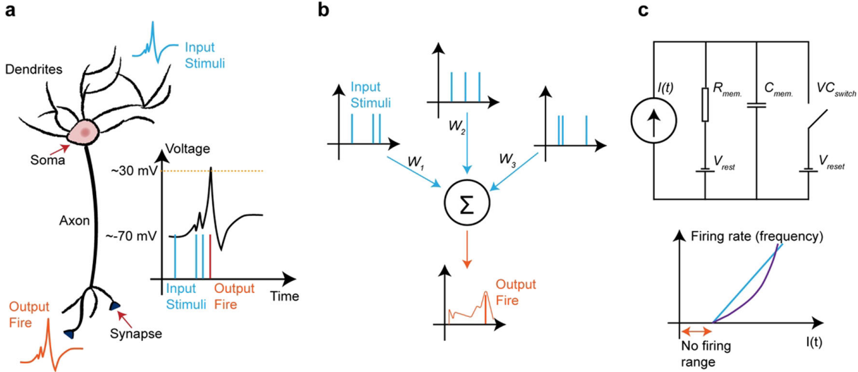
Abstract Brain-inspired computing is a growing and interdisciplinary area of research that investigates how the computational principles of the biological brain can be translated into hardware design to achieve improved energy efficiency. Brain-inspired computing encompasses various subfields, including neuromorphic and in-memory computing, that have been shown to outperform traditional digital hardware in executing specific tasks. With the rising demand for more powerful yet energy-efficient hardware for large-scale artificial neural networks , brain-inspired computing is emerging as a promising solution for enabling energy-efficient computing and expanding AI to the edge. However, the vast scope of the field has made it challenging to compare and assess the effectiveness of the solutions compared to state-of-the-art digital counterparts. This systematic literature review provides a comprehensive overview of the latest advances in brain-inspired computing hardware. To ensure accessibility for researchers from diverse backgrounds, we begin by introducing key concepts and pointing out respective in-depth topical reviews. We continue with categorizing the dominant hardware platforms. We highlight various studies and potential applications that could greatly benefit from brain-inspired computing systems and compare their reported computational accuracy. Finally, to have a fair comparison of the performance of different approaches, we employ a standardized normalization approach for energy efficiency reports in the literature. Graphical abstract
Overview
CoChat Summary
TL;DR
This systematic literature review surveys brain-inspired computing publications from 2016–2023, focusing on hardware approaches, applications, and energy-efficiency trade-offs. It argues that in-memory computing currently offers the strongest energy-efficiency results overall, while photonic approaches show high throughput but are often limited by power and signal-conversion costs.
Key findings
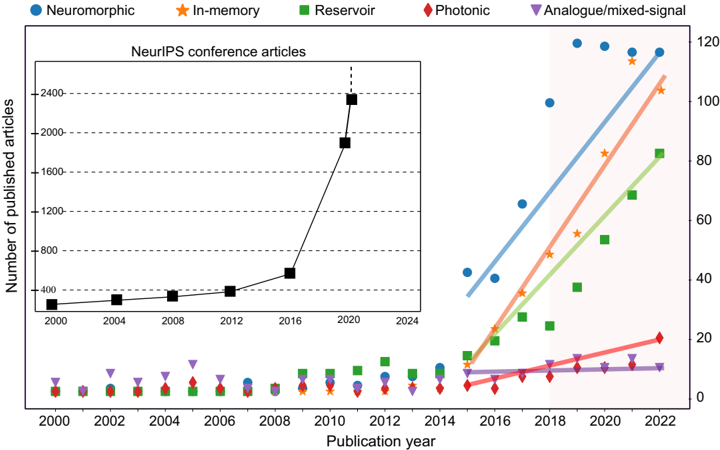
- The review found a sharp rise in publications since 2015, especially in neuromorphic, in-memory, and reservoir computing.
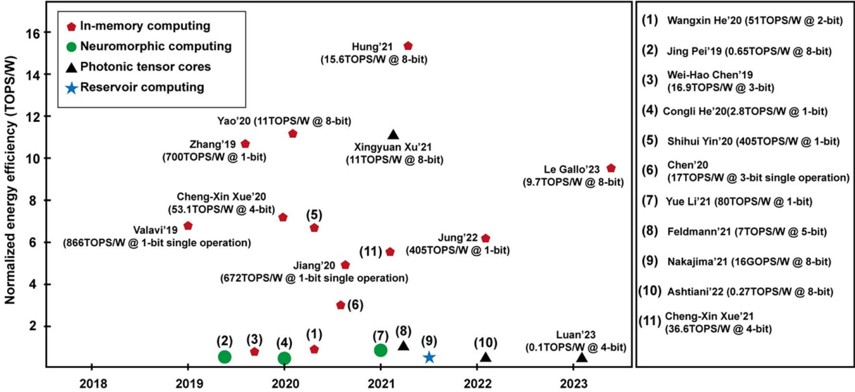
- The authors report that in-memory computing delivers the highest energy efficiency regardless of implementation type, whether using CMOS-based SRAM or non-volatile memristive devices.
- They conclude that, in a fair comparison using a normalized metric, brain-inspired/unconventional computing is still far from human brain efficiency, which they approximate as ~100 TOPS/W or 10 fJ/Op.
- A representative example cited for photonic tensor cores reports the highest energy efficiency in that category, but a 256 × 256 system also consumed ~1 kW, which the paper says is too high for most edge devices.
Methods
- Systematic literature review of brain-inspired computing papers published between 2016 and 2023.
- Literature search across Springer Nature, IEEE Xplore, HPCA/MICRO, and ACM digital libraries using keywords such as unconventional, reservoir, neuromorphic, in-memory, near-memory, photonic, and brain/bio-inspired.
- Articles were filtered by title, abstract, and full text; the synthesis included papers that scored 3 or higher out of 6 on the authors’ quality assessment rules.
- The paper combines descriptive, narrative, and quantitative synthesis, and normalizes reported efficiency to an 8-bit MAC standard for comparison.
Limitations
- The paper states that not many publications report efficiency metrics uniquely, making comparisons difficult.
- It also states that “operation” is not uniquely defined across fields, so naïve cross-paper comparisons are not fair; this is why the authors normalize metrics.
- Evident from the text: the review relies on reported experimental results and correspondence with original authors for data availability, so its comparisons depend on the completeness and consistency of prior studies.
Model-written summary. Check it against the paper before relying on it.
Integrity signals
Registry
Cites
Statistics
Figures

Verification
Claims the paper makes
10 Valid · 4 Not valid · 41 Not checked · 37 Own results and interpretations
Some cited sources support this claim and some don’t — read each source’s verdict below.
In the paper
“What further stands out in Fig. 8 is that photonic tensor cores, which accelerate matrix-by-vector multiplication (MVM), report modest energy efficiency despite their admirable throughput [36, 164, 237].”
§ 3 Synthesis and analysis of collected research articles > 3.3 Efficiency perspectives
What the sources say
- Disputedcites [36] F. Ashtiani, A.J. Geers, F. Aflatouni, Nature (2022). https://doi.org/10.1038/s41586-022-04714-0 Article Google Scholar sourceExperimental — accuracy not yet measured
Our copy of Ashtiani et al. (2022) supports the throughput half of the claim — the Discussion states sub-100 picosecond processing per neuron layer and end-to-end classification 'within a single clock cycle of a state-of-the-art GPU' — but it contradicts the 'modest energy efficiency' half: the Discussion summarizes the chip as enabling networks that are 'significantly faster and consume less power compared to the conventional all-electrical solutions' with 'low energy consumption', and the introduction frames photonics as a platform for 'fast and energy-efficient processing units'. The paper also never uses the terms 'photonic tensor core' or 'matrix-by-vector multiplication' (searched: energy efficiency/fJ per operation, wall-plug efficiency, tensor core/MVM); it reports an on-chip photonic DNN classifier, so the collective characterization 'report modest energy efficiency' is not what this source says. (LLM, conf=0.72)
Checked by a reasoning model — may be wrong.
- Supportedcites [164] J. Feldmann, N. Youngblood, M. Karpov, H. Gehring, X. Li, M. Stappers et al., Nature 589(7840), 52 (2021) source
The photonic tensor core section describes parallel matrix–vector multiplication. In “Projections to the future” (page unavailable), the paper reports throughput of 2 TMAC/s but energy efficiency of 0.4 TOPS/W in the experiments, with 7.0 TOPS/W projected after improvements. Those reported figures support the citing sentence’s characterization of high throughput alongside comparatively modest measured efficiency. (LLM, conf=0.86)
- Not checked — no full text of the sourcecites [237] J. Wang, Y. Long, Sci. Bull. 63(19), 1267 (2018) source
plainstates an association- Asserted: passes — The authors put it forward as true.
- Checkable: passes — It can be checked against evidence.
- Load-bearing: unclear — It is unclear whether the paper’s conclusions depend on it.
- Based: passes — The paper gives a reason why it holds.
- Disputed
The cited sources support only part of this claim — read each source’s verdict below.
In the paper
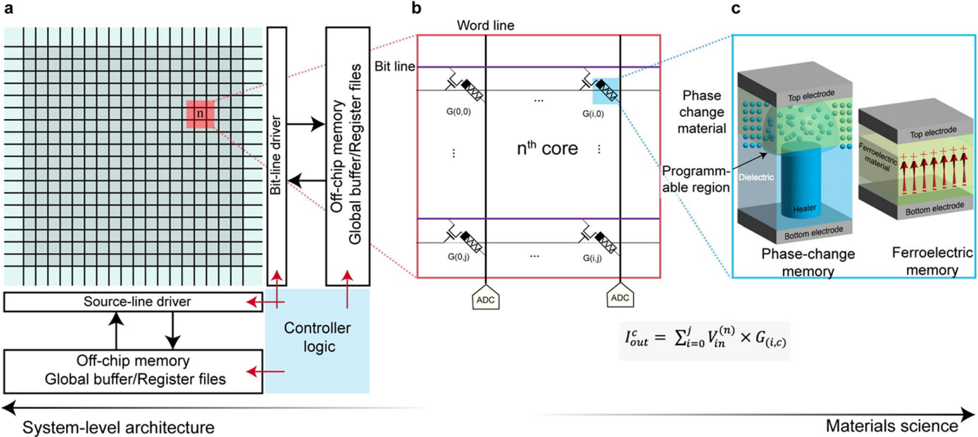
“However, it is worth mentioning that driving in-memory computing cores requires peripheral circuitry, such as analog-to-digital and digital-to-analog converters (ADC/DAC), global memory, and controller logic, which have a significant contribution to the total power consumption of the chip [49].”
§ 2 Background and other reviews > 2.1 In(near)-memory computing
What the sources say
- Partly supportedcites [49] A. Sebastian, M. Le Gallo, R. Khaddam-Aljameh, E. Eleftheriou, Nat. Nanotechnol. 15(7), 529 (2020) sourceExperimental — accuracy not yet measured
Split into 2 atoms — 0 confirmed, 2 partially supported, 0 disputed, 0 misattributed, 0 unverifiable. Expand the claim to see per-atom verdicts.
plainstates a cause- Asserted: passes — The authors put it forward as true.
- Checkable: passes — It can be checked against evidence.
- Load-bearing: unclear — It is unclear whether the paper’s conclusions depend on it.
- Based: passes — The paper gives a reason why it holds.
- Partly supported
The cited sources support only part of this claim — read each source’s verdict below.
In the paper
“Although photonic integration with in-memory computing has gained noticeable attention, optical power supply, signal conversions, and modulators are the dominant power consumers [164].”
§ 3 Synthesis and analysis of collected research articles > 3.3 Efficiency perspectives
What the sources say
- Partly supportedcites [164] J. Feldmann, N. Youngblood, M. Karpov, H. Gehring, X. Li, M. Stappers et al., Nature 589(7840), 52 (2021) sourceExperimental — accuracy not yet measured
In “Projections to the future” (page not provided), the paper estimates that optical power, ADCs and modulators dominate consumption in its actual experiments. The citing sentence turns that experiment-specific estimate into an unqualified statement about photonic in-memory computing generally. (LLM, conf=0.86)
plain- Asserted: passes — The authors put it forward as true.
- Checkable: passes — It can be checked against evidence.
- Load-bearing: unclear — It is unclear whether the paper’s conclusions depend on it.
- Based: passes — The paper gives a reason why it holds.
- Partly supported
Every source the paper cites for this claim was checked and supports it.
In the paper
“These results imply that with better architecture, materials, and hardware-software co-design [161], in-memory computing can set new standards for parallel processing.”
§ 3 Synthesis and analysis of collected research articles > 3.3 Efficiency perspectives
What the sources say
- Supportedcites [161] W. Wan, R. Kubendran, C. Schaefer, S.B. Eryilmaz, W. Zhang, D. Wu et al., Nature 608(7923), 504 (2022) source
The Main section describes improvements at the device, circuit, architecture, system and algorithm levels, including 48 cores that perform inference in parallel. Hardware-algorithm co-optimizations says further cross-layer co-optimization could improve RRAM compute-in-memory performance and efficiency. The sentence’s prediction about setting new standards is framed as the citing authors’ inference, rather than a finding attributed directly to this paper. (LLM, conf=0.86)
plainstates a possible cause- Asserted: passes — The authors put it forward as true.
- Checkable: passes — It can be checked against evidence.
- Load-bearing: passes — The paper’s conclusions depend on it.
- Based: passes — The paper gives a reason why it holds.
- Supported
None of the sources cited for this claim have been checked yet.
In the paper
“However, conventional CMOS-based analog/mixed-signal circuits are less studied for the neuromorphic computing paradigm.”
§ 3 Synthesis and analysis of collected research articles > 3.1 Hardware perspectives
plain- Asserted: passes — The authors put it forward as true.
- Checkable: passes — It can be checked against evidence.
- Load-bearing: unclear — It is unclear whether the paper’s conclusions depend on it.
- Based: passes — The paper gives a reason why it holds.
30 more claims
Create a free account to see all 92 claims and to verify the 24 references still open.
- Probably not a substantial claim. 43
- It may state two separate claims as one. 24
Citations
Cites
Edge computing: Vision and challenges
Shi, W., Cao, J., Zhang, Q., Li, Y., & Xu, L. (2016) · IEEE Internet of Things Journal · doi:10.1109/jiot.2016.2579198 · Cited by 8,733
Anomalous collapses of Nares Strait ice arches leads to enhanced export of Arctic sea ice
Moore, G. W. K., Howell, S. E. L., Brady, M., Xu, X., & McNeil, K. (2021) · Nature Communications · doi:10.1038/s41467-020-20314-w · Cited by 5,155
In-Datacenter Performance Analysis of a Tensor Processing Unit
Jouppi, N. P., Young, C., Patil, N., Patterson, D., Agrawal, G., Bajwa, R., Bates, S., Bhatia, S., Boden, N., Borchers, A., et al. (2017) · Proceedings of the 44th Annual International Symposium on Computer Architecture · doi:10.1145/3079856.3080246 · Cited by 4,537
Efficient Processing of Deep Neural Networks: A Tutorial and Survey
Sze, V., Chen, Y.-H., Yang, T.-J., & Emer, J. S. (2017) · Proceedings of the IEEE · doi:10.1109/jproc.2017.2761740 · Cited by 4,215
Maass, W., Natschläger, T., & Markram, H. (2002) · Neural Computation · doi:10.1162/089976602760407955 · Cited by 4,025
Memristive devices for computing
Yang, J. J., Strukov, D. B., & Stewart, D. R. (2013) · Nature Nanotechnology · doi:10.1038/nnano.2012.240 · Cited by 3,885
Design of ion-implanted MOSFET's with very small physical dimensions
Dennard, R. H., Gaensslen, F. H., Yu, H.-N., Rideout, V. L., Bassous, E., & LeBlanc, A. R. (1974) · IEEE Journal of Solid-State Circuits · doi:10.1109/jssc.1974.1050511 · Cited by 3,548
The economy of brain network organization
Bullmore, E., & Sporns, O. (2012) · Nature Reviews Neuroscience · doi:10.1038/nrn3214 · Cited by 3,284
Eyeriss: An Energy-Efficient Reconfigurable Accelerator for Deep Convolutional Neural Networks
Chen, Y.-H., Krishna, T., Emer, J. S., & Sze, V. (2017) · IEEE Journal of Solid-State Circuits · doi:10.1109/jssc.2016.2616357 · Cited by 3,247
Reservoir computing approaches to recurrent neural network training
Lukoševičius, M., & Jaeger, H. (2009) · Computer Science Review · doi:10.1016/j.cosrev.2009.03.005 · Cited by 2,956
The Vanishing Gradient Problem During Learning Recurrent Neural Nets and Problem Solutions
Hochreiter, S. (1998) · International Journal of Uncertainty, Fuzziness and Knowledge-Based Systems · doi:10.1142/s0218488598000094 · Cited by 2,939
Azevedo, F. A. C., Carvalho, L. R. B., Grinberg, L. T., Farfel, J. M., Ferretti, R. E. L., Leite, R. E. P., Filho, W. J., Lent, R., & Herculano‐Houzel, S. (2009) · Journal of Comparative Neurology · doi:10.1002/cne.21974 · Cited by 2,337
Memory devices and applications for in-memory computing
Sebastian, A., Le Gallo, M., Khaddam-Aljameh, R., & Eleftheriou, E. (2020) · Nature Nanotechnology · doi:10.1038/s41565-020-0655-z · Cited by 2,289
Towards spike-based machine intelligence with neuromorphic computing
Roy, K., Jaiswal, A., & Panda, P. (2019) · Nature · doi:10.1038/s41586-019-1677-2 · Cited by 2,190
Fully hardware-implemented memristor convolutional neural network
Yao, P., Wu, H., Gao, B., Tang, J., Zhang, Q., Zhang, W., Yang, J. J., & Qian, H. (2020) · Nature · doi:10.1038/s41586-020-1942-4 · Cited by 2,179
Recent advances in physical reservoir computing: A review
Tanaka, G., Yamane, T., Héroux, J. B., Nakane, R., Kanazawa, N., Takeda, S., Numata, H., Nakano, D., & Hirose, A. (2019) · Neural Networks · doi:10.1016/j.neunet.2019.03.005 · Cited by 2,146
How ‘big data’ can make big impact: findings from a systematic review and a longitudinal case study
Fosso Wamba, S., Akter, S., Edwards, A., Chopin, G., & Gnanzou, D. (2015) · International Journal of Production Economics · doi:10.1016/j.ijpe.2014.12.031 · Cited by 1,905
Parallel convolutional processing using an integrated photonic tensor core
Feldmann, J., Youngblood, N., Karpov, M., Gehring, H., Li, X., Stappers, M., Le Gallo, M., Fu, X., Lukashchuk, A., Raja, A. S., et al. (2021) · Nature · doi:10.1038/s41586-020-03070-1 · Cited by 1,900
A survey of deep learning techniques for autonomous driving
Grigorescu, S., Trasnea, B., Cocias, T., & Macesanu, G. (2020) · Journal of Field Robotics · doi:10.1002/rob.21918 · Cited by 1,809
Deep Learning With Edge Computing: A Review
Chen, J., & Ran, X. (2019) · Proceedings of the IEEE · doi:10.1109/jproc.2019.2921977 · Cited by 1,540
11 TOPS photonic convolutional accelerator for optical neural networks
Xu, X., Tan, M., Corcoran, B., Wu, J., Boes, A., Nguyen, T. G., Chu, S. T., Little, B. E., Hicks, D. G., Morandotti, R., et al. (2021) · Nature · doi:10.1038/s41586-020-03063-0 · Cited by 1,518
Owens, J. D., Houston, M., Luebke, D., Green, S., Stone, J. E., & Phillips, J. C. (2008) · Proceedings of the IEEE · doi:10.1109/jproc.2008.917757 · Cited by 1,495
Recurrent neural networks and robust time series prediction
Connor, J. T., Martin, R. D., & Atlas, L. E. (1994) · IEEE Transactions on Neural Networks · doi:10.1109/72.279188 · Cited by 1,316
Chi, P., Li, S., Xu, C., Zhang, T., Zhao, J., Liu, Y., Wang, Y., & Xie, Y. (2016) · ACM SIGARCH Computer Architecture News · doi:10.1145/3007787.3001140 · Cited by 1,231
Resistive switching materials for information processing
Wang, Z., Wu, H., Burr, G. W., Hwang, C. S., Wang, K. L., Xia, Q., & Yang, J. J. (2020) · Nature Reviews Materials · doi:10.1038/s41578-019-0159-3 · Cited by 1,214
Neuro-Inspired Computing With Emerging Nonvolatile Memorys
Yu, S. (2018) · Proceedings of the IEEE · doi:10.1109/jproc.2018.2790840 · Cited by 1,170
Opportunities for neuromorphic computing algorithms and applications
Schuman, C. D., Kulkarni, S. R., Parsa, M., Mitchell, J. P., Date, P., & Kay, B. (2022) · Nature Computational Science · doi:10.1038/s43588-021-00184-y · Cited by 1,117
Eyeriss v2: A Flexible Accelerator for Emerging Deep Neural Networks on Mobile Devices
Chen, Y.-H., Yang, T.-J., Emer, J. S., & Sze, V. (2019) · IEEE Journal on Emerging and Selected Topics in Circuits and Systems · doi:10.1109/jetcas.2019.2910232 · Cited by 1,106
Organic electronics for neuromorphic computing
van de Burgt, Y., Melianas, A., Keene, S. T., Malliaras, G., & Salleo, A. (2018) · Nature Electronics · doi:10.1038/s41928-018-0103-3 · Cited by 1,104
Quantum computational advantage with a programmable photonic processor
Madsen, L. S., Laudenbach, F., Askarani, M. F., Rortais, F., Vincent, T., Bulmer, J. F. F., Miatto, F. M., Neuhaus, L., Helt, L. G., Collins, M. J., et al. (2022) · Nature · doi:10.1038/s41586-022-04725-x · Cited by 1,101
Towards artificial general intelligence with hybrid Tianjic chip architecture
Pei, J., Deng, L., Song, S., Zhao, M., Zhang, Y., Wu, S., Wang, G., Zou, Z., Wu, Z., He, W., et al. (2019) · Nature · doi:10.1038/s41586-019-1424-8 · Cited by 1,082
A Low Power, Fully Event-Based Gesture Recognition System
Amir, A., Taba, B., Berg, D., Melano, T., McKinstry, J., Di Nolfo, C., Nayak, T., Andreopoulos, A., Garreau, G., Mendoza, M., et al. (2017) · 2017 IEEE Conference on Computer Vision and Pattern Recognition (CVPR) · doi:10.1109/cvpr.2017.781 · Cited by 1,017 · cited 1×
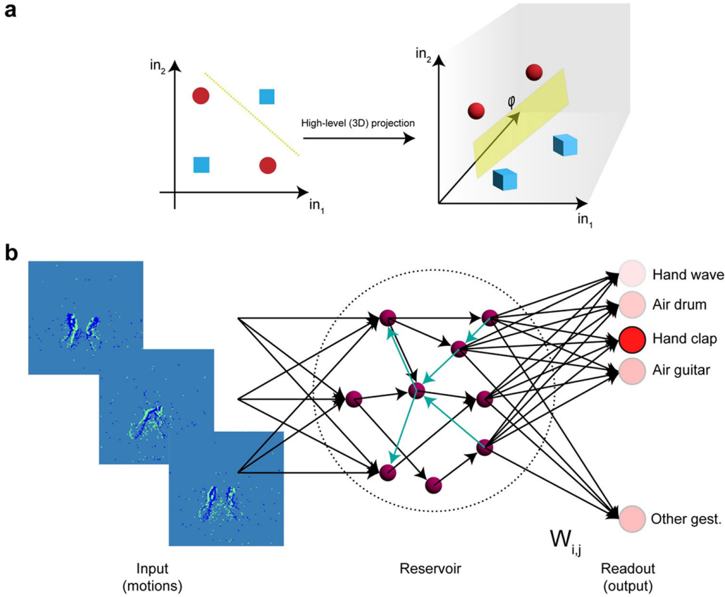
“Figure 6b gives an example of RC-based motion recognition, which requires spatial and temporal feature extraction using the DVS-128 gesture dataset [121].”
MethodGrollier, J., Querlioz, D., Camsari, K. Y., Everschor-Sitte, K., Fukami, S., & Stiles, M. D. (2020) · Nature Electronics · doi:10.1038/s41928-019-0360-9 · Cited by 975
A compute-in-memory chip based on resistive random-access memory
Wan, W., Kubendran, R., Schaefer, C., Eryilmaz, S. B., Zhang, W., Wu, D., Deiss, S., Raina, P., Qian, H., Gao, B., et al. (2022) · Nature · doi:10.1038/s41586-022-04992-8 · Cited by 943
Neuro-inspired computing chips
Zhang, W., Gao, B., Tang, J., Yao, P., Yu, S., Chang, M.-F., Yoo, H.-J., Qian, H., & Wu, H. (2020) · Nature Electronics · doi:10.1038/s41928-020-0435-7 · Cited by 892
Zhang, W., Mazzarello, R., Wuttig, M., & Ma, E. (2019) · Nature Reviews Materials · doi:10.1038/s41578-018-0076-x · Cited by 885
Convolutional networks for fast, energy-efficient neuromorphic computing
Esser, S. K., Merolla, P. A., Arthur, J. V., Cassidy, A. S., Appuswamy, R., Andreopoulos, A., Berg, D. J., McKinstry, J. L., Melano, T., Barch, D. R., et al. (2016) · Proceedings of the National Academy of Sciences · doi:10.1073/pnas.1604850113 · Cited by 781
An on-chip photonic deep neural network for image classification
Ashtiani, F., Geers, A. J., & Aflatouni, F. (2022) · Nature · doi:10.1038/s41586-022-04714-0 · Cited by 699
Choi, S., Tan, S. H., Li, Z., Kim, Y., Choi, C., Chen, P.-Y., Yeon, H., Yu, S., & Kim, J. (2018) · Nature Materials · doi:10.1038/s41563-017-0001-5 · Cited by 690
Advancing Neuromorphic Computing With Loihi: A Survey of Results and Outlook
Davies, M., Wild, A., Orchard, G., Sandamirskaya, Y., Guerra, G. A. F., Joshi, P., Plank, P., & Risbud, S. R. (2021) · Proceedings of the IEEE · doi:10.1109/jproc.2021.3067593 · Cited by 688
Hu, M., Strachan, J. P., Li, Z., Grafals, E. M., Davila, N., Graves, C., Lam, S., Ge, N., Yang, J. J., & Williams, R. S. (2016) · Proceedings of the 53rd Annual Design Automation Conference · doi:10.1145/2897937.2898010 · Cited by 686
Embedded Devices for Neuromorphic Time-Series Assessment
Mazumder, A. N., Hosseini, M., & Mohsenin, T. (2022) · Research Explorer (The University of Manchester) · doi:10.13016/m2ksy0-wxr3 · Cited by 652
Temporal data classification and forecasting using a memristor-based reservoir computing system
Moon, J., Ma, W., Shin, J. H., Cai, F., Du, C., Lee, S. H., & Lu, W. D. (2019) · Nature Electronics · doi:10.1038/s41928-019-0313-3 · Cited by 645
A crossbar array of magnetoresistive memory devices for in-memory computing
Jung, S., Lee, H., Myung, S., Kim, H., Yoon, S. K., Kwon, S.-W., Ju, Y., Kim, M., Yi, W., Han, S., et al. (2022) · Nature · doi:10.1038/s41586-021-04196-6 · Cited by 644
Cao, W., Bu, H., Vinet, M., Cao, M., Takagi, S., Hwang, S., Ghani, T., & Banerjee, K. (2023) · Nature · doi:10.1038/s41586-023-06145-x · Cited by 621
Advances in photonic reservoir computing
Van der Sande, G., Brunner, D., & Soriano, M. C. (2017) · Nanophotonics · doi:10.1515/nanoph-2016-0132 · Cited by 591
Next generation reservoir computing
Gauthier, D. J., Bollt, E., Griffith, A., & Barbosa, W. A. S. (2021) · Nature Communications · doi:10.1038/s41467-021-25801-2 · Cited by 582
Vowel recognition with four coupled spin-torque nano-oscillators
Romera, M., Talatchian, P., Tsunegi, S., Abreu Araujo, F., Cros, V., Bortolotti, P., Trastoy, J., Yakushiji, K., Fukushima, A., Kubota, H., et al. (2018) · Nature · doi:10.1038/s41586-018-0632-y · Cited by 572
Aligning artificial intelligence with climate change mitigation
Kaack, L. H., Donti, P. L., Strubell, E., Kamiya, G., Creutzig, F., & Rolnick, D. (2022) · Nature Climate Change · doi:10.1038/s41558-022-01377-7 · Cited by 570
Large-scale neuromorphic computing systems
Furber, S. (2016) · Journal of Neural Engineering · doi:10.1088/1741-2560/13/5/051001 · Cited by 567
Dynamical memristors for higher-complexity neuromorphic computing
Kumar, S., Wang, X., Strachan, J. P., Yang, Y., & Lu, W. D. (2022) · Nature Reviews Materials · doi:10.1038/s41578-022-00434-z · Cited by 558
Bit Fusion: Bit-Level Dynamically Composable Architecture for Accelerating Deep Neural Network
Sharma, H., Park, J., Suda, N., Lai, L., Chau, B., Kim, J. K., Chandra, V., & Esmaeilzadeh, H. (2018) · 2018 ACM/IEEE 45th Annual International Symposium on Computer Architecture (ISCA) · doi:10.1109/isca.2018.00069 · Cited by 543 · cited 2×
“To clarify, consider the multiply-and-accumulate (MAC) operation in digital processors, where the operation energy consumption is significantly dependent on the bit width of the input operands [13, 235] or equivalently to the signal-to-noise ratio (SNR) in analog computing [236].”
BackgroundMethodThe future of computing beyond Moore’s Law
Shalf, J. (2020) · Philosophical Transactions of the Royal Society A: Mathematical, Physical and Engineering Sciences · doi:10.1098/rsta.2019.0061 · Cited by 526
The rise of intelligent matter
Kaspar, C., Ravoo, B. J., van der Wiel, W. G., Wegner, S. V., & Pernice, W. H. P. (2021) · Nature · doi:10.1038/s41586-021-03453-y · Cited by 526
Dark Silicon and the End of Multicore Scaling
Esmaeilzadeh, H., Blem, E., St. Amant, R., Sankaralingam, K., & Burger, D. (2012) · IEEE Micro · doi:10.1109/mm.2012.17 · Cited by 490
In-Memory Computing: Advances and Prospects
Verma, N., Jia, H., Valavi, H., Tang, Y., Ozatay, M., Chen, L.-Y., Zhang, B., & Deaville, P. (2019) · IEEE Solid-State Circuits Magazine · doi:10.1109/mssc.2019.2922889 · Cited by 473
Milano, G., Pedretti, G., Montano, K., Ricci, S., Hashemkhani, S., Boarino, L., Ielmini, D., & Ricciardi, C. (2022) · Nature Materials · doi:10.1038/s41563-021-01099-9 · Cited by 462
An overview of phase-change memory device physics
Le Gallo, M., & Sebastian, A. (2020) · Journal of Physics D: Applied Physics · doi:10.1088/1361-6463/ab7794 · Cited by 460
Machine Learning at Facebook: Understanding Inference at the Edge
Wu, C.-J., Brooks, D., Chen, K., Chen, D., Choudhury, S., Dukhan, M., Hazelwood, K., Isaac, E., Jia, Y., Jia, B., et al. (2019) · 2019 IEEE International Symposium on High Performance Computer Architecture (HPCA) · doi:10.1109/hpca.2019.00048 · Cited by 439
Ambit: in-memory accelerator for bulk bitwise operations using commodity DRAM technology
Seshadri, V., Lee, D., Mullins, T., Hassan, H., Boroumand, A., Kim, J., Kozuch, M. A., Mutlu, O., Gibbons, P. B., & Mowry, T. C. (2017) · Proceedings of the 50th Annual IEEE/ACM International Symposium on Microarchitecture · doi:10.1145/3123939.3124544 · Cited by 434
Spintronic Nanodevices for Bioinspired Computing
Grollier, J., Querlioz, D., & Stiles, M. D. (2016) · Proceedings of the IEEE · doi:10.1109/jproc.2016.2597152 · Cited by 433
Long short-term memory networks in memristor crossbar arrays
Li, C., Wang, Z., Rao, M., Belkin, D., Song, W., Jiang, H., Yan, P., Li, Y., Lin, P., Hu, M., et al. (2019) · Nature Machine Intelligence · doi:10.1038/s42256-018-0001-4 · Cited by 429
Physical reservoir computing—an introductory perspective
Nakajima, K. (2020) · Japanese Journal of Applied Physics · doi:10.35848/1347-4065/ab8d4f · Cited by 422
Compute-in-Memory Chips for Deep Learning: Recent Trends and Prospects
Yu, S., Jiang, H., Huang, S., Peng, X., & Lu, A. (2021) · IEEE Circuits and Systems Magazine · doi:10.1109/mcas.2021.3092533 · Cited by 391
Next generation reservoir computing
Gauthier, D. J., Bollt, E. M., Griffith, A., et al. (n.d.) · RePEc: Research Papers in Economics · Cited by 386
Is plasticity of synapses the mechanism of long-term memory storage?
Abraham, W. C., Jones, O. D., & Glanzman, D. L. (2019) · npj Science of Learning · doi:10.1038/s41539-019-0048-y · Cited by 370
Computing in Memory With Spin-Transfer Torque Magnetic RAM
Jain, S., Ranjan, A., Roy, K., & Raghunathan, A. (2018) · IEEE Transactions on Very Large Scale Integration (VLSI) Systems · doi:10.1109/tvlsi.2017.2776954 · Cited by 355
Reliability of analog resistive switching memory for neuromorphic computing
Zhao, M., Gao, B., Tang, J., Qian, H., & Wu, H. (2020) · Applied Physics Reviews · doi:10.1063/1.5124915 · Cited by 349
Zhong, Y., Tang, J., Li, X., Liang, X., Liu, Z., Li, Y., Xi, Y., Yao, P., Hao, Z., Gao, B., et al. (2022) · Nature Electronics · doi:10.1038/s41928-022-00838-3 · Cited by 343
Ielmini, D. (2018) · Microelectronic Engineering · doi:10.1016/j.mee.2018.01.009 · Cited by 338
A 64-Tile 2.4-Mb In-Memory-Computing CNN Accelerator Employing Charge-Domain Compute
Valavi, H., Ramadge, P. J., Nestler, E., & Verma, N. (2019) · IEEE Journal of Solid-State Circuits · doi:10.1109/jssc.2019.2899730 · Cited by 328
C3SRAM: An In-Memory-Computing SRAM Macro Based on Robust Capacitive Coupling Computing Mechanism
Jiang, Z., Yin, S., Seo, J.-S., & Seok, M. (2020) · IEEE Journal of Solid-State Circuits · doi:10.1109/jssc.2020.2992886 · Cited by 324
Le Gallo, M., Khaddam-Aljameh, R., Stanisavljevic, M., Vasilopoulos, A., Kersting, B., Dazzi, M., Karunaratne, G., Brändli, M., Singh, A., Müller, S. M., et al. (2023) · Nature Electronics · doi:10.1038/s41928-023-01010-1 · Cited by 310
Large-Area Soft e-Skin: The Challenges Beyond Sensor Designs
Dahiya, R., Yogeswaran, N., Liu, F., Manjakkal, L., Burdet, E., Hayward, V., & Jörntell, H. (2019) · Proceedings of the IEEE · doi:10.1109/jproc.2019.2941366 · Cited by 309
Oxide-based RRAM materials for neuromorphic computing
Hong, X., Loy, D. J., Dananjaya, P. A., Tan, F., Ng, C., & Lew, W. (2018) · Journal of Materials Science · doi:10.1007/s10853-018-2134-6 · Cited by 307
Tutorial: Brain-inspired computing using phase-change memory devices
Sebastian, A., Le Gallo, M., Burr, G. W., Kim, S., BrightSky, M., & Eleftheriou, E. (2018) · Journal of Applied Physics · doi:10.1063/1.5042413 · Cited by 303
Photonic Multiply-Accumulate Operations for Neural Networks
Nahmias, M. A., de Lima, T. F., Tait, A. N., Peng, H.-T., Shastri, B. J., & Prucnal, P. R. (2020) · IEEE Journal of Selected Topics in Quantum Electronics · doi:10.1109/jstqe.2019.2941485 · Cited by 301
Challenges and Trends of SRAM-Based Computing-In-Memory for AI Edge Devices
Jhang, C.-J., Xue, C.-X., Hung, J.-M., Chang, F.-C., & Chang, M.-F. (2021) · IEEE Transactions on Circuits and Systems I: Regular Papers · doi:10.1109/tcsi.2021.3064189 · Cited by 294
In-memory hyperdimensional computing
Karunaratne, G., Le Gallo, M., Cherubini, G., Benini, L., Rahimi, A., & Sebastian, A. (2020) · Nature Electronics · doi:10.1038/s41928-020-0410-3 · Cited by 293
Coupled oscillators for computing: A review and perspective
Csaba, G., & Porod, W. (2020) · Applied Physics Reviews · doi:10.1063/1.5120412 · Cited by 279
A Robust and Energy-Efficient Classifier Using Brain-Inspired Hyperdimensional Computing
Rahimi, A., Kanerva, P., & Rabaey, J. M. (2016) · Proceedings of the 2016 International Symposium on Low Power Electronics and Design · doi:10.1145/2934583.2934624 · Cited by 276
CMOS-integrated memristive non-volatile computing-in-memory for AI edge processors
Chen, W.-H., Dou, C., Li, K.-X., Lin, W.-Y., Li, P.-Y., Huang, J.-H., Wang, J.-H., Wei, W.-C., Xue, C.-X., Chiu, Y.-C., et al. (2019) · Nature Electronics · doi:10.1038/s41928-019-0288-0 · Cited by 276
Spiking Neural Networks Hardware Implementations and Challenges: A Survey
Bouvier, M., Valentian, A., Mesquida, T., Rummens, F., Reyboz, M., Vianello, E., & Beigne, E. (2019) · ACM Journal on Emerging Technologies in Computing Systems · doi:10.1145/3304103 · Cited by 267
Memory scaling: A systems architecture perspective
Mutlu, O. (2013) · 2013 5th IEEE International Memory Workshop · doi:10.1109/imw.2013.6582088 · Cited by 256 · cited 1×
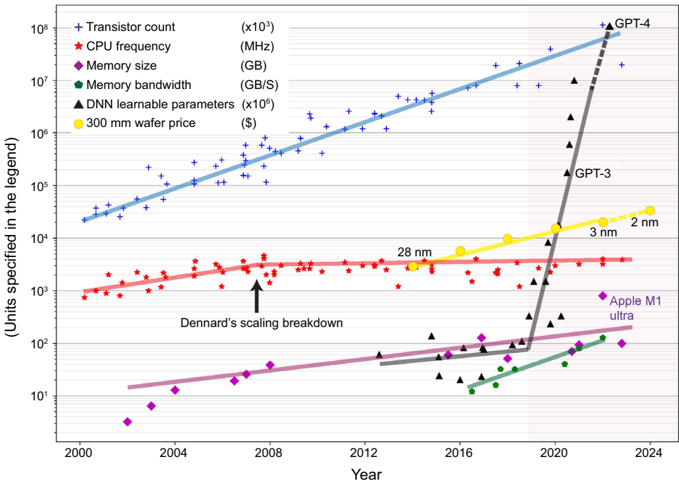
“Transistors in arithmetic logic units and memory circuits have both gone through this miniaturization, yet at different rates [18] (purple vs. blue curve in Fig.”
BackgroundChallenges in materials and devices for resistive-switching-based neuromorphic computing
del Valle, J., Ramírez, J. G., Rozenberg, M. J., & Schuller, I. K. (2018) · Journal of Applied Physics · doi:10.1063/1.5047800 · Cited by 254
Wang, J., Wang, X., Eckert, C., Subramaniyan, A., Das, R., Blaauw, D., & Sylvester, D. (2020) · IEEE Journal of Solid-State Circuits · doi:10.1109/jssc.2019.2939682 · Cited by 244
Nonvolatile Memory Materials for Neuromorphic Intelligent Machines
Jeong, D. S., & Hwang, C. S. (2018) · Advanced Materials · doi:10.1002/adma.201704729 · Cited by 242
The Next Generation of Deep Learning Hardware: Analog Computing
Haensch, W., Gokmen, T., & Puri, R. (2019) · Proceedings of the IEEE · doi:10.1109/jproc.2018.2871057 · Cited by 235
Xue, C.-X., Huang, T.-Y., Liu, J.-S., Chang, T.-W., Kao, H.-Y., Wang, J.-H., Liu, T.-W., Wei, S.-Y., Huang, S.-P., Wei, W.-C., et al. (2020) · 2020 IEEE International Solid- State Circuits Conference - (ISSCC) · doi:10.1109/isscc19947.2020.9063078 · Cited by 230
Classification using hyperdimensional computing: a review
Ge, L., & Parhi, K. K. (2020) · IEEE Circuits and Systems Magazine · doi:10.1109/mcas.2020.2988388 · Cited by 227
Electric-field-driven dual-functional molecular switches in tunnel junctions
Han, Y., Nickle, C., Zhang, Z., Astier, H. P. A. G., Duffin, T. J., Qi, D., Wang, Z., del Barco, E., Thompson, D., & Nijhuis, C. A. (2020) · Nature Materials · doi:10.1038/s41563-020-0697-5 · Cited by 227
Deep learning and alternative learning strategies for retrospective real-world clinical data
Chen, D., Liu, S., Kingsbury, P., Sohn, S., Storlie, C. B., Habermann, E. B., Naessens, J. M., Larson, D. W., & Liu, H. (2019) · npj Digital Medicine · doi:10.1038/s41746-019-0122-0 · Cited by 223
On-chip silicon photonic signaling and processing: a review
Wang, J., & Long, Y. (2018) · Science Bulletin · doi:10.1016/j.scib.2018.05.038 · Cited by 206
Photonic tensor cores for machine learning
Miscuglio, M., & Sorger, V. J. (2020) · Applied Physics Reviews · doi:10.1063/5.0001942 · Cited by 206
Superconducting Optoelectronic Circuits for Neuromorphic Computing
Shainline, J. M., Buckley, S. M., Mirin, R. P., & Nam, S. W. (2017) · Physical Review Applied · doi:10.1103/physrevapplied.7.034013 · Cited by 205
Scalable reservoir computing on coherent linear photonic processor
Nakajima, M., Tanaka, K., & Hashimoto, T. (2021) · Communications Physics · doi:10.1038/s42005-021-00519-1 · Cited by 203
Frenkel, C., Bol, D., & Indiveri, G. (2023) · Proceedings of the IEEE · doi:10.1109/jproc.2023.3273520 · Cited by 198
In-memory Learning with Analog Resistive Switching Memory: A Review and Perspective
Xi, Y., Gao, B., Tang, J., Chen, A., Chang, M.-F., Hu, X. S., Spiegel, J. V. D., Qian, H., & Wu, H. (2021) · Proceedings of the IEEE · doi:10.1109/jproc.2020.3004543 · Cited by 196
Human action recognition with a large-scale brain-inspired photonic computer
Antonik, P., Marsal, N., Brunner, D., & Rontani, D. (2019) · Nature Machine Intelligence · doi:10.1038/s42256-019-0110-8 · Cited by 177
A Theoretical Perspective on Hyperdimensional Computing
Thomas, A. H., Dasgupta, S., & Rosing, T. (2021) · Journal of Artificial Intelligence Research · doi:10.1613/jair.1.12664 · Cited by 175
The promise of spintronics for unconventional computing
Finocchio, G., Di Ventra, M., Camsari, K. Y., Everschor-Sitte, K., Khalili Amiri, P., & Zeng, Z. (2021) · Journal of Magnetism and Magnetic Materials · doi:10.1016/j.jmmm.2020.167506 · Cited by 173
Yin, S., Sun, X., Yu, S., & Seo, J.-S. (2020) · IEEE Transactions on Electron Devices · doi:10.1109/ted.2020.3015178 · Cited by 171
Pathways to efficient neuromorphic computing with non-volatile memory technologies
Chakraborty, I., Jaiswal, A., Saha, A. K., Gupta, S. K., & Roy, K. (2020) · Applied Physics Reviews · doi:10.1063/1.5113536 · Cited by 168
Computational phase-change memory: beyond von Neumann computing
Sebastian, A., Gallo, M. L., & Eleftheriou, E. S. (2019) · Journal of Physics D Applied Physics · doi:10.1088/1361-6463/ab37b6 · Cited by 167
Thraskias, C. A., Lallas, E. N., Neumann, N., Schares, L., Offrein, B. J., Henker, R., Plettemeier, D., Ellinger, F., Leuthold, J., & Tomkos, I. (2018) · IEEE Communications Surveys & Tutorials · doi:10.1109/comst.2018.2839672 · Cited by 165
Opportunities in Quantum Reservoir Computing and Extreme Learning Machines
Mujal, P., Martínez‐Peña, R., Nokkala, J., García‐Beni, J., Giorgi, G. L., Soriano, M. C., & Zambrini, R. (2021) · Advanced Quantum Technologies · doi:10.1002/qute.202100027 · Cited by 163
Electronic-photonic arithmetic logic unit for high-speed computing
Ying, Z., Feng, C., Zhao, Z., Dhar, S., Dalir, H., Gu, J., Cheng, Y., Soref, R., Pan, D. Z., & Chen, R. T. (2020) · Nature Communications · doi:10.1038/s41467-020-16057-3 · Cited by 159
Magnetic skyrmions for unconventional computing
Li, S., Kang, W., Zhang, X., Nie, T., Zhou, Y., Wang, K. L., & Zhao, W. S. (2021) · Materials Horizons · doi:10.1039/d0mh01603a · Cited by 159
Quantum neuromorphic computing
Marković, D., & Grollier, J. (2020) · Applied Physics Letters · doi:10.1063/5.0020014 · Cited by 158
In‐Materio Reservoir Computing in a Sulfonated Polyaniline Network
Usami, Y., van de Ven, B., Mathew, D. G., Chen, T., Kotooka, T., Kawashima, Y., Tanaka, Y., Otsuka, Y., Ohoyama, H., Tamukoh, H., et al. (2021) · Advanced Materials · doi:10.1002/adma.202102688 · Cited by 142
Self-citationKleyko, D., Rachkovskij, D., Osipov, E., & Rahimi, A. (2023) · ACM Computing Surveys · doi:10.1145/3558000 · Cited by 141
Novel Electronics for Flexible and Neuromorphic Computing
Lee, H. E., Park, J. H., Kim, T., Im, D., Shin, J. H., Kim, D. H., Mohammad, B. S., Kang, I., & Lee, K. J. (2018) · Advanced Functional Materials · doi:10.1002/adfm.201801690 · Cited by 140
Neuromorphic Computing with Memristor Crossbar
Zhang, X., Huang, A., Hu, Q., Xiao, Z., & Chu, P. K.-H. (2018) · physica status solidi (a) · doi:10.1002/pssa.201700875 · Cited by 138
Li, H., Wu, T. F., Rahimi, A., Li, K.-S., Rusch, M., Lin, C.-H., Hsu, J.-L., Sabry, M. M., Eryilmaz, S. B., Sohn, J., et al. (2016) · 2016 IEEE International Electron Devices Meeting (IEDM) · doi:10.1109/iedm.2016.7838428 · Cited by 136 · cited 1×
“Therefore, in-memory computing is widely studied as an energy-efficient approach for hyperdimensional computing [135, 140–142].”
MethodHung, J.-M., Xue, C.-X., Kao, H.-Y., Huang, Y.-H., Chang, F.-C., Huang, S.-P., Liu, T.-W., Jhang, C.-J., Su, C.-I., Khwa, W.-S., et al. (2021) · Nature Electronics · doi:10.1038/s41928-021-00676-9 · Cited by 135
Emerging dynamic memristors for neuromorphic reservoir computing
Cao, J., Zhang, X., Cheng, H., Qiu, J., Liu, X., Wang, M., & Liu, Q. (2022) · Nanoscale · doi:10.1039/d1nr06680c · Cited by 134
Near-memory computing: Past, present, and future
Singh, G., Chelini, L., Corda, S., Awan, A. J., Stuijk, S., Jordans, R., Corporaal, H., & Boonstra, A. (2019) · Microprocessors and Microsystems · doi:10.1016/j.micpro.2019.102868 · Cited by 132
Toward a formal theory for computing machines made out of whatever physics offers
Jaeger, H., Noheda, B., & van der Wiel, W. G. (2023) · Nature Communications · doi:10.1038/s41467-023-40533-1 · Cited by 130
Self-citationLead federated neuromorphic learning for wireless edge artificial intelligence
Yang, H., Lam, K.-Y., Xiao, L., Xiong, Z., Hu, H., Niyato, D., & Vincent Poor, H. (2022) · Nature Communications · doi:10.1038/s41467-022-32020-w · Cited by 127
Submilliwatt thermo-optic switches using free-standing silicon-on-insulator strip waveguides
Sun, P., & Reano, R. M. (2010) · Optics Express · doi:10.1364/oe.18.008406 · Cited by 124
Zhang, Y., Xu, L., Dong, Q., Wang, J., Blaauw, D., & Sylvester, D. (2018) · IEEE Journal of Solid-State Circuits · doi:10.1109/jssc.2017.2776302 · Cited by 123
Alexoudi, T., Terzenidis, N., Pitris, S., Moralis‐Pegios, M., Maniotis, P., Vagionas, C., Mitsolidou, C., Mourgias-Alexandris, G., Kanellos, G. T., Miliou, A. N., et al. (2019) · Journal of Lightwave Technology · doi:10.1109/jlt.2018.2875995 · Cited by 123
Memristor-Based Artificial Chips
Sun, B. T., Chen, Y., Zhou, G., Cao, Z., Yang, C. S., Du, J., Chen, X., & Shao, J. (2023) · ACS Nano · doi:10.1021/acsnano.3c07384 · Cited by 123
A Review of Near-Memory Computing Architectures: Opportunities and Challenges
Singh, G., Chelini, L., Corda, S., Awan, A. J., Stuijk, S., Jordans, R., Corporaal, H., & Boonstra, A. (2018) · Euromicro Conference on Digital System Design (DSD) · doi:10.1109/dsd.2018.00106 · Cited by 122 · cited 1×
“References [55] and [56] classify computing platforms based on the memory access types, whether processing units are far , near , or in the memory.”
BackgroundAll-Optical Reservoir Computing on a Photonic Chip Using Silicon-Based Ring Resonators
Coarer, F. D.-L., Sciamanna, M., Katumba, A., Freiberger, M., Dambre, J., Bienstman, P., & Rontani, D. (2018) · IEEE Journal of Selected Topics in Quantum Electronics · doi:10.1109/jstqe.2018.2836985 · Cited by 119
Xue, C.-X., Chen, W.-H., Liu, J.-S., Li, J.-F., Lin, W.-Y., Lin, W.-E., Wang, J.-H., Wei, W.-C., Huang, T.-Y., Chang, T.-W., et al. (2020) · IEEE Journal of Solid-State Circuits · doi:10.1109/jssc.2019.2951363 · Cited by 113
In-Memory Computing with Resistive Memory Circuits: Status and Outlook
Pedretti, G., & Ielmini, D. (2021) · Electronics · doi:10.3390/electronics10091063 · Cited by 113
Silicon Photonic Phase Shifters and Their Applications: A Review
Sun, H., Qiao, Q., Guan, Q., & Zhou, G. (2022) · Micromachines · doi:10.3390/mi13091509 · Cited by 111
Brain-inspired computing via memory device physics
Ielmini, D., Wang, Z., & Liu, Y. (2021) · APL Materials · doi:10.1063/5.0047641 · Cited by 110
S2TA: Exploiting Structured Sparsity for Energy-Efficient Mobile CNN Acceleration
Liu, Z.-G., Whatmough, P. N., Zhu, Y., & Mattina, M. (2022) · 2022 IEEE International Symposium on High-Performance Computer Architecture (HPCA) · doi:10.1109/hpca53966.2022.00049 · Cited by 109 · cited 1×
“In terms of computational model development, various approaches, such a e-mail: W.G.vanderWiel@utwente.nl (corresponding author) as efficient deep learning [9], neural architecture search [10], and benefiting from sparsity in matrix multiplications [11], have been studied.”
BackgroundA 4 + 2T SRAM for Searching and In-Memory Computing With 0.3-V $V_{\mathrm {DDmin}}$
Dong, Q., Jeloka, S., Saligane, M., Kim, Y., Kawaminami, M., Harada, A., Miyoshi, S., Yasuda, M., Blaauw, D. T., & Sylvester, D. (2017) · IEEE Journal of Solid-State Circuits · doi:10.1109/jssc.2017.2776309 · Cited by 107
QuantHD: A Quantization Framework for Hyperdimensional Computing
Imani, M., Bosch, S., Datta, S., Ramakrishna, S., Salamat, S., Rabaey, J. M., & Rosing, T. (2020) · IEEE Transactions on Computer-Aided Design of Integrated Circuits and Systems · doi:10.1109/tcad.2019.2954472 · Cited by 105
An Overview of Processing-in-Memory Circuits for Artificial Intelligence and Machine Learning
Kim, D., Yu, C., Xie, S., Chen, Y., Kim, J.-Y., Kim, B., Kulkarni, J. P., & Kim, T. T.-H. (2022) · IEEE Journal on Emerging and Selected Topics in Circuits and Systems · doi:10.1109/jetcas.2022.3160455 · Cited by 104
Computing in memory with FeFETs
Reis, D., Niemier, M., & Hu, X. S. (2018) · Proceedings of the International Symposium on Low Power Electronics and Design · doi:10.1145/3218603.3218640 · Cited by 102 · cited 1×
“We chose this standard because 8-bit integer operations, or even fewer bits [219, 221], offer sufficient precision for training and deploying neural networks across diverse applications.”
MethodA review on morphotropic phase boundary in fluorite-structure hafnia towards DRAM technology
Jung, M., Gaddam, V., & Jeon, S. (2022) · Nano Convergence · doi:10.1186/s40580-022-00333-7 · Cited by 100
Classification with a disordered dopant-atom network in silicon
Chen, T., van Gelder, J., van de Ven, B., Amitonov, S. V., de Wilde, B., Ruiz Euler, H.-C., Broersma, H., Bobbert, P. A., Zwanenburg, F. A., & van der Wiel, W. G. (2020) · Nature · doi:10.1038/s41586-019-1901-0 · Cited by 95
Self-citationSearcHD: A Memory-Centric Hyperdimensional Computing With Stochastic Training
Imani, M., Yin, X., Messerly, J., Gupta, S., Niemier, M., Hu, X. S., & Rosing, T. (2020) · IEEE Transactions on Computer-Aided Design of Integrated Circuits and Systems · doi:10.1109/tcad.2019.2952544 · Cited by 87
A Survey of Neuromorphic Computing-in-Memory: Architectures, Simulators, and Security
Staudigl, F., Merchant, F., & Leupers, R. (2021) · IEEE Design and Test · doi:10.1109/mdat.2021.3102013 · Cited by 83
SuperMind: a survey of the potential of superconducting electronics for neuromorphic computing
Schneider, M. L., Toomey, E., Rowlands, G. E., Shainline, J. M., Tschirhart, P., & Segall, K. (2022) · Superconductor Science and Technology · doi:10.1088/1361-6668/ac4cd2 · Cited by 83
Vesti: Energy-Efficient In-Memory Computing Accelerator for Deep Neural Networks
Yin, S., Jiang, Z., Kim, M., Gupta, T., Seok, M., & Seo, J.-S. (2019) · IEEE Transactions on Very Large Scale Integration (VLSI) Systems · doi:10.1109/tvlsi.2019.2940649 · Cited by 81
FPGA based spike-time dependent encoder and reservoir design in neuromorphic computing processors
Yi, Y., Liao, Y., Wang, B., Fu, X., Shen, F., Hou, H., & Liu, L. (2016) · Microprocessors and Microsystems · doi:10.1016/j.micpro.2016.03.009 · Cited by 79
Long Short-Term Memory Network Design for Analog Computing
Zhao, Z., Srivastava, A., Peng, L., & Chen, Q. (2019) · ACM Journal on Emerging Technologies in Computing Systems · doi:10.1145/3289393 · Cited by 79
Photonic Matrix Computing: From Fundamentals to Applications
Cheng, J., Zhou, H., & Dong, J. (2021) · Nanomaterials · doi:10.3390/nano11071683 · Cited by 76
Jain, S., Tsai, H., Chen, C.-T., Muralidhar, R., Boybat, I., Frank, M. M., Woźniak, S., Stanisavljevic, M., Adusumilli, P., Narayanan, P., et al. (2023) · IEEE Transactions on Very Large Scale Integration (VLSI) Systems · doi:10.1109/tvlsi.2022.3221390 · Cited by 76
Bit Parallel 6T SRAM In-memory Computing with Reconfigurable Bit-Precision
Lee, K., Jeong, J., Cheon, S., Choi, W., & Park, J. (2020) · ACM/IEEE Design Automation Conference (DAC) · doi:10.1109/dac18072.2020.9218567 · Cited by 75
RNSnet: In-Memory Neural Network Acceleration Using Residue Number System
Salamat, S., Imani, M., Gupta, S., & Rosing, T. (2018) · IEEE International Conference on Rebooting Computing (ICRC) · doi:10.1109/icrc.2018.8638592 · Cited by 74
Liu, X., Mao, M., Liu, B., Li, B., Wang, Y., Jiang, H., Barnell, M., Wu, Q., Yang, J., Li, H., et al. (2016) · IEEE Transactions on Circuits and Systems I: Regular Papers · doi:10.1109/tcsi.2016.2529279 · Cited by 72
Mao, R., Wen, B., Kazemi, A., Zhao, Y., Laguna, A. F., Lin, R., Wong, N., Niemier, M., Hu, X. S., Sheng, X., et al. (2022) · Nature Communications · doi:10.1038/s41467-022-33629-7 · Cited by 71
Fast Stencil-Code Computation on a Wafer-Scale Processor
Rocki, K., Essendelft, D. T. V., Sharapov, I., Schreiber, R., Morrison, M., Kibardin, V., Portnoy, A., Dietiker, J.-F., Syamlal, M., & James, M. (2020) · International Conference for High Performance Computing, Networking, Storage and Analysis (SC) · doi:10.1109/sc41405.2020.00062 · Cited by 70 · cited 1×
“…part to the breakthroughs in parallel processing achieved by graphics processing units (GPUs) and, more recently by specialized hardware accelerators, such as wafer-scale chips [14], application-specific integrated circuit (ASIC) hardware accelerators [12, 13], and tensor processing units [15–17].”
Background2-Bit-Per-Cell RRAM-Based In-Memory Computing for Area-/Energy-Efficient Deep Learning
He, W., Yin, S., Kim, Y., Sun, X., Kim, J.-J., Yu, S., & Seo, J.-S. (2020) · IEEE Solid-State Circuits Letters · doi:10.1109/lssc.2020.3010795 · Cited by 67
Neuromorphic computing enabled by physics of electron spins: Prospects and perspectives
Sengupta, A., & Roy, K. (2018) · Applied Physics Express · doi:10.7567/apex.11.030101 · Cited by 65
A deep-learning approach to realizing functionality in nanoelectronic devices
Ruiz Euler, H.-C., Boon, M. N., Wildeboer, J. T., van de Ven, B., Chen, T., Broersma, H., Bobbert, P. A., & van der Wiel, W. G. (2020) · Nature Nanotechnology · doi:10.1038/s41565-020-00779-y · Cited by 65
Self-citationReal-Time Reservoir Computing Network-Based Systems for Detection Tasks on Visual Contents
Jalalvand, A., Van Wallendael, G., & Van De Walle, R. (2015) · 2015 7th International Conference on Computational Intelligence, Communication Systems and Networks · doi:10.1109/cicsyn.2015.35 · Cited by 63 · cited 1×
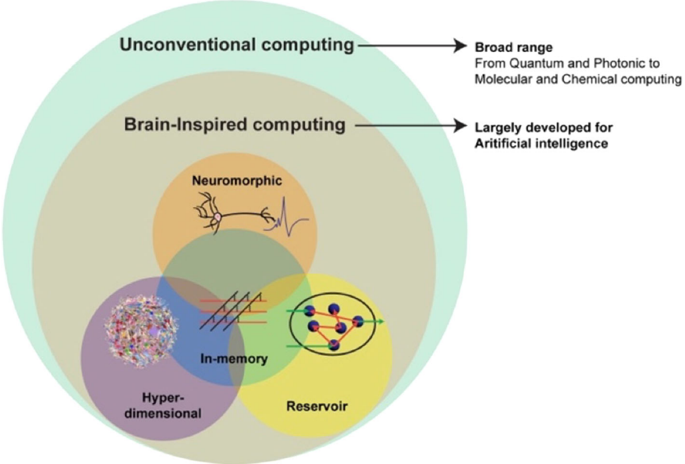
“However, it is assumed that the recurrent connections as well as the (variable) time delay between different nodes causes high-dimensional input mapping [126].”
BackgroundHyper-Dimensional Computing Challenges and Opportunities for AI Applications
Hassan, E., Halawani, Y., Mohammad, B., & Saleh, H. (2022) · IEEE Access · doi:10.1109/access.2021.3059762 · Cited by 61
The Path to Successful Wafer-Scale Integration: The Cerebras Story
Lauterbach, G. (2021) · IEEE Micro · doi:10.1109/mm.2021.3112025 · Cited by 60
Neuromorphic Computing Using Emerging Synaptic Devices: A Retrospective Summary and an Outlook
Park, J. (2020) · Electronics · doi:10.3390/electronics9091414 · Cited by 59
In‐Memory Stateful Logic Computing Using Memristors: Gate, Calculation, and Application
Xu, N., Park, T., Yoon, K. J., & Hwang, C. S. (2021) · physica status solidi (RRL) - Rapid Research Letters · doi:10.1002/pssr.202100208 · Cited by 59
Data-Centric Computing Frontiers: A Survey On Processing-In-Memory
Siegl, P., Buchty, R., & Berekovic, M. (2016) · Proceedings of the Second International Symposium on Memory Systems · doi:10.1145/2989081.2989087 · Cited by 55
Angizi, S., & Fan, D. (2019) · ACM Great Lakes Symposium on VLSI (GLSVLSI) · doi:10.1145/3299874.3317984 · Cited by 54
Applications of Metaheuristics in Reservoir Computing Techniques: A Review
Bala, A., Ismail, I., Ibrahim, R., & Sait, S. M. (2018) · IEEE Access · doi:10.1109/access.2018.2873770 · Cited by 53
Superconducting optoelectronic single-photon synapses
Khan, S., Primavera, B. A., Chiles, J., McCaughan, A. N., Buckley, S. M., Tait, A. N., Lita, A. E., Biesecker, J. P., Fox, A. E., Olaya, D. I., et al. (2022) · Nature Electronics · doi:10.1038/s41928-022-00840-9 · Cited by 53
Ni, L., Wang, Y., Yu, H., Yang, W., Weng, C., & Zhao, J. (2016) · 2016 21st Asia and South Pacific Design Automation Conference (ASP-DAC) · doi:10.1109/aspdac.2016.7428024 · Cited by 52
Solving the big computing problems in the twenty-first century
Conklin, A. A., & Kumar, S. (2023) · Nature Electronics · doi:10.1038/s41928-023-00985-1 · Cited by 51
Reverse engineering the cognitive brain
Cauwenberghs, G. (2013) · Proceedings of the National Academy of Sciences · doi:10.1073/pnas.1313114110 · Cited by 50
Distributed In-Memory Computing on Binary RRAM Crossbar
Ni, L., Huang, H., Liu, Z., Joshi, R. V., & Yu, H. (2017) · ACM Journal on Emerging Technologies in Computing Systems · doi:10.1145/2996192 · Cited by 49
An Efficient Heterogeneous Memristive xnor for In-Memory Computing
Lebdeh, M. A., Abunahla, H., Mohammad, B. S., & Al‐Qutayri, M. (2017) · IEEE Transactions on Circuits and Systems I Regular Papers · doi:10.1109/tcsi.2017.2706299 · Cited by 49
Compact oscillation neuron exploiting metal-insulator-transition for neuromorphic computing
Chen, P.-Y., Seo, J.-S., Cao, Y. K., & Yu, S. (2016) · doi:10.1145/2966986.2967015 · Cited by 48
AI Chips: What They Are and Why They Matter
Center for Security and Emerging Technology, Khan, S., & Mann, A. (2020) · doi:10.51593/20190014 · Cited by 47 · cited 1×
“[23, 27, 28] Year ( U n i t s s pe c i f i ed i n t he l egend ) Fig.”
BackgroundHielM: Highly flexible in-memory computing using STT MRAM
Parveen, F., He, Z., Angizi, S., & Fan, D. (2018) · Asia and South Pacific Design Automation Conference (ASP-DAC) · doi:10.1109/aspdac.2018.8297350 · Cited by 46
High write endurance up to 1012 cycles in a spin current-type magnetic memory array
Shiokawa, Y., Komura, E., Ishitani, Y., Tsumita, A., Suda, K., Kakinuma, Y., & Sasaki, T. (2019) · AIP Advances · doi:10.1063/1.5079917 · Cited by 43
Ferroelectric Hafnium Oxide Films for In‐Memory Computing Applications
Li, Z., Wang, T., Yu, J., Meng, J., Liu, Y., Zhu, H., Sun, Q., Zhang, D. W., & Chen, L. (2022) · Advanced Electronic Materials · doi:10.1002/aelm.202200951 · Cited by 42
Luan, E., Yu, S., Salmani, M., Nezami, M. S., Shastri, B. J., Chrostowski, L., & Eshaghi, A. (2023) · Scientific Reports · doi:10.1038/s41598-023-27724-y · Cited by 42
In-Memory Computing with Spintronic Devices
Fan, D., Angizi, S., & He, Z. (2017) · IEEE Computer Society Annual Symposium on VLSI · doi:10.1109/isvlsi.2017.116 · Cited by 41
Exploring a SOT-MRAM Based In-Memory Computing for Data Processing
He, Z., Zhang, Y., Angizi, S., et al. (2018) · IEEE Transactions on Multi-Scale Computing Systems · doi:10.1109/tmscs.2018.2836967 · Cited by 41
Deep In-Memory Architectures in SRAM: An Analog Approach to Approximate Computing
Kang, M., Gonugondla, S. K., & Shanbhag, N. R. (2020) · Proceedings of the IEEE · doi:10.1109/jproc.2020.3034117 · Cited by 41
Pedretti, G., Ambrosi, E., & Ielmini, D. (2021) · 2021 IEEE International Reliability Physics Symposium (IRPS) · doi:10.1109/irps46558.2021.9405130 · Cited by 39 · cited 1×
“Related challenges are achieving higher computational precision [50, 51], inherent stochastic switching of devices and their impacts on reliability [52, 53], and levels of parallelism [54].”
BackgroundExploring STT-MRAM Based In-Memory Computing Paradigm with Application of Image Edge Extraction
He, Z., Angizi, S., & Fan, D. (2017) · Proceedings, IEEE International Conference on Computer Design/Proceedings - IEEE International Conference on Computer Design · doi:10.1109/iccd.2017.78 · Cited by 38
Metal chalcogenides for neuromorphic computing: emerging materials and mechanisms
Bauers, S. R., Tellekamp, M. B., Roberts, D. M., Hammett, B., Lany, S., Ferguson, A. J., Zakutayev, A., & Nanayakkara, S. U. (2021) · Nanotechnology · doi:10.1088/1361-6528/abfa51 · Cited by 38
SRAM-Based Computing-in-Memory Macro With Fully Parallel One-Step Multibit Computation
Choi, E. J., Choi, I., Jeon, C., Yun, G., Yi, D., Ha, S., Chang, I., & Je, M. (2022) · IEEE Solid-State Circuits Letters · doi:10.1109/lssc.2022.3206416 · Cited by 31
Neuromorphic Processors with Memristive Synapses: Synaptic Interface and Architectural Exploration
Wang, Q., Kim, Y., & Li, P. (2016) · ACM Journal on Emerging Technologies in Computing Systems · doi:10.1145/2894756 · Cited by 30
Parallel matrix multiplication on memristor-based computation-in-memory architecture
Haron, M. A., Yu, J., Nane, R., Taouil, M., Hamdioui, S., & Bertels, K. (2016) · International Conference on High Performance Computing & Simulation (HPCS) · doi:10.1109/hpcsim.2016.7568411 · Cited by 30
Processing data where it makes sense in modern computing systems: Enabling in-memory computation
Mutlu, O. (2018) · 2018 7th Mediterranean Conference on Embedded Computing (MECO) · doi:10.1109/meco.2018.8405955 · Cited by 30
Moore's law and price trends of digital products: the case of smartphones
Feng, J., & Yu, K. (2019) · Economics of Innovation and New Technology · doi:10.1080/10438599.2019.1628509 · Cited by 28
Approximate Memristive In-memory Computing
Yantır, H. E., Eltawil, A. M., & Kurdahi, F. (2017) · ACM Transactions on Embedded Computing Systems · doi:10.1145/3126526 · Cited by 27
On the Reliability of In-Memory Computing: Impact of Temperature on Ferroelectric TCAM
Thomann, S., Li, C., Zhuo, C., Prakash, O., Yin, X., Hu, X. S., & Amrouch, H. (2021) · 2021 IEEE 39th VLSI Test Symposium (VTS) · doi:10.1109/vts50974.2021.9441038 · Cited by 24 · cited 1×
“Related challenges are achieving higher computational precision [50, 51], inherent stochastic switching of devices and their impacts on reliability [52, 53], and levels of parallelism [54].”
BackgroundAn In-memory-Computing DNN Achieving 700 TOPS/W and 6 TOPS/mm2 in 130-nm CMOS
Zhang, J., & Verma, N. (2019) · IEEE Journal on Emerging and Selected Topics in Circuits and Systems · doi:10.1109/jetcas.2019.2912352 · Cited by 23
IMC: energy-efficient in-memory convolver for accelerating binarized deep neural network
Angizi, S., & Fan, D. (2017) · doi:10.1145/3183584.3183613 · Cited by 21
A novel ReRAM-based processing-in-memory architecture for graph computing
Han, L., Shen, Z., Shao, Z., Huang, H. H., & Li, T. (2017) · IEEE Non-Volatile Memory Systems and Applications Symposium (NVMSA) · doi:10.1109/nvmsa.2017.8064464 · Cited by 18
Gradient descent-based programming of analog in-memory computing cores
Büchel, J., Vasilopoulos, A., Kersting, B., Odermatt, F., Brew, K., Ok, I., Choi, S., Saraf, I., Chan, V., Philip, T., et al. (2022) · 2022 International Electron Devices Meeting (IEDM) · doi:10.1109/iedm45625.2022.10019486 · Cited by 18
Jamshidi, V. (2020) · IEEE Transactions on Very Large Scale Integration (VLSI) Systems · doi:10.1109/tvlsi.2020.2997369 · Cited by 16
Zanotti, T., Puglisi, F. M., & Pavan, P. (2021) · Journal of Low Power Electronics and Applications · doi:10.3390/jlpea11030029 · Cited by 14
Hopping-Transport Mechanism for Reconfigurable Logic in Disordered Dopant Networks
Tertilt, H., Bakker, J., Becker, M., de Wilde, B., Klanberg, I., Geurts, B. J., van der Wiel, W. G., Heuer, A., & Bobbert, P. A. (2022) · Physical Review Applied · doi:10.1103/physrevapplied.17.064025 · Cited by 8
Stochastic CBRAM-Based Neuromorphic Time Series Prediction System
Merkel, C. E., Kudithipudi, D., Suri, M., & Wysocki, B. T. (2017) · ACM Journal on Emerging Technologies in Computing Systems · doi:10.1145/2996193 · Cited by 5
On-chip Parallel Photonic Reservoir Computing using Multiple Delay Lines
Hasnain, S. A., & Mahapatra, R. (2020) · International Symposium on Computer Architecture and High Performance Computing (SBAC-PAD) · doi:10.1109/sbac-pad49847.2020.00015 · Cited by 4
Woo, J. (2021) · 2021 IEEE International Symposium on Circuits and Systems (ISCAS) · doi:10.1109/iscas51556.2021.9401627 · Cited by 4 · cited 2×
“The in-memory computing core relies on memristive devices such as phase-change memory (PCM) [44] and ferroelectric [45] memory cells, which are programmed to maintain a spe-cific conductance over an extended period.”
BackgroundAnalog Neural Networks With Deep-Submicrometer Nonlinear Synapses
Yüzügüler, A. C., Çelik, F., Drumond, M. P., Falsafi, B., & Pascal Frossard, B. (2019) · IEEE Micro · doi:10.1109/mm.2019.2931182 · Cited by 3
Hart, R. (2018) · SecEd · doi:10.12968/sece.2018.4.11 · Cited by 3
Phase-Change Memory: Device Physics and Application to non-von Neumann Computing
Le Gallo, M. (2017) · ETH Zurich · doi:10.3929/ethz-b-000250342 · Cited by 2 · cited 2×
“The in-memory computing core relies on memristive devices such as phase-change memory (PCM) [44] and ferroelectric [45] memory cells, which are programmed to maintain a spe-cific conductance over an extended period.”
BackgroundDopant network processing units as tuneable extreme learning machines
van de Ven, B., Alegre-Ibarra, U., Lemieszczuk, P. J., Bobbert, P. A., Ruiz Euler, H.-C., & van der Wiel, W. G. (2023) · Frontiers in Nanotechnology · doi:10.3389/fnano.2023.1055527 · Cited by 2
Self-citationBeyond von Neumann Era: Brain-Inspired Hyperdimensional Computing to the Rescue
Amrouch, H., Genssler, P. R., Imani, M., Issa, M., Jiao, X., Mohammad, W., Sepanta, G., & Wang, R. (2023) · Proceedings of the 28th Asia and South Pacific Design Automation Conference · doi:10.1145/3566097.3568354 · Cited by 1
Research works printed but not linked: 36
- A. Morán, V. Canals, F. Galan-Prado, C.F. Frasser, D. Radhakrishnan, S. Safavi et al., Cogn. Comput. 1, 1–9 (2021)
- R. David, J. Duke, A. Jain, V. Janapa Reddi, N. Jeffries, J. Li et al., Proc. Mach. Learn. Syst. 3, 800 (2021)
- B. Zoph, Q. V. Le, arXiv preprint https://arXiv.org/1611.01578 (2016)
- Ziegler, M., Mussenbrock, T., & Kohlstedt, H.: Springer Nature, 2024.
- A. Adamatzky, vol 22, Springer (2016) H. Jaeger, B. Noheda, W.G. van Der Wiel, Nat. Commun. 14(1), 4911 (2023) ADS Google Scholar Y. Han, C. Nickle, Z. Zhang, H.P. Astier, T.J. Duffin, D. Qi et al., Nat. Mater. 19(8), 843 (2020) ADS Google Scholar L.S. Madsen, F. Laudenbach, M.F. Askarani, F. Rortais, T. Vincent, J.F. Bulmer et al., Nature 606(7912), 75 (2022) ADS Google Scholar
- D. Melanson, M. A. Khater, M. Aifer, K. Donatella, M. H. Gordon, T. Ahle et al., arXiv preprint https://arXiv.org/2312.04836 (2023)
- O. Mutlu, S. Ghose, J. Gómez-Luna, R. Ausavarungnirun, A modern primer on processing in memory, in Emerging computing: from devices to systems: looking beyond Moore and Von Neumann. (Springer, 2022), p.171
- Y. Li, Z. Wang, R. Midya, Q. Xia, J.J. Yang, J. Phys. D Appl. Phys. 51(50), 503002 (2018)
- Z. Li, T. Wang, J. Yu, J. Meng, Y. Liu, H. Zhu et al., Adv. Electron. Mater. 8, 2200951 (2022) Google Scholar N. Xu, T. Park, K.J. Yoon, C.S. Hwang, Phys. Status Solidi (RRL) Rapid Res. Lett. 15(9), 2100208 (2021) ADS Google Scholar NVIDIA A100 TENSOR CORE GPU [White paper]. 3 (2021) G. Van der Sande, D. Brunner, M.C. Soriano, Nanophotonics 6(3), 561 (2017) Google Scholar M. Davies, A. Wild, G. Orchard, Y. Sandamirskaya, G.A.F. Guerra, P. Joshi et al., Proc. IEEE 109(5), 911 (2021) Google Scholar W.C. Abraham, O.D. Jones, D.L. Glanzman, NPJ Sci. Learn. 4(1), 9 (2019) Google Scholar F.A. Azevedo, L.R. Carvalho, L.T. Grinberg, J.M. Farfel, R.E. Ferretti, R.E. Leite et al., J. Comp. Neurol. 513(5), 532 (2009) Google Scholar K. Roy, A. Jaiswal, P. Panda, Nature 575(7784), 607 (2019) ADS Google Scholar E. Bullmore, O. Sporns, Nat. Rev. Neurosci. 13(5), 336 (2012) Google Scholar G.W. Burr, R.M. Shelby, A. Sebastian, S. Kim, S. Kim, S. Sidler et al., Adv. Phys. X 2(1), 89 (2017) Google Scholar
- F. Ottati, C. Gao, Q. Chen, G. Brignone, M. R. Casu, J. K. Eshraghian et al. arXiv preprint https://arXiv.org/2306.15749 (2023)
- L. Wang, X. Fang, D. Liu, S. Duan, Front. Neurosci. 374, 853010 (2022)
- J.-Q. Yang, R. Wang, Z.-P. Wang, Q.-Y. Ma, J.-Y. Mao, Y. Ren et al., Nano Energy 74, 104828 (2020)
- C.D. James, J.B. Aimone, N.E. Miner, C.M. Vineyard, F.H. Rothganger, K.D. Carlson et al., Biol. Inspired Cogn. Architect. 19, 49 (2017)
- C.-H. Kim, S. Lim, S.Y. Woo, W.-M. Kang, Y.-T. Seo, S.-T. Lee et al., Nanotechnology 30(3), 032001 (2018)
- Y. Shimeng, Proc. IEEE 106, 260 (2018) · DOI · Paper page
- Y. Zhang, Z. Wang, J. Zhu, Y. Yang, M. Rao, W. Song et al., Appl. Phys. Rev. 7(1), 011308 (2020)
- S. Oh, H. Hwang, I. Yoo, APL Mater. 7(9), 091109 (2019)
- J. Cai, L. Zhang, B. Fang, W. Lv, B. Zhang, G. Finocchio et al., Appl. Phys. Lett. 114(19), 192402 (2019)
- Z. Kuncic, T. Nakayama, Adv. Phys.: X 6(1), 1894234 (2021)
- G. Cao, P. Meng, J. Chen, H. Liu, R. Bian, C. Zhu et al., Adv. Funct. Mater. 31(4), 2005443 (2021)
- B. Lu, Y. Xia, Y. Ren, M. Xie, L. Zhou, G. Vinai et al., Adv. Sci. 11, 2305277 (2024)
- R. Pascanu, T. Mikolov, Y. Bengio, On the difficulty of training recurrent neural networks. In: International conference on machine learning, p 1310 PMLR (2013)
- Jaeger, H. Advances in neural information processing systems, 15 (2002)
- T. Yu, Y. Zhang, Z. Zhang, C. De Sa, arXiv preprint https://arXiv.org/2202.04805 (2022)
- T. Chen, J. van Gelder, B. van de Ven, S.V. Amitonov, B. de Wilde, H.-C. Ruiz Euler et al., Nature 577(7790), 341 (2020) · DOI · Paper page
- U.A. Ibarra, H.-C.R. Euler, H.A. Mollah, B.P. Petrov, S.S. Sastry, M.N. Boon et al., J. Open Sourc. Softw. 8(90), 1 (2023)
- H.-C. Ruiz-Euler, U. Alegre-Ibarra, B. van de Ven, H.J. Broersma, P.A. Bobbert, W.G. van der Wiel, Neuromorph. Comput. Eng. 1(2), 024002 (2021)
- P. Mannocci, M. Farronato, N. Lepri, L. Cattaneo, A. Glukhov, Z. Sun et al., APL Mach. Learn. 1(1), 010902 (2023)
- M.T. Sharbati, Y. Du, J. Torres, N.D. Ardolino, M. Yun, F. Xiong, Adv. Mater. 30(36), 1802353 (2018)
- Y. Li, Z. Xuan, J. Lu, Z. Wang, X. Zhang, Z. Wu et al., Adv. Func. Mater. 31(26), 2100042 (2021)
- C. He, J. Tang, D.-S. Shang, J. Tang, Y. Xi, S. Wang et al., ACS Appl. Mater. Interfaces 12(10), 11945 (2020)
- A.M. Zyarah, K. Gomez, D. Kudithipudi, IEEE Trans. Comput. 69(8), 1099 (2020)
- A. Pullini, F. Conti, D. Rossi, I. Loi, M. Gautschi, L. Benini, IEEE Trans. Circ. Syst. II Express Briefs 65(8), 1094 (2017)
- I. Chakraborty, G. Saha, A. Sengupta, K. Roy, Sci. Rep. 8(1), 1 (2018)
- Y. Pan, P. Ouyang, Y. Zhao, W. Kang, S. Yin, Y. Zhang et al., IEEE Trans. Magn. 54(11), 1 (2018)
- S. Yin, Z. Jiang, J.-S. Seo, M. Seok, IEEE J. Solid-State Circ. 55(6), 1733 (2020)
Cited by
Mondal, I., Attri, R., Rao, T. S., Yadav, B., & Kulkarni, G. U. (2024) · Applied Physics Reviews · doi:10.1063/5.0220628 · Cited by 33
Physical reservoir computing: a tutorial
Stepney, S. (2024) · Natural Computing · doi:10.1007/s11047-024-09997-y · Cited by 57
“Zolfagharinejad et al. (2024) provide a wider review of physical neuromorphic computing.”
Halide perovskite photovoltaics for in-sensor reservoir computing
Sharma, D., Luqman, A., Ng, S. E., Yantara, N., Xing, X., Tay, Y. B., Basu, A., Chattopadhyay, A., & Mathews, N. (2024) · Nano Energy · doi:10.1016/j.nanoen.2024.109949 · Cited by 26
Analogue speech recognition based on physical computing
Zolfagharinejad, M., Büchel, J., Cassola, L., Kinge, S., Sarwat, S. G., Sebastian, A., & van der Wiel, W. G. (2025) · Nature · doi:10.1038/s41586-025-09501-1 · Cited by 40
“These difficulties have led to a growing interest in alternative, more efficient approaches 22,23 .”
Self-citationMajumdar, P. (2025) · Evolving Systems · doi:10.1007/s12530-025-09755-0 · Cited by 13
“In Zolfagharinejad et al. ( 2024), the promise of SNNs in cognitive computing is illustrated by discussing how neuromorphic systems, in conjunction with SNNs, integrate learning algorithms like STDP to enable real-time adaptation to novel tasks and contexts.”
Metadata
- Authors
- Zolfagharinejad, M., Alegre-Ibarra, U., Chen, T., Kinge, S., & van der Wiel, W. G.
- Affiliations
- University of Twente (NL)
- Toyota Motor Corporation (Belgium) (BE)
- Venue
- The European Physical Journal B
- Published
- 2024-06
- Volume
- 97
- Issue
- 6
- ISSN
- 1434-6028 (ISSN-L)
- 1434-6036
- OpenAlex
- W4399391441
- Semantic Scholar
- 04036b701df09c5943932a9716c294395b50ea2c
- Cited by
- 39
- References
- 217
- Citations by year
- 2026: 14 · 2025: 20 · 2024: 5
- FWCI
- 0.89
- Type
- journal article
- Language
- en
- Open access
- hybrid
- doi.org
- Licence
- cc-by
- creativecommons.org/licenses/by/4.0 (tdm)
- creativecommons.org/licenses/by/4.0 (vor, 5 d)
- Locations
- The European Physical Journal B (publishedVersion, cc-by)
- RePEc: Research Papers in Economics (submittedVersion)
- University of Twente Research Information (submittedVersion, cc-by)
- Funders
- Nederlandse Organisatie voor Wetenschappelijk Onderzoek (16237)
- Deutsche Forschungsgemeinschaft (433682494 – SFB 1459)
- Toyota Motor Europe
- Topics
- Physical Sciences › Engineering › Electrical and Electronic Engineering › Advanced Memory and Neural Computing
- Physical Sciences › Computer Science › Artificial Intelligence › Cognitive Computing and Networks
- Physical Sciences › Computer Science › Hardware and Architecture › Parallel Computing and Optimization Techniques
- Keywords
- neuromorphic computing, neuromorphic hardware, in-memory computing, energy efficiency, artificial neural networks, edge AI, hardware platform, computational accuracy
About these checks
Registry, retraction, Cites and statistics results are computed, not judged, with one exception: a printed reference that no index lists is read once by a model before it counts as a citation error. Claims are extracted by a model and kept only when their quote appears verbatim in the text; each cited source is then checked, with a model’s help, for whether it says what the claim relies on. Those verdicts can be wrong — read the claim’s quote and the cited source before relying on one.
The claim verdicts this report counts are experimental: their accuracy is not yet measured.
A language model drew the claims from the paper on 2026-10-10, under version 3 of the claim definition (model deepseek-v4.1-flash, prompt extract-v3).
A second model labelled each claim on 2026-10-10 (model jev-1.13-20260917, definition revision gold-guideline-v0.2).
Cited sources are checked with a language model’s help (qwen3.8-omni-flash and gpt-6-sol).
Statistics and arithmetic are recomputed, not judged.
Confidence bands are shown only for fields calibrated on our annotated test set. None is calibrated yet, so no band is shown.
What counts as a claim ›How we measure confidence ›How we check this ›
Are you an author, or do you see a problem with this page? Request a review
Data sources
Bibliographic data: Semantic Scholar, OpenAlex, Crossref.
Contains information from the Semantic Scholar Academic Graph Datasets, made available under the ODC Attribution License (ODC-BY 1.0).
Semantic Scholar’s data is described in: Kinney, R., et al. (2023). The Semantic Scholar Open Data Platform. arXiv:2301.10140.
