

Geodesically complete cyclic cosmologies and entropy
Open accessThe DOI matches its Crossref record; 60 of the 61 references it cites were found in a registry or an index; 7 of the 9 sources its claims cite were checked for support.
Abstract
We demonstrate that there exists a class of cyclic cosmological models, such that these models can in principle solve the problem of the entropy growth, and are at the same time geodesically complete. We thus show that some recently stated conclusions, according to which cyclic cosmologies solving the problem of entropy growth can not be geodesically complete due to the Borde-Guth-Vilenkin (BGV) theorem, are not justified. We also add a short conceptual discussion on entropy and cyclic cosmology, and present a detailed analysis of entropy density growth during periodic and non-periodic evolution for cyclic cosmologies.
Overview
CoChat Summary
## TL;DR
The paper argues that some cyclic cosmologies can both avoid unbounded entropy-density growth and remain geodesically complete, contradicting claims that the Borde-Guth-Vilenkin (BGV) theorem rules this out. It does so by analyzing entropy density in periodic and non-periodic cyclic models and showing that geodesic completeness is compatible with asymptotic behavior where \(a(t)\to \mathrm{const}\) as \(t\to -\infty\).
## Key findings
- For strictly periodic cyclic models, the paper finds the entropy-density change per cycle is positive, and over infinitely many cycles the entropy density diverges; in the toy model, \(\rho_S/\rho_b \approx S_{\mathrm{mat}}(t_b+T)/S_{\mathrm{rad}}(\mathrm{today})\).
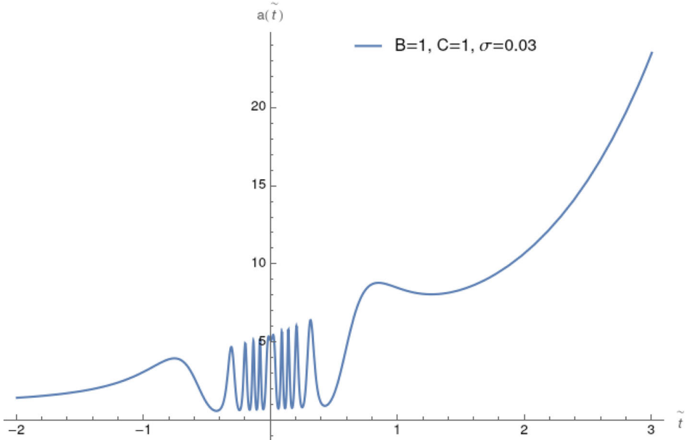
- For cyclic models with exponentially growing scale-factor oscillations, the entropy-density change can decrease over time; the paper gives \(\rho_S/\rho_b \approx -1 + e^{-3\sigma T}\left(1 + S_{\mathrm{mat}}(t_b+T)/S_{\mathrm{rad}}(\mathrm{today})\right)\), and says the late-time limit is approximately zero entropy density at cycle end.
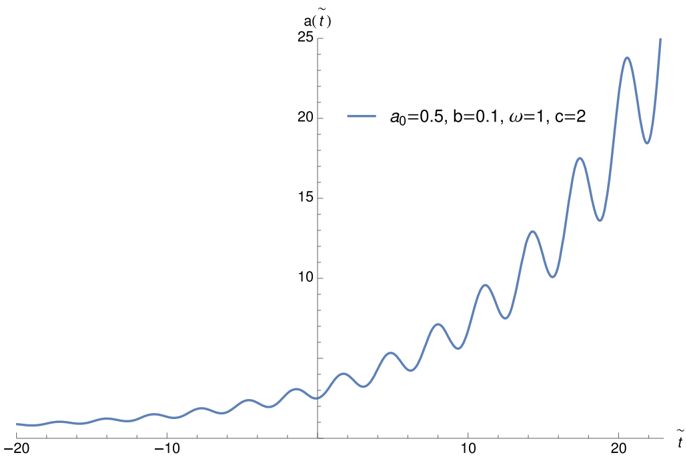
- The paper presents a class of models with a positive constant offset in the scale factor, e.g. \(a(t)=a_0+e^{bt}[\sin^2(\omega t)+c]\), for which \(a(t)\to a_0\) and \(H_{\mathrm{av}}\to 0\) as \(t\to -\infty\); it states the relevant proper-time integral diverges, so the spacetime is geodesically complete.
- It concludes that the BGV theorem can show geodesic incompleteness for some simple cyclic models, but not for cyclic cosmologies in general; the paper states that “some very simple models can at the same time be past geodesically complete and solve the problem of entropy growth.”
## Methods
- Conceptual/theoretical analysis of cyclic cosmology and entropy, with a critical discussion of whether entropy growth is a valid argument against cyclic models in cosmology.
- FLRW spacetime analysis using the scale factor \(a(t)\), the Hubble parameter \(H(t)=\dot a/a\), and the BGV criterion based on the average Hubble parameter and a proper-time/geodesic integral.
- Toy-model calculations for entropy-density evolution in periodic cycles, exponentially growing oscillatory cycles, and more general growth laws \(a(t_b+T)=f(T)a(t_b)\), with rough estimates using radiation entropy, matter entropy, and the present-day radiation entropy.
## Limitations
- The paper states that its entropy calculations are only rough estimates, because the entropy density of the Universe is not well known and depends on unknown dark- and high-energy physics, and it ignores phase transitions and changes in effective degrees of freedom.
- It explicitly says the physical viability of the proposed geodesically complete cyclic cosmologies must be assessed “case to case,” and that some of the proposed forms require modified gravity or exotic fluids.
- Evident from the text: the paper does not provide observational tests or a full microphysical derivation of the entropy evolution; it is a theoretical argument based on toy models and asymptotic conditions.
Model-written summary. Check it against the paper before relying on it.
Integrity signals
Registry
Cites
Statistics
Figures
Verification
Claims the paper makes
6 Valid · 1 Not valid · 1 Not checked · 61 Own results and interpretations
Every source the paper cites for this claim was checked and supports it.
In the paper
“Even the most simple modified gravity theories, such as f (R) and f (T ) gravity have the mathematical structure which is rich enough to support such type of solutions, although the appropriate modification function may not be expressible in analytical form (compare the discussion in [1]).”
§ Geodesically complete cyclic cosmologies and entropy > 3.3 Physical viability of the proposed models
What the sources say
- Supportedcites [1] 1. P. Pavlovic, M. Sossich, Phys. Rev. D 103(2), 023529 (2021). arXiv:2009.03625 [gr-qc] source
Split into 2 atoms — 2 confirmed, 0 partially supported, 0 disputed, 0 misattributed, 0 unverifiable. Expand the claim to see per-atom verdicts.
plainstates an association- Asserted: passes — The authors put it forward as true.
- Checkable: passes — It can be checked against evidence.
- Load-bearing: unclear — It is unclear whether the paper’s conclusions depend on it.
- Based: passes — The paper gives a reason why it holds.
- Supported
The cited sources support only part of this claim — read each source’s verdict below.
In the paper
“On the other hand, the matter contribution to entropy will in general rise with respect to the contribution at the bounce time, t = t b , due to the second law of thermodynamics, i.e. for the entropy values in the observable Universe we have S(t) mat = S(t b ) mat + S mat (t) (with S mat (t) > 0) [50].”
§ Geodesically complete cyclic cosmologies and entropy > 3.1 Entropy growth considerations
What the sources say
- Partly supportedcites [50] 51. P.H. Frampton, Int. J. Mod. Phys. A 30(21), 1550129 (2015) sourceExperimental — accuracy not yet measured
Our copy supports the general second-law point — the Introduction (p. 2) states that 'the entropy of the universe necessarily increases, due to the second law of thermodynamics', and the Discussion (p. 13) refers to 'the huge entropy which accumulates from irreversible processes during expansion' — but it never decomposes entropy into a matter contribution rising above its bounce value, and gives no relation of the form S(t)_mat = S(t_b)_mat + dS_mat(t) with dS_mat > 0. Indeed the bounce-entropy passages say the opposite of a bounce matter term: 'The CBE contracting universe contains no matter' (Sec. 4, p. 9) and 'the value of the dimensionless entropy S_TOTAL(t_B)/k ... originates only from electromagnetic radiation, S_TOTAL(t_B) = S_gamma(t_B)' (Sec. 4, pp. 11-12). So the second-law growth is attributable to this source, while the specific 'matter contribution relative to the bounce' framing is not. (LLM, conf=0.68)
hedgedstates a cause- Asserted: passes — The authors put it forward as true.
- Checkable: passes — It can be checked against evidence.
- Load-bearing: unclear — It is unclear whether the paper’s conclusions depend on it.
- Based: passes — The paper gives a reason why it holds.
- Rests on 2 assumptions not shown here.
- Partly supported
Every source the paper cites for this claim was checked and supports it.
In the paper
“As very properly pointed out by [36], the absence of geodesic completeness does not necessary imply the existence of a physical singularity.”
§ Geodesically complete cyclic cosmologies and entropy > 1 Entropy and cyclic cosmology
What the sources say
- Supportedcites [36] 37. H. Lam, T. Prokopec, Phys. Lett. B 775, 311 (2017). arXiv:1606.01147 [gr-qc] source
The Abstract states the claim almost verbatim: 'past-incompleteness of geodesics in FLRW spacetimes does not necessarily imply that these spacetimes start from a singularity.' Section 4 (Conclusion) reinforces it by distinguishing 'the usual definition of a singularity' (incomplete geodesic) from a genuine one, arguing the past-incomplete trajectories of non-comoving test particles break down at super-Planckian energies and so should not define an initial singularity; only spacetimes with a(t0)=0 are truly singular (also Section 1, Introduction, and Section 3). The only scope qualifier is that the source argues this for FLRW/cosmological spacetimes, whereas the citing sentence states it unqualifiedly, but the attributed content itself is directly asserted. (LLM, conf=0.90)
plain- Asserted: passes — The authors put it forward as true.
- Checkable: passes — It can be checked against evidence.
- Load-bearing: passes — The paper’s conclusions depend on it.
- Based: passes — The paper gives a reason why it holds.
- Supported
Every source the paper cites for this claim was checked and supports it.
In the paper
“As further shown in [36], when only the particles not reaching the super-Planckian scales are considered, then there will be no singularities if the cosmological scale factor is not vanishing.”
§ Geodesically complete cyclic cosmologies and entropy > 1 Entropy and cyclic cosmology
What the sources say
- Supportedcites [36] 37. H. Lam, T. Prokopec, Phys. Lett. B 775, 311 (2017). arXiv:1606.01147 [gr-qc] source
The Introduction (p. 1, passage 1) states that when one considers only test-particle trajectories without a breakdown of their description, 'the only FLRW spacetimes that start from a singularity are the ones with a scale factor that vanishes at some initial time', and that eternal-inflation/bouncing models are 'singularity free provided one requires sub-Planckian test particles at all times'. The Abstract and the Conclusion (sections 2 and 4) repeat this with the super-Planckian-energy breakdown argument of Section 3, matching the claim's two qualifiers exactly. (LLM, conf=0.92)
plainstates a possible cause- Asserted: passes — The authors put it forward as true.
- Checkable: passes — It can be checked against evidence.
- Load-bearing: passes — The paper’s conclusions depend on it.
- Based: passes — The paper gives a reason why it holds.
- Supported
A result the paper states — it cites no source for it, so there is none to check. The quote shows it is in the paper.
In the paper
“while the considered class of toy models, a(t) = e σ t (a 0 +sin 2 (ωt)), solves the problem of unbounded entropy density growth”
§ Geodesically complete cyclic cosmologies and entropy > 3.1 Entropy growth considerations
plainstates a cause- Asserted: passes — The authors put it forward as true.
- Checkable: passes — It can be checked against evidence.
- Load-bearing: passes — The paper’s conclusions depend on it.
- Based: passes — The paper gives a reason why it holds.
- Rests on an assumption not shown here.
46 more claims
Create a free account to see all 69 claims and to verify the 1 reference still open.
- It may state two separate claims as one. 14
- Probably not a substantial claim. 4
- The quote only partly states this claim. 3
Citations
Cites
The Large Scale Structure of Space-Time
Hawking, S. W., & Ellis, G. F. R. (1973) · doi:10.1017/cbo9780511524646 · Cited by 10,624
Wald, R. M. (1984) · doi:10.7208/chicago/9780226870373.001.0001 · Cited by 7,188
Gravitation and Cosmology: Principles and Applications of the General Theory of Relativity
Weinberg, S., & Dicke, R. H. (1973) · American Journal of Physics · doi:10.1119/1.1987308 · Cited by 3,103
Gravitational Collapse and Space-Time Singularities
Penrose, R. (1965) · Physical Review Letters · doi:10.1103/physrevlett.14.57 · Cited by 2,977
General Relativity – An Einstein Centenary Survey
Irvine, J. M. (1980) · Physics Bulletin · doi:10.1088/0031-9112/31/4/029 · Cited by 2,620
The singularities of gravitational collapse and cosmology
Hawking, S. W., & Penrose, R. (1970) · Proceedings of the Royal Society of London. A. Mathematical and Physical Sciences · doi:10.1098/rspa.1970.0021 · Cited by 2,100
Ekpyrotic universe: Colliding branes and the origin of the hot big bang
Khoury, J., Ovrut, B. A., Steinhardt, P. J., & Turok, N. (2001) · Physical Review D · doi:10.1103/physrevd.64.123522 · Cited by 1,549
Investigations in relativistic cosmology
Lifshitz, E. M., & Khalatnikov, I. M. (1963) · Advances in Physics · doi:10.1080/00018736300101283 · Cited by 912
Misner, C. W. (1969) · Physical Review Letters · doi:10.1103/physrevlett.22.1071 · Cited by 856
A Cyclic Model of the Universe
Steinhardt, P. J., & Turok, N. (2002) · Science · doi:10.1126/science.1070462 · Cited by 614
Inflationary spacetimes are not past-complete
Borde, A., Guth, A. H., & Vilenkin, A. (2001) · arXiv · doi:10.48550/arxiv.gr-qc/0110012 · Cited by 594
Inflationary Spacetimes Are Incomplete in Past Directions
Borde, A., Guth, A. H., & Vilenkin, A. (2003) · Physical Review Letters · doi:10.1103/physrevlett.90.151301 · Cited by 582
Ekpyrotic and Cyclic Cosmology
Lehners, J.-L. (2008) · Physics Reports · doi:10.1016/j.physrep.2008.06.001 · Cited by 381
The occurrence of singularities in cosmology. ɪɪɪ. Causality and singularities
Hawking, S. W. (1967) · Proceedings of the Royal Society of London. Series A. Mathematical and Physical Sciences · doi:10.1098/rspa.1967.0164 · Cited by 360
The occurrence of singularities in cosmology
Hawking, S. W. (1966) · Proceedings of the Royal Society of London. Series A. Mathematical and Physical Sciences · doi:10.1098/rspa.1966.0221 · Cited by 269
Nonsingular bouncing universes in loop quantum cosmology
Singh, P., Vandersloot, K., & Vereshchagin, G. V. (2006) · Physical Review D · doi:10.1103/physrevd.74.043510 · Cited by 208
The Large Scale Structure of Space-Time
Hawking, S. W., Ellis, G. F. R., & Sachs, R. K. (1974) · Physics Today · doi:10.1063/1.3128542 · Cited by 166
Turnaround in Cyclic Cosmology
Baum, L., & Frampton, P. H. (2007) · Physical Review Letters · doi:10.1103/physrevlett.98.071301 · Cited by 162
Occurrence of Singularities in Open Universes
Hawking, S. W. (1965) · Physical Review Letters · doi:10.1103/physrevlett.15.689 · Cited by 159
Ijjas, A., & Steinhardt, P. J. (2019) · Physics Letters B · doi:10.1016/j.physletb.2019.06.056 · Cited by 145
On the Theoretical Requirements for a Periodic Behaviour of the Universe
Tolman, R. C. (1931) · Physical Review · doi:10.1103/physrev.38.1758 · Cited by 145
The occurrence of singularities in cosmology. II
Hawking, S. W. (1966) · Proceedings of the Royal Society of London. Series A. Mathematical and Physical Sciences · doi:10.1098/rspa.1966.0255 · Cited by 114
Barrow, J. D., & Dabrowski, M. P. (1995) · Monthly Notices of the Royal Astronomical Society · doi:10.1093/mnras/275.3.850 · Cited by 80
The arrow of time and the initial conditions of the universe
Wald, R. M. (2006) · Studies in History and Philosophy of Science Part B: Studies in History and Philosophy of Modern Physics · doi:10.1016/j.shpsb.2006.03.005 · Cited by 61 · cited 1×
“the early Universe was in the state of law entropy which is increasing [15, 16].”
BackgroundCyclic cosmology from Lagrange-multiplier modified gravity
Cai, Y.-F., & Saridakis, E. N. (2011) · Classical and Quantum Gravity · doi:10.1088/0264-9381/28/3/035010 · Cited by 56
Ups and downs of cyclic universes
(2007) · doi:10.1103/physrevd.75.043515 · Cited by 55
Oscillating Friedman Cosmology
Da̧browski, M. P. (1996) · Annals of Physics · doi:10.1006/aphy.1996.0057 · Cited by 53
Collapse of simple harmonic universe
Mithani, A. T., & Vilenkin, A. (2012) · Journal of Cosmology and Astroparticle Physics · doi:10.1088/1475-7516/2012/01/028 · Cited by 53
Graham, P. W., Horn, B., Kachru, S., Rajendran, S., & Torroba, G. (2014) · Journal of High Energy Physics · doi:10.1007/jhep02(2014)029 · Cited by 37
Cosmological hysteresis and the cyclic universe
Sahni, V., & Toporensky, A. (2012) · Physical Review D · doi:10.1103/physrevd.85.123542 · Cited by 37
Past-completeness of inflationary spacetimes
Lesnefsky, J. E., Easson, D. A., & Davies, P. C. W. (2023) · Physical Review D · doi:10.1103/physrevd.107.044024 · Cited by 37
Barrow, J. D., & Ganguly, C. (2017) · Physical review. D/Physical review. D. · doi:10.1103/physrevd.95.083515 · Cited by 33
On the initial singularity and extendibility of flat quasi-de Sitter spacetimes
Geshnizjani, G., Ling, E., & Quintin, J. (2023) · Journal of High Energy Physics · doi:10.1007/jhep10(2023)182 · Cited by 32
Maximal extensions and singularities in inflationary spacetimes
Yoshida, D., & Quintin, J. (2018) · Classical and Quantum Gravity · doi:10.1088/1361-6382/aacf4b · Cited by 31
Cyclic cosmology in modified gravity
Pavlović, P., & Sossich, M. (2017) · Physical review. D/Physical review. D. · doi:10.1103/physrevd.95.103519 · Cited by 31
Self-citationUltralocality and slow contraction
Ijjas, A., Sullivan, A., Pretorius, F., Steinhardt, P. J., & Cook, W. G. (2021) · Journal of Cosmology and Astroparticle Physics · doi:10.1088/1475-7516/2021/06/013 · Cited by 29
Nomura, K., & Yoshida, D. (2021) · Journal of Cosmology and Astroparticle Physics · doi:10.1088/1475-7516/2021/07/047 · Cited by 19
Ultralocality and slow contraction
(2021) · doi:10.15488/12410 · Cited by 18
Cyclic entropy: An alternative to inflationary cosmology
Frampton, P. H. (2015) · International Journal of Modern Physics A · doi:10.1142/s0217751x15501298 · Cited by 14
Cyclic cosmology and geodesic completeness
Kinney, W. H., & Stein, N. K. (2022) · Journal of Cosmology and Astroparticle Physics · doi:10.1088/1475-7516/2022/06/011 · Cited by 13
Evolution of cyclic mixmaster universes with noncomoving radiation
Ganguly, C., & Barrow, J. D. (2017) · Physical review. D/Physical review. D. · doi:10.1103/physrevd.96.123534 · Cited by 12
Dynamic properties of cyclic cosmologies
Pavlović, P., & Sossich, M. (2021) · Physical Review D · doi:10.1103/physrevd.103.023529 · Cited by 12
Self-citationCyclic universe with an inflationary phase from a cosmological model with real gas quintessence
Ivanov, R. I., & Prodanov, E. M. (2012) · Physical review. D. Particles, fields, gravitation, and cosmology/Physical review. D. Particles and fields · doi:10.1103/physrevd.86.083536 · Cited by 12
Magnetogenesis in cyclical Universe
Leite, N., & Pavlović, P. (2018) · Classical and Quantum Gravity · doi:10.1088/1361-6382/aae2d6 · Cited by 11
Self-citationCreation of wormholes during the cosmological bounce
Pavlović, P., & Sossich, M. (2023) · The European Physical Journal C · doi:10.1140/epjc/s10052-023-11386-1 · Cited by 11
Self-citationSingularities in FLRW spacetimes
het Lam, H., & Prokopec, T. (2017) · Physics Letters B · doi:10.1016/j.physletb.2017.10.070 · Cited by 6
Cosmological bounce and the cosmological constant problem
Pavlović, P., & Sossich, M. (2022) · Physics of the Dark Universe · doi:10.1016/j.dark.2022.101161 · Cited by 4
Self-citationGeroch, R. (1984) · Physica A Statistical Mechanics and its Applications · doi:10.1016/0378-4371(84)90250-4 · Cited by 3
The Borde-Guth-Vilenkin Theorem in extended de Sitter spacesPreprint
Kinney, W. H., Maity, S., & Sriramkumar, L. (2023) · arXiv (Cornell University) · doi:10.48550/arxiv.2307.10958 · Cited by 1
A Simple Harmonic UniversePreprint
Graham, P. W., Horn, B., Shamit Kachru, A., et al. (2011) · arXiv (Cornell University) · doi:10.48550/arxiv.1109.0282
Entropy, black holes, and the new cyclic universe
Ijjas, A., & Steinhardt, P. J. (2022) · Physics Letters B · doi:10.1016/j.physletb.2021.136823
Cyclic Cosmology and Geodesic Completeness
Kinney, W. H., & Stein, N. K. (2021) · arXiv · doi:10.48550/arxiv.2110.15380
Ijjas, A., & Steinhardt, P. J. (2019) · arXiv · doi:10.48550/arxiv.1904.08022
Entropy, Black holes, and the New Cyclic Universe
Ijjas, A., & Steinhardt, P. J. (2021) · arXiv · doi:10.48550/arxiv.2108.07101
Dynamic properties of cyclic cosmologies
Pavlović, P., & Sossich, M. (2020) · arXiv · doi:10.48550/arxiv.2009.03625
Self-citationCyclic cosmology in modified gravity
Pavlovic, P., & Sossich, M. (2017) · arXiv · doi:10.48550/arxiv.1701.03657
Self-citationMagnetogenesis in Cyclical Universe
Leite, N., & Pavlović, P. (2018) · arXiv · doi:10.48550/arxiv.1805.06036
Self-citationCosmological bounce and the cosmological constant problem
Pavlović, P., & Sossich, M. (2021) · arXiv · doi:10.48550/arxiv.2112.09523
Self-citationCreation of wormholes during the cosmological bounce
Pavlović, P., & Sossich, M. (2022) · arXiv · doi:10.48550/arxiv.2210.06142
Self-citationCollapse of simple harmonic universe
Mithani, A. T., & Vilenkin, A. (2011) · arXiv · doi:10.48550/arxiv.1110.4096
Singularities in FLRW Spacetimes
Lam, H. H., & Prokopec, T. (2016) · arXiv · doi:10.48550/arxiv.1606.01147
Research works printed but not linked: 5
- 6. Y.F. Cai, E.N. Saridakis, J. Cosmol. 17, 7238-7254 (2011)
- 19. Ernst, G., Hüttemann, A., Eds.; Cambridge University Press: Cambridge, UK, 2009; Phil. Sci. Archive 2008
- 21. R. Penrose, Singularities and Time Asymmetry, in General Relativ- ity, An Einstein Centenary Survey. ed. by S.W. Hawking, W. Israel (Cambridge University Press, Cambridge, UK, 1979), pp.581-638
- 29. A. Mithani, A. Vilenkin, Proceedings of the 10th International Con- ferenceon Gravitation, Astrophysics and Cosmology, Quy-Nhon, Vietnam, (2011)
- 31. N.S. Kardashev, MNRAS 243, 252 (1990)
Cited by
Geodesic completeness, cosmological bounces, and inflation
García-Sáenz, S., Hua, J., & Zhao, Y. (2024) · Physical review. D/Physical review. D. · doi:10.1103/physrevd.110.l061304 · Cited by 11
Metadata
- Authors
- Pavlović, P., & Sossich, M.
- Affiliations
- Institute for Cosmology and Philosophy of Nature (HR)
- University of Zagreb (HR)
- Corresponding author
- Sossich, Marko
- Venue
- The European Physical Journal C
- Published
- 2024-03-08
- Volume
- 84
- Issue
- 3
- ISSN
- 1434-6044 (ISSN-L)
- 1434-6052
- OpenAlex
- W4392599226
- Semantic Scholar
- 5d3f1861384578f1e3be74b741f746b3c0e7bfd4
- Cited by
- 3
- References
- 52
- Citations by year
- 2026: 1 · 2025: 1 · 2024: 1
- FWCI
- 0.57
- Type
- journal article
- Language
- en
- Open access
- diamond
- doi.org
- Licence
- cc-by
- creativecommons.org/licenses/by/4.0 (tdm)
- creativecommons.org/licenses/by/4.0 (vor)
- Locations
- The European Physical Journal C (publishedVersion, cc-by)
- arXiv (Cornell University) (submittedVersion)
- DOAJ (DOAJ: Directory of Open Access Journals) (submittedVersion)
- arXiv (Cornell University)
- Topics
- Physical Sciences › Physics and Astronomy › Astronomy and Astrophysics › Cosmology and Gravitation Theories
- Physical Sciences › Physics and Astronomy › Nuclear and High Energy Physics › Noncommutative and Quantum Gravity Theories
- Physical Sciences › Physics and Astronomy › Nuclear and High Energy Physics › Black Holes and Theoretical Physics
- Keywords
- cyclic cosmology, geodesic completeness, entropy increase, entropy density, arrow of time
About these checks
Registry, retraction, Cites and statistics results are computed, not judged, with one exception: a printed reference that no index lists is read once by a model before it counts as a citation error. Claims are extracted by a model and kept only when their quote appears verbatim in the text; each cited source is then checked, with a model’s help, for whether it says what the claim relies on. Those verdicts can be wrong — read the claim’s quote and the cited source before relying on one.
The claim verdicts this report counts are experimental: their accuracy is not yet measured.
A language model drew the claims from the paper on 2026-10-10, under version 3 of the claim definition (model deepseek-v4.1-flash, prompt extract-v3).
A second model labelled each claim on 2026-10-10 (model jev-1.13-20260917, definition revision gold-guideline-v0.2).
Cited sources are checked with a language model’s help (qwen3.8-omni-flash).
Statistics and arithmetic are recomputed, not judged.
Confidence bands are shown only for fields calibrated on our annotated test set. None is calibrated yet, so no band is shown.
What counts as a claim ›How we measure confidence ›How we check this ›
Are you an author, or do you see a problem with this page? Request a review
Data sources
Bibliographic data: Semantic Scholar, OpenAlex, Crossref.
Contains information from the Semantic Scholar Academic Graph Datasets, made available under the ODC Attribution License (ODC-BY 1.0).
Semantic Scholar’s data is described in: Kinney, R., et al. (2023). The Semantic Scholar Open Data Platform. arXiv:2301.10140.
