

The DOI matches its Crossref record; 96 of the 97 references it cites were found in a registry or an index.
The ripple of fear, sympathy and solidarity during the Boston bombings
Open accessAbstract
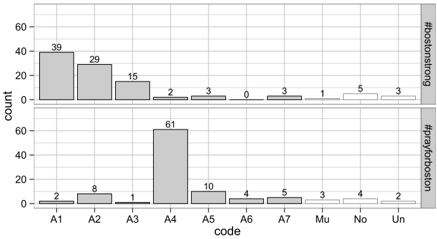
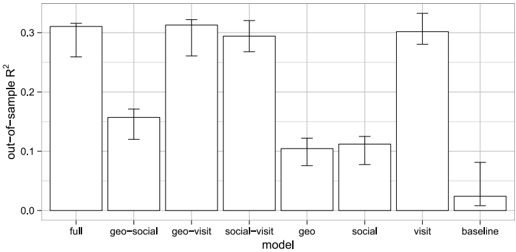
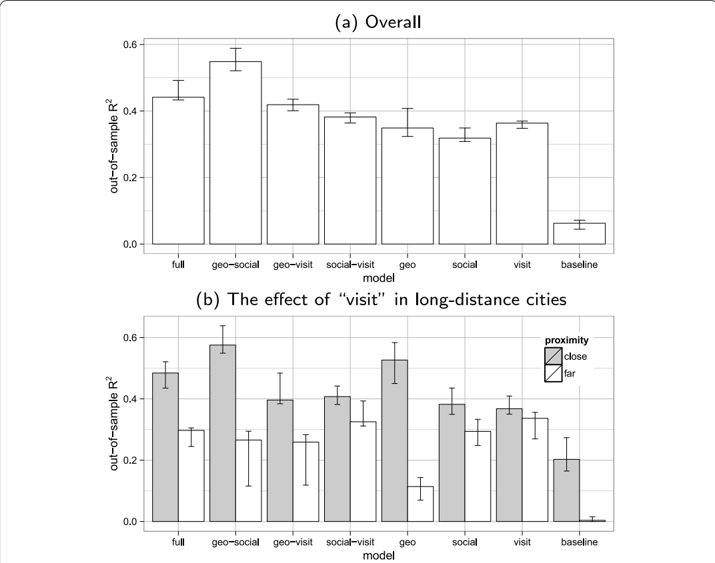
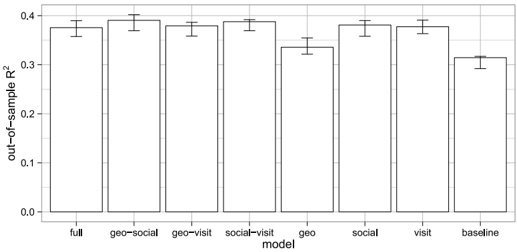
The Boston Marathon bombing presents a rare opportunity to study how a disruptive event can trigger inter-communal emotions and expressions - where members of one community express feelings about and support for members of a distant community. In this work, we use over 180 million geocoded tweets over an entire month to study how Twitter users from different cities expressed three different emotions: fear , sympathy and solidarity , in reaction to the bombings. We capture spikes in fear in different cities by using sentiment and time-series analyses, and track expressions of sympathy and solidarity based on the emergent use of two hashtags, #prayforboston and #bostonstrong, widely adopted after the bombings. We find first that the extent to which communities outside Boston express these emotions is correlated with their geographic proximity, social network connections, and residents’ direct, physical experiences with Boston (captured by the number of citizens who had visited Boston recently). This general effect shows interesting differences across the different kinds of emotions, however. Analyses show that the extent to which residents of a city visit Boston is the best predictor of fear and solidarity expression, as well as a strong predictor of the expression of sympathy. The expression of fear is also directly related to the expression of solidarity. Our study has theoretical implications regarding the diffusion of information and emotional contagion as well as practical implications for understanding how important information and social support can be effectively collected and distributed to populations in need.
Overview
The claims and statistics of this paper haven’t been checked yet.
Run the check — free, no account needed. It reads the open-access text and checks the sources it cites.
Integrity signals
Registry
Cites
Statistics
Figures
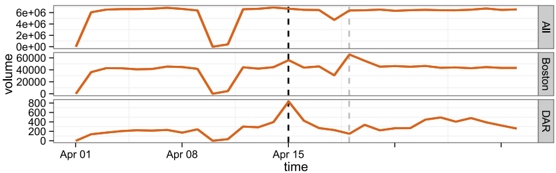
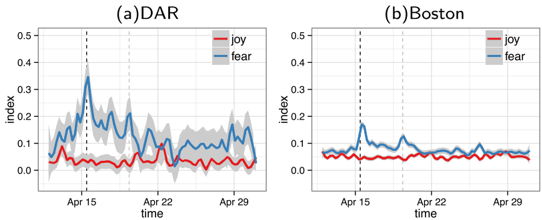
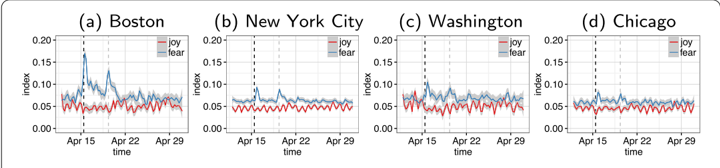
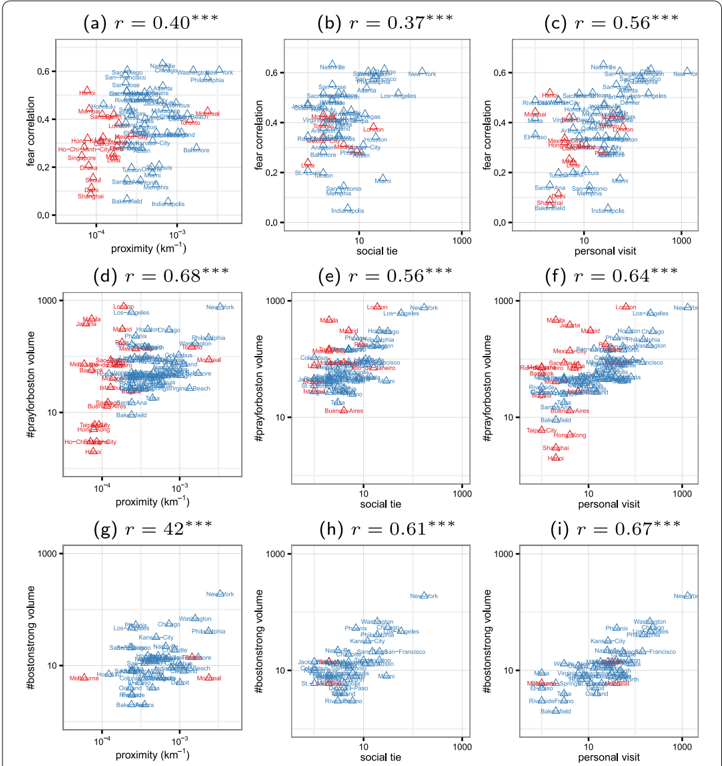

Verification
Claims the paper makes
The claims and statistics of this paper haven’t been checked yet.
Run the check — free, no account needed. It reads the open-access text and checks the sources it cites.
Claims other papers make about this one
Each is checked against this paper’s own text: does it say what the citing paper says it does?
The source backs part of the claim, not all of it — or backs it for a different population, condition or comparison.
In the citing paper
“This tool is known to work well with short text and social media data, as revealed in a large body of social computing and crisis informatics literature (Lin and Margolin, 2014; Mark et al., 2012; Saha and De Choudhury, 2017).”
From Impacts of school shooter drills on the psychological well-being of American K-12 school communities: a social media study (2021) · cites this paper as Lin and Margolin, 2014
Experimental — accuracy not yet measured
Self-check
Percentages, sums and reported differences re-computed from the paper’s own numbers.
The self-check needs the paper’s full text.
Citations
Cites
(2005) · Springer eBooks · doi:10.1007/0-387-27255-0_9 · Cited by 20,333
McCullagh, P., & Nelder, J. A. (1989) · doi:10.1007/978-1-4899-3242-6 · Cited by 16,836
An Analysis of Transformations
Box, G. E. P., & Cox, D. R. (1964) · Journal of the Royal Statistical Society Series B (Statistical Methodology) · doi:10.1111/j.2517-6161.1964.tb00553.x · Cited by 15,356
An Integrative Theory of Intergroup Conflict
Tajfel, H., & Turner, J. C. (2000) · Oxford University Press eBooks · doi:10.1093/oso/9780199269464.003.0005 · Cited by 12,701
The Social psychology of intergroup relations
Austin, W. G., & Worchel, S. (1979) · Medical Entomology and Zoology · Cited by 11,577
Slovic, P. (1987) · Science · doi:10.1126/science.3563507 · Cited by 9,271
Social psychology of intergroup relations
Tajfel, H. (1982) · Annual Review of Psychology · doi:10.1146/annurev.ps.33.020182.000245 · Cited by 7,949
Recursive Deep Models for Semantic Compositionality Over a Sentiment Treebank
Socher, R., Perelygin, A., Wu, J., Chuang, J., Manning, C. D., Ng, A., & Potts, C. (2013) · Proceedings of the 2013 Conference on Empirical Methods in Natural Language Processing · doi:10.18653/v1/d13-1170 · Cited by 6,878
The Information Age: Economy, Society and Culture
Castells, M. (1999) · Cited by 6,045
Experimental evidence of massive-scale emotional contagion through social networks
Kramer, A. D. I., Guillory, J. E., & Hancock, J. T. (2014) · Proceedings of the National Academy of Sciences · doi:10.1073/pnas.1320040111 · Cited by 3,687
Earthquake shakes Twitter users
Sakaki, T., Okazaki, M., & Matsuo, Y. (2010) · International World Wide Web Conference (WWW) · doi:10.1145/1772690.1772777 · Cited by 3,631
Lerner, J. S., & Keltner, D. (2001) · Journal of Personality and Social Psychology · doi:10.1037/0022-3514.81.1.146 · Cited by 3,325
Rise of the Network Society: The Information Age: Economy, Society and Culture
Castells, M. (1996) · Blackwell Publishers Inc. eBooks · Cited by 2,782
The Social Amplification of Risk: A Conceptual Framework
Kasperson, R. E., Renn, O., Slovic, P., Brown, H. S., Emel, J., Goble, R., Kasperson, J. X., & Ratick, S. (1988) · Risk Analysis · doi:10.1111/j.1539-6924.1988.tb01168.x · Cited by 2,740
Intergroup emotions: Explaining offensive action tendencies in an intergroup context.
Mackie, D. M., Devos, T., & Smith, E. R. (2000) · Journal of Personality and Social Psychology · doi:10.1037/0022-3514.79.4.602 · Cited by 1,797
Rainie, L., & Wellman, B. (2012) · The MIT Press eBooks · doi:10.7551/mitpress/8358.001.0001 · Cited by 1,757
Talking about tactile experiences
Obrist, M., Seah, S. A., & Subramanian, S. (2013) · CHI Conference on Human Factors in Computing Systems · doi:10.1145/2470654.2466220 · Cited by 1,634
The role of social networks in information diffusion
Bakshy, E., Rosenn, I., Marlow, C., & Adamic, L. (2012) · Proceedings of the 21st international conference on World Wide Web · doi:10.1145/2187836.2187907 · Cited by 1,526
Microblogging during two natural hazards events
Vieweg, S. E., Hughes, A., Starbird, K., & Palen, L. A. (2010) · CHI Conference on Human Factors in Computing Systems · doi:10.1145/1753326.1753486 · Cited by 1,485
Effects of Fear and Anger on Perceived Risks of Terrorism
Lerner, J. S., Gonzalez, R. M., Small, D. A., & Fischhoff, B. (2003) · Psychological Science · doi:10.1111/1467-9280.01433 · Cited by 1,377
The Rise of the Network Society - The Information Age: Economy, Society, and Culture
Kızılhan, T., & Kizilhan, S. B. (2016) · Contemporary Educational Technology · doi:10.30935/cedtech/6177 · Cited by 1,220
Twitter adoption and use in mass convergence and emergency events
Hughes, A., & Palen, L. (2009) · International Journal of Emergency Management · doi:10.1504/ijem.2009.031564 · Cited by 1,002
Twitter under crisis: can we trust what we RT?
Mendoza, M., Poblete, B., & Castillo, C. (2010) · Proceedings of the First Workshop on Social Media Analytics · doi:10.1145/1964858.1964869 · Cited by 955
Networked: The New Social Operating System
Rainie, L., & Wellman, B. (2012) · Medical Entomology and Zoology · Cited by 851
Lazarus, R. S. (2005) · Journal of Personality · doi:10.1111/j.1467-6494.2005.00368.x · Cited by 785
Using Social Media to Enhance Emergency Situation Awareness
Yin, J., Lampert, A., Cameron, M., Robinson, B., & Power, R. (2012) · IEEE Intelligent Systems · doi:10.1109/mis.2012.6 · Cited by 652
Networks and Netwars: The Future of Terror, Crime, and Militancy
Cohen, E. A., Arquilla, J., & Ronfeldt, D. F. (2002) · Foreign Affairs · doi:10.2307/20033106 · Cited by 636
Gupta, A., Lamba, H., Kumaraguru, P., & Joshi, A. (2013) · Proceedings of the 22nd International Conference on World Wide Web Companion · doi:10.1145/2487788.2488033 · Cited by 573
The Social Amplification of Risk: Theoretical Foundations and Empirical Applications
Renn, O., Burns, W. J., Kasperson, J. X., Kasperson, R. E., & Slovic, P. (1992) · Journal of Social Issues · doi:10.1111/j.1540-4560.1992.tb01949.x · Cited by 564
Ratkiewicz (2011) · doi:10.1145/1963192.1963301 · Cited by 541
Twitter Catches The Flu: Detecting Influenza Epidemics using Twitter
Aramaki, E., Maskawa, S., & Morita, M. (2011) · Cited by 515
Detecting Emotional Contagion in Massive Social Networks
Coviello, L., Sohn, Y., Kramer, A. D. I., Marlow, C. A., Franceschetti, M., Christakis, N. A., & Fowler, J. H. (2014) · PLoS ONE · doi:10.1371/journal.pone.0090315 · Cited by 510
Using Empathy to Improve Intergroup Attitudes and Relations
Batson, C. D., & Ahmad, N. Y. (2009) · Social Issues and Policy Review · doi:10.1111/j.1751-2409.2009.01013.x · Cited by 508
Palen, L. A., Vieweg, S. E., Liu, S. B., & Hughes, A. (2009) · Social Science Computer Review · doi:10.1177/0894439309332302 · Cited by 428
(2014) · iConference 2014 Proceedings · doi:10.9776/14308 · Cited by 423
Twitter earthquake detection: earthquake monitoring in a social world
Earle, P. S., Bowden, D. C., & Guy, M. R. (2012) · Annals of Geophysics · doi:10.4401/ag-5364 · Cited by 417
Terrorism and Probability Neglect
Sunstein, C. R. (2003) · Journal of Risk and Uncertainty · doi:10.1023/a:1024111006336 · Cited by 388
Comparing and combining sentiment analysis methods
Gonçalves, P., Araújo, M., Benevenuto, F., & Cha, M. (2013) · Conference on Online Social Networks · doi:10.1145/2512938.2512951 · Cited by 373
The Nature of Collective Resilience: Survivor Reactions to the 2005 London Bombings
Drury, J., Cocking, C., & Reicher, S. (2009) · International Journal of Mass Emergencies & Disasters · doi:10.1177/028072700902700104 · Cited by 352
Comparing and combining sentiment analysis methods
Gonçalves, P., Araújo, M., Benevenuto, F., & Cha, M. (2013) · Cited by 304
Terrorism and Probability Neglect
Sunstein, C. R. (2003) · Springer eBooks · doi:10.1007/978-1-4757-6787-2_2 · Cited by 296
DiPaola, R. S., & Lattime, E. C. (2007) · The Journal of Urology · doi:10.1016/j.juro.2007.08.063 · Cited by 286
Rituals of Solidarity and Security in the Wake of Terrorist Attack
Collins, R. (2004) · Sociological Theory · doi:10.1111/j.1467-9558.2004.00204.x · Cited by 286
Marshall, R. D., Bryant, R. A., Amsel, L., Suh, E. J., Cook, J. M., & Neria, Y. (2007) · American Psychologist · doi:10.1037/0003-066x.62.4.304 · Cited by 272
Pass It On?: Retweeting in Mass Emergency
Starbird, K., & Palen, L. A. (2010) · ISCRAM · Cited by 270
Cosmopolitanized Nations: Re-imagining Collectivity in World Risk Society
Beck, U., & Levy, D. C. (2013) · Theory Culture & Society · doi:10.1177/0263276412457223 · Cited by 238
Cross-Cultural Differences in Risk Perceptions of Disasters
Gierlach, E., Belsher, B. E., & Beutler, L. E. (2010) · Risk Analysis · doi:10.1111/j.1539-6924.2010.01451.x · Cited by 237
Post-Traumatic Stress Disorder (PTSD): What We Have Learned and What We Still Have Not Found Out
Flouri, E. (2005) · Journal of Interpersonal Violence · doi:10.1177/0886260504267549 · Cited by 235
Information control and terrorism: Tracking the Mumbai terrorist attack through twitter
Oh, O., Agrawal, M., & Rao, H. (2011) · Inf. Syst. Frontiers · doi:10.1007/s10796-010-9275-8 · Cited by 230
In search of the bigger picture: The emergent role of on-line photo sharing in times of disaster
Liu, S. B., Palen, L. A., Sutton, J. N., Hughes, A., & Vieweg, S. E. (2008) · International Conference on Information Systems for Crisis Response and Management · Cited by 220
The Human Being in Disasters: A Research Perspective
Fritz, C. E., & Williams, H. B. (1957) · The Annals of the American Academy of Political and Social Science · doi:10.1177/000271625730900107 · Cited by 187
Classifying text messages for the haiti earthquake
Caragea, C., McNeese, N. J., Jaiswal, A., Traylor, G., Kim, H., Mitra, P., Wu, D., Tapia, A., Giles, C. L., Jansen, B. J. J., et al. (2011) · Cited by 172
Online Community Response to Major Disaster: A Study of Tianya Forum in the 2008 Sichuan Earthquake
Qu, Y., Wu, P. F., & Wang, X. (2009) · Proceedings of the ... Annual Hawaii International Conference on System Sciences/Proceedings of the Annual Hawaii International Conference on System Sciences · doi:10.1109/hicss.2009.330 · Cited by 169
Clear danger: situational determinants of the appraisal of threat.
Paterson, R., & Neufeld, R. J. (1987) · Psychological bulletin · doi:10.1037/0033-2909.101.3.404 · Cited by 156
Twitter as a Rapid Response News Service: An Exploration in the Context of the 2008 China Earthquake
Li, J., & Rao, H. R. (2010) · The Electronic Journal of Information Systems in Developing Countries · doi:10.1002/j.1681-4835.2010.tb00300.x · Cited by 136
Vasterman, P. L. M., & Ruigrok, N. (2013) · European Journal of Communication · doi:10.1177/0267323113486235 · Cited by 129
The emergence of online widescale interaction in unexpected events
Palen, L. A., & Vieweg, S. E. (2008) · ACM Conference on Computer Supported Cooperative Work (CSCW) · doi:10.1145/1460563.1460583 · Cited by 127
Maitner, A. T., Mackie, D. M., & Smith, E. R. (2006) · Journal of Experimental Social Psychology · doi:10.1016/j.jesp.2005.08.001 · Cited by 124
Mapping moods: Geo-mapped sentiment analysis during hurricane sandy.
Caragea, C., Squicciarini, A., Stehle, S., Neppalli, V. K., & Tapia, A. (2014) · Cited by 118
Mark, G. J., & Semaan, B. (2008) · ACM Conference on Computer Supported Cooperative Work (CSCW) · doi:10.1145/1460563.1460585 · Cited by 115
Sorrow and Solidarity: Why Americans Volunteered for 9/11 Relief Efforts
Beyerlein, K., & Sikkink, D. (2008) · Social Problems · doi:10.1525/sp.2008.55.2.190 · Cited by 114
SentiSense: An easily scalable concept-based affective lexicon for sentiment analysis
Carrillo‐de‐Albornoz, J., Plaza, L., & Gervás, P. (2012) · Language Resources and Evaluation Conference (LREC) · doi:10.63317/5h25wp4omkgp · Cited by 108
Changes in Perceived Vulnerability Following Natural Disaster
Weinstein, N. D., Lyon, J. E., Rothman, A. J., & Cuite, C. L. (2000) · Journal of Social and Clinical Psychology · doi:10.1521/jscp.2000.19.3.372 · Cited by 102
Guy, M. R., Earle, P. S., Ostrum, C., Gruchalla, K., & Horvath, S. (2010) · Lecture notes in computer science · doi:10.1007/978-3-642-13062-5_6 · Cited by 99
A revenue sharing mechanism for federated search and advertising
Brambilla, M., Ceppi, S., Gatti, N., & Gerding, E. (2012) · International World Wide Web Conference (WWW) · doi:10.1145/2187980.2188079 · Cited by 98
Twittering Tennessee: Distributed networks and collaboration following a technological disaster.
Sutton, J. N. (2010) · Cited by 91
Information resonance on Twitter
Zhou, Z., Bandari, R., Kong, J. S., Qian, H., & Roychowdhury, V. (2010) · doi:10.1145/1964858.1964875 · Cited by 90
Early Warning and Outbreak Detection Using Social Networking Websites: The Potential of Twitter
de Quincey, E., & Kostkova, P. (2010) · Lecture notes of the Institute for Computer Sciences, Social Informatics and Telecommunications Engineering · doi:10.1007/978-3-642-11745-9_4 · Cited by 86
Emotion guided threat detection: Expecting guns where there are none.
Wormwood, J. B., & DeSteno, D. A. (2010) · Journal of Personality and Social Psychology · doi:10.1037/a0020665 · Cited by 79
Zeitzoff, T. (2014) · Political Psychology · doi:10.1111/pops.12065 · Cited by 78
Coping with the threat of terrorism: A review
Maguen, S., Papa, A., & Litz, B. T. (2007) · Anxiety Stress & Coping · doi:10.1080/10615800701652777 · Cited by 76
#Bigbirds Never Die: Understanding Social Dynamics of Emergent Hashtags
Lin, Y., Margolin, D., Keegan, B., Baronchelli, A., & Lazer, D. M. J. (2021) · Proceedings of the International AAAI Conference on Web and Social Media · doi:10.1609/icwsm.v7i1.14407 · Cited by 73
Self-citationMedia Exposure to Bioterrorism: Stress and the Anthrax Attacks
Dougall, A. L., Hayward, M. C., & Baum, A. E. (2005) · Psychiatry · doi:10.1521/psyc.68.1.28.64188 · Cited by 63
Terrorism and the Media: A Rhetorical Genre
Dowling, R. E. (1986) · Journal of Communication · doi:10.1111/j.1460-2466.1986.tb03036.x · Cited by 60
Types of Solidarity in the Reconstituting of Groups
Turner, R. H. (1967) · The Pacific Sociological Review · doi:10.2307/1388423 · Cited by 54
Sudden Solidarity and the Rush to Normalization: Toward an Alternative Approach
Turkel, G. (2002) · Sociological Focus · doi:10.1080/00380237.2002.10571221 · Cited by 48
Nurmi, J., Räsänen, P., & Oksanen, A. (2011) · Journal of Social Work · doi:10.1177/1468017310386426 · Cited by 47
Post-Traumatic Stress Disorder
Apolone, G., Mosconi, P., & Vecchia, C. L. (2002) · New England Journal of Medicine · doi:10.1056/nejm200205093461913 · Cited by 47
Proceedings of the first ACM conference on Online social networks
Muthukrishnan, M., Abbadi, A. E., & Krishnamurthy, B. (2013) · doi:10.1145/2512938 · Cited by 44
Shavit, T., Shahrabani, S., Ben‐Zion, U., & Rosenboim, M. (2013) · Journal of Environmental Psychology · doi:10.1016/j.jenvp.2013.07.018 · Cited by 42
#Bigbirds Never Die: Understanding Social Dynamics of Emergent HashtagPreprint
Lin, Y., Margolin, D., Keegan, B., Baronchelli, A., & Lazer, D. M. J. (2013) · arXiv (Cornell University) · doi:10.48550/arxiv.1303.7144 · Cited by 41
Self-citationBalzarotti, S., & Ciceri, M. R. (2014) · Media Psychology · doi:10.1080/15213269.2013.826588 · Cited by 41
Lee, J. E. C., Lemyre, L., & Krewski, D. R. (2010) · Journal of Applied Social Psychology · doi:10.1111/j.1559-1816.2009.00572.x · Cited by 34
How Viewers Process Live, Breaking, and Emotional Television News
Miller, A., & Leshner, G. (2007) · Media Psychology · doi:10.1080/15213260701300915 · Cited by 31
Terror in America: Assessments of the Attacks and Their Impact in Germany
Noelle-Neumann, E. (2002) · International Journal for Quality in Health Care · doi:10.1093/ijpor/14.1.93 · Cited by 20
Proceedings of the First Workshop on Social Media Analytics
Melville, P., Leskovec, J., & Provost, F. J. (2010) · Cited by 19
Proceedings of the 2010 ACM-BCS Visions of Computer Science Conference
McAuley, D. M., & Peyton-Jones, S. (2010) · Cited by 16
Anagondahalli, D., & Turner, M. M. (2011) · Risk Analysis · doi:10.1111/j.1539-6924.2011.01727.x · Cited by 13
Participatory Journalism and Crisis Communications: A Swedish Case Study of Swine Flu Coverage
Karlsson, M. (2010) · Observatorio (OBS*) · doi:10.15847/obsobs412010333 · Cited by 10
Bracha, H. S., & Burkle, F. M. (2006) · Prehospital and Disaster Medicine · doi:10.1017/s1049023x00003897 · Cited by 10
From push brooms to prayer books: Social media and social networks during the London riots
Glasgow, K., & Fink, C. (2013) · Illinois Digital Environment for Access to Learning and Scholarship (University of Illinois at Urbana-Champaign) · doi:10.9776/13167 · Cited by 8
Emotions and economic expectations: A field study
Ben‐Zion, U., Shahrabani, S., Shavit, T., & Weiss, R. (2012) · RePEc: Research Papers in Economics · Cited by 7
Research works printed but not linked: 7
- Sutton J, Palen L, Shklovski I: Backchannels on the front lines: emergent uses of social media in the 2007 southern California wildfires. ISCRAM2008 2008, 624–632.
- Globe Staff (2013) 102 hours in pursuit of Marathon bombing suspects - The Boston Globe. Accessed 2014-04-10, [ https://www.bostonglobe.com/metro/2013/04/28/bombreconstruct/VbSZhzHm35yR88EVmVdbDM/story.html ]
- Markon J, Horwitz S, Johnson J (2013) Dzhokhar Tsarnaev charged with using ‘weapon of mass destruction’11. The Washington Post. Chap. National. Accessed 2013–09–15
- Feinsand M (2013) Boston Marathon bombings: Yankees play Neil Diamond’s ’Sweet Caroline,’ a staple at Fenway. Accessed 2014-04-10, [ http://www.nydailynews.com/sports/baseball/yankees-honor-boston-play-sweet-caroline-wake-bombings-article-1.1318805 ]
- Dudek M (2013) Chicagoans run to show solidarity with Boston Marathon victims - Chicago Sun-Times. Accessed 2014-04-10, [ http://www.suntimes.com/news/metro/19530547–418/chicagoans-run-to-show-solidarity-with-boston-marathon-victims.html ]
- Chew C, Eysenbach G: Pandemics in the age of Twitter: content analysis of Tweets during the 2009 H1N1 outbreak. PLoS ONE 2010., 5(11): 10.1371/journal.pone.0014118 · DOI
- Zimmer B (2013) ‘Boston Strong,’ the phrase that rallied a city. Boston Globe Zimmer B (2013) ‘Boston Strong,’ the phrase that rallied a city. Boston Globe
Cited by
Sorted by citations
Social media use in disaster recovery: A systematic literature review
Ogie, R., James, S., Moore, A. R., Dilworth, T.-L., Amirghasemi, M., & Whittaker, J. (2022) · International Journal of Disaster Risk Reduction · doi:10.1016/j.ijdrr.2022.102783 · Cited by 199
Systematic literature review of sentiment analysis on Twitter using soft computing techniques
Kumar, A., & Jaiswal, A. (2019) · Concurrency and Computation Practice and Experience · doi:10.1002/cpe.5107 · Cited by 166
Population Bias in Geotagged Tweets
Malik, M. M., Lamba, H., Nakos, C., & Pfeffer, J. (2021) · Proceedings of the International AAAI Conference on Web and Social Media · doi:10.1609/icwsm.v9i4.14688 · Cited by 172
Modeling Stress with Social Media Around Incidents of Gun Violence on College Campuses
Saha, K., & De Choudhury, M. (2017) · Proceedings of the ACM on Human-Computer Interaction · doi:10.1145/3134727 · Cited by 124
Whose Lives Matter? Mass Shootings and Social Media Discourses of Sympathy and Policy, 2012–2014
Zhang, Y., Shah, D. V., Foley, J. M., Abhishek, A., Lukito, J., Suk, J., Kim, S. J., Sun, Z., Pevehouse, J. C. W., & Garlough, C. (2019) · Journal of Computer-Mediated Communication · doi:10.1093/jcmc/zmz009 · Cited by 92
Metadata
- Authors
- Lin, Y.-R., & Margolin, D.
- Affiliations
- University of Pittsburgh (US)
- Cornell University (US)
- Corresponding author
- Lin, Yu-Ru
- Venue
- EPJ Data Science
- Published
- 2014-11-05
- Volume
- 3
- Issue
- 1
- ISSN
- 2193-1127 (ISSN-L)
- OpenAlex
- W2149307575
- Cited by
- 72
- References
- 97
- Citations by year
- 2026: 1 · 2025: 2 · 2024: 3 · 2023: 5 · 2022: 9 · 2021: 13 · 2020: 7 · 2019: 7 · 2018: 11 · 2017: 7 · 2016: 4 · 2015: 1 · 2014: 1
- FWCI
- 12.77
- Type
- journal article
- Language
- en
- Open access
- gold
- doi.org
- Licence
- Locations
- EPJ Data Science (publishedVersion, cc-by)
- D-Scholarship@Pitt (University of Pittsburgh) (acceptedVersion)
- Funders
- National Science Foundation (1423697)
- Topics
- Social Sciences › Communication › Public Relations and Crisis Communication
- Physical Sciences › Computer Science › Artificial Intelligence › Sentiment Analysis and Opinion Mining
- Physical Sciences › Physics and Astronomy › Statistical and Nonlinear Physics › Complex Network Analysis Techniques
- Keywords
- Boston Marathon bombing, fear, sympathy, solidarity, emotional contagion, hashtags, Twitter, geographic proximity, disaster response, social support
About these checks
Registry, retraction, Cites and statistics results are computed, not judged, with one exception: a printed reference that no index lists is read once by a model before it counts as a citation error. Claims are extracted by a model and kept only when their quote appears verbatim in the text; each cited source is then checked, with a model’s help, for whether it says what the claim relies on. Those verdicts can be wrong — read the claim’s quote and the cited source before relying on one.
Statistics and arithmetic are recomputed, not judged.
Confidence bands are shown only for fields calibrated on our annotated test set. None is calibrated yet, so no band is shown.
What counts as a claim ›How we measure confidence ›How we check this ›
Are you an author, or do you see a problem with this page? Request a review
