

Black Lives Matter in Wikipedia: Collective Memory and Collaboration around Online Social Movements
Open accessThe DOI matches its Crossref record; 47 of the 47 references it cites were found in a registry or an index; none of the 16 sources its claims cite is checked for support yet.
Abstract
Social movements use social computing systems to complement offline mobilizations, but prior literature has focused almost exclusively on movement actors' use of social media. In this paper, we analyze participation and attention to topics connected with the Black Lives Matter movement in the English language version of Wikipedia between 2014 and 2016. Our results point to the use of Wikipedia to (1) intensively document and connect historical and contemporary events, (2) collaboratively migrate activity to support coverage of new events, and (3) dynamically re-appraise pre-existing knowledge in the aftermath of new events. These findings reveal patterns of behavior that complement theories of collective memory and collective action and help explain how social computing systems can encode and retrieve knowledge about social movements as they unfold.
Overview
CoChat Summary
TL;DR
Analyzing English Wikipedia revision histories and pageviews around Black Lives Matter (BLM) from 2014–2016, this paper identifies three mechanisms: intensified documentation, collaborative migration, and dynamic re-appraisal. It argues these patterns show how a peer-production system encodes collective memory and knowledge about an unfolding social movement without direct movement control.
Key findings
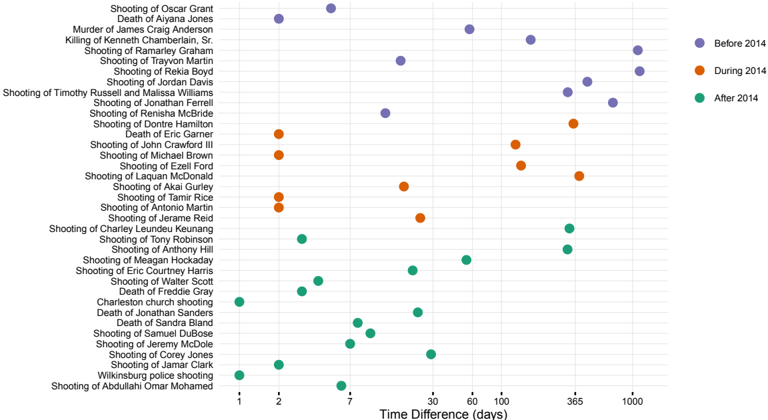
- Intensified documentation: average article-creation lag for BLM-related deaths fell from 361 days before 2014 to 107 days during 2014 to 51 days after 2014, an 86% reduction. Only 2 of 37 deaths had articles created within 24 hours, and 12 events had lags of at least 100 days.
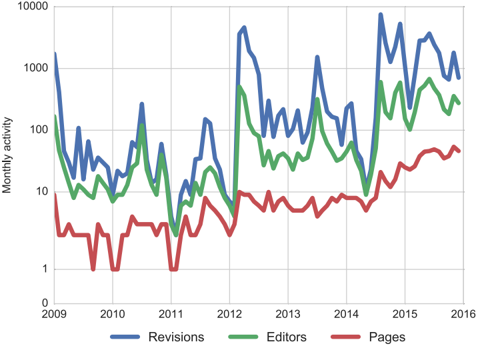
- Activity was highly concentrated: 141 articles/talk pages had 86,940 revisions by 6,795 editors; the Top 10 pages and talk pages accounted for 76,194 (87.6%) revisions and 5,449 (80.2%) editors. The “Shooting of Michael Brown” and “Shooting of Trayvon Martin” articles alone contributed 52,941 (60.9%) revisions.
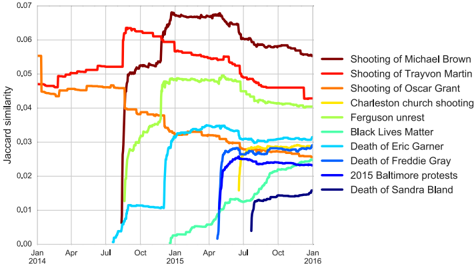
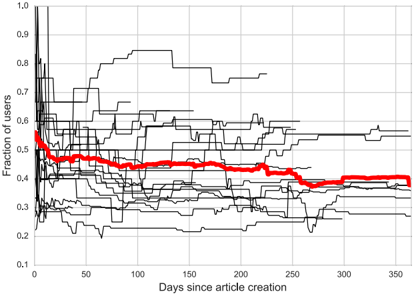
- Collaborative migration: daily editor similarity was low; the “Shooting of Michael Brown” article had the greatest similarity but never rose above 7%, while the “Black Lives Matter” article showed an increasing similarity trajectory. On the BLM talk page, 74 editors made 534 revisions, and 41 also edited the article itself, meaning only 10% of article editors participated in talk discussions.
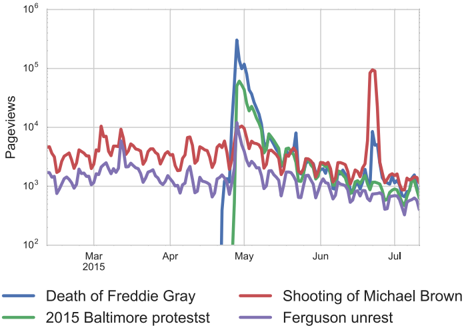
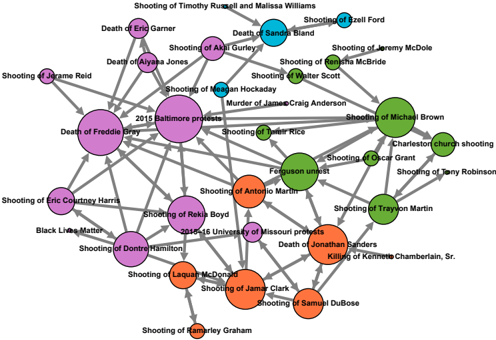
- Dynamic re-appraisal: revision correlations were consistently lower than pageview or revision-pageview correlations; the strongest revision pair was Freddie Gray–Baltimore protests at 0.672, while pageview/revision-pageview pairs included Michael Brown–Ferguson unrest at 0.918 and Freddie Gray–Baltimore protests at 0.942. The “Black Lives Matter” article was peripheral in the correlation network, with a single connection to the shooting of Dontre Hamilton.
Methods
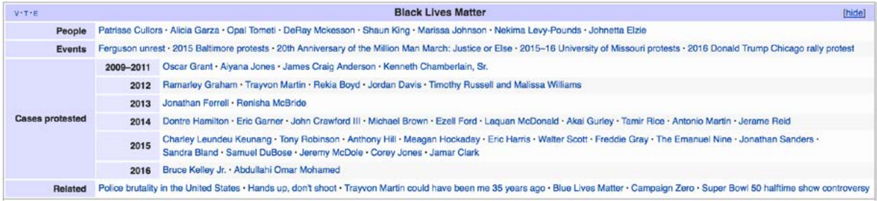
- Trace data from English Wikipedia revision histories collected April 21, 2016 using a custom Python script with Wikitools and the MediaWiki API. The sample was built from the union of 59 articles in the Black Lives Matter template and 74 in the Black Lives Matter category, excluding pages not focused on the movement, a death, or a protest, yielding 42 main articles (1 movement, 37 deaths, 4 protests); redirects and talk pages were included, totaling 141 articles/talk pages, 86,940 revisions by 6,795 editors from January 6, 2009 to April 21, 2016.
- Pageviews from January 1, 2014 to January 1, 2016 were extracted from a third-party daily pageviews database. The study is exploratory and descriptive, using temporal dynamics, Jaccard similarity, correlations, hierarchical clustering with Ward variance minimization, network visualization, and qualitative review of the BLM talk page.
Limitations
- Stated: the analysis covers only a single prominent contemporary U.S. social movement on the largest Wikipedia language edition, limiting generalizability; revision data are a convenient sample that censors contributions during page protections and overlooks source choices and automated agents; there are no demographic data on editors or readers; the authors cannot claim whether editors support the movement; and the descriptive quantitative analyses could be extended with regression, network, time-series, text, sequence, or causal-inference methods.
- Evident: the pageview time range truncates some information for some articles, as the paper notes, and data collection ends April 21, 2016, so later BLM-related activity is not captured.
Model-written summary. Check it against the paper before relying on it.
Integrity signals
Registry
Cites
Statistics
Figures
Verification
Claims the paper makes
0 Valid · 1 Not valid · 12 Not checked · 103 Own results and interpretations
A result the paper states — it cites no source for it, so there is none to check. The quote shows it is in the paper.
In the paper
“This indicates that only 10% of editors to the article participated in discussions on the talk page.”
§ Black Lives Matter in Wikipedia: Collaboration and Collective Memory around Online Social Movements > Black Lives Matter talk page discussion
hedged- Asserted: passes — The authors put it forward as true.
- Checkable: passes — It can be checked against evidence.
- Load-bearing: unclear — It is unclear whether the paper’s conclusions depend on it.
- Based: passes — The paper gives a reason why it holds.
A result the paper reports from its own data — it cites no other source for it, so there is none to check. The quote shows it is in the paper.
In the paper
“During 2014, when the BLM movement gained attention, the 10 pages about deaths took on average 107 days to be created.”
§ Black Lives Matter in Wikipedia: Collaboration and Collective Memory around Online Social Movements > Temporal dynamics of article creation
plain- Asserted: passes — The authors put it forward as true.
- Checkable: passes — It can be checked against evidence.
- Load-bearing: passes — The paper’s conclusions depend on it.
- Based: passes — The paper gives a reason why it holds.
A result the paper states — it cites no source for it, so there is none to check. The quote shows it is in the paper.
In the paper
“faster coverage of new movement topics”
§ Black Lives Matter in Wikipedia: Collaboration and Collective Memory around Online Social Movements > INTRODUCTION
plainstates a cause- Asserted: passes — The authors put it forward as true.
- Checkable: passes — It can be checked against evidence.
- Load-bearing: passes — The paper’s conclusions depend on it.
- Based: passes — The paper gives a reason why it holds.
A result the paper states — it cites no source for it, so there is none to check. The quote shows it is in the paper.
In the paper
“In the case of BLM, many of these structures were not created until mid-2015.”
§ Black Lives Matter in Wikipedia: Collaboration and Collective Memory around Online Social Movements > RQ2: Collaborative migration
plainSingle case- Asserted: passes — The authors put it forward as true.
- Checkable: passes — It can be checked against evidence.
- Load-bearing: passes — The paper’s conclusions depend on it.
- Based: passes — The paper gives a reason why it holds.
A result the paper states — it cites no source for it, so there is none to check. The quote shows it is in the paper.
In the paper
“expanded discussion”
§ Black Lives Matter in Wikipedia: Collaboration and Collective Memory around Online Social Movements > INTRODUCTION
plainstates an association- Asserted: passes — The authors put it forward as true.
- Checkable: passes — It can be checked against evidence.
- Load-bearing: passes — The paper’s conclusions depend on it.
- Based: passes — The paper gives a reason why it holds.
66 more claims
Create a free account to see all 116 claims and to verify the 16 references still open.
- It may state two separate claims as one. 23
- Probably not a substantial claim. 27
- The quote only partly states this claim. 1
Claims other papers make about this one
Each is checked against this paper’s own text: does it say what the citing paper says it does?
In the citing paper
“Using computational techniques to study social movements and the emergence of non-dominant narratives situated within particular cultures is becoming increasingly common (e.g., [67,72]).”
From Addressing age-related bias in sentiment analysis, (2018) · cites this paper as [72]
Self-check
Percentages, sums and reported differences re-computed from the paper’s own numbers.
Each contradiction between two passages listed here was confirmed by an independent check.
Rated minor: it would not touch a result — a value no result rests on, a p-value that stays on the same side of the significance level, or a conflict that is clerical, resolved elsewhere in the paper, or outside its own findings.
In the paper
§ Black Lives Matter in Wikipedia: Collaboration and Collective Memory around Online Social Movements > Temporal dynamics of article creation
“The "Shooting of Rekia Boyd" (1,133 days) and the "Shooting of Ramarley Grant" (1,097 days) had the longest article creation lag.”
§ Black Lives Matter in Wikipedia: Collaboration and Collective Memory around Online Social Movements > Acknowledgements
“Shooting of Ramarley Graham”
Rated minor: it would not touch a result — a value no result rests on, a p-value that stays on the same side of the significance level, or a conflict that is clerical, resolved elsewhere in the paper, or outside its own findings.
In the paper
§ Black Lives Matter in Wikipedia: Collaboration and Collective Memory around Online Social Movements > Editor similarities over time
“Substantively, this metric describes what fraction of users on an article in a given day had edited any other article in the corpus at any time leading up to and including that day.”
§ Black Lives Matter in Wikipedia: Collaboration and Collective Memory around Online Social Movements > Editor similarities over time
“The Jaccard coefficient captures the similarity between two sets of entities by computing the size of the intersection between entities in both sets, divided by the union of the sets.”
Citations
Cites
Halbwachs, M., & Coser, L. A. (1992) · doi:10.7208/chicago/9780226774497.001.0001 · Cited by 4,939
Recruitment to High-Risk Activism: The Case of Freedom Summer
McAdam, D. (1986) · American Journal of Sociology · doi:10.1086/228463 · Cited by 2,203 · cited 1×
“A groups’ shared sense of the past contributes to collective action by providing common frames to articulate grievances, develop shared identity, regenerate networks and resources, and increase incentives for cooperation [12, 34].”
BackgroundSocial Media and the Decision to Participate in Political Protest: Observations From Tahrir Square
Tufekci, Z., & Wilson, C. (2012) · Journal of Communication · doi:10.1111/j.1460-2466.2012.01629.x · Cited by 1,532 · cited 1×
“These platforms are designed to reduce coordination costs as well as enhance information sharing, potentially encouraging more people to engage in protest politics than would have otherwise [41].”
BackgroundGenerations and Collective Memories
Schuman, H., & Scott, J. (1989) · American Sociological Review · doi:10.2307/2095611 · Cited by 1,071
Harnessing the wisdom of crowds in wikipedia: quality through coordination
Kittur, A., & Kraut, R. E. (2008) · Proceedings of the 2008 ACM conference on Computer supported cooperative work · doi:10.1145/1460563.1460572 · Cited by 680
Networked Gatekeeping and Networked Framing on #Egypt
Meraz, S., & Papacharissi, Z. (2013) · The International Journal of Press/Politics · doi:10.1177/1940161212474472 · Cited by 580 · cited 1×
“Contemporary social movements use social computing and social media platforms to mobilize supporters, negotiate meaning, alter their relationship to media gatekeepers, and reframe issues [3, 35].”
BackgroundHe says, she says: conflict and coordination in Wikipedia
Kittur, A., Suh, B., Pendleton, B. A., & Chi, E. H. (2007) · Proceedings of the SIGCHI Conference on Human Factors in Computing Systems · doi:10.1145/1240624.1240698 · Cited by 574 · cited 1×
“A broader literature has shown that editors act interdependently assuming nuanced social roles [1, 43], managing conflict dynamics [30, 44], and coordinating their actions to produce high quality content [29].”
BackgroundBeyond the Hashtags: #Ferguson, #Blacklivesmatter, and the Online Struggle for Offline Justice
Freelon, D., McIlwain, C. D., & Clark, M. D. (2016) · SSRN Electronic Journal · doi:10.2139/ssrn.2747066 · Cited by 566 · cited 4×
“As it became clear that the events in Ferguson had provoked nationwide concern, the phrase spread on social media and in the press [10].”
BackgroundInfluentialHijacking #myNYPD: Social Media Dissent and Networked Counterpublics
Jackson, S. J., & Foucault Welles, B. (2015) · Journal of Communication · doi:10.1111/jcom.12185 · Cited by 416
Benford, R. D. (1993) · The Sociological Quarterly · doi:10.1111/j.1533-8525.1993.tb00387.x · Cited by 316 · cited 1×
“Typically, a movement’s framing describes the grievances at stake, determines how the movement is understood, and specifies the scope of issues to be addressed by fostering a “sense of severity, urgency, efficacy, and propriety” [2].”
Background
Cited by
On the Dangers of Stochastic Parrots: Can Language Models Be Too Big? 🦜
Bender, E. M., Gebru, T., McMillan-Major, A., & Shmitchell, S. (2021) · Proceedings of the 2021 ACM Conference on Fairness, Accountability, and Transparency · doi:10.1145/3442188.3445922 · Cited by 6,988
“For instance, the Black Lives Matter movement (BLM) influenced Wikipedia article generation and editing such that, as the BLM movement grew, articles covering shootings of Black people increased in coverage and were generated with reduced latency [135].”
BackgroundAddressing age-related bias in sentiment analysis,
Diaz, M., Johnson, I., Lazar, A., Piper, A. M., & Gergle, D. (2018) · Proceedings of the 2018 CHI Conference on Human Factors in Computing Systems · doi:10.1145/3173574.3173986 · Cited by 138
Drawing the Lines of Contention: Networked Frame Contests Within #BlackLivesMatter Discourse
Stewart, L. G., Arif, A., Nied, A. C., Spiro, E. S., & Starbird, K. (2017) · Proceedings of the ACM on Human-Computer Interaction · doi:10.1145/3134920 · Cited by 82
Ma, Z., Mei, Y., Long, Y., Su, Z., & Gajos, K. Z. (2024) · Proceedings of the CHI Conference on Human Factors in Computing Systems · doi:10.1145/3613904.3642482 · Cited by 68
“Even when the filtered versions are used, they may inadvertently offend and silence the voices of marginalized communities such as LGBTQ+ due to inherent limitations in the filtering algorithms [104].”
BackgroundToward a Grassroots Culture of Technology Practice
Ghoshal, S., Mendhekar, R., & Bruckman, A. (2020) · Proceedings of the ACM on Human-Computer Interaction · doi:10.1145/3392862 · Cited by 60
“Today in the western world, grassroots organizing has a distinctly technological character [48, 82].”
Background
Metadata
- Authors
- Twyman, M., Keegan, B. C., & Shaw, A.
- Affiliations
- Northwestern University (US)
- University of Colorado Boulder (US)
- Venue
- Proceedings of the 2017 ACM Conference on Computer Supported Cooperative Work and Social Computing
- Publisher
- ACM
- Published
- 2017-02-25
- Pages
- 1400-1412
- OpenAlex
- W4299397191
- Cited by
- 51
- References
- 47
- Citations by year
- 2026: 3 · 2025: 8 · 2024: 8 · 2023: 6 · 2022: 8 · 2021: 5 · 2020: 4 · 2019: 4 · 2018: 4 · 2017: 1
- FWCI
- 9.77
- Type
- conference paper
- Language
- en
- Open access
- hybrid
- doi.org
- Licence
- Locations
- ACM Conference on Computer Supported Cooperative Work (CSCW) (publishedVersion, cc-by-sa)
- CU Scholar (University of Colorado Boulder) (submittedVersion)
- OSF Preprints (OSF Preprints) (submittedVersion)
- Funders
- Northwestern University
- University of Missouri
- Topics
- Social Sciences › Communication › Wikis in Education and Collaboration
- Social Sciences › Communication › Social Media and Politics
- Social Sciences › Sociology and Political Science › Social Movements and Cultural Identity
- Keywords
- Black Lives Matter, Wikipedia, social movements, social computing, collective memory, collective action, online mobilization, knowledge co-production, event coverage, social media
About these checks
Registry, retraction, Cites and statistics results are computed, not judged, with one exception: a printed reference that no index lists is read once by a model before it counts as a citation error. Claims are extracted by a model and kept only when their quote appears verbatim in the text; each cited source is then checked, with a model’s help, for whether it says what the claim relies on. Those verdicts can be wrong — read the claim’s quote and the cited source before relying on one.
A language model drew the claims from the paper on 2026-10-10, under version 3 of the claim definition (model deepseek-v4.1-flash, prompt extract-v3).
A second model labelled each claim on 2026-10-10 (model jev-1.13-20260917, definition revision gold-guideline-v0.2).
Statistics and arithmetic are recomputed, not judged.
Confidence bands are shown only for fields calibrated on our annotated test set. None is calibrated yet, so no band is shown.
What counts as a claim ›How we measure confidence ›How we check this ›
Are you an author, or do you see a problem with this page? Request a review
How to cite
Cite CoChat for the checks on this page, and the paper for its own findings.
- This page
- CoChat. (2026). Citation check: Black Lives Matter in Wikipedia: Collective Memory and Collaboration around Online Social Movements. https://app.cochat.ai/papers/10.1145/2998181.2998232
- The paper
- Twyman, M., Keegan, B. C., & Shaw, A. (2017). Black Lives Matter in Wikipedia: Collective Memory and Collaboration around Online Social Movements. Proceedings of the 2017 ACM Conference on Computer Supported Cooperative Work and Social Computing. https://doi.org/10.1145/2998181.2998232
Data sources
Bibliographic data: Semantic Scholar, OpenAlex, Crossref.
Contains information from the Semantic Scholar Academic Graph Datasets, made available under the ODC Attribution License (ODC-BY 1.0).
Semantic Scholar’s data is described in: Kinney, R., et al. (2023). The Semantic Scholar Open Data Platform. arXiv:2301.10140.
