

Private Stateful Information Retrieval
Open accessThe DOI matches its Crossref record; 42 of the 43 references it cites were found in a registry or an index.
Abstract
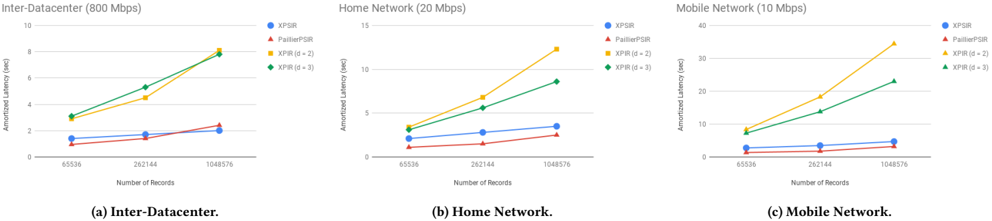
Private information retrieval (PIR) is a fundamental tool for preserving query privacy when accessing outsourced data. All previous PIR constructions have significant costs preventing widespread use. In this work, we present private stateful information retrieval (PSIR), an extension of PIR, allowing clients to be stateful and maintain information between multiple queries. Our design of the PSIR primitive maintains three important properties of PIR: multiple clients may simultaneously query without complex concurrency primitives, query privacy should be maintained if the server colludes with other clients, and new clients should be able to enroll into the system by exclusively interacting with the server. We present a PSIR framework that reduces an online query to performing one single-server PIR on a sub-linear number of database records. All other operations beyond the single-server PIR consist of cryptographic hashes or plaintext operations. In practice, the dominating costs of resources occur due to the public-key operations involved with PIR. By reducing the input database to PIR, we are able to limit expensive computation and avoid transmitting large ciphertexts. We show that various instantiations of PSIR reduce server CPU by up to 10x and online network costs by up to 10x over the previous best PIR construction.
Overview
The claims and statistics of this paper haven’t been checked yet.
Free: it reads the open-access text and checks the first 5 claims that cite a source we can check. Create a free account to check every claim.
Integrity signals
Registry
Cites
Statistics
Figures
Verification
Claims the paper makes
The claims and statistics of this paper haven’t been checked yet.
Free: it reads the open-access text and checks the first 5 claims that cite a source we can check. Create a free account to check every claim.
Claims other papers make about this one
Each is checked against this paper’s own text: does it say what the citing paper says it does?
The check wasn’t confident either way, so it gives no verdict — never disputed.
In the citing paper
“Methods combining Federated Averaging with sparsification and/or quantization of model updates to a small number of bits have demonstrated significant reductions in communication cost with minimal impact on training accuracy [282].”
From Advances and Open Problems in Federated Learning (2021) · cites this paper as [282]
Experimental — accuracy not yet measuredThe check wasn’t confident either way, so it gives no verdict — never disputed.
In the citing paper
“Much of the existing literature applies to the objective (a) [282, 440, 281, 17, 235, 55].”
From Advances and Open Problems in Federated Learning (2021) · cites this paper as [282]
Experimental — accuracy not yet measured
Self-check
Percentages, sums and reported differences re-computed from the paper’s own numbers.
The self-check needs the paper’s full text.
Citations
Cites
Handbook of applied cryptography
(1997) · Choice Reviews Online · doi:10.5860/choice.34-4512 · Cited by 10,357
Public-Key Cryptosystems Based on Composite Degree Residuosity Classes
Paillier, P. (2007) · Lecture Notes in Computer Science · doi:10.1007/3-540-48910-x_16 · Cited by 7,250 · cited 5×
“We construct a library that constructs PIR based on the Paillier cryptosystem [43] and build a PSIR scheme on top of the Paillier PIR library.”
BackgroundMethodInfluentialUntraceable electronic mail, return addresses, and digital pseudonyms
Chaum, D. L. (1981) · Communications of the ACM · doi:10.1145/358549.358563 · Cited by 4,289 · cited 1×
“That is, the adversary cannot learn the identity of the querying clients which can be enforced by requiring clients to use anonymous mix networks [16].”
BackgroundStatistical Tables for Biological, Agricultural and Medical Research.
Reed, L. J., Fisher, R. A., & Yates, F. (1944) · Journal of the American Statistical Association · doi:10.2307/2280633 · Cited by 2,998
Modular multiplication without trial division
Montgomery, P. L. (1985) · Mathematics of Computation · doi:10.1090/s0025-5718-1985-0777282-x · Cited by 2,669 · cited 1×
“In addition, we perform all modular multiplications using the Montgomery representation [40] of multiplicands described in OpenSSL.”
MethodSoftware protection and simulation on oblivious RAMs
Goldreich, O., & Ostrovsky, R. (1996) · Journal of the ACM · doi:10.1145/233551.233553 · Cited by 1,617
(Leveled) Fully Homomorphic Encryption without Bootstrapping
Brakerski, Z., Gentry, C., & Vaikuntanathan, V. (2014) · ACM Transactions on Computation Theory · doi:10.1145/2633600 · Cited by 1,430 · cited 1×
“Using leveled fully homomorphic encryption [13] and Reed-Muller codes [42, 46], Hamlin et al.”
Chor, B., Goldreich, O., Kushilevitz, E., & Sudan, M. (2002) · Proceedings of IEEE 36th Annual Foundations of Computer Science · doi:10.1109/sfcs.1995.492461 · Cited by 1,116 · cited 1×
“Private Information Retrieval (PIR) [18, 36] is a very important privacy-preserving primitive for accessing data held by untrusted servers.”
BackgroundFully Homomorphic Encryption from Ring-LWE and Security for Key Dependent Messages
Brakerski, Z., & Vaikuntanathan, V. (2011) · Lecture Notes in Computer Science · doi:10.1007/978-3-642-22792-9_29 · Cited by 1,096
Damgård, I., & Jurik, M. (2001) · Lecture Notes in Computer Science · doi:10.1007/3-540-44586-2_9 · Cited by 1,063
How to Construct Pseudorandom Permutations from Pseudorandom Functions
Luby, M., & Rackoff, C. (1988) · SIAM Journal on Computing · doi:10.1137/0217022 · Cited by 938
Replication is not needed: single database, computationally-private information retrieval
Kushilevitz, E., & Ostrovsky, R. (2002) · Proceedings 38th Annual Symposium on Foundations of Computer Science · doi:10.1109/sfcs.1997.646125 · Cited by 932 · cited 3×
“In this work, we are interested in single-server PIR with computational security as first considered by Kushilevitz and Ostrovsky [36].”
BackgroundMethodA class of multiple-error-correcting codes and the decoding scheme
Reed, I. (1954) · Transactions of the IRE Professional Group on Information Theory · doi:10.1109/tit.1954.1057465 · Cited by 864 · cited 2×
“Using leveled fully homomorphic encryption [13] and Reed-Muller codes [42, 46], Hamlin et al.”
MethodOn the concrete hardness of Learning with Errors
Albrecht, M. R., Player, R., & Scott, S. (2015) · Journal of Mathematical Cryptology · doi:10.1515/jmc-2015-0016 · Cited by 861
Application of Boolean algebra to switching circuit design and to error detection
Muller, D. E. (1954) · Transactions of the I.R.E. Professional Group on Electronic Computers · doi:10.1109/irepgelc.1954.6499441 · Cited by 668 · cited 2×
“Using leveled fully homomorphic encryption [13] and Reed-Muller codes [42, 46], Hamlin et al.”
MethodTowards a theory of software protection and simulation by oblivious RAMs
Goldreich, O. (1987) · Proceedings of the nineteenth annual ACM conference on Theory of computing - STOC '87 · doi:10.1145/28395.28416 · Cited by 507 · cited 15×
“To retrieve/overwrite a record, the client performs a protocol with all non-colluding servers to generate an access to the shared ORAM scheme.”
BackgroundInfluentialSingle-Database Private Information Retrieval with Constant Communication Rate
Gentry, C., & Ramzan, Z. (2005) · Lecture Notes in Computer Science · doi:10.1007/11523468_65 · Cited by 313 · cited 1×
“A more complex algorithm makes use of a private batched retrieval (PBR) scheme [7, 22, 26, 30].”
MethodPIR with Compressed Queries and Amortized Query Processing
Angel, S., Chen, H., Laine, K., & Setty, S. (2018) · 2018 IEEE Symposium on Security and Privacy (SP) · doi:10.1109/sp.2018.00062 · Cited by 251 · cited 10×
“Our experimental database contains n = 216, 218, 220 records of 288 bytes and to match the experiments of previous works [7, 8].”
BackgroundMethodResultInfluentialTail bounds for sums of geometric and exponential variables
Janson, S. (2017) · Statistics & Probability Letters · doi:10.1016/j.spl.2017.11.017 · Cited by 247
Batch codes and their applications
Ishai, Y., Kushilevitz, E., Ostrovsky, R., & Sahai, A. (2004) · Proceedings of the thirty-sixth annual ACM symposium on Theory of computing · doi:10.1145/1007352.1007396 · Cited by 227 · cited 2×
“This is an extension of private batched retrieval [30] where only records, instead of sums of records, are retrieved.”
BackgroundMethodMulti-query Computationally-Private Information Retrieval with Constant Communication Rate
Groth, J., Kiayias, A., & Lipmaa, H. (2010) · Lecture Notes in Computer Science · doi:10.1007/978-3-642-13013-7_7 · Cited by 214 · cited 1×
“A more complex algorithm makes use of a private batched retrieval (PBR) scheme [7, 22, 26, 30].”
MethodA new data structure for cumulative frequency tables
Fenwick, P. M. (1994) · Software: Practice and Experience · doi:10.1002/spe.4380240306 · Cited by 200
XPIR: Private information retrieval for everyone
Aguilar-Melchor, C., Barrier, J., Fousse, L., & Killijian, M.-O. (2016) · Proceedings on Privacy Enhancing Technologies · doi:10.1515/popets-2016-0010 · Cited by 185 · cited 2×
“We construct PSIR using XPIR [5] as well as a PIR construction built from the Paillier cryptosystem [43].”
MethodReducing the Servers Computation in Private Information Retrieval: PIR with Preprocessing
Beimel, A., Ishai, Y., & Malkin, T. (2000) · Lecture notes in computer science · doi:10.1007/3-540-44598-6_4 · Cited by 179 · cited 2×
“[9] in the multiple, non-colluding server setting that is information-theoretically secure.”
BackgroundMethodPrivate Information Retrieval With Side Information
Kadhe, S., Garcia, B., Heidarzadeh, A., Rouayheb, S. E., & Sprintson, A. (2019) · IEEE Transactions on Information Theory · doi:10.1109/tit.2019.2948845 · Cited by 165 · cited 2×
“[33] that considers the following hypothetical scenario.”
BackgroundHow to Encipher Messages on a Small Domain
Morris, B., Rogaway, P., & Stegers, T. (2009) · Lecture notes in computer science · doi:10.1007/978-3-642-03356-8_17 · Cited by 112 · cited 1×
“The second problem with PRP is that instantiating them securely is quite expensive: in practice one would use PRP based on block ciphers on small domains that can be constructed from secure block ciphers at the cost of multiple evaluations (see, for example, [41, 47]).”
BackgroundPanORAMa: Oblivious RAM with Logarithmic Overhead
Patel, S., Persiano, G., Raykova, M., & Yeo, K. (2018) · Annual Symposium on Foundations of Computer Science · doi:10.1109/focs.2018.00087 · Cited by 92 · cited 1×
“The secret key enables ORAM to use sublinear computation and bandwidth (the current, best ORAM construction usesO(logn · log logn) bandwidth and computation [44]).”
MethodSelf-citationCan We Access a Database Both Locally and Privately?
Boyle, E., Ishai, Y., Pass, R., & Wootters, M. K. (2017) · Lecture notes in computer science · doi:10.1007/978-3-319-70503-3_22 · Cited by 91 · cited 2×
“[12] present a public-key DEPIR scheme using a variant of obfuscation.”
BackgroundMethodTowards Doubly Efficient Private Information Retrieval
Canetti, R., Holmgren, J., & Richelson, S. (2017) · Lecture notes in computer science · doi:10.1007/978-3-319-70503-3_23 · Cited by 91 · cited 1×
“[15] present symmetric-key DEPIR schemes in the single-server setting using locally decodable codes built from Reed-Muller codes [42, 46].”
MethodDP5: A Private Presence Service
Borisov, N., Danezis, G., & Goldberg, I. (2015) · Proceedings on Privacy Enhancing Technologies · doi:10.1515/popets-2015-0008 · Cited by 86 · cited 2×
“For example, if the evaluation at row 5 results in 11 then the actual value for row 5 is read from table as T [11]which, for column 1, happens to be 11 also since all values are unused.”
BackgroundPrivacy and Access Control for Outsourced Personal Records
Maffei, M., Malavolta, G., Reinert, M., & Schröder, D. (2015) · IEEE Symposium on Security and Privacy (S&P) · doi:10.1109/sp.2015.28 · Cited by 72 · cited 1×
“Several previous works have considered extending the ORAM scheme to enable access to a large group of clients [34, 38, 39, 50].”
BackgroundPaterson, M. B., Stinson, D. R., & Wei, R. (2009) · Advances in Mathematics of Communications · doi:10.3934/amc.2009.3.13 · Cited by 72
Scalable and private media consumption with Popcorn.Preprint
Gupta, T., Crooks, N., Setty, S., Alvisi, L., & Walfish, M. (2015) · IACR Cryptology ePrint Archive · Cited by 66
The Mix-and-Cut Shuffle: Small-Domain Encryption Secure against N Queries
Ristenpart, T., & Yilek, S. (2013) · Lecture notes in computer science · doi:10.1007/978-3-642-40041-4_22 · Cited by 57 · cited 1×
“The second problem with PRP is that instantiating them securely is quite expensive: in practice one would use PRP based on block ciphers on small domains that can be constructed from secure block ciphers at the cost of multiple evaluations (see, for example, [41, 47]).”
BackgroundA Protocol for Privately Reporting Ad Impressions at Scale
Green, M., Ladd, W., & Miers, I. (2016) · ACM SIGSAC Conference on Computer and Communications Security (CCS) · doi:10.1145/2976749.2978407 · Cited by 54 · cited 1×
“3243821 advertisement [25] and media consumption [27].”
Tight bounds for the partial-sums problem
Pǎtraşcu, M., & Demaine, E. D. (2004) · Symposium on Discrete Algorithms · doi:10.5555/982792.982796 · Cited by 51
Polynomial Batch Codes for Efficient IT-PIR
Henry, R. (2016) · Proceedings on Privacy Enhancing Technologies · doi:10.1515/popets-2016-0036 · Cited by 39
Hamlin, A., Ostrovsky, R., Weiss, M., & Wichs, D. (2019) · Lecture notes in computer science · doi:10.1007/978-3-030-17656-3_9 · Cited by 31 · cited 2×
“[28] have recently introduced the Private Anonymous Data Access (PANDA) primitive.”
BackgroundMulti-client Oblivious RAM Secure Against Malicious Servers
Blaß, E.-O., Mayberry, T., & Noubir, G. (2017) · Lecture notes in computer science · doi:10.1007/978-3-319-61204-1_34 · Cited by 20 · cited 1×
“Several previous works have considered extending the ORAM scheme to enable access to a large group of clients [34, 38, 39, 50].”
BackgroundAddition of El Gamal Plaintexts
Jakobsson, M., & Juels, A. (2000) · Lecture notes in computer science · doi:10.1007/3-540-44448-3_26 · Cited by 11
Blurry-ORAM: A Multi-Client Oblivious Storage Architecture.Preprint
Karvelas, N. P., Andreas, P., & Katzenbeisser, S. (2016) · IACR Cryptology ePrint Archive · Cited by 6
MU-ORAM: Dealing with Stealthy Privacy Attacks in Multi-User Data Outsourcing Services.Preprint
Zhang, J., Zhang, W., & Qiao, D. (2016) · IACR Cryptology ePrint Archive · Cited by 4
Research works printed but not linked: 7
- 5. Carlos Aguilar-Melchor, Joris Barrier, Laurent Fousse, and Marc-Olivier Killijian. 2016. XPIR: Private information retrieval for everyone. Proceedings on Privacy Enhancing Technologies 2016, 2 (2016), 155-174.
- 8. Sebastian Angel and Srinath TV Setty. 2016. Unobservable Communication over Fully Untrusted Infrastructure.. In OSDI. 551-569.
- 18. Benny Chor, Oded Goldreich, Eyal Kushilevitz, and Madhu Sudan. 1995. Private information retrieval. In Foundations of Computer Science, 1995. Proceedings., 36th Annual Symposium on. IEEE, 41-50.
- 10.5555/795662.796270 · doi:10.5555/795662.796270
- 10.5555/648118.746742 · doi:10.5555/648118.746742
- 10.5555/1756123.1756146 · doi:10.5555/1756123.1756146
- 49. Ernst G. Straus. 1964. Addition chains of vectors (problem 5125). In American Mathematical Monthly, Vol. 70. 806-808.
Cited by
Advances and Open Problems in Federated Learning
Kairouz, P., McMahan, H. B., Avent, B., Bellet, A., Bennis, M., Bhagoji, A. N., Bonawitz, K., Charles, Z., Cormode, G., Cummings, R., et al. (2019) · arXiv · doi:10.48550/arxiv.1912.04977 · Cited by 7,857
Advances and Open Problems in Federated Learning
Kairouz, P., & McMahan, H. B. (2021) · Foundations and Trends in Machine Learning · doi:10.1561/2200000083 · Cited by 7,772
“[319] shows how the latter side information can be obtained and a practical hybrid (computational and information theoretic) PIR scheme on a single server was implemented and validated.”
BackgroundPrivacy-preserving cloud computing on sensitive data: A survey of methods, products and challenges
Domingo-Ferrer, J., Farràs, O., Ribes-González, J., & Sánchez, D. (2019) · Computer Communications · doi:10.1016/j.comcom.2019.04.011 · Cited by 202
Private Information Retrieval With Side Information
Kadhe, S., Garcia, B., Heidarzadeh, A., Rouayheb, S. E., & Sprintson, A. (2019) · IEEE Transactions on Information Theory · doi:10.1109/tit.2019.2948845 · Cited by 165
“The work of [34] builds up on the Partition and Code scheme to design a computationally efficient single-server PIR scheme with computational privacy guarantees.”
MethodSPIRAL: Fast, High-Rate Single-Server PIR via FHE Composition
Menon, S. J., & Wu, D. J. (2022) · IEEE Symposium on Security and Privacy (S&P) · doi:10.1109/sp46214.2022.9833700 · Cited by 175
Metadata
- Authors
- Patel, S., Persiano, G., & Yeo, K.
- Affiliations
- Google (United States) (US)
- Venue
- Proceedings of the 2018 ACM SIGSAC Conference on Computer and Communications Security
- Publisher
- ACM
- Published
- 2018-10-15
- Pages
- 1002-1019
- ISSN
- 1543-7221 (ISSN-L)
- OpenAlex
- W2889812870
- Cited by
- 61
- References
- 43
- Citations by year
- 2026: 8 · 2025: 9 · 2024: 11 · 2023: 8 · 2022: 3 · 2021: 8 · 2020: 8 · 2019: 6
- FWCI
- 2.24
- Type
- conference paper
- Language
- en
- Open access
- hybrid
- doi.org
- Licence
- Locations
- ACM SIGSAC Conference on Computer and Communications Security (CCS) (publishedVersion, cc-by-nc-sa)
- Topics
- Physical Sciences › Computer Science › Computer Networks and Communications › Cryptography and Data Security
- Physical Sciences › Computer Science › Information Systems › Cloud Data Security Solutions
- Physical Sciences › Computer Science › Artificial Intelligence › Internet Traffic Analysis and Secure E-voting
- Keywords
- private information retrieval, query privacy, outsourced data, public-key cryptography, computational efficiency, network cost reduction
About these checks
Registry, retraction, Cites and statistics results are computed, not judged, with one exception: a printed reference that no index lists is read once by a model before it counts as a citation error. Claims are extracted by a model and kept only when their quote appears verbatim in the text; each cited source is then checked, with a model’s help, for whether it says what the claim relies on. Those verdicts can be wrong — read the claim’s quote and the cited source before relying on one.
Statistics and arithmetic are recomputed, not judged.
Confidence bands are shown only for fields calibrated on our annotated test set. None is calibrated yet, so no band is shown.
What counts as a claim ›How we measure confidence ›How we check this ›
Are you an author, or do you see a problem with this page? Request a review
Data sources
Bibliographic data: Semantic Scholar, OpenAlex, Crossref.
Contains information from the Semantic Scholar Academic Graph Datasets, made available under the ODC Attribution License (ODC-BY 1.0).
Semantic Scholar’s data is described in: Kinney, R., et al. (2023). The Semantic Scholar Open Data Platform. arXiv:2301.10140.
