

Understanding and Visualizing Data Iteration in Machine Learning
Open accessThe DOI matches its Crossref record; 50 of the 50 references it cites were found in a registry or an index.
Abstract
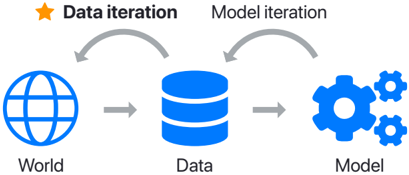
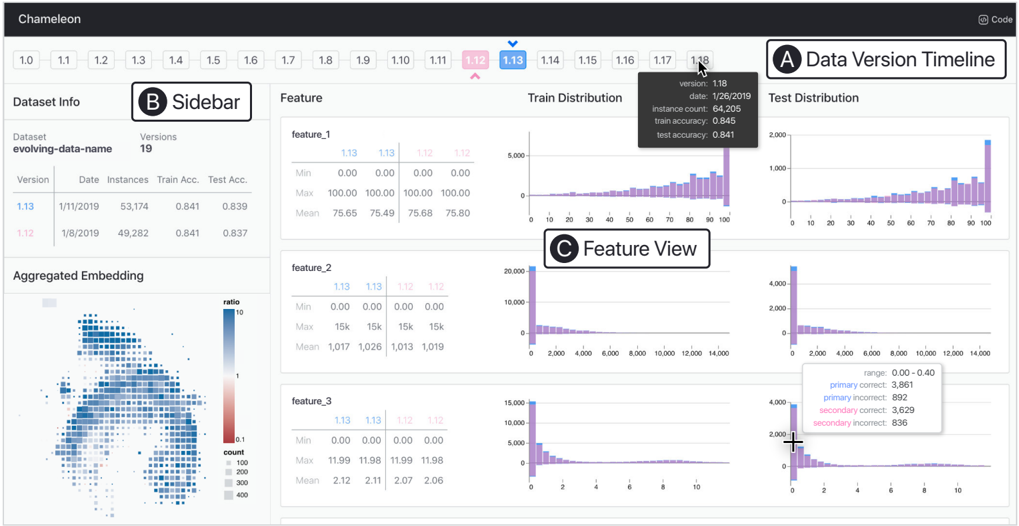
Successful machine learning (ML) applications require iterations on both modeling and the underlying data. While prior visualization tools for ML primarily focus on modeling, our interviews with 23 ML practitioners reveal that they improve model performance frequently by iterating on their data (e.g., collecting new data, adding labels) rather than their models. We also identify common types of data iterations and associated analysis tasks and challenges. To help attribute data iterations to model performance, we design a collection of interactive visualizations and integrate them into a prototype, Chameleon, that lets users compare data features, training/testing splits, and performance across data versions. We present two case studies where developers apply \system to their own evolving datasets on production ML projects. Our interface helps them verify data collection efforts, find failure cases stretching across data versions, capture data processing changes that impacted performance, and identify opportunities for future data iterations.
Overview
The claims and statistics of this paper haven’t been checked yet.
Free: it reads the open-access text and checks the first 5 claims that cite a source we can check. Create a free account to check every claim.
Integrity signals
Registry
Cites
Statistics
Figures

Verification
Claims the paper makes
The claims and statistics of this paper haven’t been checked yet.
Free: it reads the open-access text and checks the first 5 claims that cite a source we can check. Create a free account to check every claim.
Self-check
Percentages, sums and reported differences re-computed from the paper’s own numbers.
The self-check needs the paper’s full text.
Citations
Cites
(2008) · Journal of Machine Learning Research · Cited by 33,051
David, F. N., & Tukey, J. W. (1977) · Biometrics · doi:10.2307/2529486 · Cited by 12,708 · cited 1×
“During exploratory data analysis [43, 14], users may be unfamiliar with their resources (e.g., data), uncertain of their goals, and unsure how to reach them.”
BackgroundTensorFlow: Large-Scale Machine Learning on Heterogeneous Distributed Systems
Abadi, M., Agarwal, A., Barham, P., Brevdo, E., Chen, Z., Citro, C., Corrado, G. S., Davis, A., Dean, J., Devin, M., et al. (2016) · arXiv · doi:10.48550/arxiv.1603.04467 · Cited by 9,408
UMAP: Uniform Manifold Approximation and Projection for Dimension Reduction
McInnes, L., Healy, J., & Melville, J. (2018) · arXiv · doi:10.48550/arxiv.1802.03426 · Cited by 7,101 · cited 2×
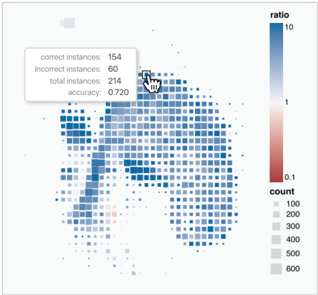
“For reduction and visualization, the Aggregated Embedding uses UMAP [26]: a non-linear dimensionality reduction that better preserves global data structure compared to other techniques like t-SNE [25].”
MethodSoftware Engineering for Machine Learning: A Case Study
Amershi, S., Begel, A., Bird, C., DeLine, R., Gall, H., Kamar, E., Nagappan, N., Nushi, B., & Zimmermann, T. (2019) · 2019 IEEE/ACM 41st International Conference on Software Engineering: Software Engineering in Practice (ICSE-SEIP) · doi:10.1109/icse-seip.2019.00042 · Cited by 1,135 · cited 1×
“A recent study of ML industry professionals found that “discovering, managing, and versioning the data needed for machine learning applications is much more complex and difficult than other types of software engi-neering” [3].”
BackgroundPower to the People: The Role of Humans in Interactive Machine Learning
Amershi, S., Cakmak, M., Knox, W. B., & Kulesza, T. (2014) · AI Magazine · doi:10.1609/aimag.v35i4.2513 · Cited by 1,084 · cited 3×
“Successful machine learning (ML) applications require an iterative process to create models that deliver desired performance and user experience [4, 38].”
BackgroundA Survey on Data Collection for Machine Learning: A Big Data - AI Integration Perspective
Roh, Y., Heo, G., & Whang, S. E. (2021) · IEEE Transactions on Knowledge and Data Engineering · doi:10.1109/tkde.2019.2946162 · Cited by 968 · cited 4×
“This is corroborated in prior data collection work [35].”
BackgroundResultInfluentialFaceted metadata for image search and browsing
Yee, K.-P., Swearingen, K., Li, K., & Hearst, M. (2003) · Proceedings of the SIGCHI Conference on Human Factors in Computing Systems · doi:10.1145/642611.642681 · Cited by 898 · cited 1×
“Faceted browsing [47] lets users use metadata to filter subsets of data that share desired properties.”
BackgroundVega-Lite: A Grammar of Interactive Graphics
Satyanarayan, A., Moritz, D., Wongsuphasawat, K., & Heer, J. (2017) · IEEE Transactions on Visualization and Computer Graphics · doi:10.1109/tvcg.2016.2599030 · Cited by 883 · cited 1×
“Visual-izations were constructed and rendered using Vega-Lite [37].”
MethodSelf-citationSnorkel: rapid training data creation with weak supervision
Ratner, A., Bach, S. H., Ehrenberg, H., Fries, J., Wu, S., & Ré, C. (2017) · Proceedings of the VLDB Endowment · doi:10.14778/3157794.3157797 · Cited by 777 · cited 1×
“…Probabilistic Labels from Data Programming As data programming, weakly-supervised probabilistic label generation for large sets of unlabeled data [32, 33], becomes more popular and is used as an alternative to expensive data labeling tasks, it is important to know when and how label updates are…”
Background
Research works printed but not linked: 1
- 12. Matthias Feurer, Aaron Klein, Katharina Eggensperger, Jost Springenberg, Manuel Blum, and Frank Hutter. 2015. Efficient and robust automated machine learning. In Advances in Neural Information Processing Systems. 2962-2970.
Cited by
Items 101–125 of 125
Eliciting Model Steering Interactions from Users via Data and Visual Design ProbesPreprint
Crisan, A., Shang, M., & Brochu, E. (2023) · arXiv (Cornell University) · doi:10.48550/arxiv.2310.09314 · Cited by 1
“The Chameleon [47] prototype enables ML practitioners to visualize the effects of their data changes on the model’s features and performance.”
BackgroundANOVA exemplars for understanding data drift.Preprint
Williamson, S. A. (2020) · arXiv (Cornell University)
Wu, T. (2021) · CHI Conference Extended Abstracts on Human Factors in Computing Systems (CHI EA) · doi:10.1145/3411763.3443423 · Cited by 2
“, LIME [26], SHAP [22], anchors [27]) or groupings of model weights [14, 19].”
BackgroundIMACS: Image Model Attribution Comparison SummariesPreprint
Schoop, E., Wedin, B., Kapishnikov, A., Bolukbasi, T., & Terry, M. (2022) · arXiv (Cornell University) · doi:10.48550/arxiv.2201.11196 · Cited by 1
Research of Data-driven Iterative Optimization Scheme for Machine Learning Models
Jin-sen, Y., Zou, Z., Xiu, J., Wang, P., & Yang, Y. (2022) · International Conference on Computing and Big Data (ICCBD) · doi:10.1109/iccbd56965.2022.10079951
“construction, and these data may have deep impact on the model performance [7].”
BackgroundYu, J.-D. (2023) · Journal of Digital Contents Society · doi:10.9728/dcs.2023.24.7.1567
Magnusson, M., Schüpbach‐Regula, G., Rieger, J., Plendl, J., Marin, I., Drews, B., & Kaessmeyer, S. (2024) · Clinical Hemorheology and Microcirculation · doi:10.3233/ch-242157
“The quality and performance of the AI exhibit a direct correlation with both the quantity of training data and the number of iterations applied during the training process [31], however, this also extends the training time.”
Song, H., Ramos, G., & Bodík, P. (2024) · IEEE Pacific Visualization Conference (PacificVis) · doi:10.1109/pacificvis60374.2024.00043
“Predictions over data that has a temporal component (e.g., temporal stability [15,24]) can reveal insightful patterns about a model’s performance, that cannot be observed by inspecting individual predictions in isolation.”
BackgroundTA3: Testing Against Adversarial Attacks on Machine Learning ModelsPreprint
Jin, Y., & Chen, M. (2024) · arXiv (Cornell University) · doi:10.48550/arxiv.2410.05334 · Cited by 3
An Investigation of How Software Developers Read Machine Learning Code
Weber, T., Winiker, C., & Mayer, S. (2024) · Proceedings of the ... ACM-IEEE International Symposium on Empirical Software Engineering and Measurement/International Symposium on Empirical Software Engineering and Measurement · doi:10.1145/3674805.3686678
“However, ML adds additional complexity to the development since developers must create and improve not just the code but also the underlying data and ML models [20].”
Examining the Efficiency of Various Classification Algorithms in Spam Detection Datasets
Umar, M., Gupta, M., Didwania, R., Verma, R., & Dhanda, N. (2024) · International Conference on Computing, Communication and Networking Technologies (ICCCNT) · doi:10.1109/icccnt61001.2024.10724121
An Effective Data Visualization Overview and Impact
Vijayalakshmi, P. S., Poorana Senthilkumar, S., & John, R. (2025) · IGI Global eBooks · doi:10.4018/979-8-3693-7868-7.ch003
Reframing AI: Three studies of AI in the laboratory life of biotechnology
Karačić, T. (2025) · doi:10.5463/thesis.1051 · Cited by 2
The Collaborative Interplay Between Data Science and UX Research
Sankar, K. P. N., Arjunwadkar, H., Gajaralwar, T., & Sinha, A. K. (2025) · Lecture notes in mechanical engineering · doi:10.1007/978-981-96-5503-8_12
Heinsohn Huala, T. (. (2021) · Research Repository (Delft University of Technology)
Data-Diff with Strict Increment Modifiers
Wattanawaroon, T., Fakcharoenphol, J., & Rakthanmanon, T. (2025) · International Computer Science and Engineering Conference · doi:10.1109/icsec67360.2025.11297993
“In developing these systems, one can choose to build a system that allows data scientists to manually annotate the manipulations performed on the datasets [6], [7] or visualize the data management efforts [1].”
Review and Analysis of Scientific Paper EmbellishmentsPreprint
Hong, J., Wang, Y., Isenberg, P., & Maciejewski, R. (2026) · arXiv (Cornell University) · doi:10.48550/arxiv.2603.20306 · Cited by 1
Teaching AI through Object Demonstrations and Language Instructions
周中一 (2024) · Institutional Repositories DataBase (IRDB) · doi:10.15083/0002012805
Interactive Machine Teaching with and for Novices
Sanchez, T. (2022) · theses.fr (ABES) · doi:10.70675/f9bbe7e9z23c5z4addza033zd820abe13bc9 · Cited by 3
Regimes of Scale in AI MeteorologyPreprint
Martin, A., & Lin, C. (2026) · arXiv (Cornell University) · doi:10.48550/arxiv.2604.06000 · Cited by 1
“For example, Hohman et. al theorize "data iteration" in AI/ML by pulling from interviewees across "diverse ML domains" including NLP, computer vision, and "Applied ML + Systems" [23].”
Analyzing Notebook Histories to Understand Data Visualization Workflows
Koop, D., Brown, C., Alhoori, H., & Sun, M. (2026) · IEEE Transactions on Visualization and Computer Graphics · doi:10.1109/tvcg.2026.3694431
“Methods to visualize changes, both to code and data, have been introduced in TACO [27] and CHAMELEON [14] which focus on a timeline to root the changes to data.”
Guo, M., Gotz, D., & Wang, Y. (2026) · ACM Conference on Fairness, Accountability, and Transparency (FAccT) · doi:10.1145/3805689.3806512
Improving Accuracy: Comparative Analysis of Machine Learning Models for Prostate Cancer Prediction
Beltozar-Clemente, S., Díaz-Vega, E., Ramos, I. C., & Tejeda-Navarrete, R. E. (2023) · International Journal of Intelligent Systems and Applications in Engineering
Zastosowanie narzędzi AI w praktyce akademickiej: Wsparcie tworzenia i weryfikacja prac dyplomowych
Popović, M., & Błaszczyk, M. (2026) · Wydawnictwo Uniwersytetu Łódzkiego eBooks · doi:10.18778/8445-081-9
Metadata
- Authors
- Hohman, F., Wongsuphasawat, K., Kery, M. B., & Patel, K.
- Affiliations
- Georgia Institute of Technology (US)
- Apple (United States) (US)
- Carnegie Mellon University (US)
- Venue
- Proceedings of the 2020 CHI Conference on Human Factors in Computing Systems
- Publisher
- ACM
- Published
- 2020-04-21
- Pages
- 1-13
- OpenAlex
- W3032086959
- Semantic Scholar
- d6b9a5a2af3c2f9044c505855b27310132b7f3d4
- Cited by
- 110
- References
- 48
- Citations by year
- 2026: 5 · 2025: 16 · 2024: 24 · 2023: 19 · 2022: 19 · 2021: 22 · 2020: 5
- FWCI
- 5.01
- Type
- conference paper
- Language
- en
- Open access
- hybrid
- doi.org
- Licence
- Locations
- CHI Conference on Human Factors in Computing Systems (publishedVersion, cc-by)
- Topics
- Physical Sciences › Computer Science › Computer Graphics and Computer-Aided Design › Data Visualization and Analytics
- Physical Sciences › Computer Science › Information Systems › Software Engineering Research
- Social Sciences › Decision Sciences › Information Systems and Management › Scientific Computing and Data Management
- Keywords
- interactive visualization, data versioning, training-test split, data collection, data annotation, failure case analysis, machine learning in production
About these checks
Registry, retraction, Cites and statistics results are computed, not judged, with one exception: a printed reference that no index lists is read once by a model before it counts as a citation error. Claims are extracted by a model and kept only when their quote appears verbatim in the text; each cited source is then checked, with a model’s help, for whether it says what the claim relies on. Those verdicts can be wrong — read the claim’s quote and the cited source before relying on one.
Statistics and arithmetic are recomputed, not judged.
Confidence bands are shown only for fields calibrated on our annotated test set. None is calibrated yet, so no band is shown.
What counts as a claim ›How we measure confidence ›How we check this ›
Are you an author, or do you see a problem with this page? Request a review
Data sources
Bibliographic data: Semantic Scholar, OpenAlex, Crossref.
Contains information from the Semantic Scholar Academic Graph Datasets, made available under the ODC Attribution License (ODC-BY 1.0).
Semantic Scholar’s data is described in: Kinney, R., et al. (2023). The Semantic Scholar Open Data Platform. arXiv:2301.10140.
