

Wordcraft: Story Writing With Large Language Models
Open accessThe DOI matches its Crossref record; 21 of the 21 references it cites were found in a registry or an index.
Abstract
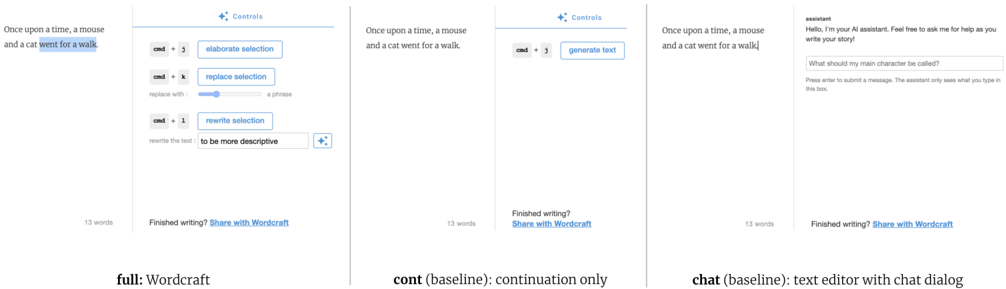
The latest generation of large neural language models such as GPT-3 have achieved new levels of performance on benchmarks for language understanding and generation. These models have even demonstrated an ability to perform arbitrary tasks without explicit training. In this work, we sought to learn how people might use such models in the process of creative writing. We built Wordcraft, a text editor in which users collaborate with a generative language model to write a story. We evaluated Wordcraft with a user study in which participants wrote short stories with and without the tool. Our results show that large language models enable novel co-writing experiences. For example, the language model is able to engage in open-ended conversation about the story, respond to writers’ custom requests expressed in natural language (such as ”rewrite this text to be more Dickensian”), and generate suggestions that serve to unblock writers in the creative process. Based on these results, we discuss design implications for future human-AI co-writing systems.
Overview
The claims and statistics of this paper haven’t been checked yet.
Free: it reads the open-access text and checks the first 5 claims that cite a source we can check. Create a free account to check every claim.
Integrity signals
Registry
Cites
Statistics
Figures
Verification
Claims the paper makes
The claims and statistics of this paper haven’t been checked yet.
Free: it reads the open-access text and checks the first 5 claims that cite a source we can check. Create a free account to check every claim.
Claims other papers make about this one
Each is checked against this paper’s own text: does it say what the citing paper says it does?
The source backs part of the claim, not all of it — or backs it for a different population, condition or comparison.
In the citing paper
“Empirical studies describing how users evaluate LLMs are still a minority and difficult to generalise due to a variation of participants, methods, systems, and disciplinary perspectives [13,27,28,38,47].”
From Playwriting with Large Language Models: Perceived Features, Interaction Strategies and Outcomes (2024) · cites this paper as [47]
Experimental — accuracy not yet measuredThe source backs part of the claim, not all of it — or backs it for a different population, condition or comparison.
In the citing paper
“Despite these limitations, playwrights identified utility at different stages of creative writing, from brainstorming through the summarisation of relevant sources to editing [27,42,47].”
From Playwriting with Large Language Models: Perceived Features, Interaction Strategies and Outcomes (2024) · cites this paper as [47]
Experimental — accuracy not yet measuredThe source backs part of the claim, not all of it — or backs it for a different population, condition or comparison.
In the citing paper
“These interfaces typically provide end-users with only one text area for inputs, which is frequently shared with the output, and one control panel to confgure global settings for the parameters [1,69,85,109].”
From Cells, Generators, and Lenses: Design Framework for Object-Oriented Interaction with Large Language Models (2023) · cites this paper as [109]
Experimental — accuracy not yet measuredThe source backs part of the claim, not all of it — or backs it for a different population, condition or comparison.
In the citing paper
“Students can continually alter prompts to refine the model output helping them to 'build-up' a solution [196].”
From The Robots Are Here: Navigating the Generative AI Revolution in Computing Education (2023) · cites this paper as [196]
Experimental — accuracy not yet measuredThe source backs part of the claim, not all of it — or backs it for a different population, condition or comparison.
In the citing paper
“End-user studies suggest that prompting is challenging, with nonexpert users making various errors and adopting ineffective strategies-a reflection of the demand on users' metacognitive monitoring and control [33,41,43,85,103,174,205].”
From The Metacognitive Demands and Opportunities of Generative AI (2024) · cites this paper as [205]
Experimental — accuracy not yet measured
7 more claims about this paper
Create a free account to see every claim other papers make about this one.
Self-check
Percentages, sums and reported differences re-computed from the paper’s own numbers.
The self-check needs the paper’s full text.
Citations
Cites
Language Models are Few-Shot Learners
Brown, T. B., Mann, B., Ryder, N., Subbiah, M., Kaplan, J., Dhariwal, P., Neelakantan, A., Shyam, P., Sastry, G., Askell, A., et al. (2020) · arXiv · doi:10.48550/arxiv.2005.14165 · Cited by 23,372 · cited 4×
“[38] proposed the idea of designing a prompt that contains several examples of the target task, written in natural language.”
BackgroundInfluential2009 International Joint Conference on Artificial Intelligence
(2009) · doi:10.1109/jcai15434.2009 · Cited by 2,800
Evaluating Large Language Models Trained on Code
Chen, M., Tworek, J., Jun, H., Yuan, Q., Pinto, H. P. D. O., Kaplan, J., Edwards, H., Burda, Y., Joseph, N., Brockman, G., et al. (2021) · arXiv · doi:10.48550/arxiv.2107.03374 · Cited by 1,436 · cited 1×
“Despite the simplicity of this API, large language models (LLMs) have demonstrated proficiency at a wide variety of tasks—from storytelling [1, 28] to code synthesis [4, 9] and email auto-completion [40].”
BackgroundLaMDA: Language Models for Dialog Applications
Thoppilan, R., De Freitas, D., Hall, J., Shazeer, N., Kulshreshtha, A., Cheng, H.-T., Jin, A., Bos, T., Baker, L., Du, Y., et al. (2022) · arXiv · doi:10.48550/arxiv.2201.08239 · Cited by 778 · cited 2×
“In the exit interview, one user commented about the chatbot: ” I loved that it felt like a more targeted version of Google, and I could do background research while writing ” (U21).”
MethodCTRL: A Conditional Transformer Language Model for Controllable Generation
Keskar, N. S., McCann, B., Varshney, L. R., Xiong, C., & Socher, R. (2019) · arXiv · doi:10.48550/arxiv.1909.05858 · Cited by 751 · cited 1×
“Researchers have also built story generation models that incorporate event sequences [33], desired topic [29], and story title [2] as control signals.”
BackgroundExtracting Training Data from Large Language Models
Carlini, N., Tramer, F., Wallace, E., Jagielski, M., Herbert-Voss, A., Lee, K., Roberts, A., Brown, T., Song, D., Erlingsson, U., et al. (2020) · arXiv · doi:10.48550/arxiv.2012.07805 · Cited by 727 · cited 1×
“LLMs have also been found to output memorized passages from their training data [26].”
BackgroundGPT-NeoX-20B: An Open-Source Autoregressive Language Model
Black, S., Biderman, S., Hallahan, E., Anthony, Q., Gao, L., Golding, L., He, H., Leahy, C., McDonell, K., Phang, J., et al. (2022) · Proceedings of BigScience Episode #5 -- Workshop on Challenges & Perspectives in Creating Large Language Models · doi:10.18653/v1/2022.bigscience-1.9 · Cited by 404
GPT-Neo: Large Scale Autoregressive Language Modeling with Mesh-Tensorflow
Black, S., Leo, G., Wang, P., Leahy, C., & Biderman, S. (2021) · Zenodo · doi:10.5281/zenodo.5297715 · Cited by 324 · cited 1×
“Neural language models, such as GPT-2 [34] or GPT-Neo [5], are neural networks that are trained only to predict the next word in a sequence given the previous words (aka a prompt).”
Background
Research works printed but not linked: 14
- 1. Nader Akoury, Shufan Wang, Josh Whiting, Stephen Hood, Nanyun Peng, and Mohit Iyyer. 2020. STORIUM: A Dataset and Evaluation Platform for Machine- in-the-Loop Story Generation. Empirical Methods in Natural Language Processing (2020).
- 3. Niki Parmar Jakob Uszkoreit Llion Jones Aidan N. Gomez Lukasz Kaiser Illia Polo- sukhin Ashish Vaswani, Noam Shazeer. 2017. Attention Is All You Need. Neural Information Processing Systems (2017).
- 6. Daniel Buschek, Martin Zurn, and Malin Eiband. 2021. The Impact of Multiple Parallel Phrase Suggestions on Email Input and Composition Behavior of Native and Non-Native English Writers. ACM (2021).
- 12. Chenhao Tan Yangfeng Ji Elizabeth Clark, Anne Spencer Ross and Noah A. Smith. 2018. Creative Writing with a Machine in the Loop: Case Studies on Slogans and Stories. Intelligent User Interfaces (2018).
- 15. Cheng-Zhi Huang. 2020. AI Song Contest: Human-AI Co-Creation in Songwriting. International Society for Music Information Retrieval Conference (2020).
- 18. Christian Remy Michael Mose Biskjaer Jonas Frich, Lindsay MacDonald Ver- meulen and Peter Dalsgaard. 2019. Mapping the Landscape of Creativity Support Tools in HCI. Computer Human Interaction (2019).
- 19. Varun Kumar Satyapriya Krishna Yada Pruksachatkun Kai-Wei Chang Jwala Dhamala, Tony Sun and Rahul Gupta. 2021. Bold: Dataset and met- rics for measuring biases in open-ended language generation. arXiv preprint arXiv:2101.11718 (2021). · arXiv
- 23. Jay Priyadarshi Marjan Ghazvininejad, Xing Shi and Kevin Knight. 2017. Hafez: an Interactive Poetry Generation System. Association for Computational Linguistics (2017).
- 24. Jonathan Chen Shao-Yu Chen Shukan Shah-Vishwa Shah Joshua Reno Gillian Smith Matthew Guzdial, Nicholas Liao and Mark O. Riedl. 2019. Friend, Collaborator, Student, Manager: How Design of an AI-Driven Game Level Editor Affects Creators. Computer Human Interaction (2019).
- 33. Wesley Cheung Zhaochen Luo William Ma Lara J Martin Prithviraj Ammanabrolu, Ethan Tien and Mark O Riedl. 2020. Story realization: Expanding plot events into sentences. Proceedings of the AAAI Conference on Artificial Intelligence (2020).
- 34. Alec Radford, Jeffrey Wu, Rewon Child, David Luan, Dario Amodei, Ilya Sutskever, et al. 2019. Language models are unsupervised multitask learners. OpenAI blog 1, 8 (2019), 9.
- 35. Nathan Dass Sadao Kurohashi Dan Jurafsky Diyi Yang Reid Pryzant, Richard Diehl Martinez. 2020. Automatically Neutralizing Subjective Bias in Text. AAAI (2020).
- 39. Shi Feng Dan Klein Sameer Singh Tony Z. Zhao, Eric Wallace. 2021. Calibrate Before Use: Improving Few-Shot Performance of Language Models. Proceedings of Machine Learning Research (2021).
- 40. Yonghui Wu. 2018. Smart compose: Using neural networks to help write emails. Google AI Blog (2018).
Cited by
Items 201–300 of 393
Leveraging Large Language Models for Analysis of Student Course Feedback
Wang, Z., Denny, P. C., Leinonen, J., & Luxton-Reilly, A. (2023) · Bangalore Annual Compute Conference · doi:10.1145/3627217.3627221 · Cited by 7
An Ensemble LLM Framework of Text Recognition Based on BERT and BPE Tokenization
Huang, Z. (2024) · International Seminar on Artificial Intelligence, Networking and Information Technology (AINIT) · doi:10.1109/ainit61980.2024.10581466 · Cited by 7
“In recent times, due to the swift advancement of technology, LLMs have also shown their potential in creative writing, game design, and artistic creation, capable of generating unique texts, scripts, game plots, and artistic patterns [3].”
BackgroundLLMs as Writing Assistants: Exploring Perspectives on Sense of Ownership and Reasoning
Wasi, A. T., Islam, M. R., & Islam, R. (2024) · Workshop on Intelligent and Interactive Writing Assistants (In2Writing) · doi:10.1145/3690712.3690723 · Cited by 35
“When using LLMs for writing assistance, our sense of ownership varies depending on the type of content we’re creating.”
MethodTransformers Can Outperform Humans in Short Creative Writing TasksPreprint
Marco, G., Gonzalo, J. A., & Rello, L. (2023) · SSRN Electronic Journal · doi:10.2139/ssrn.4673692 · Cited by 9
Ironies of Generative AI: Understanding and mitigating productivity loss in human-AI interactions
Simkute, A., Tankelevitch, L., Kewenig, V., Scott, A. E., Sellen, A., & Rintel, S. (2024) · arXiv · doi:10.48550/arxiv.2402.11364 · Cited by 7
Nabokov's Cards: An AI Assisted Prewriting System to Support Bottom-Up Creative Writing
Carrera, D., Zhao, Z., Ajin Thomas, A., & Wigdor, D. (2025) · Proceedings of the 2025 Conference on Creativity and Cognition · doi:10.1145/3698061.3726916 · Cited by 6
Comuniqa: Exploring Large Language Models For Improving English Speaking Skills
Sharma, S., Mhasakar, M., Mehra, A., Venaik, U., Singhal, U., Kumar, D., & Mittal, K. C. (2024) · ACM SIGCAS/SIGCHI Conference on Computing and Sustainable Societies (COMPASS) · doi:10.1145/3674829.3675082 · Cited by 27
Visual Story-Writing: Writing by Manipulating Visual Representations of Stories
Masson, D., Zhao, Z., & Chevalier, F. (2025) · ACM Symposium on User Interface Software and Technology (UIST) · doi:10.1145/3746059.3747758 · Cited by 24
NoTeeline: Supporting Real-Time, Personalized Notetaking with LLM-Enhanced Micronotes
Huq, F., Samee, A., Lin, D. C.-E., Tang, A. X., & Bigham, J. P. (2025) · Proceedings of the 30th International Conference on Intelligent User Interfaces · doi:10.1145/3708359.3712086 · Cited by 7
Infinity Book: Speculating Literary Expressions in the Age of Generative AI
Holopainen, J. P., Huang, Y., Shin, J., Nissinen, E., & Lucero, A. (2025) · Designing Interactive Systems Conference · doi:10.1145/3715336.3735735 · Cited by 11
Gursesli, M. C., Chen, S., Dewantoro, M. F., You, X., Anbar, E., Taveekitworachai, P., Abdullah, F., Tarchi, P., Duradoni, M., Lanatà, A., et al. (2025) · International Journal of Human-Computer Interaction · doi:10.1080/10447318.2025.2528993 · Cited by 11
“Similarly, Yuan et al. (2022) proposed Wordcraft an LLM-powered web application to assist writers in story creation, enhancing co-writing experience.”
EchoLadder: Progressive AI-Assisted Design of Immersive VR Scenes
Hou, Z., Tian, J., Li, N., Ren, F., & Liu, C. (2025) · ACM Symposium on User Interface Software and Technology (UIST) · doi:10.1145/3746059.3747659 · Cited by 15
Semantic Commit: Helping Users Update Intent Specifications for AI Memory at Scale
Vaithilingam, P., Kim, M. G., Acosta-Parenteau, F.-C., Lee, D. W., Mhedhbi, A., Glassman, E. L., & Arawjo, I. (2025) · ACM Symposium on User Interface Software and Technology (UIST) · doi:10.1145/3746059.3747778 · Cited by 31
Schömbs, S., Zhang, Y., Gonçalves, J., & Johal, W. (2025) · International Conference on Human-Agent Interaction (HAI) · doi:10.1145/3765766.3765795 · Cited by 19
Trustworthiness of Children Stories Generated by Large Language Models
Bhandari, P., & Brennan, H. (2023) · International Conference on Natural Language Generation · doi:10.18653/v1/2023.inlg-main.24 · Cited by 31
Chung, J. G., Hong, S., Choi, J., & Oh, C. (2025) · CHI Conference on Human Factors in Computing Systems · doi:10.1145/3706598.3713532 · Cited by 11
Flathmann, C., McNeese, N. J., Sengupta, S., & Johnson, E. (2025) · ACM Transactions on Interactive Intelligent Systems · doi:10.1145/3764591 · Cited by 12
-generAItor: Tree-in-the-loop Text Generation for Language Model Explainability and Adaptation
Spinner, T., Kehlbeck, R., Sevastjanova, R., Stähle, T., Keim, D. A., Deußen, O., & El‐Assady, M. (2024) · ACM Transactions on Interactive Intelligent Systems · doi:10.1145/3652028 · Cited by 15
GL-NER: Generation-Aware Large Language Models for Few-Shot Named Entity Recognition
Zhu, X., Dai, F., Gu, X., Li, B., Zhang, M., & Wang, W. (2024) · Lecture notes in computer science · doi:10.1007/978-3-031-72350-6_30 · Cited by 17
A Pattern-Oriented AI-Powered Approach to Story Composition
de Lima, E. S., Neggers, M. M. E., Casanova, M. A., Feijó, B., & Furtado, A. L. (2024) · Lecture notes in computer science · doi:10.1007/978-3-031-74353-5_10 · Cited by 13
Can LLMs Infer Domain Knowledge from Code Exemplars? A Preliminary Study
Guo, J., Mohanty, V., Hao, H., Gou, L., & Ren, L. (2024) · ACM International Conference on Intelligent User Interfaces (IUI) · doi:10.1145/3640544.3645228 · Cited by 9
Toyteller: Toy-Playing with Character Symbols for AI-Powered Visual Storytelling
Chung, J. J. Y., Roemmele, M., & Kreminski, M. (2024) · ACM Symposium on User Interface Software and Technology (UIST) · doi:10.1145/3672539.3686781 · Cited by 5
Automated Software Testing through Large Language Models: Opportunities and Challenges
Fuente, J. A. D. (2022) · Qubahan Techno Journal · doi:10.48161/qtj.v1n3a15 · Cited by 5
Authoring LLM-Based Assistance for Real-World Contexts and Tasks
Dang, H., Lafreniere, B., Grossman, T., Todi, K., & Li, M. (2025) · ACM International Conference on Intelligent User Interfaces (IUI) · doi:10.1145/3708359.3712164 · Cited by 11
VR, Deepfakes and Epistemic Security
Aliman, N.-M., & Kester, L. J. H. M. (2022) · IEEE International Conference on Artificial Intelligence and Virtual Reality (AIVR) · doi:10.1109/aivr56993.2022.00019 · Cited by 14
“Firstly, large language models have been described to be able to enhance human creativity [64]–[66] especially by generating counterfactual text samples that unfold a “multi-versal” [67] approach.”
BackgroundGPT for the Metaverse in Smart Cities
Ramalingam, M., Yenduri, G., Baza, M., Srivastava, G., Raj, G. D., Chemmalar Selvi, G., & Gadekallu, T. R. (2023) · International Symposium on Wireless Personal Multimedia Communications (WPMC) · doi:10.1109/wpmc59531.2023.10338966 · Cited by 13
“Large language models are investigated by [15] in order to construct a story in collaboration with users.”
BackgroundFrom Imitation to Introspection: Probing Self-Consciousness in Language Models
Chen, S., Yu, S., Zhao, S., & Lu, C. (2025) · Findings of the Association for Computational Linguistics: ACL 2025 · doi:10.18653/v1/2025.findings-acl.392 · Cited by 29
Personality Emulation Utilizing Large Language Models
Kolenbrander, J., & Michaels, A. J. (2025) · Applied Sciences · doi:10.3390/app15126636 · Cited by 6
“Large language models (LLMs) are one tool that has demonstrated the ability to efficiently generate written content [7–9] and email responses [10,11].”
Zhou, D., Gallagher, J. R., & Sterman, S. (2025) · Creativity and Cognition · doi:10.1145/3698061.3726907 · Cited by 9
Park, S., Kim, J., Choi, J., Seering, J., Lee, U., & Lee, S.-J. (2025) · Proceedings of the ACM on Human-Computer Interaction · doi:10.1145/3757609 · Cited by 4
Human-AI Co-Creation: A New Interaction Paradigm for Human-AI Interaction
Davis, N., Clemens, M., Rezwana, J., & Browne, E. (2025) · Springer eBooks · doi:10.1007/978-981-97-8440-0_76-1 · Cited by 9
Can We Enhance Bug Report Quality Using LLMs?: An Empirical Study of LLM-Based Bug Report Generation
Acharya, J., & Ginde, G. (2025) · International Conference on Evaluation and Assessment in Software Engineering (EASE) · doi:10.1145/3756681.3756995 · Cited by 18
Reactive Writers: How Co-Writing with AI Changes How We Engage with Ideas
Bhat, A., Quéré, M. A. L., Naaman, M., & Jakesch, M. (2026) · CHI Conference on Human Factors in Computing Systems · doi:10.1145/3772318.3791529 · Cited by 18
GigSense: An LLM-Infused Tool for Workers’ Collective Intelligence
Imteyaz, K., Flores-Saviaga, C., & Savage, S. (2024) · Avances en Interacción Humano-Computadora · doi:10.47756/aihc.y9i1.159 · Cited by 11
Kim, D. H., Jeong, D., Yadgarova, S., Shin, H., Son, J., Subramonyam, H., & Kim, J. (2025) · CHI Conference on Human Factors in Computing Systems · doi:10.1145/3706598.3714044 · Cited by 8
Zhao, W., Yu, F., Zhang, P., Gu, H., Wang, L., Qiao, S., Lu, T., & Gu, N. (2025) · CHI Conference on Human Factors in Computing Systems · doi:10.1145/3706598.3713360 · Cited by 8
Can LLMs Generate Good Stories? Insights and Challenges from a Narrative Planning Perspective
Wang, Y., & Kreminski, M. (2025) · IEEE Conference on Games (CoG) · doi:10.1109/cog64752.2025.11114137 · Cited by 11
“…has brought about increased interest in text-oriented story generation, including via text continuation [23], [24]; instruction-based prompting [25]; more complicated prompt-chaining strategies, such as plan-and-write [26]; emergent narrative via LLM-based character simulation [27]; and even…”
Synthia: Visually Interpreting and Synthesizing Feedback for Writing Revision
Zhang, C., Ju, K. P., Han, Z., Yen, Y.-C. G., & Rzeszotarski, J. M. (2025) · ACM Symposium on User Interface Software and Technology (UIST) · doi:10.1145/3746059.3747703 · Cited by 15
Effective Tool Augmented Multi-Agent Framework for Data Analysis
Zhang, X., Mao, Z., Chen, Z., & Gao, S. (2024) · Data Intelligence · doi:10.3724/2096-7004.di.2024.0013 · Cited by 17
Chen, Y., & Liu, Z. (2024) · Workshop on Intelligent and Interactive Writing Assistants (In2Writing) · doi:10.1145/3690712.3690715 · Cited by 6
Exploring Mobile Touch Interaction with Large Language Models
Zindulka, T., Sekowski, J. M., Lehmann, F., & Buschek, D. (2025) · CHI Conference on Human Factors in Computing Systems · doi:10.1145/3706598.3713554 · Cited by 8
“Additionally, recent re-lated research as well as industry products 2 have introduced elements like a sidebar , to integrate a text editor with a UI for accessing LLMs (e.g. Wordcraft [37]).”
TutorCraftEase: Enhancing Pedagogical Question Creation with Large Language Models
Kang, W., Zhang, L., Peng, X., Zhang, H., Li, A., Wang, M., Huang, J., Tian, F., & Dai, G. (2025) · CHI Conference on Human Factors in Computing Systems · doi:10.1145/3706598.3713731 · Cited by 13
Integrating Reinforcement AI into the Design of Educational Games
Amresh, A. (2023) · European Conference on Games Based Learning · doi:10.34190/ecgbl.17.1.1709 · Cited by 4
ARIES: A Corpus of Scientific Paper Edits Made in Response to Peer Reviews
D’Arcy, M., Ross, A., Bransom, E., Kuehl, B., Bragg, J., Hope, T., & Downey, D. (2024) · Proceedings of the 62nd Annual Meeting of the Association for Computational Linguistics (Volume 1: Long Papers) · doi:10.18653/v1/2024.acl-long.377 · Cited by 4
Zhang, S., Ye, L., Yi, X., Tang, J., Shui, B., Xing, H., Liu, P., & Li, H. (2024) · arXiv · doi:10.48550/arxiv.2410.14931 · Cited by 4
Where Do I 'Add the Egg'?: Exploring Agency and Ownership in AI Creative Co-Writing Systems
Carrera, D., Thomas-Mitchell, J., & Wigdor, D. (2026) · Proceedings of the 2026 CHI Conference on Human Factors in Computing Systems · doi:10.1145/3772318.3791952 · Cited by 3
Gupta, U., Kumar, A., Gupta, A., Raj, G., & Agrawal, A. P. (2024) · International Conference on Emerging Technologies and Innovation for Sustainability (EmergIN) · doi:10.1109/emergin63207.2024.10961487 · Cited by 5
“The objective is to improve the model's performance using the knowledge gathered from the assessment [27]. e) Prompting : This illustrates the exchange in which users give the LLM prompts.”
Incorporating Personality into AI Writing Companions: Mapping the Design Space
Wu, M., Quan, K., Liu, W., Yao, M. Z., & Chin, J. (2025) · CHI Conference Extended Abstracts on Human Factors in Computing Systems (CHI EA) · doi:10.1145/3706599.3720185 · Cited by 7
LLMs for Cold-Start Cutting Plane Separator Configuration
Lawless, C., Li, Y., Wikum, A., Udell, M. R., & Vitercik, E. (2025) · Lecture notes in computer science · doi:10.1007/978-3-031-95976-9_4 · Cited by 25
Tracing Creativity: A Design Space For Creative Activity Traces in HCI
Hammad, N., Lin, D. C.-E., Smith, A., Kreminski, M., Harpstead, E., & Hammer, J. (2026) · CHI Conference on Human Factors in Computing Systems · doi:10.1145/3772318.3791263 · Cited by 16
Nishal, S., Lee, M., Diakopoulos, N. A., & Vaughan, J. (2026) · CHI Conference on Human Factors in Computing Systems · doi:10.1145/3772318.3790372 · Cited by 7
“The scenario involved a health-focused story where participants explored system-generated suggestions tailored to these journalistic criteria, with an optional prompt for custom criteria [66].”
CHATGPT, SMART WRITING ASSISTANT CHATBOT FOR STUDENTS: AN ANALYSIS OF ITS DRAWBACKS
Yazid, S. R., & Dzulfikri, D. (2024) · Abjadia International Journal of Education · doi:10.18860/abj.v9i1.24459 · Cited by 8
“According to earlier research, it may have been difficult to grasp the output produced by AI writing assistants (Kasneci et al., 2023; Malinka et al., 2023; Yuan et al., 2022)(Kasneci et al., 2023; Malinka et al., 2023; Yuan et al., 2022).”
ResultAuthoring Educational Hypercomics assisted by Large Language Models
Grimm, V., & Rubart, J. (2024) · ACM Conference on Hypertext and Social Media (HT) · doi:10.1145/3648188.3675124 · Cited by 4
Is ChatGPT Ready for Public Use in Organ-Specific Drug Toxicity Research?
Connor, S., Wu, L., Roberts, R. A., & Tong, W. (2025) · Drug Discovery Today · doi:10.1016/j.drudis.2025.104297 · Cited by 4
Prompt Injection Detection in LLM Integrated Applications
Lan, Q.-L., AnujKaul, & Jones, S. (2025) · International Journal of Network Dynamics and Intelligence · doi:10.53941/ijndi.2025.100013 · Cited by 25
Textual Alchemy: AI, Authorship and the Shifting Paradigms of Interpretation
Hussain, A., & Qazi, K. A. (2023) · Rupkatha Journal on Interdisciplinary Studies in Humanities · doi:10.21659/rupkatha.v15n4.08 · Cited by 3
Alhussain, A., & Azmi, A. M. (2024) · Mathematics · doi:10.3390/math12101548 · Cited by 4
Can a Large Language Model Generate Plausible Business Cases from Agent-Based Simulation Results?
Kikuchi, T., Tanaka, Y., Kunigami, M., Takahashi, H., & Terano, T. (2024) · Studies in computational intelligence · doi:10.1007/978-3-031-56388-1_11 · Cited by 3
Cardistry: Exploring a GPT Model Workflow as an Adapted Method of Gaminiscing
Lyman, B., Ebrahimi, A., Cox, J., Chan, S., Barney, C., & Schutter, B. D. (2024) · International Conference on the Foundations of Digital Games (FDG) · doi:10.1145/3649921.3656984 · Cited by 4
Zindulka, T., Goller, S., Lehmann, F., & Buschek, D. (2025) · CHI Conference on Human Factors in Computing Systems · doi:10.1145/3706598.3713890 · Cited by 6
Ma, J., Sreedhar, K., Liu, V., Perez, P. A., Wang, S., Sahni, R., & Chilton, L. B. (2025) · CHI Conference on Human Factors in Computing Systems · doi:10.1145/3706598.3714115 · Cited by 14
Bao, H., He, K., Wang, Y., & Gao, Z. (2025) · Cognitive Computation · doi:10.1007/s12559-025-10466-6 · Cited by 7
“Inpractical applications, LLMs are extensively utilized in domains such as customer service automation, content recommendation systems, and writing assistance [44].”
GEAR: An Efficient KV Cache Compression Recipe for Near-Lossless Generative Inference of LLM
Kang, H., Zhang, Q., Kundu, S., Jeong, G., Liu, Z., Krishna, T., & Zhao, T. (2024) · arXiv · doi:10.48550/arxiv.2403.05527 · Cited by 2
“This phenomenon can be attributed to the non-trivial approximation error induced by them, i.e., di ff erence between original KV and the compressed ones.”
BackgroundELF-Gym: Evaluating Large Language Models Generated Features for Tabular Prediction
Zhang, Y., Li, N., Gan, Q., Zhang, W., Wipf, D., & Wang, M. (2024) · ACM International Conference on Information and Knowledge Management (CIKM) · doi:10.1145/3627673.3679153 · Cited by 14
Bhattacharya, K., Srinivasan, V., Keshwani, S., & Chakrabarti, A. (2025) · Journal of Computing and Information Science in Engineering · doi:10.1115/1.4068637 · Cited by 2
Fitzsimons, A., Gerber, E. M., & Long, D. (2025) · Creativity and Cognition · doi:10.1145/3698061.3726909 · Cited by 8
Script2Screen: Supporting Dialogue-Centric Scriptwriting with Interactive Audiovisual Generation
Wang, Z., Ma, J., Grinspun, E., Grossman, T., & Wang, B. K. (2026) · ACM International Conference on Intelligent User Interfaces (IUI) · doi:10.1145/3742413.3789075 · Cited by 6
PuppetLine: An Interactive System for Embodied Storytelling with LLM-driven Swarm Robots
Wang, R., Li, S., Zhang, P., Huang, D., Guo, Y., & Mi, H. (2025) · ACM Symposium on User Interface Software and Technology (UIST) · doi:10.1145/3746058.3759016 · Cited by 4
Facilitating Asynchronous Idea Generation and Selection with Chatbots
Shin, J., Khatri, A., Hedderich, M. A., Lucero, A., & Oulasvirta, A. (2024) · Australian Conference on Human-Computer Interaction (OzCHI) · doi:10.1145/3726986.3726994 · Cited by 4
Beyond Pre-Defined Scripts: Player Perceptions on Generative Non-Player Character Dialogues
Hochreiter, M., Kriglstein, S., & Wallner, G. (2026) · ACM International Conference on Intelligent User Interfaces (IUI) · doi:10.1145/3742413.3789221 · Cited by 10
Wu, M., Liu, G., Wang, B., & Ma, Z. (2026) · International Journal of Human-Computer Interaction · doi:10.1080/10447318.2026.2633738 · Cited by 3
From Crafting Text to Crafting Thought: Grounding AI Writing Support to Writing Center Pedagogy
Liu, Y., Gallagher, J., Sterman, S., & August, T. (2026) · CHI Conference on Human Factors in Computing Systems · doi:10.1145/3772318.3790292 · Cited by 7
Kerimoğlu, C. (2026) · Dil Araştırmaları · doi:10.54316/dilarastirmalari.1879242 · Cited by 2
DesignerlyLoop: Forming Design Intent through Curated Reasoning for Human-LLM Alignment
Wang, A., Li, Z., Tong, X., & Hui, P. (2026) · Designing Interactive Systems Conference · doi:10.1145/3800645.3812885 · Cited by 6
GIRT-Model: Automated Generation of Issue Report Templates
Nikeghbal, N., Kargaran, A. H., & Heydarnoori, A. (2024) · International Conference on Mining Software Repositories (MSR) · doi:10.1145/3643991.3644906 · Cited by 12
Accelerating Pharmacovigilance using Large Language Models
Prakash, M., Parab, G., Veeramalla, M., Reddy, S., Varun, V., Gopalakrishnan, S., Pagidipally, V., & Vaddina, V. (2024) · ACM International Conference on Web Search and Data Mining (WSDM) · doi:10.1145/3616855.3635741 · Cited by 2
The Unexpected Effects of Google Smart Compose on Open-Ended Writing Tasks
Cummings, R. E., Le, T., Shrestha, S., & Smith, C. V. (2024) · Lecture notes in computer science · doi:10.1007/978-3-031-64302-6_33 · Cited by 2
Ink and Individuality: Crafting a Personalised Narrative in the Age of LLMs
Wasi, A. T., Islam, R., & Islam, M. R. (2024) · Proceedings of the Third Workshop on Intelligent and Interactive Writing Assistants · doi:10.1145/3690712.3690724 · Cited by 2
Revolutionizing Metaverse Content Creation: GenAI's Role and Future Directions
Park, H., Hong, J., Ko, H., & Woo, W. (2024) · IEEE Consumer Electronics Magazine · doi:10.1109/mce.2024.3501512 · Cited by 2
“19 In addition, LLMs structure events logically by mapping causal relationships in interactive, linear, or nonlinear approaches, enabling creators to explore diverse user experiences.”
Prasodjo, P., Kweldju, S., Mukminatien, N., & Ivone, F. M. (2025) · International Journal of Religion · doi:10.61707/hb2kzm10 · Cited by 5
“Further, by analyzing student writing (Yuan et al., 2022), LLMs can identify stylistic inconsistencies and suggest improvements.”
Bai, S., & Chan, T.-T. (2024) · International Conference on Educational Technology (ICET) · doi:10.1109/icet62460.2024.10867905 · Cited by 3
“Recently, researchers started to examine the possibility of co-writing stories with ChatGPT [8], [9], [10].”
Generating creativity through ChatGPT: an empirical investigation in open innovation platforms
Li, Y., Xinyue, L., & Wang, L. (2025) · Information Technology and Management · doi:10.1007/s10799-025-00454-5 · Cited by 5
“From one perspective, LLMs enhance productivity by automating repetitive tasks and providing support in creative endeavors such as coding and story generation [ 67].”
Overview and Trend of Large-scale Model Deployment Mode
Zheng, Q., Wang, J., & Yun, S. (2024) · IEEE International Symposium on Broadband Multimedia Systems and Broadcasting (BMSB) · doi:10.1109/bmsb62888.2024.10608242 · Cited by 4
“With the rapid development of deep learning technology, large-scale model has made significant breakthroughs in various fields such as natural language processing [1]-[4], image recognition [5, 6], and speech synthesis[7].”
BackgroundChen, J., Brandimarte, L., & Susarla, A. (2024) · SSRN Electronic Journal · doi:10.2139/ssrn.4898166 · Cited by 2
Wang, S.-C., & Yang, Y.-F. (2025) · Proceedings of the International CALL Research Conference · doi:10.29140/97817637116240-24 · Cited by 1
“It enhances college students’ various learning outcomes (Fang et al., 2023) and improves their creativity, writing skills, engagement, and sense of satisfaction (Chung et al., 2022; Suh & An, 2022; Yuan et al., 2022).”
ARIES: A Corpus of Scientific Paper Edits Made in Response to Peer Reviews
D'Arcy, M., Ross, A., Bransom, E., Kuehl, B., Bragg, J., Hope, T., & Downey, D. (2023) · arXiv · doi:10.48550/arxiv.2306.12587 · Cited by 1
“…examples of the kinds of conditioning information used to guide edits in our work (review comments) compared to previous work which considered Wikipedia edits (Faltings et al., 2021) and author-provided instructions (Ito et al., 2020; Yuan et al., 2022; Liu et al., 2022; Raheja et al., 2023).”
BackgroundInfluentialUnleashing GPT on the Metaverse: Savior or Destroyer? [Point of View]
Zhou, P. (2024) · Proceedings of the IEEE · doi:10.1109/jproc.2024.3462604 · Cited by 1
Ahn, C. (2025) · Asian Communication Research · doi:10.20879/acr.2025.22.005 · Cited by 1
Fujiwara, M., Chujo, R., & Hautasaari, A. (2025) · CHI Conference Extended Abstracts on Human Factors in Computing Systems (CHI EA) · doi:10.1145/3706599.3719718 · Cited by 2
Transformer-Based Approach for Detecting LLM-Generated Scientific Text
Bader, A., & Alhijawi, B. (2025) · International Conference on New Trends in Computing Sciences (ICTCS) · doi:10.1109/ictcs65341.2025.10989343 · Cited by 4
“Also, GPT models have been used to generate homework exercises, TOEFL writing tasks, graduate record examinations writing tasks [8], creative short stories [9], restaurant reviews [10], the United States medical licensing exam [11], and scientific content [12], [13].”
Supporting Material Writing Practice with Phraselette, a Palette of Phrases
Calderwood, A., Kim, T., Sun, Y., Roemmele, M., Chung, J. J. Y., & Kreminski, M. (2025) · Designing Interactive Systems Conference · doi:10.1145/3715668.3735608 · Cited by 1
Trapped in the Prompt Loop: Reprompt Behavior in Writing with ChatGPT
Jung, H., Jeong, Y., & Lee, J. (2025) · International Journal of Human-Computer Interaction · doi:10.1080/10447318.2025.2530100 · Cited by 3
“LLMs can also help improve the quality of writing (Utami et al., 2023; Yuan et al., 2022).”
Mendes, A. C. D. S., Adsero, M., Palicka, J., Zholdoshov, N., & Xin, Z. (2025) · Applied Intelligence · doi:10.1007/s10489-025-06833-3 · Cited by 2
“In addition to studying surveys on AI-generated content, [ 17]’s user study provided a practical example of working with users to collect sentiment regarding AI-assisted writ - ing.”
RhymASL: An Interactive Rhyming ASL Story Generator
Li, Y., Willis, A. S., Zhiyuan, Y., & Bai, Z. (2025) · International ACM SIGACCESS Conference on Computers and Accessibility (ASSETS) · doi:10.1145/3663547.3759734 · Cited by 1
Constella: Supporting Storywriters’ Interconnected Character Creation through LLM-Based Multi-Agents
Park, S., Park, S., & Lim, Y.-K. (2026) · ACM Transactions on Computer-Human Interaction · doi:10.1145/3796234 · Cited by 7
StoryGuard: Ethical Monitoring of AI-Generated Narratives for Children
Langer, P., Kalnoor, G., Murthy, Y. V. S., Akkur, S. A., Rajeshwari, R. R., & Motghare, M. (2025) · doi:10.1109/icet67257.2025.11290752 · Cited by 1
“This is complemented by co-creative tools such as TaleBrush [13], Saga[14], and Wordcraft [15], which allow users to iteratively co-author stories with LLMs, balancing creative control and automation.”
Preventing Accidental Sharing of Misinformation Using Large Language Models
Franco, M., Grimm, V., & Herder, E. (2025) · International Conference on Information Technology for Social Good (GoodIT) · doi:10.1145/3748699.3749798 · Cited by 2
RoboTheater: A Multi-Robot Storytelling Platform from LLM Scripts to Stage Performance
Gao, Y., Yang, Y., Zhong, C. H., Zhang, X., Song, J., Kim, L. H., Chang, T., & Tong, X. (2026) · International Conference on Tangible, Embedded, and Embodied Interaction (TEI) · doi:10.1145/3731459.3779333 · Cited by 1
“Later, hybrid systems extended storytelling into augmented or generative contexts: Re-alityTalk [19], Jigsaw [32], and Wordcraft [31], bridging physical enactment with computational narrative creation.”
BitStopper: An Efficient Transformer Attention Accelerator via Stage-fusion and Early Termination
Wang, H., Wang, H., Wei, S., Hu, Y., & Yin, S. (2026) · Asia and South Pacific Design Automation Conference (ASP-DAC) · doi:10.1109/asp-dac66049.2026.11420780 · Cited by 5
“Large language models (LLMs) now underpin a wide range of applications, from automated content generation [1], [2] to conversational assistants [3], [4].”
Metadata
- Authors
- Yuan, A., Coenen, A., Reif, E., & Ippolito, D.
- Affiliations
- Google (United States) (US)
- Venue
- 27th International Conference on Intelligent User Interfaces
- Publisher
- ACM
- Published
- 2022-03-22
- Pages
- 841-852
- OpenAlex
- W4221055872
- Semantic Scholar
- fb5c11bbf63884f75d2da615fbf37a3bcfa2bd20
- Cited by
- 374
- References
- 12
- Citations by year
- 2026: 65 · 2025: 123 · 2024: 121 · 2023: 59 · 2022: 6
- FWCI
- 42.71
- Type
- conference paper
- Language
- en
- Open access
- hybrid
- doi.org
- Licence
- Locations
- ACM International Conference on Intelligent User Interfaces (IUI) (publishedVersion, cc-by)
- Topics
- Physical Sciences › Computer Science › Artificial Intelligence › Artificial Intelligence in Games
- Physical Sciences › Computer Science › Human-Computer Interaction › Innovative Human-Technology Interaction
- Physical Sciences › Computer Science › Artificial Intelligence › Natural Language Processing Techniques
- Keywords
- large language models, creative writing, story writing, text editor, GPT-3, text generation, user study, AI writing tools
About these checks
Registry, retraction, Cites and statistics results are computed, not judged, with one exception: a printed reference that no index lists is read once by a model before it counts as a citation error. Claims are extracted by a model and kept only when their quote appears verbatim in the text; each cited source is then checked, with a model’s help, for whether it says what the claim relies on. Those verdicts can be wrong — read the claim’s quote and the cited source before relying on one.
Statistics and arithmetic are recomputed, not judged.
Confidence bands are shown only for fields calibrated on our annotated test set. None is calibrated yet, so no band is shown.
What counts as a claim ›How we measure confidence ›How we check this ›
Are you an author, or do you see a problem with this page? Request a review
Data sources
Bibliographic data: Semantic Scholar, OpenAlex, Crossref.
Contains information from the Semantic Scholar Academic Graph Datasets, made available under the ODC Attribution License (ODC-BY 1.0).
Semantic Scholar’s data is described in: Kinney, R., et al. (2023). The Semantic Scholar Open Data Platform. arXiv:2301.10140.
