

Wordcraft: Story Writing With Large Language Models
Open accessThe DOI matches its Crossref record; 21 of the 21 references it cites were found in a registry or an index.
Abstract
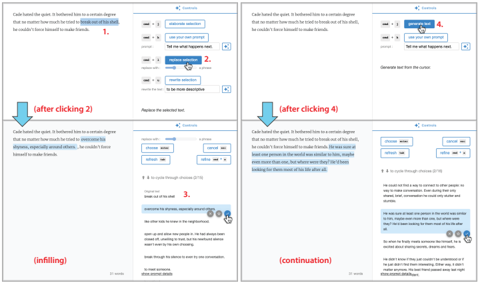
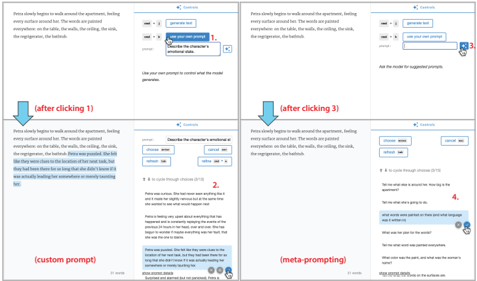
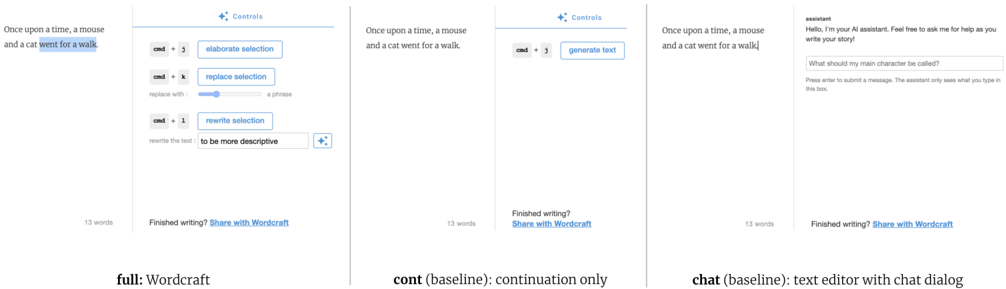
The latest generation of large neural language models such as GPT-3 have achieved new levels of performance on benchmarks for language understanding and generation. These models have even demonstrated an ability to perform arbitrary tasks without explicit training. In this work, we sought to learn how people might use such models in the process of creative writing. We built Wordcraft, a text editor in which users collaborate with a generative language model to write a story. We evaluated Wordcraft with a user study in which participants wrote short stories with and without the tool. Our results show that large language models enable novel co-writing experiences. For example, the language model is able to engage in open-ended conversation about the story, respond to writers’ custom requests expressed in natural language (such as ”rewrite this text to be more Dickensian”), and generate suggestions that serve to unblock writers in the creative process. Based on these results, we discuss design implications for future human-AI co-writing systems.
Overview
The claims and statistics of this paper haven’t been checked yet.
Free: it reads the open-access text and checks the first 5 claims that cite a source we can check. Create a free account to check every claim.
Integrity signals
Registry
Cites
Statistics
Figures
Verification
Claims the paper makes
The claims and statistics of this paper haven’t been checked yet.
Free: it reads the open-access text and checks the first 5 claims that cite a source we can check. Create a free account to check every claim.
Claims other papers make about this one
Each is checked against this paper’s own text: does it say what the citing paper says it does?
The source backs part of the claim, not all of it — or backs it for a different population, condition or comparison.
In the citing paper
“Empirical studies describing how users evaluate LLMs are still a minority and difficult to generalise due to a variation of participants, methods, systems, and disciplinary perspectives [13,27,28,38,47].”
From Playwriting with Large Language Models: Perceived Features, Interaction Strategies and Outcomes (2024) · cites this paper as [47]
Experimental — accuracy not yet measuredThe source backs part of the claim, not all of it — or backs it for a different population, condition or comparison.
In the citing paper
“Despite these limitations, playwrights identified utility at different stages of creative writing, from brainstorming through the summarisation of relevant sources to editing [27,42,47].”
From Playwriting with Large Language Models: Perceived Features, Interaction Strategies and Outcomes (2024) · cites this paper as [47]
Experimental — accuracy not yet measuredThe source backs part of the claim, not all of it — or backs it for a different population, condition or comparison.
In the citing paper
“These interfaces typically provide end-users with only one text area for inputs, which is frequently shared with the output, and one control panel to confgure global settings for the parameters [1,69,85,109].”
From Cells, Generators, and Lenses: Design Framework for Object-Oriented Interaction with Large Language Models (2023) · cites this paper as [109]
Experimental — accuracy not yet measuredThe source backs part of the claim, not all of it — or backs it for a different population, condition or comparison.
In the citing paper
“Students can continually alter prompts to refine the model output helping them to 'build-up' a solution [196].”
From The Robots Are Here: Navigating the Generative AI Revolution in Computing Education (2023) · cites this paper as [196]
Experimental — accuracy not yet measuredThe source backs part of the claim, not all of it — or backs it for a different population, condition or comparison.
In the citing paper
“End-user studies suggest that prompting is challenging, with nonexpert users making various errors and adopting ineffective strategies-a reflection of the demand on users' metacognitive monitoring and control [33,41,43,85,103,174,205].”
From The Metacognitive Demands and Opportunities of Generative AI (2024) · cites this paper as [205]
Experimental — accuracy not yet measured
7 more claims about this paper
Create a free account to see every claim other papers make about this one.
Self-check
Percentages, sums and reported differences re-computed from the paper’s own numbers.
The self-check needs the paper’s full text.
Citations
Cites
Language Models are Few-Shot Learners
Brown, T. B., Mann, B., Ryder, N., Subbiah, M., Kaplan, J., Dhariwal, P., Neelakantan, A., Shyam, P., Sastry, G., Askell, A., et al. (2020) · arXiv · doi:10.48550/arxiv.2005.14165 · Cited by 23,372 · cited 4×
“[38] proposed the idea of designing a prompt that contains several examples of the target task, written in natural language.”
BackgroundInfluential2009 International Joint Conference on Artificial Intelligence
(2009) · doi:10.1109/jcai15434.2009 · Cited by 2,800
Evaluating Large Language Models Trained on Code
Chen, M., Tworek, J., Jun, H., Yuan, Q., Pinto, H. P. D. O., Kaplan, J., Edwards, H., Burda, Y., Joseph, N., Brockman, G., et al. (2021) · arXiv · doi:10.48550/arxiv.2107.03374 · Cited by 1,436 · cited 1×
“Despite the simplicity of this API, large language models (LLMs) have demonstrated proficiency at a wide variety of tasks—from storytelling [1, 28] to code synthesis [4, 9] and email auto-completion [40].”
BackgroundLaMDA: Language Models for Dialog Applications
Thoppilan, R., De Freitas, D., Hall, J., Shazeer, N., Kulshreshtha, A., Cheng, H.-T., Jin, A., Bos, T., Baker, L., Du, Y., et al. (2022) · arXiv · doi:10.48550/arxiv.2201.08239 · Cited by 778 · cited 2×
“In the exit interview, one user commented about the chatbot: ” I loved that it felt like a more targeted version of Google, and I could do background research while writing ” (U21).”
MethodCTRL: A Conditional Transformer Language Model for Controllable Generation
Keskar, N. S., McCann, B., Varshney, L. R., Xiong, C., & Socher, R. (2019) · arXiv · doi:10.48550/arxiv.1909.05858 · Cited by 751 · cited 1×
“Researchers have also built story generation models that incorporate event sequences [33], desired topic [29], and story title [2] as control signals.”
BackgroundExtracting Training Data from Large Language Models
Carlini, N., Tramer, F., Wallace, E., Jagielski, M., Herbert-Voss, A., Lee, K., Roberts, A., Brown, T., Song, D., Erlingsson, U., et al. (2020) · arXiv · doi:10.48550/arxiv.2012.07805 · Cited by 727 · cited 1×
“LLMs have also been found to output memorized passages from their training data [26].”
BackgroundGPT-NeoX-20B: An Open-Source Autoregressive Language Model
Black, S., Biderman, S., Hallahan, E., Anthony, Q., Gao, L., Golding, L., He, H., Leahy, C., McDonell, K., Phang, J., et al. (2022) · Proceedings of BigScience Episode #5 -- Workshop on Challenges & Perspectives in Creating Large Language Models · doi:10.18653/v1/2022.bigscience-1.9 · Cited by 404
GPT-Neo: Large Scale Autoregressive Language Modeling with Mesh-Tensorflow
Black, S., Leo, G., Wang, P., Leahy, C., & Biderman, S. (2021) · Zenodo · doi:10.5281/zenodo.5297715 · Cited by 324 · cited 1×
“Neural language models, such as GPT-2 [34] or GPT-Neo [5], are neural networks that are trained only to predict the next word in a sequence given the previous words (aka a prompt).”
Background
Research works printed but not linked: 14
- 1. Nader Akoury, Shufan Wang, Josh Whiting, Stephen Hood, Nanyun Peng, and Mohit Iyyer. 2020. STORIUM: A Dataset and Evaluation Platform for Machine- in-the-Loop Story Generation. Empirical Methods in Natural Language Processing (2020).
- 3. Niki Parmar Jakob Uszkoreit Llion Jones Aidan N. Gomez Lukasz Kaiser Illia Polo- sukhin Ashish Vaswani, Noam Shazeer. 2017. Attention Is All You Need. Neural Information Processing Systems (2017).
- 6. Daniel Buschek, Martin Zurn, and Malin Eiband. 2021. The Impact of Multiple Parallel Phrase Suggestions on Email Input and Composition Behavior of Native and Non-Native English Writers. ACM (2021).
- 12. Chenhao Tan Yangfeng Ji Elizabeth Clark, Anne Spencer Ross and Noah A. Smith. 2018. Creative Writing with a Machine in the Loop: Case Studies on Slogans and Stories. Intelligent User Interfaces (2018).
- 15. Cheng-Zhi Huang. 2020. AI Song Contest: Human-AI Co-Creation in Songwriting. International Society for Music Information Retrieval Conference (2020).
- 18. Christian Remy Michael Mose Biskjaer Jonas Frich, Lindsay MacDonald Ver- meulen and Peter Dalsgaard. 2019. Mapping the Landscape of Creativity Support Tools in HCI. Computer Human Interaction (2019).
- 19. Varun Kumar Satyapriya Krishna Yada Pruksachatkun Kai-Wei Chang Jwala Dhamala, Tony Sun and Rahul Gupta. 2021. Bold: Dataset and met- rics for measuring biases in open-ended language generation. arXiv preprint arXiv:2101.11718 (2021). · arXiv
- 23. Jay Priyadarshi Marjan Ghazvininejad, Xing Shi and Kevin Knight. 2017. Hafez: an Interactive Poetry Generation System. Association for Computational Linguistics (2017).
- 24. Jonathan Chen Shao-Yu Chen Shukan Shah-Vishwa Shah Joshua Reno Gillian Smith Matthew Guzdial, Nicholas Liao and Mark O. Riedl. 2019. Friend, Collaborator, Student, Manager: How Design of an AI-Driven Game Level Editor Affects Creators. Computer Human Interaction (2019).
- 33. Wesley Cheung Zhaochen Luo William Ma Lara J Martin Prithviraj Ammanabrolu, Ethan Tien and Mark O Riedl. 2020. Story realization: Expanding plot events into sentences. Proceedings of the AAAI Conference on Artificial Intelligence (2020).
- 34. Alec Radford, Jeffrey Wu, Rewon Child, David Luan, Dario Amodei, Ilya Sutskever, et al. 2019. Language models are unsupervised multitask learners. OpenAI blog 1, 8 (2019), 9.
- 35. Nathan Dass Sadao Kurohashi Dan Jurafsky Diyi Yang Reid Pryzant, Richard Diehl Martinez. 2020. Automatically Neutralizing Subjective Bias in Text. AAAI (2020).
- 39. Shi Feng Dan Klein Sameer Singh Tony Z. Zhao, Eric Wallace. 2021. Calibrate Before Use: Improving Few-Shot Performance of Language Models. Proceedings of Machine Learning Research (2021).
- 40. Yonghui Wu. 2018. Smart compose: Using neural networks to help write emails. Google AI Blog (2018).
Cited by
Items 101–200 of 393
Gursesli, M. C., Taveekitworachai, P., Abdullah, F., Dewantoro, M. F., Lanatà, A., Guazzini, A., Lê, V. K., Villars, A., & Thawonmas, R. (2023) · Lecture notes in computer science · doi:10.1007/978-3-031-47658-7_16 · Cited by 34
Friction: Deciphering Writing Feedback into Writing Revisions through LLM-Assisted Reflection
Zhang, C., Ju, K., Bidoshi, P., Yen, Y.-C. G., & Rzeszotarski, J. M. (2025) · CHI Conference on Human Factors in Computing Systems · doi:10.1145/3706598.3714316 · Cited by 49
Ai.llude: Investigating Rewriting AI-Generated Text to Support Creative Expression
Zhou, D., & Sterman, S. (2024) · Creativity and Cognition · doi:10.1145/3635636.3656187 · Cited by 41
Steenstra, I., Murali, P., Perkins, R. B., Pierre-Joseph, N., Paasche‐Orlow, M. K., & Bickmore, T. (2024) · CHI Conference Extended Abstracts on Human Factors in Computing Systems (CHI EA) · doi:10.1145/3613905.3650983 · Cited by 39
AI-Assisted Causal Pathway Diagram for Human-Centered Design
Zhong, R., Shin, D.-H., Meza, R. D., Klasnja, P., Colusso, L. F., & Hsieh, G. (2024) · CHI Conference on Human Factors in Computing Systems · doi:10.1145/3613904.3642179 · Cited by 35
Lai, H., & Nissim, M. (2024) · ACM Computing Surveys · doi:10.1145/3654795 · Cited by 53
CausalMapper: Challenging designers to think in systems with Causal Maps and Large Language Model
Huang, Z., Quan, K., Chan, J., & MacNeil, S. (2023) · Creativity and Cognition · doi:10.1145/3591196.3596818 · Cited by 24
The Impact of Generative AI on Creativity in Software Development: A Research Agenda
Jackson, V., Vasilescu, B., Russo, D., Ralph, P., Prikladnicki, R., Izadi, M., D’Angelo, S., Inman, S., Andrade, A., & van der Hoek, A. (2025) · ACM Transactions on Software Engineering and Methodology · doi:10.1145/3708523 · Cited by 23
A Map of Exploring Human Interaction Patterns with LLM: Insights into Collaboration and Creativity
Li, J., Li, J., & Su, Y. (2024) · Lecture notes in computer science · doi:10.1007/978-3-031-60615-1_5 · Cited by 44
"Ronaldo's a poser!": How the Use of Generative AI Shapes Debates in Online Forums
Zeng, Y., Shi, Y., Huang, X., Nah, F. F., & Lc, R. (2025) · CHI Conference on Human Factors in Computing Systems · doi:10.1145/3706598.3713829 · Cited by 34
Large language models reflect the ideology of their creators
Buyl, M., Rogiers, A., Noels, S., Bied, G., Dominguez-Catena, I., Heiter, E., Johary, I., Mara, A. C., Romero, R., Lijffijt, J., et al. (2026) · npj Artificial Intelligence · doi:10.1038/s44387-025-00048-0 · Cited by 82
“Serving as the backbone of search engines, 10 chatbots, 4 writing assistants 11 and more, they are increasingly acting as gatekeeper of information.”
Qin, P., Yang, C.-L., Li, J., Wen, J., & Lee, Y. (2025) · CHI Conference on Human Factors in Computing Systems · doi:10.1145/3706598.3713146 · Cited by 54
Portrayal: Leveraging NLP and Visualization for Analyzing Fictional Characters
Hoque, M. N., Ghai, B., Kraus, K., & Elmqvist, N. (2023) · Designing Interactive Systems Conference · doi:10.1145/3563657.3596000 · Cited by 37
“These tools can generate text based on a prompt, often helping writers explore alternate narrative worlds and creative angles [8, 11, 23, 45, 53, 69].”
BackgroundMethodPEER: Empowering Writing with Large Language Models
Seßler, K., Xiang, T., Bogenrieder, L., & Kasneci, E. (2023) · Lecture notes in computer science · doi:10.1007/978-3-031-42682-7_73 · Cited by 36
“Since LLMs are trained to write high quality texts, they can assist users in their writing process [15].”
BackgroundDoes Writing with Language Models Reduce Content Diversity?
Padmakumar, V., & He, H. (2023) · arXiv · doi:10.48550/arxiv.2309.05196 · Cited by 21
Authors' Values and Attitudes Towards AI-bridged Scalable Personalization of Creative Language Arts
Kim, T., Han, H., Adar, E., Kay, M., & Chung, J. J. Y. (2024) · Proceedings of the CHI Conference on Human Factors in Computing Systems · doi:10.1145/3613904.3642529 · Cited by 20
Dango: A Mixed-Initiative Data Wrangling System using Large Language Model
Chen, W., Tong, W., Case, A., & Zhang, T. (2025) · CHI Conference on Human Factors in Computing Systems · doi:10.1145/3706598.3714135 · Cited by 41
Ye, L., Jiang, J., Liu, Y., Ran, Y., & Chang, D. (2025) · CHI Conference Extended Abstracts on Human Factors in Computing Systems (CHI EA) · doi:10.1145/3706599.3719837 · Cited by 46
Ito, T., Yamashita, N., Kuribayashi, T., Hidaka, M., Suzuki, J., Gao, G., Jamieson, J., & Inui, K. (2023) · ACM Symposium on User Interface Software and Technology (UIST) · doi:10.1145/3586183.3606810 · Cited by 36
“Many of these tools employ a user interface (UI) that suggests multiple alternatives to human-written drafts in their user interfaces [3, 22, 29, 54], and the human author then selects the one that best fits his or her intentions.”
InfluentialSpecification overfitting in artificial intelligence
Roth, B., de Araujo, P. H. L., Xia, Y., Kaltenbrunner, S., & Korab, C. (2024) · Artificial Intelligence Review · doi:10.1007/s10462-024-11040-6 · Cited by 26
“Current research investigates the use of language models in areas such as creative writing (Yuan et al, 2022), code development (Zan et al, 2023), education (Kasneci et al, 2023), and medicine (Thirunavukarasu et al, 2023).”
Xu, X. (., Konnova, A., Gao, B., Peng, C., Vo, D., & Dow, S. P. (2025) · CHI Conference on Human Factors in Computing Systems · doi:10.1145/3706598.3713649 · Cited by 54
The impact of large language models on computer science student writing
Zdravkova, K., & Ilijoski, B. (2025) · International Journal of Educational Technology in Higher Education · doi:10.1186/s41239-025-00525-1 · Cited by 27
“Since last year, students have had a great ally for academic writing: large language models (Yuan et al., 2022).”
Chun, J., & Elkins, K. (2023) · International Journal of Digital Humanities · doi:10.1007/s42803-023-00069-8 · Cited by 34
“LLMs can also provide more immediate control in terms of Human–Computer Interaction (HCI) collaborative writing using systems like Cue-Me-In (Brahman et al., 2020), Wordcraft (Yuan et al., 2022) (Ippolito et al., 2022), Loose Ends (Kreminski et al., 2022), and Dramatron (Mirowski et al., 2022).”
An AI-powered approach to the semiotic reconstruction of narratives
de Lima, E. S., Neggers, M. M. E., Feijó, B., Casanova, M. A., & Furtado, A. L. (2024) · Entertainment Computing · doi:10.1016/j.entcom.2024.100810 · Cited by 30
Bomba, F., Menéndez-Blanco, M., Grigis, P., Cremaschi, M., & Angeli, A. D. (2024) · ACM Transactions on Computer-Human Interaction · doi:10.1145/3689040 · Cited by 33
Lee, S., Hwang, S., Kim, D.-J., & Lee, K. (2025) · CHI Conference Extended Abstracts on Human Factors in Computing Systems (CHI EA) · doi:10.1145/3706599.3719792 · Cited by 39
From Text to Trust: Empowering AI-assisted Decision Making with Adaptive LLM-powered Analysis
Li, Z., Zhu, H., Lu, Z., Xiao, Z., & Yin, M. (2025) · CHI Conference on Human Factors in Computing Systems · doi:10.1145/3706598.3713133 · Cited by 38
Open-world story generation with structured knowledge enhancement: A comprehensive survey
Wang, Y., Lin, J., Yu, Z., Hu, W. P., & Karlsson, B. F. (2023) · Neurocomputing · doi:10.1016/j.neucom.2023.126792 · Cited by 40
Collage is the New Writing: Exploring the Fragmentation of Text and User Interfaces in AI Tools
Buschek, D. (2024) · Designing Interactive Systems Conference · doi:10.1145/3643834.3660681 · Cited by 44
“…composition: writing high-level intentions (e.g. log line [65]); drawing lines for story arcs [21]; engaging in a conversation with the AI about the text [82] or within the narrative world [12]; or (re-)ordering text pieces, which may imply rewriting tasks that are delegated to the AI [23, 61].”
BackgroundMethodInfluentialReading Subtext: Evaluating Large Language Models on Short Story Summarization with Writers
Subbiah, M., Zhang, S., Chilton, L. B., & McKeown, K. R. (2024) · Transactions of the Association for Computational Linguistics · doi:10.1162/tacl_a_00702 · Cited by 53
HarmonyCut: Supporting Creative Chinese Paper-cutting Design with Form and Connotation Harmony
Wang, H., Qiu, T., Li, J., Lu, Z., & Ma, Y. (2025) · CHI Conference on Human Factors in Computing Systems · doi:10.1145/3706598.3714159 · Cited by 34
Ding, Z., Smith, A., Zhang, W., Tetreault, J., & Jaimes, A. (2023) · Findings of the Association for Computational Linguistics: EMNLP (Findings of EMNLP) · doi:10.18653/v1/2023.findings-emnlp.217 · Cited by 47
Understanding Screenwriters' Practices, Attitudes, and Future Expectations in Human-AI Co-Creation
Tang, Y., Li, H., Lan, M., Ma, X., & Qu, H. (2025) · Proceedings of the 2025 CHI Conference on Human Factors in Computing Systems · doi:10.1145/3706598.3714120 · Cited by 18
Chakrabarty, T., Laban, P., & Wu, C.-S. (2025) · CHI Conference on Human Factors in Computing Systems · doi:10.1145/3706598.3713559 · Cited by 92
What Is Waiting for Us at the End? Inherent Biases of Game Story Endings in Large Language Models
Taveekitworachai, P., Abdullah, F., Gursesli, M. C., Dewantoro, M. F., Chen, S., Lanatà, A., Guazzini, A., & Thawonmas, R. (2023) · Lecture notes in computer science · doi:10.1007/978-3-031-47658-7_26 · Cited by 22
ChatGeppetto - an AI-powered Storyteller
de Lima, E. S., Feijó, B., Casanova, M. A., & Furtado, A. L. (2023) · Brazilian Symposium on Computer Games and Digital Entertainment (SBGames) · doi:10.1145/3631085.3631302 · Cited by 27
Challenges and Opportunities of LLM-Based Synthetic Personae and Data in HCI
Prpa, M., Troiano, G. M., Wood, M., & Coady, Y. (2024) · CHI Conference Extended Abstracts on Human Factors in Computing Systems (CHI EA) · doi:10.1145/3613905.3636293 · Cited by 33
EditScribe: Non-Visual Image Editing with Natural Language Verification Loops
Chang, R.-C., Liu, Y., Zhang, L., & Guo, A. (2024) · International ACM SIGACCESS Conference on Computers and Accessibility (ASSETS) · doi:10.1145/3663548.3675599 · Cited by 27
Salikutluk, V., Koert, D., & Jäkel, F. (2023) · Frontiers in artificial intelligence and applications · doi:10.3233/faia230081 · Cited by 22
“writing with AI-support [3,33], performance in guesstimation tasks can be objectively and quantitatively evaluated.”
BackgroundTaleStream: Supporting Story Ideation with Trope Knowledge
Chou, J.-P., Siu, A. F., Lipka, N., Rossi, R. A., Dernoncourt, F., & Agrawala, M. (2023) · ACM Symposium on User Interface Software and Technology (UIST) · doi:10.1145/3586183.3606807 · Cited by 25
Sänger, M., Mecquenem, N. D., Lewińska, K. E., Bountris, V., Lehmann, F., Leser, U., & Kosch, T. (2024) · GigaScience · doi:10.1093/gigascience/giae030 · Cited by 24
“These generative capabilities have empowered these models to assist in diverse (creative) writing tasks and have been utilized to facilitate a wide range”
BackgroundGlassMail: Towards Personalised Wearable Assistant for On-the-Go Email Creation on Smart Glasses
Zhou, C., Yan, Z., Ram, A., Gu, Y. S., Xiang, Y., Liu, C., Huang, Y., Ooi, W. T., & Zhao, S. (2024) · Designing Interactive Systems Conference · doi:10.1145/3643834.3660683 · Cited by 25
Generative AI and Perceptual Harms: Who's Suspected of using LLMs?
Kadoma, K., Metaxa, D., & Naaman, M. (2025) · Proceedings of the 2025 CHI Conference on Human Factors in Computing Systems · doi:10.1145/3706598.3713897 · Cited by 14
A Data-Driven Approach for the Identification of Features for Automated Feedback on Academic Essays
Abbas, M., van Rosmalen, P., & Kalz, M. (2023) · IEEE Transactions on Learning Technologies · doi:10.1109/tlt.2023.3320877 · Cited by 19
Yin, M., Wang, E., Ng, C., & Xiao, R. (2024) · CHI Conference on Human Factors in Computing Systems · doi:10.1145/3613904.3642253 · Cited by 25
Playwriting with Large Language Models: Perceived Features, Interaction Strategies and Outcomes
Grigis, P., & De Angeli, A. (2024) · Proceedings of the 2024 International Conference on Advanced Visual Interfaces · doi:10.1145/3656650.3656688 · Cited by 13
wr-AI-ter: Enhancing Ownership Perception in AI-Driven Script Writing
Weber, C. J., Burgkart, S., & Rothe, S. (2024) · ACM International Conference on Interactive Media Experiences · doi:10.1145/3639701.3656325 · Cited by 21
CreAItive Collaboration? Users' Misjudgment of AI-Creativity Affects Their Collaborative Performance
Bangerl, M. M., Disch, L., David, T., & Pammer-Schindler, V. (2025) · Proceedings of the 2025 CHI Conference on Human Factors in Computing Systems · doi:10.1145/3706598.3713886 · Cited by 13
Qin, H. X., Zhu, G., Fan, M., & Hui, P. (2025) · CHI Conference on Human Factors in Computing Systems · doi:10.1145/3706598.3713569 · Cited by 31
Önden, A., Kara, K., Önden, İ., Yalçın, G. C., Šimić, V., & Pamucar, D. S. (2024) · Engineering Applications of Artificial Intelligence · doi:10.1016/j.engappai.2024.108378 · Cited by 21
GPT-Neo-CRV: Elevating Information Accuracy in GPT-Neo with Cross-Referential ValidationPreprint
Xiong, X., & Zheng, M. (2024) · doi:10.36227/techrxiv.170473976.61241065/v1 · Cited by 17
SARD: A Human-AI Collaborative Story Generation
Radwan, A. Y., Alasmari, K. M., Abdulbagi, O. A., & Alghamdi, E. A. (2024) · Lecture notes in computer science · doi:10.1007/978-3-031-76806-4_7 · Cited by 28
Wu, Z., Weber, T., & Müller, F. (2025) · ACM International Conference on Intelligent User Interfaces (IUI) · doi:10.1145/3708359.3712094 · Cited by 32
JournalAIde: Empowering Older Adults in Digital Journal Writing
Zhou, S., Lin, W., Xu, Z., Wei, X., Huang, R., Ma, X., & Fan, M. (2025) · CHI Conference on Human Factors in Computing Systems · doi:10.1145/3706598.3713339 · Cited by 24
Jiang, P. (2025) · Journal of Engineering Design · doi:10.1080/09544828.2025.2574209 · Cited by 14
“These LLMs have demonstrated a significant impact across diverse language-intensive applications, including document retrieval systems (Cosme et al. 2024), question-answering frameworks (Yang et al. 2023) and story writing (Yuan et al. 2022).”
Digital Facilitation of Group Work to Gain Predictable Performance
Gimpel, H., Lahmer, S., Wöhl, M., & Graf‐Drasch, V. (2023) · Group Decision and Negotiation · doi:10.1007/s10726-023-09856-8 · Cited by 17
“Recent progress in the realm of natural language processing—especially based on large language models—allows for an ever more powerful integration of assistance systems in digital work environments (e.g., GitHub Copilot (Moradi Dakhel et al. 2023), Grammarly (Yuan et al. 2022).”
Detecting LLM-assisted writing in scientific communication: Are we there yet?
Lazebnik, T., & Rosenfeld, A. (2024) · Journal of Data and Information Science · doi:10.2478/jdis-2024-0020 · Cited by 24
“Unfortunately, at least in the realm of scientific communication, gathering more unsolicited instances of LLM-assisted writing is highly challenging since, as currently believed, most authors who practice LLM-assisted writing avoid explicitly reporting it for a variety of reasons [14, 15].”
BackgroundTost, J., Gohsen, M., Schulte, B. F., Thomet, F., Kuhn, M., Kiesel, J., Stein, B., & Hornecker, E. (2024) · ACM Conference on Conversational User Interfaces (CUI) · doi:10.1145/3640794.3665904 · Cited by 15
Toyteller: AI-powered Visual Storytelling Through Toy-Playing with Character Symbols
Chung, J. J. Y., Roemmele, M., & Kreminski, M. (2025) · CHI Conference on Human Factors in Computing Systems · doi:10.1145/3706598.3713435 · Cited by 24
Making the Write Connections: Linking Writing Support Tools with Writer Needs
Zhao, Z., Masson, D., Kim, Y., Penn, G., & Chevalier, F. (2025) · CHI Conference on Human Factors in Computing Systems · doi:10.1145/3706598.3713161 · Cited by 25
“For example, most of the commercial tools and literature focus specifically on planning (e.g. [6, 16]), generating (e.g. [24, 73, 123]) or revising (e.g. [1, 101]), as shown in Figure 2.”
Biswas, S., Erlei, A., & Gadiraju, U. (2025) · CHI Conference on Human Factors in Computing Systems · doi:10.1145/3706598.3713201 · Cited by 20
Paratrouper: Exploratory Creation of Character Cast Visuals Using Generative AI
Leong, J., Ledo, D., Driscoll, T. R., Grossman, T., Fitzmaurice, G. W., & Anderson, F. (2025) · CHI Conference on Human Factors in Computing Systems · doi:10.1145/3706598.3714242 · Cited by 18
Orchid: A Creative Approach for Authoring LLM-Driven Interactive Narratives
Wu, Z., Kumyol, S., Wong, S., Hu, X., Tong, X., & Braud, T. (2025) · Creativity and Cognition · doi:10.1145/3698061.3726906 · Cited by 14
“Commercial applications such as Talefy [71], Dream Gen [20], and Sto-ryscape [66], mainly focus on the complete narrative construction process, guiding users to create stories through defining different settings [48, 83].”
Helpful assistant or fruitful facilitator? Investigating how personas affect language model behavior
de Araujo, P. H. L., & Roth, B. (2025) · PLoS ONE · doi:10.1371/journal.pone.0325664 · Cited by 42
“LLMs are now applied to creative writing (Yuan et al., 2022), code development (Zan et al., 2023), education (Kasneci et al., 2023), healthcare (Thirunavukarasu et al., 2023), and search engines (Mehdi, 2023).”
Breaking Bad: Unraveling Influences and Risks of User Inputs to ChatGPT for Game Story Generation
Taveekitworachai, P., Abdullah, F., Gursesli, M. C., Dewantoro, M. F., Chen, S., Lanatà, A., Guazzini, A., & Thawonmas, R. (2023) · Lecture notes in computer science · doi:10.1007/978-3-031-47658-7_27 · Cited by 17
Ding, Z. (2024) · ACM International Conference on Intelligent User Interfaces (IUI) · doi:10.1145/3640544.3645241 · Cited by 18
Liu, Y., Wen, Z., Weng, L., Woodman, O., Yang, Y., & Chen, W. (2024) · IEEE Transactions on Visualization and Computer Graphics · doi:10.1109/tvcg.2024.3410523 · Cited by 18
“Other works focus on designing interfaces for specific writing tasks, such as email writing [52], story creation [14], argumentative writing [16], scientific writing [5] and journalistic angle ideation [53].”
LaMPost: AI Writing Assistance for Adults with Dyslexia Using Large Language Models
Goodman, S. M., Buehler, E., Clary, P., Coenen, A., Donsbach, A., Horne, T. N., Lahav, M., MacDonald, R., Michaels, R. B., Narayanan, A., et al. (2024) · Communications of the ACM · doi:10.1145/3626952 · Cited by 20
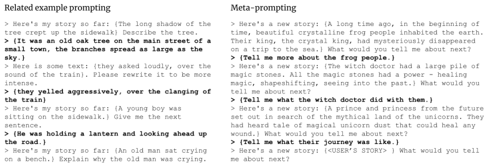
“Users can make revisions themselves or use a preferred choice as a precursor prompt (that is, meta-prompting ) 24 to generate rewritten passages in the operation described below.”
InfluentialSelf-citationXiao, Y., Chen, Y., Yamashita, N., Chen, Y., Liu, Z., & Gao, G. (2024) · Proceedings of the ACM on Human-Computer Interaction · doi:10.1145/3686942 · Cited by 15
Challenges and Opportunities of LLM-Based Synthetic Personae and Data in HCI
Prpa, M., Troiano, G. M., Yao, B., Li, T. J.-J., Wang, D., & Gu, H. (2024) · ACM Conference on Computer Supported Cooperative Work (CSCW) · doi:10.1145/3678884.3681826 · Cited by 25
He, K., Liu, X., Xu, Y., Bustamante, A. S., & Warschauer, M. (2025) · ACM International Conference on Interaction Design and Children (IDC) · doi:10.1145/3713043.3727056 · Cited by 16
Phraselette: A Poet’s Procedural Palette
Calderwood, A., Chung, J. J. Y., Sun, Y., Roemmele, M., & Kreminski, M. (2025) · Designing Interactive Systems Conference · doi:10.1145/3715336.3735832 · Cited by 17
Jiang, P., Han, J., & Ahmed‐Kristensen, S. (2025) · Sustainable Futures · doi:10.1016/j.sftr.2025.101094 · Cited by 18
Autorepo: A General Framework for Multimodal Llm-Based Automated Construction ReportingPreprint
Pu, H., Yang, X., Li, J., & Guo, R. (2023) · SSRN Electronic Journal · doi:10.2139/ssrn.4678046 · Cited by 10
Mapping the Design Space of Interactions in Human-AI Text Co-creation Tasks
Ding, Z., & Chan, J. (2023) · arXiv · doi:10.48550/arxiv.2303.06430 · Cited by 9
“[28] also focused primarily on exploring various formats of guiding model outputs, such as continuation, elaboration, story seeding, and infilling.”
BackgroundInfluentialOn the Automatic Generation and Simplification of Children’s Stories
Valentini, M., Weber, J., Salcido, J., Wright, T., Colunga, E., & von der Wense, K. (2023) · Conference on Empirical Methods in Natural Language Processing (EMNLP) · doi:10.18653/v1/2023.emnlp-main.218 · Cited by 41
Huang, Q. Y., Sun, Y., Xing, Z., Cao, Y., Chen, J., Xu, X., Jin, H., & Lu, J. (2024) · ACM Transactions on Software Engineering and Methodology · doi:10.1145/3680469 · Cited by 13
LIGS: Developing an LLM-infused Game System for Emergent Narrative
Jeong, J., & Lee, T. Y. (2025) · CHI Conference Extended Abstracts on Human Factors in Computing Systems (CHI EA) · doi:10.1145/3706599.3720212 · Cited by 14
Notice of Removal October 9, 2026: Social Life Simulation for Non-Cognitive Skills Learning
Yan, Z., & Xiang, Y. (2025) · Proceedings of the ACM on Human-Computer Interaction · doi:10.1145/3711068 · Cited by 20
BETA: A Bit-Grained Transformer Attention Accelerator With Efficient Early Termination
Wang, H., Wang, H., Yue, Z., Liu, J., Wei, T., Wei, S., Hu, Y., & Yin, S. (2025) · IEEE Transactions on Circuits & Systems II Express Briefs · doi:10.1109/tcsii.2025.3596228 · Cited by 13
“L ARGE language models (LLMs) have demonstrated remarkable proficiency across a broad spectrum of tasks, ranging from content creation [1], [2] to chatbots [3], [4].”
Mixed-Initiative Interaction with Computational Generative Systems
Lehmann, F. (2023) · CHI Conference Extended Abstracts on Human Factors in Computing Systems (CHI EA) · doi:10.1145/3544549.3577061 · Cited by 17
“[35] explored how people might use generative models in the process of creative writing.”
BackgroundWhat Is a Person? Emerging Interpretations of AI Authorship and Attribution
Moulaison, H. L. (2023) · Proceedings of the Association for Information Science and Technology · doi:10.1002/pra2.788 · Cited by 9
“Authorship using generative AI tools like ChatGPT has been studied in a limited capacity from a computer-science perspective (e.g., Draxler et al., 2023, Yuan et al., 2022) and from a policy perspective (e.g., Ballardini et al., 2019).”
MethodThe Robots are Here: Navigating the Generative AI Revolution in Computing Education
Prather, J., Denny, P., Leinonen, J., Becker, B. A., Albluwi, I., Craig, M., Keuning, H., Kiesler, N., Kohn, T., Luxton-Reilly, A., et al. (2023) · arXiv · doi:10.48550/arxiv.2310.00658 · Cited by 9
CoCo Matrix: Taxonomy of Cognitive Contributions in Co-writing with Intelligent Agents
Wan, R., Gebreegziabher, S. A., Li, T. J.-J., & Badillo-Urquiola, K. (2024) · Creativity and Cognition · doi:10.1145/3635636.3664260 · Cited by 9
Generating Meaning: Active Inference and the Scope and Limits of Passive AI
Pezzulo, G., Parr, T., Cisek, P., Clark, A., & Friston, K. (2023) · doi:10.31234/osf.io/8xgzv · Cited by 8
Empowering Children’s AI Literacy Through Co-Creating Stories with LLM
Han, A., & Han, S. (2025) · Proceedings of the 24th Interaction Design and Children · doi:10.1145/3713043.3731520 · Cited by 8
Hardiman, J. P. W., Thio, D. C., Zakiyyah, A. Y., & Meiliana, M. (2024) · Procedia Computer Science · doi:10.1016/j.procs.2024.10.340 · Cited by 8
Fu, J., Wang, X., Vi, K., Li, Z., Xu, C., & Sun, Y. (2025) · CHI Conference Extended Abstracts on Human Factors in Computing Systems (CHI EA) · doi:10.1145/3706599.3721163 · Cited by 16
PromptPilot: Exploring User Experience of Prompting with AI-Enhanced Initiative in LLMs
Kim, S., Eun, J., Park, Y. E., Lee, K., Lee, G., & Lee, J. (2025) · International Journal of Human-Computer Interaction · doi:10.1080/10447318.2025.2489030 · Cited by 12
“LLMs are applied in a variety of areas, from enhancing productivity (Nijkamp et al., 2022; Petridis et al., 2023; Ross et al., 2023) to facilitating creativity (Shakeri et al., 2021; Yuan et al., 2022).”
Designing a Language Model-Based Authoring Tool Prototype for Interactive Storytelling
Park, J., Shin, J., Kim, G., & Bae, B.-C. (2023) · Lecture notes in computer science · doi:10.1007/978-3-031-47658-7_22 · Cited by 12
Boosting Mixed-Initiative Co-Creativity in Game Design: A Tutorial
Margarido, S., Machado, P., Roque, L., & Martins, P. (2025) · ACM Computing Surveys · doi:10.1145/3759914 · Cited by 18
Bala, P., James, S., Bue, A. D., & Nisi, V. (2022) · Lecture notes in computer science · doi:10.1007/978-3-031-22298-6_9 · Cited by 10
Authorship Drift: How Self-Efficacy and Trust Evolve During LLM-Assisted Writing
Park, Y. S., Arvi, N. A. P., Kim, S., & Kim, J. (2026) · Proceedings of the 2026 CHI Conference on Human Factors in Computing Systems · doi:10.1145/3772318.3790276 · Cited by 8
Every Thing Can Be a Hero! Narrative Visualization of Person, Object, and Other Biographies
Kusnick, J., Mayr, E., Seirafi, K., Beck, S., Liem, J., & Windhager, F. (2024) · Informatics · doi:10.3390/informatics11020026 · Cited by 14
“Using LLMs both in the creative and scientific writing process is currently transforming content creation and storytelling processes everywhere, while numerous issues have to be sorted out in real time [161,176].”
BackgroundNo Evidence for LLMs Being Useful in Problem Reframing
Shin, J., Polyanskaya, A., Lucero, A., & Oulasvirta, A. (2025) · CHI Conference on Human Factors in Computing Systems · doi:10.1145/3706598.3713273 · Cited by 17
Emails by LLMs: A Comparison of Language in AI-Generated and Human-Written Emails
Li, W., Lai, Y., Soni, S., & Saha, K. (2025) · ACM Web Science Conference (WebSci) · doi:10.1145/3717867.3717872 · Cited by 19
Sculpt-to-Image: Exploring Clay-based Sculpting to Support Human-AI-Co-Creation of Images
Hesselbarth, L., Wenig, N., Döring, T., & Malaka, R. (2025) · Creativity and Cognition · doi:10.1145/3698061.3734408 · Cited by 10
ImprovMate: Multimodal AI Assistant for Improv Actor Training
Drago, R., Sechayk, Y., Dogan, M. D., Sanna, A., & Igarashi, T. (2025) · Designing Interactive Systems Conference · doi:10.1145/3715668.3736363 · Cited by 11
Building Stereotype Repositories with Complementary Approaches for Scale and Depth
Dev, S., Jha, A., Goyal, J., Tewari, D., Dave, S., & Prabhakaran, V. (2023) · Workshop on Cross-Cultural Considerations in NLP (C3NLP) · doi:10.18653/v1/2023.c3nlp-1.9 · Cited by 28
Prompt Engineering for Narrative Choice Generation
Harmon, S., & Rutman, S. (2023) · Lecture notes in computer science · doi:10.1007/978-3-031-47655-6_13 · Cited by 19
Metadata
- Authors
- Yuan, A., Coenen, A., Reif, E., & Ippolito, D.
- Affiliations
- Google (United States) (US)
- Venue
- 27th International Conference on Intelligent User Interfaces
- Publisher
- ACM
- Published
- 2022-03-22
- Pages
- 841-852
- OpenAlex
- W4221055872
- Semantic Scholar
- fb5c11bbf63884f75d2da615fbf37a3bcfa2bd20
- Cited by
- 374
- References
- 12
- Citations by year
- 2026: 65 · 2025: 123 · 2024: 121 · 2023: 59 · 2022: 6
- FWCI
- 42.71
- Type
- conference paper
- Language
- en
- Open access
- hybrid
- doi.org
- Licence
- Locations
- ACM International Conference on Intelligent User Interfaces (IUI) (publishedVersion, cc-by)
- Topics
- Physical Sciences › Computer Science › Artificial Intelligence › Artificial Intelligence in Games
- Physical Sciences › Computer Science › Human-Computer Interaction › Innovative Human-Technology Interaction
- Physical Sciences › Computer Science › Artificial Intelligence › Natural Language Processing Techniques
- Keywords
- large language models, creative writing, story writing, text editor, GPT-3, text generation, user study, AI writing tools
About these checks
Registry, retraction, Cites and statistics results are computed, not judged, with one exception: a printed reference that no index lists is read once by a model before it counts as a citation error. Claims are extracted by a model and kept only when their quote appears verbatim in the text; each cited source is then checked, with a model’s help, for whether it says what the claim relies on. Those verdicts can be wrong — read the claim’s quote and the cited source before relying on one.
Statistics and arithmetic are recomputed, not judged.
Confidence bands are shown only for fields calibrated on our annotated test set. None is calibrated yet, so no band is shown.
What counts as a claim ›How we measure confidence ›How we check this ›
Are you an author, or do you see a problem with this page? Request a review
Data sources
Bibliographic data: Semantic Scholar, OpenAlex, Crossref.
Contains information from the Semantic Scholar Academic Graph Datasets, made available under the ODC Attribution License (ODC-BY 1.0).
Semantic Scholar’s data is described in: Kinney, R., et al. (2023). The Semantic Scholar Open Data Platform. arXiv:2301.10140.
