

Wordcraft: Story Writing With Large Language Models
Open accessThe DOI matches its Crossref record; 21 of the 21 references it cites were found in a registry or an index.
Abstract
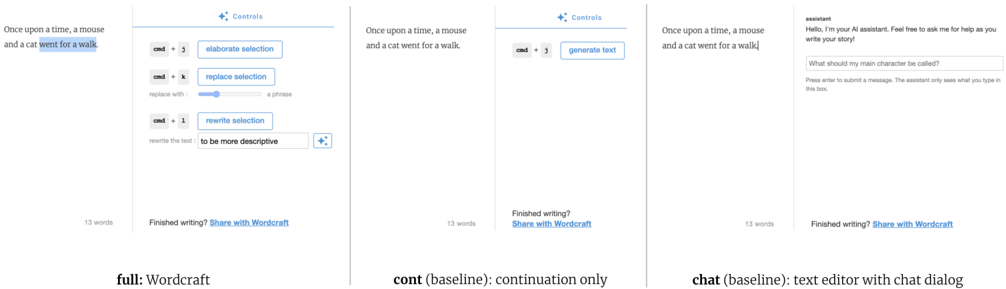
The latest generation of large neural language models such as GPT-3 have achieved new levels of performance on benchmarks for language understanding and generation. These models have even demonstrated an ability to perform arbitrary tasks without explicit training. In this work, we sought to learn how people might use such models in the process of creative writing. We built Wordcraft, a text editor in which users collaborate with a generative language model to write a story. We evaluated Wordcraft with a user study in which participants wrote short stories with and without the tool. Our results show that large language models enable novel co-writing experiences. For example, the language model is able to engage in open-ended conversation about the story, respond to writers’ custom requests expressed in natural language (such as ”rewrite this text to be more Dickensian”), and generate suggestions that serve to unblock writers in the creative process. Based on these results, we discuss design implications for future human-AI co-writing systems.
Overview
The claims and statistics of this paper haven’t been checked yet.
Free: it reads the open-access text and checks the first 5 claims that cite a source we can check. Create a free account to check every claim.
Integrity signals
Registry
Cites
Statistics
Figures
Verification
Claims the paper makes
The claims and statistics of this paper haven’t been checked yet.
Free: it reads the open-access text and checks the first 5 claims that cite a source we can check. Create a free account to check every claim.
Claims other papers make about this one
Each is checked against this paper’s own text: does it say what the citing paper says it does?
The source backs part of the claim, not all of it — or backs it for a different population, condition or comparison.
In the citing paper
“Empirical studies describing how users evaluate LLMs are still a minority and difficult to generalise due to a variation of participants, methods, systems, and disciplinary perspectives [13,27,28,38,47].”
From Playwriting with Large Language Models: Perceived Features, Interaction Strategies and Outcomes (2024) · cites this paper as [47]
Experimental — accuracy not yet measuredThe source backs part of the claim, not all of it — or backs it for a different population, condition or comparison.
In the citing paper
“Despite these limitations, playwrights identified utility at different stages of creative writing, from brainstorming through the summarisation of relevant sources to editing [27,42,47].”
From Playwriting with Large Language Models: Perceived Features, Interaction Strategies and Outcomes (2024) · cites this paper as [47]
Experimental — accuracy not yet measuredThe source backs part of the claim, not all of it — or backs it for a different population, condition or comparison.
In the citing paper
“These interfaces typically provide end-users with only one text area for inputs, which is frequently shared with the output, and one control panel to confgure global settings for the parameters [1,69,85,109].”
From Cells, Generators, and Lenses: Design Framework for Object-Oriented Interaction with Large Language Models (2023) · cites this paper as [109]
Experimental — accuracy not yet measuredThe source backs part of the claim, not all of it — or backs it for a different population, condition or comparison.
In the citing paper
“Students can continually alter prompts to refine the model output helping them to 'build-up' a solution [196].”
From The Robots Are Here: Navigating the Generative AI Revolution in Computing Education (2023) · cites this paper as [196]
Experimental — accuracy not yet measuredThe source backs part of the claim, not all of it — or backs it for a different population, condition or comparison.
In the citing paper
“End-user studies suggest that prompting is challenging, with nonexpert users making various errors and adopting ineffective strategies-a reflection of the demand on users' metacognitive monitoring and control [33,41,43,85,103,174,205].”
From The Metacognitive Demands and Opportunities of Generative AI (2024) · cites this paper as [205]
Experimental — accuracy not yet measured
7 more claims about this paper
Create a free account to see every claim other papers make about this one.
Self-check
Percentages, sums and reported differences re-computed from the paper’s own numbers.
The self-check needs the paper’s full text.
Citations
Cites
Language Models are Few-Shot Learners
Brown, T. B., Mann, B., Ryder, N., Subbiah, M., Kaplan, J., Dhariwal, P., Neelakantan, A., Shyam, P., Sastry, G., Askell, A., et al. (2020) · arXiv · doi:10.48550/arxiv.2005.14165 · Cited by 23,372 · cited 4×
“[38] proposed the idea of designing a prompt that contains several examples of the target task, written in natural language.”
BackgroundInfluential2009 International Joint Conference on Artificial Intelligence
(2009) · doi:10.1109/jcai15434.2009 · Cited by 2,800
Evaluating Large Language Models Trained on Code
Chen, M., Tworek, J., Jun, H., Yuan, Q., Pinto, H. P. D. O., Kaplan, J., Edwards, H., Burda, Y., Joseph, N., Brockman, G., et al. (2021) · arXiv · doi:10.48550/arxiv.2107.03374 · Cited by 1,436 · cited 1×
“Despite the simplicity of this API, large language models (LLMs) have demonstrated proficiency at a wide variety of tasks—from storytelling [1, 28] to code synthesis [4, 9] and email auto-completion [40].”
BackgroundLaMDA: Language Models for Dialog Applications
Thoppilan, R., De Freitas, D., Hall, J., Shazeer, N., Kulshreshtha, A., Cheng, H.-T., Jin, A., Bos, T., Baker, L., Du, Y., et al. (2022) · arXiv · doi:10.48550/arxiv.2201.08239 · Cited by 778 · cited 2×
“In the exit interview, one user commented about the chatbot: ” I loved that it felt like a more targeted version of Google, and I could do background research while writing ” (U21).”
MethodCTRL: A Conditional Transformer Language Model for Controllable Generation
Keskar, N. S., McCann, B., Varshney, L. R., Xiong, C., & Socher, R. (2019) · arXiv · doi:10.48550/arxiv.1909.05858 · Cited by 751 · cited 1×
“Researchers have also built story generation models that incorporate event sequences [33], desired topic [29], and story title [2] as control signals.”
BackgroundExtracting Training Data from Large Language Models
Carlini, N., Tramer, F., Wallace, E., Jagielski, M., Herbert-Voss, A., Lee, K., Roberts, A., Brown, T., Song, D., Erlingsson, U., et al. (2020) · arXiv · doi:10.48550/arxiv.2012.07805 · Cited by 727 · cited 1×
“LLMs have also been found to output memorized passages from their training data [26].”
BackgroundGPT-NeoX-20B: An Open-Source Autoregressive Language Model
Black, S., Biderman, S., Hallahan, E., Anthony, Q., Gao, L., Golding, L., He, H., Leahy, C., McDonell, K., Phang, J., et al. (2022) · Proceedings of BigScience Episode #5 -- Workshop on Challenges & Perspectives in Creating Large Language Models · doi:10.18653/v1/2022.bigscience-1.9 · Cited by 404
GPT-Neo: Large Scale Autoregressive Language Modeling with Mesh-Tensorflow
Black, S., Leo, G., Wang, P., Leahy, C., & Biderman, S. (2021) · Zenodo · doi:10.5281/zenodo.5297715 · Cited by 324 · cited 1×
“Neural language models, such as GPT-2 [34] or GPT-Neo [5], are neural networks that are trained only to predict the next word in a sequence given the previous words (aka a prompt).”
Background
Research works printed but not linked: 14
- 1. Nader Akoury, Shufan Wang, Josh Whiting, Stephen Hood, Nanyun Peng, and Mohit Iyyer. 2020. STORIUM: A Dataset and Evaluation Platform for Machine- in-the-Loop Story Generation. Empirical Methods in Natural Language Processing (2020).
- 3. Niki Parmar Jakob Uszkoreit Llion Jones Aidan N. Gomez Lukasz Kaiser Illia Polo- sukhin Ashish Vaswani, Noam Shazeer. 2017. Attention Is All You Need. Neural Information Processing Systems (2017).
- 6. Daniel Buschek, Martin Zurn, and Malin Eiband. 2021. The Impact of Multiple Parallel Phrase Suggestions on Email Input and Composition Behavior of Native and Non-Native English Writers. ACM (2021).
- 12. Chenhao Tan Yangfeng Ji Elizabeth Clark, Anne Spencer Ross and Noah A. Smith. 2018. Creative Writing with a Machine in the Loop: Case Studies on Slogans and Stories. Intelligent User Interfaces (2018).
- 15. Cheng-Zhi Huang. 2020. AI Song Contest: Human-AI Co-Creation in Songwriting. International Society for Music Information Retrieval Conference (2020).
- 18. Christian Remy Michael Mose Biskjaer Jonas Frich, Lindsay MacDonald Ver- meulen and Peter Dalsgaard. 2019. Mapping the Landscape of Creativity Support Tools in HCI. Computer Human Interaction (2019).
- 19. Varun Kumar Satyapriya Krishna Yada Pruksachatkun Kai-Wei Chang Jwala Dhamala, Tony Sun and Rahul Gupta. 2021. Bold: Dataset and met- rics for measuring biases in open-ended language generation. arXiv preprint arXiv:2101.11718 (2021). · arXiv
- 23. Jay Priyadarshi Marjan Ghazvininejad, Xing Shi and Kevin Knight. 2017. Hafez: an Interactive Poetry Generation System. Association for Computational Linguistics (2017).
- 24. Jonathan Chen Shao-Yu Chen Shukan Shah-Vishwa Shah Joshua Reno Gillian Smith Matthew Guzdial, Nicholas Liao and Mark O. Riedl. 2019. Friend, Collaborator, Student, Manager: How Design of an AI-Driven Game Level Editor Affects Creators. Computer Human Interaction (2019).
- 33. Wesley Cheung Zhaochen Luo William Ma Lara J Martin Prithviraj Ammanabrolu, Ethan Tien and Mark O Riedl. 2020. Story realization: Expanding plot events into sentences. Proceedings of the AAAI Conference on Artificial Intelligence (2020).
- 34. Alec Radford, Jeffrey Wu, Rewon Child, David Luan, Dario Amodei, Ilya Sutskever, et al. 2019. Language models are unsupervised multitask learners. OpenAI blog 1, 8 (2019), 9.
- 35. Nathan Dass Sadao Kurohashi Dan Jurafsky Diyi Yang Reid Pryzant, Richard Diehl Martinez. 2020. Automatically Neutralizing Subjective Bias in Text. AAAI (2020).
- 39. Shi Feng Dan Klein Sameer Singh Tony Z. Zhao, Eric Wallace. 2021. Calibrate Before Use: Improving Few-Shot Performance of Language Models. Proceedings of Machine Learning Research (2021).
- 40. Yonghui Wu. 2018. Smart compose: Using neural networks to help write emails. Google AI Blog (2018).
Cited by
Items 301–393 of 393
Evalet: Evaluating Large Language Models through Functional Fragmentation
Kim, T. S., Lee, H., Lee, Y., Seering, J., & Kim, J. (2026) · CHI Conference on Human Factors in Computing Systems · doi:10.1145/3772318.3790285 · Cited by 14
Chakrabarty, T., & Dhillon, P. S. (2026) · CHI Conference on Human Factors in Computing Systems · doi:10.1145/3772318.3791276 · Cited by 12
Venus and Mars on Canvas: AI-Mediated Collaborative Drawing for Romantic Relationship Insight
Won, H., Kim, J., Kim, J., Kim, T., & Han, J. (2026) · CHI Conference on Human Factors in Computing Systems · doi:10.1145/3772318.3791153 · Cited by 4
Orchid-Creator: An Authoring Tool Supporting LLM-Driven Interactive Narrative Creation
Wu, Z., Kumyol, S., Ma, Z., & Braud, T. (2026) · CHI Conference on Human Factors in Computing Systems · doi:10.1145/3772318.3791426 · Cited by 2
🧑🍳 Cooking Up Creativity : Enhancing LLM Creativity through Structured Recombination
Mizrahi, M., Shani, C., Stanovsky, G., Jurafsky, D., & Shahaf, D. (2026) · Transactions of the Association for Computational Linguistics · doi:10.1162/tacl.a.638 · Cited by 10
Kim, Y., Yin, Y., Karumbaiah, S., & Saxena, D. (2026) · Annual Symposium on Human-Computer Interaction for Work (CHIWORK) · doi:10.1145/3808045.3808094 · Cited by 1
Desolda, G., Deufemia, V., Spano, L. D., Buono, P., Cau, F. M., Cimino, G., Mocci, M., & Tucci, C. (2026) · Behaviour and Information Technology · doi:10.1080/0144929x.2026.2714170 · Cited by 1
“This framing may support critical engagement with AI-generated content (Kizilcec 2016; Kulesza et al. 2013; Yuan et al. 2022); however, our study provides only indirect behavioural evidence for this possibility.”
Paraskevas, T., Konstanta, I., Germanakos, P., Sotirakou, C., Karampela, A., Mourlas, C., & Gekas, C. (2023) · International Conference of the ACM Greek SIGCHI Chapter (CHIGreece) · doi:10.1145/3609987.3610009 · Cited by 1
“[27] developed “Wordcraft”, a Web application that consists of a traditional text editor and a set of integrated controls powered by LLM for authoring tasks such as rewording, resuming, or even conversion of the text style.”
MethodControllable Story Generation Based on Perplexity Minimization
Vychegzhanin, S., Kotelnikova, A., Sergeev, A., & Котельников, Е. В. (2024) · Lecture notes in computer science · doi:10.1007/978-3-031-54534-4_11 · Cited by 2
Rafner, J. F. (2025) · Oxford University Press eBooks · doi:10.1093/oxfordhb/9780197698181.013.0043 · Cited by 4
Testing the limits of large language models in debating humans
Flamino, J., Modi, M. S., Szymanski, B. K., Cross, B., & Mikolajczyk, C. (2025) · Scientific Reports · doi:10.1038/s41598-025-98378-1 · Cited by 1
Trustworthiness Evaluation of Large Language Models
Chen, P., & Liu, S. (2025) · Springer eBooks · doi:10.1007/978-3-031-76770-8_12 · Cited by 2
Why Softmax Attention Outperforms Linear Attention
Deng, Y., Song, Z., Yuan, K., & Zhou, T. (2025) · IEEE International Conference on Big Data (BigData) · doi:10.1109/bigdata66926.2025.11400978 · Cited by 20
Mahlow, C. (2023) · EdArXiv (OSF Preprints) · doi:10.35542/osf.io/da2rm · Cited by 7
Game Plot Design With an LLM-Powered Assistant: An Empirical Study With Game Designers
Alavi, S. H., Xu, W., Jojic, N., Kennett, D., Ng, R. T., Rao, S., Zhang, H., Dolan, B., & Shwartz, V. (2026) · IEEE Transactions on Games · doi:10.1109/tg.2026.3663566
Toward an AI-Collaborated Authoring Tool for Writing Flash Fiction
Bae, B.-C., Kim, Y., Yu, M., Park, S., Kim, Y., & Cheong, Y.-G. (2023) · Communications in computer and information science · doi:10.1007/978-3-031-36004-6_51
Designing mixed-initiative video games
Yang, D. (2023) · Digital Repository Service (Northeastern University) · doi:10.17760/d20618670 · Cited by 1
Designing Metaphor-Based Character Archetypes for a Story Authoring Tool
Kang, I., & Bae, B.-C. (2024) · Communications in computer and information science · doi:10.1007/978-3-031-61932-8_5
Thirimanne, S. P., Lemango, E. Y., Antoniol, G., & Nayebi, M. (2024) · SSRN Electronic Journal · doi:10.2139/ssrn.4865036
Anchor Your Embeddings Through the Storm: Mitigating Instance-to-Document Semantic Gap
Barros, R. M., Arguello, K. K., & Wehrmann, J. (2024) · International Joint Conference on Neural Networks (IJCNN) · doi:10.1109/ijcnn60899.2024.10650518 · Cited by 2
“By leveraging the vast amount of textual data available, large language models have become indispensable in various domains, including coding [16], customer support [11], content creation [39] and day-to-day usage.”
BackgroundStreamAdapter: Efficient Test Time Adaptation from Contextual StreamsPreprint
Muhtar, D., Shen, Y., Yang, Y., Liu, X., Lu, Y., Liu, J., Zhan, Y., Sun, H., Deng, W., Sun, F., et al. (2024) · Qeios · doi:10.32388/g5h95j · Cited by 11
Integration of Large Language Models in Fashion Storytelling for Crowdfunding Campaigns
An, H., choi, Y., Kim, S., Ji, D., Kim, S., & Park, M. (2025) · doi:10.31274/itaa.18561
“LLMs show significant promise in storytelling (Yuan et al., 2022).”
Rassulova, S. K., & Nurmukhambetova, Z. (2025) · SSRN Electronic Journal · doi:10.2139/ssrn.5141067 · Cited by 1
LaGR-SEQ: Language-guided reinforcement learning with sample-efficient querying
Karimpanal, T. G., Semage, B. L., Rana, S., Lê, H., Tran, T., Gupta, S., & Venkatesh, S. (2025) · Neural Computing and Applications · doi:10.1007/s00521-025-11156-y · Cited by 8
“…Christiano et al. [2017] have demonstrated their ability to produce context-aware and meaningful responses in several domains Mirchandani et al. [2023], which has propelled their widespread adoption for a number of applications Yuan et al. [2022], Meyer et al. [2023], Kasneci et al. [2023].”
Future Sight: Fine-Tuning Language Models for Dynamic Story Generation
Zimmerman, B. D., Sahu, G., & Vechtomova, O. (2025) · Lecture notes in computer science · doi:10.1007/978-3-031-90167-6_16
On Comparing LLM-Generated Causal Networks with a Rule-Based Approach
Sheikh, S. J., & Haider, S. (2025) · Communications in computer and information science · doi:10.1007/978-981-96-5887-9_5 · Cited by 1
The Probing Machine: Can Using GenAI Tools Help With Better Reflections During User Interviews
Tran, C., Parayno, R. L., Venkitachalam, B. K., Deja, J. A., & Deja, J. A. (2025) · Lecture notes in computer science · doi:10.1007/978-3-031-93418-6_6 · Cited by 1
Weber, C. J., Huang, J., & Rothe, S. (2025) · ACM International Conference on Interactive Media Experiences · doi:10.1145/3706370.3727862 · Cited by 5
The Game Boy Learning Environment
Fazzari, E., Romano, D., Falchi, F., & Stefanini, C. (2025) · IEEE Transactions on Games · doi:10.1109/tg.2025.3575527 · Cited by 2
“Presently, while AI models are proficient at tasks, such as writing computer programs [14], composing music [15], writing stories [62], and playing various games, including chess [16], Go [17], board games [18], [19], and video games [20], [21], they lack the ability to plan over long time horizons…”
Tamton, N., Karim, K., & Gayar, N. E. (2025) · Lecture notes in networks and systems · doi:10.1007/978-981-96-1758-6_24 · Cited by 1
Sotirakou, C., Germanakos, P., Karampela, A., & Mourlas, C. (2025) · Electronics · doi:10.3390/electronics14132552 · Cited by 2
Lehmann, F., & Buschek, D. (2025) · Proceedings of the ACM on Human-Computer Interaction · doi:10.1145/3733053 · Cited by 3
Sentiment Steering in Large Language Models via Activation Vector Manipulation
Farooq, M., Silva, D., Rahulamathavan, R., & Shi, X. (2025) · IEEE International Conference on Digital Signal Processing (DSP) · doi:10.1109/dsp65409.2025.11075111 · Cited by 5
“They have been explored for conversational information retrieval [4], human-AI collaboration [5], and context-aware goal-oriented dialogues [6], paving the way for smarter and more intuitive AI systems.”
Singh, A., Srivastav, J., Banerjee, J., Jindal, S., & Mohapatra, A. K. (2025) · International Conference on Networks and Cryptology (NETCRYPT) · doi:10.1109/netcrypt65877.2025.11102417
“Large Language Models (LLMs) have emerged as key instruments in domains such as medicine [1,2], networking [3], literature [4], law [5] and many others, providing remarkable progress in natural language processing methods [6] including understanding, interpreting, and composing text.”
Bhattacharya, K., Majumder, A., & Chakrabarti, A. (2025) · Lecture notes in mechanical engineering · doi:10.1007/978-981-96-5511-3_39 · Cited by 2
“A large language model (LLM) can be used to generate content in natural language text [2].”
BackgroundHarish, S., Nawar, S., Chaitra, B. N., Amin, R., & Vijayan, A. (2025) · Lecture notes in networks and systems · doi:10.1007/978-981-96-4008-9_44
Enhancing Genre Fidelity in Children's Story Generation via Fine-Tuned LLMs
Pramanik, S., Chawdhury, A., Biswas, P., & Bhattacharjee, S. (2025) · IEEE International Conference on Quantum Photonics, Artificial Intelligence & Networking (QPAIN) · doi:10.1109/qpain66474.2025.11171897
“Unlike previous studies that focused primarily on adult-oriented content [13] or general story generation [1], we specifically target the understudied domain of children’s genre fiction.”
LLM Integration in Game Writing: An Investigation of Visions and Tools
Sezen, D., & Sezen, T. İ. (2025) · Lecture notes of the Institute for Computer Sciences, Social Informatics and Telecommunications Engineering · doi:10.1007/978-3-032-06982-5_5
GenFODrawing: Supporting Creative Found Object Drawing With Generative AI
Leng, J., Ye, H., Xu, P., Lam, M.-L., & Fu, H. (2025) · IEEE Transactions on Visualization and Computer Graphics · doi:10.1109/tvcg.2025.3626754 · Cited by 2
“Sofar,existingworkshave exploredhuman-AIco-creationtopicsacrossvariousdomains, achievingnotableprogress,suchasmusic[29],video[30], [31], writing [32], [33], programming tutorials [34], sports news [35], design [36], [37], etc.”
A Visualization System for LLM-based Fault Entity Extraction of Power Equipment
You, L., Guo, X., Wang, D., Zhang, Z., Zhong, K., Chen, N., & Wang, H. (2025) · doi:10.1109/icbdse65491.2025.11220034
IMPLEMENTATION OF ARTIFICIAL INTELLIGENCE IN OPTIMIZING RURAL TOURISM MANAGEMENT
Muntean, T., Briscan, L.-E., Iancu, T., Ciolac, R. M., & ADAMOV, T. C. (2025) · International Multidisciplinary Scientific GeoConference SGEM ... · doi:10.5593/sgem2025/5.1/s20.053
Augmented human intelligence goes beyond the AGI mirage
Lissack, M. R., & Meagher, B. (2025) · Discover Artificial Intelligence · doi:10.1007/s44163-025-00683-1 · Cited by 1
Buhnila, I. (2025) · Langages · doi:10.3917/lang.240.0023 · Cited by 1
Emerging Practices in LLM-integrated Game Writing
Sezen, D., & Sezen, T. İ. (2025) · Baltic screen media review./Baltic screen media review · doi:10.2478/bsmr-2025-0004
Leveraging LLM in the Implementation of the CFIHOS Standards Conceptual Model
de Armas, E. M., Campos, J. G., da Silva, G. M. H., Santos, P. I. N., Corseuil, E. T., & de Lima, D. T. (2026) · Lecture notes in networks and systems · doi:10.1007/978-3-032-10721-3_8
Axes-and-Tags: LLM-Driven Design Galleries for Generative Content
Gupta, A., Sarukkai, V., & Fatahalian, K. (2025) · IEEE International Conference on Computer Vision Workshops · doi:10.1109/iccvw69036.2025.00209
From Sound to Sight: Towards AI-authored Music Videos
Vitasovic, L., Graßhof, S., Kloft, A. M., Lehtola, V., Cunneen, M., Starostka, J., McGarry, G., Li, K., & Brandt, S. S. (2025) · IEEE International Conference on Computer Vision Workshops · doi:10.1109/iccvw69036.2025.00401 · Cited by 4
“Recent advances in large language models (LLMs) have made them adept at performing a wide range of tasks, from summarisation to complex reasoning and creative text generation [39, 42, 61].”
Vistoryteller: Designing Data Stories with LLM Agent-Based Generation and Interactive User Control
Shi, Y., Zheng, C., Yang, Z., Xu, K., & Cao, N. (2026) · ACM International Conference on Intelligent User Interfaces (IUI) · doi:10.1145/3742413.3789086 · Cited by 1
CoLyricist: Enhancing Lyric Writing with AI through Workflow-Aligned Support
Yoshida, M., Li, B. Q., Zhao, S., Zhou, Q., Hu, S., Chen, X. '., & Peng, N. (2026) · ACM International Conference on Intelligent User Interfaces (IUI) · doi:10.1145/3742413.3789099 · Cited by 4
From Text to Movement: LLM-driven Swarm User Interfaces for Embodied and Interactive Storytelling
Wang, R., Li, S., Zhang, P., Huang, D., Guo, Y., & Mi, H. (2026) · ACM International Conference on Intelligent User Interfaces (IUI) · doi:10.1145/3742413.3789128
Enhancing Writing Quality with AI: A Multi-Model Approach for Grammar, Tone, and Style Optimization
Prasad, S. D., Akash, K., Naseem, P. K. M., Angeline, J. B. R., Rampriya, R. S., & Arun, R. A. (2026) · International Conference on Computing, Communication, Control and Cyber-Physical Systems (I5CPS) · doi:10.1109/i5cps67958.2026.11452396
“Yuan et al. [14] reported a user study on how the authors of novels can interact with generative language models and provide valuable insights on a user-friendly AI writing tool.”
Wang, Z., Zhang, G., Chen, X., Hao, S., Li, Y., Xiong, G., Yang, Z., Yang, K., Sim, M. Y., & Xu, K. (2026) · Synthesis lectures on human language technologies · doi:10.1007/978-3-032-06264-2_11
From Text-First to Structure-First: A Visual Pipeline for Narrative Writing
Sillano, A., Calò, T., & Russis, L. D. (2026) · CHI Conference Extended Abstracts on Human Factors in Computing Systems (CHI EA) · doi:10.1145/3772363.3799344 · Cited by 1
“Some primarily focus on text level co-writing [36, 37], like continuation or rewrites, while others provide light steering signals, emphasize exploring a wide space of alternatives, or support re-combining fragments into emergent story directions [5, 19, 32].”
Ma, X., Fan, M., Jiang, B., Wang, J., & 何, 彧. (2026) · CHI Conference Extended Abstracts on Human Factors in Computing Systems (CHI EA) · doi:10.1145/3772363.3798316
Zhu, Z., Guo, W., Liu, Y., & Chen, W. (2026) · CHI Conference Extended Abstracts on Human Factors in Computing Systems (CHI EA) · doi:10.1145/3772363.3798881
AI Agents and the Future of Deliberation: Designing Human–AI Collaboration for Democratic Dialogue
Zhang, W., Perrault, S. T., Yeo, S., Pei, J., Liddo, A. D., Veri, F., Flechtner, M., & Saggion, H. (2026) · CHI Conference Extended Abstracts on Human Factors in Computing Systems (CHI EA) · doi:10.1145/3772363.3790075
Singh, S., Baraka, K., Hindriks, K. V., & Heylen, D. (2026) · CHI Conference Extended Abstracts on Human Factors in Computing Systems (CHI EA) · doi:10.1145/3772363.3798698
“…challenge in co-creative systems[21], in writing and storytelling, where users may reject or overlook suggestions not because they are irrelevant or low-quality, but because they struggle to interpret them, or cannot immediately see how they align with their evolving creative vision [9], [29], [3].”
Yin, Y., Wu, M., Huang, R., Tong, X., Zhou, J., Yu, C., & Shi, Y. (2026) · CHI Conference on Human Factors in Computing Systems · doi:10.1145/3772318.3790848 · Cited by 4
Hu, Y., Zhang, J., Wang, Z., & Yu, C. (2026) · CHI Conference on Human Factors in Computing Systems · doi:10.1145/3772318.3790926 · Cited by 4
Exploring Creator-Centric Methods for LLM-Assisted Interactive Storytelling
Li, Y. F., Wu, S., Lujin, Z., Guo, Z., Lu, W., & Yip, D. K. M. (2026) · CHI Conference on Human Factors in Computing Systems · doi:10.1145/3772318.3791362 · Cited by 3
NarrativeLoom: Enhancing Creative Storytelling through Multi-Persona Collaborative Improvisation
Ma, Y., Peng, Y., Yang, F., Zha, S., Zhang, C., Jia, Z., Zheng, Z., & Zhu, Y. B. (2026) · CHI Conference on Human Factors in Computing Systems · doi:10.1145/3772318.3790416 · Cited by 3
Writing with AI Can Reduce Gender Bias in Hiring Evaluations
Liu, A. T. H., Lee, M., & Bai, X. (2026) · CHI Conference on Human Factors in Computing Systems · doi:10.1145/3772318.3791136 · Cited by 1
Narrix: Remixing Narrative Strategies from Examples for Story Writing
Zhang, C., Guo, S., Davis, A., & Koh, E. (2026) · CHI Conference on Human Factors in Computing Systems · doi:10.1145/3772318.3790813 · Cited by 6
Xu, H., Kharrufa, A., Solaiman, E., & Vlachokyriakos, V. (2026) · CHI Conference on Human Factors in Computing Systems · doi:10.1145/3772318.3791087 · Cited by 3
VidTune: Creating Video Soundtracks with Generative Music and Contextual Thumbnails
Huh, M., Fraser, C. A., Li, D., Dontcheva, M., & Wang, B. K. (2026) · CHI Conference on Human Factors in Computing Systems · doi:10.1145/3772318.3791572 · Cited by 5
From Use to Oversight: How Mental Models Influence User Behavior and Output in AI Writing Assistants
Rismani, S., Blodgett, S. L., Liao, Q. V., Olteanu, A., & Moon, A. (2026) · CHI Conference on Human Factors in Computing Systems · doi:10.1145/3772318.3791670 · Cited by 4
Vidmento: Creating Video Stories through Context-Aware Expansion with Generative Video
Yeh, C., Truong, A., Dontcheva, M., & Wang, B. K. (2026) · CHI Conference on Human Factors in Computing Systems · doi:10.1145/3772318.3791337 · Cited by 6
Sci-Fi Spark: A Human-AI Co-Creation System for Science Fiction Ideation
Jiang, Z., Cheang, W., Xu, X., Zuo, H., Zheng, C., & Chen, L. (2026) · CHI Conference on Human Factors in Computing Systems · doi:10.1145/3772318.3791950 · Cited by 1
HOICraft: In-Situ VLM-based Authoring Tool for Part-Level Hand-Object Interaction Design in VR
Lee, D., Sun, Q., & Yoon, S. H. (2026) · CHI Conference on Human Factors in Computing Systems · doi:10.1145/3772318.3790823 · Cited by 6
Liu, Y., & Song, Y. (2026) · British Journal of Educational Technology · doi:10.1111/bjet.70071
Attention Output Projection Importance Score for Key-Value Eviction
Yuan, J., He, Z., Lin, Z., & Jiang, B. (2026) · IEEE International Conference on Acoustics Speech and Signal Processing · doi:10.1109/icassp55912.2026.11463309
A Multimodal Interactive System for Autobiographical Memory: AI-Assisted Reflection and Expression
Zhong, C., Yu, J., Wu, W., Wu, S., Shen, H., & Zhang, K. (2026) · Communications in computer and information science · doi:10.1007/978-981-95-8256-3_2 · Cited by 1
EmbroidVR: Weaving Cultural Heritage with AI-Powered Immersive Interaction
Kang, X., Hua, X., Tan, J., Huang, Z., & Chen, Y. (2025) · International Conference on Human-Engaged Computing (ICHEC) · doi:10.1145/3786995.3787074
Human-AI Co-Creation: A New Interaction Paradigm for Human-AI Interaction
Davis, N., Clemens, M. P., Rezwana, J., & Browne, E. (2026) · Springer eBooks · doi:10.1007/978-981-95-3658-0_76 · Cited by 4
Feng, P., Chen, Y., Lan, H., He, G., Li, Y., & Guan, J. (2026) · Springer eBooks · doi:10.1007/978-981-95-5879-7_1
Design and Implementation of Story Creation Software Based on Large Language Models
Chen, J., Song, S., Wang, J., (510004), X. W., Li, L., & Yu, G. (2026) · Communications in computer and information science · doi:10.1007/978-981-95-8318-8_27
A Diffractive Analysis of GenAI through Perspectives on Productivity
Swift, I. P., & Chattopadhyay, D. (2026) · Annual Symposium on Human-Computer Interaction for Work (CHIWORK) · doi:10.1145/3808045.3808074 · Cited by 1
AI-Supported Regulation Processes in Collaborative Writing
Kolarik, S. (2026) · Communications in computer and information science · doi:10.1007/978-3-032-29794-5_33
A Persona-Augmented Multi-Agent System for Varied Narrative Generation
Sillano, A., Arbore, G., & Russis, L. D. (2026) · ACM SIGCHI Symposium on Engineering Interactive Computing Systems (EICS) · doi:10.1145/3807968.3810931
Saraiva, V., Santos, C., & Ferreira, L. (2026) · Lecture notes in computer science · doi:10.1007/978-3-032-30846-7_11
Reasoning About Humor: It’s No Laughing Matter
Sung, I., & Hu, R. (2026) · Lecture notes in networks and systems · doi:10.1007/978-3-032-20897-2_13
CapSmith: Contextual Refinement of Additive Text Captions for Video Storytelling
Hwang, S., Chou, J.-P., & Truong, A. (2026) · Creativity and Cognition · doi:10.1145/3803784.3807559
Rock Talk: An AI-Mediated Community Garden for Collective Reflection and Purpose Finding
Lee, C., Sun, C., & Leeyouk, S. (2026) · Creativity and Cognition · doi:10.1145/3803784.3809268
Sequencing Human-Artificial Intelligence Creative Writing Collaboration Affects Perceived Authorship
Lizat, P., Jost, P., Leus, D., Alves, M. D. C., & Schmidt, L. V. (2026) · Cureus Journal of Computer Science. · doi:10.7759/s44389-026-00183-y
Goudarzi, A., & Zonouz, A. N. (2026) · Digital studies in language and literature · doi:10.1515/dsll-2026-0052 · Cited by 1
LLM-generated scientific content detection method
Bader, A., & Alhijawi, B. (2026) · Neural Computing and Applications · doi:10.1007/s00521-026-12465-6
A Guideline-Based Approach for Creating Personalized Storybooks with Generative AI
Yang, J., Lim, D., Huh, J., Chang, Y., & Oh, U. (2026) · IEEE International Conference on Information Reuse and Integration (IRI) · doi:10.1109/iri69576.2026.00097
“In summary, this work extends existing research on story-book generation [18] and human–AI co-creation [19], [20] by exploring guideline design in AI-assisted storybook creation.”
Xia, M. (2026) · Procedia Computer Science · doi:10.1016/j.procs.2026.08.169
Lee, S. W., Choi, J., Yun, Y., Jin, S., Jang, Y., Hwang, G., Park, S. W., Ban, S., & Hyun, K. H. (2026) · International Journal of Human-Computer Interaction · doi:10.1080/10447318.2026.2739092
Yang, R., Chu, S., 袁道武, Sun, X., & Zeng, H. (2026) · IEEE Information Technology and Mechatronics Engineering Conference (ITOEC) · doi:10.1109/itoec69754.2026.11732778
“However, most current collaborative platforms, such as Wordcraft [3] and Dramatron [4], remain primarily text-centric.”
CausalPatch: Count-Constrained Causal Repair for User-Edited Multi-Shot Narratives
Liu, Z., Liu, W., Wang, X. Y., & Zhu, W. (2026) · International Workshop on Human-centric Multimedia Analysis (HCMA) · doi:10.1145/3841192.3841748
Where Do I 'Add the Egg'?: Exploring Agency and Ownership in AI Creative Co-Writing Systems
Carrera, D., Thomas-Mitchell, J., & Wigdor, D. (2025) · arXiv · doi:10.48550/arxiv.2509.15440
Metadata
- Authors
- Yuan, A., Coenen, A., Reif, E., & Ippolito, D.
- Affiliations
- Google (United States) (US)
- Venue
- 27th International Conference on Intelligent User Interfaces
- Publisher
- ACM
- Published
- 2022-03-22
- Pages
- 841-852
- OpenAlex
- W4221055872
- Semantic Scholar
- fb5c11bbf63884f75d2da615fbf37a3bcfa2bd20
- Cited by
- 374
- References
- 12
- Citations by year
- 2026: 65 · 2025: 123 · 2024: 121 · 2023: 59 · 2022: 6
- FWCI
- 42.71
- Type
- conference paper
- Language
- en
- Open access
- hybrid
- doi.org
- Licence
- Locations
- ACM International Conference on Intelligent User Interfaces (IUI) (publishedVersion, cc-by)
- Topics
- Physical Sciences › Computer Science › Artificial Intelligence › Artificial Intelligence in Games
- Physical Sciences › Computer Science › Human-Computer Interaction › Innovative Human-Technology Interaction
- Physical Sciences › Computer Science › Artificial Intelligence › Natural Language Processing Techniques
- Keywords
- large language models, creative writing, story writing, text editor, GPT-3, text generation, user study, AI writing tools
About these checks
Registry, retraction, Cites and statistics results are computed, not judged, with one exception: a printed reference that no index lists is read once by a model before it counts as a citation error. Claims are extracted by a model and kept only when their quote appears verbatim in the text; each cited source is then checked, with a model’s help, for whether it says what the claim relies on. Those verdicts can be wrong — read the claim’s quote and the cited source before relying on one.
Statistics and arithmetic are recomputed, not judged.
Confidence bands are shown only for fields calibrated on our annotated test set. None is calibrated yet, so no band is shown.
What counts as a claim ›How we measure confidence ›How we check this ›
Are you an author, or do you see a problem with this page? Request a review
Data sources
Bibliographic data: Semantic Scholar, OpenAlex, Crossref.
Contains information from the Semantic Scholar Academic Graph Datasets, made available under the ODC Attribution License (ODC-BY 1.0).
Semantic Scholar’s data is described in: Kinney, R., et al. (2023). The Semantic Scholar Open Data Platform. arXiv:2301.10140.
