

Understanding User Perceptions of Response Delays in Crowd-Powered Conversational Systems
Open accessThe DOI matches its Crossref record; 125 of the 126 references it cites were found in a registry or an index, and 1 are not checked yet; none of the 113 sources its claims cite is checked for support yet.
Abstract
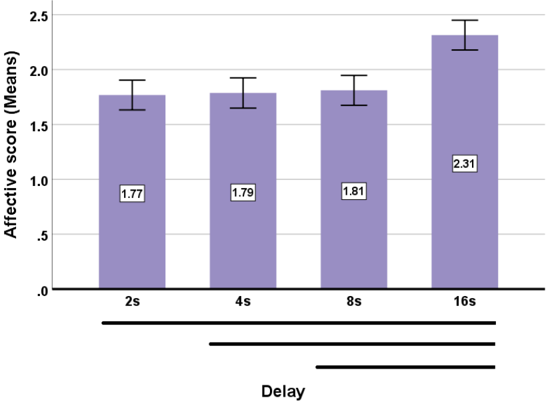
Crowd-powered conversational systems (CPCS) are gaining considerable attention for their potential utility in a variety of application domains, for which automated conversational interfaces are still too limited. CPCS currently suffer from long response delays, which hampers their potential as conversational partners. The majority of prior work in this area has focused on demonstrating the feasibility of the approach and improving performance, while evaluation studies have primarily focused on response latency and ways to reduce it. Relatively little is currently known about how response delays in a CPCS can affect user experience. While the importance of reducing response latency is widely recognized in the broader field of human-computer interaction, little attention has been paid to how response quality, response delay, conversational context, and the complexity of the task affect how users experience the conversation, and how they perceive waiting for responses in particular. We conducted a between-subjects experiment (N = 478), to examine the influence of these four factors on the overall waiting experience of users. Results show that users 1) evaluated the waiting experience more negatively when the response delay was longer than 8 seconds, 2) underestimated the elapsed time but experienced more frustration in tasks with high complexity, 3) underestimated the elapsed time and experienced less frustration with high quality bot's utterances, 4) judged response delays to be slightly longer, and experienced more frustration in an emotion-centric CPCS compared to a task-centric CPCS. Our insights can inform the design of future CPCSs with regards to defining performance requirements and anticipating their potential impact on the user experience they can facilitate.
Checked 2026-11-24 · 1 reference not checked yet
Overview
CoChat Summary
TL;DR
In a 2×2×2×4 between-subjects experiment (N = 478), the paper examines how response delay, response quality, task complexity, and conversational context shape users’ waiting experience in crowd-powered conversational systems. It finds 8 s delays tolerable, 16 s irritating, high-quality responses and lower task complexity improving aspects of the waiting experience, and task-centric IR conversations judged more positively than emotion-centric stress conversations.
Key findings
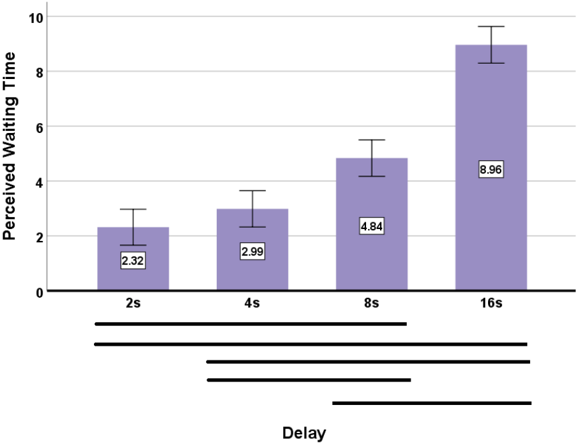
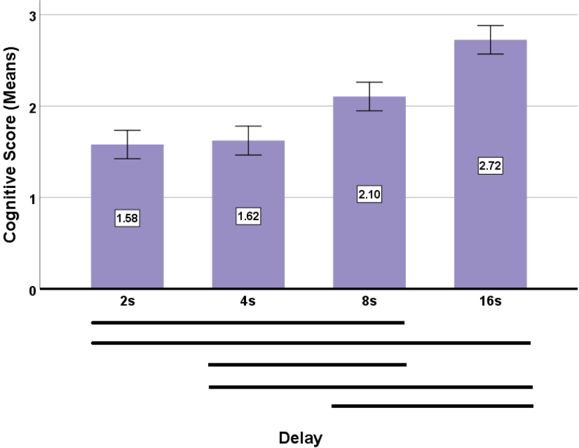
- Response delay significantly affected perceived waiting time, F(3, 427) = 77.90, p < .001, η²p = 0.354; perceived waiting time was 2.52 points higher for 8 s than 2 s, 6.65 points higher for 16 s than 2 s, and 16 s produced more negative affect than 2, 4, or 8 s. Qualitatively, 2–4 s was seen as robotic/unrealistically fast, 8 s as tolerable, and 16 s as irritating for some participants.
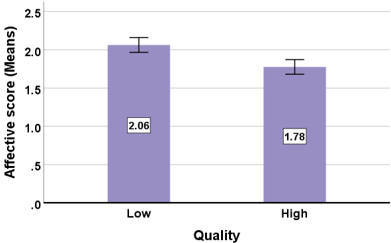
- Low response quality led to more negative affective waiting experience (M = 2.06) than high response quality (M = 1.78), F(1, 441) = 17.00, p < .001, η²p = 0.037; high-quality responses were also associated with an 8.8% decrease in time estimation for 8 s delays and a 4.7% decrease for 16 s delays.
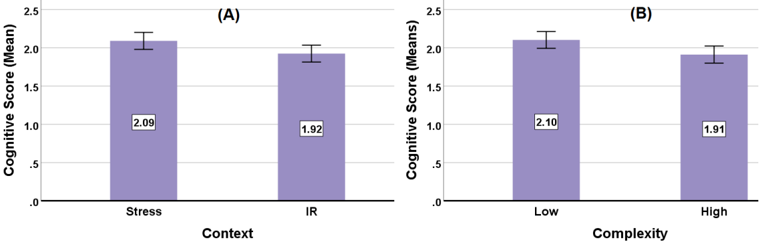
- Lower task complexity led participants to perceive delays as longer (M = 2.10) than high complexity (M = 1.91), F(1, 441) = 5.73, p = .017, η²p = 0.013; stress-task participants judged delays longer (M = 2.09) than IR-task participants (M = 1.92), F(1, 441) = 4.34, p = .038, η²p = 0.010.
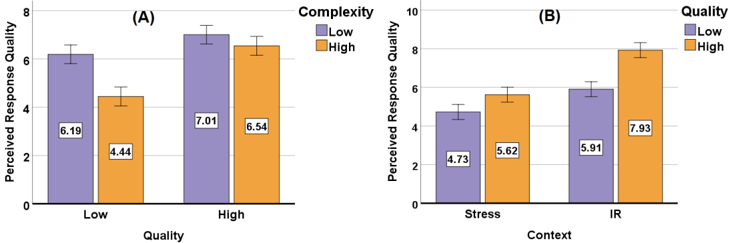
- For perceived response quality, low-quality responses with low-complexity tasks were rated higher (M = 6.09) than low-quality responses with high-complexity tasks (M = 4.45), F(1, 232) = 30.15, p < .001, η²p = 0.115; both stress and IR contexts significantly differentiated high- from low-quality responses.
Methods
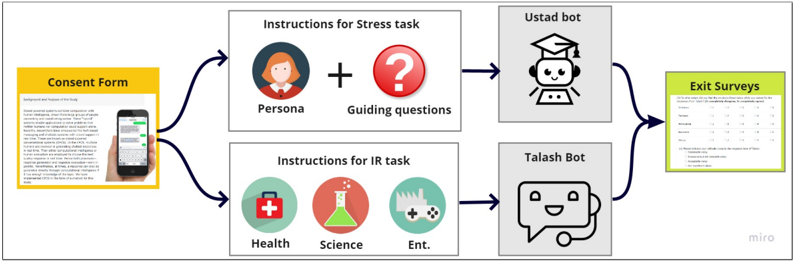
- Between-subjects experiment on Prolific with 32 conditions: 2 (context: stress vs. IR) × 2 (complexity: low vs. high) × 2 (quality: low vs. high) × 4 (delay: 2 s, 4 s, 8 s, 16 s). Final sample was N = 478 after recruiting 522 participants.
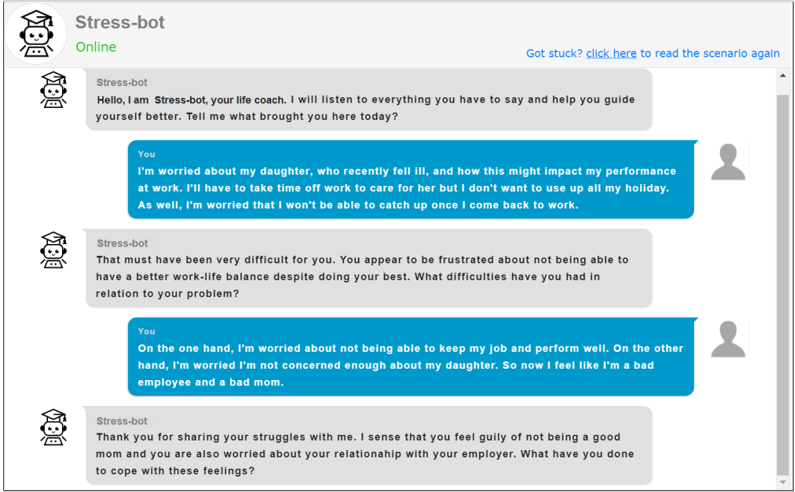
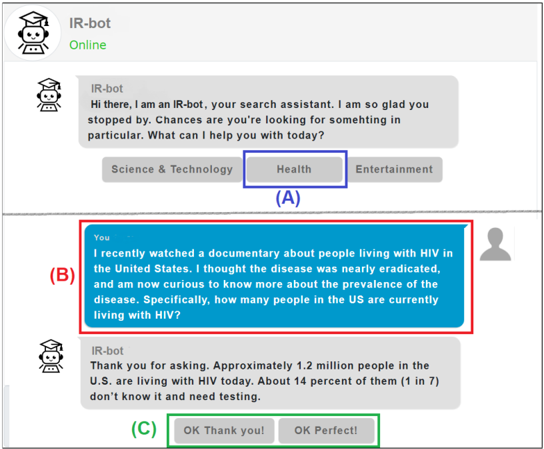
- Two simulated chatbots were used: Stress-bot, based on active listening and Motivational Interviewing, and IR-bot, based on cognitive-complexity search tasks. Measures included perceived waiting time in seconds, cognitive long/short judgment, affective appraisal of the wait, perceived response quality, and qualitative feedback.
- Main analysis used 2×2×2×4 factorial ANCOVA with social orientation toward chatbots, experience with chatbots, and affinity for technology interaction as covariates; qualitative feedback was analyzed with inductive thematic analysis.
Limitations
- Stated by the authors: user responses were restricted to template-based utterances rather than free-form typing, so results may not generalize to extended free-form text input; the bot’s response time was not adjusted based on the complexity of the user’s enquiry; and the study cannot ascertain how participants interpreted the bots’ identities (AI vs. human-powered).
- Evident from the text: the CPCS was simulated with pre-programmed responses rather than actual real-time crowd workers, which may limit ecological validity.
- Evident from the text: the sample was predominantly UK-based (89.9%) and female (67.9%), and three conditions had slightly fewer than 15 participants (13 or 14), which may constrain generalizability.
Model-written summary. Check it against the paper before relying on it.
Integrity signals
Registry
Cites
Statistics
Figures
Verification
Claims the paper makes
0 Valid · 6 Not valid · 95 Not checked · 99 Own results and interpretations
A result the paper reports from its own data — it cites no other source for it, so there is none to check. The quote shows it is in the paper.
In the paper
“4) judged response delays to be slightly longer, and experienced more frustration in an emotion-centric CPCS compared to a task-centric CPCS”
§ Understanding User Perceptions of Response Delays in Crowd-Powered Conversational Systems > Abstract
plainstates an association- Asserted: passes — The authors put it forward as true.
- Checkable: passes — It can be checked against evidence.
- Load-bearing: passes — The paper’s conclusions depend on it.
- Based: passes — The paper gives a reason why it holds.
A result the paper reports from its own data — it cites no other source for it, so there is none to check. The quote shows it is in the paper.
In the paper
“RQ2: When the quality of the response content was high, participants reported a more positive waiting experience”
§ Understanding User Perceptions of Response Delays in Crowd-Powered Conversational Systems > Topics of Motivational Interviewing (MI) / Active listening
plainstates an association- Asserted: passes — The authors put it forward as true.
- Checkable: passes — It can be checked against evidence.
- Load-bearing: passes — The paper’s conclusions depend on it.
- Based: passes — The paper gives a reason why it holds.
A result the paper reports from its own data — it cites no other source for it, so there is none to check. The quote shows it is in the paper.
In the paper
“and perceived the quality of interaction more positively than participants who performed the stress mitigation tasks (Stress-bot).”
§ Understanding User Perceptions of Response Delays in Crowd-Powered Conversational Systems > Topics of Motivational Interviewing (MI) / Active listening
plainstates an association- Asserted: passes — The authors put it forward as true.
- Checkable: passes — It can be checked against evidence.
- Load-bearing: passes — The paper’s conclusions depend on it.
- Based: passes — The paper gives a reason why it holds.
A result the paper reports from its own data — it cites no other source for it, so there is none to check. The quote shows it is in the paper.
In the paper
“Results show that users 1) evaluated the waiting experience more negatively when the response delay was longer than 8 seconds”
§ Understanding User Perceptions of Response Delays in Crowd-Powered Conversational Systems > Abstract
plainstates a cause- Asserted: passes — The authors put it forward as true.
- Checkable: passes — It can be checked against evidence.
- Load-bearing: passes — The paper’s conclusions depend on it.
- Based: passes — The paper gives a reason why it holds.
A result the paper reports from its own data — it cites no other source for it, so there is none to check. The quote shows it is in the paper.
In the paper
“and showed a greater engagement with the CPCS.”
§ Understanding User Perceptions of Response Delays in Crowd-Powered Conversational Systems > Topics of Motivational Interviewing (MI) / Active listening
plainstates an association- Asserted: passes — The authors put it forward as true.
- Checkable: passes — It can be checked against evidence.
- Load-bearing: passes — The paper’s conclusions depend on it.
- Based: passes — The paper gives a reason why it holds.
65 more claims
Create a free account to see all 200 claims and every source verdict.
- The quote only partly states this claim. 1
- Probably not a substantial claim. 111
- It may state two separate claims as one. 46
Statistics recomputed
Every reported test result, recomputed from its test statistic and degrees of freedom. A result shows as not adding up only once an independent check has confirmed it.
- ConsistentF(3, 427) = 77.9reported p < .001 · recomputed p < .001
“F (3, 427) = 77.90,p < .001”
- ConsistentF(1, 441) = 4.34reported p = .038 · recomputed p = .038
“F (1, 441) = 4.34, p = .038”
- ConsistentF(1, 441) = 5.73reported p = .017 · recomputed p = .017
“F (1, 441) = 5.73, p = .017”
- ConsistentF(3, 441) = 44.96reported p < .001 · recomputed p < .001
“F (3, 441) = 44.96,p < .001”
- ConsistentF(1, 441) = 17reported p < .001 · recomputed p < .001
“F (1, 441) = 17.00, p < .001”
10 more recomputed tests
Create a free account to see every test the Stats check recomputed.
Self-check
Percentages, sums and reported differences re-computed from the paper’s own numbers.
Each contradiction between two passages listed here was confirmed by an independent check.
Rated minor: it would not touch a result — a value no result rests on, a p-value that stays on the same side of the significance level, or a conflict that is clerical, resolved elsewhere in the paper, or outside its own findings.
In the paper
§ Understanding User Perceptions of Response Delays in Crowd-Powered Conversational Systems > 3.9 Data Analysis
“We removed five cases from the dataset because participants provided anomalous feedback.Except in three cases (two conditions had 13 participants and one had 14), each condition had fifteen participants in total.”
§ Understanding User Perceptions of Response Delays in Crowd-Powered Conversational Systems > 3.6 Participants
“Hence, our remaining sample included 478 participants.”
Rated minor: it would not touch a result — a value no result rests on, a p-value that stays on the same side of the significance level, or a conflict that is clerical, resolved elsewhere in the paper, or outside its own findings.
In the paper
§ Understanding User Perceptions of Response Delays in Crowd-Powered Conversational Systems > 3.6 Participants
“there were just 16 for the stress task and 16 for the IR task across all conditions.”
§ Understanding User Perceptions of Response Delays in Crowd-Powered Conversational Systems > A SAMPLE STRESS MANAGEMENT TASK
“| | United States | 21 (8.9%) | 27 (11.2%) 48 (10.0%) | |”
Citations
Cites
Statistical Power Analysis for the Behavioral Sciences
Muller, K. (1989) · Technometrics · doi:10.1080/00401706.1989.10488618 · Cited by 99,167
Faul, F., Erdfelder, E., Lang, A.-G., & Buchner, A. (2007) · Behavior Research Methods · doi:10.3758/bf03193146 · Cited by 65,971
Statistical power analyses using G∗Power 3.1: tests for correlation and regression analyses
Faul, F., Erdfelder, E., Buchner, A., & Lang, A.-G. (2009) · Behavior Research Methods · doi:10.3758/brm.41.4.1149 · Cited by 37,615
Baltosser, W. H., & Zar, J. H. (1996) · Ecology · doi:10.2307/2265725 · Cited by 35,166
Statistical Power Analysis for the Behavioral Sciences
Cohen, J. (2013) · doi:10.4324/9780203771587 · Cited by 25,373
Lakens, D. (2013) · Frontiers in Psychology · doi:10.3389/fpsyg.2013.00863 · Cited by 10,303
Braun, V., & Clarke, V. (2012) · APA handbook of research methods in psychology, Vol 2: Research designs: Quantitative, qualitative, neuropsychological, and biological. · doi:10.1037/13620-004 · Cited by 10,299
Flow: The Psychology of Optimal Experience
Buchanan, R., & Csikszentmihalyi, M. (1991) · Design Issues · doi:10.2307/1511458 · Cited by 9,394
Agarwal, R., & Karahanna, E. (2000) · MIS Quarterly · doi:10.2307/3250951 · Cited by 4,726
Motivational Interviewing: Helping People Change
Tober, G. (2013) · Alcohol and Alcoholism · doi:10.1093/alcalc/agt010 · Cited by 4,268
Research works printed but not linked: 10
- Hee-Kyung Ahn, Maggie Wenjing Liu, and Dilip Soman. 2006. Memory for Time: A Cognitive Model of Retrospective Duration and Sequence Judgments. Available at SSRN 897933 (2006).
- John A Hoxmeier and Chris DiCesare. 2000. System response time and user satisfaction: An experimental study of browser-based applications. AMCIS 2000 Proceedings (2000), 347.
- 10.2307/1251932 · doi:10.2307/1251932
- Azizuddin Khan, Narendra K Sharma, and Shikha Dixit. 2006. Effect of cognitive load and paradigm on time perception. Journal of the Indian Academy of applied Psychology 32, 1 (2006), 37-42.
- Robert B Miller. 1968. Response time in man-computer conversational transactions. In Proceedings of the December 9-11, 1968, fall joint computer conference, part I. 267-277. · DOI · Paper page
- William R Miller, Theresa B Moyers, Denise Ernst, and Paul Amrhein. 2003. Manual for the motivational interviewing skill code (MISC). Unpublished manuscript. Albuquerque: Center on Alcoholism, Substance Abuse and Addictions, University of New Mexico (2003).
- Robert Robert Randall Morris. 2015. Crowdsourcing mental health and emotional well-being. Ph.D. Dissertation. Massachusetts Institute of Technology.
- Carl R Rogers and Richard E Farson. 1957. Active listening. Chicago, IL.
- Ryan M Schuetzler, Mark Grimes, Justin Scott Giboney, and Joesph Buckman. 2014. Facilitating natural conversational agent interactions: lessons from a deception experiment. (2014).
- Hans Van Der Heijden. 2002. On the cognitive-affective structure of attitudes toward information systems. ICIS 2002 Proceedings (2002).
Cited by
The effects of response time on older and young adults’ interaction experience with Chatbot
Wang, Y., & Lo, C.-W. (2025) · BMC Psychology · doi:10.1186/s40359-025-02459-9 · Cited by 60
Finding the sweet spot: Exploring the optimal communication delay for AI feedback tools
Shi, Y., & Deng, B. (2023) · Information Processing & Management · doi:10.1016/j.ipm.2023.103572 · Cited by 32
Zhang, K., Luo, J., Huang, Q., Zhang, K., & Du, J. (2025) · Journal of theoretical and applied electronic commerce research · doi:10.3390/jtaer20040255 · Cited by 27
Salimzadeh, S., & Gadiraju, U. (2024) · ACM Conference on User Modeling, Adaptation and Personalization (UMAP) · doi:10.1145/3627043.3659567 · Cited by 20
Self-citationTetriServe: Efficiently Serving Mixed DiT Workloads
Lu, R., He, S., Tan, W., Li, S., Wu, R., Ma, J. J., Chen, A., & Chowdhury, M. (2026) · International Conference on Architectural Support for Programming Languages and Operating Systems (ASPLOS) · doi:10.1145/3779212.3790233 · Cited by 16
Metadata
- Authors
- Abbas, T., Gadiraju, U., Khan, V.-J., & Markopoulos, P.
- Affiliations
- Mirpur University of Science and Technology (PK)
- Delft University of Technology (NL)
- Sappi Europe, Brussels, Belgium
- Eindhoven University of Technology (NL)
- Venue
- Proceedings of the ACM on Human-Computer Interaction
- Published
- 2022-11-07
- Volume
- 6
- Issue
- CSCW2
- Pages
- 1-42
- ISSN
- 2573-0142 (ISSN-L)
- OpenAlex
- W4309618976
- Semantic Scholar
- 7756388aee5b545b7aa0cedf85668cd26647e2e0
- Cited by
- 26
- References
- 118
- Citations by year
- 2026: 11 · 2025: 10 · 2024: 4 · 2023: 1
- FWCI
- 1.50
- Type
- journal article
- Language
- en
- Open access
- hybrid
- doi.org
- Licence
- Locations
- Proceedings of the ACM on Human-Computer Interaction (publishedVersion, cc-by)
- TU/e Research Portal (publishedVersion, cc-by)
- Funders
- 4TU.CEE UNCAGE project
- Mirpur University of Science and technology (611-19 P.D/2017)
- Topics
- Social Sciences › Business, Management and Accounting › Marketing › AI in Service Interactions
- Physical Sciences › Computer Science › Artificial Intelligence › Speech and dialogue systems
- Physical Sciences › Computer Science › Human-Computer Interaction › Usability and User Interface Design
- Keywords
- response latency, user experience, waiting experience, response quality, task complexity, conversational context, frustration, time perception, conversational agent design
About these checks
Registry, retraction, Cites and statistics results are computed, not judged, with one exception: a printed reference that no index lists is read once by a model before it counts as a citation error. Claims are extracted by a model and kept only when their quote appears verbatim in the text; each cited source is then checked, with a model’s help, for whether it says what the claim relies on. Those verdicts can be wrong — read the claim’s quote and the cited source before relying on one.
A language model drew the claims from the paper on 2026-11-24, under version 3 of the claim definition (model deepseek-v4.1-flash, prompt extract-v3).
A second model labelled each claim on 2026-11-24 (model jev-1.13-20260917, definition revision gold-guideline-v0.2).
Statistics and arithmetic are recomputed, not judged.
Confidence bands are shown only for fields calibrated on our annotated test set. None is calibrated yet, so no band is shown.
What counts as a claim ›How we measure confidence ›How we check this ›
Are you an author, or do you see a problem with this page? Request a review
How to cite
Cite CoChat for the checks on this page, and the paper for its own findings.
- This page
- CoChat. (2026). Citation check: Understanding User Perceptions of Response Delays in Crowd-Powered Conversational Systems. https://app.cochat.ai/papers/10.1145/3555765
- The paper
- Abbas, T., Gadiraju, U., Khan, V.-J., & Markopoulos, P. (2022). Understanding User Perceptions of Response Delays in Crowd-Powered Conversational Systems. Proceedings of the ACM on Human-Computer Interaction. https://doi.org/10.1145/3555765
Data sources
Bibliographic data: Semantic Scholar, OpenAlex, Crossref.
Contains information from the Semantic Scholar Academic Graph Datasets, made available under the ODC Attribution License (ODC-BY 1.0).
Semantic Scholar’s data is described in: Kinney, R., et al. (2023). The Semantic Scholar Open Data Platform. arXiv:2301.10140.
