

Understanding User Perceptions of Response Delays in Crowd-Powered Conversational Systems
Open accessThe DOI matches its Crossref record; 125 of the 126 references it cites were found in a registry or an index, and 1 are not checked yet; none of the 113 sources its claims cite is checked for support yet.
Abstract
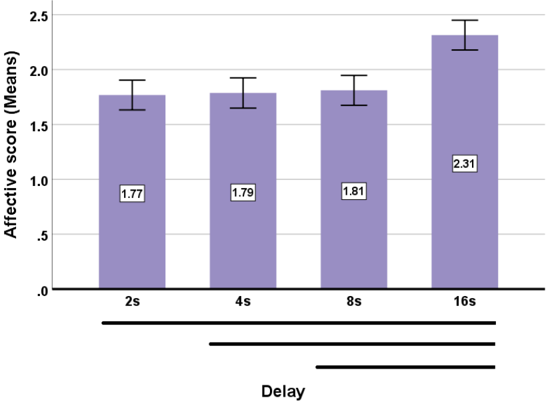
Crowd-powered conversational systems (CPCS) are gaining considerable attention for their potential utility in a variety of application domains, for which automated conversational interfaces are still too limited. CPCS currently suffer from long response delays, which hampers their potential as conversational partners. The majority of prior work in this area has focused on demonstrating the feasibility of the approach and improving performance, while evaluation studies have primarily focused on response latency and ways to reduce it. Relatively little is currently known about how response delays in a CPCS can affect user experience. While the importance of reducing response latency is widely recognized in the broader field of human-computer interaction, little attention has been paid to how response quality, response delay, conversational context, and the complexity of the task affect how users experience the conversation, and how they perceive waiting for responses in particular. We conducted a between-subjects experiment (N = 478), to examine the influence of these four factors on the overall waiting experience of users. Results show that users 1) evaluated the waiting experience more negatively when the response delay was longer than 8 seconds, 2) underestimated the elapsed time but experienced more frustration in tasks with high complexity, 3) underestimated the elapsed time and experienced less frustration with high quality bot's utterances, 4) judged response delays to be slightly longer, and experienced more frustration in an emotion-centric CPCS compared to a task-centric CPCS. Our insights can inform the design of future CPCSs with regards to defining performance requirements and anticipating their potential impact on the user experience they can facilitate.
Checked 2026-11-24 · 1 reference not checked yet
Overview
CoChat Summary
TL;DR
In a 2×2×2×4 between-subjects experiment (N = 478), the paper examines how response delay, response quality, task complexity, and conversational context shape users’ waiting experience in crowd-powered conversational systems. It finds 8 s delays tolerable, 16 s irritating, high-quality responses and lower task complexity improving aspects of the waiting experience, and task-centric IR conversations judged more positively than emotion-centric stress conversations.
Key findings
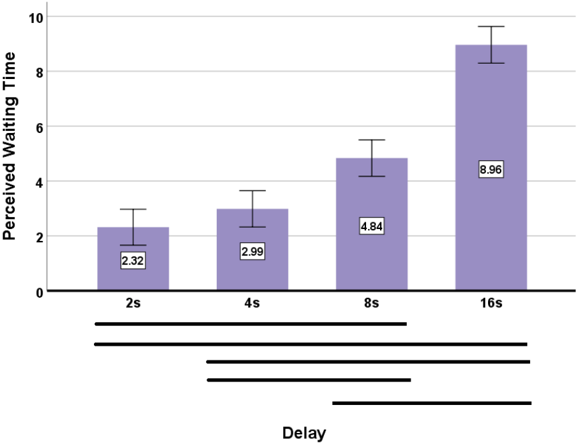
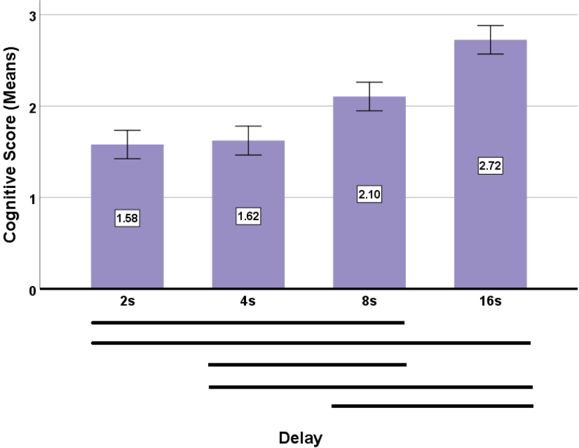
- Response delay significantly affected perceived waiting time, F(3, 427) = 77.90, p < .001, η²p = 0.354; perceived waiting time was 2.52 points higher for 8 s than 2 s, 6.65 points higher for 16 s than 2 s, and 16 s produced more negative affect than 2, 4, or 8 s. Qualitatively, 2–4 s was seen as robotic/unrealistically fast, 8 s as tolerable, and 16 s as irritating for some participants.
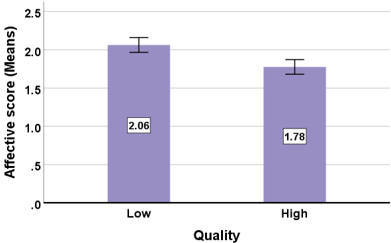
- Low response quality led to more negative affective waiting experience (M = 2.06) than high response quality (M = 1.78), F(1, 441) = 17.00, p < .001, η²p = 0.037; high-quality responses were also associated with an 8.8% decrease in time estimation for 8 s delays and a 4.7% decrease for 16 s delays.
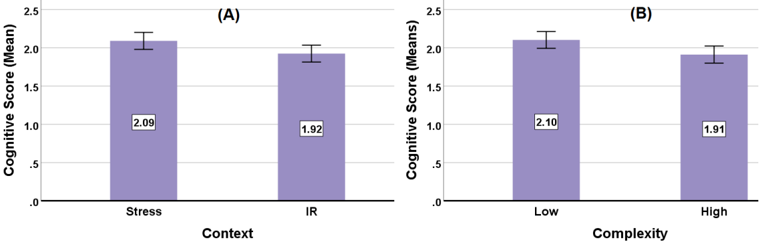
- Lower task complexity led participants to perceive delays as longer (M = 2.10) than high complexity (M = 1.91), F(1, 441) = 5.73, p = .017, η²p = 0.013; stress-task participants judged delays longer (M = 2.09) than IR-task participants (M = 1.92), F(1, 441) = 4.34, p = .038, η²p = 0.010.
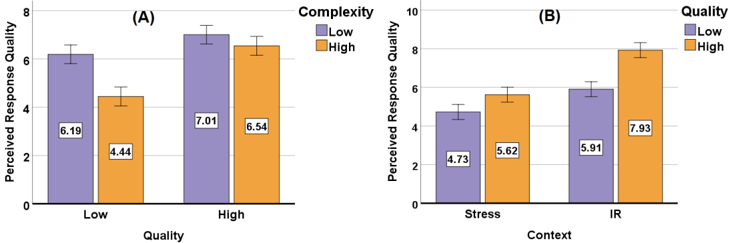
- For perceived response quality, low-quality responses with low-complexity tasks were rated higher (M = 6.09) than low-quality responses with high-complexity tasks (M = 4.45), F(1, 232) = 30.15, p < .001, η²p = 0.115; both stress and IR contexts significantly differentiated high- from low-quality responses.
Methods
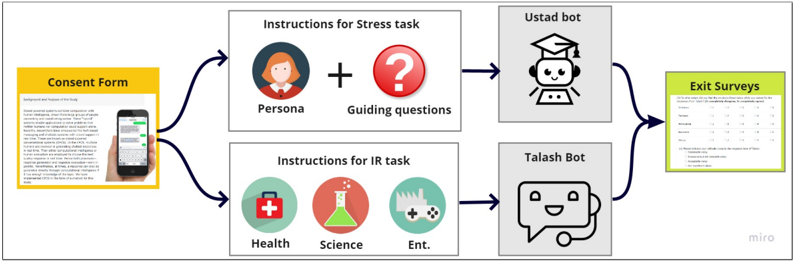
- Between-subjects experiment on Prolific with 32 conditions: 2 (context: stress vs. IR) × 2 (complexity: low vs. high) × 2 (quality: low vs. high) × 4 (delay: 2 s, 4 s, 8 s, 16 s). Final sample was N = 478 after recruiting 522 participants.
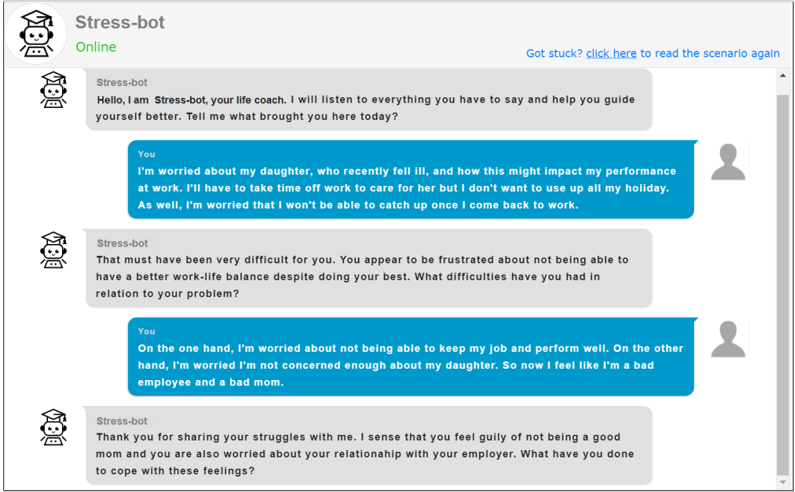
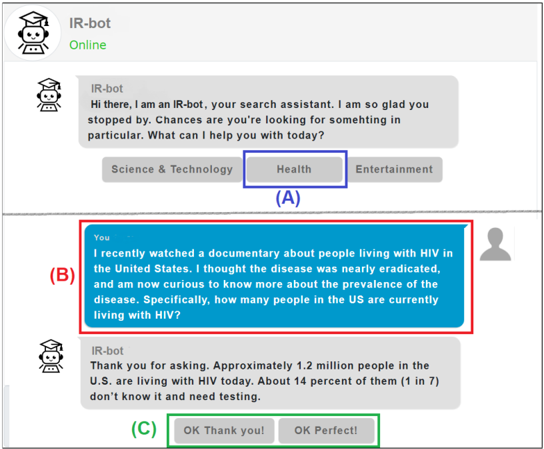
- Two simulated chatbots were used: Stress-bot, based on active listening and Motivational Interviewing, and IR-bot, based on cognitive-complexity search tasks. Measures included perceived waiting time in seconds, cognitive long/short judgment, affective appraisal of the wait, perceived response quality, and qualitative feedback.
- Main analysis used 2×2×2×4 factorial ANCOVA with social orientation toward chatbots, experience with chatbots, and affinity for technology interaction as covariates; qualitative feedback was analyzed with inductive thematic analysis.
Limitations
- Stated by the authors: user responses were restricted to template-based utterances rather than free-form typing, so results may not generalize to extended free-form text input; the bot’s response time was not adjusted based on the complexity of the user’s enquiry; and the study cannot ascertain how participants interpreted the bots’ identities (AI vs. human-powered).
- Evident from the text: the CPCS was simulated with pre-programmed responses rather than actual real-time crowd workers, which may limit ecological validity.
- Evident from the text: the sample was predominantly UK-based (89.9%) and female (67.9%), and three conditions had slightly fewer than 15 participants (13 or 14), which may constrain generalizability.
Model-written summary. Check it against the paper before relying on it.
Integrity signals
Registry
Cites
Statistics
Figures
Verification
Claims the paper makes
0 Valid · 6 Not valid · 95 Not checked · 99 Own results and interpretations
A result the paper reports from its own data — it cites no other source for it, so there is none to check. The quote shows it is in the paper.
In the paper
“4) judged response delays to be slightly longer, and experienced more frustration in an emotion-centric CPCS compared to a task-centric CPCS”
§ Understanding User Perceptions of Response Delays in Crowd-Powered Conversational Systems > Abstract
plainstates an association- Asserted: passes — The authors put it forward as true.
- Checkable: passes — It can be checked against evidence.
- Load-bearing: passes — The paper’s conclusions depend on it.
- Based: passes — The paper gives a reason why it holds.
A result the paper reports from its own data — it cites no other source for it, so there is none to check. The quote shows it is in the paper.
In the paper
“RQ2: When the quality of the response content was high, participants reported a more positive waiting experience”
§ Understanding User Perceptions of Response Delays in Crowd-Powered Conversational Systems > Topics of Motivational Interviewing (MI) / Active listening
plainstates an association- Asserted: passes — The authors put it forward as true.
- Checkable: passes — It can be checked against evidence.
- Load-bearing: passes — The paper’s conclusions depend on it.
- Based: passes — The paper gives a reason why it holds.
A result the paper reports from its own data — it cites no other source for it, so there is none to check. The quote shows it is in the paper.
In the paper
“and perceived the quality of interaction more positively than participants who performed the stress mitigation tasks (Stress-bot).”
§ Understanding User Perceptions of Response Delays in Crowd-Powered Conversational Systems > Topics of Motivational Interviewing (MI) / Active listening
plainstates an association- Asserted: passes — The authors put it forward as true.
- Checkable: passes — It can be checked against evidence.
- Load-bearing: passes — The paper’s conclusions depend on it.
- Based: passes — The paper gives a reason why it holds.
A result the paper reports from its own data — it cites no other source for it, so there is none to check. The quote shows it is in the paper.
In the paper
“Results show that users 1) evaluated the waiting experience more negatively when the response delay was longer than 8 seconds”
§ Understanding User Perceptions of Response Delays in Crowd-Powered Conversational Systems > Abstract
plainstates a cause- Asserted: passes — The authors put it forward as true.
- Checkable: passes — It can be checked against evidence.
- Load-bearing: passes — The paper’s conclusions depend on it.
- Based: passes — The paper gives a reason why it holds.
A result the paper reports from its own data — it cites no other source for it, so there is none to check. The quote shows it is in the paper.
In the paper
“and showed a greater engagement with the CPCS.”
§ Understanding User Perceptions of Response Delays in Crowd-Powered Conversational Systems > Topics of Motivational Interviewing (MI) / Active listening
plainstates an association- Asserted: passes — The authors put it forward as true.
- Checkable: passes — It can be checked against evidence.
- Load-bearing: passes — The paper’s conclusions depend on it.
- Based: passes — The paper gives a reason why it holds.
65 more claims
Create a free account to see all 200 claims and every source verdict.
- The quote only partly states this claim. 1
- Probably not a substantial claim. 111
- It may state two separate claims as one. 46
Statistics recomputed
Every reported test result, recomputed from its test statistic and degrees of freedom. A result shows as not adding up only once an independent check has confirmed it.
- ConsistentF(3, 427) = 77.9reported p < .001 · recomputed p < .001
“F (3, 427) = 77.90,p < .001”
- ConsistentF(1, 441) = 4.34reported p = .038 · recomputed p = .038
“F (1, 441) = 4.34, p = .038”
- ConsistentF(1, 441) = 5.73reported p = .017 · recomputed p = .017
“F (1, 441) = 5.73, p = .017”
- ConsistentF(3, 441) = 44.96reported p < .001 · recomputed p < .001
“F (3, 441) = 44.96,p < .001”
- ConsistentF(1, 441) = 17reported p < .001 · recomputed p < .001
“F (1, 441) = 17.00, p < .001”
10 more recomputed tests
Create a free account to see every test the Stats check recomputed.
Self-check
Percentages, sums and reported differences re-computed from the paper’s own numbers.
Each contradiction between two passages listed here was confirmed by an independent check.
Rated minor: it would not touch a result — a value no result rests on, a p-value that stays on the same side of the significance level, or a conflict that is clerical, resolved elsewhere in the paper, or outside its own findings.
In the paper
§ Understanding User Perceptions of Response Delays in Crowd-Powered Conversational Systems > 3.9 Data Analysis
“We removed five cases from the dataset because participants provided anomalous feedback.Except in three cases (two conditions had 13 participants and one had 14), each condition had fifteen participants in total.”
§ Understanding User Perceptions of Response Delays in Crowd-Powered Conversational Systems > 3.6 Participants
“Hence, our remaining sample included 478 participants.”
Rated minor: it would not touch a result — a value no result rests on, a p-value that stays on the same side of the significance level, or a conflict that is clerical, resolved elsewhere in the paper, or outside its own findings.
In the paper
§ Understanding User Perceptions of Response Delays in Crowd-Powered Conversational Systems > 3.6 Participants
“there were just 16 for the stress task and 16 for the IR task across all conditions.”
§ Understanding User Perceptions of Response Delays in Crowd-Powered Conversational Systems > A SAMPLE STRESS MANAGEMENT TASK
“| | United States | 21 (8.9%) | 27 (11.2%) 48 (10.0%) | |”
Citations
Cites
Statistical Power Analysis for the Behavioral Sciences
Muller, K. (1989) · Technometrics · doi:10.1080/00401706.1989.10488618 · Cited by 99,167
Faul, F., Erdfelder, E., Lang, A.-G., & Buchner, A. (2007) · Behavior Research Methods · doi:10.3758/bf03193146 · Cited by 65,971
Statistical power analyses using G∗Power 3.1: tests for correlation and regression analyses
Faul, F., Erdfelder, E., Buchner, A., & Lang, A.-G. (2009) · Behavior Research Methods · doi:10.3758/brm.41.4.1149 · Cited by 37,615
Baltosser, W. H., & Zar, J. H. (1996) · Ecology · doi:10.2307/2265725 · Cited by 35,166
Statistical Power Analysis for the Behavioral Sciences
Cohen, J. (2013) · doi:10.4324/9780203771587 · Cited by 25,373
Lakens, D. (2013) · Frontiers in Psychology · doi:10.3389/fpsyg.2013.00863 · Cited by 10,303
Braun, V., & Clarke, V. (2012) · APA handbook of research methods in psychology, Vol 2: Research designs: Quantitative, qualitative, neuropsychological, and biological. · doi:10.1037/13620-004 · Cited by 10,299
Flow: The Psychology of Optimal Experience
Buchanan, R., & Csikszentmihalyi, M. (1991) · Design Issues · doi:10.2307/1511458 · Cited by 9,394
Agarwal, R., & Karahanna, E. (2000) · MIS Quarterly · doi:10.2307/3250951 · Cited by 4,726
Motivational Interviewing: Helping People Change
Tober, G. (2013) · Alcohol and Alcoholism · doi:10.1093/alcalc/agt010 · Cited by 4,268
Neural Information Processing Systems
(2018) · The Deep Learning Revolution · doi:10.7551/mitpress/11474.003.0014 · Cited by 3,730
The Uncanny Valley [From the Field]
Mori, M., MacDorman, K., & Kageki, N. (2012) · IEEE Robotics & Automation Magazine · doi:10.1109/mra.2012.2192811 · Cited by 3,542
Using Bayes to get the most out of non-significant results
Dienes, Z. (2014) · Frontiers in Psychology · doi:10.3389/fpsyg.2014.00781 · Cited by 1,998
Crowdsourcing user studies with Mechanical Turk
Kittur, A., Chi, E. H., & Suh, B. (2008) · Proceedings of the SIGCHI Conference on Human Factors in Computing Systems · doi:10.1145/1357054.1357127 · Cited by 1,923
Task complexity: Definition of the construct
Wood, R. E. (1986) · Organizational Behavior and Human Decision Processes · doi:10.1016/0749-5978(86)90044-0 · Cited by 1,393
Perski, O., Blandford, A., West, R., & Michie, S. (2017) · Translational Behavioral Medicine · doi:10.1007/s13142-016-0453-1 · Cited by 1,193
Araujo, T. (2018) · Computers in Human Behavior · doi:10.1016/j.chb.2018.03.051 · Cited by 1,156
Response time in man-computer conversational transactions
Miller, R. B. (1968) · Proceedings of the December 9-11, 1968, fall joint computer conference, part I on - AFIPS '68 (Fall, part I) · doi:10.1145/1476589.1476628 · Cited by 942 · cited 1×
“Miller [76] wrote in his report about response time in conversational transactions that “captivity of more than 15 seconds, even for information essential to him, may be more than an annoyance and disruption”.”
BackgroundNIELSEN, J. (1993) · Usability Engineering · doi:10.1016/b978-0-08-052029-2.50009-7 · Cited by 934
Analyzing the Amazon Mechanical Turk marketplace
Ipeirotis, P. G. (2010) · XRDS: Crossroads, The ACM Magazine for Students · doi:10.1145/1869086.1869094 · Cited by 879
Franke, T., Attig, C., & Wessel, D. (2019) · International Journal of Human–Computer Interaction · doi:10.1080/10447318.2018.1456150 · Cited by 828
Wizard of Oz Studies in HRI: A Systematic Review and New Reporting Guidelines
Riek, L. (2012) · Journal of Human-Robot Interaction · doi:10.5898/jhri.1.1.riek · Cited by 779
Flipping the Classroom to Improve Student Performance and Satisfaction
Missildine, K., Fountain, R., Summers, L., & Gosselin, K. (2013) · Journal of Nursing Education · doi:10.3928/01484834-20130919-03 · Cited by 696
VizWiz: nearly real-time answers to visual questions
Bigham, J. P., Jayant, C., Ji, H., Little, G., Miller, A., Miller, R. C., Miller, R., Tatarowicz, A., White, B., White, S., et al. (2010) · Proceedings of the 23nd annual ACM symposium on User interface software and technology · doi:10.1145/1866029.1866080 · Cited by 601 · cited 3×
“VizWiz [12] is one of the earliest real-time crowd-powered system which helps blind users in answering visual questions about their surroundings by sending photos of objects and audio questions from their phones to crowd workers.”
BackgroundMethodLinardon, J., & Fuller-Tyszkiewicz, M. (2020) · Journal of Consulting and Clinical Psychology · doi:10.1037/ccp0000459 · Cited by 573 · cited 1×
“Due to the inability of artificial intelligence (AI) to give answers for users’ particular circumstances, AI-based mental health interventions currently have a high rate of attrition and low adherence [72].”
BackgroundA New Chatbot for Customer Service on Social Media
Xu, A., Liu, Z., Guo, Y., Sinha, V., & Akkiraju, R. (2017) · Proceedings of the 2017 CHI Conference on Human Factors in Computing Systems · doi:10.1145/3025453.3025496 · Cited by 550
Cognitive processing and time perception
Thomas, E. A. C., & Weaver, W. B. (1975) · Perception & Psychophysics · doi:10.3758/bf03199347 · Cited by 483
What to Tell Consumers in Waits of Different Lengths: An Integrative Model of Service Evaluation
Hui, M. K., & Tse, D. K. (1996) · Journal of Marketing · doi:10.1177/002224299606000206 · Cited by 469
Iterative Learning for Reliable Crowdsourcing Systems
Karger, D. R., Oh, S., & Shah, D. (2011) · DSpace@MIT (Massachusetts Institute of Technology) · Cited by 468
Fraser, N. M., & Gilbert, G. N. (1991) · Computer Speech & Language · doi:10.1016/0885-2308(91)90019-m · Cited by 442
Quality Control in Crowdsourcing Systems: Issues and Directions
Allahbakhsh, M., Benatallah, B., Ignjatovic, A., Motahari-Nezhad, H. R., Bertino, E., & Dustdar, S. (2013) · IEEE Internet Computing · doi:10.1109/mic.2013.20 · Cited by 385
Physicians’ perceptions of chatbots in health Care: cross-sectional web-based survey
Palanica, A., Flaschner, P., Thommandram, A., Li, M., & Fossat, Y. (2019) · Journal of Medical Internet Research · doi:10.2196/12887 · Cited by 384 · cited 1×
“While technology-assisted behavioral interventions can be implemented more easily than in-person interventions, they are limited in their ability to comprehend or express emotions and provide contextualized assistance [62, 87].”
BackgroundWaiting for the Web: How Screen Color Affects Time Perception
Gorn, G. J., Chattopadhyay, A., Sengupta, J., & Tripathi, S. (2004) · Journal of Marketing Research · doi:10.1509/jmkr.41.2.215.28668 · Cited by 378
MacFarlane, K., & Woolfson, L. M. (2013) · Teaching and Teacher Education · doi:10.1016/j.tate.2012.08.006 · Cited by 378
Kempf, D. S. (1999) · Psychology and Marketing · doi:10.1002/(sici)1520-6793(199901)16:1<35::aid-mar3>3.0.co;2-u · Cited by 363
Response time and display rate in human performance with computers
Shneiderman, B. (1984) · ACM Computing Surveys · doi:10.1145/2514.2517 · Cited by 347
Effects of waiting on the satisfaction with the service: Beyond objective time measures
Pruyn, A., & Smidts, A. (1998) · International Journal of Research in Marketing · doi:10.1016/s0167-8116(98)00008-1 · Cited by 343
Daniel, F., Kucherbaev, P., Cappiello, C., Benatallah, B., & Allahbakhsh, M. (2019) · ACM Computing Surveys · doi:10.1145/3148148 · Cited by 313
Crowds in two seconds: enabling realtime crowd-powered interfaces
Bernstein, M. S., Brandt, J., Miller, R. C., & Karger, D. R. (2011) · Proceedings of the 24th annual ACM symposium on User interface software and technology · doi:10.1145/2047196.2047201 · Cited by 302
Chatbots, Humbots, and the Quest for Artificial General Intelligence
Grudin, J., & Jacques, R. (2019) · Proceedings of the 2019 CHI Conference on Human Factors in Computing Systems · doi:10.1145/3290605.3300439 · Cited by 275 · cited 2×
“The two tasks differ in breadth and depth of focus, duration, and speed [42].”
BackgroundKretzschmar, K., Tyroll, H., Pavarini, G., Manzini, A., Singh, I., & NeurOx Young People’s Advisory Group (2019) · Biomedical Informatics Insights · doi:10.1177/1178222619829083 · Cited by 270 · cited 1×
“While technology-assisted behavioral interventions can be implemented more easily than in-person interventions, they are limited in their ability to comprehend or express emotions and provide contextualized assistance [62, 87].”
BackgroundFan, Y., Guthrie, A., & Levinson, D. (2016) · Transportation Research Part A: Policy and Practice · doi:10.1016/j.tra.2016.04.012 · Cited by 238
Resilient Chatbots: Repair Strategy Preferences for Conversational Breakdowns
Ashktorab, Z., Jain, M., Liao, Q. V., & Weisz, J. D. (2019) · Proceedings of the 2019 CHI Conference on Human Factors in Computing Systems · doi:10.1145/3290605.3300484 · Cited by 224 · cited 3×
“For instance, a recent study shows that users with more experience with chatbot technology desired more detailed features that can explain the decisions made by the underlying machine learning models [9].”
BackgroundInfluentialHow disconfirmation, perception and actual waiting times impact customer satisfaction
Davis, M. M., & Heineke, J. (1998) · International Journal of Service Industry Management · doi:10.1108/09564239810199950 · Cited by 223
Taylor, S. F. (1994) · Journal of the Academy of Marketing Science · doi:10.1007/bf02894610 · Cited by 198
Real-time captioning by groups of non-experts
Lasecki, W., Miller, C., Sadilek, A., Abumoussa, A., Borrello, D., Kushalnagar, R., & Bigham, J. (2012) · Proceedings of the 25th annual ACM symposium on User interface software and technology · doi:10.1145/2380116.2380122 · Cited by 197
Stress reactions in computerized administrative work
Johansson, G., & Aronsson, G. (1984) · Journal of Organizational Behavior · doi:10.1002/job.4030050302 · Cited by 194
Principles of robotics: regulating robots in the real world
Boden, M., Bryson, J., Caldwell, D., Dautenhahn, K., Edwards, L., Kember, S., Newman, P., Parry, V., Pegman, G., Rodden, T., et al. (2017) · Connection Science · doi:10.1080/09540091.2016.1271400 · Cited by 193 · cited 1×
“Additionally, the funding agency EPSRC [15] developed ethical principles for robotics, highlighting the need of users being able to “lift the curtain" and see how a robot operates on the inside.”
BackgroundRecent advances and challenges in task-oriented dialog systems
Zhang, Z., Takanobu, R., Zhu, Q., Huang, M., & Zhu, X. (2020) · Science China Technological Sciences · doi:10.1007/s11431-020-1692-3 · Cited by 175
Real-time crowd control of existing interfaces
Lasecki, W. S., Murray, K. I., White, S., Miller, R. C., & Bigham, J. P. (2011) · Proceedings of the 24th annual ACM symposium on User interface software and technology · doi:10.1145/2047196.2047200 · Cited by 164
Designing and engineering time: the psychology of time perception in software
(2008) · Choice Reviews Online · doi:10.5860/choice.46-2138 · Cited by 160
Sex differences in duration judgments: A meta-analytic review
Block, R. A., Hancock, P. A., & Zakay, D. (2000) · Memory & Cognition · doi:10.3758/bf03211834 · Cited by 157 · cited 1×
“We only asked them to estimate the time after they engage with the task, which is called retrospective paradigm [14].”
BackgroundKelly, D., Arguello, J., Edwards, A., & Wu, W.-C. (2015) · Proceedings of the 2015 International Conference on The Theory of Information Retrieval · doi:10.1145/2808194.2809465 · Cited by 155 · cited 6×
“Kelly et al. [57] has already developed a dataset of reusable search tasks based on the cognitive complexity framework.”
BackgroundMethodInfluentialPharmabot: A Pediatric Generic Medicine Consultant Chatbot
Comendador, B. E. V., Francisco, B. M. B., Medenilla, J. S., Nacion, S. M. T., & Serac, T. B. E. (2015) · Journal of Automation and Control Engineering · doi:10.12720/joace.3.2.137-140 · Cited by 150
Chorus: a crowd-powered conversational assistant
Lasecki, W. S., Wesley, R., Nichols, J., Kulkarni, A., Allen, J. F., & Bigham, J. P. (2013) · Proceedings of the 26th annual ACM symposium on User interface software and technology · doi:10.1145/2501988.2502057 · Cited by 148
Skjuve, M., Haugstveit, I. M., Følstad, A., & Brandtzaeg, P. B. (2019) · Human Technology · doi:10.17011/ht/urn.201902201607 · Cited by 138
Temporal Cognition and the Phenomenology of Time: A Multiplicative Function for Apparent Duration
Glicksohn, J. (2001) · Consciousness and Cognition · doi:10.1006/ccog.2000.0468 · Cited by 137
Perski, O., Crane, D., Beard, E., & Brown, J. (2019) · DIGITAL HEALTH · doi:10.1177/2055207619880676 · Cited by 135 · cited 1×
“This might have helped participants to divert their focus away from the time until 4s and increased their engagement [91, 92, 95].”
BackgroundDesigning a Chatbot for a Brief Motivational Interview on Stress Management: Qualitative Case Study
Park, S., Choi, J., Lee, S., Oh, C., Kim, C., La, S., Lee, J., & Suh, B. (2019) · Journal of Medical Internet Research · doi:10.2196/12231 · Cited by 135
Stress Reduction Through Psychoeducation: A Meta- Analytic Review
Van Daele, T., Hermans, D., Van Audenhove, C., & Van den Bergh, O. (2012) · Health Education & Behavior · doi:10.1177/1090198111419202 · Cited by 127
We feel fine and searching the emotional web
Kamvar, S. D., & Harris, J. (2011) · Proceedings of the fourth ACM international conference on Web search and data mining · doi:10.1145/1935826.1935854 · Cited by 118
Pérez‐Rosas, V., Wu, X., Resnicow, K., & Mihalcea, R. F. (2019) · Proceedings of the conference - Association for Computational Linguistics. Meeting · doi:10.18653/v1/p19-1088 · Cited by 118
How quickly should communication robots respond?
Shiwa, T., Kanda, T., Imai, M., Ishiguro, H., & Hagita, N. (2008) · Proceedings of the 3rd ACM/IEEE international conference on Human robot interaction · doi:10.1145/1349822.1349843 · Cited by 111
Gnewuch, U., Morana, S., Adam, M. T. P., & Maedche, A. (2018) · Journal of the Association for Information Systems · Cited by 108
The effect of network delay and media on user perceptions of web resources
Jacko, J. A., Sears, A., & Borella, M. S. (2000) · Behaviour and Information Technology · doi:10.1080/014492900750052688 · Cited by 97
Treasure, J. (2004) · Advances in Psychiatric Treatment · doi:10.1192/apt.10.5.331 · Cited by 95
Understanding Affective Experiences with Conversational Agents
Yang, X., Aurisicchio, M., & Baxter, W. (2019) · Proceedings of the 2019 CHI Conference on Human Factors in Computing Systems · doi:10.1145/3290605.3300772 · Cited by 95
System response time and method of pay: Stress effects in computer‐based tasks
Schleifer, L. M., & Amick, B. C. (1989) · International Journal of Human-Computer Interaction · doi:10.1080/10447318909525955 · Cited by 92
Liao, Q. V., Davis, M., Geyer, W., Muller, M., & Shami, N. S. (2016) · Proceedings of the 2016 ACM Conference on Designing Interactive Systems · doi:10.1145/2901790.2901842 · Cited by 92
Effect of a behavioral self-regulation intervention on patient adherence in hemodialysis.
Christensen, A. J., Moran, P. J., Wiebe, J. S., Ehlers, S. L., & Lawton, W. J. (2002) · Health Psychology · doi:10.1037//0278-6133.21.4.393 · Cited by 89
Clarity is a Worthwhile Quality: On the Role of Task Clarity in Microtask Crowdsourcing
Gadiraju, U., Yang, J., & Bozzon, A. (2017) · Proceedings of the 28th ACM Conference on Hypertext and Social Media · doi:10.1145/3078714.3078715 · Cited by 87
Self-citationVirtual Reality Training with Cognitive Load Improves Walking Function in Chronic Stroke Patients
Cho, K. H., Kim, M., Lee, H.-J., & Lee, W. H. (2015) · The Tohoku Journal of Experimental Medicine · doi:10.1620/tjem.236.273 · Cited by 87
Lee, Y., Chen, A. N. K., & Ilie, V. (2012) · MIS Quarterly · doi:10.5555/2481639.2481643 · Cited by 87
Modeling Task Complexity in Crowdsourcing
Yang, J., Redi, J., Demartini, G., & Bozzon, A. (2016) · Proceedings of the AAAI Conference on Human Computation and Crowdsourcing · doi:10.1609/hcomp.v4i1.13283 · Cited by 83
Supporting Workplace Detachment and Reattachment with Conversational Intelligence
Williams, A. C., Kaur, H., Mark, G., Thompson, A. L., Iqbal, S. T., & Teevan, J. (2018) · Proceedings of the 2018 CHI Conference on Human Factors in Computing Systems · doi:10.1145/3173574.3173662 · Cited by 79
Moon, Y. (1999) · Journal of Experimental Psychology Applied · doi:10.1037/1076-898x.5.4.379 · Cited by 72
Among the Machines: Human-Bot Interaction on Social Q&A Websites
Murgia, A., Janssens, D., Demeyer, S., & Vasilescu, B. (2016) · Proceedings of the 2016 CHI Conference Extended Abstracts on Human Factors in Computing Systems · doi:10.1145/2851581.2892311 · Cited by 72
Answering visual questions with conversational crowd assistants
Lasecki, W. S., Thiha, P., Zhong, Y., Brady, E., & Bigham, J. P. (2013) · Proceedings of the 15th International ACM SIGACCESS Conference on Computers and Accessibility · doi:10.1145/2513383.2517033 · Cited by 69
Evorus: A Crowd-powered Conversational Assistant Built to Automate Itself Over Time
Huang, T.-H. (., Chang, J. C., & Bigham, J. P. (2018) · Proceedings of the 2018 CHI Conference on Human Factors in Computing Systems · doi:10.1145/3173574.3173869 · Cited by 68
RegionSpeak: Quick Comprehensive Spatial Descriptions of Complex Images for Blind Users
Zhong, Y., Lasecki, W. S., Brady, E., & Bigham, J. P. (2015) · Proceedings of the 33rd Annual ACM Conference on Human Factors in Computing Systems · doi:10.1145/2702123.2702437 · Cited by 67
Improving Worker Engagement Through Conversational Microtask Crowdsourcing
Qiu, S., Gadiraju, U., & Bozzon, A. (2020) · Proceedings of the 2020 CHI Conference on Human Factors in Computing Systems · doi:10.1145/3313831.3376403 · Cited by 65
Self-citationRuscio, A. M., & Holohan, D. R. (2006) · Clinical Psychology: Science and Practice · doi:10.1111/j.1468-2850.2006.00017.x · Cited by 65
CLAMShell: speeding up crowds for low-latency data labeling
Haas, D., Wang, J., Wu, E., & Franklin, M. J. M. (2015) · Proceedings of the VLDB Endowment · doi:10.14778/2856318.2856331 · Cited by 65
Seo, S. H., Griffin, K., Young, J. E., Bunt, A., Prentice, S., & Loureiro-Rodríguez, V. (2018) · International Journal of Social Robotics · doi:10.1007/s12369-017-0441-8 · Cited by 64 · cited 1×
“In comparison, the primary goal of emotion-driven discussion is to enhance user engagement and rapport [3, 101, 106]; as a result, the conversation involves various turns and is typically broad and deep in scope [126].”
BackgroundUtility of human-computer interactions: toward a science of preference measurement
Toomim, M., Kriplean, T., Pörtner, C., & Landay, J. (2011) · Proceedings of the SIGCHI Conference on Human Factors in Computing Systems · doi:10.1145/1978942.1979277 · Cited by 64 · cited 1×
“[114] found that Mechanical Turk workers”
Rose, E. J., & Björling, E. A. (2017) · Proceedings of the 35th ACM International Conference on the Design of Communication · doi:10.1145/3121113.3121212 · Cited by 60
Enhancing User eXperience during waiting time in HCI: contributions of cognitive psychology
Lallemand, C., & Gronier, G. (2012) · Designing Interactive Systems Conference · doi:10.1145/2317956.2318069 · Cited by 59
Weekly, T., Walker, N., Beck, J., Akers, S., & Weaver, M. (2018) · Children · doi:10.3390/children5020016 · Cited by 53 · cited 1×
“In case of stress tasks, it is more relevant to augment filler messages with calming music or relaxing visual images/animations that showed effectiveness in relieving stress [118].”
BackgroundDo expert drivers have a reduced illusion of superiority?
Waylen, A. E., Horswill, M. S., Alexander, J. L., & MCKENNA, F. P. (2004) · Transportation Research Part F Traffic Psychology and Behaviour · doi:10.1016/j.trf.2004.09.009 · Cited by 52
Huang, T.-H., Lasecki, W. S., Azaria, A., & Bigham, J. P. (2016) · Proceedings of the AAAI Conference on Human Computation and Crowdsourcing · doi:10.1609/hcomp.v4i1.13292 · Cited by 48
Can a Humorous Conversational Agent Enhance Learning Experience and Outcomes?
Ceha, J., Lee, K. J., Nilsen, E., Goh, J., & Law, E. (2021) · Proceedings of the 2021 CHI Conference on Human Factors in Computing Systems · doi:10.1145/3411764.3445068 · Cited by 44
Computer response time and user performance.
Butler, T. W. (1983) · CHI Conference on Human Factors in Computing Systems · doi:10.1145/800045.801581 · Cited by 44
Proceedings of the 20th annual ACM symposium on User interface software and technology
Shen, C., Jacob, R., & Balakrishnan, R. (2007) · doi:10.1145/1294211 · Cited by 44
Acknowledgment tokens in series
Drummond, K., & Hopper, R. (1993) · Communication Reports · doi:10.1080/08934219309367561 · Cited by 42
Empirically Derived Guidelines for Effect Size Interpretation in Social PsychologyPreprint
Lovakov, A. V., & Рафиковна, А. Е. (2017) · PsyArXiv (OSF Preprints) · doi:10.31234/osf.io/2epc4 · Cited by 42
Improving learning through achievement priming in crowdsourced information finding microtasks
Gadiraju, U., & Dietze, S. (2017) · Proceedings of the Seventh International Learning Analytics & Knowledge Conference · doi:10.1145/3027385.3027402 · Cited by 40
Self-citationUsing language complexity to measure cognitive load for adaptive interaction design
Khawaja, M. A., Chen, F., & Marcus, N. (2010) · Proceedings of the 15th international conference on Intelligent user interfaces · doi:10.1145/1719970.1720024 · Cited by 32
Shortened versions of the Gudjonsson Suggestibility Scale meet the standards
Smeets, T., Leppink, J., Jelícic, M., & Merckelbach, H. L. G. J. (2009) · Legal and Criminological Psychology · doi:10.1348/135532507x190207 · Cited by 30
Tell Me More: Transparency and Time-Fillers to Optimize Chatbots’ Waiting Time Experience
Wintersberger, P., Klotz, T., & Riener, A. (2020) · Nordic Conference on Human-Computer Interaction · doi:10.1145/3419249.3420170 · Cited by 28
Online quality control for real-time crowd captioning
Lasecki, W. S., & Bigham, J. P. (2012) · International ACM SIGACCESS Conference on Computers and Accessibility (ASSETS) · doi:10.1145/2384916.2384942 · Cited by 28
Architecting Real-Time Crowd-Powered Systems
Lasecki, W. S., Homan, C. M., & Bigham, J. P. (2014) · Human Computation · doi:10.15346/hc.v1i1.5 · Cited by 27
Customers' Evaluations of Queues: Three Exploratory Studies
Pruyn, A. T. H., & Smidts, A. (1993) · ACR European Advances · Cited by 27
Crowd of Oz: A Crowd-Powered Social Robotics System for Stress Management
Abbas, T., Khan, V.-J., Gadiraju, U., Barakova, E. I., & Markopoulos, P. (2020) · Sensors · doi:10.3390/s20020569 · Cited by 26
Self-citationGuardian: A Crowd-Powered Spoken Dialog System for Web APIs
Huang, T.-H., Lasecki, W. S., & Bigham, J. P. (2015) · Proceedings of the AAAI Conference on Human Computation and Crowdsourcing · doi:10.1609/hcomp.v3i1.13237 · Cited by 26
Thinking Too Classically: Research Topics in Human-Quantum Computer Interaction
Ashktorab, Z., Weisz, J. D., & Ashoori, M. (2019) · CHI Conference on Human Factors in Computing Systems · doi:10.1145/3290605.3300486 · Cited by 26
Trainbot: A Conversational Interface to Train Crowd Workers for Delivering On-Demand Therapy
Abbas, T., Khan, V.-J., Gadiraju, U., & Markopoulos, P. (2020) · Proceedings of the AAAI Conference on Human Computation and Crowdsourcing · doi:10.1609/hcomp.v8i1.7458 · Cited by 23
Self-citationInstructableCrowd: Creating IF-THEN Rules for Smartphones via Conversations with the Crowd
Huang, T.-H., Azaria, A., Romero, O. J., & Bigham, J. P. (2019) · Human Computation · doi:10.15346/hc.v6i1.104 · Cited by 23
System Response Time as a Stressor in a Digital World: Literature Review and Theoretical Model
Riedl, R., & Fischer, T. (2018) · Lecture notes in computer science · doi:10.1007/978-3-319-91716-0_14 · Cited by 22
CRQA: Crowd-Powered Real-Time Automatic Question Answering System
Savenkov, D., & Agichtein, E. (2016) · Proceedings of the AAAI Conference on Human Computation and Crowdsourcing · doi:10.1609/hcomp.v4i1.13291 · Cited by 21
Peng, Z., Mo, K., Zhu, X., Chen, J., Chen, Z., Xu, Q., & Ma, X. (2020) · CHI Conference Extended Abstracts on Human Factors in Computing Systems (CHI EA) · doi:10.1145/3334480.3382792 · Cited by 21
TickTalkTurk: Conversational Crowdsourcing Made Easy
Qiu, S., Gadiraju, U., & Bozzon, A. (2020) · ACM Conference on Computer Supported Cooperative Work (CSCW) · doi:10.1145/3406865.3418572 · Cited by 20
Self-citationThe Influence of Crowd Type and Task Complexity on Crowdsourced Work Quality
Borromeo, R. M., Laurent, T., & Toyama, M. (2016) · International Database Engineering and Applications Symposium (IDEAS) · doi:10.1145/2938503.2938511 · Cited by 20
Taylor, S. (1994) · Journal of the Academy of Marketing Science · doi:10.1177/0092070395231005 · Cited by 20
Rechkemmer, A., & Yin, M. (2020) · Proceedings of the AAAI Conference on Human Computation and Crowdsourcing · doi:10.1609/hcomp.v8i1.7470 · Cited by 18
The impact of cognitive load on the perception of time
Block, F., & Gellersen, H. W. (2010) · Nordic Conference on Human-Computer Interaction · doi:10.1145/1868914.1868985 · Cited by 17
InstructableCrowd: Creating IF-THEN Rules for Smartphones via Conversations with the Crowd
Huang, T.-H. K., Azaria, A., Romero, O. J., & Bigham, J. P. (2019) · Human Computation · doi:10.15346/hc.v6i1.7 · Cited by 17
Making Time Fly: Using Fillers to Improve Perceived Latency in Crowd-Powered Conversational Systems
Abbas, T., Gadiraju, U., Khan, V.-J., & Markopoulos, P. (2021) · Proceedings of the AAAI Conference on Human Computation and Crowdsourcing · doi:10.1609/hcomp.v9i1.18935 · Cited by 16
Self-citationA 10-Month-Long Deployment Study of On-Demand Recruiting for Low-Latency Crowdsourcing
Huang, T.-H., & Bigham, J. P. (2017) · Proceedings of the AAAI Conference on Human Computation and Crowdsourcing · doi:10.1609/hcomp.v5i1.13318 · Cited by 14
Dealing with system response times in interactive speech applications
Fröhlich, P. (2005) · CHI Conference Extended Abstracts on Human Factors in Computing Systems (CHI EA) · doi:10.1145/1056808.1056921 · Cited by 12
Crowdsourcing Workshop: The Emergence of Affective
Morris, R. R. (n.d.) · Cited by 12
Real-time On-Demand Crowd-powered Entity ExtractionPreprint
Huang, T.-H., Chen, Y.-N., & Bigham, J. P. (2017) · arXiv · doi:10.48550/arxiv.1704.03627 · Cited by 10
Abbas, T., Khan, V.-J., Gadiraju, U., Barakova, E. I., & Markopoulos, P. (2020) · ACM/IEEE International Conference on Human-Robot Interaction (HRI) · doi:10.1145/3371382.3378335 · Cited by 3
Self-citation(1990)
Architecting Real-Time Crowd-Powered Systems
Lasecki, W. S., Homan, C., & Bigham, J. P. (2014) · Human Computation · doi:10.15346/hc.v1i1.29
Research works printed but not linked: 10
- Hee-Kyung Ahn, Maggie Wenjing Liu, and Dilip Soman. 2006. Memory for Time: A Cognitive Model of Retrospective Duration and Sequence Judgments. Available at SSRN 897933 (2006).
- John A Hoxmeier and Chris DiCesare. 2000. System response time and user satisfaction: An experimental study of browser-based applications. AMCIS 2000 Proceedings (2000), 347.
- 10.2307/1251932 · doi:10.2307/1251932
- Azizuddin Khan, Narendra K Sharma, and Shikha Dixit. 2006. Effect of cognitive load and paradigm on time perception. Journal of the Indian Academy of applied Psychology 32, 1 (2006), 37-42.
- Robert B Miller. 1968. Response time in man-computer conversational transactions. In Proceedings of the December 9-11, 1968, fall joint computer conference, part I. 267-277. · DOI · Paper page
- William R Miller, Theresa B Moyers, Denise Ernst, and Paul Amrhein. 2003. Manual for the motivational interviewing skill code (MISC). Unpublished manuscript. Albuquerque: Center on Alcoholism, Substance Abuse and Addictions, University of New Mexico (2003).
- Robert Robert Randall Morris. 2015. Crowdsourcing mental health and emotional well-being. Ph.D. Dissertation. Massachusetts Institute of Technology.
- Carl R Rogers and Richard E Farson. 1957. Active listening. Chicago, IL.
- Ryan M Schuetzler, Mark Grimes, Justin Scott Giboney, and Joesph Buckman. 2014. Facilitating natural conversational agent interactions: lessons from a deception experiment. (2014).
- Hans Van Der Heijden. 2002. On the cognitive-affective structure of attitudes toward information systems. ICIS 2002 Proceedings (2002).
Cited by
The effects of response time on older and young adults’ interaction experience with Chatbot
Wang, Y., & Lo, C.-W. (2025) · BMC Psychology · doi:10.1186/s40359-025-02459-9 · Cited by 60
Finding the sweet spot: Exploring the optimal communication delay for AI feedback tools
Shi, Y., & Deng, B. (2023) · Information Processing & Management · doi:10.1016/j.ipm.2023.103572 · Cited by 32
Zhang, K., Luo, J., Huang, Q., Zhang, K., & Du, J. (2025) · Journal of theoretical and applied electronic commerce research · doi:10.3390/jtaer20040255 · Cited by 27
Salimzadeh, S., & Gadiraju, U. (2024) · ACM Conference on User Modeling, Adaptation and Personalization (UMAP) · doi:10.1145/3627043.3659567 · Cited by 20
Self-citationTetriServe: Efficiently Serving Mixed DiT Workloads
Lu, R., He, S., Tan, W., Li, S., Wu, R., Ma, J. J., Chen, A., & Chowdhury, M. (2026) · International Conference on Architectural Support for Programming Languages and Operating Systems (ASPLOS) · doi:10.1145/3779212.3790233 · Cited by 16
Metadata
- Authors
- Abbas, T., Gadiraju, U., Khan, V.-J., & Markopoulos, P.
- Affiliations
- Mirpur University of Science and Technology (PK)
- Delft University of Technology (NL)
- Sappi Europe, Brussels, Belgium
- Eindhoven University of Technology (NL)
- Venue
- Proceedings of the ACM on Human-Computer Interaction
- Published
- 2022-11-07
- Volume
- 6
- Issue
- CSCW2
- Pages
- 1-42
- ISSN
- 2573-0142 (ISSN-L)
- OpenAlex
- W4309618976
- Semantic Scholar
- 7756388aee5b545b7aa0cedf85668cd26647e2e0
- Cited by
- 26
- References
- 118
- Citations by year
- 2026: 11 · 2025: 10 · 2024: 4 · 2023: 1
- FWCI
- 1.50
- Type
- journal article
- Language
- en
- Open access
- hybrid
- doi.org
- Licence
- Locations
- Proceedings of the ACM on Human-Computer Interaction (publishedVersion, cc-by)
- TU/e Research Portal (publishedVersion, cc-by)
- Funders
- 4TU.CEE UNCAGE project
- Mirpur University of Science and technology (611-19 P.D/2017)
- Topics
- Social Sciences › Business, Management and Accounting › Marketing › AI in Service Interactions
- Physical Sciences › Computer Science › Artificial Intelligence › Speech and dialogue systems
- Physical Sciences › Computer Science › Human-Computer Interaction › Usability and User Interface Design
- Keywords
- response latency, user experience, waiting experience, response quality, task complexity, conversational context, frustration, time perception, conversational agent design
About these checks
Registry, retraction, Cites and statistics results are computed, not judged, with one exception: a printed reference that no index lists is read once by a model before it counts as a citation error. Claims are extracted by a model and kept only when their quote appears verbatim in the text; each cited source is then checked, with a model’s help, for whether it says what the claim relies on. Those verdicts can be wrong — read the claim’s quote and the cited source before relying on one.
A language model drew the claims from the paper on 2026-11-24, under version 3 of the claim definition (model deepseek-v4.1-flash, prompt extract-v3).
A second model labelled each claim on 2026-11-24 (model jev-1.13-20260917, definition revision gold-guideline-v0.2).
Statistics and arithmetic are recomputed, not judged.
Confidence bands are shown only for fields calibrated on our annotated test set. None is calibrated yet, so no band is shown.
What counts as a claim ›How we measure confidence ›How we check this ›
Are you an author, or do you see a problem with this page? Request a review
Data sources
Bibliographic data: Semantic Scholar, OpenAlex, Crossref.
Contains information from the Semantic Scholar Academic Graph Datasets, made available under the ODC Attribution License (ODC-BY 1.0).
Semantic Scholar’s data is described in: Kinney, R., et al. (2023). The Semantic Scholar Open Data Platform. arXiv:2301.10140.
