

ABScribe: Rapid Exploration & Organization of Multiple Writing Variations in Human-AI Co-Writing Tasks using Large Language Models
Open accessThe DOI matches its Crossref record; 78 of the 78 references it cites were found in a registry or an index; 10 of the 99 sources its claims cite were checked for support.
Abstract
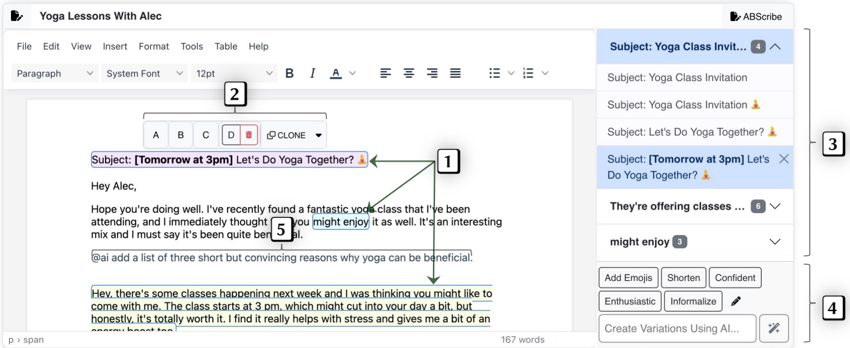
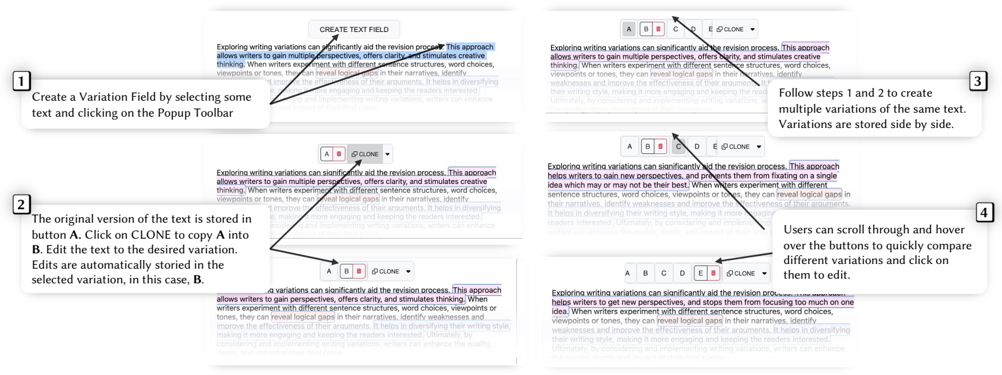
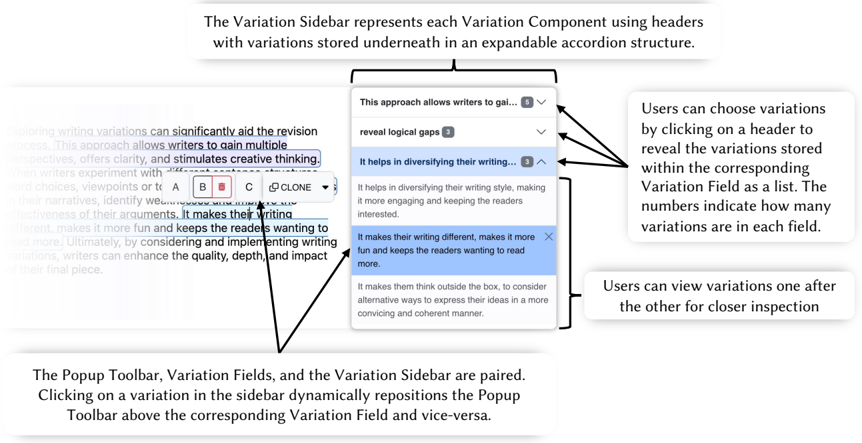
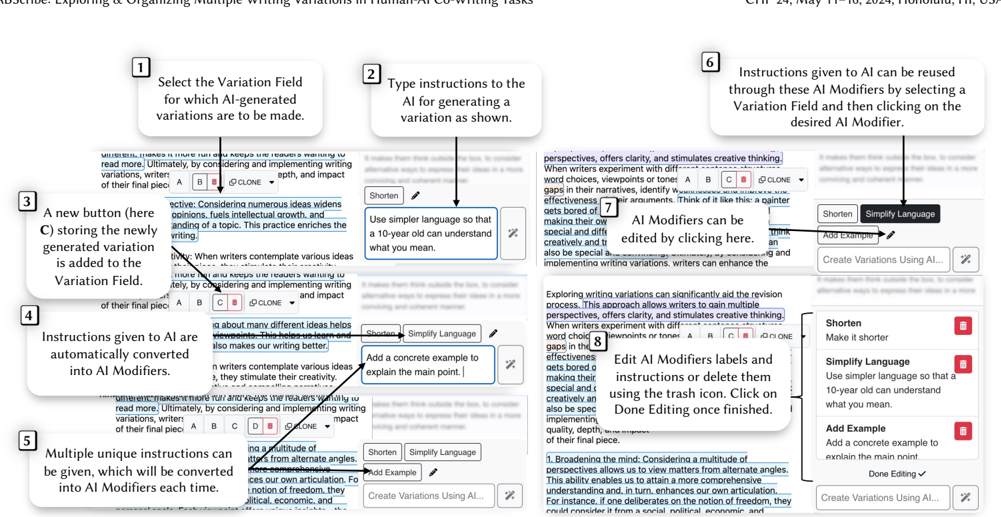
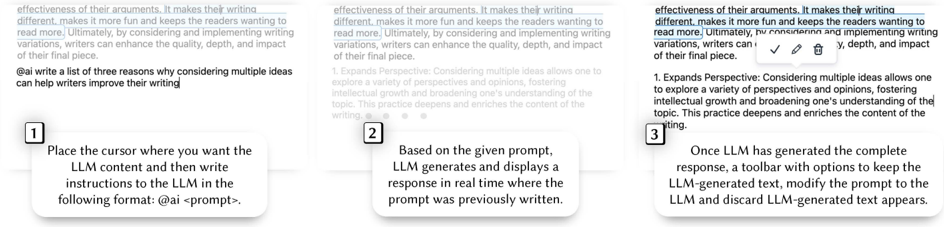
Exploring alternative ideas by rewriting text is integral to the writing process. State-of-the-art Large Language Models (LLMs) can simplify writing variation generation. However, current interfaces pose challenges for simultaneous consideration of multiple variations: creating new variations without overwriting text can be difficult, and pasting them sequentially can clutter documents, increasing workload and disrupting writers’ flow. To tackle this, we present ABScribe, an interface that supports rapid, yet visually structured, exploration and organization of writing variations in human-AI co-writing tasks. With ABScribe, users can swiftly modify variations using LLM prompts, which are auto-converted into reusable buttons. Variations are stored adjacently within text fields for rapid in-place comparisons using mouse-over interactions on a popup toolbar. Our user study with 12 writers shows that ABScribe significantly reduces task workload (d = 1.20, p < 0.001), enhances user perceptions of the revision process (d = 2.41, p < 0.001) compared to a popular baseline workflow, and provides insights into how writers explore variations using LLMs.
Overview
CoChat Summary
TL;DR
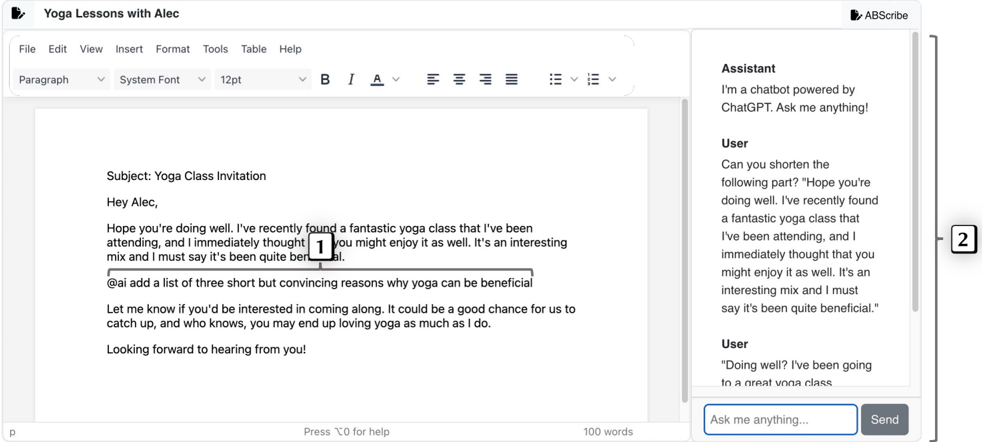
ABScribe is an LLM-based writing interface that stores multiple text variations in Variation Fields with a Popup Toolbar, Variation Sidebar, AI Modifiers, and AI Drafter. In a within-subjects study with 12 writers, it reduced subjective task workload and improved perceptions of the revision process compared with a chat-based baseline.
Key findings
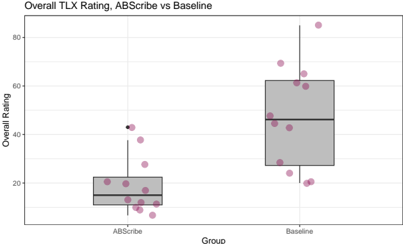
- ABScribe significantly reduced NASA-TLX subjective task workload versus the baseline (𝑑 = 1.20, 𝑝 < 0.001).
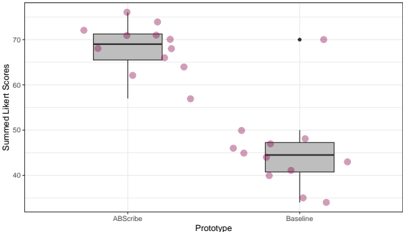
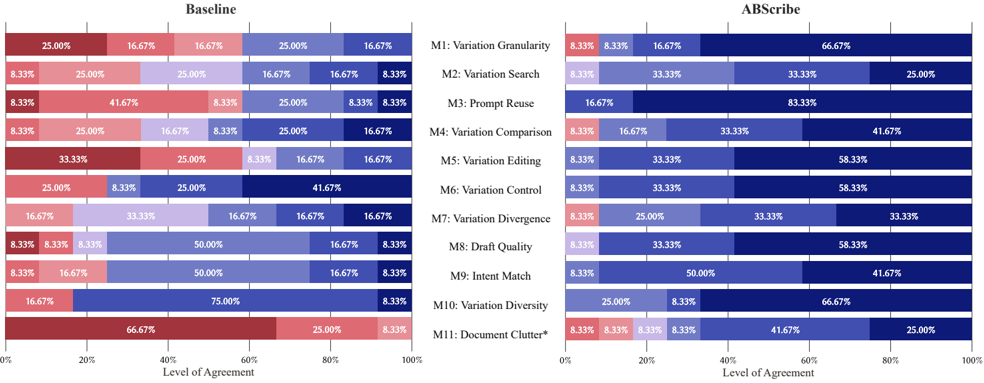
- ABScribe significantly increased summed Likert agreement on the efficacy of the revision process versus the baseline (𝑑 = 2.41, 𝑝 < 0.001).
- Qualitative themes: non-linear variation storage reduced clutter and pressure to commit early; the Popup Toolbar supported in-context comparison; AI Modifiers made prompts reusable and encouraged more imperative, generalizable prompt writing.
- Trade-offs: two participants perceived clutter as unproblematic or beneficial, and some preferred linear side-by-side comparison for large segments, though the Variation Sidebar was seen as mitigating this.
Methods
- Within-subjects controlled evaluation with 12 writers (5 women, 7 men, aged 18–34), compensated 30 CAD; each completed two guided tasks (LinkedIn post and email to a professor) randomly paired with counterbalanced ABScribe versus baseline.
- Participants used AI to explore eight variations of three text segments (24 variations total) per task; the baseline was a GPT-4 rich-text editor with a chat-based assistant and direct AI text insertion.
- Measures included weighted NASA-TLX and 7-point Likert scales; analysis used pairwise one-sided t-tests and reflexive thematic analysis of interview transcripts and task observation notes.
Limitations
- Stated: the baseline was constructed rather than an existing system, which may have affected ecological validity; future studies could compare ABScribe with real-world AI-assisted writing workflows.
- Stated: external validity is limited to English writers and a single 1.5-hour session with two guided tasks; AI Drafter and AI Modifiers carry hallucination risk; no logging metrics were collected.
- Evident: the small sample (N = 12) and lab-based tasks limit generalizability, and the reported trade-offs from two participants suggest individual differences in preference for clutter and linear editing.
Model-written summary. Check it against the paper before relying on it.
Integrity signals
Registry
Cites
Statistics
Figures
Verification
Claims the paper makes
5 Valid · 3 Not valid · 43 Not checked · 57 Own results and interpretations
The cited sources support only part of this claim — read each source’s verdict below.
In the paper
“Advanced Large Language Models (LLMs) such as ChatGPT [68], GPT-4 [69], PaLM 2 [32], LLaMA 2 [90], and Gemini [73] can enable writers to generate multiple variations of text via natural language prompting [8,15,26,66], potentially reducing the workload of generating text variations.”
§ ABScribe: Rapid Exploration & Organization of Multiple Writing Variations in Human-AI Co-Writing Tasks using Large Language Models > 1 INTRODUCTION
What the sources say
- Not checked yetcites [8]
- Not checked yetcites [15]
- Partly supportedcites [26] matched to “Sparks: Inspiration for Science Writing using Language Models” (2022) sourceExperimental — accuracy not yet measured
Our copy supports the mechanism and the effort saving, but at a different level than the claim: Sparks builds on GPT-2, a 'mid-sized (1.5 billion parameters)' model, and Section 4.1.1 explicitly chose it over larger models (GPT-3, Megatron-LM) because of cost and critiques of super-large language models — so nothing in it attributes the capability to 'advanced LLMs such as ChatGPT, GPT-4, PaLM 2, LLaMA 2, Gemini'. The design goals (3.3.2, Section 3.2.2) do call for diverse natural-language-prompt outputs 'such that writers have a variety of outputs to make use of', and the user evaluation (6.2.3, Section 6.2) reports participants found it 'much faster and easier to draw on language from the sparks than to write a sentence from scratch', with P7 noting the system 'generated multiple [ideas]'. That covers the 'multiple variations via prompting, reducing workload' part, but for a GPT-2 idea-sparking system in science writing, not for frontier chatbots; additionally Section 5.2 notes both language-model methods produced outputs that were 'shorter, less specific, and more repetitive' than human-created ones. (LLM, conf=0.72)
- Partly supportedcites [66] matched to “Co-Writing Screenplays and Theatre Scripts with Language Models: Evaluation by Industry Professionals” (2023) sourceExperimental — accuracy not yet measured
Our copy clearly supports the first half of the attributed point: LLMs prompted in natural language yield multiple text variations for a writer to draw on — §3.2 (p. ~3) states that 'the current state-of-the-art method for longer text generation incorporates a human-in-the-loop who selects from various generations sampled from the model', §3.6 lists 'Generate a new suggestion (i.e., run the LLM again with the same prompt)' as a standard writer operation, and Figure 2's caption describes several title outputs generated for different random seeds; §1 frames LLMs as 'an augmentative tool for human writers'. What the paper does not state is the workload-reduction consequence attached to this citation: the closest material is qualitative (§5.2.4, p8: 'getting words on the page. This helps with that step'; §5.2.2 on generating alternative choices), and §5.1.2 (p1) records that running multiple generations gave 'lots of material' to 'cherrypick' but also 'requires more massaging on my end'. The paper also studies Chinchilla 70B via Dramatron rather than the chat systems the citing sentence names, so the specific model list is not this source's. (LLM, conf=0.68)
hedgedstates a possible cause- Asserted: passes — The authors put it forward as true.
- Checkable: passes — It can be checked against evidence.
- Load-bearing: passes — The paper’s conclusions depend on it.
- Based: passes — The paper gives a reason why it holds.
None of the sources cited for this claim have been checked yet.
In the paper
“Insights from HCI and traditional design practice suggest that simultaneous consideration of multiple (at least 5) variations can lead to better ideas [89] and avoid fixation [10,34,44,89].”
§ ABScribe: Rapid Exploration & Organization of Multiple Writing Variations in Human-AI Co-Writing Tasks using Large Language Models > 1 INTRODUCTION
What the sources say
- Not checked yetcites [10]
- Not checked yetcites [34]
- Could not verifycites [44] matched to “Survey of Hallucination in Natural Language Generation” (2023) sourceExperimental — accuracy not yet measured
Our copy of Ji et al. (2023) is a survey of hallucination in NLG and contains no passage on design/HCI fixation or on considering multiple variations simultaneously to avoid it (searched: 'design fixation / multiple variations', 'simultaneous consideration', 'generation diversity avoiding convergence'). The closest material concerns model-side diversity — Sec. 3.2 ('Erroneous decoding') notes that decoding strategies improving generation diversity, e.g. top-k sampling, are positively correlated with increased hallucination, and Sec. 5.2.2 ('Planning/Sketching') speaks of striking a balance between faithfulness and diversity — but neither addresses the human ideation claim the citing sentence attributes here. The claim's point is simply not covered by this source, so it cannot be confirmed or contradicted from our copy. (LLM, conf=0.70)
- Not checked yetcites [89]
hedgedstates a cause- Asserted: passes — The authors put it forward as true.
- Checkable: passes — It can be checked against evidence.
- Load-bearing: passes — The paper’s conclusions depend on it.
- Based: passes — The paper gives a reason why it holds.
None of the sources cited for this claim have been checked yet.
In the paper
“HCI and traditional design practices encourage the parallel exploration of multiple variations to help avoid fixation on a singular idea [30,44], to reduce the chances of eliminating rough but innovative ideas due to premature evaluation [10,34], and to make us less prone to inflated subjective appraisals by giving us an opportunity to critically assess ideas in relation to each other [10,89].”
§ ABScribe: Rapid Exploration & Organization of Multiple Writing Variations in Human-AI Co-Writing Tasks using Large Language Models > 2.1 Exploring Multiple Variations
What the sources say
- Not checked yetcites [30] matched to “Avoiding Design Fixation: Transformation and Abstraction in Mapping from Source to Target” (2011) source
- Could not verifycites [44] matched to “Survey of Hallucination in Natural Language Generation” (2023) sourceExperimental — accuracy not yet measured
Our copy of Ji et al.'s 'Survey of Hallucination in Natural Language Generation' is a survey of hallucination definitions, metrics and mitigation across summarization, dialogue, GQA, data-to-text, NMT and LLMs; it contains no discussion of HCI or traditional design practice, parallel exploration of variations, or fixation on a single idea. Searched: 'HCI design practice parallel exploration of multiple variations avoid fixation', 'human-computer interaction design disciplines brainstorming divergent thinking', 'design practice fixation premature evaluation creative ideas multiple prototypes', and 'human factors interaction design diversity of generated candidates comparing alternatives' — the closest hits are only metaphorical neighbours (e.g. Planning/Sketching in 5.2.2, ensemble/debate and contrast-candidate selection in 13.3.2 and 7.3), none of which attribute anything to HCI or design methodology. Since no passage addresses the claim's point, it can be neither confirmed nor contradicted from this source. (LLM, conf=0.72)
plainstates a cause- Asserted: passes — The authors put it forward as true.
- Checkable: passes — It can be checked against evidence.
- Load-bearing: passes — The paper’s conclusions depend on it.
- Based: passes — The paper gives a reason why it holds.
The cited sources support only part of this claim — read each source’s verdict below.
In the paper
“Advanced Large Language Models (LLMs) such as ChatGPT [68], GPT-4 [69], PaLM 2 [32], LLaMA 2 [90], and Gemini [73] can enable writers to generate multiple variations of text via natural language prompting [8,15,26,66], potentially reducing the workload of generating text variations.”
§ ABScribe: Rapid Exploration & Organization of Multiple Writing Variations in Human-AI Co-Writing Tasks using Large Language Models > 1 INTRODUCTION
What the sources say
- Not checked yetcites [8]
- Not checked yetcites [15]
- Partly supportedcites [26] matched to “Sparks: Inspiration for Science Writing using Language Models” (2022) sourceExperimental — accuracy not yet measured
Our copy supports the general mechanism: Related Work 2.1 and System Design 4.1.2 describe generating text by feeding a language model a hand-crafted natural-language prefix, and Results 6.2.8 shows writers entering their own prompts to steer output; Discussion 7.2 notes that 'prompt engineering can be done in natural language' as a route to controlling what a model generates. But the multiple-variations capability is framed as a design aim and future direction, not a demonstrated property of advanced LLMs: the system deliberately used GPT-2 rather than GPT-3 (4.1.1), produced only 10-token 'sparks' meant to inspire rather than variants of the writer's own text, and the Introduction lists 'lack of diversity in their outputs [28]' and 'generic outputs [26]' as continuing problems. Nothing in our copy attributes variation-generating capability to models such as ChatGPT, GPT-4, PaLM 2, LLaMA 2 or Gemini, so the 'advanced LLMs ... multiple variations of text' part of the claim is not supported by this source. (LLM, conf=0.72)
- Supportedcites [66] matched to “Co-Writing Screenplays and Theatre Scripts with Language Models: Evaluation by Industry Professionals” (2023) source
Our copy of Mirowski et al. (2023) treats LLM-assisted writers generating repeated text variants as a core mechanic: the Introduction's contribution list states authors 'can generate multiple responses, edit, and then regenerate at various levels of the story hierarchy', and Section 3.6 (Interactive Writing with Dramatron) lists 'Generate a new suggestion (i.e., run the LLM again with the same prompt)' as an operation the writer may perform as many times as desired. Section 3.1 explains the mechanism (probabilistic sampling, different random seeds yielding different samples; Fig. 2 shows several title outputs for different seeds), and Section 5.1.2 reports participant p1 curating outputs from 3-4 generations for 'lots of material' and 'more interpretations'. The natural-language-prompting aspect is covered by Section 3.5, which describes prompt prefixes combined with user-supplied inputs (e.g., the log line) as the way users control the LLM. (LLM, conf=0.85)
plainstates a cause- Asserted: passes — The authors put it forward as true.
- Checkable: passes — It can be checked against evidence.
- Load-bearing: passes — The paper’s conclusions depend on it.
- Based: passes — The paper gives a reason why it holds.
A result the paper reports from its own data — it cites no other source for it, so there is none to check. The quote shows it is in the paper.
In the paper
“F3: AI Integration-ABScribe nudges writers toward an imperative LLM prompt writing style in contrast to the conversational style in Baseline.”
§ ABScribe: Rapid Exploration & Organization of Multiple Writing Variations in Human-AI Co-Writing Tasks using Large Language Models > 5.1 RQ1: User Perceptions on the AI-Assisted Revision Process
plainstates a cause- Asserted: passes — The authors put it forward as true.
- Checkable: passes — It can be checked against evidence.
- Load-bearing: unclear — It is unclear whether the paper’s conclusions depend on it.
- Based: passes — The paper gives a reason why it holds.
35 more claims
Create a free account to see all 108 claims and to verify the 89 references still open.
- Probably not a substantial claim. 60
- It may state two separate claims as one. 21
Claims other papers make about this one
Each is checked against this paper’s own text: does it say what the citing paper says it does?
The source backs part of the claim, not all of it — or backs it for a different population, condition or comparison.
In the citing paper
“Researchers in HCI have worked extensively to investigate these dimensions, producing studies characterizing user values, social dynamics, and professional contexts [9,39,53,63,77,105] that influence ownership preferences and how they shape users' attitudes toward AI assistance.”
From Co-Writing with AI, on Human Terms: Aligning Research with User Demands Across the Writing Process (2025) · cites this paper as [105]
Experimental — accuracy not yet measuredThe check wasn’t confident either way, so it gives no verdict — never disputed.
In the citing paper
“Rezwana et al. 's [105] work highlighted that ownership perceptions depend on both contribution levels and leadership in the writing process, suggesting that interaction designs that maximize user agency can enhance ownership.”
From Co-Writing with AI, on Human Terms: Aligning Research with User Demands Across the Writing Process (2025) · cites this paper as [105]
Experimental — accuracy not yet measured
Self-check
Percentages, sums and reported differences re-computed from the paper’s own numbers.
Each contradiction between two passages listed here was confirmed by an independent check.
Rated minor: it would not touch a result — a value no result rests on, a p-value that stays on the same side of the significance level, or a conflict that is clerical, resolved elsewhere in the paper, or outside its own findings.
In the paper
§ ABScribe: Rapid Exploration & Organization of Multiple Writing Variations in Human-AI Co-Writing Tasks using Large Language Models > 2.2 Working with Multiple Variations from Large Language Models
“We also incorporate Kim et al. 's concepts of object-oriented interactions with LLMs [37]”
§ ABScribe: Rapid Exploration & Organization of Multiple Writing Variations in Human-AI Co-Writing Tasks using Large Language Models > References
“37. Han L. Han, Miguel A. Renom, Wendy E. Mackay, and Michel Beaudouin-Lafon. 2020. Textlets: Supporting Constraints and Consistency in Text Documents.”
Citations
Cites
BERT: Pre-training of Deep Bidirectional Transformers for Language Understanding
Devlin, J., Chang, M.-W., Lee, K., & Toutanova, K. (2018) · arXiv · doi:10.48550/arxiv.1810.04805 · Cited by 73,173 · cited 1×
“…31, 47, 48, 50, 56, 67, 82, 84, 97] on interfaces for writing with LLMs in tandem with rapid advancements in AI writing capabilities using LLMs [8, 18, 66, 76, 91], examining various aspects of the AI-assisted writing process including prompting [28, 94], text suggestions [9, 16], creative…”
Language Models are Few-Shot Learners
Brown, T. B., Mann, B., Ryder, N., Subbiah, M., Kaplan, J., Dhariwal, P., Neelakantan, A., Shyam, P., Sastry, G., Askell, A., et al. (2020) · arXiv · doi:10.48550/arxiv.2005.14165 · Cited by 23,372
Survey of Hallucination in Natural Language Generation
Ji, Z., Lee, N., Frieske, R., Yu, T., Su, D., Xu, Y., Ishii, E., Bang, Y. J., Madotto, A., & Fung, P. (2023) · ACM Computing Surveys · doi:10.1145/3571730 · Cited by 5,025
Survey of Hallucination in Natural Language Generation
Ji, Z., Lee, N., Frieske, R., Yu, T., Su, D., Xu, Y., Ishii, E., Bang, Y., Chen, D., Dai, W., et al. (2022) · arXiv · doi:10.48550/arxiv.2202.03629 · Cited by 4,981
NASA-Task Load Index (NASA-TLX); 20 Years Later
Hart, S. G. (2006) · Proceedings of the Human Factors and Ergonomics Society Annual Meeting · doi:10.1177/154193120605000909 · Cited by 4,297 · cited 1×
“To assess subjective task-workload, we used the widely used NASA-TLX [39] procedure with weighting.”
Recent Advances in Natural Language Processing via Large Pre-trained Language Models: A Survey
Min, B., Ross, H., Sulem, E., Veyseh, A. P. B., Nguyen, T. H., Sainz, O., Agirre, E., Heintz, I., & Roth, D. (2024) · ACM Computing Surveys · doi:10.1145/3605943 · Cited by 1,387 · cited 2×
“Advanced Large Language Models (LLMs) such as ChatGPT [68], GPT-4 [69], PaLM 2 [32], LLaMA 2 [90], and Gemini[73] can enable writers to generate multiple variations of text via natural language prompting [8, 15, 26, 66], potentially reducing the workload of generating text variations.”
Recent Advances in Natural Language Processing via Large Pre-Trained Language Models: A Survey
Min, B., Ross, H., Sulem, E., Veyseh, A. P. B., Nguyen, T. H., Sainz, O., Agirre, E., Heinz, I., & Roth, D. (2021) · arXiv · doi:10.48550/arxiv.2111.01243 · Cited by 1,387
Why Johnny Can’t Prompt: How Non-AI Experts Try (and Fail) to Design LLM Prompts
Zamfirescu-Pereira, J. D., Wong, R. Y., Hartmann, B., & Yang, Q. (2023) · Proceedings of the 2023 CHI Conference on Human Factors in Computing Systems · doi:10.1145/3544548.3581388 · Cited by 1,274 · cited 2×
“Recent HCI studies on LLM-based tool design have mainly focused on prompt engineering [6, 16, 46, 55, 94, 98] and exploring the generative capabilities of LLMs [50, 58, 63, 67, 97].”
A cognitive process theory of writing
Flower, L., & Hayes, J. R. (1981) · College Composition & Communication · doi:10.58680/ccc198115885 · Cited by 1,025 · cited 1×
“…of facilitating the swift exploration of multiple writing variations using LLMs: the role and nuances of revision within the writing process [23, 25, 38, 57, 83, 87]; HCI design philosophies that emphasize the consideration of multiple ideas before evaluation [19, 34, 89]; principles on…”
Prompt Engineering with ChatGPT: A Guide for Academic Writers
Giray, L. (2023) · Annals of Biomedical Engineering · doi:10.1007/s10439-023-03272-4 · Cited by 776 · cited 2×
“There has been an explosion of recent work [4, 9, 14, 16, 26–28, 31, 47, 48, 50, 56, 67, 82, 84, 97] on interfaces for writing with LLMs in tandem with rapid advancements in AI writing capabilities using LLMs [8, 18, 66, 76, 91], examining various aspects of the AI-assisted writing process…”
Research works printed but not linked: 18
- 10.7551/mitpress · doi:10.7551/mitpress
- Virginia Braun and Victoria Clarke. 2019. Reflecting on reflexive thematic analysis. Qualitative research in sport, exercise and health 11, 4 (2019), 589-597.
- Bill Buxton. 2010. Sketching user experiences: getting the design right and the right design. Morgan kaufmann, Boston.
- John Joon Young Chung, Wooseok Kim, Kang Min Yoo, Hwaran Lee, Eytan Adar, and Minsuk Chang. 2022. TaleBrush: Sketching stories with generative pretrained language models. In Proceedings of the 2022 CHI Conference on Human Factors in Computing Systems. Association for Computing Machinery, New York, NY, USA, 1-19.
- 10.18653/v1 · DOI
- Jill Fitzgerald. 1987. Research on revision in writing. Review of educational research 57, 4 (1987), 481-506.
- Linda Flower and John R. Hayes. 1981. A Cognitive Process Theory of Writing. College Composition and Communication 32, 4 (1981), 365-387. http://www. jstor.org/stable/356600 · DOI · Paper page
- Han L Han. 2020. Designing Representations for Digital Documents. In Adjunct Proceedings of the 33rd Annual ACM Symposium on User Interface Software and Technology. Association for Computing Machinery, New York, NY, USA, 174- 178.
- Han L Han, Miguel A Renom, Wendy E Mackay, and Michel Beaudouin-Lafon. 2020. Textlets: Supporting constraints and consistency in text documents. In Proceedings of the 2020 CHI Conference on Human Factors in Computing Systems. Association for Computing Machinery, New York, NY, USA, 1-13. · DOI · Paper page
- Iikka Hauhio, Anna Kantosalo, Simo Linkola, and Hannu Toivonen. 2023. The Spectrum of Unpredictability and its Relation to Creative Autonomy. In Proceedings of the 14th International Conference on Computational Creativ- ity. Association for Computational Creativity (ACC), Spain, 148-152. https: //computationalcreativity.net/iccc23/ International Conference on Computa- tional Creativity, ICCC ; Conference date: 19-06-2023 Through 23-06-2023.
- Ernest Hemingway. 2014. Moveable feast: the restored edition. Simon and Schuster, New York, NY, USA.
- David G Jansson and Steven M Smith. 1991. Design fixation. Design studies 12, 1 (1991), 3-11.
- Charles A MacArthur. 2018. Evaluation and revision. Best practices in writing instruction 287 (2018), 23 pages.
- Thomas Mahatody, Mouldi Sagar, and Christophe Kolski. 2010. State of the art on the cognitive walkthrough method, its variants and evolutions. Intl. Journal of Human-Computer Interaction 26, 8 (2010), 741-785.
- James P. Purdy. 2014. What Can Design Thinking Offer Writing Studies? College Composition and Communication 65, 4 (2014), 612-641. http://www.jstor.org/ stable/43490875
- Horst Rittel. 1967. Wicked problems. Management Science,(December 1967) 4, 14 (1967), B141-B142.
- Ashish Vaswani, Noam Shazeer, Niki Parmar, Jakob Uszkoreit, Llion Jones, Aidan N Gomez, Ł ukasz Kaiser, and Illia Polosukhin. 2017. Attention is All you Need. In Advances in Neural Information Processing Systems, I.
- William Knowlton Zinsser. 2001. On writing well: The classic guide to writing nonfiction. Quill/A Harper Collins Books, 195 Broadway New York, NY, USA.
Cited by
AI makes you smarter but none the wiser: The disconnect between performance and metacognition
Fernandes, D., Villa, S., Nicholls, S., Haavisto, O., Buschek, D., Schmidt, A., Kosch, T., Shen, C., & Welsch, R. (2025) · Computers in Human Behavior · doi:10.1016/j.chb.2025.108779 · Cited by 188
Chakrabarty, T., Laban, P., & Wu, C.-S. (2025) · CHI Conference on Human Factors in Computing Systems · doi:10.1145/3706598.3713559 · Cited by 92
Performance and Metacognition Disconnect when Reasoning in Human-AI Interaction
Fernandes, D., Villa, S., Nicholls, S., Haavisto, O., Buschek, D., Schmidt, A., Kosch, T., Shen, C., & Welsch, R. (2024) · arXiv · doi:10.48550/arxiv.2409.16708 · Cited by 71
AI as Extraherics: Fostering Higher-order Thinking Skills in Human-AI InteractionPreprint
Yatani, K., Sramek, Z., & Yang, C.-L. (2024) · arXiv (Cornell University) · doi:10.48550/arxiv.2409.09218 · Cited by 64
Designing Interactions with Generative AI for Art and Creativity: A Systematic Review and Taxonomy
Hu, X., Xing, Y., Cai, X., Zhao, Y., Cook, M., Borgo, R., & Neate, T. (2025) · Designing Interactive Systems Conference · doi:10.1145/3715336.3735843 · Cited by 61
Xu, S., Wen, H.-N., Pan, H., Dominguez, D., Hu, D., & Zhang, X. (2025) · CHI Conference on Human Factors in Computing Systems · doi:10.1145/3706598.3713773 · Cited by 50
Malik, M. A., & Amjad, A. I. (2025) · Journal of Applied Learning & Teaching · doi:10.37074/jalt.2025.8.1.9 · Cited by 51
Friction: Deciphering Writing Feedback into Writing Revisions through LLM-Assisted Reflection
Zhang, C., Ju, K., Bidoshi, P., Yen, Y.-C. G., & Rzeszotarski, J. M. (2025) · CHI Conference on Human Factors in Computing Systems · doi:10.1145/3706598.3714316 · Cited by 49
Textoshop: Interactions Inspired by Drawing Software to Facilitate Text Editing
Masson, D., Kim, Y., & Chevalier, F. (2025) · CHI Conference on Human Factors in Computing Systems · doi:10.1145/3706598.3713862 · Cited by 49
Siddiqui, M. N., Pea, R. D., & Subramonyam, H. (2025) · CHI Conference on Human Factors in Computing Systems · doi:10.1145/3706598.3714119 · Cited by 45
Reza, M., Anastasopoulos, I., Bhandari, S., & Pardos, Z. A. (2025) · CHI Conference on Human Factors in Computing Systems · doi:10.1145/3706598.3714051 · Cited by 43
Self-citationInie, N., Falk, J., & Selvan, R. (2025) · CHI Conference on Human Factors in Computing Systems · doi:10.1145/3706598.3714227 · Cited by 43
Wang, J. S., Haider, S., Tohidi, A., Gupta, A., Zhang, Y., Callison-Burch, C., Rothschild, D. M., & Watts, D. J. (2025) · CHI Conference on Human Factors in Computing Systems · doi:10.1145/3706598.3713716 · Cited by 40
Co-Writing with AI, on Human Terms: Aligning Research with User Demands Across the Writing Process
Reza, M., Thomas-Mitchell, J., Dushniku, P., Laundry, N., Williams, J. J., & Kuzminykh, A. (2025) · Proceedings of the ACM on Human-Computer Interaction · doi:10.1145/3757566 · Cited by 37
Self-citationVideoDiff: Human-AI Video Co-Creation with Alternatives
Huh, M., Li, D., Pimmel, K., Shin, H. V., Pavel, A., & Dontcheva, M. (2025) · CHI Conference on Human Factors in Computing Systems · doi:10.1145/3706598.3713417 · Cited by 37
Prompting Generative AI with Interaction-Augmented Instructions
Shen, L., Li, H., Wang, Y., Xie, X., & Qu, H. (2025) · CHI Conference Extended Abstracts on Human Factors in Computing Systems (CHI EA) · doi:10.1145/3706599.3720080 · Cited by 36
Qin, H. X., Zhu, G., Fan, M., & Hui, P. (2025) · CHI Conference on Human Factors in Computing Systems · doi:10.1145/3706598.3713569 · Cited by 31
HarmonyCut: Supporting Creative Chinese Paper-cutting Design with Form and Connotation Harmony
Wang, H., Qiu, T., Li, J., Lu, Z., & Ma, Y. (2025) · CHI Conference on Human Factors in Computing Systems · doi:10.1145/3706598.3714159 · Cited by 34
Beyond Productivity: Rethinking the Impact of Creativity Support Tools
Rhys Cox, S., Bøjer Djernæs, H., & van Berkel, N. (2025) · Proceedings of the 2025 Conference on Creativity and Cognition · doi:10.1145/3698061.3726924 · Cited by 28
Bhattacharjee, A., Xu, S. Y., Rao, P., Zeng, Y., Meyerhoff, J., Ahmed, S. I., Mohr, D. C., Liut, M., Mariakakis, A. T., Kornfield, R., et al. (2025) · Designing Interactive Systems Conference · doi:10.1145/3715336.3735810 · Cited by 28
Self-citationHACo-Det: A Study Towards Fine-Grained Machine-Generated Text Detection under Human-AI Coauthoring
Su, Z., Wang, Y., Wan, H., Zhang, Z., & Luo, M. (2025) · Proceedings of the conference - Association for Computational Linguistics. Meeting · doi:10.18653/v1/2025.acl-long.1069 · Cited by 28
Varanasi, R. A., Wiesenfeld, B. M., & Nov, O. (2025) · CHI Conference on Human Factors in Computing Systems · doi:10.1145/3706598.3714035 · Cited by 26
Pitts, G., Hridi, A. P., & Narayanan, A. B. L. (2025) · Workshop on Bridging Human-Computer Interaction and Natural Language Processing (HCI+NLP) · doi:10.18653/v1/2025.hcinlp-1.21 · Cited by 27
A Review of LLM-Assisted IdeationPreprint
Li, S., Padilla, S., Bras, P. L., Dong, J., & Chantler, M. J. (2025) · arXiv (Cornell University) · doi:10.48550/arxiv.2503.00946 · Cited by 25
“…writing [52], [45], [80] argumentative writing [53], [42] student peer review writing [54] report writing [45] proposal writing [42], [45] Digital and Informal Writing email [55],[43],[44],[45] blog post [42], [45], [80] social media post [44] copywriting [43] web article [45] newsletter [42], [48]”
InfluentialVisual Story-Writing: Writing by Manipulating Visual Representations of Stories
Masson, D., Zhao, Z., & Chevalier, F. (2025) · ACM Symposium on User Interface Software and Technology (UIST) · doi:10.1145/3746059.3747758 · Cited by 24
Xiao, Y., Hancock, C., Agrawal, S., Mehandru, N., Salehi, N., Carpuat, M. J., & Gao, G. (2025) · CHI Conference on Human Factors in Computing Systems · doi:10.1145/3706598.3713626 · Cited by 23
An Exploratory Study on How AI Awareness Impacts Human-AI Design Collaboration
Cheng, Z., Chen, P., Song, W., Zhang, H., Li, Z., & Sun, L. (2025) · ACM International Conference on Intelligent User Interfaces (IUI) · doi:10.1145/3708359.3712162 · Cited by 23
Biswas, S., Erlei, A., & Gadiraju, U. (2025) · CHI Conference on Human Factors in Computing Systems · doi:10.1145/3706598.3713201 · Cited by 20
Multi-Agent Based Character Simulation for Story Writing
Tian, Y., Shi, K., Zhao, Z., & Penn, G. (2025) · Workshop on Intelligent and Interactive Writing Assistants (In2Writing) · doi:10.18653/v1/2025.in2writing-1.9 · Cited by 20
Bhattacharjee, A., Suh, J., Ershadi, M., Iqbal, S. T., Wilson, A. D., & Hernandez, J. (2024) · arXiv (Cornell University) · doi:10.48550/arxiv.2410.20468 · Cited by 18
Siddiqui, M. N., Nasseri, N., Coscia, A. J., Pea, R. D., & Subramonyam, H. (2026) · CHI Conference on Human Factors in Computing Systems · doi:10.1145/3772318.3791109 · Cited by 15
Biswas, S., Erlei, A., & Gadiraju, U. (2026) · CHI Conference on Human Factors in Computing Systems · doi:10.1145/3772318.3790775 · Cited by 15
Synthia: Visually Interpreting and Synthesizing Feedback for Writing Revision
Zhang, C., Ju, K. P., Han, Z., Yen, Y.-C. G., & Rzeszotarski, J. M. (2025) · ACM Symposium on User Interface Software and Technology (UIST) · doi:10.1145/3746059.3747703 · Cited by 15
PromptPilot: Exploring User Experience of Prompting with AI-Enhanced Initiative in LLMs
Kim, S., Eun, J., Park, Y. E., Lee, K., Lee, G., & Lee, J. (2025) · International Journal of Human-Computer Interaction · doi:10.1080/10447318.2025.2489030 · Cited by 12
“For example, studies of SAGA (Shakeri et al., 2021) and ABScribe (Reza et al., 2024) found that asynchronous collaboration through LLMs enabled users to effectively alternate between creation and review roles, while systems like AngleKindling (Petridis et al., 2023) and CharacterMeet (Qin et al.,…”
A Literature Review of Personalized Large Language Models for Email Generation and Automation
Novelo, R., Silva, R. R., & Bernardino, J. (2025) · Future Internet · doi:10.3390/fi17120536 · Cited by 12
“Building on the foundational work summarized in the literature review by Rasheed et al. [21], recent research has introduced novel methods for incrementally improving AI-generated content through self-feedback mechanisms.”
InfluentialIntentFlow: Investigating Fluid Dynamics of Intent Communication in Generative AI
Kim, Y., Son, K., Kim, S., Chin, B., & Kim, J. (2026) · Designing Interactive Systems Conference · doi:10.1145/3800645.3812999 · Cited by 12
Collaborative Document Editing with Multiple Users and AI Agents
Lehmann, F., Shauchenka, K., & Buschek, D. (2026) · CHI Conference on Human Factors in Computing Systems · doi:10.1145/3772318.3790648 · Cited by 11
Interaction-Required Suggestions for Control, Ownership, and Awareness in Human-AI Co-Writing
Arnold, K. C., & Kim, J. (2025) · Workshop on Intelligent and Interactive Writing Assistants (In2Writing) · doi:10.18653/v1/2025.in2writing-1.6 · Cited by 10
Authorship Drift: How Self-Efficacy and Trust Evolve During LLM-Assisted Writing
Park, Y. S., Arvi, N. A. P., Kim, S., & Kim, J. (2026) · Proceedings of the 2026 CHI Conference on Human Factors in Computing Systems · doi:10.1145/3772318.3790276 · Cited by 8
Constella: Supporting Storywriters’ Interconnected Character Creation through LLM-Based Multi-Agents
Park, S., Park, S., & Lim, Y.-K. (2026) · ACM Transactions on Computer-Human Interaction · doi:10.1145/3796234 · Cited by 7
From Crafting Text to Crafting Thought: Grounding AI Writing Support to Writing Center Pedagogy
Liu, Y., Gallagher, J., Sterman, S., & August, T. (2026) · CHI Conference on Human Factors in Computing Systems · doi:10.1145/3772318.3790292 · Cited by 7
Nabokov's Cards: An AI Assisted Prewriting System to Support Bottom-Up Creative Writing
Carrera, D., Zhao, Z., Ajin Thomas, A., & Wigdor, D. (2025) · Proceedings of the 2025 Conference on Creativity and Cognition · doi:10.1145/3698061.3726916 · Cited by 6
Helpful or Harmful? Exploring the Efficacy of Large Language Models for Online Grooming Prevention
Prosser, E., & Edwards, M. (2024) · European Interdisciplinary Cybersecurity Conference · doi:10.1145/3655693.3655694 · Cited by 6
Kim, Y., Chin, B., Son, K., Kim, S., & Kim, J. (2025) · CHI Conference Extended Abstracts on Human Factors in Computing Systems (CHI EA) · doi:10.1145/3706599.3719759 · Cited by 6
Script2Screen: Supporting Dialogue-Centric Scriptwriting with Interactive Audiovisual Generation
Wang, Z., Ma, J., Grinspun, E., Grossman, T., & Wang, B. K. (2026) · ACM International Conference on Intelligent User Interfaces (IUI) · doi:10.1145/3742413.3789075 · Cited by 6
Self-citationNarrix: Remixing Narrative Strategies from Examples for Story Writing
Zhang, C., Guo, S., Davis, A., & Koh, E. (2026) · CHI Conference on Human Factors in Computing Systems · doi:10.1145/3772318.3790813 · Cited by 6
Cui, Y., Goldman, A., Zhou, J., Liu, X., Shieh, C., Yao, J., Cheng, M. K., Kay, M., & Yang, F. (2026) · CHI Conference on Human Factors in Computing Systems · doi:10.1145/3772318.3790418 · Cited by 5
VidTune: Creating Video Soundtracks with Generative Music and Contextual Thumbnails
Huh, M., Fraser, C. A., Li, D., Dontcheva, M., & Wang, B. K. (2026) · CHI Conference on Human Factors in Computing Systems · doi:10.1145/3772318.3791572 · Cited by 5
Kim, Y., Chin, B., Son, K., Kim, S., & Kim, J. (2025) · arXiv (Cornell University) · doi:10.48550/arxiv.2503.00858 · Cited by 5
Diffraction, Creativity and AI: Towards New Methods for Design Research
Bird, C. (2025) · CHI Conference Extended Abstracts on Human Factors in Computing Systems (CHI EA) · doi:10.1145/3706599.3721091 · Cited by 4
Varanasi, R. A., Nov, O., & Wiesenfeld, B. M. (2026) · CHI Conference on Human Factors in Computing Systems · doi:10.1145/3772318.3790466 · Cited by 4
What Happens When Reviewers Receive AI Feedback in Their Reviews?
Chen, S., Zhong, S., Brumby, D. P., & Cox, A. L. (2026) · CHI Conference on Human Factors in Computing Systems · doi:10.1145/3772318.3791431 · Cited by 4
CoLyricist: Enhancing Lyric Writing with AI through Workflow-Aligned Support
Yoshida, M., Li, B. Q., Zhao, S., Zhou, Q., Hu, S., Chen, X. '., & Peng, N. (2026) · ACM International Conference on Intelligent User Interfaces (IUI) · doi:10.1145/3742413.3789099 · Cited by 4
Hu, Y., Zhang, J., Wang, Z., & Yu, C. (2026) · CHI Conference on Human Factors in Computing Systems · doi:10.1145/3772318.3790926 · Cited by 4
CrossLit: Connecting Visual and Textual Sensemaking for Literature Review
Choe, K., Kim, E., Kim, M. H., Hwang, S., Park, S., Kim, N. W., & Seo, J. (2026) · CHI Conference on Human Factors in Computing Systems · doi:10.1145/3772318.3791418 · Cited by 4
Co-Writing with AI: An Empirical Study of Diverse Academic Writing Workflows
Bodei, S., Brumby, D. P., Fisher, K., & Mella, J. (2026) · Annual Symposium on Human-Computer Interaction for Work (CHIWORK) · doi:10.1145/3808045.3808072 · Cited by 4
Fitzsimons, A. (2024) · Creativity and Cognition · doi:10.1145/3635636.3664625 · Cited by 4
Pammer‐Schindler, V., Liut, M., & Ley, T. (2025) · CHI Conference Extended Abstracts on Human Factors in Computing Systems (CHI EA) · doi:10.1145/3706599.3719804 · Cited by 4
Self-citationEvaluation of Instruction-Following Ability for Large Language Models on Story-Ending GenerationPreprint
Hida, R., Ohmura, J., & Sekiya, T. (2024) · arXiv (Cornell University) · doi:10.48550/arxiv.2406.16356 · Cited by 4
Scaffolding Recursive Divergence and Convergence in Story IdeationPreprint
Kim, T.-W., Kay, M., Sun, Y., Roemmele, M., Kreminski, M., & Chung, J. J. Y. (2025) · arXiv (Cornell University) · doi:10.48550/arxiv.2507.03307 · Cited by 4
Where Do I 'Add the Egg'?: Exploring Agency and Ownership in AI Creative Co-Writing Systems
Carrera, D., Thomas-Mitchell, J., & Wigdor, D. (2026) · Proceedings of the 2026 CHI Conference on Human Factors in Computing Systems · doi:10.1145/3772318.3791952 · Cited by 3
SYNthia: An Interface Concept for Writing With Large Language Models
Liang, I., & Gero, K. I. (2025) · Creativity and Cognition · doi:10.1145/3698061.3734401 · Cited by 3
Yao, W., & Saad, M. N. (2025) · Asian Education and Development Studies · doi:10.1108/aeds-02-2025-0061 · Cited by 3
Workshop: Designing with AI-based tools
Okopnyi, P., Guribye, F., Bachinski, M., Fjeld, M., Buschek, D., Zindulka, T., Lehmann, F., & Palma, P. B. (2024) · Nordic Conference on Human-Computer Interaction · doi:10.1145/3677045.3685449 · Cited by 3
Conversations in Space: Non-Linear LLM Interaction in Everyday UsePreprint
Amin, R. M., Adatepe, A., Fernandes, D., Buschek, D., & Butz, A. M. (2026) · arXiv (Cornell University) · doi:10.48550/arxiv.2605.15848 · Cited by 3
Chen, Y., Xiao, Y., Zinat, K. T., Yamashita, N., Gao, G., & Liu, Z. (2025) · Proceedings of the 2025 CHI Conference on Human Factors in Computing Systems · doi:10.1145/3706598.3713693 · Cited by 2
Dinakar, K., Lieberman, H. A., & Wu, M.-H. (2025) · ACM International Conference on Intelligent User Interfaces (IUI) · doi:10.1145/3708557.3716160 · Cited by 2
Fujiwara, M., Chujo, R., & Hautasaari, A. (2025) · CHI Conference Extended Abstracts on Human Factors in Computing Systems (CHI EA) · doi:10.1145/3706599.3719718 · Cited by 2
Fu, K., Leng, J., Zhang, Y., Huang, J., Zuo, Y., Cai, R., Ding, Z., Lc, R., Zhao, S., & Lei, Q. (2026) · Designing Interactive Systems Conference · doi:10.1145/3800645.3812998 · Cited by 3
Neural and Cognitive Impacts of AI: The Influence of Task Subjectivity on Human-LLM CollaborationPreprint
Russell, M., Shah, A., Blaney, G. P., Amores, J., Czerwinski, M. P., & Jacob, R. J. K. (2025) · arXiv (Cornell University) · doi:10.48550/arxiv.2506.04167 · Cited by 2
“Nihil [5] examined the potential and challenges of LLM use for creative writing, and Reza produced ABScribe, a novel interface for more easily integrating human and machine-generated work in Human-AI co-writing tasks [6].”
Roderick, R., & Tanner, S. (2026) · Written Communication · doi:10.1177/07410883261440232 · Cited by 1
“Reza et al. (2024) observed users of ABScribe, a co-writing platform enabling rapid text variation, finding that while AI assistance reduced drafting workload, it simultaneously required substantial cognitive effort to assess and integrate AI-generated text critically.”
TombWriter: Scaffolding Story Archeology through Beat-Level Interaction in Human-AI Co-Writing
Andersson, H., & Elmqvist, N. (2026) · International Conference on Advanced Visual Interfaces (AVI) · doi:10.1145/3811427.3811443 · Cited by 1
A Diffractive Analysis of GenAI through Perspectives on Productivity
Swift, I. P., & Chattopadhyay, D. (2026) · Annual Symposium on Human-Computer Interaction for Work (CHIWORK) · doi:10.1145/3808045.3808074 · Cited by 1
Beyond Compliance: How AI Could Help Creative Writers by Refusing Them
Qin, H. X., Zhu, G., Fan, M., & Hui, P. (2026) · Creativity and Cognition · doi:10.1145/3803784.3807571 · Cited by 1
Narrative Keyframing for Generative Creative Writing
Zhang, C., & Davis, A. (2026) · ACM Symposium on User Interface Software and Technology (UIST) · doi:10.1145/3830398.3830586 · Cited by 1
Zhao, Y., Hu, X., Neate, T., Penuela, A. M., & Simperl, E. P. B. (2026) · Semantic Web · doi:10.1177/22104968261494823 · Cited by 1
Who Decides How Knowing Becomes Doing? Redistributing Authority in Human-AI Music Co-CreationPreprint
Hu, Z., Liu, Y., Zhang, Z., Chen, G., Yu, B. X. B., & Cao, J. (2025) · arXiv (Cornell University) · doi:10.48550/arxiv.2509.10331 · Cited by 2
Editing with AI: How Doctors Refine LLM-Generated Answers to Patient QueriesPreprint
Sharma, R., Ramjee, P., Murali, K., & Jain, M. (2025) · arXiv (Cornell University) · doi:10.48550/arxiv.2511.19940 · Cited by 1
“Designing for fluid transitions between modes can reduce cognitive load and support seamless editing, consistent with principles of mixed-initiative interaction [2, 13] and recent work on AI-assisted writing [21].”
TreeWriter: AI-Assisted Hierarchical Planning and Writing for Long-Form DocumentsPreprint
Zhang, Z., Du, F., Liu, X., Chen, P., Huang, O., Ye, R., Liut, M., & Aspuru‐Guzik, A. (2026) · arXiv (Cornell University) · doi:10.48550/arxiv.2601.12740 · Cited by 1
Self-citationGradingAttack: Exposing Security Vulnerabilities in LLM Based Educational Grading AgentsPreprint
Li, X., Zhou, Z., Liu, Z., & Wu, Y. (2026) · arXiv (Cornell University) · doi:10.48550/arxiv.2602.00979 · Cited by 1
“In the educational domain, LLM based agents are increasingly deployed “in the wild” to perform critical tasks such as tutoring (Pal Chowdhury et al., 2024), oral practice (Mhasakar et al., 2024) and automatic writing assistance (Reza et al., 2024).”
Rethinking the UI of GenUI: A Tale of Two DesignsPreprint
Chen, X. `., Petridis, S., Du, R., & Li, Y. (2026) · arXiv (Cornell University) · doi:10.48550/arxiv.2606.13843 · Cited by 1
StorySpark: Module-wise Evolutionary Search for Story Premise GenerationPreprint
Yang, Y., Zhong, Z., Cao, Q., Li, J., Xu, B., Yuan, K., Yang, M., & Yue, Y. (2026) · arXiv (Cornell University) · doi:10.48550/arxiv.2608.12336 · Cited by 1
Институт востоковедения РАН, М., Syrtypova, S.-K. D., Парфёнов, М. В., Институт востоковедения РАН, М., Вячеславович, К. А., Институт востоковедения РАН, М., Максаров, Д. Ч., & Лондонский университет, Л. (2025) · Orientalistica · doi:10.31696/2618-7043-2025-8-3-481-505
Conijn, R., Shibani, A., Allen, L., Buckingham Shum, S., & Mahlow, C. (2025) · TU/e Research Portal · doi:10.21256/zhaw-33269
Accelerating Evidence-Based Learning Design Improvement with Adaptive Interventions
Леонидович, М. И. (2025) · TSpace (University of Toronto)
Jokeasy: Exploring Human-AI Collaboration in Thematic Joke Generation
Ge, Y., Tian, L., Xu, C., Xu, L., Li, M., Hu, Y., & Guo, W. (2025) · International Association of Societies of Design Research Congress (IASDR) · doi:10.21606/iasdr.2025.991
Kumar, G., N.Hema, Jain, N., Robinson, J. A., Sajiv, G., & Sreela, B. (2025) · International Conference on Artificial Intelligence and Quantum Computation-Based Sensor Application (ICAIQSA) · doi:10.1109/icaiqsa67794.2025.11440669
“At the same time, interactive AI software based on transformers can involve learners in adaptive writing support proposing words, rearranging sentences, and even initiating context-sensitive ideas thus reducing cognitive load and enhancing linguistic output [7].”
Voronin, A. N., & Palenova, V. V. (2026) · Journal of Psycholinguistic · doi:10.30982/2077-5911-2026-67-1-105-127
NarrAid: Supporting Storytelling of People with Aphasia via Generative Visual Scene Displays
Hu, X., Zheng, X., Liu, Q., Li, Z., Zhang, Y., Wang, L., & Ren, X. (2026) · CHI Conference Extended Abstracts on Human Factors in Computing Systems (CHI EA) · doi:10.1145/3772363.3798625
Jang, Y., Lyu, Z., Arsenault, A. C., Kreps, S. E., & Yang, Q. (2026) · Designing Interactive Systems Conference · doi:10.1145/3800645.3813085
IRIS: Navigating and Reflecting on Writing Traces Using Intelligent Document Histories
Zhou, D., Chen, A., Chung, J. J. Y., & Sterman, S. (2026) · ACM Symposium on User Interface Software and Technology (UIST) · doi:10.1145/3830398.3830611
Fujiwara, M., Chujo, R., & Hautasaari, A. (2026) · Computers in Human Behavior Artificial Humans · doi:10.1016/j.chbah.2026.100372
InstructMesh: Selective Refinement of Generative 3D Models for Fabrication
Faruqi, F., Katary, A., Tas, D., Hradilak, T., Zhang, N., Li, J., Manhardt, F., Nisser, M., Phadnis, V., Du, R., et al. (2026) · ACM Symposium on User Interface Software and Technology (UIST) · doi:10.1145/3830398.3830647
Who Asked for This? Inline Annotations as Authoring Transactions for Provenance in Agentic AuthoringPreprint
Xiao, C. (2026) · arXiv (Cornell University) · doi:10.48550/arxiv.2609.40126
Working Through Representation: Malleable Workspaces for Human-Agent Knowledge WorkPreprint
Chen, N., Ling, L., Qiu, L. K., Wang, Z., & Yang, Y. (2026) · arXiv (Cornell University) · doi:10.48550/arxiv.2610.30893
ABRA: Agent-Bound UI for Human-Agent Communication beyond Chat with Reusable Views
Kim, S. G., & Kim, H. (2026) · Conference on Empirical Methods in Natural Language Processing: System Demonstrations (EMNLP) · doi:10.18653/2026.emnlp-demos.74
Matsuyama, H., & Higuchi, K. (2026) · ACM Symposium on User Interface Software and Technology (UIST) · doi:10.1145/3830398.3830558
IntentWeaver: Sustaining Coherence across Evolving Intents in Human-AI Co-WritingPreprint
Zhang, Y., Cheng, X., Zhang, B., Zhang, X., Zhunis, A., Ma, S., & Ma, X. (2026) · arXiv (Cornell University) · doi:10.48550/arxiv.2611.08214
Fan, Y., Li, Z., & Zhao, P. (2026) · Conference on Human System Interactions · doi:10.1109/hsi70218.2026.11773204
Metadata
- Authors
- Reza, M., Laundry, N. M., Musabirov, I., Dushniku, P., Yu, Z. Y. “., Mittal, K., Grossman, T., Liut, M., Kuzminykh, A., & Williams, J. J.
- Affiliations
- University of Toronto (CA)
- Computer Science, University of Toronto, Canada
- ORCID
- Venue
- Proceedings of the CHI Conference on Human Factors in Computing Systems
- Publisher
- ACM
- Published
- 2024-05-11
- Pages
- 1-18
- OpenAlex
- W4396832282
- Cited by
- 52
- References
- 67
- Citations by year
- 2026: 16 · 2025: 34 · 2024: 2
- FWCI
- 16.76
- Type
- conference paper
- Language
- en
- Open access
- green
- arxiv.org
- Locations
- CHI Conference on Human Factors in Computing Systems (publishedVersion)
- arXiv (Cornell University) (submittedVersion, cc-by)
- arXiv (Cornell University) (cc-by)
- Funders
- NSF (National Science Foundation) (2209819)
- Natural Sciences and Engineering Research Council of Canada (RGPIN-2019-06968)
- Office of Naval Research (N00014-21-1-2576)
- Topics
- Physical Sciences › Computer Science › Human-Computer Interaction › Usability and User Interface Design
- Physical Sciences › Computer Science › Human-Computer Interaction › Innovative Human-Technology Interaction
- Physical Sciences › Computer Science › Computer Graphics and Computer-Aided Design › Data Visualization and Analytics
- Keywords
- rewriting, large language models, textual revision, LLM prompts, text structure
About these checks
Registry, retraction, Cites and statistics results are computed, not judged, with one exception: a printed reference that no index lists is read once by a model before it counts as a citation error. Claims are extracted by a model and kept only when their quote appears verbatim in the text; each cited source is then checked, with a model’s help, for whether it says what the claim relies on. Those verdicts can be wrong — read the claim’s quote and the cited source before relying on one.
The claim verdicts this report counts are experimental: their accuracy is not yet measured.
A language model drew the claims from the paper on 2026-10-04, under version 3 of the claim definition (model deepseek-v4.1-flash, prompt extract-v3).
A second model labelled each claim on 2026-10-04 (model jev-1.13-20260917, definition revision gold-guideline-v0.2).
Cited sources are checked with a language model’s help (qwen3.8-omni-flash).
Statistics and arithmetic are recomputed, not judged.
Confidence bands are shown only for fields calibrated on our annotated test set. None is calibrated yet, so no band is shown.
What counts as a claim ›How we measure confidence ›How we check this ›
Are you an author, or do you see a problem with this page? Request a review
Data sources
Bibliographic data: Semantic Scholar, OpenAlex, Crossref.
Contains information from the Semantic Scholar Academic Graph Datasets, made available under the ODC Attribution License (ODC-BY 1.0).
Semantic Scholar’s data is described in: Kinney, R., et al. (2023). The Semantic Scholar Open Data Platform. arXiv:2301.10140.
