

Automatic Root Cause Analysis via Large Language Models for Cloud Incidents
Open accessThe DOI matches its Crossref record; 55 of the 55 references it cites were found in a registry or an index.
Abstract
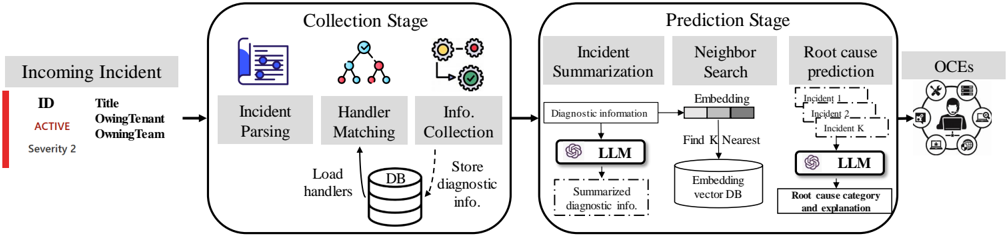
Ensuring the reliability and availability of cloud services necessitates efficient root cause analysis (RCA) for cloud incidents. Traditional RCA methods, which rely on manual investigations of data sources such as logs and traces, are often laborious, error-prone, and challenging for on-call engineers. In this paper, we introduce RCACopilot, an innovative on-call system empowered by the large language model for automating RCA of cloud incidents. RCACopilot matches incoming incidents to corresponding incident handlers based on their alert types, aggregates the critical runtime diagnostic information, predicts the incident's root cause category, and provides an explanatory narrative. We evaluate RCACopilot using a real-world dataset consisting of a year's worth of incidents from Microsoft. Our evaluation demonstrates that RCACopilot achieves RCA accuracy up to 0.766. Furthermore, the diagnostic information collection component of RCACopilot has been successfully in use at Microsoft for over four years.
Overview
The claims and statistics of this paper haven’t been checked yet.
Free: it reads the open-access text and checks the first 5 claims that cite a source we can check. Create a free account to check every claim.
Integrity signals
Registry
Cites
Statistics
Figures
Verification
Claims the paper makes
The claims and statistics of this paper haven’t been checked yet.
Free: it reads the open-access text and checks the first 5 claims that cite a source we can check. Create a free account to check every claim.
Claims other papers make about this one
Each is checked against this paper’s own text: does it say what the citing paper says it does?
The source backs part of the claim, not all of it — or backs it for a different population, condition or comparison.
In the citing paper
“However, these models are not aware of the workflow of cloud RCA, leaving them simply analytical tools.”
From RCAgent: Cloud Root Cause Analysis by Autonomous Agents with Tool-Augmented Large Language Models (2024) · cites this paper as [10]
Experimental — accuracy not yet measuredIn the citing paper
“In incident management, this helps in developing systems capable of recommending investigative queries, summarising monitoring signals, and identifying potential root causes [7], [8], [10].”
From Large language models for agentic NetOps and AIOps: Architectures, evaluation, and safety (2027) · cites this paper as [10]
In the citing paper
“This boundary matters because security and governance depend on the tools an agent can invoke, the permissions attached to those tools, and the checks enforced before action [18], [8], [10].”
From Large language models for agentic NetOps and AIOps: Architectures, evaluation, and safety (2027) · cites this paper as [10]
In the citing paper
“There is a latent system state x t (network and service state), operators and automation observe it only through tool-mediated observations o t (logs, metrics, traces, reachability checks), and they apply actions a t (changes, mitigations) that alter future state [1], [10], [8], [18].”
From Large language models for agentic NetOps and AIOps: Architectures, evaluation, and safety (2027) · cites this paper as [10]
In the citing paper
“Recent operational assistants therefore collect and structure diagnostic artefacts before asking the model to draw conclusions [10], [8], [9], [7], [86].”
From Large language models for agentic NetOps and AIOps: Architectures, evaluation, and safety (2027) · cites this paper as [10]
12 more claims about this paper
Create a free account to see every claim other papers make about this one.
Self-check
Percentages, sums and reported differences re-computed from the paper’s own numbers.
The self-check needs the paper’s full text.
Citations
Cites
Language Models are Few-Shot Learners
Brown, T. B., Mann, B., Ryder, N., Subbiah, M., Kaplan, J., Dhariwal, P., Neelakantan, A., Shyam, P., Sastry, G., Askell, A., et al. (2020) · arXiv · doi:10.48550/arxiv.2005.14165 · Cited by 23,372
Chain-Of-Thought Prompting Elicits Reasoning in Large Language Models
Wei, J., Wang, X., Schuurmans, D., Bosma, M., Ichter, B., Xia, F., Chi, E., Le, Q. V., & Zhou, D. (2022) · Advances in Neural Information Processing Systems 35 · doi:10.52202/068431-1800 · Cited by 4,505
Chain-of-Thought Prompting Elicits Reasoning in Large Language Models
Wei, J., Wang, X., Schuurmans, D., Bosma, M., Ichter, B., Xia, F., Chi, E., Le, Q., & Zhou, D. (2022) · arXiv · doi:10.48550/arxiv.2201.11903 · Cited by 4,263 · cited 1×
“The recent advent and success of large language models (LLMs) in performing complex tasks [21, 28, 46], suggests a promising avenue for enhancing RCA.”
BackgroundIEEE Transactions on Knowledge and Data Engineering
(2023) · IEEE Transactions on Knowledge and Data Engineering · doi:10.1109/tkde.69 · Cited by 1,671
Evaluating Large Language Models Trained on Code
Chen, M., Tworek, J., Jun, H., Yuan, Q., Pinto, H. P. D. O., Kaplan, J., Edwards, H., Burda, Y., Joseph, N., Brockman, G., et al. (2021) · arXiv · doi:10.48550/arxiv.2107.03374 · Cited by 1,436 · cited 1×
“The rapid advancements in natural language processing and machine learning have led to the development of powerful LLMs, which are reported to be effective at various down-stream tasks with zero-shot and few-shot learning [5, 11, 28].”
Background2020 IEEE Symposium on Security and Privacy (SP)
(2020) · doi:10.1109/sp40000.2020 · Cited by 423
SHADEWATCHER: Recommendation-guided Cyber Threat Analysis using System Audit Records
Zengy, J., Wang, X., Liu, J., Chen, Y., Liang, Z., Chua, T.-S., & Chua, Z. L. (2022) · 2022 IEEE Symposium on Security and Privacy (SP) · doi:10.1109/sp46214.2022.9833669 · Cited by 288 · cited 1×
“A typical incident life-cycle consists of four stages: (1) Detection [37, 51, 52]: When an anomalous system behavior is observed, an alert is raised by monitors or users of the service (internal engineers or exter-nal customers).”
BackgroundSelf-citationStudying the Usage of Text-To-Text Transfer Transformer to Support Code-Related Tasks
Mastropaolo, A., Scalabrino, S., Cooper, N., Nader Palacio, D., Poshyvanyk, D., Oliveto, R., & Bavota, G. (2021) · 2021 IEEE/ACM 43rd International Conference on Software Engineering (ICSE) · doi:10.1109/icse43902.2021.00041 · Cited by 247 · cited 3×
“LLMs have shown potential for automatic summarization [40].”
BackgroundVulRepair: a T5-based automated software vulnerability repair
Fu, M., Tantithamthavorn, C., Le, T., Nguyen, V., & Phung, D. (2022) · Proceedings of the 30th ACM Joint European Software Engineering Conference and Symposium on the Foundations of Software Engineering · doi:10.1145/3540250.3549098 · Cited by 207 · cited 2×
“VulRepair [13] also fine-tune T5 on vulnerability repairs datasets to automatically propose vulnerability fixes.”
BackgroundMicroHECL: High-Efficient Root Cause Localization in Large-Scale Microservice Systems
Liu, D., He, C., Peng, X., Lin, F., Zhang, C., Gong, S., Li, Z., Ou, J., & Wu, Z. (2021) · 2021 IEEE/ACM 43rd International Conference on Software Engineering: Software Engineering in Practice (ICSE-SEIP) · doi:10.1109/icse-seip52600.2021.00043 · Cited by 192 · cited 1×
“Moreover, some techniques utilize trace to locate the faulty service [26, 29, 48, 54].”
Self-citation
Research works printed but not linked: 9
- Chen, Y., Sun, X., Nath, S., Yang, Z., and Xu, T. Push-Button Re- liability Testing for Cloud-Backed Applications with Rainmaker. In Proceedings of the 20th USENIX Symposium on Networked Systems De- sign and Implementation (NSDI'23) (2023).
- Lou, C., Chen, C., Huang, P., Dang, Y., Qin, S., Yang, X., Li, X., Lin, Q., and Chintalapati, M. RESIN: A holistic service for dealing with mem- ory leaks in production cloud infrastructure. In Proceedings of the 16th USENIX Symposium on Operating Systems Design and Implementation (OSDI'22) (2022).
- Lou, C., Huang, P., and Smith, S. Understanding, detecting and local- izing partial failures in large system software. In Proceedings of the 17th USENIX Symposium on Networked Systems Design and Implementation (NSDI'20) (2020).
- Ma, M., Zhang, S., Chen, J., Xu, J., Li, H., Lin, Y., Nie, X., Zhou, B., Wang, Y., and Pei, D. Jump-starting multivariate time series anomaly detection for online service systems. In 2021 USENIX Annual Technical Conference (ATC'21) (2021).
- Sun, X., Cheng, R., Chen, J., Ang, E., Legunsen, O., and Xu, T. Testing Configuration Changes in Context to Prevent Production Failures. In Proceedings of the 14th USENIX Symposium on Operating Systems Design and Implementation (OSDI'20) (2020).
- Sun, X., Luo, W., Gu, J. T., Ganesan, A., Alagappan, R., Gasch, M., Suresh, L., and Xu, T. Automatic Reliability Testing for Cluster Management Controllers. In Proceedings of the 16th USENIX Symposium on Operating Systems Design and Implementation (OSDI'22) (2022).
- Wu, Y., Chen, A., Haeberlen, A., Zhou, W., and Loo, B. T. Automated bug removal for software-defined networks. In Proceedings of the 14th USENIX Symposium on Networked Systems Design and Implementation (NSDI'17) (2017).
- Yuan, D., Luo, Y., Zhuang, X., Rodrigues, G. R., Zhao, X., Zhang, Y., Jain, P., and Stumm, M. Simple testing can prevent most critical failures: An analysis of production failures in distributed data-intensive systems. In Proceedings of the 12th USENIX Symposium on Operating Systems Design and Implementation (OSDI'14) (2014).
- Zeng, Z., Zhang, Y., Xu, Y., Ma, M., Qiao, B., Zou, W., Chen, Q., Zhang, M., Zhang, X., Zhang, H., Gao, X., Fan, H., Rajmohan, S., Lin, Q., and Zhang, D. Traceark: Towards actionable performance anomaly alerting for online service systems. In To appear in Proc. of ICSE (2023). · DOI · Paper page
Cited by
Items 201–300 of 442
PropLLM: Propagation-Aware Scene Reconstruction for Network Fault DiagnosisPreprint
Wu, Z., Zhao, M., Tang, F., & Kato, N. (2026) · arXiv (Cornell University) · doi:10.48550/arxiv.2606.00582 · Cited by 3
“Recent LLM-based meth-ods [5], [7], [9], [25] show promise, but effectively harnessing their reasoning capabilities in knowledge interaction and causal awareness remains an open question.”
Qi, J., Luan, Z., Zhang, H., Huang, S., Fung, C., Tong, Y., Yang, H., & Qian, D. (2026) · arXiv (Cornell University) · doi:10.48550/arxiv.2607.04623 · Cited by 3
“LLM-based systems such as mitigation-step recommendation, RCACopilot, and RCAgent support root-cause analysis, diagnostic data collection, or mitigation recommendation in production cloud settings [26], [15], [14].”
From General Agents to RCA Experts: A Self-Evolving Harness for Root Cause AnalysisPreprint
Huang, H., Lyu, J., Jiang, Z., Liu, J., He, X., Zhang, T., Xiang, W., & Lyu, M. R. (2026) · arXiv (Cornell University) · doi:10.48550/arxiv.2608.25661 · Cited by 4
“RCAgent [14] and the RCA-Agent [21] act over raw multi-modal telemetry, mABC [15] and Flow-of-Action [16] coordinate role-specialized agents under SOPs, and others assist incident management from tickets and logs, such as RCACopilot [13], Xpert [26], and in-context approaches [27]–[30].”
Towards Scalable and Interpretable Mobile App Risk Analysis via Large Language Models
Yu, Y., Li, Z., Ran, X., Liu, J., Wang, J., Yu, B., & Ji, S. (2026) · ACM/IEEE International Conference on Software Engineering: Companion Proceedings (ICSE-Companion) · doi:10.1145/3744916.3773184 · Cited by 2
Probably Correct: Rethinking Formal Verification for LLM-Driven Systems
Bhardwaj, A., & Fomina, S. (2025) · IEEE International Conference on Cyber Security and Cloud Computing (CSCloud) · doi:10.1109/cscloud66326.2025.00020 · Cited by 2
“Large Language Models (LLMs) are increasingly employed in distributed systems to automate tasks such as network algorithm generation [1], [2], system configuration [3], and incident remediation [4].”
Digital Twin and LLM Assisted Online Diagnosis in Microservices Based Enterprise Systems
Das, S., & Kant, K. (2025) · International Conference on Network and Service Management (CNSM) · doi:10.23919/cnsm67658.2025.11297544 · Cited by 3
“…advancements in Artificial Intelligence for IT Operations (AIOps) have seen the rise of intelligent AI agents and the application of LLMs to automate complex operational tasks, including root cause analysis (e.g., RCACopilot [10]), fault detection, and incident response (e.g., IRCopilot [11]).”
Transformer substation network disconnection prediction via semantic reasoning with causal modeling
Ren, J., Yao, X., & Chen, H. (2026) · Computer Science and Information Systems · doi:10.2298/csis251027010r · Cited by 2
LLM-Augmented Knowledge Base Construction for Root Cause Analysis
Tran, N. P., Jaumard, B., Delgado, O. E., Tristan Glatard, B., Premkumar, K., & Ni, K. (2026) · IEEE Access · doi:10.1109/access.2026.3658655 · Cited by 2
“Within the domain of RCA, several studies have emerged that explore the application of RAG concepts (e.g., [18], [19]).”
Leveraging LLM for Enhanced Incident Management in Wireless Networks
Towhid, M. S., Khan, N. S., Shahriar, N., Tornatore, M., Boutaba, R., & Saleh, A. (2026) · IEEE Journal on Selected Areas in Communications · doi:10.1109/jsac.2026.3680419 · Cited by 1
“Similarly, [36] and [37] show how LLMs can support hypothesis generation and mitigation planning, with RCACopilot automating root cause analysis.”
AIMS: Cost-Efficient LLM-Based Agent Deployment in Hybrid Cloud-Edge Environments
Liu, S., Shen, H., Che, S., Ghandi, M., & Li, M. (2026) · European Conference on Computer Systems · doi:10.1145/3767295.3803622 · Cited by 2
“Most studies within this domain can be categorized into three main areas: agent architecture design [37, 45, 46, 59, 60, 62, 67, 70], capability acquisition [42, 44, 54], and application domains [1, 5, 37, 52, 72].”
AI-Automated Root-Cause Analysis for Cloud Incidents
Rajamandrapu, A. K., Gudipati, R. R., Gujja, V. K., Apuri, H., Balasubramaniam, S., & Sadat, Q. T. (2026) · International Conference on Smart Futuristic Technology (SMARTTECH) · doi:10.1109/icsft66733.2026.11535905 · Cited by 2
“RCACopilot is an unstructured diagnostic data processing model based on large language models that can predict root-cause categories and substantially reduce the amount of effort required on-call by major cloud providers [1], [2], [5].”
LLMGuard: Multi-Agent Fault Diagnosis for Reliable Language-Model-as-a-Service
Zhong, Y., Yu, G., Huang, Y., Fu, Q., Ren, R., Feng, C., Yang, Y., & Lyu, M. R. (2026) · International Conference on Dependable Systems & Networks/Proceedings · doi:10.1109/dsn69566.2026.00018 · Cited by 2
R-Log: Incentivizing Log Analysis Capability in LLMs via Reasoning-based Reinforcement Learning
Liu, Y., Chen, Z. Q., Xu, S., He, M., Tao, S., Meng, W., Xie, Y., Han, T., Zhao, C., Du, J., et al. (2026) · IEEE/ACM International Conference on Software Engineering: Software Engineering in Practice (ICSE-SEIP) · doi:10.1145/3786583.3786913 · Cited by 2
AIDA: Accelerating Root Cause Analysis for Multi-Vendor Device Failures with LLM-Powered Reasoning
Xu, H., Zeng, X., Zhang, X., Zhang, X., Lv, Y., Zhang, P., Guo, D., & Zhai, E. (2026) · ACM SIGCOMM Conference (SIGCOMM) · doi:10.1145/3789240.3829126 · Cited by 3
Self-citationYu, H., Iqbal, S., Neto, E. C. P., Buffett, S., & Taylor, A. (2026) · International Journal of Information Security · doi:10.1007/s10207-026-01321-2 · Cited by 2
“RCACopilot [47] represents an early large-scale implementation that integrates LLM-based reasoning into cloud incident management.”
Lian, X. (2024) · Illinois Digital Environment for Access to Learning and Scholarship (University of Illinois at Urbana-Champaign) · Cited by 2
Game Theory Approach to Identifying Deception in Large Language ModelsPreprint
Maggio, T. D., & Santiago, R. (2024) · doi:10.36227/techrxiv.171822179.99413216/v1 · Cited by 2
LatencyPrism: Online Non-intrusive Latency Sculpting for SLO-Guaranteed LLM InferencePreprint
Du, Y., Ren, J., Sun, X., Zhou, T., Zhou, H., Ma, R., & Zhang, D. (2026) · arXiv (Cornell University) · doi:10.48550/arxiv.2601.09258 · Cited by 2
“Operators are forced to choose either spend significant effort manually parsing massive logs [7] or resort to conservative resource strategies, relying on expensive resource over-provisioning or service restarts to alleviate symptoms.”
InfluentialSelf-citationAgentic Observability: Automated Alert Triage for Adobe E-CommercePreprint
Bharadwaj, A., & Tu, K. (2026) · arXiv (Cornell University) · doi:10.48550/arxiv.2602.02585 · Cited by 2
OpsMem: Dual-Memory Reasoning with Cross-Memory Resonance for Failure DiagnosisPreprint
Sun, Y., Gao, R., Luo, Y., Gu, W., Zhang, S., Guo, Q., Fu, Q., Wu, Y., & Pei, D. (2026) · arXiv (Cornell University) · doi:10.48550/arxiv.2607.11357 · Cited by 3
“RCA-Copilot [17] uses historical failure cases to support root cause analysis.”
Safe Remediation as Risk-Constrained Intervention Decision in Microservice SystemsPreprint
Dai, C., Yan, Z., Lei, C., Li, Q., & Zhang, L. (2026) · arXiv (Cornell University) · doi:10.48550/arxiv.2607.20005 · Cited by 2
“…s t ∈ S is a feature vector aggregating: (i) the diagnosed root cause and its confidence from an upstream diagnosis module (treated as a black box [2]); (ii) affected-service summaries and topology context; (iii) telemetry anomaly features; and (iv) operational context o t (on-call load,…”
InfluentialDBA-Bench: A Production-Fidelity Benchmark for LLM-Based Database Operations AgentsPreprint
Chen, J., Jiang, J., Chen, X., Liang, Z., & Zheng, K. (2026) · arXiv (Cornell University) · doi:10.48550/arxiv.2607.22165 · Cited by 2
Qisheng, L., Fang, A., Junjielong, X., Shang, J., Zhang, S., Yang, Y., Yan, X., & He, P. (2026) · arXiv (Cornell University) · doi:10.48550/arxiv.2608.21310 · Cited by 2
“work, following the workflow -versus- agent distinction [2].”
ARGUS: MCP-Grounded Root Cause Analysis for Kubernetes IncidentsPreprint
Senja, E., Zadegan, S. M. R., & Leitner, P. (2026) · arXiv (Cornell University) · doi:10.48550/arxiv.2608.23084 · Cited by 2
Where Root Cause Analysis Fails: A Retrieval-Reranking DecompositionPreprint
Muhammad, H. M., Pham, L., Barrière, L., Shetty, S., Pulga, L., & Salim, F. D. (2026) · arXiv (Cornell University) · doi:10.48550/arxiv.2609.36686 · Cited by 2
“This task is known as root cause analysis (RCA), and automated approaches to it have progressed through statistical analysis [8, 9], causal inference-based approaches [10–12], and LLM-based reasoners [13], with each generation reporting improvements on standard benchmarks.”
Alert Summarization for Online Service Systems by Validating Propagation Paths of Faults
Chen, J., He, Y., Wang, P., Chen, X., Shi, J., & Wang, W. (2025) · Proceedings of the ACM on software engineering. · doi:10.1145/3729367 · Cited by 1
“Chen et al. [4] introduce RCACopilot, a system that utilizes LLMs to automate the process of root cause analysis for service incidents.”
Benchmarking AI Agents for IT Automation Tasks with ITBench
Clark, J., Arora, R., & Jha, S. K. (2025) · IEEE/IFIP International Conference on Dependable Systems and Networks - Supplemental Volume (DSN-S) · doi:10.1109/dsn-s65789.2025.00060 · Cited by 1
“…scenarios • Evaluation methodologies 3) Large Language Models (LLMs) and Agents—45 minutes: • LLMs: overview [4] • Agents: overview [3] [6] [7] • Leveraging SREAgent, an existing open-source agent 4) Break—15 minutes: 5) Hands-On Session—75 minutes: • Environment setup • Running an…”
Heterogeneous data-driven resolution generation for software systems via large language models
Liu, W., Sun, D., Yang, H., Wang, Y., & Huang, W. (2025) · Information Processing & Management · doi:10.1016/j.ipm.2025.104376 · Cited by 1
Characterizing the System Evolution That is Proposed After a Software Incident
Pope, M., & Sillito, J. (2025) · IEEE International Conference on Software Maintenance (ICSM) · doi:10.1109/icsme64153.2025.00037 · Cited by 1
Automatically Surfacing Opportunities for Improvements In Internet-Scale Applications
Harsh, V., Sinha, S., Milner, H., Wu, H., Prakash, B. A., Sekar, V., & Zhang, H. (2025) · ACM Workshop on Hot Topics in Networks (HotNets) · doi:10.1145/3772356.3772423 · Cited by 1
“Related approaches exist in other domains—for example, RcaCopilot [12] uses an ML model to select RCA handlers based on incident type.”
NFVAgent: A Retrieval-Augmented LLM Agent for Resilient NFV Failure Recovery
Woo, Y., & Woo, H. (2025) · International Conference on Network and Service Management (CNSM) · doi:10.23919/cnsm67658.2025.11297536 · Cited by 2
“Applications span log-based RCA [13], [14], time-series anomaly detection [15], recovery agents [16], [17], multi-modal orchestration [18], agent collaboration [19], [20], and prompting-based fault inference [21].”
Nangi, P. R., Obannagari, C. K. R. N., & Settipi, S. (2025) · International Journal of Emerging Research in Engineering and Technology · doi:10.63282/3050-922x.ijeret-v6i1p113 · Cited by 1
GPT-Powered Virtual Assistants for Intelligent Cloud Service Management: A Systematic Review
Devnath, S., Huda, M. S., & Taz, T. H. (2025) · Pacific Journal of Advanced Engineering Innovations · doi:10.70818/pjaei.v02i02.0167 · Cited by 1
“The observed decline in such errors suggests that GPT-powered assistants effectively capture contextual cues and disambiguate operator intent, corroborating recent research on in-context learning and reasoning capabilities of GPT-4-class models [15].”
Automated Single-Turn Solution Recommendation System for Software IT Support Tickets
Isaza, P. T., Nidd, M., Zheutlin, N., Ahn, J., Bhatt, C., Deng, Y., Mahindru, R., Franz, M., Florian, H., & Roukos, S. (2025) · IEEE International Conference on Big Data (BigData) · doi:10.1109/bigdata66926.2025.11402036 · Cited by 1
“As far as we are aware, no current work exists that leverages a RAG-based approach to solve this task, although one does exist for a similar IT task of root cause analysis [6].”
PAGER: Proactive Monitoring Agent for Enterprise AI Assistant
Dutta, S., Ayala, J. F. G., Pujar, P., Harsha, S. S., Luo, D., Vasudeva, N., Saha, B., Baruah, P., & Li, Y. (2026) · Proceedings of the AAAI Conference on Artificial Intelligence · doi:10.1609/aaai.v40i48.42344 · Cited by 1
Trustworthy root cause analysis for distributed systems via neurosymbolic fusion
Zhang, H., Zhang, Y., Ni, Q., Li, T., & Zou, Y. (2026) · Results in Engineering · doi:10.1016/j.rineng.2026.110491 · Cited by 1
Harutyunyan, A. N., Poghosyan, A., Davtyan, E., Petrosyan, K., & Baloian, N. A. (2026) · IEEE Access · doi:10.1109/access.2026.3686885 · Cited by 1
“Similarly, Chen et al. introduce an on-call assistant, RCACopilot, that uses an LLM to automate incident analysis [11].”
EvidenT: An Evidence-Preserving Framework for Iterative System-Level Package Repair
Zhao, C., Ma, M., Zhang, S., Huang, Z., Sun, Y., Bansal, C., Rajmohan, S., & Pei, D. (2026) · Proceedings of the ACM on software engineering. · doi:10.1145/3832294 · Cited by 1
Self-citationGraphMind: From Operational Traces to Self-Evolving Workflow Automation
Zhu, Y., Cahoon, J., Pavlenko, A., Bai, Q., Shahbazi, N., Vermareddy, D., Wang, M., Demarne, M. B., Bararia, S., Wang, W., et al. (2026) · ACM International Conference on Information and Knowledge Management (CIKM) · doi:10.1145/3799682.3840085 · Cited by 1
NetCause: Counterfactual Learning for Root Cause Analysis in Large-Scale Networks
Chraim, F., Zhang, J., Janzing, D., Song, X., Faloutsos, C., & Evans, J. (2026) · International Conference on Computer Communications and Networks (ICCCN) · doi:10.1109/icccn69946.2026.11662666 · Cited by 1
“Large language models have recently been explored as RCA assistants [20, 21], but primarily support investigation workflows with causal hypotheses that are not transparent [22].”
CORE - An LLM-Powered System for Resolution Mining and Retrieval from Conversational Platforms
Dutta, A., Sisodiya, V. R., Airen, H., & Nivarthi, P. (2026) · IEEE International Conference on Data Engineering Workshops (ICDEW) · doi:10.1109/icdew71238.2026.00020 · Cited by 1
“Chen et al. [17] presented a system for automatic RCA via LLMs for cloud incidents, using structured incident logs and telemetry data to generate root cause hypotheses.”
Graphical-Probabilistic Modeling of Generative Flows in LLM-Native Software Systems
Braberman, V. A., & Bonomo, F. (2026) · IEEE/ACM International Conference on AI Engineering – Software Engineering for AI (CAIN) · doi:10.1145/3793653.3793780 · Cited by 1
“Figure 1 illustrates an abstract execution scenario of a hypothetical LLM-based Root Cause Analysis (RCA) tool inspired by [8].”
KAT: Knowledge-Context Augmentation for Evolving LLM-Based Telecom Troubleshooting
Kai, Q., Lyu, F., Wu, H. W., Gao, J., Li, S., Wu, F., Luo, Q., Chen, B., & Xu, F. (2026) · IEEE Conference on Computer Communications (INFOCOM) · doi:10.1109/infocom59046.2026.11571301 · Cited by 1
“Retrieval-based methods [6], [11]– [15] leverage external knowledge bases to enrich model responses.”
InfluentialBui, D., Grintz, S., Berndt, A., & Bach, T. (2026) · IEEE International Conference on Software Analysis, Evolution and Reengineering (SANER) · doi:10.1109/saner67736.2026.00063 · Cited by 1
“It often requires engineers with several years experience who deeply understand the CI/CD pipeline and its behavior to manually inspect lengthy logs filled with ∗ Both authors contributed equally to this work. irrelevant information [4], [7]–[9].”
InfluentialMantis: Decoding HPC Telemetry Data for Robust System Prediction
Lu, Y., Ren, J., & Smirni, E. (2026) · International Conference on Supercomputing · doi:10.1145/3797905.3800527 · Cited by 1
Intelligent Triage: Interpretable Incident Triage Workflow using LLM Extracted Triage Reasoning
Liu, J., Ren, H., Kang, Y., Ma, M., Yang, F., Xu, Y., Gao, X., Zhang, M., Wang, H., Gao, X. Y., et al. (2026) · IEEE/ACM International Conference on Software Engineering: Software Engineering in Practice (ICSE-SEIP) · doi:10.1145/3786583.3786887 · Cited by 1
Self-citationLeveraging LLMs for Alert Summarization and Mitigation Plan Generation
Sarda, K., Ji, H., Zaki, A. M., Watts, I., Shwartz, L., & Litoiu, M. (2026) · ACM Joint European Software Engineering Conference and Symposium on the Foundations of Software Engineering (ESEC/FSE) · doi:10.1145/3803437.3805255 · Cited by 1
郑明卓, Wu, G., Zhang, J., Wei, J., Chen, W., Zhu, J., & Liang, Z. (2026) · ACM Joint European Software Engineering Conference and Symposium on the Foundations of Software Engineering (ESEC/FSE) · doi:10.1145/3803437.3805257 · Cited by 1
TELLER: Non-intrusive Cross-Layer Root-Cause Analysis for LLM Inference
Xu, R., Li, J., Chen, P., & Xie, Z. (2026) · IEEE/ACM International Conference on Automated Software Engineering (ASE) · doi:10.1145/3832783.3837440 · Cited by 1
RunbookFX: Type- and Effect-Safe LLM Synthesis for Executable Incident Diagnosis and Mitigation
Xiao, Y., Li, S., & Ge, Y. (2026) · Proceedings of the ACM on Programming Languages · doi:10.1145/3828675 · Cited by 1
“…[Pham et al. 2024], a statistical Bayesian change point detector operating on metrics only (included as the strongest non-LLM method); RCACopilot [Chen et al. 2024], an LLM-based RCA system; TAMO [Zhang et al. 2025b], a multi-modal LLM agent; and ReAct-RCA [Roy et al. 2024], a ReAct agent with…”
InfluentialChatRCA: A Root Cause Analysis Method via LLMs-based Multi-Agent with Human-in-the-Loop
Hui, M., Wang, L., Li, Q., Zhang, L., Bai, Z., Hu, J., Li, H., Ren, Y., Song, F., Wang, Y., et al. (2026) · ACM Transactions on Software Engineering and Methodology · doi:10.1145/3842744 · Cited by 1
“…have been used to fine-tune GPT-3.x for predicting root causes [2], OASIS employs LLMs to generate practical summaries [18], and RCACopilot predicts root causes by manually building a cloud incident handler workflow and combining few-shot learning capabilities with historical incidents [6].”
DBAgent: An RL-Based Agent for Autonomous Database Operations and Maintenance
Chen, X., Chen, J., Liu, S., Xia, Y., Liang, Z., Qin, X., Zeng, K., Su, H., & Zheng, K. (2026) · Proceedings of the VLDB Endowment · doi:10.14778/3827998.3828006 · Cited by 1
Gottimukkala, P., & Nune, S. (2024) · Sciences du Nord Nature Science and Technology · doi:10.71238/snnst.v1i02.183 · Cited by 1
DBPrompt: A Database Anomaly Operation Detection and Analysis via Prompt Learning
Zhong, H., Wang, J., Wang, X., Wang, X., Xiao, W., Tang, X., & Zang, L. (2024) · Lecture notes in computer science · doi:10.1007/978-981-97-5603-2_29 · Cited by 1
Liu, Y., Cai, J., Ren, J., Zhou, P., Zhang, D., Du, Y., & Li, S. (2025) · arXiv (Cornell University) · doi:10.48550/arxiv.2511.05978 · Cited by 1
“There has been a growing number of works looking into employing LLMs instead of traditional deep learning models in the areas of TSAD and (Chen et al. 2024b; Guan et al. 2025; Roy et al. 2024).”
Self-citationAOI: Turning Failed Trajectories into Training Signals for Autonomous Cloud DiagnosisPreprint
Yang, P., Chen, W., Zheng, Y., Li, X., Li, X., Tu, H., Xiao, J., Pang, Y., Zhang, D., Li, F., et al. (2026) · arXiv (Cornell University) · doi:10.48550/arxiv.2603.03378 · Cited by 1
“The application of LLMs to cloud operations spans log analysis [13], anomaly detection [14], root cause analysis [15, 16], and interactive diagnosis.”
Self-citationInteractive Clarification for Cloud Infrastructure-as-Code SynthesisPreprint
Yang, Z., Gruizenga, K., Miao, T., Kon, P. T. J., Guan, H., Barto, A. G., & Chen, A. (2026) · arXiv (Cornell University) · doi:10.48550/arxiv.2604.02382 · Cited by 1
DeepParse: Hybrid Log Parsing with LLM-Synthesized Regex MasksPreprint
Shetaia, A., & Kauffman, S. (2026) · arXiv (Cornell University) · doi:10.48550/arxiv.2604.20553 · Cited by 1
CUJBench: Benchmarking LLM Agents for Browser-to-Backend Failure DiagnosisPreprint
Meng, H. (2026) · arXiv (Cornell University) · doi:10.48550/arxiv.2604.23455 · Cited by 1
“LLM-based incident assistants [34] and operational RCA systems [35] address adjacent diagnostic tasks from incident tickets and backend telemetry, but are not designed as evaluation benchmarks.”
OpsLLM: Construction of Large Language Model for Software Operations with Multi-stage LearningPreprint
He, J., Chen, P., Wu, C., Liang, S., Li, Y., Tan, G., Wen, X., Zhang, C., Situ, F., & Zhou, Q. (2026) · arXiv (Cornell University) · doi:10.48550/arxiv.2605.02906 · Cited by 1
“Existing AIOps studies mainly improve RCA at inference time through prompting, agents, or tool use (e.g., RCACopilot [15], RCA-gent [16], and Flow-of-Action [17]), while RL-based approaches such as HRLHF [18] and ThinkFL [19] focus on specific localization objectives.”
Self-citationEvoCause: LLM-Guided Evolution of Causal Graphs for Root Cause AnalysisPreprint
Zan, L., Zhang, K., Xie, S., Zheng, J., Xiao, Z., Dong, Z., Zhang, K., Cai, R., Tiomoko, M., & Pan, L. (2026) · arXiv (Cornell University) · doi:10.48550/arxiv.2607.27290 · Cited by 1
Eshun, S., Murage, D., Muoki, S., Chen, C.-C., Adjignon, S., Staar, M., & Angélil, O. (2026) · arXiv (Cornell University) · doi:10.48550/arxiv.2608.01955 · Cited by 2
“…et al. show that fine-tuned language models can recommend plausible root causes and mitigation steps for cloud incidents at scale [7], and Chen et al. demonstrate an LLM-based RCA assistant deployed over real production incidents, using retrieval over incident history to ground its diagnoses [8].”
InfluentialSkillEvo: Self-Renewing Evolution Gradients from Multi-Turn Interaction FeedbackPreprint
Yan, Q., Chen, C., Zhao, J., Zhang, M., Xu, Y., & Xu, X. (2026) · arXiv (Cornell University) · doi:10.48550/arxiv.2608.13120 · Cited by 1
“In the cloud-services domain, RCACopilot (Chen et al., 2024) applies LLMs to incident root-cause analysis, RCAgent (Wang et al., 2024b) endows the agent with autonomous diagnosis, and D-Bot (Zhou et al., 2023) structures database diagnosis via tree search; all three, however, focus on single-exchange capability and do…”
FaulT-Bench: Towards Benchmarking Network Troubleshooting LLM Agents under Unreliable User TicketsPreprint
Tseng, K.-H., Bogahawatta, N., Ginige, Y., Patel, K., Dakic, K., & Seneviratne, S. (2026) · arXiv (Cornell University) · doi:10.48550/arxiv.2608.27021 · Cited by 1
ASTRA - Agentic System for Ticket Resolution and AnalysisPreprint
Javaji, S. R., Trabelsi, M., Cao, J., & Uzunalioğlu, H. (2026) · arXiv (Cornell University) · doi:10.48550/arxiv.2608.28790 · Cited by 1
“In cloud incident settings, LLMs have been used to generate root-cause analyses and mitigation steps [1, 5, 6], and agentic approaches such as RCAgent [47] emphasize tool-augmented interaction for collecting evidence during RCA.”
Agrawal, A., & Babu, R. S. (2026) · arXiv (Cornell University) · doi:10.48550/arxiv.2609.01616 · Cited by 1
“LLM-based RCA systems add tool use, workflow planning, and multimodal observations (Chen et al., 2024; Zhang et al., 2025c; Gao et al., 2026).”
EviRCA: Decoupling Evidence Extraction from Reasoning for Microservice Root-Cause AnalysisPreprint
Wang, Y., Qin, Z., Wang, X., Li, G., Li, W., & Deng, S. (2026) · arXiv (Cornell University) · doi:10.48550/arxiv.2609.19825 · Cited by 1
“Early LLM-based RCA approaches primarily treated the model as a text summarizer or classifier over incident reports, focusing on predicting broad root-cause categories or suggesting mitiga-tions [11], [12], [13].”
Rethinking Tool Design for Agentic RCA: A Controlled Empirical StudyPreprint
Luo, Y., Gao, R., Zhou, Z., Liu, C., 游余良, Sun, Y., Zhang, S., Fu, Q., Wang, S., & Pei, D. (2026) · arXiv (Cornell University) · doi:10.48550/arxiv.2610.05009 · Cited by 1
Regression test prioritization for modern software
Cheng, R. (2025) · Illinois Digital Environment for Access to Learning and Scholarship (University of Illinois at Urbana-Champaign) · Cited by 1
A Self-Defining Operator for Distributed ApplicationsPreprint
Li, S., Anderson, T. E., Mahajan, R., Peter, S., & Zettlemoyer, L. (2026) · arXiv (Cornell University) · doi:10.48550/arxiv.2610.14547 · Cited by 1
“Such agents have begun to appear, as research root-cause analysis assistants [11, 46, 64], multi-agent diagnosis systems [9], and commercial cloud services [2, 3].”
AIOpsLab in Action: An Open Platform for AIOps Research
Ma, M., Clark, J., & Zhang, S. (2025) · Proceedings of the 33rd ACM International Conference on the Foundations of Software Engineering · doi:10.1145/3696630.3728619
Self-citationLet’s read the log: root cause analysis of railway test execution logs with large language models
Hermawan, R., Bucaioni, A., Enoiu, E., Afzal, W., Saadatmand, M., Zaimovic, N., & Ibtasham, M. S. (2026) · Innovations in Systems and Software Engineering · doi:10.1007/s11334-026-00657-1
“This perspective complements prior industrial LLM-based RCA systems such as RCACopilot [26], which are designed as assistive tools rather than fully autonomous solutions.”
Duan, T., Chen, R.-Q., Wang, P., Zhao, J., Liu, J., Han, S., Liu, Y., & Xu, F. (2025) · IEEE/ACM International Conference on Software Engineering: Software Engineering in Practice (ICSE-SEIP) · doi:10.1109/icse-seip66354.2025.00049 · Cited by 1
“Root cause analysis (RCA) [6,7,33] aims to locate the root cause failures [34].”
Towards Automatic Network Diagram Comprehension
Ren, Y.-Y., Miao, Y., Chen, L., Li, D., Wang, X., Bai, Y., Wu, Z., & Long, F. (2025) · IEEE International Conference on Network Protocols (ICNP) · doi:10.1109/icnp65844.2025.11192381
“Despite the importance of network diagrams, they are underutilized in the automatic networking tasks compared to textual alert or traffic [3], [4].”
Methods for Analysis and Classification of Errors in Automated Tests Using Modern LLM Models
Senior Software Development Enginee Austin, T., & Buriak, T. (2025) · The American Journal of Applied Sciences · doi:10.37547/tajas/volume07issue10-11
Yang, P., Zhao, M., Guo, W., Hongyi, X., Yiming, L., & Fayuan, Q. (2025) · IEEE International Conference on Intelligent Rail Transportation (ICIRT) · doi:10.1109/icirt66379.2025.11216727
gigiProfiler: Diagnosing Performance Issues by Uncovering Application Resource BottlenecksPreprint
Hu, Y. C., Zheng, H. Q., Liu, Y., Xie, D., Huang, Y., & Kasikci, B. (2025) · arXiv (Cornell University) · doi:10.48550/arxiv.2507.06452
“Large Language Models have demonstrated exceptional capabilities in processing such metadata [1, 6, 55], often rivaling human experts in code understanding tasks.”
Once Bitten, Still Shy: Can We Prevent Cloud Systems from Repeating Their Mistakes?
Parikesit, D. S., & Lou, C. (2025) · ACM Workshop on Hot Topics in Networks (HotNets) · doi:10.1145/3772356.3772385
“Recently LLMs have become increasingly popular in assisting developers to analyze existing resources for system insights [23, 50, 52, 57, 58].”
Model-Based Diagnosis: Automating End-to-End Diagnosis of Network FailuresPreprint
Wu, C. H., Yu, Y., Lee, M., Srinivasa, J., Zhai, E., Varghese, G., & Tamir, Y. (2025) · arXiv (Cornell University) · doi:10.48550/arxiv.2506.23083
“RCAcopilot[20] only shows the compound F-1 score for diagnosing multi-class distributed systems.”
LLM-based Blackboard Pattern for Diagnostic SystemsPreprint
Mahr, F., Bruegge, B., Meier, S., Raum, C., Scagliola, F., Franke, J., & Ockel, M. (2025) · SSRN Electronic Journal · doi:10.2139/ssrn.5784368
SlsReuse: LLM-Powered Serverless Function ReusePreprint
Wen, J., & Sun, Y. (2025) · arXiv (Cornell University) · doi:10.48550/arxiv.2511.17262
“To ensure reproducibility and deterministic behavior, we follow prior work [13, 23, 47, 48] and fix the temperature to 0 for all identical queries.”
DrP: Meta's Efficient Investigations Platform at ScalePreprint
Somani, S., Talwar, V., Parikh, M., Hernández, E. P., Wang, J., Shah, S., Gandhi, C., Sundarajan, S., Sharma, N., Kamath, S., et al. (2025) · arXiv (Cornell University) · doi:10.48550/arxiv.2512.04250
“RCACopilot [17] introduces a system that automatically matches incoming incidents with the predefined incident handlers based on the alert type to collect multi-modal diagnostic data to the incident, and utilize LLMs to predict a root cause category.”
Dynamic Agent Generation for Self-Adaptive Root Cause Analysis
Sanwouo, B., Temple, P., & Quinton, C. (2026) · HAL
James, K. (2024) · Carolina Digital Repository (University of North Carolina at Chapel Hill) · doi:10.17615/psrh-9g29
Su, J. (2025) · Diva portal (Dalarna University Library)
Ekhlasi, M. (2025) · PolyPublie (École Polytechnique de Montréal)
Detecting Tiny Performance Regressions at Hyperscale
Wang, Y., Chow, M., Yoon, D. Y., Bopardikar, R., Chen, S., Farkas, Z., Gocmen, C., Goenka, K., Hailu, A., Hodges, D., et al. (2026) · ACM Transactions on Computer Systems · doi:10.1145/3785504
Xiao, Z., Liu, H., Zhou, X., Cong, S., & Ju, Y. (2026) · SSRN Electronic Journal · doi:10.2139/ssrn.6017994
CrossDiag: A Cross-Modal Consistent Framework for Hardware Fault Diagnosis
Zhang, P., Zhang, Y., Su, Z., Zhang, X., & Guo, F. (2025) · IEEE Advanced Information Management, Communicates, Electronic and Automation Control Conference (IMCEC) · doi:10.1109/imcec66174.2025.11331821
“Representative studies include RCACopilot [18] and Unilog [19], which demonstrate that LLM-based automated diagnostic frameworks can effectively support the parsing and analysis of cloud platform incident reports and logs.”
Self-citationShanubhog, S. A. (2026) · Journal of Information Systems Engineering & Management · doi:10.52783/jisem.v11i2s.14353
Enhancing Multi-Modal RCA in Resource Management Systems via Fine-Tuning of LLMs
Wen, Z., Wang, C., Yang, G., & Li, T. (2025) · International Conference on Communication Technology and Information Technology (ICCTIT) · doi:10.1109/icctit68197.2025.11406394
“Recent advances in Large Language Models (LLMs) have shown promising results in failure analysis tasks [13], [14].”
Haritas, H. K., Sadarangani, V. H., Shidaganti, G. I., Bankapure, D., Vishal, R. K., & Vijayasimha, S. (2026) · IAES International Journal of Robotics and Automation (IJRA) · doi:10.11591/ijra.v15i1.pp149-161
“The idea of expediently calling LLMs — i.e., only when an exception occurs and the RPA is progressing along an incorrect path — was inspired by other software engineering research solutions including [17].”
Jia, X., Yahia, T., Haubeil, K., Siegel, D., & Davis, D. J. (2025) · IEEE ... International Conference on Data Mining workshops · doi:10.1109/icdmw69685.2025.00197
“…the ReAct framework combines chain-of-thought reasoning with tool-use actions for problem solving, and specialized agent systems such as RCACopilot and RCAgent leverage LLMs as autonomous agents to diagnose the underlying cause of incidents and suggest corrective actions [17] [18] [19] [20].”
Towards Knowledge Retrieval for Agentic Systems in Cloud: Learning, Analysis and Control
Daniëlse, P., Ilager, S., & Zhao, Z. (2026) · Lecture notes in computer science · doi:10.1007/978-981-95-5009-8_32
Analysis of Furniture Product Defects Using Fault Tree Analysis and Root Cause Analysis Methods
Anasari, S. F., & Rochmoeljati, R. (2025) · Journal La Multiapp · doi:10.37899/journallamultiapp.v6i6.2227
“So effective quality control is needed to identify, prevent, and resolve quality problems that occur (Chen et al., 2024; Rame et al., 2023; Wieruszewski et al., 2023).”
GARNET: GoT-Based Alert Reduction and Narrative Event Tracing
Gong, Y., Liu, S., Zhao, C., Liu, J., tian, T., Yang, X., Jiang, B., & Lu, Z. (2026) · Proceedings of the AAAI Conference on Artificial Intelligence · doi:10.1609/aaai.v40i1.36994
Damarched, M. K. (2026) · Journal of Computer Science and Technology Studies · doi:10.32996/jcsts.2026.8.5.4
“Wang et al. (2023) [[9]] reported results from RCACopilot's production deployment at Microsoft spanning multiple cloud services: Diagnostic Accuracy: • Overall root cause accuracy: 76.6% • Performance on structured data (logs, metrics): 82.3% • Performance on unstructured data (descriptions): 68.9%…”
InfluentialAlothman, Y., Bader-El-Den, M., Maurya, L., & Amer, E. (2026) · IEEE Transactions on Semiconductor Manufacturing · doi:10.1109/tsm.2026.3681810
“Still, most working RCA automation with LLMs target cloud / IT incidents rather than semiconductor defect reports [36], [37], [38], [39].”
Smart Eye: LLM-Guided Proposer-Verifier Framework for Industrial-Scale Log Anomaly Detection
Pei, C., Cui, H., Li, J., Li, Y., Liu, Z., Liao, X., Hu, C., Wang, J., Li, Z., Wang, Z., et al. (2026) · International World Wide Web Conference (WWW) · doi:10.1145/3774904.3792804
LogNER: Enhancing log semantics with LLM-driven entity recognition
Zhao, C., Xiang, J., Zhao, L., Yu, A., Cai, L., & Meng, D. (2026) · Journal of Systems and Software · doi:10.1016/j.jss.2026.112892
Metadata
- Authors
- Chen, Y., Xie, H., Ma, M., Kang, Y., Gao, X., Shi, L., Cao, Y., Gao, X., Fan, H., Wen, M., Zeng, J., Ghosh, S., Zhang, X., Zhang, C., Lin, Q., Rajmohan, S., Zhang, D., & Xu, T.
- Affiliations
- Huazhong University of Science and Technology (CN)
- Peking University (CN)
- National University of Singapore (SG)
- Microsoft (United States) (US)
- University of Illinois Urbana-Champaign (US)
- ORCID
- Venue
- Proceedings of the Nineteenth European Conference on Computer Systems
- Publisher
- ACM
- Published
- 2024-04-22
- Pages
- 674-688
- OpenAlex
- W4394946189
- Cited by
- 190
- References
- 48
- Citations by year
- 2026: 89 · 2025: 59 · 2024: 41
- FWCI
- 82.63
- Type
- conference paper
- Language
- en
- Open access
- green
- arxiv.org
- Locations
- European Conference on Computer Systems (publishedVersion)
- arXiv (Cornell University) (submittedVersion, cc-by)
- arXiv (Cornell University) (cc-by)
- Topics
- Physical Sciences › Computer Science › Computer Networks and Communications › Software System Performance and Reliability
- Physical Sciences › Computer Science › Information Systems › Cloud Computing and Resource Management
- Physical Sciences › Computer Science › Information Systems › Software Engineering Research
- Keywords
- root cause analysis, large language models, incident diagnosis, cloud reliability
About these checks
Registry, retraction, Cites and statistics results are computed, not judged, with one exception: a printed reference that no index lists is read once by a model before it counts as a citation error. Claims are extracted by a model and kept only when their quote appears verbatim in the text; each cited source is then checked, with a model’s help, for whether it says what the claim relies on. Those verdicts can be wrong — read the claim’s quote and the cited source before relying on one.
Statistics and arithmetic are recomputed, not judged.
Confidence bands are shown only for fields calibrated on our annotated test set. None is calibrated yet, so no band is shown.
What counts as a claim ›How we measure confidence ›How we check this ›
Are you an author, or do you see a problem with this page? Request a review
Data sources
Bibliographic data: Semantic Scholar, OpenAlex, Crossref.
Contains information from the Semantic Scholar Academic Graph Datasets, made available under the ODC Attribution License (ODC-BY 1.0).
Semantic Scholar’s data is described in: Kinney, R., et al. (2023). The Semantic Scholar Open Data Platform. arXiv:2301.10140.
