

Automatic Root Cause Analysis via Large Language Models for Cloud Incidents
Open accessThe DOI matches its Crossref record; 55 of the 55 references it cites were found in a registry or an index.
Abstract
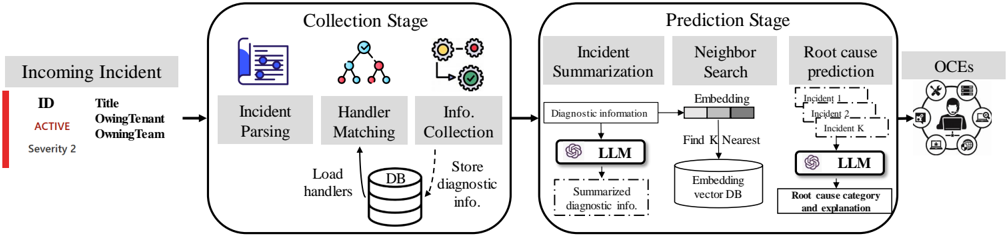
Ensuring the reliability and availability of cloud services necessitates efficient root cause analysis (RCA) for cloud incidents. Traditional RCA methods, which rely on manual investigations of data sources such as logs and traces, are often laborious, error-prone, and challenging for on-call engineers. In this paper, we introduce RCACopilot, an innovative on-call system empowered by the large language model for automating RCA of cloud incidents. RCACopilot matches incoming incidents to corresponding incident handlers based on their alert types, aggregates the critical runtime diagnostic information, predicts the incident's root cause category, and provides an explanatory narrative. We evaluate RCACopilot using a real-world dataset consisting of a year's worth of incidents from Microsoft. Our evaluation demonstrates that RCACopilot achieves RCA accuracy up to 0.766. Furthermore, the diagnostic information collection component of RCACopilot has been successfully in use at Microsoft for over four years.
Overview
The claims and statistics of this paper haven’t been checked yet.
Free: it reads the open-access text and checks the first 5 claims that cite a source we can check. Create a free account to check every claim.
Integrity signals
Registry
Cites
Statistics
Figures
Verification
Claims the paper makes
The claims and statistics of this paper haven’t been checked yet.
Free: it reads the open-access text and checks the first 5 claims that cite a source we can check. Create a free account to check every claim.
Claims other papers make about this one
Each is checked against this paper’s own text: does it say what the citing paper says it does?
The source backs part of the claim, not all of it — or backs it for a different population, condition or comparison.
In the citing paper
“However, these models are not aware of the workflow of cloud RCA, leaving them simply analytical tools.”
From RCAgent: Cloud Root Cause Analysis by Autonomous Agents with Tool-Augmented Large Language Models (2024) · cites this paper as [10]
Experimental — accuracy not yet measuredIn the citing paper
“In incident management, this helps in developing systems capable of recommending investigative queries, summarising monitoring signals, and identifying potential root causes [7], [8], [10].”
From Large language models for agentic NetOps and AIOps: Architectures, evaluation, and safety (2027) · cites this paper as [10]
In the citing paper
“This boundary matters because security and governance depend on the tools an agent can invoke, the permissions attached to those tools, and the checks enforced before action [18], [8], [10].”
From Large language models for agentic NetOps and AIOps: Architectures, evaluation, and safety (2027) · cites this paper as [10]
In the citing paper
“There is a latent system state x t (network and service state), operators and automation observe it only through tool-mediated observations o t (logs, metrics, traces, reachability checks), and they apply actions a t (changes, mitigations) that alter future state [1], [10], [8], [18].”
From Large language models for agentic NetOps and AIOps: Architectures, evaluation, and safety (2027) · cites this paper as [10]
In the citing paper
“Recent operational assistants therefore collect and structure diagnostic artefacts before asking the model to draw conclusions [10], [8], [9], [7], [86].”
From Large language models for agentic NetOps and AIOps: Architectures, evaluation, and safety (2027) · cites this paper as [10]
12 more claims about this paper
Create a free account to see every claim other papers make about this one.
Self-check
Percentages, sums and reported differences re-computed from the paper’s own numbers.
The self-check needs the paper’s full text.
Citations
Cites
Language Models are Few-Shot Learners
Brown, T. B., Mann, B., Ryder, N., Subbiah, M., Kaplan, J., Dhariwal, P., Neelakantan, A., Shyam, P., Sastry, G., Askell, A., et al. (2020) · arXiv · doi:10.48550/arxiv.2005.14165 · Cited by 23,372
Chain-Of-Thought Prompting Elicits Reasoning in Large Language Models
Wei, J., Wang, X., Schuurmans, D., Bosma, M., Ichter, B., Xia, F., Chi, E., Le, Q. V., & Zhou, D. (2022) · Advances in Neural Information Processing Systems 35 · doi:10.52202/068431-1800 · Cited by 4,505
Chain-of-Thought Prompting Elicits Reasoning in Large Language Models
Wei, J., Wang, X., Schuurmans, D., Bosma, M., Ichter, B., Xia, F., Chi, E., Le, Q., & Zhou, D. (2022) · arXiv · doi:10.48550/arxiv.2201.11903 · Cited by 4,263 · cited 1×
“The recent advent and success of large language models (LLMs) in performing complex tasks [21, 28, 46], suggests a promising avenue for enhancing RCA.”
BackgroundIEEE Transactions on Knowledge and Data Engineering
(2023) · IEEE Transactions on Knowledge and Data Engineering · doi:10.1109/tkde.69 · Cited by 1,671
Evaluating Large Language Models Trained on Code
Chen, M., Tworek, J., Jun, H., Yuan, Q., Pinto, H. P. D. O., Kaplan, J., Edwards, H., Burda, Y., Joseph, N., Brockman, G., et al. (2021) · arXiv · doi:10.48550/arxiv.2107.03374 · Cited by 1,436 · cited 1×
“The rapid advancements in natural language processing and machine learning have led to the development of powerful LLMs, which are reported to be effective at various down-stream tasks with zero-shot and few-shot learning [5, 11, 28].”
Background2020 IEEE Symposium on Security and Privacy (SP)
(2020) · doi:10.1109/sp40000.2020 · Cited by 423
SHADEWATCHER: Recommendation-guided Cyber Threat Analysis using System Audit Records
Zengy, J., Wang, X., Liu, J., Chen, Y., Liang, Z., Chua, T.-S., & Chua, Z. L. (2022) · 2022 IEEE Symposium on Security and Privacy (SP) · doi:10.1109/sp46214.2022.9833669 · Cited by 288 · cited 1×
“A typical incident life-cycle consists of four stages: (1) Detection [37, 51, 52]: When an anomalous system behavior is observed, an alert is raised by monitors or users of the service (internal engineers or exter-nal customers).”
BackgroundSelf-citationStudying the Usage of Text-To-Text Transfer Transformer to Support Code-Related Tasks
Mastropaolo, A., Scalabrino, S., Cooper, N., Nader Palacio, D., Poshyvanyk, D., Oliveto, R., & Bavota, G. (2021) · 2021 IEEE/ACM 43rd International Conference on Software Engineering (ICSE) · doi:10.1109/icse43902.2021.00041 · Cited by 247 · cited 3×
“LLMs have shown potential for automatic summarization [40].”
BackgroundVulRepair: a T5-based automated software vulnerability repair
Fu, M., Tantithamthavorn, C., Le, T., Nguyen, V., & Phung, D. (2022) · Proceedings of the 30th ACM Joint European Software Engineering Conference and Symposium on the Foundations of Software Engineering · doi:10.1145/3540250.3549098 · Cited by 207 · cited 2×
“VulRepair [13] also fine-tune T5 on vulnerability repairs datasets to automatically propose vulnerability fixes.”
BackgroundMicroHECL: High-Efficient Root Cause Localization in Large-Scale Microservice Systems
Liu, D., He, C., Peng, X., Lin, F., Zhang, C., Gong, S., Li, Z., Ou, J., & Wu, Z. (2021) · 2021 IEEE/ACM 43rd International Conference on Software Engineering: Software Engineering in Practice (ICSE-SEIP) · doi:10.1109/icse-seip52600.2021.00043 · Cited by 192 · cited 1×
“Moreover, some techniques utilize trace to locate the faulty service [26, 29, 48, 54].”
Self-citation
Research works printed but not linked: 9
- Chen, Y., Sun, X., Nath, S., Yang, Z., and Xu, T. Push-Button Re- liability Testing for Cloud-Backed Applications with Rainmaker. In Proceedings of the 20th USENIX Symposium on Networked Systems De- sign and Implementation (NSDI'23) (2023).
- Lou, C., Chen, C., Huang, P., Dang, Y., Qin, S., Yang, X., Li, X., Lin, Q., and Chintalapati, M. RESIN: A holistic service for dealing with mem- ory leaks in production cloud infrastructure. In Proceedings of the 16th USENIX Symposium on Operating Systems Design and Implementation (OSDI'22) (2022).
- Lou, C., Huang, P., and Smith, S. Understanding, detecting and local- izing partial failures in large system software. In Proceedings of the 17th USENIX Symposium on Networked Systems Design and Implementation (NSDI'20) (2020).
- Ma, M., Zhang, S., Chen, J., Xu, J., Li, H., Lin, Y., Nie, X., Zhou, B., Wang, Y., and Pei, D. Jump-starting multivariate time series anomaly detection for online service systems. In 2021 USENIX Annual Technical Conference (ATC'21) (2021).
- Sun, X., Cheng, R., Chen, J., Ang, E., Legunsen, O., and Xu, T. Testing Configuration Changes in Context to Prevent Production Failures. In Proceedings of the 14th USENIX Symposium on Operating Systems Design and Implementation (OSDI'20) (2020).
- Sun, X., Luo, W., Gu, J. T., Ganesan, A., Alagappan, R., Gasch, M., Suresh, L., and Xu, T. Automatic Reliability Testing for Cluster Management Controllers. In Proceedings of the 16th USENIX Symposium on Operating Systems Design and Implementation (OSDI'22) (2022).
- Wu, Y., Chen, A., Haeberlen, A., Zhou, W., and Loo, B. T. Automated bug removal for software-defined networks. In Proceedings of the 14th USENIX Symposium on Networked Systems Design and Implementation (NSDI'17) (2017).
- Yuan, D., Luo, Y., Zhuang, X., Rodrigues, G. R., Zhao, X., Zhang, Y., Jain, P., and Stumm, M. Simple testing can prevent most critical failures: An analysis of production failures in distributed data-intensive systems. In Proceedings of the 12th USENIX Symposium on Operating Systems Design and Implementation (OSDI'14) (2014).
- Zeng, Z., Zhang, Y., Xu, Y., Ma, M., Qiao, B., Zou, W., Chen, Q., Zhang, M., Zhang, X., Zhang, H., Gao, X., Fan, H., Rajmohan, S., Lin, Q., and Zhang, D. Traceark: Towards actionable performance anomaly alerting for online service systems. In To appear in Proc. of ICSE (2023). · DOI · Paper page
Cited by
Items 401–442 of 442
Liu, K., & Chen, L. (2026) · arXiv (Cornell University) · doi:10.48550/arxiv.2610.10256
“RCACopilot instead studies naturally occurring cloud incidents using runtime information and operational root-cause categories [28].”
Mballa, A. N. O., Eyezo'o, H. B. M., & Sali, C. B. (2026) · SSRN Electronic Journal · doi:10.2139/ssrn.7580899
Agentic RCA for Internet-Scale Services Using Constrained CreativityPreprint
Sinha, S., Harsh, V., Prakash, B. A., Sekar, V., & Zhang, H. (2026) · arXiv (Cornell University) · doi:10.48550/arxiv.2610.08622
“More recently, there is significant interest in LLM-assisted agentic workflows (e.g., [12,54,66]).”
Ma, M., Wang, R., Bansal, C., Rajmohan, S., Dang, Y., & Zhang, H. (2026) · IEEE/ACM International Conference on Automated Software Engineering (ASE) · doi:10.1145/3832783.3837473
Self-citationРекечинський, Д., & Долголенко, О. (2026) · Information, computing and intelligent systems · doi:10.20535/2786-8729.9.2026.357375
Jiawei, Q., Li, F., Xuan, K., Zhao, P., & Gongfa, L. (2026) · Journal of Instrumentation · doi:10.1088/1748-0221/21/10/p10017
“LLMs have also been investigated for root-cause analysis of complex operational incidents, where they can assist in organizing heterogeneous observations and producing human-readable explanations [19].”
AgenticRCA: An Industry-Driven Agentic AI Framework for Incident Root Cause Analysis
Wen, Y. (2026) · Spectrum Research Repository (Concordia University)
Ser, J. D., Moreno-Sánchez, P. A., Gómez, E., & Llorca, D. F. (2026) · Information Fusion · doi:10.1016/j.inffus.2026.104861
Holčák¹, M. (2026) · Research Square · doi:10.21203/rs.3.rs-11125630/v1
REPORT-OPS: Hybrid Evidence-Guided Reporting with Human-Supervised Refinement for HPCPreprint
Konate, M. K., Akewar, M., Bhimani, J., & Farrell, S. (2026) · arXiv (Cornell University) · doi:10.48550/arxiv.2610.19222
“In HPC, C HAT HPC, A SK HPC, and ATHOS demonstrate domain assistance, retrieval, tool integration, and configurable evaluation [7]–[9], while RCAC OPILOT demonstrates evidence collection for incident diagnosis [12].”
Improving microservice failure diagnosis with llms and observability evidence
Zazhogin, S. (2026) · Universum Technical sciences · doi:10.32743/unitech.2026.150.9.23417
Diviner: Agentic RCA with Human-Governed Adaptation for Large-Scale InfrastructurePreprint
Ghosh, P., Mitra, G., Nadgowda, S., Shah, A., Liu, J., Isci, C., Bandla, S., Hu, X., Deshpande, O., & Dasgupta, A. (2026) · arXiv (Cornell University) · doi:10.48550/arxiv.2610.21281
“Prior systems provide incident context, executable guides, tool-augmented planning, evidence-grounded hypotheses, and evolving operational skills [2, 6, 13, 17, 24, 30, 31].”
Veerendeswari, J., Karunagaran, V., Sujeethan, S., Sivabaalan, S., & Dhanush, R. (2026) · Indian Journal of Computer Science and Technology · doi:10.59256/indjcst.20260503039
Automated Postmortem Action Generation (PAG) using LLM
Pattnayak, P., & Chowdhuri, S. (2026) · International Joint Conference on Neural Networks (IJCNN) · doi:10.1109/ijcnn69854.2026.11729549
“Similarly, RCACopilot [5] and Zhang et al. [6] demonstrate the effectiveness of LLMs and in-context learning for diagnostic reasoning.”
Hussain, M. S., & Farrukh, A. (2026) · Research Square · doi:10.21203/rs.3.rs-11401166/v1
Generative AI in Cloud Computing: Applications, Security Challenges, and Future Research Directions
Konde, R. B., & Phatangare, M. A. M. (2026) · INTERANTIONAL JOURNAL OF SCIENTIFIC RESEARCH IN ENGINEERING AND MANAGEMENT · doi:10.55041/ijsrem68137
CloudIR-Bench: A Benchmark for Root Cause Analysis and Mitigation of Cloud IncidentsPreprint
Tran, H., Ha, H., Dang, T., Chan, J., & Zhang, H. (2026) · arXiv (Cornell University) · doi:10.48550/arxiv.2610.29185
“Despite significant investments in cloud system reliability [1], [2], [3], [4], unplanned incidents (e.g., service failures, unexpected disruptions, and performance degradations) remain unavoidable.”
InfluentialSahebjade, & Daniel, D. (2026) · International Conference on Next-Gen Intelligent Computing and Applications (ICONICA) · doi:10.1109/iconica70605.2026.11736526
“Alibaba proposed RCAgent [28] and Microsoft built RCACopilot [29], both reporting substantial reductions in resolution time in industrial settings.”
Puchakayala, S. S. (2026) · International journal of open information technologies
IOSage: Detecting HPC I/O Bottleneck Patterns to Guide LLM RecommendationsPreprint
Banisharif, M., Mahmud, T., Tarraf, A., Byna, S., & Jannesari, A. (2026) · arXiv (Cornell University) · doi:10.48550/arxiv.2610.36370
“RCACopilot [49] retrieves past cloud incidents for an LLM, and KORAL [50] guides an LLM with knowledge graphs of solid-state drive telemetry and literature; in both, the LLM decides the root-cause category or the diagnosis.”
Context Is a Pipeline, Not a Window: Information Attrition in LLM Agent HarnessesPreprint
Sehgal, Y., Panahandeh, M., & Ezzati‐Jivan, N. (2026) · arXiv (Cornell University) · doi:10.48550/arxiv.2610.36114
“Such agents are an active research area [14], [15].”
When LLM Plans Fail: Solver-Verified Remediation Under Operational Constraints
Pattnayak, P. (2026) · Conference on Empirical Methods in Natural Language Processing (EMNLP) · doi:10.18653/2026.emnlp-industry.146
Deploying LLM Agents for Auditable Complaint Investigation in Banking
Hartley, J., Hamill, C. B., Din, A., Siddiqui, F., Acheampong, K. N., Cowan, G. A., & Khraishi, R. (2026) · Conference on Empirical Methods in Natural Language Processing (EMNLP) · doi:10.18653/2026.emnlp-industry.227
Gaikwad, M., & Maddula, M. (2026) · Conference on Empirical Methods in Natural Language Processing (EMNLP) · doi:10.18653/2026.emnlp-industry.47
Can We Rely on Language Models to Orchestrate Services across the Edge-Cloud Continuum?Preprint
Wu, Z., Dong, R., Farahani, R., Haddadi, H., Rana, O., & Malazi, H. T. (2026) · arXiv (Cornell University) · doi:10.48550/arxiv.2610.40477
“Operational deployment therefore does not remove the need to distinguish diagnostic support from actuation evidence [30], [37], [43].”
InfluentialEfficient Agentic AI at the Edge: Exception-Triggered Reasoning for IoT Microservices
Khan, Z., Driss, M., Boulila, W., & Ma, J. (2026) · Procedia Computer Science · doi:10.1016/j.procs.2026.10.088
Automated Software Ticket Generation Using Large Language Models and Code Graphs
Sieger, T. M., & Heindorf, S. (2026) · ACM International Conference on Information and Knowledge Management (CIKM) · doi:10.1145/3799682.3839849
Puchakayala, S. S. (2026) · Universal library of engineering technology. · doi:10.70315/uloap.ulete.2026.0304006
Fault-Free Profiles and Decision-Level Training for Root Cause Analysis via Small Language ModelsPreprint
Lee, K., Park, W., Kim, T., Baik, S., & Lee, K. (2026) · arXiv (Cornell University) · doi:10.48550/arxiv.2611.02416
Runtime Failure Recovery in LLM-Based Agent Systems: A Review of Detection, Attribution and Repair
Islam, M. T., Rahman, K. A., Biswas, P., Khan, S., & Mahmud, S. (2026) · European Journal of Theoretical and Applied Sciences · doi:10.59324/ejtas.2026.4(6).04
WISE: An Agentic Framework for Whole-page Multimodal Search Experience AttributionPreprint
Xu, W., Zhou, R., Li, S., Zhu, F., Zhao, R., Dai, C., Li, X., Zhan, K., & Zhuo, J. (2026) · arXiv (Cornell University) · doi:10.48550/arxiv.2611.06777
SWEOps-Bench: Evaluating Agents for End-to-End Resolution of Software-Induced Cloud IncidentsPreprint
Chen, D., Yu, G., & Chen, P. (2026) · arXiv (Cornell University) · doi:10.48550/arxiv.2611.06099
Sun, S., Teng, F., Zheng, D., & Xu, J. (2026) · Journal of Systems and Software · doi:10.1016/j.jss.2026.113166
Islam, M. S., Long, J., & Wang, C. (2026) · Scientia. Technology, science and society. · doi:10.59324/stss.2026.3(11).01
Building an Anomaly Detection and Root Cause Analysis Tool for Monitoring Data
Eck, T. (2026) · Aaltodoc (Aalto University)
Kiryl, H. (2026) · International Journal of Modern Computer Science and IT Innovations · doi:10.55640/ijmcsit-v03i11-02
Where LLM Agents Get Stuck Debugging Databases: Access More Than ReasoningPreprint
Pinto, G. (2026) · arXiv (Cornell University) · doi:10.48550/arxiv.2611.17304
Understanding and Detecting Performance Regressions in Modern Open-Source Server Applications
Si, J., Ma, X., Wu, M., & Chen, H. (2026) · doi:10.1145/3828523.3857106
TraJudger: Structure-Guided Failure Attribution for LLM-Powered Multi-Agent Systems
Zhao, Y., Zhang, S., Gu, W., Que, Z., Qian, W., Sun, Y., Shi, L., Li, W., Zhang, L., & Pei, D. (2026) · doi:10.1145/3828523.3857043
Self-citationDasheng: LLM-powered Reliability Engineering Assistant for Cloud Overlay Networks
Qi, Y., Fang, C., Sun, X., Wu, T., Chen, J., Xue, X., Zhang, S., Shi, X., Shi, Y., Yang, S., et al. (2026) · doi:10.1145/3828523.3857068
CoreCapture: Anomaly-Aware System Trace Sampling for Resource-Constrained Mobile Devices
Sun, Y., Wang, X., Sui, Y., Feng, J., Zhang, Y., Zhang, S., Zheng, B., Li, Q., Liang, W., & Pei, D. (2026) · doi:10.1145/3828523.3857128
Metadata
- Authors
- Chen, Y., Xie, H., Ma, M., Kang, Y., Gao, X., Shi, L., Cao, Y., Gao, X., Fan, H., Wen, M., Zeng, J., Ghosh, S., Zhang, X., Zhang, C., Lin, Q., Rajmohan, S., Zhang, D., & Xu, T.
- Affiliations
- Huazhong University of Science and Technology (CN)
- Peking University (CN)
- National University of Singapore (SG)
- Microsoft (United States) (US)
- University of Illinois Urbana-Champaign (US)
- ORCID
- Venue
- Proceedings of the Nineteenth European Conference on Computer Systems
- Publisher
- ACM
- Published
- 2024-04-22
- Pages
- 674-688
- OpenAlex
- W4394946189
- Cited by
- 190
- References
- 48
- Citations by year
- 2026: 89 · 2025: 59 · 2024: 41
- FWCI
- 82.63
- Type
- conference paper
- Language
- en
- Open access
- green
- arxiv.org
- Locations
- European Conference on Computer Systems (publishedVersion)
- arXiv (Cornell University) (submittedVersion, cc-by)
- arXiv (Cornell University) (cc-by)
- Topics
- Physical Sciences › Computer Science › Computer Networks and Communications › Software System Performance and Reliability
- Physical Sciences › Computer Science › Information Systems › Cloud Computing and Resource Management
- Physical Sciences › Computer Science › Information Systems › Software Engineering Research
- Keywords
- root cause analysis, large language models, incident diagnosis, cloud reliability
About these checks
Registry, retraction, Cites and statistics results are computed, not judged, with one exception: a printed reference that no index lists is read once by a model before it counts as a citation error. Claims are extracted by a model and kept only when their quote appears verbatim in the text; each cited source is then checked, with a model’s help, for whether it says what the claim relies on. Those verdicts can be wrong — read the claim’s quote and the cited source before relying on one.
Statistics and arithmetic are recomputed, not judged.
Confidence bands are shown only for fields calibrated on our annotated test set. None is calibrated yet, so no band is shown.
What counts as a claim ›How we measure confidence ›How we check this ›
Are you an author, or do you see a problem with this page? Request a review
Data sources
Bibliographic data: Semantic Scholar, OpenAlex, Crossref.
Contains information from the Semantic Scholar Academic Graph Datasets, made available under the ODC Attribution License (ODC-BY 1.0).
Semantic Scholar’s data is described in: Kinney, R., et al. (2023). The Semantic Scholar Open Data Platform. arXiv:2301.10140.
