

Automatic Root Cause Analysis via Large Language Models for Cloud Incidents
Open accessThe DOI matches its Crossref record; 55 of the 55 references it cites were found in a registry or an index.
Abstract
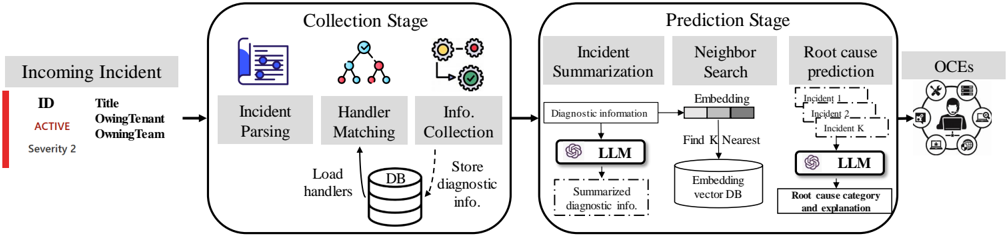
Ensuring the reliability and availability of cloud services necessitates efficient root cause analysis (RCA) for cloud incidents. Traditional RCA methods, which rely on manual investigations of data sources such as logs and traces, are often laborious, error-prone, and challenging for on-call engineers. In this paper, we introduce RCACopilot, an innovative on-call system empowered by the large language model for automating RCA of cloud incidents. RCACopilot matches incoming incidents to corresponding incident handlers based on their alert types, aggregates the critical runtime diagnostic information, predicts the incident's root cause category, and provides an explanatory narrative. We evaluate RCACopilot using a real-world dataset consisting of a year's worth of incidents from Microsoft. Our evaluation demonstrates that RCACopilot achieves RCA accuracy up to 0.766. Furthermore, the diagnostic information collection component of RCACopilot has been successfully in use at Microsoft for over four years.
Overview
The claims and statistics of this paper haven’t been checked yet.
Free: it reads the open-access text and checks the first 5 claims that cite a source we can check. Create a free account to check every claim.
Integrity signals
Registry
Cites
Statistics
Figures
Verification
Claims the paper makes
The claims and statistics of this paper haven’t been checked yet.
Free: it reads the open-access text and checks the first 5 claims that cite a source we can check. Create a free account to check every claim.
Claims other papers make about this one
Each is checked against this paper’s own text: does it say what the citing paper says it does?
The source backs part of the claim, not all of it — or backs it for a different population, condition or comparison.
In the citing paper
“However, these models are not aware of the workflow of cloud RCA, leaving them simply analytical tools.”
From RCAgent: Cloud Root Cause Analysis by Autonomous Agents with Tool-Augmented Large Language Models (2024) · cites this paper as [10]
Experimental — accuracy not yet measuredIn the citing paper
“In incident management, this helps in developing systems capable of recommending investigative queries, summarising monitoring signals, and identifying potential root causes [7], [8], [10].”
From Large language models for agentic NetOps and AIOps: Architectures, evaluation, and safety (2027) · cites this paper as [10]
In the citing paper
“This boundary matters because security and governance depend on the tools an agent can invoke, the permissions attached to those tools, and the checks enforced before action [18], [8], [10].”
From Large language models for agentic NetOps and AIOps: Architectures, evaluation, and safety (2027) · cites this paper as [10]
In the citing paper
“There is a latent system state x t (network and service state), operators and automation observe it only through tool-mediated observations o t (logs, metrics, traces, reachability checks), and they apply actions a t (changes, mitigations) that alter future state [1], [10], [8], [18].”
From Large language models for agentic NetOps and AIOps: Architectures, evaluation, and safety (2027) · cites this paper as [10]
In the citing paper
“Recent operational assistants therefore collect and structure diagnostic artefacts before asking the model to draw conclusions [10], [8], [9], [7], [86].”
From Large language models for agentic NetOps and AIOps: Architectures, evaluation, and safety (2027) · cites this paper as [10]
12 more claims about this paper
Create a free account to see every claim other papers make about this one.
Self-check
Percentages, sums and reported differences re-computed from the paper’s own numbers.
The self-check needs the paper’s full text.
Citations
Cites
Language Models are Few-Shot Learners
Brown, T. B., Mann, B., Ryder, N., Subbiah, M., Kaplan, J., Dhariwal, P., Neelakantan, A., Shyam, P., Sastry, G., Askell, A., et al. (2020) · arXiv · doi:10.48550/arxiv.2005.14165 · Cited by 23,372
Chain-Of-Thought Prompting Elicits Reasoning in Large Language Models
Wei, J., Wang, X., Schuurmans, D., Bosma, M., Ichter, B., Xia, F., Chi, E., Le, Q. V., & Zhou, D. (2022) · Advances in Neural Information Processing Systems 35 · doi:10.52202/068431-1800 · Cited by 4,505
Chain-of-Thought Prompting Elicits Reasoning in Large Language Models
Wei, J., Wang, X., Schuurmans, D., Bosma, M., Ichter, B., Xia, F., Chi, E., Le, Q., & Zhou, D. (2022) · arXiv · doi:10.48550/arxiv.2201.11903 · Cited by 4,263 · cited 1×
“The recent advent and success of large language models (LLMs) in performing complex tasks [21, 28, 46], suggests a promising avenue for enhancing RCA.”
BackgroundIEEE Transactions on Knowledge and Data Engineering
(2023) · IEEE Transactions on Knowledge and Data Engineering · doi:10.1109/tkde.69 · Cited by 1,671
Evaluating Large Language Models Trained on Code
Chen, M., Tworek, J., Jun, H., Yuan, Q., Pinto, H. P. D. O., Kaplan, J., Edwards, H., Burda, Y., Joseph, N., Brockman, G., et al. (2021) · arXiv · doi:10.48550/arxiv.2107.03374 · Cited by 1,436 · cited 1×
“The rapid advancements in natural language processing and machine learning have led to the development of powerful LLMs, which are reported to be effective at various down-stream tasks with zero-shot and few-shot learning [5, 11, 28].”
Background2020 IEEE Symposium on Security and Privacy (SP)
(2020) · doi:10.1109/sp40000.2020 · Cited by 423
SHADEWATCHER: Recommendation-guided Cyber Threat Analysis using System Audit Records
Zengy, J., Wang, X., Liu, J., Chen, Y., Liang, Z., Chua, T.-S., & Chua, Z. L. (2022) · 2022 IEEE Symposium on Security and Privacy (SP) · doi:10.1109/sp46214.2022.9833669 · Cited by 288 · cited 1×
“A typical incident life-cycle consists of four stages: (1) Detection [37, 51, 52]: When an anomalous system behavior is observed, an alert is raised by monitors or users of the service (internal engineers or exter-nal customers).”
BackgroundSelf-citationStudying the Usage of Text-To-Text Transfer Transformer to Support Code-Related Tasks
Mastropaolo, A., Scalabrino, S., Cooper, N., Nader Palacio, D., Poshyvanyk, D., Oliveto, R., & Bavota, G. (2021) · 2021 IEEE/ACM 43rd International Conference on Software Engineering (ICSE) · doi:10.1109/icse43902.2021.00041 · Cited by 247 · cited 3×
“LLMs have shown potential for automatic summarization [40].”
BackgroundVulRepair: a T5-based automated software vulnerability repair
Fu, M., Tantithamthavorn, C., Le, T., Nguyen, V., & Phung, D. (2022) · Proceedings of the 30th ACM Joint European Software Engineering Conference and Symposium on the Foundations of Software Engineering · doi:10.1145/3540250.3549098 · Cited by 207 · cited 2×
“VulRepair [13] also fine-tune T5 on vulnerability repairs datasets to automatically propose vulnerability fixes.”
BackgroundMicroHECL: High-Efficient Root Cause Localization in Large-Scale Microservice Systems
Liu, D., He, C., Peng, X., Lin, F., Zhang, C., Gong, S., Li, Z., Ou, J., & Wu, Z. (2021) · 2021 IEEE/ACM 43rd International Conference on Software Engineering: Software Engineering in Practice (ICSE-SEIP) · doi:10.1109/icse-seip52600.2021.00043 · Cited by 192 · cited 1×
“Moreover, some techniques utilize trace to locate the faulty service [26, 29, 48, 54].”
Self-citation
Research works printed but not linked: 9
- Chen, Y., Sun, X., Nath, S., Yang, Z., and Xu, T. Push-Button Re- liability Testing for Cloud-Backed Applications with Rainmaker. In Proceedings of the 20th USENIX Symposium on Networked Systems De- sign and Implementation (NSDI'23) (2023).
- Lou, C., Chen, C., Huang, P., Dang, Y., Qin, S., Yang, X., Li, X., Lin, Q., and Chintalapati, M. RESIN: A holistic service for dealing with mem- ory leaks in production cloud infrastructure. In Proceedings of the 16th USENIX Symposium on Operating Systems Design and Implementation (OSDI'22) (2022).
- Lou, C., Huang, P., and Smith, S. Understanding, detecting and local- izing partial failures in large system software. In Proceedings of the 17th USENIX Symposium on Networked Systems Design and Implementation (NSDI'20) (2020).
- Ma, M., Zhang, S., Chen, J., Xu, J., Li, H., Lin, Y., Nie, X., Zhou, B., Wang, Y., and Pei, D. Jump-starting multivariate time series anomaly detection for online service systems. In 2021 USENIX Annual Technical Conference (ATC'21) (2021).
- Sun, X., Cheng, R., Chen, J., Ang, E., Legunsen, O., and Xu, T. Testing Configuration Changes in Context to Prevent Production Failures. In Proceedings of the 14th USENIX Symposium on Operating Systems Design and Implementation (OSDI'20) (2020).
- Sun, X., Luo, W., Gu, J. T., Ganesan, A., Alagappan, R., Gasch, M., Suresh, L., and Xu, T. Automatic Reliability Testing for Cluster Management Controllers. In Proceedings of the 16th USENIX Symposium on Operating Systems Design and Implementation (OSDI'22) (2022).
- Wu, Y., Chen, A., Haeberlen, A., Zhou, W., and Loo, B. T. Automated bug removal for software-defined networks. In Proceedings of the 14th USENIX Symposium on Networked Systems Design and Implementation (NSDI'17) (2017).
- Yuan, D., Luo, Y., Zhuang, X., Rodrigues, G. R., Zhao, X., Zhang, Y., Jain, P., and Stumm, M. Simple testing can prevent most critical failures: An analysis of production failures in distributed data-intensive systems. In Proceedings of the 12th USENIX Symposium on Operating Systems Design and Implementation (OSDI'14) (2014).
- Zeng, Z., Zhang, Y., Xu, Y., Ma, M., Qiao, B., Zou, W., Chen, Q., Zhang, M., Zhang, X., Zhang, H., Gao, X., Fan, H., Rajmohan, S., Lin, Q., and Zhang, D. Traceark: Towards actionable performance anomaly alerting for online service systems. In To appear in Proc. of ICSE (2023). · DOI · Paper page
Cited by
Items 301–400 of 442
Transformer substation network disconnection prediction via semantic reasoning with causal modeling
Ren, J., Yao, X., & Chen, H. (2026) · Computer Science and Information Systems · doi:10.2298/csis251022018r
Representation-Aware Root Cause Analysis with Large Language Models (Position Paper)
Wen, Y., Panahandeh, M., Chouchen, M., & Hamou‐Lhadj, A. (2026) · ACM/SPEC International Conference on Performance Engineering (ICPE) · doi:10.1145/3777911.3801108
Proactive Change Risk Detection in Production Cloud Systems: ByteDance’s Experience
Liu, J., Li, Y., Zhang, T., Chen, B., He, X., Jiang, Z., Zhang, H., Wu, G., & Li, Y. (2026) · European Conference on Computer Systems · doi:10.1145/3767295.3803614
FlyCatcher: Neural Inference of Runtime Checkers from TestsPreprint
Souza, B., Lou, C., Nath, S., & Pradel, M. (2026) · arXiv (Cornell University) · doi:10.48550/arxiv.2604.22028
“The use of LLMs to reason about software and generate code has rapidly become a popular trend among researchers and developers [8, 13, 52, 56, 63, 64].”
LLM-based AIOps via Log Prioritization in Air-Gapped Systems
송상희, & Kim, H. (2026) · Workshop on Machine Learning and Systems (EuroMLSys) · doi:10.1145/3805621.3807626
The Impact of Modern AI on Software Development: A Systematic Literature Review
Bensaid, M., Achbari, M., Younesse, O., & Ziti, S. (2026) · International Journal of Advanced Computer Science and Applications · doi:10.14569/ijacsa.2026.0170478
“…multi-agent (SRE) [61] Operations Maintenance assistance Ontology-based RAG [62] Operations Incident mitigation Fine-tuned Code-davinci [63] Operations Automated root cause analysis GPT-4 workflow-driven (RCACopilot) [64] Operations Log parsing Flan-T5 and LLaMA few-shot [65]…”
Kasinadhuni, B. (2026) · International Journal of AI BigData Computational and Management Studies · doi:10.63282/3050-9416.ijaibdcms-v7i2p126
From Bug Report to Pull Request: An Autonomous Agent Pipeline for Production Issue Resolution
Milev, R., Kanagala, U., & Cholette, C. (2026) · ACM Conference on AI and Agentic Systems (CAIS) · doi:10.1145/3786335.3813187
PAGER: Proactive Monitoring Agent for Enterprise AI Assistant
Ayala, J. F. G., Dutta, S., Pujar, P., Harsha, S. S., Luo, D., Vasudeva, N., Saha, B., Baruah, P., & Li, Y. (2026) · ACM Conference on AI and Agentic Systems (CAIS) · doi:10.1145/3786335.3813212
FAME: Failure-Aware Mixture-of-Experts for Message-Level Log Anomaly DetectionPreprint
Wang, H., Huang, Z., Tian, Y., Dzeparoska, K., Jacobsen, H., & León-García, A. (2026) · arXiv (Cornell University) · doi:10.48550/arxiv.2605.22779 · Cited by 1
“LLMs have been applied to parsing through LUNAR [38] and CSLParser [39], to prompt-based log anomaly classification through LogGPT [12], and to root-cause analysis through RCACopilot [13], AetherLog [14], LogKG [40], COMET [41], and causal approaches [42].”
Marques, M., Bastos, C. A. M., & de Sousa, C. (2026) · arXiv (Cornell University) · doi:10.48550/arxiv.2605.24683
“Accurate physical topology is the essential precondition for automated root-cause analysis in AIOps environments [1], [2].”
Root-Cause Diagnosis with Remediation Recommendations for ETL Pipelines via LLM-Based Reasoning
Vijaykeerthy, D., Rajmohan, C., Agarwal, A., Saha, A., Mehta, S., Adhoute, E., Vahav, N., Porokhnia, T., Dąbrowski, A., Asher, B. E. A., et al. (2026) · ACM SIGMOD International Conference on Management of Data (SIGMOD) · doi:10.1145/3788853.3801613
Disaster Recovery and Business Continuity for IIoT-Cloud Services
Olasehan, O. A. (2026) · IGI Global eBooks · doi:10.4018/979-8-3373-4581-9.ch001
Gu, Y., Zhang, J., & Du, Y. (2026) · Electronics · doi:10.3390/electronics15112359
“…diagnostic processes and fur-nishing recommendations via comprehensive data analysis has been substantiated across diverse domains, notably yielding impressive outcomes in medical diagnostic support [21], cloud incident root cause analysis [22], and sensor-based industrial fault diagnosis [23].”
Argo AI: A Multi-Agentic RAG System for GitOps
Soham, T., & S., R. B. (2026) · International Research Journal of Computer Science · doi:10.26562/irjcs.2026.v1305.04
Ekka: Automated Diagnosis of Silent Errors in LLM InferencePreprint
Gu, Y., Zhang, Z., Zhu, S., Fu, X., (4002), J. W., Wang, Y., & Kasikci, B. (2026) · arXiv (Cornell University) · doi:10.48550/arxiv.2606.04594
Auditable Graph-Guided Root Cause Analysis for Kubernetes IncidentsPreprint
Kuvshinova, A., & Jin, S. (2026) · arXiv (Cornell University) · doi:10.48550/arxiv.2606.08590
“RCACopilot applies LLMs to cloud incident RCA through alert handling, evidence aggregation, root-cause category prediction, and narrative generation [7]; RCAgent studies autonomous tool use for cloud RCA with context management and trajectory stabilization [8]; COCA uses code knowledge to…”
Zafar, T. (2026) · Iconic Research and Engineering Journals · doi:10.64388/irev9i12-1718609
Wang, D., Li, T., Wang, S., Lin, B., Zhang, Z., Lei, Y., & Mao, X. (2026) · Research Square · doi:10.21203/rs.3.rs-9541120/v1
Wang, X., He, X., Cui, X., & Guo, X. S. (2026) · China Aerospace Information Technology Conference (CAIT) · doi:10.1109/cait70489.2026.11553922
“Recent studies have explored LLM-based agents for cloud fault diagnosis [6], [7], yet most approaches treat each fault as an independent episode without accumulating reusable diagnostic knowledge, leading to redundant exploration across similar fault patterns.”
Generative AI for Anomaly Diagnosis in 5G NR Scheduling Logs
Li, H. (2026) · Lund University Publications Student Papers (Lund University)
Root Cause Analysis for Wireless Networks Using Causal Knowledge Graphs and a Large Language Model
Kikuzuki, T., Wada, A., Okawa, Y., & Ogawa, M. (2026) · IEEE Wireless Communications and Networking Conference · doi:10.1109/wcnc65185.2026.11555431
“Consequently, several companies have begun applying these big-data-driven RCA methods [10], [12], [13].”
InfluentialA REFERENCE ARCHITECTURE FOR LLM-POWERED INCIDENT RESPONSE IN REGULATED FINANCIAL SERVICES
Murugan, G. K. (2026) · INTERNATIONAL JOURNAL OF ADVANCED RESEARCH IN ENGINEERING & TECHNOLOGY · doi:10.34218/ijaret_17_03_001
GLLM4FD: Graph-Enhanced Large Language Model Framework for Industrial Equipment Fault Diagnosis
Zhang, J. C., Wang, H., Jia, Z., & Ren, L. (2026) · International Symposium on Autonomous Systems (ISAS) · doi:10.1109/icaisisas68969.2026.11567824
“Representative work such as RCA Copilot aggregates cloud-incident information and uses an LLM to generate root-cause categories and explanatory text, demonstrating the feasibility of automated RCA [4].”
Enhancing Systematic Problem-Solving with Large Language Models
Chytraeus, J., Wang, Y., & Metternich, J. (2026) · Lecture notes in production engineering · doi:10.1007/978-3-032-19524-1_72
Unfulfilled Promises: LLM-Based Detection of OS Compatibility Issues in Infrastructure as Code
Drosos, G.-P., Alexopoulos, G., Sotiropoulos, T., Mitropoulos, D., & Su, Z. (2026) · Proceedings of the ACM on software engineering. · doi:10.1145/3797097
“Recent work [12, 41] also demonstrates that LLMs effectively detect misconfigurations in declarative configuration files, analogous to declarative module invocations in our setting.”
PRISM: Cross-Layer Observability Framework for Mobile Core Networks
Samarakoon, S., Mohan, N., & Kuipers, F. A. (2026) · IFIP Networking Conference (IFIP Networking) · doi:10.23919/ifipnetworking70592.2026.11579127
“Nevertheless, they typically remain centered on the service layer, using application-or ]–[24].”
MobileLogZip: Lightweight LLM-Driven Tiered Log Compression for Mobile Computing
Zhang, Y., Yuan, J., Yue, L., & Tian, W. (2026) · Lecture notes of the Institute for Computer Sciences, Social Informatics and Telecommunications Engineering · doi:10.1007/978-3-032-22500-9_4
Prototype of a Generative AI–Based Analogy Application for Human Error Case Analysis
Fujiwara, A., Banno, Y., & Okada, Y. (2026) · AHFE international · doi:10.54941/ahfe1007936
Can Large Language Models Generate Observability-Aware Code?Preprint
Tao, Y., Zhang, H., Gao, P., Ma, M., Fan, Z., Kang, Y., Zhang, J., Qin, S., Li, L., Lin, Q., et al. (2026) · arXiv (Cornell University) · doi:10.48550/arxiv.2607.05785
“We do not require logs to fully diagnose root causes or support complete Root Cause Analysis [15], [16], [17], [18], [19], [20] (RCA).”
Self-citationLog-Insight: Automating Microservice Incident Diagnosis via Neuro-Symbolic Log AnalysisPreprint
Garcia-Hernandez, C., Abdali, A., Wu, G., Wang, M.-Z., Shen, F., Pang, Z., & Zhang, Y. (2026) · arXiv (Cornell University) · doi:10.48550/arxiv.2607.08529
LLM-Assisted PDDL Modeling for Reliable Network Configuration Synthesis
Fukuda, N., Ito, Y., & Nozue, H. (2026) · International Conference on Communications · doi:10.1109/icc59461.2026.11587622
“For instance, PROSPER [6], RCACopilot [7], and NetPress [8] apply LLMs to protocol understanding, cloud incident analysis, and autonomous fault remediation, respectively.”
FixItFlow: Automated Troubleshooting Guide Generation from Cloud IncidentsPreprint
Unnikrishnan, S., Walia, J. S., Goel, D., & Ghosh, S. K. (2026) · arXiv (Cornell University) · doi:10.48550/arxiv.2607.13035
“In practice, delayed detection, misrouted ownership, and cross-service dependencies complicate root-cause analysis [4–6 , 8].”
Self-citationZhang, S., Wu, Y., Ren, J., Sun, Y., Gu, W., Zhang, C., Li, L., Lin, Q., Zhang, D., Rajmohan, S., et al. (2026) · ACM Joint European Software Engineering Conference and Symposium on the Foundations of Software Engineering (ESEC/FSE) · doi:10.1145/3803437.3805241
Self-citationAn Agentic Framework for Triaging Incidents in Production Cloud Infrastructure
Yao, Y., Jiang, Y., Ma, M., Vaidya, M., Deng, J., Hu, Y. C., Bansal, C., Li, Z., & Chintalapati, M. (2026) · ACM Joint European Software Engineering Conference and Symposium on the Foundations of Software Engineering (ESEC/FSE) · doi:10.1145/3803437.3805228
Self-citationRedesigning the vendor performance evaluation system in PT PLN (Persero)
Novananda, C., & Partiwi, S. G. (2026) · Procedia Computer Science · doi:10.1016/j.procs.2026.07.125
TSGen: Automated Troubleshooting Guide Generation
Xiao, Y., Zhang, H., Genkin, D., Zhang, C., Wang, R., Bansal, C., Ranganathan, B., Rajmohan, S., & Ma, M. (2026) · ACM Joint European Software Engineering Conference and Symposium on the Foundations of Software Engineering (ESEC/FSE) · doi:10.1145/3803437.3805239
“Notable work includes mining knowledge graphs from cloud incidents [24], neural extraction of incident-related entities [23], and LLM-based root cause analysis [5].”
Self-citationLiao, M. (2025) · Stout in Computer Science and Technology Studies · doi:10.61424/zngee941
KernelDiag: Agent-Based Root Cause Diagnosis for Kernel CrashesPreprint
Wang, W., Wang, Z., Wang, D., Wang, H., & Chen, J. (2026) · arXiv (Cornell University) · doi:10.48550/arxiv.2607.17722
“Early studies mainly treated RCA as a text generation or classification task, where an LLM predicts the root-cause category, faulty component, or mitigation strategy from incident descriptions and historical cases [10], [17], [76], [77].”
Towards Autonomous O&M: An Agent Framework for Cloud Infrastructure Incident Management
Dou, R., Chen, B., Wang, Y., Wang, Q., Cui, T., Xia, X., Zhu, D., Li, Q., Ma, Y., & Li, J. (2026) · IEEE International Conference on Electronic Technology, Communication and Information (ICETCI) · doi:10.1109/icetci68937.2026.11610831
“Representative works include MonitorAssistant [18], RCACopilot [19], and BIAN [20], demonstrating that LLMs become substantially more powerful when coupled with domain knowledge such as network topology.”
ARBITER: Guarded Agentic Control for SLO-Oriented Kubernetes RemediationPreprint
Habibi, P., & León-García, A. (2026) · arXiv (Cornell University) · doi:10.48550/arxiv.2607.19182
“LLM-based incident recommenders [15], RCACopilot [16], RCAgent [17], and AIOpsLab [18] show that language models can synthesize heterogeneous operational evidence and invoke tools over realistic cloud tasks.”
He, Y., Yang, Y., Rui, L., & Wu, C. (2026) · IEEE Transactions on Cognitive Communications and Networking · doi:10.1109/tccn.2026.3715900
“Existing pipelines range from retrieval-augmented generation in RCACOPILOT [29] to full-stack frameworks like D-Bot [30] and MicroRCA-Agent [31] that leverage multimodal data with structured prompting.”
Leveraging Resolved Incident History for LLM-Assisted Software Bug DiagnosisPreprint
Guan, B., Xu, H., & Rogers, J. (2026) · arXiv (Cornell University) · doi:10.48550/arxiv.2607.21911
“Recent AIOps systems retrieve historical incidents for diagnosis [17], [18], [19], [20].”
ConfigTransLE: Large Language Models Enhanced Network Configuration Translation
Li, F., Zheng, N., Liang, B., Yang, Y., Liu, C., Gao, C., Wang, X., & Cao, J. (2026) · IEEE Transactions on Networking · doi:10.1109/ton.2026.3716703
“…processing (NLP) tasks such as translation [7], summarization [8], and named entity recognition [9], as well as their unique contributions in network operations [10], [11], particularly in network configuration generation [12], [13], we have thus attempted to employ LLMs to accomplish this task.”
Lin, K. J., Wu, M., Lian, Y., & Wen, C. (2026) · International Conference on Artificial Intelligence, Big Data and Algorithms (CAIBDA) · doi:10.1109/caibda70336.2026.11621372
Potluri, M. (2026) · Journal of Information Systems Engineering & Management · doi:10.52783/jisem.v11i3s.15185
Cybersecurity Detection Classification with Reasoning-enabled Language ModelsPreprint
Khanna, A., Nandan, M., Popa, C. V., Roig, J. S. P., Bolocan, D., Vasilie, L., Apostu, A., Helwig, C., Găman, M., Brautbar, M., et al. (2026) · arXiv (Cornell University) · doi:10.48550/arxiv.2607.28460 · Cited by 1
“The most mature LLM triage systems instead target IT and cloud operations: RCACopilot routes incidents and predicts root-cause categories with explanatory narratives (Chen et al. 2023), and PACE-LM augments such predictions with calibrated confidence estimates (Zhang et al. 2023).”
Principles of building observability systems in cloud-based applications using OpenTelemetry
Yakhin, S. (2026) · Journal of Electrical Systems and Information Technology · doi:10.1186/s43067-026-00385-3
“A representative system trained on a year of real incidents from a large cloud provider predicts the root cause category and produces a human-readable explanation, reaching a reported accuracy of up to 0.766 on that dataset [3].”
InfluentialZhang, T., Zheng, C., Wang, S., Zhang, Y., Shi, L., Jin, Y., Wang, X., & Qiu, M. (2026) · arXiv (Cornell University) · doi:10.48550/arxiv.2608.01538
“RCACopilot [196], although focused on cloud incidents rather than network-specific OAM, uses LLM-based reasoning over collected diagnostic information to predict a root-cause category and produce an explanatory report for human responders.”
Self-citationJia, Z., Das, S., Sewall, J. D., Bhuyan, L., Shamis, P., & Wong, D. (2026) · IEEE International Symposium on Workload Characterization · doi:10.1109/iiswc71020.2026.00054
Garousi, V. (2026) · SSRN Electronic Journal · doi:10.2139/ssrn.7228950
CausalDX: Diagnosing Long-Tail and Cascading Cloud Incidents With LLM-Guided Causal Reasoning
Chang, Z., Wu, Y.-J., Feng, H., Li, Y., Fang, Y., Liu, L., Jin, Z., Huang, D.-Q., Yang, X., Chen, P., et al. (2026) · IEEE Transactions on Knowledge and Data Engineering · doi:10.1109/tkde.2026.3722256
“This diagnostic burden is further exacerbated by the increasing complexity of modern cloud systems [6], [19], [20].”
InfluentialWu, M., Lin, K. J., Lian, Y., & Wen, C. (2026) · International Symposium on Advances in Electrical, Electronics and Computer Engineering (ISAEECE) · doi:10.1109/isaeece70502.2026.11635268
“RCACopilot and RCAgent further apply LLMs or tool-augmented agents to cloud incident root cause analysis [4], [5], while Oasis improves outage understanding through LLM-based assessment and summarization [6].”
SiriusDeliver: Automating Data Warehouse Delivery at TencentPreprint
Xie, H., Zhou, X., Yang, J., Shen, S., Wang, Z., Zheng, Y., Xu, T., Shi, Y., Zong, Z., Li, Y., et al. (2026) · arXiv (Cornell University) · doi:10.48550/arxiv.2608.09185
Self-citationPromQLAgent: A Text-to-PromQL Framework Based on Dual Knowledge Base Retrieval and Adaptive Repair
Deng, C., Guo, Y., Yan, L., Ma, J., Gao, D., & Wang, Y. (2026) · International Conference on Artificial Intelligence and Big Data (ICAIBD) · doi:10.1109/icaibd69640.2026.11637335
“LLMs have been applied in AIOps for root cause localization [16] [17], log parsing, and incident mitigation [18].”
Gothi, S. R. (2026) · International Journal of Intelligent Systems and Applications in Engineering · doi:10.5281/zenodo.22002634
Kang, J., Zhang, X., Zhai, Y., Feng, D., Ding, B., & Wang, H. (2026) · IEEE International Conference on Joint Cloud Computing (JCC) · doi:10.1109/jcc72984.2026.00052
“Recent LLM-based methods improve flexibility by processing semi-structured operational data and supporting tool-augmented reasoning [15], [19]–[21].”
Self-citationLogHound: Coverage-Aware Path Reconstruction for Log-Based Fault Localization
Lin, Z., Feng, Y., Chen, J., Zhu, T., Chen, G., & Liu, J. (2026) · IEEE International Conference on Joint Cloud Computing (JCC) · doi:10.1109/jcc72984.2026.00026
“For baselines, we consider RCACopilot[31] and ReAct[32], which share a comparable workflow and exploit historical bug reports to assist in localization and summarization.”
AI-Driven Root Cause Analysis In Real-Time Distributed Systems
Vangapelli, S. (2026) · International Journal of Artificial Intelligence and Machine Learning · doi:10.51483/ijaiml.6.7s.2026.202-209
SOPSmith: Forging Executable SOPs for LLM-Driven GPU Cluster Network Diagnosis
Yu, G., Sun, X., Huang, Z., Shi, Y., Xiao, X., Song, Y., Li, X., Lyu, B., Liu, Z., & He, Q. (2026) · International Workshop on Quality of Service · doi:10.1109/iwqos70441.2026.11661084
“LLM-based agents, in contrast, promise to absorb heterogeneous evidence through open-ended reasoning [5], [6], but their unstructured exploration is hard to reproduce and audit and gives no machine-verifiable guarantee that the actions taken were correct.”
Khan, R. F. (2026) · Veredas do Direito Direito Ambiental e Desenvolvimento Sustentável · doi:10.18623/rvd.v23.8136
Zhang, M., Miranda, E., Baynes, B., Jain, S., Chen, W., He, T., & Borodavkin, S. (2026) · arXiv (Cornell University) · doi:10.48550/arxiv.2608.26332
Five Whys as an Epistemic-Honesty Scaffold for Multi-Agent LLM Analysis of Industrial Time Series
Ochi, Y., & Uchiyama, Y. (2026) · International Journal of Advanced Computer Science and Applications · doi:10.14569/ijacsa.2026.0170803
“A line of systems applies LLMs to root-cause analysis, typically to generate a most-likely root cause for an incident — RCACopilot reports high rates of plausible root causes [16] — while a recent benchmark finds that even strong models struggle to locate true root causes [17].”
Shi, B., Zhang, S., Wang, J., Hao, B., Shao, M., Yu, L., Gu, W., Sun, Y., Xia, S., Zhao, Y., et al. (2026) · ACM Transactions on Software Engineering and Methodology · doi:10.1145/3840387
Zhang, Y., Zhang, J., Wang, J., & Zhang, S. (2026) · Sensors · doi:10.3390/s26175571
“The standard deviation interval further characterizes the degree of fluctuation of the metric during the fault process [27].”
Towards Agentic Cloud Engineering: Graph and Loop Engineering with a Zero-Trust Agent HarnessPreprint
Sakhinana, S. S., & Runkana, V. (2026) · arXiv (Cornell University) · doi:10.48550/arxiv.2609.00050
Tomas, P. R., Dias, T., Neto, M., Rosa, L., Proença, J., Cruz, T., & Cordeiro, L. (2026) · IEEE/IFIP Network Operations and Management Symposium (NOMS) · doi:10.1109/noms69089.2026.11668309
“More recently, LLMs have been incorporated into cloud incident management pipelines to automate diagnostic summarisation and root cause categorisation, as in RCACopilot [8], or extended into tool-augmented agents capable of dynamically querying logs and diagnostic such as RCAgent [9].”
Design and Practice of an AIOps Framework for Large-Scale Campus Networks
Lai, Q., Liu, W., Chen, J., Fu, Z., & Ma, H. (2026) · IEEE/IFIP Network Operations and Management Symposium (NOMS) · doi:10.1109/noms69089.2026.11668372
“More advanced systems like RCAgent [17] and RCACopilot [18] integrate tool usage for cloud RCA.”
Arora, A. (2026) · International Journal of Intelligent Systems and Applications in Engineering · doi:10.5281/zenodo.22259084
Davineni, P. (2026) · arXiv (Cornell University) · doi:10.48550/arxiv.2609.00227
“LLMs are used for incident root-cause analysis and mitigation recommendation [5, 6] and surveyed for failure management [9]; these systems propose fixes but stop short of a guaranteed-faithful GitOps edit.”
Ren, F., Zhang, Y., & Sun, C. (2026) · Electronics · doi:10.3390/electronics15174001
Reliable Orchestration of Specialized Multi-Agents for Cloud Incident Diagnosis
Huang, H., Lyu, J., Lai, S., Jiang, Z., Chen, P., & Lyu, M. R.-T. (2026) · IEEE International Conference on Web Services (ICWS) · doi:10.1109/icws72778.2026.00187
“LLMs have been applied to cloud diagnostics along several axes: domain-adapted fine-tuning [29], [30], retrieval-augmented prompting with historical incident corpora [7], [31], [32], and tool-augmented agentic workflows [3], [9].”
InfluentialEntropy-Guided Telemetry Compression for LLM-Based RCA: An Industrial Pilot on Log Data
García-Hernández, C. F., Abdali, A., Wu, G., Pang, Z., Shen, F., Zhang, Y., & Wang, M. (2026) · Lecture notes in computer science · doi:10.1007/978-3-032-37685-5_51
SCALER: LLM-Based Cross-Modal Alignment for Microservice Root Cause Analysis
Yang, S., Wang, G., Ming, Z., He, D., Cui, L., Yu, X., & Zhou, X. (2026) · IEEE International Conference on Web Services (ICWS) · doi:10.1109/icws72778.2026.00101
“More recently, LLM-based multi-modal RCA frameworks have been proposed to better exploit textual semantics together with other telemetry data [8], [9], [14], [15].”
InfluentialJindal, P. (2026) · International Journal of Artificial Intelligence and Machine Learning · doi:10.51483/ijaiml.6.9s.2026.833-841
Li, Z. (2026) · SSRN Electronic Journal · doi:10.2139/ssrn.7438214
Multiagent Incident Response Planning with Code Models
Hammar, K., Alpcan, T., & Lupu, E. (2026) · Lecture notes in computer science · doi:10.1007/978-3-032-40367-4_21
Supporting Root Cause Analysis Decision in Cloud Microservices Using Hybrid Ai Techniques
Elambooranan, G., Sood, P., Zaman, M. H. U., Singh, K., & Liu, Y. (2026) · International Conference on Cloud Computing and Big Data Analytics (ICCCBDA) · doi:10.1109/icccbda69573.2026.11676559
“C. Retrieval-Augmented Generation for RCA Yinfang Chen et al. [5] developed RCACopilot, an LLM-powered system that automates RCA by aggregating diagnostic information, predicting root cause categories, and providing explanatory narratives.”
Sobie, C., Scheuermann, A. G., Burke, T., Meik, G., Re'em, S., & Zatarain, C. (2026) · Journal of Surface Mount Technology · doi:10.37665/wj4ey345
FunPilot: Runtime Performance Diagnosis and Remediation for Serverless Applications with LLMs
Lin, C., Wang, Y., & Shahrad, M. (2026) · ACM SIGOPS Asia-Pacific Workshop on Systems (APSys) · doi:10.1145/3838177.3841720
Supporting Industrial Test-Failure Analysis with LLM-Based Systems: An Experience ReportPreprint
Jansson, E., Strandberg, P. E., Sörensen, T., Enoiu, E. P., & Afzal, W. (2026) · arXiv (Cornell University) · doi:10.48550/arxiv.2609.21843
“RCACopilot collects diagnostic information before generating root-cause predictions and explanations [5], while ReAct-style agents and RCA-gent retrieve evidence dynamically from external diagnostic services [19, 25].”
MARCA: Multi-Agent Root Cause Analysis with Multi-Modal DataPreprint
Wang, Y. (2026) · Research Square · doi:10.21203/rs.3.rs-10852927/v1
PALM: Protocol-Aware PCIe Link Fault Prediction for Large-Scale GPU Clusters
Li, Y., Li, Z., Zhang, Z., Li, M., He, J., Xu, F., Tang, F., & Li, K. (2026) · IEEE Transactions on Computers · doi:10.1109/tc.2026.3733250
Backstitch: Restoring Request Causality Across a Production Microservice FleetPreprint
Dang, Z., Wu, Q., Xu, H., Wang, T., Ling, Y., Chen, W., & Luo, G. (2026) · arXiv (Cornell University) · doi:10.48550/arxiv.2609.27538
“Diagnosis and performance-analysis systems [13, 19, 27, 31, 35, 58, 66, 82, 84] depend on accurate causal structure; Backstitch repairs the propagation that supplies it.”
Bhansali, D. (2026) · International Journal of Computer Science and Engineering · doi:10.14445/23488387/ijcse-v13i8p102
“One possible automated root cause resolution system described by Chen et al. [9] makes use of the LLMs to analyze cloud events based on data in the operational logs, telemetry, and past experience.”
DepTwin: A Digital Twin-Based Framework to Manage Deployments in Cloud
Ahlawat, S., & Sharma, K. (2026) · Electronics · doi:10.3390/electronics15194443
“With large language models now available, Ahmed et al. [25] showed that a fi ne-tuned model could recommend a root cause and mitigate cloud incidents, while Chen et al. [26] applied RCACopilot in Microsoft to align incidents with their handlers and predict the root-cause categories in production.”
Closed-Loop LLM-Driven Self-Healing for Enterprise Data Pipelines
Sivaraman, M. K. (2026) · Technology and Innovation Conference (TIC) · doi:10.1109/tic68483.2026.11703022
SRE-Marathon: A Continuous, Change-Driven Benchmark for Autonomous Site Reliability AgentsPreprint
Tian, Y., Bai, Y., He, Y., Chong, Z., Gao, Y., Li, Y., & Jacobsen, H. (2026) · arXiv (Cornell University) · doi:10.48550/arxiv.2609.33023
“…generation (Kuang et al., 2024; Jiang et al., 2025; Gu et al., 2025; Wang et al., 2024b), root-cause analysis from tickets, telemetry, and code (Chen et al., 2024; Jiang et al., 2024; Wang et al., 2024a; Roy et al., 2024; Pei et al., 2025; Tian et al., 2026), or mitigation from runbooks (An et…”
Pan, S., Ravva, P., Williams, W., Barberan, C., Sahoo, N., Min, Z., Gross, D., & Shaffer, I. (2026) · arXiv (Cornell University) · doi:10.48550/arxiv.2609.35780
OBSERVE-ML: An Auditable Decision Layer for Trustworthy Production Machine Learning Operations
Vytla, S. K. (2026) · Engineering Technology & Applied Science Research · doi:10.48084/etasr.21503
“AIOps and microservice root-cause-analysis studies distinguish these tasks [12, 13], while LLM-based incident analysis and database diagnosis can retrieve, rank, and summarize evidence [14-16].”
Lim, H. (2026) · Journal of Software Forensics · doi:10.29056/jsf.2026.09.16
The application of Large Language Model in system log analysis: A literature review
Chen, Y., li, W., Yang, P., Jiang, B., Yang, X., Lu, Z., & Liu, B. (2026) · Computer Networks · doi:10.1016/j.comnet.2026.112817
Self-citationCausal Graph Constrained LLM for Fault Diagnosis in Industrial Data CentersPreprint
Wei, S., Qiuyuan, Z., Wei, L., Yang, W., & Luo, Y. (2026) · Authorea · doi:10.22541/authorea.15009845/v1
From Alert Floods to Precedence Forests: Zero-Prior-Knowledge Incident Triage with LOGOSPreprint
Mysore, R. N. (2026) · arXiv (Cornell University) · doi:10.48550/arxiv.2610.02297
“Finally, LOGOS intersects with recent generative AI and agentic AIOps frameworks [8, 22, 36, 37, 42, 44, 49].”
Expanding Guard Reach: Online Learning-Driven Incremental Kernel Panic Diagnosis
Sui, Y., Wang, X., Zhang, H., Zhang, S., Jiang, B., Zheng, H., Sun, Y., Zhang, Y., Zhang, Y., Wu, X., et al. (2026) · IEEE/ACM International Conference on Automated Software Engineering (ASE) · doi:10.1145/3832783.3834474
LLM-Assisted Joint Ticket and Log Analysis for Incident Triage in Intelligent and Connected Vehicles
Fu, R., Zhang, S., Gu, W., Li, W., Sun, Y., & Pei, D. (2026) · IEEE/ACM International Conference on Automated Software Engineering (ASE) · doi:10.1145/3832783.3834521
OpsLens: Runbook-Free Root Cause Analysis via Multi-agent Collaboration and Tool Management
Huang, H., Lyu, J., Tan, G., Chen, P., Jiang, Z., Yu, G., Mi, P., Wang, F., Jian, H., Tan, C., et al. (2026) · IEEE/ACM International Conference on Automated Software Engineering (ASE) · doi:10.1145/3832783.3834501
HERO: Hypothesis-Centered Root-Cause Analysis for Microservice Incidents
Lyu, J., Yi, J., Liang, S., Chen, P., & Pan, L. (2026) · IEEE/ACM International Conference on Automated Software Engineering (ASE) · doi:10.1145/3832783.3837509
AlarmClaw: Context-Enriched Alarm Management with Category-/Severity-Aware Incident Graphs
Yu, S., Li, M., Yang, J., Wu, Y., Wang, N., Chen, Z., Liu, M., 任心池, Ren, X., Li, C., et al. (2026) · IEEE/ACM International Conference on Automated Software Engineering (ASE) · doi:10.1145/3832783.3834524
Self-citationTowards Reliable Alarm Flood Reduction in Data Center via Grammar-Guided Verifiable LLM Reasoning
Liu, J., Lin, G., Yan, J., Zheng, H., Ma, H., Zhou, C., Yu, Z., Li, Y., Liu, Y., Li, D., et al. (2026) · IEEE/ACM International Conference on Automated Software Engineering (ASE) · doi:10.1145/3832783.3834481
Metadata
- Authors
- Chen, Y., Xie, H., Ma, M., Kang, Y., Gao, X., Shi, L., Cao, Y., Gao, X., Fan, H., Wen, M., Zeng, J., Ghosh, S., Zhang, X., Zhang, C., Lin, Q., Rajmohan, S., Zhang, D., & Xu, T.
- Affiliations
- Huazhong University of Science and Technology (CN)
- Peking University (CN)
- National University of Singapore (SG)
- Microsoft (United States) (US)
- University of Illinois Urbana-Champaign (US)
- ORCID
- Venue
- Proceedings of the Nineteenth European Conference on Computer Systems
- Publisher
- ACM
- Published
- 2024-04-22
- Pages
- 674-688
- OpenAlex
- W4394946189
- Cited by
- 190
- References
- 48
- Citations by year
- 2026: 89 · 2025: 59 · 2024: 41
- FWCI
- 82.63
- Type
- conference paper
- Language
- en
- Open access
- green
- arxiv.org
- Locations
- European Conference on Computer Systems (publishedVersion)
- arXiv (Cornell University) (submittedVersion, cc-by)
- arXiv (Cornell University) (cc-by)
- Topics
- Physical Sciences › Computer Science › Computer Networks and Communications › Software System Performance and Reliability
- Physical Sciences › Computer Science › Information Systems › Cloud Computing and Resource Management
- Physical Sciences › Computer Science › Information Systems › Software Engineering Research
- Keywords
- root cause analysis, large language models, incident diagnosis, cloud reliability
About these checks
Registry, retraction, Cites and statistics results are computed, not judged, with one exception: a printed reference that no index lists is read once by a model before it counts as a citation error. Claims are extracted by a model and kept only when their quote appears verbatim in the text; each cited source is then checked, with a model’s help, for whether it says what the claim relies on. Those verdicts can be wrong — read the claim’s quote and the cited source before relying on one.
Statistics and arithmetic are recomputed, not judged.
Confidence bands are shown only for fields calibrated on our annotated test set. None is calibrated yet, so no band is shown.
What counts as a claim ›How we measure confidence ›How we check this ›
Are you an author, or do you see a problem with this page? Request a review
Data sources
Bibliographic data: Semantic Scholar, OpenAlex, Crossref.
Contains information from the Semantic Scholar Academic Graph Datasets, made available under the ODC Attribution License (ODC-BY 1.0).
Semantic Scholar’s data is described in: Kinney, R., et al. (2023). The Semantic Scholar Open Data Platform. arXiv:2301.10140.
