

The DOI matches its Crossref record; 8 of the 8 references it cites were found in a registry or an index.
A Dataset for Research on Water Sustainability
Abstract
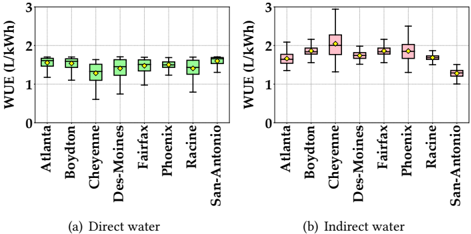
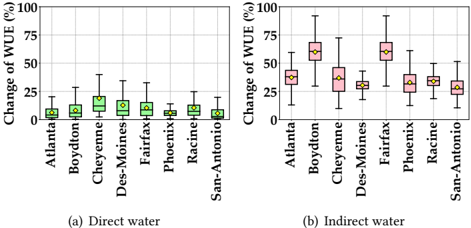
Freshwater scarcity is a global problem that requires collective efforts across all industry sectors. Nevertheless, a lack of access to operational water footprint data bars many applications from exploring optimization opportunities hidden within the temporal and spatial variations. To break this barrier into research in water sustainability, we build a dataset for operation direct water usage in the cooling systems and indirect water embedded in electricity generation. Our dataset consists of the hourly water efficiency of major U.S. cities and states from 2019 to 2023. We also offer cooling system models that capture the impact of weather on water efficiency. We present a preliminary analysis of our dataset and discuss three potential applications that can benefit from it. Our dataset is publicly available at Open Science Framework (OSF) [1].
Overview
The claims and statistics of this paper haven’t been checked yet.
Run the check — free, no account needed. It reads the open-access text and checks the sources it cites.
Integrity signals
Registry
Cites
Statistics
Figures
Verification
Claims the paper makes
The claims and statistics of this paper haven’t been checked yet.
Run the check — free, no account needed. It reads the open-access text and checks the sources it cites.
Claims other papers make about this one
Each is checked against this paper’s own text: does it say what the citing paper says it does?
The source backs part of the claim, not all of it — or backs it for a different population, condition or comparison.
In the citing paper
“While recent studies have begun to address the growing water consumption of data centers and AI computing [12, 15, 20, 23], they have predominantly focused on regions with large data center concentrations, such as the U.S. and Europe, while leaving out Africa-despite its rapid expansion of data centers and pressing challenges of water scarcity [44, 50].”
From A Water Efficiency Dataset for African Data Centers (2025) · cites this paper as [15]
Experimental — accuracy not yet measuredThe source backs part of the claim, not all of it — or backs it for a different population, condition or comparison.
In the citing paper
“While our dataset is partly based on the methodology and modeling of [15, 23], which study WUE and AI model water consumption with a heavy emphasis on the U.S. data centers, we also incorporate regional water stresses and infrastructure inefficiencies due to leakages in our model.”
From A Water Efficiency Dataset for African Data Centers (2025) · cites this paper as [15]
Experimental — accuracy not yet measuredThe source backs part of the claim, not all of it — or backs it for a different population, condition or comparison.
In the citing paper
“Like [15], we do not model supply chain manufacturing because this aspect often relies on generalized, less accurate data that may not reflect the unique operational practices of individual data centers or computing workloads.”
From A Water Efficiency Dataset for African Data Centers (2025) · cites this paper as [15]
Experimental — accuracy not yet measuredThe cited source says what the claim attributes to it.
In the citing paper
“Existing studies quantifying data center water usage in the U.S. and Western regions typically do not model the impact of water infrastructure damage [15, 19, 24].”
From A Water Efficiency Dataset for African Data Centers (2025) · cites this paper as [15]
Self-check
Percentages, sums and reported differences re-computed from the paper’s own numbers.
The self-check needs the paper’s full text.
Citations
Cites
Wet-Bulb Temperature from Relative Humidity and Air Temperature
Stull, R. (2011) · Journal of Applied Meteorology and Climatology · doi:10.1175/jamc-d-11-0143.1 · Cited by 773
Macknick, J., Newmark, R., Heath, G., & Hallett, K. C. (2012) · Environmental Research Letters · doi:10.1088/1748-9326/7/4/045802 · Cited by 631
The water consumption of energy production: an international comparison
Spang, E. S., Moomaw, W. R., Gallagher, K. S., Kirshen, P., & Marks, D. H. (2014) · Environmental Research Letters · doi:10.1088/1748-9326/9/10/105002 · Cited by 282
Greening Geographical Load Balancing
Liu, Z., Lin, M., Wierman, A., Low, S. H., & Andrew, L. L. H. (2014) · IEEE/ACM Transactions on Networking · doi:10.1109/tnet.2014.2308295 · Cited by 168
Online EV Charging Scheduling With On-Arrival Commitment
Alinia, B., Hajiesmaili, M., & Crespi, N. (2019) · IEEE Transactions on Intelligent Transportation Systems · doi:10.1109/tits.2018.2887194 · Cited by 83
(2018) · doi:10.1109/tcc.2016.2535201 · Cited by 39
Making AI Ethical by Design: The UNESCO Perspective
Ramos, G., Squicciarini, M., & Lamm, E. (2024) · Computer · doi:10.1109/mc.2023.3325949 · Cited by 7
Guidance for Calculating Water Use Embedded in Purchased Electricity
Reig, P., Luo, T., Christensen, E., & Sinistore, J. C. (2020) · Cited by 5
Research works printed but not linked: 6
- [4] Palm Beach Daily News, “Drought dilemma: Palm Beach leaders struggle to cap water use,” https://www.palmbeachpost.com/story/weather/2011/06/09/water-managers-shortage-near-crisis/7179447007/.
- [6] Google, “Environmental report,” 2023, https://sustainability.google/reports/.
- [12] M. A. Islam, K. Ahmed, H. Xu, N. H. Tran, G. Quan, and S. Ren, “Exploiting spatio-temporal diversity for water saving in geo-distributed data centers,” IEEE Transactions on Cloud Computing, vol. 6, no. 3, pp. 734–746, 2016.
- [14] P. Reig, “What’s the difference between water use and water consumption?,” World Resources Institute Commentary, 2013, https://www.wri.org/insights/whats-difference-between-water-use-and-water-consumption.
- [15] J. Macknick R. Newmark G. Heath and K. Hallett “A review of operational water consumption and withdrawal factors for electricity generating technologies ” NREL Tech. Report: NREL/TP-6A20-50900 2011. · DOI · Paper page
- [16] G. G. Protocol, “Greenhouse gas protocol,” Sector Toolsets for Iron and Steel-Guidance Document, 2011.
Cited by
A Water Efficiency Dataset for African Data Centers
Shumba, N., Tshekiso, O., Li, P., Fanti, G., & Ren, S. (2025) · Proceedings of the ACM SIGCAS/SIGCHI Conference on Computing and Sustainable Societies · doi:10.1145/3715335.3735483 · Cited by 10
Self-citation
Metadata
- Authors
- Gupta, P. S., Hossen, M. R., Li, P., Ren, S., & Islam, M. A.
- Affiliations
- Computer Science and Engineering, University of Texas at Arlington, USA
- Computer Science and Engineering, University of Texas at Arlington, United States of America
- Computer Science and Engineering, University of California, Riverside, USA
- Electrical and Computer Engineering, University of California, Riverside, United States of America
- Computer Sciencd and Engineering, University of Texas at Arlington, United States of America
- Venue
- The 15th ACM International Conference on Future and Sustainable Energy Systems
- Publisher
- ACM
- Published
- 2024-05-31
- Pages
- 442-446
- Cited by
- 13
- References
- 8
- Funders
- National Science Foundation (2152357, 2324915, 2324916)
About these checks
Registry, retraction, Cites and statistics results are computed, not judged, with one exception: a printed reference that no index lists is read once by a model before it counts as a citation error. Claims are extracted by a model and kept only when their quote appears verbatim in the text; each cited source is then checked, with a model’s help, for whether it says what the claim relies on. Those verdicts can be wrong — read the claim’s quote and the cited source before relying on one.
Statistics and arithmetic are recomputed, not judged.
Confidence bands are shown only for fields calibrated on our annotated test set. None is calibrated yet, so no band is shown.
What counts as a claim ›How we measure confidence ›How we check this ›
Are you an author, or do you see a problem with this page? Request a review
Data sources
Bibliographic data: Semantic Scholar, OpenAlex, Crossref.
Contains information from the Semantic Scholar Academic Graph Datasets, made available under the ODC Attribution License (ODC-BY 1.0).
Semantic Scholar’s data is described in: Kinney, R., et al. (2023). The Semantic Scholar Open Data Platform. arXiv:2301.10140.
