

Exploring the Collaborative Co-Creation Process with AI: A Case Study in Novice Music Production
Open accessThe DOI matches its Crossref record; 59 of the 60 references it cites were found in a registry or an index, and 1 are not checked yet; 10 of the 25 sources its claims cite were checked for support.
Abstract
Artificial intelligence is reshaping creative domains, yet its co-creative processes, especially in group settings with novice users, remain under explored. To bridge this gap, we conducted a case study in a college-level course where nine undergraduate students were tasked with creating three original music tracks using AI tools over 10 weeks. The study spanned the entire creative journey from ideation to releasing these songs on Spotify. Participants leveraged AI for music and lyric production, cover art, and distribution. Our findings highlight how AI transforms creative workflows: accelerating ideation but compressing the traditional preparation stage, and requiring novices to navigate a challenging idea selection and validation phase. We also identified a new “collaging and refinement” stage, where participants creatively combined diverse AI-generated outputs into cohesive works. Furthermore, AI influenced group social dynamics and role division among human creators. Based on these insights, we propose the Human-AI Co-Creation Stage Model and the Human-AI Agency Model, offering new perspectives on collaborative co-creation with AI.
Verified 2026-11-22 · 1 reference not checked yet
Overview
CoChat Summary
TL;DR
This case study of nine undergraduates in a 10-week AI music-production course finds that AI accelerates ideation but compresses preparation, creates a new collaging/refinement stage, and reshapes group dynamics and agency. It proposes the Human-AI Co-Creation Stage Model and the Human-AI Agency Model.
Key findings
- Nine interviewed students from 20 course attendees, across three teams, each produced and published three EP tracks; AI lowered barriers and boosted confidence, with one participant saying they “never would have made a song” without AI.
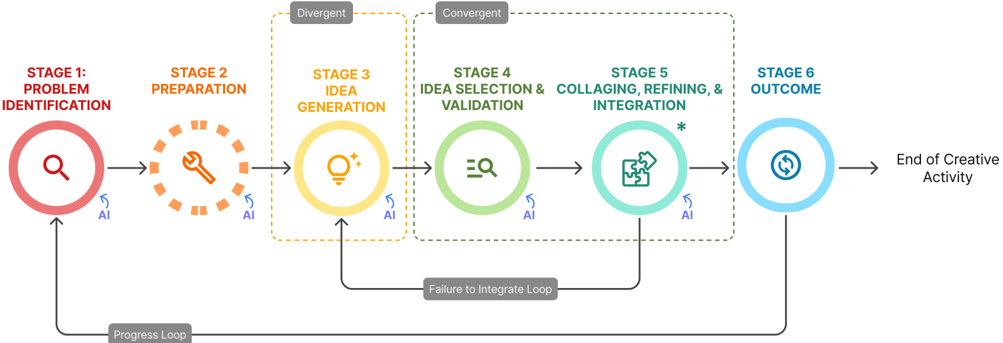
- AI compressed or bypassed the preparation stage, moving teams quickly from task presentation to idea generation; idea selection and validation became challenging because abundant AI outputs caused decision paralysis and reliance on intuition.
- A new Stage 5 emerged: collaging, refining, and integrating scattered AI outputs with human-created elements; AI audio was often “fixed” WAV/MP3 and hard to manipulate, and one participant spent “four to five hours just editing the chords.”
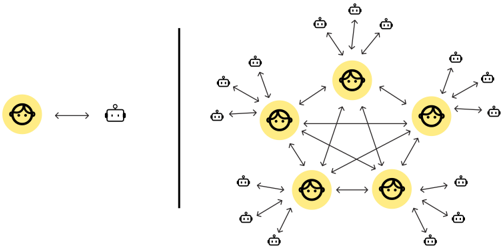
- AI mediated social dynamics: participants found it easier to critique AI than human teammates, treated AI as teammate/technical assistant/environmental factor, and consciously retained ownership and control while valuing human emotional expression.
Methods
- Case study in a 10-week undergraduate capstone course; nine of 20 students were interviewed across three teams, and researchers reviewed artifacts, process logs, presentations, online canvases, final EPs on Spotify, and team websites.
- Interviews lasted approximately 55 to 70 minutes and were conducted in the summer after the course; analysis used an abductive approach with Reflexive Thematic Analysis, weekly team meetings, and a half-day workshop mapping quotes to Amabile’s stages and human-AI collaboration themes in Figma.
Limitations
- Stated: limited number of interview participants; the structured course with deadlines and a three-song requirement introduced external pressures; rapid team formation likely inhibited deep interpersonal rapport typical of long-term professional collaborations.
- Evident from the text: the study is qualitative and context-specific to one undergraduate novice course, so findings may not generalize to expert, professional, or other creative domains; the paper does not report quantitative causal tests.
Model-written summary. Check it against the paper before relying on it.
Integrity signals
Registry
Cites
Statistics
Figures
Verification
Claims the paper makes
3 Valid · 8 Not valid · 12 Not checked · 118 Own results and interpretations
The cited sources that could be checked couldn’t confirm or dispute this claim.
In the paper
“where research shows individuals partly blame AI rather than attributing all responsibility to their conversation partners [36].”
§ Exploring the Collaborative Co-Creation Process with AI: A Case Study in Novice Music Production > 5.2 AI-mediated Social Dynamics and Roles
What the sources say
- Not checked — no full text of the sourcecites [28] 28. Vlad Petre Glăveanu. 2013. Rewriting the language of creativity: The Five A's framework. Review of general psychology 17, 1 (2013), 69-81. source
- Could not verifycites [34] 34. Cheng-Zhi Anna Huang, Tim Cooijmans, Adam Roberts, Aaron Courville, and Douglas Eck. 2019. Counterpoint by Convolution. arXiv:1903.07227 [cs.LG] httpxs://arxiv.org/abs/1903.07227 sourceExperimental — accuracy not yet measured
The Human Evaluations section (p. 6) reports listeners’ judgments of how Bach-like generated music sounds, not judgments of responsibility. Searches for blame, responsibility attribution, and conversation partners found no passage addressing the claim. (LLM, conf=0.78)
- Could not verifycites [36] 36. Tasin Islam, Alina Miron, Monomita Nandy, Jyoti Choudrie, Xiaohui Liu, and Yongmin Li. 2024. Transforming digital marketing with generative AI. Computers 13, 7 (2024), 168. sourceExperimental — accuracy not yet measured
Section 2.6, “Concerns with Digital Marketing” (page not provided), discusses privacy, intrusiveness and customer trust, not how people assign blame in conversations. Searches for blame attributed to AI and for responsibility in AI-mediated conversations found no passage addressing the claim. (LLM, conf=0.74)
plain- Asserted: passes — The authors put it forward as true.
- Checkable: passes — It can be checked against evidence.
- Load-bearing: passes — The paper’s conclusions depend on it.
- Based: passes — The paper gives a reason why it holds.
A result the paper reports from its own data — it cites no other source for it, so there is none to check. The quote shows it is in the paper.
In the paper
“However, in our case, students advanced quickly from Stage 1 (problem presentation) to Stage 3 (ideation).”
§ Exploring the Collaborative Co-Creation Process with AI: A Case Study in Novice Music Production > 4.1.2 Stage 2: Preparation: Building Up Relevant Information and Skills.
plain- Asserted: passes — The authors put it forward as true.
- Checkable: passes — It can be checked against evidence.
- Load-bearing: passes — The paper’s conclusions depend on it.
- Based: passes — The paper gives a reason why it holds.
- Rests on an assumption not shown here.
A result the paper reports from its own data — it cites no other source for it, so there is none to check. The quote shows it is in the paper.
In the paper
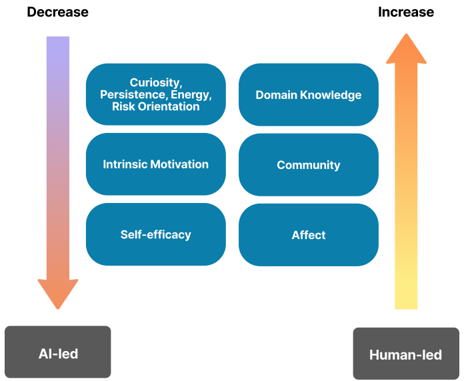
“Additionally, AI mediated social dynamics and boosted self-efficacy among team members, yet it sometimes constrained emotional expression and artistic exploration.”
§ Exploring the Collaborative Co-Creation Process with AI: A Case Study in Novice Music Production > 1 Introduction
plainstates a cause- Asserted: passes — The authors put it forward as true.
- Checkable: passes — It can be checked against evidence.
- Load-bearing: unclear — It is unclear whether the paper’s conclusions depend on it.
- Based: passes — The paper gives a reason why it holds.
- Rests on an assumption not shown here.
A result the paper reports from its own data — it cites no other source for it, so there is none to check. The quote shows it is in the paper.
In the paper
“Our findings highlight how AI transforms creative workflows: accelerating ideation but compressing the traditional preparation stage, and requiring novices to navigate a challenging idea selection and validation phase.”
- Also stated in: § 1 Introduction · boosted
“We found that AI significantly accelerated ideation but shortened the preparation stage-potentially limiting the deeper domain knowledge acquisition that often develops early in creative processes.”
- Also stated in: § 4.1.3 Stage 3: Idea Generation. · hedged
“Our data suggest that AI served as a powerful springboard for inspiration, speeding up the ideation process, and a potential source of idea fixation on initial AI's output.”
§ Exploring the Collaborative Co-Creation Process with AI: A Case Study in Novice Music Production > Abstract
boostedstates a cause- Asserted: passes — The authors put it forward as true.
- Checkable: passes — It can be checked against evidence.
- Load-bearing: passes — The paper’s conclusions depend on it.
- Based: passes — The paper gives a reason why it holds.
- Rests on an assumption not shown here.
- Also stated in: § 1 Introduction · boosted
A result the paper reports from its own data — it cites no other source for it, so there is none to check. The quote shows it is in the paper.
In the paper
“We also identified a new”
- Also stated in: § 1 Introduction · plain
“We also identified a new stage-collaging, refining, and integrating diverse AI outputs with human-created elements to form a cohesive song.”
§ Exploring the Collaborative Co-Creation Process with AI: A Case Study in Novice Music Production > Abstract
plain- Asserted: passes — The authors put it forward as true.
- Checkable: passes — It can be checked against evidence.
- Load-bearing: passes — The paper’s conclusions depend on it.
- Based: passes — The paper gives a reason why it holds.
- Rests on an assumption not shown here.
- Also stated in: § 1 Introduction · plain
71 more claims
Create a free account to see all 141 claims and to verify the 1 reference still open.
- Borderline: one of the tests for a substantial claim is unclear. 1
- It may state two separate claims as one. 38
- Probably not a substantial claim. 35
- The quote only partly states this claim. 1
Citations
Cites
Systematic combining: an abductive approach to case research
Dubois, A., & Gadde, L.-E. (2002) · Journal of Business Research · doi:10.1016/s0148-2963(00)00195-8 · Cited by 4,941 · cited 2×
“The abductive approach is often used in case studies [62] and the process systematically combines theoretical framework, empirical data, and case analysis [26].”
The social psychology of creativity: A componential conceptualization.
Amabile, T. M. (1983) · Journal of Personality and Social Psychology · doi:10.1037/0022-3514.45.2.357 · Cited by 4,034 · cited 3×
“This stands in contrast to the long “warm-up” periods often noted in creativity literature [12, 71, 77].”
InfluentialBeyond Big and Little: The Four C Model of Creativity
Kaufman, J. C., & Beghetto, R. A. (2009) · Review of General Psychology · doi:10.1037/a0013688 · Cited by 2,669 · cited 1×
“In the field of creativity research, scholars have proposed various models—such as the Four C Model [43], the Four P’s model [32], the Five A’s model [31], as well as stage-based frameworks like design thinking and Pearlman’s model [60]—to capture the multifaceted nature of creative processes.”
Amabile, T. M., & Pratt, M. G. (2016) · Research in Organizational Behavior · doi:10.1016/j.riob.2016.10.001 · Cited by 1,863 · cited 5×
“Involving AI also facilitate achieving tangible results, fosters a “progress loop” [15], giving creators a sense of accomplishment and prompting them to revisit Stage 1 for subsequent creation cycles.”
InfluentialAmbiguity as a resource for design
Gaver, W. W., Beaver, J., & Benford, S. (2003) · Proceedings of the SIGCHI Conference on Human Factors in Computing Systems · doi:10.1145/642611.642653 · Cited by 1,474
The Cambridge Handbook of Creativity
(2010) · doi:10.1017/cbo9780511763205 · Cited by 1,291
Jansson, D. G., & Smith, S. M. (1991) · Design Studies · doi:10.1016/0142-694x(91)90003-f · Cited by 1,087
Group genius: the creative power of collaboration
(2007) · Choice Reviews Online · doi:10.5860/choice.45-2126 · Cited by 909 · cited 1×
“Although AI is praised for facilitating idea generation in Stage 3, it can also quickly lead to convergent stages in Stages 4 and 5, potentially linearize the creative process (see Section 5.3).”
InfluentialCase Study Method: A Step-by-Step Guide for Business Researchers
Rashid, Y., Rashid, A., Warraich, M. A., Sabir, S. S., & Waseem, A. (2019) · International Journal of Qualitative Methods · doi:10.1177/1609406919862424 · Cited by 804 · cited 2×
“The abductive approach is often used in case studies [62] and the process systematically combines theoretical framework, empirical data, and case analysis [26].”
Rewriting the Language of Creativity: The Five A's Framework
Glăveanu, V. P. (2013) · Review of General Psychology · doi:10.1037/a0029528 · Cited by 660 · cited 1×
“In the field of creativity research, scholars have proposed various models—such as the Four C Model [43], the Four P’s model [32], the Five A’s model [31], as well as stage-based frameworks like design thinking and Pearlman’s model [60]—to capture the multifaceted nature of creative processes.”
Research works printed but not linked: 11
- 13. HKG Andersen and Peter Knees. 2016. Conversations with expert users in music retrieval and research challenges for creative MIR. In 17th International Society for Music Information Retrieval Conference (ISMIR 2016). International Society for Music Information Retrieval, 122-128.
- 14. A Bain. 1874. The Senses and the Intellect. D. Appleton & Company.
- 18. Adam Patrick Bell. 2015. Can we afford these affordances? GarageBand and the doubleedged sword of the digital audio workstation. Action, Criticism & Theory for Music Education 14, 1 (2015), 43-65.
- 35. Eric J Humphrey, Douglas Turnbull, and Tom Collins. 2013. A brief review of creative MIR. ISMIR Late-Breaking News and Demos (2013).
- 43. Atsuya Kobayashi, Tetsuro Sato, and Kei Tateno. 2024. Novice-Centered Appli- cation Design for Music Creation. In Companion Publication of the 2024 ACM Designing Interactive Systems Conference (IT University of Copenhagen, Den- mark) (DIS '24 Companion). Association for Computing Machinery, New York, NY, USA, 125-129. https://doi.org/10.1145/3656156.3663695 · DOI · Paper page
- 49. Ryan Louie, Andy Coenen, Cheng Zhi Huang, Michael Terry, and Carrie J Cai. 2020. Novice-AI music co-creation via AI-steering tools for deep generative models. In Proceedings of the 2020 CHI conference on human factors in computing systems. 1-13. · DOI · Paper page
- 52. Michele Newman, Lidia Morris, Jun Kato, Masataka Goto, Jason Yip, and Jin Ha Lee. 2024. Purposeful Play: Evaluation and Co-Design of Casual Music Creation Applications with Children. Proc. of the 25th Int. Society for Music Information Retrieval Conf., San Francisco, United States (2024).
- 53. Michele Newman, Lidia Morris, and Jin Ha Lee. 2023. Human-AI Music Creation: Understanding the Perceptions and Experiences of Music Creators for Ethical and Productive Collaboration.. In ISMIR. 80-88.
- 57. Charles Pearlman. 1983. A theoretical model for creativity. Education 103, 3 (1983), 294-305.
- 65. Mark Shtern, Pedro Casas, and Vassilios Tzerpos. 2018. Evaluating music master- ing quality using machine learning. In Proceedings of the 28th Annual International Conference on Computer Science and Software Engineering (Markham, Ontario, Canada) (CASCON '18). IBM Corp., USA, 126-135. · doi:10.5555/3291291.3291305
- 67. H Simon. 1957. A Behavioral Model of Rational Choice. Models of Man, So- cial and Rational: Mathematical Essays on Rational Human Behavior in a Social Setting/Wiley (1957).
Cited by
Applications of Artificial Intelligence in Music: A Review
Ma, W., & Zheng, Z. (2025) · International Journal of Crowd Science · doi:10.26599/ijcs.2025.9100011 · Cited by 14
Zhou, Y., Wang, Y., & Su, J. (2025) · Scientific Reports · doi:10.1038/s41598-025-28532-2 · Cited by 9
From friction to synergy: The complex interplay of human creativity and AI
Deschryver, M., Henriksen, D., & Leahy, S. (2025) · Possibility Studies & Society · doi:10.1177/27538699251350483 · Cited by 14
“A similar pattern has been seen in music composition, as research by Fu et al. (2025) found that while AI tools enable rapid idea generation, to create something effective, students had to invest time and effort in combining, cur-ating, and editing those fragments into cohesive pieces.”
Fu, Y., Zhou, T., Han, B., Wang, M., Chen, Y., Gomes Da Costa Lai, Z., Pang, R. Y., Reinecke, K., Wobbrock, J. O., & Hiniker, A. (2026) · Proceedings of the 2026 CHI Conference on Human Factors in Computing Systems · doi:10.1145/3772318.3791329 · Cited by 2
Self-citationInteractive Co-Creation with StyleGAN for Enhancing Visual Design Using Generative AI
Wibowo, M. C., Manongga, D., Hendry, H., & Bayu, T. I. (2025) · International Conference on Creative Communication and Innovative Technology (ICCIT) · doi:10.1109/iccit65724.2025.11167676 · Cited by 3
“In terms of human-AI collaboration, co-creative systems have emerged as an interdisciplinary research focus [27].”
Human–AI Co-Creation in Contemporary Composition: Interaction and Artistic Strategies with Ricercar
Nikrang, A., & Kiesenhofer, S. (2025) · Conference on Animation and Interactive Art (CAIA) · doi:10.1145/3749893.3749961 · Cited by 3
“Despite their capabilities, audio-based systems have certain limitations, particularly in terms of post-generational processing and musical control[12].”
Between Imperative and Panic: Navigating AI's Educational Moment with Leon Furze
McCaleb, L., Henriksen, D., Mishra, P., & Oster, N. J. (2025) · TechTrends · doi:10.1007/s11528-025-01116-7 · Cited by 1
“Across creative domains, this friction can invite reflection, slow thinking, and iterative engagement, to preserve human voice and meaning-making in Human-AI collaboration (Fu et al., 2025).”
Liang, H., Zhang, D., An, X., & Xu, J. (2026) · Research Square · doi:10.21203/rs.3.rs-8774138/v1 · Cited by 1
CoLyricist: Enhancing Lyric Writing with AI through Workflow-Aligned Support
Yoshida, M., Li, B. Q., Zhao, S., Zhou, Q., Hu, S., Chen, X. '., & Peng, N. (2026) · ACM International Conference on Intelligent User Interfaces (IUI) · doi:10.1145/3742413.3789099 · Cited by 4
“Meanwhile, in music composition, researchers have increasingly focused on analyzing the creative process itself to understand how human and AI contributions evolve across stages [19, 43].”
InfluentialKobiella, C., Schneider, L., Schmidt, A., & Terzimehić, N. (2026) · CHI Conference on Human Factors in Computing Systems · doi:10.1145/3772318.3790758 · Cited by 1
“AI tools are increasingly embedded in professional creative work-flows, and research shows they fundamentally reshape how users experience creative work – producing ambivalent responses ranging from empowerment to anxiety [18, 31, 32, 41, 46, 48, 60].”
Generative AI in Children's Creative Collaboration: Impact, Perception, and Design Guidelines
Yoo, D., Newman, M., Pitt, C. R., Vo, K. H., Zhang, M., Kim, M., Davis, K., & Yip, J. (2026) · CHI Conference on Human Factors in Computing Systems · doi:10.1145/3772318.3790907 · Cited by 7
“Due to these capabilities, Human-AI co-creation has been widely studied in individual domains such as drawing [42, 80, 89, 134], creative writing [30, 35, 51, 71], music composition [45, 61], and data presentation [79, 128].”
Self-citationVidTune: Creating Video Soundtracks with Generative Music and Contextual Thumbnails
Huh, M., Fraser, C. A., Li, D., Dontcheva, M., & Wang, B. K. (2026) · CHI Conference on Human Factors in Computing Systems · doi:10.1145/3772318.3791572 · Cited by 5
“However, they mainly focus on initial prompting and refinement of a few outputs, with less attention to how creators can efficiently understand, compare, and evaluate the large number of options produced in music creation workflows [34, 45].”
Fotaris, P. (2026) · Cogent Arts & Humanities · doi:10.1080/23311983.2026.2722084
Evaluation of music generated by artificial intelligence from a compositional perspective
Küpeli, S. O. (2025) · ARTS Artuklu Sanat ve Beşeri Bilimler Dergisi · doi:10.46372/arts.1743089
The Role of AI in Preserving and Remastering Classic Games
Selvakumar, P., Poorani, S., Waiker, V., Satheesh Kumar, D., Jaggi, P., Mohit, M., & Manjunath, T. C. (2025) · Advances in computational intelligence and robotics book series · doi:10.4018/979-8-3373-4637-3.ch011
Huang, X., Guan, T., & Wang, Y. (2026) · International Conference on Tangible, Embedded, and Embodied Interaction (TEI) · doi:10.1145/3731459.3773330
Yuan, Y., Wang, R., Cao, J., Xian, L., Yang, J., & Yarosh, S. (2026) · Proceedings of the ACM on Human-Computer Interaction · doi:10.1145/3799443
The Classroom and Beyond: Teacher Education in a GenAI World
Mishra, P., & Henriksen, D. (2026) · Springer international handbooks of education · doi:10.1007/978-3-031-88898-4_28-1
Capturing Inspiration: Designing a Multimodal Human–AI Collaboration Framework for Music Creation
Wang, L., Zhou, Y., Dong, L., & Chang, D. (2025) · International Conference on Human-Engaged Computing (ICHEC) · doi:10.1145/3786995.3787005
“Particularly in the early creative stage, especially for novice music producers [9], musicians require fast, low-threshold input channels rather than full-scale compositional workflows.”
HarmonizeAI: Enhancing Group Dynamics Through AI-Assisted Collaborative Music Generation
Chi, M., Tang, H., Wang, M. Y., Chen, Y., & Yang, B. (2025) · Artificial Intelligence x Humanities, Education, and Art (AIxHEART) · doi:10.1109/aixheart65685.2025.00011
“Specifically, Lobber [29] and Fu et al. [30] pointed out that articulating musical concepts can be challenging and particularly requires shared technical terms.”
What Influences Readers' and Writers' Perceived Necessity of AI Disclosure?
Fang, J., Wen, V. X., & Lee, M. (2026) · ACM Conference on Fairness, Accountability, and Transparency (FAccT) · doi:10.1145/3805689.3806724 · Cited by 1
“The rise of AI capabilities and applications enables human-AI collaborative creation (co-creation) of texts [34, 47, 63], music [30, 79, 85], images [25, 62, 87], and videos [18, 46, 74].”
Sandnes, F. E., Canlar, K., & Kuriakose, B. (2026) · Lecture notes in computer science · doi:10.1007/978-3-032-29653-5_7
Enhancing student creative thinking: a new approach based on generative artificial intelligence a
Morán, F.-E., Peña, F. L. M., & Parrales, E. P. B. (2026) · Prisma social · doi:10.65598/rps.6245 · Cited by 1
Wang, Z. (2026) · International Journal of Human-Computer Interaction · doi:10.1080/10447318.2026.2712101
Ferrán, C. (2026) · AI and Ethics · doi:10.1007/s43681-026-01320-y
“…and evaluative labor between human and AI shifted over successive iterations, with human contributors assuming progressively greater selective control as a project matured, a pattern consistent with the view that complementarity is achieved dynamically rather than fixed at the outset [ 82].”
Artificial Intelligence in Interdisciplinary Synesthetic Sound and Video Design Project
Kljajić, I., Jankov, M., Toljaga-Nikolić, D., et al. (2026) · Interdisciplinary Description of Complex Systems · doi:10.7906/indecs.24.6.8 · Cited by 1
The Work to Make Assistance Work: Learning from Videos by Visually Impaired Content Creators
Wester, J., Rudaz, D., Khan, M. H., Due, B. L., & Brown, B. A. T. (2026) · Nordic Conference on Human-Computer Interaction · doi:10.1145/3829807.3829822
Metadata
- Authors
- Fu, Y., Newman, M., Going, L., Feng, Q., & Lee, J. H.
- Affiliations
- University of Washington (US)
- Venue
- Proceedings of the 2025 ACM Designing Interactive Systems Conference
- Publisher
- ACM
- Published
- 2025-07-04
- Pages
- 1298-1312
- OpenAlex
- W4412017471
- Cited by
- 30
- References
- 46
- Citations by year
- 2026: 18 · 2025: 12
- FWCI
- 22.67
- Type
- conference paper
- Language
- en
- Open access
- hybrid
- doi.org
- Licence
- cc-by
- Locations
- Designing Interactive Systems Conference (publishedVersion, cc-by)
- arXiv (Cornell University) (submittedVersion, cc-by-sa)
- arXiv (Cornell University)
- Topics
- Social Sciences › Arts and Humanities › Music › Music Technology and Sound Studies
- Social Sciences › Arts and Humanities › Visual Arts and Performing Arts › Art, Technology, and Culture
- Social Sciences › Psychology › Experimental and Cognitive Psychology › Creativity in Education and Neuroscience
- Keywords
- human-AI co-creation, novice users, AI-generated music, creative workflows, idea generation, role division, music education
About these checks
Registry, retraction, Cites and statistics results are computed, not judged, with one exception: a printed reference that no index lists is read once by a model before it counts as a citation error. Claims are extracted by a model and kept only when their quote appears verbatim in the text; each cited source is then checked, with a model’s help, for whether it says what the claim relies on. Those verdicts can be wrong — read the claim’s quote and the cited source before relying on one.
The claim verdicts this report counts are experimental: their accuracy is not yet measured.
A language model drew the claims from the paper on 2026-10-02, under version 3 of the claim definition (model deepseek-v4.1-flash, prompt extract-v3).
A second model labelled each claim on 2026-10-02 (model jev-1.13-20260917, definition revision gold-guideline-v0.2).
Cited sources are checked with a language model’s help (gpt-6-sol).
Statistics and arithmetic are recomputed, not judged.
Confidence bands are shown only for fields calibrated on our annotated test set. None is calibrated yet, so no band is shown.
What counts as a claim ›How we measure confidence ›How we check this ›
Are you an author, or do you see a problem with this page? Request a review
Data sources
Bibliographic data: Semantic Scholar, OpenAlex, Crossref.
Contains information from the Semantic Scholar Academic Graph Datasets, made available under the ODC Attribution License (ODC-BY 1.0).
Semantic Scholar’s data is described in: Kinney, R., et al. (2023). The Semantic Scholar Open Data Platform. arXiv:2301.10140.
