

The DOI matches its Crossref record; 60 of the 60 references it cites were found in a registry or an index; 10 of the 25 sources its claims cite were checked for support.
Exploring the Collaborative Co-Creation Process with AI: A Case Study in Novice Music Production
Open accessAbstract
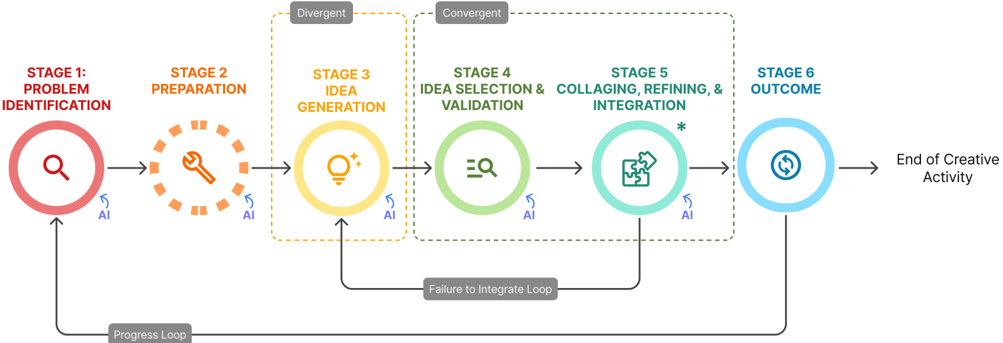
Artificial intelligence is reshaping creative domains, yet its co-creative processes, especially in group settings with novice users, remain under explored. To bridge this gap, we conducted a case study in a college-level course where nine undergraduate students were tasked with creating three original music tracks using AI tools over 10 weeks. The study spanned the entire creative journey from ideation to releasing these songs on Spotify. Participants leveraged AI for music and lyric production, cover art, and distribution. Our findings highlight how AI transforms creative workflows: accelerating ideation but compressing the traditional preparation stage, and requiring novices to navigate a challenging idea selection and validation phase. We also identified a new “collaging and refinement” stage, where participants creatively combined diverse AI-generated outputs into cohesive works. Furthermore, AI influenced group social dynamics and role division among human creators. Based on these insights, we propose the Human-AI Co-Creation Stage Model and the Human-AI Agency Model, offering new perspectives on collaborative co-creation with AI.
Overview
CoChat Summary
TL;DR
This case study of nine undergraduates in a 10-week AI music-production course finds that AI accelerates ideation but compresses preparation, creates a new collaging/refinement stage, and reshapes group dynamics and agency. It proposes the Human-AI Co-Creation Stage Model and the Human-AI Agency Model.
Key findings
- Nine interviewed students from 20 course attendees, across three teams, each produced and published three EP tracks; AI lowered barriers and boosted confidence, with one participant saying they “never would have made a song” without AI.
- AI compressed or bypassed the preparation stage, moving teams quickly from task presentation to idea generation; idea selection and validation became challenging because abundant AI outputs caused decision paralysis and reliance on intuition.
- A new Stage 5 emerged: collaging, refining, and integrating scattered AI outputs with human-created elements; AI audio was often “fixed” WAV/MP3 and hard to manipulate, and one participant spent “four to five hours just editing the chords.”
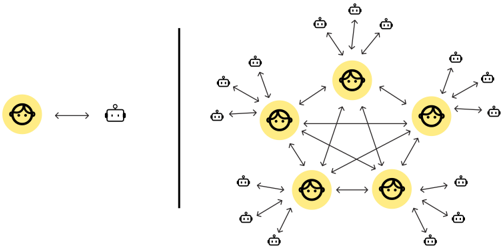
- AI mediated social dynamics: participants found it easier to critique AI than human teammates, treated AI as teammate/technical assistant/environmental factor, and consciously retained ownership and control while valuing human emotional expression.
Methods
- Case study in a 10-week undergraduate capstone course; nine of 20 students were interviewed across three teams, and researchers reviewed artifacts, process logs, presentations, online canvases, final EPs on Spotify, and team websites.
- Interviews lasted approximately 55 to 70 minutes and were conducted in the summer after the course; analysis used an abductive approach with Reflexive Thematic Analysis, weekly team meetings, and a half-day workshop mapping quotes to Amabile’s stages and human-AI collaboration themes in Figma.
Limitations
- Stated: limited number of interview participants; the structured course with deadlines and a three-song requirement introduced external pressures; rapid team formation likely inhibited deep interpersonal rapport typical of long-term professional collaborations.
- Evident from the text: the study is qualitative and context-specific to one undergraduate novice course, so findings may not generalize to expert, professional, or other creative domains; the paper does not report quantitative causal tests.
Model-written summary. Check it against the paper before relying on it.
Integrity signals
Registry
Cites
Statistics
Figures

Verification
Claims the paper makes
3 Valid · 8 Not valid · 12 Not checked · 118 Own results and interpretations
The cited sources that could be checked couldn’t confirm or dispute this claim.
In the paper
“where research shows individuals partly blame AI rather than attributing all responsibility to their conversation partners [36].”
§ Exploring the Collaborative Co-Creation Process with AI: A Case Study in Novice Music Production > 5.2 AI-mediated Social Dynamics and Roles
What the sources say
- Not checked — no full text of the sourcecites [28] 28. Vlad Petre Glăveanu. 2013. Rewriting the language of creativity: The Five A's framework. Review of general psychology 17, 1 (2013), 69-81. source
- Could not verifycites [34] 34. Cheng-Zhi Anna Huang, Tim Cooijmans, Adam Roberts, Aaron Courville, and Douglas Eck. 2019. Counterpoint by Convolution. arXiv:1903.07227 [cs.LG] httpxs://arxiv.org/abs/1903.07227 sourceExperimental — accuracy not yet measured
The Human Evaluations section (p. 6) reports listeners’ judgments of how Bach-like generated music sounds, not judgments of responsibility. Searches for blame, responsibility attribution, and conversation partners found no passage addressing the claim. (LLM, conf=0.78)
- Could not verifycites [36] 36. Tasin Islam, Alina Miron, Monomita Nandy, Jyoti Choudrie, Xiaohui Liu, and Yongmin Li. 2024. Transforming digital marketing with generative AI. Computers 13, 7 (2024), 168. sourceExperimental — accuracy not yet measured
Section 2.6, “Concerns with Digital Marketing” (page not provided), discusses privacy, intrusiveness and customer trust, not how people assign blame in conversations. Searches for blame attributed to AI and for responsibility in AI-mediated conversations found no passage addressing the claim. (LLM, conf=0.74)
plain- Asserted: passes — The authors put it forward as true.
- Checkable: passes — It can be checked against evidence.
- Load-bearing: passes — The paper’s conclusions depend on it.
- Based: passes — The paper gives a reason why it holds.
A result the paper reports from its own data — it cites no other source for it, so there is none to check. The quote shows it is in the paper.
In the paper
“However, in our case, students advanced quickly from Stage 1 (problem presentation) to Stage 3 (ideation).”
§ Exploring the Collaborative Co-Creation Process with AI: A Case Study in Novice Music Production > 4.1.2 Stage 2: Preparation: Building Up Relevant Information and Skills.
plain- Asserted: passes — The authors put it forward as true.
- Checkable: passes — It can be checked against evidence.
- Load-bearing: passes — The paper’s conclusions depend on it.
- Based: passes — The paper gives a reason why it holds.
- Rests on an assumption not shown here.
A result the paper reports from its own data — it cites no other source for it, so there is none to check. The quote shows it is in the paper.
In the paper
“Additionally, AI mediated social dynamics and boosted self-efficacy among team members, yet it sometimes constrained emotional expression and artistic exploration.”
§ Exploring the Collaborative Co-Creation Process with AI: A Case Study in Novice Music Production > 1 Introduction
plainstates a cause- Asserted: passes — The authors put it forward as true.
- Checkable: passes — It can be checked against evidence.
- Load-bearing: unclear — It is unclear whether the paper’s conclusions depend on it.
- Based: passes — The paper gives a reason why it holds.
- Rests on an assumption not shown here.
A result the paper reports from its own data — it cites no other source for it, so there is none to check. The quote shows it is in the paper.
In the paper
“Our findings highlight how AI transforms creative workflows: accelerating ideation but compressing the traditional preparation stage, and requiring novices to navigate a challenging idea selection and validation phase.”
- Also stated in: § 1 Introduction · boosted
“We found that AI significantly accelerated ideation but shortened the preparation stage-potentially limiting the deeper domain knowledge acquisition that often develops early in creative processes.”
- Also stated in: § 4.1.3 Stage 3: Idea Generation. · hedged
“Our data suggest that AI served as a powerful springboard for inspiration, speeding up the ideation process, and a potential source of idea fixation on initial AI's output.”
§ Exploring the Collaborative Co-Creation Process with AI: A Case Study in Novice Music Production > Abstract
boostedstates a cause- Asserted: passes — The authors put it forward as true.
- Checkable: passes — It can be checked against evidence.
- Load-bearing: passes — The paper’s conclusions depend on it.
- Based: passes — The paper gives a reason why it holds.
- Rests on an assumption not shown here.
- Also stated in: § 1 Introduction · boosted
A result the paper reports from its own data — it cites no other source for it, so there is none to check. The quote shows it is in the paper.
In the paper
“We also identified a new”
- Also stated in: § 1 Introduction · plain
“We also identified a new stage-collaging, refining, and integrating diverse AI outputs with human-created elements to form a cohesive song.”
§ Exploring the Collaborative Co-Creation Process with AI: A Case Study in Novice Music Production > Abstract
plain- Asserted: passes — The authors put it forward as true.
- Checkable: passes — It can be checked against evidence.
- Load-bearing: passes — The paper’s conclusions depend on it.
- Based: passes — The paper gives a reason why it holds.
- Rests on an assumption not shown here.
- Also stated in: § 1 Introduction · plain
71 more claims
Create a free account to see all 141 claims and to verify the 1 reference still open.
- Borderline: one of the tests for a substantial claim is unclear. 1
- It may state two separate claims as one. 38
- Probably not a substantial claim. 35
- The quote only partly states this claim. 1
Citations
Cites
Systematic combining: an abductive approach to case research
Dubois, A., & Gadde, L.-E. (2002) · Journal of Business Research · doi:10.1016/s0148-2963(00)00195-8 · Cited by 4,941 · cited 2×
“The abductive approach is often used in case studies [62] and the process systematically combines theoretical framework, empirical data, and case analysis [26].”
The social psychology of creativity: A componential conceptualization.
Amabile, T. M. (1983) · Journal of Personality and Social Psychology · doi:10.1037/0022-3514.45.2.357 · Cited by 4,034
Beyond Big and Little: The Four C Model of Creativity
Kaufman, J. C., & Beghetto, R. A. (2009) · Review of General Psychology · doi:10.1037/a0013688 · Cited by 2,669 · cited 1×
“In the field of creativity research, scholars have proposed various models—such as the Four C Model [43], the Four P’s model [32], the Five A’s model [31], as well as stage-based frameworks like design thinking and Pearlman’s model [60]—to capture the multifaceted nature of creative processes.”
Amabile, T. M., & Pratt, M. G. (2016) · Research in Organizational Behavior · doi:10.1016/j.riob.2016.10.001 · Cited by 1,863 · cited 5×
“Involving AI also facilitate achieving tangible results, fosters a “progress loop” [15], giving creators a sense of accomplishment and prompting them to revisit Stage 1 for subsequent creation cycles.”
InfluentialAmbiguity as a resource for design
Gaver, W. W., Beaver, J., & Benford, S. (2003) · Proceedings of the SIGCHI Conference on Human Factors in Computing Systems · doi:10.1145/642611.642653 · Cited by 1,474
The Cambridge Handbook of Creativity
(2010) · doi:10.1017/cbo9780511763205 · Cited by 1,291
Jansson, D. G., & Smith, S. M. (1991) · Design Studies · doi:10.1016/0142-694x(91)90003-f · Cited by 1,087
Group genius: the creative power of collaboration
(2007) · Choice Reviews Online · doi:10.5860/choice.45-2126 · Cited by 909 · cited 1×
“Although AI is praised for facilitating idea generation in Stage 3, it can also quickly lead to convergent stages in Stages 4 and 5, potentially linearize the creative process (see Section 5.3).”
InfluentialCase Study Method: A Step-by-Step Guide for Business Researchers
Rashid, Y., Rashid, A., Warraich, M. A., Sabir, S. S., & Waseem, A. (2019) · International Journal of Qualitative Methods · doi:10.1177/1609406919862424 · Cited by 804 · cited 2×
“The abductive approach is often used in case studies [62] and the process systematically combines theoretical framework, empirical data, and case analysis [26].”
Rewriting the Language of Creativity: The Five A's Framework
Glăveanu, V. P. (2013) · Review of General Psychology · doi:10.1037/a0029528 · Cited by 660 · cited 1×
“In the field of creativity research, scholars have proposed various models—such as the Four C Model [43], the Four P’s model [32], the Five A’s model [31], as well as stage-based frameworks like design thinking and Pearlman’s model [60]—to capture the multifaceted nature of creative processes.”
AI-Mediated Communication: Definition, Research Agenda, and Ethical Considerations
Hancock, J. T., Naaman, M., & Levy, K. (2020) · Journal of Computer-Mediated Communication · doi:10.1093/jcmc/zmz022 · Cited by 658 · cited 1×
“This tendency resonates with findings from AI-mediated communication research [28, 34], where research shows individuals partly blame AI rather than attributing all responsibility to their conversation partners [36].”
Origins of Genius: Darwinian Perspectives on Creativity
Simonton, D. K. (1999) · doi:10.1093/oso/9780195128796.001.0001 · Cited by 639
Componential Theory of Creativity
Amabile, T. (2012) · doi:10.4135/9781452276090.n42 · Cited by 559
Componential Theory of Creativity
(2013) · Encyclopedia of Management Theory · doi:10.4135/9781452276090.n50 · Cited by 478
Generative artificial intelligence, human creativity, and art
Zhou, E., & Lee, D. (2024) · PNAS Nexus · doi:10.1093/pnasnexus/pgae052 · Cited by 459 · cited 1×
“Such synergy has found applications across various domains, including writing [59], fashion design [25], architecture [72], marketing and advertising [39], visual arts [84], and more.”
Creativity in Context: Update to The Social Psychology of Creativity
Amabile, T. M., Amabile, T. M., Collins, M. A., Conti, R., Phillips, E., Picariello, M., Ruscio, J., & Whitney, D. (2018) · doi:10.4324/9780429501234 · Cited by 399
Novice-AI Music Co-Creation via AI-Steering Tools for Deep Generative Models
Louie, R., Coenen, A., Huang, C. Z., Terry, M., & Cai, C. J. (2020) · Proceedings of the 2020 CHI Conference on Human Factors in Computing Systems · doi:10.1145/3313831.3376739 · Cited by 271 · cited 1×
“However, previous studies have predominantly examined individual musicians’ interactions with single-purpose AI tools in controlled settings [37, 52], leaving a gap in understanding how teams of creators, particularly novices, integrate AI tools across an entire production cycle.”
Decision fatigue and heuristic analyst forecasts
Hirshleifer, D., Levi, Y., Lourie, B., & Teoh, S. H. (2019) · Journal of Financial Economics · doi:10.1016/j.jfineco.2019.01.005 · Cited by 248 · cited 1×
“Participants in our study expressed decision fatigue [35] when confronted with numerous AI-generated options.”
The Cambridge handbook of creativity
(2011) · Choice Reviews Online · doi:10.5860/choice.48-5383 · Cited by 248
AI as a moral crumple zone: The effects of AI-mediated communication on attribution and trust
Hohenstein, J., & Jung, M. (2020) · Computers in Human Behavior · doi:10.1016/j.chb.2019.106190 · Cited by 212 · cited 1×
“This tendency resonates with findings from AI-mediated communication research [28, 34], where research shows individuals partly blame AI rather than attributing all responsibility to their conversation partners [36].”
Productive struggle in middle school mathematics classrooms
Warshauer, H. K. (2015) · Journal of Mathematics Teacher Education · doi:10.1007/s10857-014-9286-3 · Cited by 208 · cited 1×
“Aligning this design approach with educational theories of “productive struggle" [79], it is beneficial for users to grapple with challenging problems during this stage before accessing AI-generated ideas.”
Redefining Creativity in the Era of AI? Perspectives of Computer Scientists and New Media Artists
Wingström, R., Hautala, J., & Lundman, R. (2024) · Creativity Research Journal · doi:10.1080/10400419.2022.2107850 · Cited by 201 · cited 1×
“The goal is to leverage the strengths of both humans and AI to produce creative outcomes that go beyond what either could achieve alone [80].”
AI-Augmented Brainwriting: Investigating the use of LLMs in group ideation
Shaer, O., Cooper, A., Mokryn, O., Kun, A. L., & Ben Shoshan, H. (2024) · Proceedings of the CHI Conference on Human Factors in Computing Systems · doi:10.1145/3613904.3642414 · Cited by 130 · cited 1×
“As multiple studies have noted, AI systems can function effectively as brainstorming aids [45, 67, 82], offering a seemingly endless array of possibilities.”
CreativeConnect: Supporting Reference Recombination for Graphic Design Ideation with Generative AI
Choi, D., Hong, S., Park, J., Chung, J. J. Y., & Kim, J. (2024) · Proceedings of the CHI Conference on Human Factors in Computing Systems · doi:10.1145/3613904.3642794 · Cited by 124 · cited 1×
“For example, in the domain of image generation, tools like CreativeConnect [24] enable users to analyze reference images, break down suggested keywords into categories, and recombine elements to create new images with AI assistance.”
The effect of AI-based inspiration on human design ideation
Kim, J., & Maher, M. L. (2023) · International Journal of Design Creativity and Innovation · doi:10.1080/21650349.2023.2167124 · Cited by 114 · cited 1×
“As multiple studies have noted, AI systems can function effectively as brainstorming aids [45, 67, 82], offering a seemingly endless array of possibilities.”
Huang, C.-Z. A., Cooijmans, T., Roberts, A., Courville, A., & Eck, D. (2019) · arXiv · doi:10.48550/arxiv.1903.07227 · Cited by 100
The 4P’s Creativity Model and its Application in Different Fields
Gruszka, A., & Tang, M. (2017) · WORLD SCIENTIFIC eBooks · doi:10.1142/9789813141889_0003 · Cited by 96 · cited 1×
“In the field of creativity research, scholars have proposed various models—such as the Four C Model [43], the Four P’s model [32], the Five A’s model [31], as well as stage-based frameworks like design thinking and Pearlman’s model [60]—to capture the multifaceted nature of creative processes.”
Creative Collaboration and Collaborative Creativity: A Systematic Literature Review
Barrett, M. S., Creech, A., & Zhukov, K. (2021) · Frontiers in Psychology · doi:10.3389/fpsyg.2021.713445 · Cited by 91 · cited 1×
“The creative collaboration has been proposed to be “dis-tributed” among audiences, materials, embodied actions, and the socio-cultural environment, which expand the collaboration concept to beyond direct human collaboration [20].”
M$^{2}$UGen: Multi-modal Music Understanding and Generation with the Power of Large Language ModelsPreprint
Liu, S., Hussain, A. S., Wu, Q., Sun, C., & Shan, Y. (2023) · arXiv (Cornell University) · doi:10.48550/arxiv.2311.11255 · Cited by 90
Schwartz, B. (2015) · Positive Psychology in Practice · doi:10.1002/9781118996874.ch8 · Cited by 77
Osone, H., Lu, J.-L., & Ochiai, Y. (2021) · Extended Abstracts of the 2021 CHI Conference on Human Factors in Computing Systems · doi:10.1145/3411763.3450391 · Cited by 74 · cited 1×
“Such synergy has found applications across various domains, including writing [59], fashion design [25], architecture [72], marketing and advertising [39], visual arts [84], and more.”
Tan, L., & Luhrs, M. (2024) · The Design Journal · doi:10.1080/14606925.2024.2353479 · Cited by 70
Transforming Digital Marketing with Generative AI
Islam, T., Miron, A., Nandy, M., Choudrie, J., Liu, X., & Li, Y. (2024) · Computers · doi:10.3390/computers13070168 · Cited by 68
From Text to Self: Users’ Perception of AIMC Tools on Interpersonal Communication and Self
Fu, Y., Foell, S., Xu, X., & Hiniker, A. (2024) · Proceedings of the CHI Conference on Human Factors in Computing Systems · doi:10.1145/3613904.3641955 · Cited by 62 · cited 1×
“Sharing creative products with others can be intrinsically rewarding, heightening creators’ sense of accomplishment and promoting further exploration and deeper involvement with creative tasks.”
Self-citationNewman, M., Sun, K., Dalla Gasperina, I. B., Shin, G. Y., Pedraja, M. K., Kanchi, R., Song, M. B., Li, R., Lee, J. H., & Yip, J. (2024) · Proceedings of the CHI Conference on Human Factors in Computing Systems · doi:10.1145/3613904.3642492 · Cited by 59
Self-citationHeart of the Machine: Our Future in a World of Artificial Emotional Intelligence
Merriam, G. (2021) · Essays in Philosophy · Cited by 53
Mixing Secrets for the Small Studio
Senior, M. (2018) · doi:10.4324/9781315150017 · Cited by 48 · cited 2×
“…music production, such as composition (creating music content, such as melodies and chord progression), arrangement (organizing musical elements), recording (capturing audio), mixing (balancing and adjusting individual audio tracks), and mastering (optimizing overall sound and tonal balance) [66].”
Rethinking designer agency: A case study of co-creation between designers and AI
Guo, X., Xiao, Y., Wang, J., & Ji, T. (2023) · IASDR 2023: Life-Changing Design · doi:10.21606/iasdr.2023.478 · Cited by 47 · cited 1×
“Moreover, intentionally delaying the introduction of the AI-driven ideation phase to incorporate a “training the brain” period may foster deeper cognitive engagement and mitigate the risk of early cognitive fixation on suboptimal ideas [33].”
Singing Voice Melody Transcription Using Deep Neural Networks.
Rigaud, F., & Radenen, M. (2016) · Zenodo (CERN European Organization for Nuclear Research) · doi:10.5281/zenodo.1418050 · Cited by 45
Ambiguity as a resource for design
Gaver, W. W., Beaver, J., & Benford, S. (2003) · ACM Conference on Human Factors in Computing Systems (CHI) · doi:10.1145/642651.642653 · Cited by 40
I Keep Counting: An Experiment in Human/AI Co-creative Songwriting
Micchi, G., Bigo, L., Giraud, M., Groult, R., & Levé, F. (2021) · Transactions of the International Society for Music Information Retrieval · doi:10.5334/tismir.93 · Cited by 37 · cited 1×
“With the advent of AI-powered systems, new possibilities have emerged to automate and augment various stages of music creation, sparking discussions about where these tools fit into the creative process [48, 54] and how to ethically define roles and re-sponsibilities for AI [22, 49, 56].”
On manipulation by emotional AI: UK adults’ views and governance implications
Bakir, V., Laffer, A., McStay, A., Miranda, D., & Urquhart, L. (2024) · Frontiers in Sociology · doi:10.3389/fsoc.2024.1339834 · Cited by 34 · cited 1×
“To further facilitate productive critique while managing interpersonal tensions, platform designers could consider implementing collaborative systems that enable anonymous and equitable feedback .”
Emerging human-technology relationships in a co-design process with generative AI
Vartiainen, H., Liukkonen, P., & Tedre, M. (2025) · Thinking Skills and Creativity · doi:10.1016/j.tsc.2024.101742 · Cited by 28
CrossGAI: A Cross-Device Generative AI Framework for Collaborative Fashion Design
Deng, H., Jiang, J., Yu, Z., Ouyang, J., & Wu, D. (2024) · Proceedings of the ACM on Interactive Mobile Wearable and Ubiquitous Technologies · doi:10.1145/3643542 · Cited by 27
Investigating the Impact of Generative Artificial Intelligence on Brainstorming: A Preliminary Study
Yu-Han, C., & Chun-Ching, C. (2023) · 2023 International Conference on Consumer Electronics - Taiwan (ICCE-Taiwan) · doi:10.1109/icce-taiwan58799.2023.10226617 · Cited by 22
Using Incongruous Genres to Explore Music Making with AI Generated Content
Bryan–Kinns, N., Noel-Hirst, A., & Ford, C. (2024) · Creativity and Cognition · doi:10.1145/3635636.3656198 · Cited by 21 · cited 1×
“In music production, AI-powered tools have become increasingly popular, supporting both expert musicians [19, 23] and novices [46, 51] in the creative process.”
Bown, O. (2021) · Springer eBooks · doi:10.1007/978-3-030-72116-9_1 · Cited by 20 · cited 1×
“With the advent of AI-powered systems, new possibilities have emerged to automate and augment various stages of music creation, sparking discussions about where these tools fit into the creative process [48, 54] and how to ethically define roles and re-sponsibilities for AI [22, 49, 56].”
Generative AI, Human Creativity, and Art
Zhou, E., & Lee, D. (2023) · doi:10.2139/ssrn.4594824 · Cited by 19
Tsushima, H., Nakamura, E., Itoyama, K., et al. (2017) · Zenodo (CERN European Organization for Nuclear Research) · doi:10.5281/zenodo.1416847 · Cited by 15
Searching for the Non-Consequential: Dialectical Activities in HCI and the Limits of Computers
Zhang, H. (2024) · Proceedings of the CHI Conference on Human Factors in Computing Systems · doi:10.1145/3613904.3641945 · Cited by 12 · cited 1×
“The creative collaboration has been proposed to be “dis-tributed” among audiences, materials, embodied actions, and the socio-cultural environment, which expand the collaboration concept to beyond direct human collaboration [20].”
Ghosh, P., & Rintel, S. (2025) · CHI Conference Extended Abstracts on Human Factors in Computing Systems (CHI EA) · doi:10.1145/3706599.3720142 · Cited by 12 · cited 1×
“Such multi-agent systems, as demonstrated in recent collaborative AI frameworks [30], can foster diverse dialogues that human collaborators may not naturally consider due to limitations in their experience or domain-specific knowledge.”
Banar, B., Bryan-Kinns, N., & Colton, S. (2023) · AAAI Conference on Artificial Intelligence · doi:10.1609/aaai.v37i13.27059 · Cited by 10 · cited 1×
“In music production, AI-powered tools have become increasingly popular, supporting both expert musicians [19, 23] and novices [46, 51] in the creative process.”
TeleMelody: Lyric-to-Melody Generation with a Template-Based Two-Stage MethodPreprint
Ju, Z., Lu, P., Tan, X., et al. (2021) · arXiv (Cornell University) · doi:10.48550/arxiv.2109.09617 · Cited by 7
Novice-Centered Application Design for Music Creation
Kobayashi, A., Sato, T., & Tateno, K. (2024) · Designing Interactive Systems Conference · doi:10.1145/3656156.3663695 · Cited by 5 · cited 2×
“Additionally, novices often lack foundational music knowledge and are deterred by the complexity of traditional production tools, making them prone to reduced motivation [47].”
Ideary: Facilitating Electronic Music Creation with Generative AI
Larsen, A. H., & Zhu, J. (2024) · Designing Interactive Systems Conference · doi:10.1145/3656156.3663731 · Cited by 5
Decision Fatigue and Heuristic Analyst Forecasts
Hirshleifer, D. A., Levi, Y., Lourie, B., & Teoh, S. H. (2018) · National Bureau of Economic Research · doi:10.3386/w24293 · Cited by 5
MINGUS: Melodic Improvisation Neural Generator Using Seq2Seq
Madaghiele, V., Lisena, P., & Raphaël Troncy, A. (2021) · Zenodo (CERN European Organization for Nuclear Research) · doi:10.5281/zenodo.5625683 · Cited by 4
Ethics of Singing Voice Synthesis: Perceptions of Users and Developers
Lee, K., Hitt, G., Terada, E., & Lee, J. H. (2022) · Zenodo (CERN European Organization for Nuclear Research) · doi:10.5281/zenodo.7316767 · Cited by 2
Self-citationAlgorithmic Harmonization of Tonal Melodies Using Weighted Pitch Context Vectors
van Kranenburg, P., & Kearns, E. (2023) · International Society for Music Information Retrieval Conference · doi:10.5281/zenodo.10265307 · Cited by 2
Meta-learning in Artificial Intelligence Lyric Composition
Wang, S., & Lin, Z. (2023) · International Conference on Artificial Intelligence and Computer Engineering (ICAICE) · doi:10.1145/3652628.3652761 · Cited by 1 · cited 1×
“AI music tools can compose melodies [41], harmonize chords [74, 75], transcribe [63], improvise [53], suggest lyrics [78], and assist in mixing and mastering tracks [68].”
Research works printed but not linked: 9
- HKG Andersen and Peter Knees. 2016. Conversations with expert users in music retrieval and research challenges for creative MIR. In 17th International Society for Music Information Retrieval Conference (ISMIR 2016). International Society for Music Information Retrieval, 122–128.
- A Bain. 1874. The Senses and the Intellect. D. Appleton & Company.
- Eric J Humphrey Douglas Turnbull and Tom Collins. 2013. A brief review of creative MIR. ISMIR Late-Breaking News and Demos (2013).
- 10.1145/3656156.3663695 · DOI · Paper page
- 10.1145/3313831.3376739 · DOI · Paper page
- Michele Newman Lidia Morris Jun Kato Masataka Goto Jason Yip and Jin Ha Lee. 2024. Purposeful Play: Evaluation and Co-Design of Casual Music Creation Applications with Children. Proc. of the 25th Int. Society for Music Information Retrieval Conf. San Francisco United States (2024).
- Michele Newman, Lidia Morris, and Jin Ha Lee. 2023. Human-AI Music Creation: Understanding the Perceptions and Experiences of Music Creators for Ethical and Productive Collaboration.. In ISMIR. 80–88.
- 10.5555/3291291.3291305 · doi:10.5555/3291291.3291305
- H Simon. 1957. A Behavioral Model of Rational Choice. Models of Man Social and Rational: Mathematical Essays on Rational Human Behavior in a Social Setting/Wiley (1957).
Cited by
Applications of Artificial Intelligence in Music: A Review
Ma, W., & Zheng, Z. (2025) · International Journal of Crowd Science · doi:10.26599/ijcs.2025.9100011 · Cited by 13
Zhou, Y., Wang, Y., & Su, J. (2025) · Scientific Reports · doi:10.1038/s41598-025-28532-2 · Cited by 9
From friction to synergy: The complex interplay of human creativity and AI
Deschryver, M., Henriksen, D., & Leahy, S. (2025) · Possibility Studies & Society · doi:10.1177/27538699251350483 · Cited by 13
“A similar pattern has been seen in music composition, as research by Fu et al. (2025) found that while AI tools enable rapid idea generation, to create something effective, students had to invest time and effort in combining, cur-ating, and editing those fragments into cohesive pieces.”
Fu, Y., Zhou, T., Han, B., Wang, M., Chen, Y., Gomes Da Costa Lai, Z., Pang, R. Y., Reinecke, K., Wobbrock, J. O., & Hiniker, A. (2026) · Proceedings of the 2026 CHI Conference on Human Factors in Computing Systems · doi:10.1145/3772318.3791329 · Cited by 2
Self-citationInteractive Co-Creation with StyleGAN for Enhancing Visual Design Using Generative AI
Wibowo, M. C., Manongga, D., Hendry, H., & Bayu, T. I. (2025) · International Conference on Creative Communication and Innovative Technology (ICCIT) · doi:10.1109/iccit65724.2025.11167676 · Cited by 2
“In terms of human-AI collaboration, co-creative systems have emerged as an interdisciplinary research focus [27].”
Metadata
- Authors
- Fu, Y., Newman, M., Going, L., Feng, Q., & Lee, J. H.
- Affiliations
- University of Washington (US)
- Venue
- Proceedings of the 2025 ACM Designing Interactive Systems Conference
- Publisher
- ACM
- Published
- 2025-07-04
- Pages
- 1298-1312
- OpenAlex
- W4412017471
- Cited by
- 30
- References
- 46
- Citations by year
- 2026: 18 · 2025: 12
- FWCI
- 22.67
- Type
- conference paper
- Language
- en
- Open access
- hybrid
- doi.org
- Licence
- cc-by
- Locations
- Designing Interactive Systems Conference (publishedVersion, cc-by)
- arXiv (Cornell University) (submittedVersion, cc-by-sa)
- arXiv (Cornell University)
- Topics
- Social Sciences › Arts and Humanities › Music › Music Technology and Sound Studies
- Social Sciences › Arts and Humanities › Visual Arts and Performing Arts › Art, Technology, and Culture
- Social Sciences › Psychology › Experimental and Cognitive Psychology › Creativity in Education and Neuroscience
- Keywords
- human-AI co-creation, novice users, AI-generated music, creative workflows, idea generation, role division, music education
About these checks
Registry, retraction, Cites and statistics results are computed, not judged, with one exception: a printed reference that no index lists is read once by a model before it counts as a citation error. Claims are extracted by a model and kept only when their quote appears verbatim in the text; each cited source is then checked, with a model’s help, for whether it says what the claim relies on. Those verdicts can be wrong — read the claim’s quote and the cited source before relying on one.
The claim verdicts this report counts are experimental: their accuracy is not yet measured.
A language model drew the claims from the paper on 2026-10-02, under version 3 of the claim definition (model deepseek-v4.1-flash, prompt extract-v3).
A second model labelled each claim on 2026-10-02 (model jev-1.13-20260917, definition revision gold-guideline-v0.2).
Cited sources are checked with a language model’s help (gpt-6-sol).
Statistics and arithmetic are recomputed, not judged.
Confidence bands are shown only for fields calibrated on our annotated test set. None is calibrated yet, so no band is shown.
What counts as a claim ›How we measure confidence ›How we check this ›
Are you an author, or do you see a problem with this page? Request a review
Data sources
Bibliographic data: Semantic Scholar, OpenAlex, Crossref.
Contains information from the Semantic Scholar Academic Graph Datasets, made available under the ODC Attribution License (ODC-BY 1.0).
Semantic Scholar’s data is described in: Kinney, R., et al. (2023). The Semantic Scholar Open Data Platform. arXiv:2301.10140.
