

Lightweight and Direct Document Relevance Optimization for Generative Information Retrieval
Open accessThe DOI matches its Crossref record; 88 of the 88 references it cites were found in a registry or an index; 7 of the 10 sources its claims cite were checked for support.
Abstract
Generative information retrieval (GenIR) is a promising neural retrieval paradigm that formulates document retrieval as a document identifier (docid) generation task, allowing for end-to-end optimization toward a unified global retrieval objective. To address token-level misalignment, we propose direct document relevance optimization (DDRO), which aligns token-level docid generation with document-level relevance estimation through direct optimization via pairwise ranking, eliminating the need for explicit reward modeling and reinforcement learning. Experimental results show DDRO achieves a 7.4% improvement in MRR@10 for MS MARCO and a 19.9% improvement for Natural Questions.
Overview
CoChat Summary
TL;DR
DDRO aligns token-level docid generation with document-level relevance by adding pairwise ranking after supervised fine-tuning, avoiding reward modeling and reinforcement learning. On MS MARCO and NQ320k it improves early ranking over GenRRL and established baselines, including 7.4% and 19.9% MRR@10 gains over RL-based methods.
Key findings
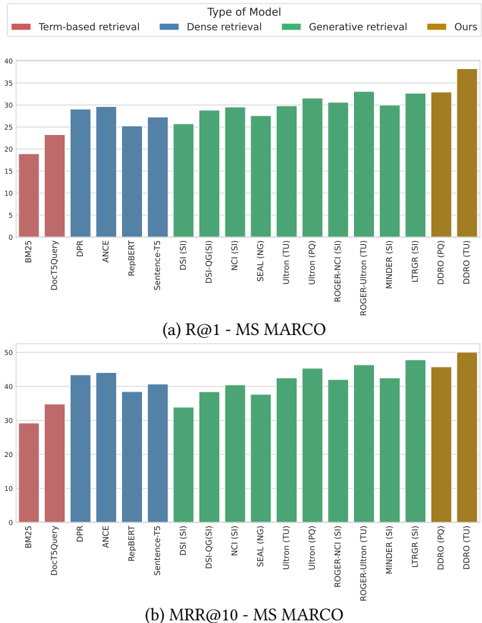
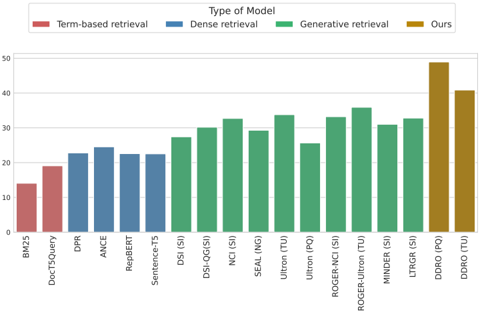
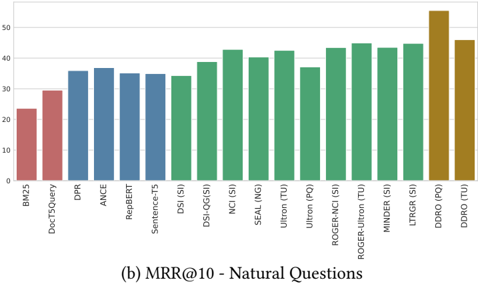
- DDRO outperforms RLRF/GenRRL: on MS MARCO, DDRO (TU) beats GenRRL (Sum) by 15.06% in R@1 and 7.4% in MRR@10; on NQ, DDRO (PQ) beats GenRRL (Sum) by 34.69% in R@1 and 19.87% in MRR@10.
- Against established baselines: on MS MARCO, DDRO (TU) improves over the best baseline ROGER-Ultron by 15.63% in R@1 and 8.03% in MRR@10; on NQ, DDRO (PQ) improves over ROGER-Ultron (TU) by 36.27% in R@1 and 23.58% in MRR@10.
- Ablation shows pairwise ranking matters: removing it lowers NQ DDRO (PQ) from 48.92 to 44.19 R@1 and from 55.51 to 50.48 MRR@10; on MS MARCO, DDRO (TU) drops from 66.46 to 64.60 R@5 and from 74.01 to 72.90 R@10.
- Docid design interacts with dataset: DDRO (TU) is strongest on MS MARCO (38.24 R@1, 50.07 MRR@10), while DDRO (PQ) is strongest on NQ (48.92 R@1, 55.51 MRR@10).
Methods
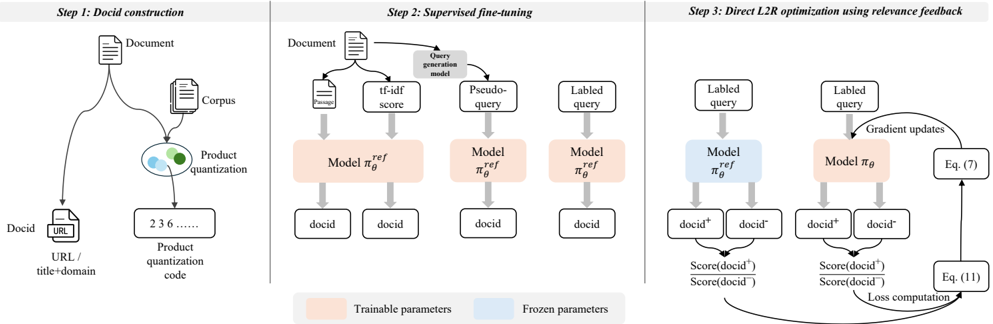
- Two docid types are constructed: TU (reverse URL if semantically rich, otherwise title + domain) and PQ (product quantization codes from a T5-based encoder).
- Supervised fine-tuning uses T5-base with indexing and retrieval tasks, passage-to-docid pairs, tf-idf-selected term-to-docid pairs, and pseudo-queries generated by DocT5Query (10 per document).
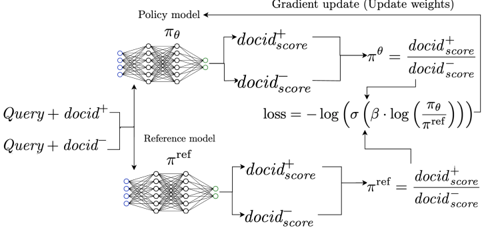
- DDRO then directly optimizes pairwise ranking with a reference-policy constraint, initialized from the SFT model and trained with a modified Hugging Face TRL DPOTrainer; experiments use MS MARCO document ranking (320k documents, 360k query-document pairs) and NQ320k (320k query-document pairs), evaluated by R@1/5/10 and MRR@10 with paired t-tests at p < 0.05.
Limitations
- Stated: evaluation primarily focuses on a subset of the MS MARCO document dataset, leaving scalability to larger, domain-specific, and multilingual corpora unexplored.
- Stated: future work includes listwise ranking, advanced hard negative mining, and multi-objective optimization; a comprehensive comparison with scalable GenIR baselines such as RIPOR and PAG remains future work.
- Evident from the text: only two benchmark datasets are used, and document summaries are excluded as docids because they depend on external summarization models, which limits direct comparison with GenRRL (Sum).
Model-written summary. Check it against the paper before relying on it.
Integrity signals
Registry
Cites
Statistics
Figures
Verification
Claims the paper makes
2 Valid · 3 Not valid · 1 Not checked · 50 Own results and interpretations
The cited sources that could be checked couldn’t confirm or dispute this claim.
In the paper
“However, existing GenIR models suffer from token-level misalignment, where models trained to predict the next token often fail to capture document-level relevance effectively.”
- Also stated in: § 3.2 Learning to Rank (L2R) · plain
“A fundamental challenge in GenIR stems from the inherent misalignment between the optimization objectives of autoregressive models and the overarching objectives of document ranking tasks.”
§ Lightweight and Direct Document Relevance Optimization for Generative Information Retrieval > Abstract
What the sources say
- Could not verifycites [28] 28. Mike Lewis, Yinhan Liu, Naman Goyal, Marjan Ghazvininejad, Abdelrahman Mohamed, Omer Levy, Veselin Stoyanov, and Luke Zettlemoyer. 2020. BART: Denoising Sequence-to-Sequence Pre-training for Natural Language Generation, Translation, and Comprehension. In Proceedings of the 58th Annual Meeting of the Association for Computational Linguistics, Dan Jurafsky, Joyce Chai, Natalie Schluter, and Joel Tetreault (Eds.). Association for Computational Linguistics, Online, 7871-7880. https://doi.org/10.18653/v1/2020.acl-main.703 sourceExperimental — accuracy not yet measured
Section 2 (Model) describes BART’s autoregressive decoder, while Section 4.3 (Results) compares pre-training methods across tasks; page numbers are not provided in our copy. Neither section addresses GenIR, docid generation, token-level misalignment with document relevance, or its effect on ranking. Searches for those terms and paraphrases found no passage that does. (LLM, conf=0.78)
- Could not verifycites [68] 68. Lee Xiong, Chenyan Xiong, Ye Li, Kwok-Fung Tang, Jialin Liu, Paul Bennett, Junaid Ahmed, and Arnold Overwijk. 2020. Approximate Nearest Neighbor Negative Contrastive Learning for Dense Text Retrieval. https://doi.org/10. 48550/ARXIV.2007.00808 sourceExperimental — accuracy not yet measured
The Related Work section (p. 8) describes dense retrieval through embedding-space search, and the training analysis (p. 3) discusses the informativeness of negative samples. Searches for autoregressive docid generation, next-token prediction, and token-level misalignment found no passage addressing the claimed failure of GenIR models. (LLM, conf=0.76)
- Could not verifycites [69] 69. Andrew Yates, Rodrigo Nogueira, and Jimmy Lin. 2021. Pretrained Transformers for Text Ranking: BERT and Beyond. In Proceedings of the 2021 Conference of the North American Chapter of the Association for Computational Linguistics: Human Language Technologies: Tutorials, Greg Kondrak, Kalina Bontcheva, and Dan Gillick (Eds.). Association for Computational Linguistics, Online, 1-4. sourceExperimental — accuracy not yet measured
Our copy of the 4-page NAACL 2021 tutorial covers only two categories of transformer ranking work — multi-stage ranking/reranking (Sec. 2) and learned dense representations (Sec. 3) — plus a short 'Looking Ahead' (Sec. 4). Generative retrieval with autoregressive document-identifier (docid) generation is mentioned only in passing as 'adapting pretrained sequence-to-sequence models (Nogueira et al., 2020; dos Santos et al., 2020)' among efforts 'beyond BERT'; the tutorial makes no statement about token-level misalignment, next-token training objectives failing to capture document-level relevance, or resulting suboptimal ranking performance. Searches for 'token-level misalignment', 'docid/identifier generation', 'autoregressive/generative retrieval', and 'next token prediction vs ranking loss' returned no passage on the point, so the claim can be neither confirmed nor contradicted from our copy. (LLM, conf=0.72)
plainstates a cause- Asserted: passes — The authors put it forward as true.
- Checkable: passes — It can be checked against evidence.
- Load-bearing: passes — The paper’s conclusions depend on it.
- Based: passes — The paper gives a reason why it holds.
- Also stated in: § 3.2 Learning to Rank (L2R) · plain
The cited sources support only part of this claim — read each source’s verdict below.
In the paper
“The performance of dense retrieval baselines is generally better than that of sparse retrieval baselines, likely because the former uses dense vectors to capture richer semantic information, which is also consistent with the findings [31,32].”
§ Lightweight and Direct Document Relevance Optimization for Generative Information Retrieval > 6.2 Comparison with Established Baselines
What the sources say
- Partly supportedcites [31] 31. Anna Rogers, Jordan Boyd-Graber, and Naoaki Okazaki (Eds.). Association for Computational Linguistics, Toronto, Canada, 6636-6648. https://doi.org/10. 18653/v1/2023.acl-long.366 sourceExperimental — accuracy not yet measured
Section 4.3 and Table 2 compare dense and sparse retrieval baselines on MS MARCO; several dense models outperform the sparse baselines. The paper does not report results on MS300K, so it supports the general comparison but not the claim for that dataset. (LLM, conf=0.85)
- Not checked yetcites [32] 32. Zihao Li, Zhuoran Yang, and Mengdi Wang. 2023. Reinforcement Learning with Human Feedback: Learning Dynamic Choices via Pessimism. https: //doi.org/10.48550/ARXIV.2305.18438 source
Checked before — its earlier verdict is held back until a new check runs.
hedgedstates an association- Asserted: passes — The authors put it forward as true.
- Checkable: passes — It can be checked against evidence.
- Load-bearing: unclear — It is unclear whether the paper’s conclusions depend on it.
- Based: passes — The paper gives a reason why it holds.
- Partly supported
A result the paper reports from its own data — it cites no other source for it, so there is none to check. The quote shows it is in the paper.
In the paper
“(ii) Dense retrieval baselines, including DPR and ANCE, improve early ranking metrics over term-based methods.”
§ Lightweight and Direct Document Relevance Optimization for Generative Information Retrieval > Comparison to baseline retrieval models.
plainstates a cause- Asserted: passes — The authors put it forward as true.
- Checkable: passes — It can be checked against evidence.
- Load-bearing: unclear — It is unclear whether the paper’s conclusions depend on it.
- Based: passes — The paper gives a reason why it holds.
A result the paper reports from its own data — it cites no other source for it, so there is none to check. The quote shows it is in the paper.
In the paper
“On the MS MARCO dataset, removing pairwise ranking optimization significantly reduces intermediate and broader recall metrics (R@5 and R@10) for both DDRO variants, highlighting its critical role in improving retrieval performance.”
§ Lightweight and Direct Document Relevance Optimization for Generative Information Retrieval > 6.3 Ablation Study
plainstates a cause- Asserted: passes — The authors put it forward as true.
- Checkable: passes — It can be checked against evidence.
- Load-bearing: passes — The paper’s conclusions depend on it.
- Based: passes — The paper gives a reason why it holds.
A result the paper reports from its own data — it cites no other source for it, so there is none to check. The quote shows it is in the paper.
In the paper
“However, at broader recall levels (R@10), ROGER-Ultron (TU) shows a slight advantage over DDRO (TU).”
§ Lightweight and Direct Document Relevance Optimization for Generative Information Retrieval > 6.5 Analysis of Relevance Distribution
plainstates an association- Asserted: passes — The authors put it forward as true.
- Checkable: passes — It can be checked against evidence.
- Load-bearing: unclear — It is unclear whether the paper’s conclusions depend on it.
- Based: passes — The paper gives a reason why it holds.
18 more claims
Create a free account to see all 56 claims and to verify the 2 references still open.
- It may state two separate claims as one. 25
- Probably not a substantial claim. 11
- Borderline: one of the tests for a substantial claim is unclear. 2
- The quote only partly states this claim. 2
Self-check
Percentages, sums and reported differences re-computed from the paper’s own numbers.
Each contradiction between two passages listed here was confirmed by an independent check.
Rated minor: it would not touch a result — a value no result rests on, a p-value that stays on the same side of the significance level, or a conflict that is clerical, resolved elsewhere in the paper, or outside its own findings.
In the paper
§ Lightweight and Direct Document Relevance Optimization for Generative Information Retrieval > 4.3 Direct L2R Optimization Using Relevance Feedback
“The gradient with respect to the model parameters 𝜃 is defined as in Eq. 7, where”
§ Lightweight and Direct Document Relevance Optimization for Generative Information Retrieval > 4.2 Supervised Fine-tuning
“passage : {𝑤 𝑖 , 𝑤 𝑖+1 , . . . , 𝑤 𝑖+𝑚-1 } → 𝑑𝑜𝑐𝑖𝑑, (7”
Rated minor: it would not touch a result — a value no result rests on, a p-value that stays on the same side of the significance level, or a conflict that is clerical, resolved elsewhere in the paper, or outside its own findings.
In the paper
§ Lightweight and Direct Document Relevance Optimization for Generative Information Retrieval > 6.1 Comparison with Reinforcement Learning-Based Methods
“To address RQ1, we compare DDRO with GenRRL [68] on both datasets.Results are presented in Table 1 and Table 2.”
§ Lightweight and Direct Document Relevance Optimization for Generative Information Retrieval > References
“68. Lee Xiong, Chenyan Xiong, Ye Li, Kwok-Fung Tang, Jialin Liu, Paul Bennett, Junaid Ahmed, and Arnold Overwijk. 2020. Approximate Nearest Neighbor Negative Contrastive Learning for Dense Text Retrieval. https://doi.org/10. 48550/ARXIV.2007.00808”
Rated minor: it would not touch a result — a value no result rests on, a p-value that stays on the same side of the significance level, or a conflict that is clerical, resolved elsewhere in the paper, or outside its own findings.
In the paper
§ Lightweight and Direct Document Relevance Optimization for Generative Information Retrieval > 5.1 Datasets and Evaluation Metrics
“the Natural Questions (NQ) datasetfoot_1 [23].”
§ Lightweight and Direct Document Relevance Optimization for Generative Information Retrieval > References
“23. Varsha Kishore, Chao Wan, Justin Lovelace, Yoav Artzi, and Kilian Q. Weinberger. 2023. IncDSI: incrementally updatable document retrieval.”
Citations
Cites
Proceedings of the 24th international conference on Machine learning
(2007) · doi:10.1145/1273496 · Cited by 11,630
Exploring the Limits of Transfer Learning with a Unified Text-to-Text Transformer
Raffel, C., Shazeer, N., Roberts, A., Lee, K., Narang, S., Matena, M., Zhou, Y., Li, W., & Liu, P. J. (2019) · arXiv · doi:10.48550/arxiv.1910.10683 · Cited by 10,929
Proximal Policy Optimization Algorithms
Schulman, J., Wolski, F., Dhariwal, P., Radford, A., & Klimov, O. (2017) · arXiv · doi:10.48550/arxiv.1707.06347 · Cited by 10,625
Lewis, M., Liu, Y., Goyal, N., Ghazvininejad, M., Mohamed, A., Levy, O., Stoyanov, V., & Zettlemoyer, L. (2020) · Proceedings of the 58th Annual Meeting of the Association for Computational Linguistics · doi:10.18653/v1/2020.acl-main.703 · Cited by 8,821 · cited 1×
“GenIR models build on large pre-trained language models, such as T5 [41] and BART [27], and are designed to take a query string and generate a ranked list of document identifiers (docids) based on their generation probabilities, ordered in descending sequence.”
Dense Passage Retrieval for Open-Domain Question Answering
Karpukhin, V., Oğuz, B., Min, S., Lewis, P., Wu, L., Edunov, S., Chen, D., & Yih, W.-T. (2020) · arXiv · doi:10.48550/arxiv.2004.04906 · Cited by 5,311
LLaMA: Open and Efficient Foundation Language Models
Touvron, H., Lavril, T., Izacard, G., Martinet, X., Lachaux, M.-A., Lacroix, T., Rozière, B., Goyal, N., Hambro, E., Azhar, F., et al. (2023) · arXiv · doi:10.48550/arxiv.2302.13971 · Cited by 4,602
A Learning Algorithm for Continually Running Fully Recurrent Neural Networks
Williams, R. J., & Zipser, D. (1989) · Neural Computation · doi:10.1162/neco.1989.1.2.270 · Cited by 4,369
Dense passage retrieval for open-domain question answering
Karpukhin, V., Oguz, B., Min, S., Lewis, P., Wu, L., Edunov, S., Chen, D., & Yih, W.-T. (2020) · Proceedings of the 2020 Conference on Empirical Methods in Natural Language Processing (EMNLP) · doi:10.18653/v1/2020.emnlp-main.550 · Cited by 3,575 · cited 4×
“A widely recognized approach [39, 47, 73] optimizes the reward function using Proximal Policy Optimization (PPO) [46], and defines the reward function as: GenRRL [68] trains a reward model using relevance-annotated data derived from BM25 [44], DPR [21], and LLaMA-13b [53].”
InfluentialThe probabilistic relevance framework: BM25 and beyond
Robertson, S., & Zaragoza, H. (2009) · Foundations and Trends® in Information Retrieval · doi:10.1561/1500000019 · Cited by 3,374 · cited 5×
“Positive samples were selected based on qrels relevance judgments, while negatives were drawn from the top 1000 BM25-retrieved documents, stratified into top (1–100), mid (101–500), and lower (501–1000) ranks.”
InfluentialTraining Language Models to Follow Instructions with Human Feedback
Ouyang, L., Wu, J., Jiang, X., Almeida, D., Wainwright, C., Mishkin, P., Zhang, C., Agarwal, S., Slama, K., Ray, A., et al. (2022) · Advances in Neural Information Processing Systems 35 · doi:10.52202/068431-2011 · Cited by 3,117
Learning to rank using gradient descent
Burges, C., Shaked, T., Renshaw, E., Lazier, A., Deeds, M., Hamilton, N., & Hullender, G. (2005) · Proceedings of the 22nd international conference on Machine learning - ICML '05 · doi:10.1145/1102351.1102363 · Cited by 2,836
MS MARCO: A Human Generated MAchine Reading COmprehension Dataset
Bajaj, P., Campos, D., Craswell, N., Deng, L., Gao, J., Liu, X., Majumder, R., McNamara, A., Mitra, B., Nguyen, T., et al. (2016) · arXiv · doi:10.48550/arxiv.1611.09268 · Cited by 2,473
Natural Questions: A benchmark for question answering research
Kwiatkowski, T., Palomaki, J., Redfield, O., Collins, M., Parikh, A., Alberti, C., Epstein, D., Polosukhin, I., Devlin, J., Lee, K., et al. (2019) · Transactions of the Association for Computational Linguistics · doi:10.1162/tacl_a_00276 · Cited by 2,069 · cited 2×
“We conduct our experiments using two widely recognized benchmarks: the MS MARCO Document Ranking dataset [3]andthe NaturalQuestions(NQ) dataset 2 [23].”
Learning to rank: from pairwise approach to listwise approach
Cao, Z., Qin, T., Liu, T.-Y., Tsai, M.-F., & Li, H. (2007) · Proceedings of the 24th international conference on Machine learning · doi:10.1145/1273496.1273513 · Cited by 1,960 · cited 2×
“To address the aforementioned limitations, Zhou et al. [68] propose GenRRL, a generative retrieval model based on RLRF to optimize generative models for alignment with document-level relevance.”
Deep reinforcement learning from human preferences
Christiano, P., Leike, J., Brown, T. B., Martic, M., Legg, S., & Amodei, D. (2017) · arXiv · doi:10.48550/arxiv.1706.03741 · Cited by 1,058 · cited 1×
“RLRF optimizes rewards while ensuring alignment with human preferences using a KL divergence constraint [2, 12, 30, 35, 39, 47, 68].”
(2006) · doi:10.7551/mitpress/7503.003.0029 · Cited by 753
Listwise approach to learning to rank: theory and algorithm
Xia, F., Liu, T.-Y., Wang, J., Zhang, W., & Li, H. (2008) · Proceedings of the 25th international conference on Machine learning - ICML '08 · doi:10.1145/1390156.1390306 · Cited by 702 · cited 1×
“This reward model guides reinforcement learning to optimize the language model’s policy for generating high-reward outputs, with a KL divergence constraint ensuring alignment with the original supervised fine-tuned model or the reference policy 𝜋 ref .”
Nogueira, R., & Cho, K. (2019) · arXiv · doi:10.48550/arxiv.1901.04085 · Cited by 615 · cited 1×
“Building on the success of transformer-based pre-trained language models, recent research has explored various neural retrieval approaches [61]: learned sparse retrieval [15, 16], dense retrieval [20, 60, 64, 65], and cross-encoders [37].”
Training a Helpful and Harmless Assistant with Reinforcement Learning from Human Feedback
Bai, Y., Jones, A., Ndousse, K., Askell, A., Chen, A., DasSarma, N., Drain, D., Fort, S., Ganguli, D., Henighan, T., et al. (2022) · arXiv · doi:10.48550/arxiv.2204.05862 · Cited by 442
Passage-level evidence in document retrieval
Callan, J. P. (1994) · doi:10.5555/188490.188589 · Cited by 414
Fine-Tuning Language Models from Human Preferences
Ziegler, D. M., Stiennon, N., Wu, J., Brown, T. B., Radford, A., Amodei, D., Christiano, P., & Irving, G. (2019) · arXiv · doi:10.48550/arxiv.1909.08593 · Cited by 413 · cited 1×
“Finally, direct learning-to-rank (L2R) optimization is applied, using relevance feedback to refine the model’s ranking quality and align its outputs with document-level relevance (Section 4.3).”
InfluentialSPLADE: Sparse Lexical and Expansion Model for First Stage Ranking
Formal, T., Piwowarski, B., & Clinchant, S. (2021) · Proceedings of the 44th International ACM SIGIR Conference on Research and Development in Information Retrieval · doi:10.1145/3404835.3463098 · Cited by 394 · cited 1×
“Building on the success of transformer-based pre-trained language models, recent research has explored various neural retrieval approaches [61]: learned sparse retrieval [15, 16], dense retrieval [20, 60, 64, 65], and cross-encoders [37].”
SPLADE v2: Sparse Lexical and Expansion Model for Information RetrievalPreprint
Formal, T., Lassance, C., Piwowarski, B., & Clinchant, S. (2021) · arXiv (Cornell University) · doi:10.48550/arxiv.2109.10086 · Cited by 366
Sentence-T5: Scalable Sentence Encoders from Pre-trained Text-to-Text Models
Ni, J., Hernandez Abrego, G., Constant, N., Ma, J., Hall, K., Cer, D., & Yang, Y. (2022) · Findings of the Association for Computational Linguistics: ACL 2022 · doi:10.18653/v1/2022.findings-acl.146 · Cited by 353 · cited 2×
“The resulting docid is defined as: where the encoder is based on a pre-trained T5 model [36].”
Bai, Y., Kadavath, S., Kundu, S., Askell, A., Kernion, J., Jones, A., Chen, A., Goldie, A., Mirhoseini, A., & Kaplan, J. (2022) · arXiv (Cornell University) · doi:10.48550/arxiv.2212.08073 · Cited by 326 · cited 1×
“Subsequently, the retrieval model is trained through a combination of self-supervised and supervised learning techniques (Section 4.2).”
InfluentialDeduplicating Training Data Makes Language Models Better
Lee, K., Ippolito, D., Nystrom, A., Zhang, C., Eck, D., Callison-Burch, C., & Carlini, N. (2022) · Proceedings of the 60th Annual Meeting of the Association for Computational Linguistics (Volume 1: Long Papers) · doi:10.18653/v1/2022.acl-long.577 · Cited by 304 · cited 1×
“To ensure reliable evaluation and improve performance [26], we deduplicate documents by title and utilize the predefined training and validation splits.”
Direct Preference Optimization: Your Language Model is Secretly a Reward Model
Rafailov, R., Sharma, A., Mitchell, E., Ermon, S., Manning, C. D., & Finn, C. (2023) · arXiv · doi:10.48550/arxiv.2305.18290 · Cited by 293 · cited 2×
“Finally, direct learning-to-rank (L2R) optimization is applied, using relevance feedback to refine the model’s ranking quality and align its outputs with document-level relevance (Section 4.3).”
InfluentialWebGPT: Browser-assisted question-answering with human feedback
Nakano, R., Hilton, J., Balaji, S., Wu, J., Ouyang, L., Kim, C., Hesse, C., Jain, S., Kosaraju, V., Saunders, W., et al. (2021) · arXiv · doi:10.48550/arxiv.2112.09332 · Cited by 272
Optimizing Dense Retrieval Model Training with Hard Negatives
Zhan, J., Mao, J., Liu, Y., Guo, J., Zhang, M., & Ma, S. (2021) · arXiv · doi:10.48550/arxiv.2104.08051 · Cited by 251 · cited 1×
“Building on the success of transformer-based pre-trained language models, recent research has explored various neural retrieval approaches [61]: learned sparse retrieval [15, 16], dense retrieval [20, 60, 64, 65], and cross-encoders [37].”
Optimizing Dense Retrieval Model Training with Hard Negatives
Zhan, J., Mao, J., Liu, Y., Guo, J., Zhang, M., & Ma, S. (2021) · Proceedings of the 44th International ACM SIGIR Conference on Research and Development in Information Retrieval · doi:10.1145/3404835.3462880 · Cited by 248 · cited 1×
“Building on the success of transformer-based pre-trained language models, recent research has explored various neural retrieval approaches [61]: learned sparse retrieval [15, 16], dense retrieval [20, 60, 64, 65], and cross-encoders [37].”
Approximate Nearest Neighbor Negative Contrastive Learning for Dense Text Retrieval
Xiong, L., Xiong, C., Li, Y., Tang, K.-F., Liu, J., Bennett, P., Ahmed, J., & Overwijk, A. (2020) · arXiv · doi:10.48550/arxiv.2007.00808 · Cited by 204 · cited 2×
“Building on the success of transformer-based pre-trained language models, recent research has explored various neural retrieval approaches [61]: learned sparse retrieval [15, 16], dense retrieval [20, 60, 64, 65], and cross-encoders [37].”
Autoregressive Entity Retrieval
Cao, N. D., Izacard, G., Riedel, S., & Petroni, F. (2020) · arXiv (Cornell University) · doi:10.48550/arxiv.2010.00904 · Cited by 193
Passage-Level Evidence in Document Retrieval
Callan, J. P. (1994) · SIGIR ’94 · doi:10.1007/978-1-4471-2099-5_31 · Cited by 182
Disentangled Contrastive Collaborative Filtering
Ren, X., Xia, L., Zhao, J., Yin, D., & Huang, C. (2023) · Proceedings of the 46th International ACM SIGIR Conference on Research and Development in Information Retrieval · doi:10.1145/3539618.3591665 · Cited by 171
Pretrained Transformers for Text Ranking: BERT and Beyond
Yates, A., Nogueira, R., & Lin, J. (2021) · Proceedings of the 14th ACM International Conference on Web Search and Data Mining · doi:10.1145/3437963.3441667 · Cited by 170
The LambdaLoss Framework for Ranking Metric Optimization
Wang, X., Li, C., Golbandi, N., Bendersky, M., & Najork, M. (2018) · Proceedings of the 27th ACM International Conference on Information and Knowledge Management · doi:10.1145/3269206.3271784 · Cited by 136 · cited 2×
“To address the aforementioned limitations, Zhou et al. [68] propose GenRRL, a generative retrieval model based on RLRF to optimize generative models for alignment with document-level relevance.”
Transformer Memory as a Differentiable Search Index
Tay, Y., Tran, V., Dehghani, M., Ni, J., Bahri, D., Mehta, H., Qin, Z., Hui, K., Zhao, Z., Gupta, J., et al. (2022) · Advances in Neural Information Processing Systems 35 · doi:10.52202/068431-1587 · Cited by 128
Human-centric Dialog Training via Offline Reinforcement Learning
Jaques, N., Shen, J. H., Ghandeharioun, A., Ferguson, C., Lapedriza, À., Jones, N., Gu, S., & Picard, R. W. (2020) · Conference on Empirical Methods in Natural Language Processing · doi:10.48550/arxiv.2010.05848 · Cited by 126
Human-centric dialog training via offline reinforcement learning
Jaques, N., Shen, J. H., Ghandeharioun, A., Ferguson, C., Lapedriza, À., Jones, N. C., Gu, S., & Picard, R. W. (2020) · Conference on Empirical Methods in Natural Language Processing (EMNLP) · doi:10.18653/v1/2020.emnlp-main.327 · Cited by 124 · cited 1×
“This method refines model predictions using a learned reward function, as formalized in prior research [18, 19]: where 𝛽 is a parameter controlling deviation from the base reference policy 𝜋 ref , which is typically the initial supervised fine-tuned model.”
Recommender Systems with Generative Retrieval
Rajput, S., Mehta, N., Singh, A., Keshavan, R. H., Vu, T., Heldt, L., Hong, L., Tay, Y., Tran, V., Samost, J., et al. (2023) · neural information processing systems · doi:10.52202/075280-0452 · Cited by 119
Ferro, N., Fuhr, N., Maistro, M., Sakai, T., & Soboroff, I. M. (2019) · Lecture notes in computer science · doi:10.1007/978-3-030-15719-7 · Cited by 113
Rethinking search: making domain experts out of dilettantes
Metzler, D., Tay, Y., Bahri, D., & Najork, M. (2021) · ACM SIGIR Forum · doi:10.1145/3476415.3476428 · Cited by 112 · cited 2×
“A new paradigm has recently been added to this palette, generative information retrieval (GenIR) [34, 52].”
Ultron: An Ultimate Retriever on Corpus with a Model-based IndexerPreprint
Zhou, Y., Yao, J., Dou, Z., Wu, L., Zhang, P., & Wen, J.-R. (2022) · arXiv (Cornell University) · doi:10.48550/arxiv.2208.09257 · Cited by 102 · cited 10×
“In contrast, the second category, termed computationally-generated are derived using techniques like quantization [8, 42, 62, 63, 71] or hierarchical clustering algorithms [33, 48, 52, 56] to encode deeper semantics by abstracting raw document content into conceptual features.”
InfluentialSequence Tutor: Conservative Fine-Tuning of Sequence Generation Models with KL-control
Jaques, N., Gu, S., Bandanau, D., Hernández-Lobato, J. M., Turner, R. E., & Eck, D. (2016) · arXiv (Cornell University) · doi:10.17863/cam.21343 · Cited by 84
Autoregressive Search Engines: Generating Substrings as Document Identifiers
Bevilacqua, M., Ottaviano, G., Lewis, P., Yih, W.-T., Riedel, S., & Petroni, F. (2022) · arXiv · doi:10.48550/arxiv.2204.10628 · Cited by 80 · cited 2×
“The first category, referred to as content-derived docids, includes identifiers that are extracted directly from document elements such as titles [10, 11, 14, 25], n-grams [4, 9, 28, 29, 57], URLs [43, 68, 71, 74], and key terms [67].”
Autoregressive Search Engines: Generating Substrings as Document Identifiers
Bevilacqua, M., Ottaviano, G., Lewis, P., Yih, S., Riedel, S., & Petroni, F. (2022) · neural information processing systems · doi:10.52202/068431-2296 · Cited by 76
A Neural Corpus Indexer for Document Retrieval
Wang, Y., Hou, Y., Wang, H., Miao, Z., Wu, S., Chen, Q., Xia, Y., Chi, C., Zhao, G., Liu, Z., et al. (2022) · Advances in Neural Information Processing Systems 35 · doi:10.52202/068431-1856 · Cited by 69
GERE: Generative Evidence Retrieval for Fact Verification
Chen, J., Zhang, R., Guo, J., Fan, Y., & Cheng, X. (2022) · Proceedings of the 45th International ACM SIGIR Conference on Research and Development in Information Retrieval · doi:10.1145/3477495.3531827 · Cited by 66 · cited 1×
“The first category, referred to as content-derived docids, includes identifiers that are extracted directly from document elements such as titles [10, 11, 14, 25], n-grams [4, 9, 28, 29, 57], URLs [43, 68, 71, 74], and key terms [67].”
Generative Retrieval via Term Set Generation
Zhang, P., Liu, Z., Zhou, Y., Dou, Z., Liu, F., & Cao, Z. (2024) · International ACM SIGIR Conference on Research and Development in Information Retrieval (SIGIR) · doi:10.1145/3626772.3657797 · Cited by 66
Towards Federated Learning against Noisy Labels via Local Self-Regularization
Jiang, X., Sun, S., Wang, Y., & Liu, M. (2022) · Proceedings of the 31st ACM International Conference on Information & Knowledge Management · doi:10.1145/3511808.3557475 · Cited by 65
CorpusBrain: Pre-train a Generative Retrieval Model for Knowledge-Intensive Language Tasks
Chen, J., Zhang, R., Guo, J., Liu, Y., Fan, Y., & Cheng, X. (2022) · Proceedings of the 31st ACM International Conference on Information & Knowledge Management · doi:10.1145/3511808.3557271 · Cited by 57
RepBERT: Contextualized Text Embeddings for First-Stage Retrieval
Zhan, J., Mao, J., Liu, Y., Zhang, M., & Ma, S. (2020) · arXiv (Cornell University) · doi:10.48550/arxiv.2006.15498 · Cited by 54 · cited 2×
“(iii) RepBERT [66], a BERT-based model that generates fixed-length contextualized embeddings, with query– document relevance computed via inner product similarity.”
Less is More: Pretrain a Strong Siamese Encoder for Dense Text Retrieval Using a Weak Decoder
Lu, S., He, D., Xiong, C., Ke, G., Malik, W., Dou, Z., Bennett, P., Liu, T.-Y., & Overwijk, A. (2021) · Proceedings of the 2021 Conference on Empirical Methods in Natural Language Processing · doi:10.18653/v1/2021.emnlp-main.220 · Cited by 49 · cited 1×
“From Table 4, we can find: (i) On the MS MARCO dataset, removing pair-wise ranking optimization significantly reduces intermediate and broader recall metrics (R@5 and R@10) for both DDRO variants, highlighting its critical role in improving retrieval performance.”
Comparing Pointwise and Listwise Objective Functions for Random-Forest-Based Learning-to-Rank
Ibrahim, M., & Carman, M. (2016) · ACM Transactions on Information Systems · doi:10.1145/2866571 · Cited by 47 · cited 1×
“RLRF optimizes rewards while ensuring alignment with human preferences using a KL divergence constraint [2, 12, 30, 35, 39, 47, 68].”
Enhancing Generative Retrieval with Reinforcement Learning from Relevance Feedback
Zhou, Y., Dou, Z., & Wen, J.-R. (2023) · Conference on Empirical Methods in Natural Language Processing (EMNLP) · doi:10.18653/v1/2023.emnlp-main.768 · Cited by 46 · cited 10×
“Subsequently, the retrieval model is trained through a combination of self-supervised and supervised learning techniques (Section 4.2).”
InfluentialCurriculum Learning for Dense Retrieval Distillation
Zeng, H., Zamani, H., & Vinay, V. (2022) · Proceedings of the 45th International ACM SIGIR Conference on Research and Development in Information Retrieval · doi:10.1145/3477495.3531791 · Cited by 41 · cited 1×
“Building on the success of transformer-based pre-trained language models, recent research has explored various neural retrieval approaches [61]: learned sparse retrieval [15, 16], dense retrieval [20, 60, 64, 65], and cross-encoders [37].”
Continual Learning for Generative Retrieval over Dynamic Corpora
Chen, J., Zhang, R., Guo, J., de Rijke, M., Chen, W., Fan, Y., & Cheng, X. (2023) · Proceedings of the 32nd ACM International Conference on Information and Knowledge Management · doi:10.1145/3583780.3614821 · Cited by 40 · cited 2×
“In contrast, the second category, termed computationally-generated are derived using techniques like quantization [8, 42, 62, 63, 71] or hierarchical clustering algorithms [33, 48, 52, 56] to encode deeper semantics by abstracting raw document content into conceptual features.”
SPLADE: Sparse Lexical and Expansion Model for First Stage RankingPreprint
Formal, T., Piwowarski, B., & Clinchant, S. (2021) · arXiv (Cornell University) · doi:10.48550/arxiv.2107.05720 · Cited by 39
Multiview Identifiers Enhanced Generative Retrieval
Li, Y., Yang, N., Wang, L., Wei, F., & Li, W. (2023) · Proceedings of the 61st Annual Meeting of the Association for Computational Linguistics (Volume 1: Long Papers) · doi:10.18653/v1/2023.acl-long.366 · Cited by 37
Listwise Generative Retrieval Models via a Sequential Learning Process
Tang, Y., Zhang, R., Guo, J., de Rijke, M., Chen, W., & Cheng, X. (2024) · ACM Transactions on Information Systems · doi:10.1145/3653712 · Cited by 37 · cited 1×
“The optimization process involves supervised fine-tuning using negative log-likelihood, pairwise ranking loss for the reward model, and reinforcement learning techniques incorporating pointwise, pairwise, and list-wise approaches to enhance ranking performance.”
Self-citationPre-train a Discriminative Text Encoder for Dense Retrieval via Contrastive Span Prediction
Ma, X., Guo, J., Zhang, R., Fan, Y., & Cheng, X. (2022) · Proceedings of the 45th International ACM SIGIR Conference on Research and Development in Information Retrieval · doi:10.1145/3477495.3531772 · Cited by 35 · cited 1×
“From Table 4, we can find: (i) On the MS MARCO dataset, removing pair-wise ranking optimization significantly reduces intermediate and broader recall metrics (R@5 and R@10) for both DDRO variants, highlighting its critical role in improving retrieval performance.”
A Unified Generative Retriever for Knowledge-Intensive Language Tasks via Prompt Learning
Chen, J., Zhang, R., Guo, J., de Rijke, M., Liu, Y., Fan, Y., & Cheng, X. (2023) · Proceedings of the 46th International ACM SIGIR Conference on Research and Development in Information Retrieval · doi:10.1145/3539618.3591631 · Cited by 32
Scalable and Effective Generative Information Retrieval
Zeng, H., Luo, C., Jin, B., Sarwar, S. M., Wei, T., & Zamani, H. (2024) · Proceedings of the ACM Web Conference 2024 · doi:10.1145/3589334.3645477 · Cited by 32 · cited 9×
“The generation process is controlled through (constrained) beam search [33, 52, 56, 62, 63, 72].”
InfluentialLarge Language Models are Built-in Autoregressive Search Engines
Ziems, N., Yu, W., Zhang, Z., & Jiang, M. (2023) · Findings of the Association for Computational Linguistics: ACL 2023 · doi:10.18653/v1/2023.findings-acl.167 · Cited by 31
Semantic-Enhanced Differentiable Search Index Inspired by Learning Strategies
Tang, Y., Zhang, R., Guo, J., Chen, J., Zhu, Z., Wang, S., Yin, D., & Cheng, X. (2023) · Proceedings of the 29th ACM SIGKDD Conference on Knowledge Discovery and Data Mining · doi:10.1145/3580305.3599903 · Cited by 29 · cited 1×
“It has inspired the development of several models, including NCI [56], DSI-QG [72], DSI++ [33], SEAL [4], ULTRON [71], TOME [43], IncDSI [22], RI-POR [62], and PAG [63].”
Self-citationLearning to Rank in Generative Retrieval
Li, Y., Yang, N., Wang, L., Wei, F., & Li, W. (2024) · Proceedings of the AAAI Conference on Artificial Intelligence · doi:10.1609/aaai.v38i8.28717 · Cited by 27
Learning to Rank in Generative Retrieval
Li, Y., Yang, N., Wang, L., Wei, F., & Li, W. (2023) · arXiv · doi:10.48550/arxiv.2306.15222 · Cited by 27 · cited 4×
“The retrieval phase employs a (constrained) beam search algorithm to decode the most probable docid, with their generation probabilities determining the final ranking [33, 52, 56, 62, 63, 72].”
InfluentialImproving Document Representations by Generating Pseudo Query Embeddings for Dense Retrieval
Tang, H., Sun, X., Jin, B., Wang, J., Zhang, F., & Wu, W. (2021) · Proceedings of the 59th Annual Meeting of the Association for Computational Linguistics and the 11th International Joint Conference on Natural Language Processing (Volume 1: Long Papers) · doi:10.18653/v1/2021.acl-long.392 · Cited by 26 · cited 1×
“PseudoQ [49] improves DPR by generating pseudo-queries using K-means clustering over document embeddings.”
NOVO: Learnable and Interpretable Document Identifiers for Model-Based IR
Wang, Z., Zhou, Y., Tu, Y., & Dou, Z. (2023) · Proceedings of the 32nd ACM International Conference on Information and Knowledge Management · doi:10.1145/3583780.3614993 · Cited by 25 · cited 3×
“Following prior work [57, 68, 70, 71], we use a subset with 320k documents and 360k query-document pairs for training.”
Zhuang, S., Ren, H., Shou, L., Pei, J., Gong, M., Zuccon, G., & Jiang, D. (2022) · arXiv · doi:10.48550/arxiv.2206.10128 · Cited by 22 · cited 5×
“This reparameterization streamlines the training process by eliminating the need for an explicit reward model and iterative fine-tuning, providing a more stable and efficient framework for aligning the retrieval model with document-level relevance objectives.”
InfluentialRecent Advances in Generative Information Retrieval
Tang, Y., Zhang, R., Guo, J., & de Rijke, M. (2023) · Proceedings of the Annual International ACM SIGIR Conference on Research and Development in Information Retrieval in the Asia Pacific Region · doi:10.1145/3624918.3629547 · Cited by 22
Self-citationZeng, H., Luo, C., & Zamani, H. (2024) · Proceedings of the 47th International ACM SIGIR Conference on Research and Development in Information Retrieval · doi:10.1145/3626772.3657746 · Cited by 22 · cited 6×
“The generation process is controlled through (constrained) beam search [33, 52, 56, 62, 63, 72].”
InfluentialDSI++: Updating Transformer Memory with New Documents
Mehta, S., Gupta, J., Tay, Y., Dehghani, M., Tran, V., Rao, J., Najork, M., Strubell, E., & Metzler, D. (2023) · Proceedings of the 2023 Conference on Empirical Methods in Natural Language Processing · doi:10.18653/v1/2023.emnlp-main.510 · Cited by 21
Using machine learning based on eye gaze to predict targets: An exploratory study
Castellanos, J. L., Gomez, M. F., & Adams, K. D. (2017) · 2017 IEEE Symposium Series on Computational Intelligence (SSCI) · doi:10.1109/ssci.2017.8285207 · Cited by 19
Reinforcement Learning with Human Feedback: Learning Dynamic Choices via Pessimism
Li, Z., Yang, Z., & Wang, M. (2023) · arXiv · doi:10.48550/arxiv.2305.18438 · Cited by 19 · cited 1×
“Subsequently, the retrieval model is trained through a combination of self-supervised and supervised learning techniques (Section 4.2).”
InfluentialIncDSI: Incrementally Updatable Document RetrievalPreprint
Kishore, V., Wan, C., Lovelace, J., Artzi, Y., & Weinberger, K. Q. (2023) · arXiv (Cornell University) · doi:10.48550/arxiv.2307.10323 · Cited by 18
ROGER: Ranking-Oriented Generative Retrieval
Zhou, Y., Yao, J., Dou, Z., Tu, Y., Wu, L., Chua, T., & Wen, J.-R. (2024) · ACM Transactions on Information Systems · doi:10.1145/3603167 · Cited by 16
TOME: A Two-stage Approach for Model-based Retrieval
Ren, R., Zhao, W. X., Liu, J., Wu, H., Wen, J.-R., & Wang, H. (2023) · Proceedings of the 61st Annual Meeting of the Association for Computational Linguistics (Volume 1: Long Papers) · doi:10.18653/v1/2023.acl-long.336 · Cited by 14
Recent Advances in Generative Information Retrieval
Tang, Y., Zhang, R., Sun, W., Guo, J., & de Rijke, M. (2024) · International World Wide Web Conference (WWW) · doi:10.1145/3589335.3641239 · Cited by 11 · cited 1×
“The first category, referred to as content-derived docids, includes identifiers that are extracted directly from document elements such as titles [10, 11, 14, 25], n-grams [4, 9, 28, 29, 57], URLs [43, 68, 71, 74], and key terms [67].”
Self-citationDynamicRetriever: A Pre-training Model-based IR System with Neither Sparse nor Dense Index
Zhou, Y., Yao, J., Dou, Z., Wu, L., & Wen, J.-R. (2022) · arXiv (Cornell University) · doi:10.48550/arxiv.2203.00537 · Cited by 10 · cited 1×
“Following prior work [57, 68, 70, 71], we use a subset with 320k documents and 360k query-document pairs for training.”
Nonparametric Decoding for Generative Retrieval
Lee, H., Kim, J., Chang, H., Oh, H., Yang, S., Karpukhin, V., Lu, Y., & Seo, M. (2023) · Findings of the Association for Computational Linguistics: ACL 2023 · doi:10.18653/v1/2023.findings-acl.801 · Cited by 9
Identifying Argumentative Questions in Web Search Logs
Ajjour, Y., Braslavski, P., Bondarenko, A., & Stein, B. (2022) · International ACM SIGIR Conference on Research and Development in Information Retrieval (SIGIR) · doi:10.1145/3477495.3531864 · Cited by 8
Improving pairwise learning to rank algorithms for document retrieval
Dammak, F., Kammoun, H., & Hamadou, A. B. (2017) · IEEE Symposium Series on Computational Intelligence (SSCI) · doi:10.1109/ssci.2017.8285374 · Cited by 6 · cited 1×
“This constraint prevents the model from straying too far from the data distribution used to train the reward function, preserving output diversity and avoiding overfitting to high-reward responses.”
Generative Retrieval for Book Search
Tang, Y., Zhang, R., Guo, J., de Rijke, M., Liu, S., Wang, S., Yin, D., & Cheng, X. (2025) · Proceedings of the 31st ACM SIGKDD Conference on Knowledge Discovery and Data Mining V.1 · doi:10.1145/3690624.3709435 · Cited by 5
Self-citationRecent Advances in Generative Information Retrieval
Tang, Y., Zhang, R., Ren, Z., Guo, J., & de Rijke, M. (2024) · Proceedings of the 47th International ACM SIGIR Conference on Research and Development in Information Retrieval · doi:10.1145/3626772.3661379 · Cited by 4
Self-citationBootstrapped Pre-training with Dynamic Identifier Prediction for Generative Retrieval
Tang, Y., Zhang, R., Guo, J., de Rijke, M., Fan, Y., & Cheng, X. (2024) · Findings of the Association for Computational Linguistics: ACL (Findings of ACL) · doi:10.18653/v1/2024.findings-acl.614 · Cited by 4
Self-citationGenerative Retrieval via Term Set GenerationPreprint
Zhang, P., Liu, Z., Zhou, Y., et al. (2023) · arXiv (Cornell University) · doi:10.48550/arxiv.2305.13859 · Cited by 3 · cited 1×
“The first category, referred to as content-derived docids, includes identifiers that are extracted directly from document elements such as titles [10, 11, 14, 25], n-grams [4, 9, 28, 29, 57], URLs [43, 68, 71, 74], and key terms [67].”
DSI++: Updating Transformer Memory with New DocumentsPreprint
Mehta, S. V., Gupta, J. P., Tay, Y., et al. (2022) · arXiv (Cornell University) · doi:10.48550/arxiv.2212.09744 · Cited by 3
Research works printed but not linked: 13
- 5. Christopher JC Burges. 2010. From RankNet to LambdaRank to LambdaMart: An Overview. Learning 11, 23-581 (2010), 81.
- 25. Yanyan Lan, Yadong Zhu, Jiafeng Guo, Shuzi Niu, and Xueqi Cheng. 2014. Position-aware ListMLE: a sequential learning process for ranking. In Proceedings of the Thirtieth Conference on Uncertainty in Artificial Intelligence (Quebec City, Quebec, Canada) (UAI'14). AUAI Press, Arlington, Virginia, USA, 449-458.
- 30. Yongqi Li, Nan Yang, Liang Wang, Furu Wei, and Wenjie Li. 2023. Multiview Identifiers Enhanced Generative Retrieval. In Proceedings of the 61st Annual Meeting of the Association for Computational Linguistics (Volume 1: Long Papers),
- 10.5555/3600270.3602281 · doi:10.5555/3600270.3602281
- 10.5555/3666122.3666574 · doi:10.5555/3666122.3666574
- 49. Stephen E. Robertson, Steve Walker, Susan Jones, Micheline Hancock-Beaulieu, and Mike Gatford. 1994. Okapi at TREC-3. In Proceedings of the Third Text REtrieval Conference (TREC-3). National Institute of Standards and Technology (NIST), Gaithersburg, Maryland, USA, 109-126. https://www.microsoft.com/en- us/research/publication/okapi-at-trec-3/
- 51. Nisan Stiennon, Long Ouyang, Jeff Wu, Daniel M. Ziegler, Ryan Lowe, Chelsea Voss, Alec Radford, Dario Amodei, and Paul Christiano. 2020. Learning to sum- marize from human feedback. In Proceedings of the 34th International Conference on Neural Information Processing Systems (Vancouver, BC, Canada) (NIPS '20).
- 10.5555/3495724.3495977 · doi:10.5555/3495724.3495977
- 10.5555/3666122.3668132 · doi:10.5555/3666122.3668132
- Yubao Tang, Ruqing Zhang, Zhaochun Ren, Jiafeng Guo, and Maarten de Rijke. 2024 e. Recent Advances in Generative Information Retrieval. In Advances in Information Retrieval, Nazli Goharian, Nicola Tonellotto, Yulan He, Aldo Lipani, Graham McDonald, Craig Macdonald, and Iadh Ounis (Eds.). Springer Nature Switzerland, Cham, 363-368.
- 53. Weiwei Sun, Lingyong Yan, Zheng Chen, Shuaiqiang Wang, Haichao Zhu, Pengjie Ren, Zhumin Chen, Dawei Yin, Maarten de Rijke, and Zhaochun Ren. 2023. Learn- ing to tokenize for generative retrieval. In Proceedings of the 37th International Conference on Neural Information Processing Systems (New Orleans, LA, USA) (NIPS '23). · DOI
- 10.5555/3600270.3601857 · doi:10.5555/3600270.3601857
- 10.5555/3600270.3602126 · doi:10.5555/3600270.3602126
Cited by
Investigating LLM Variability in Personalized Conversational Information Retrieval
Lupart, S., Dijk, D. V., Langezaal, E., van Dort, I., & Aliannejadi, M. (2025) · Annual International ACM SIGIR Conference on Research and Development in Information Retrieval in the Asia Pacific Region (SIGIR-AP) · doi:10.1145/3767695.3769502 · Cited by 8
Multi-Step Semantic Reasoning in Generative Retrieval
Dong, S., Tang, Y., & de Rijke, M. (2026) · Lecture notes in computer science · doi:10.1007/978-3-032-21300-6_17 · Cited by 4
Self-citationGenerative Retrieval with Few-Shot Indexing
Askari, A., Meng, C., Aliannejadi, M., Ren, Z., Kanoulas, E., & Verberne, S. (2026) · Lecture notes in computer science · doi:10.1007/978-3-032-21300-6_52 · Cited by 16
Metadata
- Authors
- Mekonnen, K. A., Tang, Y., & de Rijke, M.
- Affiliations
- University of Amsterdam (NL)
- University of Amsterdam, Amsterdam, Netherlands
- Venue
- Proceedings of the 48th International ACM SIGIR Conference on Research and Development in Information Retrieval
- Publisher
- ACM
- Published
- 2025-07-13
- Pages
- 1327-1338
- OpenAlex
- W4412376958
- Semantic Scholar
- ea9f2b40e15cf26943e16dcc3982b6168a31ec0b
- Cited by
- 3
- References
- 72
- Citations by year
- 2026: 2 · 2025: 1
- FWCI
- 3.43
- Type
- conference paper
- Language
- en
- Open access
- hybrid
- doi.org
- Licence
- cc-by
- Locations
- International ACM SIGIR Conference on Research and Development in Information Retrieval (SIGIR) (publishedVersion, cc-by)
- UvA-DARE (University of Amsterdam) (publishedVersion, cc-by)
- arXiv (Cornell University) (submittedVersion, cc-by)
- arXiv (Cornell University) (cc-by)
- Funders
- Funder: Dutch Research Council (Identifiers: 024.004.022, NWA.1389.20.\-183, KICH3.LTP.20.006)
- Funder: Ahold Delhaize (Identifier: AIRLab Amsterdam)
- Funder: EU (Identifier: 101070212.)
- Topics
- Physical Sciences › Computer Science › Information Systems › Information Retrieval and Search Behavior
- Physical Sciences › Computer Science › Artificial Intelligence › Topic Modeling
- Physical Sciences › Computer Science › Information Systems › Recommender Systems and Techniques
- Keywords
- pairwise ranking, reward modeling, MS MARCO, Natural Questions
About these checks
Registry, retraction, Cites and statistics results are computed, not judged, with one exception: a printed reference that no index lists is read once by a model before it counts as a citation error. Claims are extracted by a model and kept only when their quote appears verbatim in the text; each cited source is then checked, with a model’s help, for whether it says what the claim relies on. Those verdicts can be wrong — read the claim’s quote and the cited source before relying on one.
The claim verdicts this report counts are experimental: their accuracy is not yet measured.
A language model drew the claims from the paper on 2026-10-10, under version 3 of the claim definition (model deepseek-v4.1-flash, prompt extract-v3).
A second model labelled each claim on 2026-10-10 (model jev-1.13-20260917, definition revision gold-guideline-v0.2).
Cited sources are checked with a language model’s help (gpt-6-sol and qwen3.8-omni-flash).
Statistics and arithmetic are recomputed, not judged.
Confidence bands are shown only for fields calibrated on our annotated test set. None is calibrated yet, so no band is shown.
What counts as a claim ›How we measure confidence ›How we check this ›
Are you an author, or do you see a problem with this page? Request a review
Data sources
Bibliographic data: Semantic Scholar, OpenAlex, Crossref.
Contains information from the Semantic Scholar Academic Graph Datasets, made available under the ODC Attribution License (ODC-BY 1.0).
Semantic Scholar’s data is described in: Kinney, R., et al. (2023). The Semantic Scholar Open Data Platform. arXiv:2301.10140.
