

The Multifaceted Role of Regulatory T Cells in Breast Cancer
Open accessThe DOI matches its Crossref record; 144 of the 145 references it cites were found in a registry or an index.
Abstract
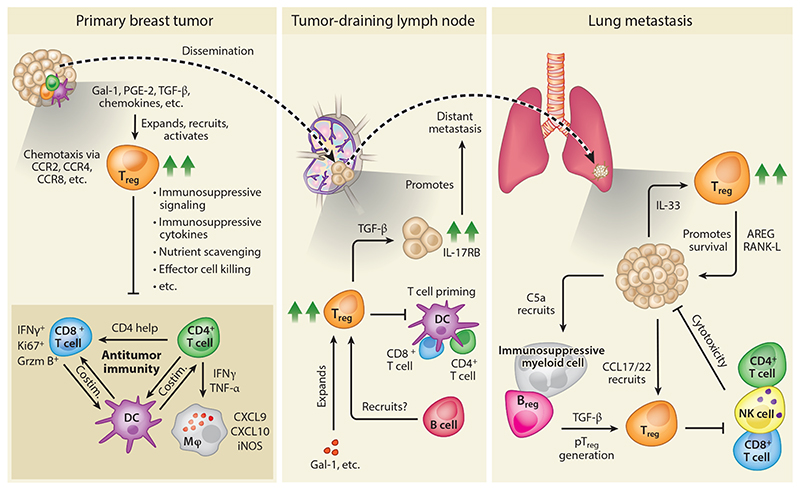
The microenvironment of breast cancer hosts a dynamic cross talk between diverse players of the immune system. While cytotoxic immune cells are equipped to control tumor growth and metastasis, tumor-corrupted immunosuppressive immune cells strive to impair effective immunity and promote tumor progression. Of these, regulatory T cells (T regs), the gatekeepers of immune homeostasis, emerge as multifaceted players involved in breast cancer. Intriguingly, clinical observations suggest that blood and intratumoral T regs can have strong prognostic value, dictated by breast cancer subtype. Accordingly, emerging preclinical evidence shows that T regs occupy a central role in breast cancer initiation and progression and provide critical support to metastasis formation. Here, T regs are not only important for immune escape but also promote tumor progression independent of their immune regulatory capacity. Combining insights into T reg biology with advances made across the rapidly growing field of immuno-oncology is expected to set the stage for the design of more effective immunotherapy strategies.
Overview
The claims and statistics of this paper haven’t been checked yet.
Free: it reads the open-access text and checks the first 5 claims that cite a source we can check. Create a free account to check every claim.
Integrity signals
Registry
Cites
Statistics
Figures
Verification
Claims the paper makes
The claims and statistics of this paper haven’t been checked yet.
Free: it reads the open-access text and checks the first 5 claims that cite a source we can check. Create a free account to check every claim.
Claims other papers make about this one
Each is checked against this paper’s own text: does it say what the citing paper says it does?
The source backs part of the claim, not all of it — or backs it for a different population, condition or comparison.
In the citing paper
“Increased presence of Tregs is linked to decreased patient survival in several types of malignancies [5–7].”
From Potential anti-tumor effects of regulatory T cells in the tumor microenvironment: a review (2024) · cites this paper as [7]
Experimental — accuracy not yet measured
Self-check
Percentages, sums and reported differences re-computed from the paper’s own numbers.
The self-check needs the paper’s full text.
Citations
Cites
Bray, F., Ferlay, J., Soerjomataram, I., Siegel, R. L., Torre, L. A., & Jemal, A. (2018) · CA: A Cancer Journal for Clinicians · doi:10.3322/caac.21492 · Cited by 84,109 · cited 1×
“Although survival rates for breast cancer patients are steadily increasing, it is still the leading cause of cancer-related deaths in women worldwide (Bray et al. 2018, DeSantis et al. 2019).”
BackgroundHallmarks of Cancer: The Next Generation
Hanahan, D., & Weinberg, R. A. (2011) · Cell · doi:10.1016/j.cell.2011.02.013 · Cited by 66,590 · cited 1×
“The local niche within and surrounding tumors is collectively described as the tumor microenvironment (TME), which can profoundly impact the development and progression of cancer (Blomberg et al. 2018, Garner & de Visser 2020, Hanahan & Weinberg 2011).”
BackgroundPD-1 and PD-L1 Immune Checkpoint Blockade to Treat Breast Cancer
Hartkopf, A. D., Taran, F.-A., Wallwiener, M., Walter, C. B., Krämer, B., Grischke, E.-M., & Brucker, S. Y. (2016) · Breast Care · doi:10.1159/000453569 · Cited by 30,845
Control of Regulatory T Cell Development by the Transcription Factor Foxp3
Hori, S., Nomura, T., & Sakaguchi, S. (2003) · Science · doi:10.1126/science.1079490 · Cited by 8,187
Foxp3 programs the development and function of CD4+CD25+ regulatory T cells
Fontenot, J. D., Gavin, M. A., & Rudensky, A. Y. (2003) · Nature Immunology · doi:10.1038/ni904 · Cited by 7,745 · cited 2×
“Further research showed that FOXP3 is the master transcription factor (TF) for the previously identified specialized immunosuppressive CD4+ CD25+ T lymphocytes, now known as Tregs (Fontenot et al. 2003, Hori et al. 2003).”
BackgroundUnderstanding the tumor immune microenvironment (TIME) for effective therapy
Binnewies, M., Roberts, E. W., Kersten, K., Chan, V., Fearon, D. F., Merad, M., Coussens, L. M., Gabrilovich, D. I., Ostrand-Rosenberg, S., Hedrick, C. C., et al. (2018) · Nature Medicine · doi:10.1038/s41591-018-0014-x · Cited by 6,145 · cited 1×
“This milieu is characterized by widespread expression of immune checkpoint receptors, inhibitory cytokines, hypoxia, and low levels of nutrients, all of which restrain the recruitment and function of cytotoxic immune cells (Binnewies et al. 2018).”
BackgroundRegulatory T Cells and Immune Tolerance
Sakaguchi, S., Yamaguchi, T., Nomura, T., & Ono, M. (2008) · Cell · doi:10.1016/j.cell.2008.05.009 · Cited by 5,325 · cited 1×
“…towards recognition of tissue-restricted selfantigens, which enable the suppression of immune responses directed towards host peptides upon activation via their TCRs ( Jordan et al. 2001, Kieback et al. 2016, Sakaguchi et al. 2008). www.annualreviews.org • Role of Tregs in Breast Cancer 293 A nn u.”
BackgroundAtezolizumab and nab-paclitaxel in advanced triple-negative breast cancer
Schmid, P., Adams, S., Rugo, H. S., Schneeweiss, A., Barrios, C. H., Iwata, H., Diéras, V., Hegg, R., Im, S.-A., Shaw Wright, G., et al. (2018) · New England Journal of Medicine · doi:10.1056/nejmoa1809615 · Cited by 4,350
The Role of Tumoral FOXP3 on Cell Proliferation, Migration, and Invasion in Gastric Cancer
Zhang, L., Xu, J., Zhang, X., Zhang, Y., Wang, L., Huang, X., & Xu, Z. (2017) · Cellular Physiology and Biochemistry · doi:10.1159/000479442 · Cited by 4,088
Vignali, D. A. A., Collison, L. W., & Workman, C. J. (2008) · Nature Reviews Immunology · doi:10.1038/nri2343 · Cited by 3,463
Cited by
Speiser, D. E., Chijioke, O., Schaeuble, K., & Münz, C. (2023) · Nature Cancer · doi:10.1038/s43018-023-00521-2 · Cited by 479
İmani, S., Farghadani, R., Roozitalab, G., Maghsoudloo, M., Emadi, M., Moradi, A., Abedi, B., & Kaboli, P. J. (2025) · Journal of Experimental & Clinical Cancer Research · doi:10.1186/s13046-025-03394-8 · Cited by 132
Potential anti-tumor effects of regulatory T cells in the tumor microenvironment: a review
Li, Y., Zhang, C., Jiang, A., Lin, A., Liu, Z., Cheng, X., Wang, W., Cheng, Q., Zhang, J., Wei, T., et al. (2024) · Journal of Translational Medicine · doi:10.1186/s12967-024-05104-y · Cited by 105
“Increased presence of Tregs is linked to decreased patient survival in several types of malignancies [5–7].”
BackgroundKos, K., Aslam, M. A., van de Ven, R., Wellenstein, M. D., Pieters, W., van Weverwijk, A., Duits, D. E. M., van Pul, K., Hau, C., Vrijland, K., et al. (2022) · Cell Reports · doi:10.1016/j.celrep.2022.110447 · Cited by 62
Self-citationKos, K., Salvagno, C., Wellenstein, M. D., Aslam, M. A., Meijer, D. A., Hau, C., Vrijland, K., Kaldenbach, D., Raeven, E. A. M., Schmittnaegel, M., et al. (2022) · OncoImmunology · doi:10.1080/2162402x.2022.2063225 · Cited by 47
Self-citationDaly, R. J., Scott, A. M., Klein, O., & Ernst, M. (2022) · Molecular Cancer · doi:10.1186/s12943-022-01656-z · Cited by 40
“Regulatory T cells (Tregs) are a specialized subpopulation of CD4+ T cells that express the nuclear transcription factor FoxP3 and help maintain homeostasis and self-tolerance by suppressing immune responses [57].”
BackgroundBlomberg, O. S., Kos, K., Spagnuolo, L., Isaeva, O. I., Garner, H., Wellenstein, M. D., Bakker, N. A. M., Duits, D. E. M., Kersten, K., Klarenbeek, S., et al. (2023) · OncoImmunology · doi:10.1080/2162402x.2023.2201147 · Cited by 39
“…regulators of immune homeostasis by safeguarding self-tolerance and promoting the resolution of inflammation 13 , but T regs also frequently infiltrate into tumor tissues, where they are key orchestrators of cancer-associated immunosuppression and contribute to immune evasion of cancer 13,14 .”
BackgroundSelf-citationPedersen, C. A., Cao, M. D., Fleischer, T., Rye, M. B., Knappskog, S., Eikesdal, H. P., Lønning, P. E., Tost, J., Kristensen, V. N., Tessem, M., et al. (2022) · Breast Cancer Research · doi:10.1186/s13058-022-01537-9 · Cited by 38
Therapeutic Targeting of Tumor-Infiltrating Regulatory T Cells in Breast Cancer
Fattori, S., Roux, H., Connen, E., Robert, L., Gorvel, L., Roy, A. L., Houacine, J., Foussat, A., Chrétien, A.-S., & Olive, D. (2022) · Cancer Research · doi:10.1158/0008-5472.can-22-0654 · Cited by 37
Bakker, N. A. M., Garner, H., van Dyk, E., Champanhet, E., Klaver, C., Duijst, M., Voorwerk, L., Nederlof, I., Voorthuis, R. A. B., Liefaard, M. C., et al. (2025) · npj Breast Cancer · doi:10.1038/s41523-025-00721-2 · Cited by 29
Engineered Adoptive T-Cell Therapies for Breast Cancer: Current Progress, Challenges, and Potential
Chamorro, D. F., Somes, L. K., & Hoyos, V. (2023) · Cancers · doi:10.3390/cancers16010124 · Cited by 25
Breast Cancer Immune Landscape: Interplay Between Systemic and Local Immunity
Gerashchenko, T. S., Frolova, A. A., Patysheva, M. R., Fedorov, A. A., Stakheyeva, M. N., Denisov, E. V., & Чердынцева, Н. В. (2024) · Advanced Biology · doi:10.1002/adbi.202400140 · Cited by 26
Silver Jubilee of HER2 targeting: a clinical success in breast cancer
Zhao, J., Zhou, Z., Saw, P. E., & Song, E. (2025) · Journal of the National Cancer Center · doi:10.1016/j.jncc.2024.12.008 · Cited by 23
“Notably, ADCC is the primary mechanism by which antibodies such as rituximab, cetuximab, and trastuzumab contribute to cancer treatment.”
Circulating Cytokines as Predictors of Depression in Patients with Breast Cancer
Ho, H.-Y., Chin-Hung Chen, V., Tzang, B.-S., Hsieh, C.-C., Wang, W.-K., Weng, Y.-P., Hsu, Y.-T., Hsaio, H.-P., Weng, J.-C., & Chen, Y.-L. (2021) · Journal of Psychiatric Research · doi:10.1016/j.jpsychires.2021.02.037 · Cited by 20
FOXP3 regulatory T cells on prognosis of breast cancer
Usman, A. N., Ahmad, M., Sinrang, A. W., Natsir, S., Takko, A. B., Ariyandy, A., Ilhamuddin, I., Eragradini, A. R., Hasan, I. I., & Hasyim, S. (2023) · Breast Disease · doi:10.3233/bd-239002 · Cited by 19
“This exposes the potential clinical significance of Tregs in the peripheral blood of breast cancer patients but also highlights how Treg heterogeneity may potentially influence disease outcomes [ 2,16].”
Riquelme, M. A., Wang, X., Acosta, F. M., Zhang, J., Chavez, J., Gu, S., Zhao, P., Xiong, W., Zhang, N., Li, G., et al. (2024) · Cell Reports · doi:10.1016/j.celrep.2024.114377 · Cited by 19
Massa, D., Tosi, A., Rosato, A., Guarneri, V., & Dieci, M. V. (2022) · Cancers · doi:10.3390/cancers14194885 · Cited by 18
The role of hypoxia-inducible factors in breast cancer stem cell specification
Fath, M. K., Garousi, S., Mottahedi, M., Ghasemzadeh, N., Salmani, K., Olfati, F., Saeed, M. B., Sotoudeh, S., & Barati, G. (2023) · Pathology - Research and Practice · doi:10.1016/j.prp.2023.154349 · Cited by 18
Regulatory T cells crosstalk with tumor cells and endothelium through lymphotoxin signaling
Piao, W., Wu, L., Xiong, Y., Zapas, G., Paluskievicz, C., Oakes, R. S., Pettit, S. M., Sleeth, M. L., Hippen, K. L., Schmitz, J., et al. (2024) · Nature Communications · doi:10.1038/s41467-024-54874-y · Cited by 17
Sitta, J., Carlo, F. D., Kirven, I. A., Tackett, B. J. H., Penfornis, P., Dobbins, G. C., Barbier, M. T., Valle, L. D., Larsen, C. T., Schutt, E. G., et al. (2024) · International Journal of Molecular Sciences · doi:10.3390/ijms252413697 · Cited by 16
“An immune-evasive tumor microenvironment favoring the accumulation of CD25 + Tregs has been previously suggested [58] in TNBC, reflecting a T cell-permissive environment, particularly in this breast cancer type [59].”
Night shift work and breast cancer: from etiopathology to precision risk analysis
Vivarelli, S., Formica, T., Puliatti, Y., Spatari, G., & Fenga, C. (2025) · npj Breast Cancer · doi:10.1038/s41523-025-00863-3 · Cited by 15
CXCL11 negatively regulated by MED19 favours antitumour immune infiltration in breast cancer
Zhang, X., Wu, J., Hu, C., Zheng, X., Guo, Z., & Li, L. (2022) · Cytokine · doi:10.1016/j.cyto.2022.156106 · Cited by 14
Papanikolaou, C., Rapti, V., Stellas, D., Stefanou, D. T., Syrigos, K., Pavlakis, G. N., & Souliotis, V. L. (2022) · Vaccines · doi:10.3390/vaccines10101764 · Cited by 13
“An important cell type involved in immunosuppression in cancer is the CD4+FOXP3+ regulatory T cell (Treg), a T-cell subpopulation that suppresses abnormal immune responses to self- and nonself-antigens to maintain immune homeostasis [88].”
BackgroundBoutet, M., Nishitani, K., Couturier, N., Erler, P., Zhang, Z., Militello, A. M., de Miranda, M. C., Barbieux, E., Guillen, E., Leavenworth, J. W., et al. (2025) · Immunity · doi:10.1016/j.immuni.2025.07.008 · Cited by 12
Exploring ceRNA networks for key biomarkers in breast cancer subtypes and immune regulation
Taleghani, A. S., Beigi, Y. Z., Zare‐Mirakabad, F., & Masoudi‐Nejad, A. (2023) · Scientific Reports · doi:10.1038/s41598-023-47816-z · Cited by 11
Akshaya, R. L., Saranya, I., & Selvamurugan, N. (2023) · Breast Cancer · doi:10.1007/s12282-023-01491-0 · Cited by 10
“Studies have identified the role of miRNAs in regulating the T cell polarization towards Tregs, highlighting the importance of miRNAs in influencing the function of Tregs during BC [104, 105].”
BackgroundHSP70 In triple negative breast cancer: Prognostic value and clinical significance
Peterko, A. C., Molek, K. R., Gulić, T., Vujaklija, D. V., Belac-Lovasić, I., Lovasić, F., Mustać, E., & Avirović, M. (2022) · Pathology - Research and Practice · doi:10.1016/j.prp.2022.154127 · Cited by 9
Houshyari, M., & Taghizadeh‐Hesary, F. (2023) · Asian Pacific Journal of Cancer Prevention · doi:10.31557/apjcp.2023.24.2.353 · Cited by 9
Mathematical modelling of tumor-immune interactions in breast cancer
Zhang, H., & Li, C. (2025) · Journal of Theoretical Biology · doi:10.1016/j.jtbi.2025.112310 · Cited by 8
Leveraging HER2-targeted biparatopic antibodies in solid tumors
Liu, X., Fan, X., Gao, X., Hu, W., & Sun, P. (2025) · Pharmacological Research · doi:10.1016/j.phrs.2025.107687 · Cited by 8
The Role of Tregs in the Tumor Microenvironment
Sato, Y. (2025) · Biomedicines · doi:10.3390/biomedicines13051173 · Cited by 8
“In addition to their divergent phenotypes such as co-inhibitory molecule expression, Tregs in breast cancer may contribute to disease progression (Figure 5) [62].”
Deciphering CD4+ T cell‐mediated responses against cancer
Kirkpatrick, C. A., & Lu, Y. (2024) · Molecular Carcinogenesis · doi:10.1002/mc.23730 · Cited by 8
“125,126 In addition, a high frequency of Treg was associated with high tumor invasion in tumor ‐ draining lymph nodes and poor prognosis for breast cancer patients.”
BackgroundSheriff, L., Copland, A., Lecky, D. A. J., Done, R., George, L., Jennings, E. K., Rouvray, S., Elliot, T. A. E., Jinks, E., Pallan, L., et al. (2024) · Immunotherapy Advances · doi:10.1093/immadv/ltaf015 · Cited by 6
“However, evidence for pro-tumour development comes from the association of CD4 + Foxp3 + Tregs with poor clinical outcomes [51].”
Regulatory B cells gain muscles with a leucine-rich diet
Manfroi, B., & Fillatreau, S. (2022) · Immunity · doi:10.1016/j.immuni.2022.05.011 · Cited by 6
Kaushik, R. R., Koranne, M., Rao, M. S., Rakshit, S., Shanmugam, G., George, M., & Sarkar, K. (2022) · Phytomedicine Plus · doi:10.1016/j.phyplu.2022.100353 · Cited by 5
Profiling regulatory T lymphocytes within the tumor microenvironment of breast cancer via radiomics
Jiang, W., Wu, R., Yang, T., Yu, S., & Xing, W. (2023) · Cancer Medicine · doi:10.1002/cam4.6757 · Cited by 5
“Even though Treg only stands for 5% of CD4 + T lymphocytes in the blood circulation of healthy donors, their abundance increases in the tumor microenvironment (TME) of BC. 11 In this study, we confirmed the risk exerted by Treg infiltration in TME on BC patients via landmark analysis.”
BackgroundImmunotherapies in breast cancer: harnessing the cancer immunity cycle
Lok, V. M., Olson-Mcpeek, S. K., Spiegelhoff, G., Cortez, J., Detz, D., & Czerniecki, B. J. (2024) · Expert Opinion on Therapeutic Targets · doi:10.1080/14728222.2024.2427038 · Cited by 4
“Several preclinical studies have demonstrated that targeting high T Reg cell infiltration has been associated with an unfavorable prognosis [67] and have shown that depleting these populations through anti-CD25 antibodies can improve T-cell function and restore antitumor immunity.”
Oleuropein: a viable therapeutic option for malaria and cancer
Devi, S., Negi, S., Tandel, N., Dalai, S. K., & Tyagi, R. K. (2024) · Drug Discovery Today · doi:10.1016/j.drudis.2024.104254 · Cited by 4
Prognostic and Predictive Biomarkers in Familial Breast Cancer
Deb, S., Chakrabarti, A., & Fox, S. B. (2023) · Cancers · doi:10.3390/cancers15041346 · Cited by 3
Loss of BPTF restores estrogen response and suppresses metastasis of mammary tumors
Ciccone, M. F., Anandan, D., Chatterjee, D., Chen, C., Trousdell, M. C., Anderson, R., Lewis, S. M., Callaway, M. K., Zhao, C. Z., Somasundara, A. V. H., et al. (2025) · Nature Communications · doi:10.1038/s41467-025-64255-8 · Cited by 2
Breaking Barriers: Immune Checkpoint Inhibitors in Breast Cancer
Dmuchowski, B., Hryniewicz, W. W., BARCZAK, I., Fręśko, K., Szarzyńska, Z., WĘCLEWSKI, H., Ślężak, J. K., Dobosz, P., & Gryczka, H. (2025) · Pharmaceutics · doi:10.3390/pharmaceutics18010034 · Cited by 2
“It can be tentatively concluded that their role depends on the breast cancer subtype [67].”
Al-Hatamleh, M. A. I., Hamid, M. A. M., Vashisht, M., Hatmal, M. M., & Mussa, A. (2026) · The American Journal of the Medical Sciences · doi:10.1016/j.amjms.2026.03.016 · Cited by 2
Interleukin-33 in the Regulation of Autophagy and Apoptosis in Macrophages During Infection
Palabıyık, A. A., & Palabıyık, E. (2025) · Immunological Investigations · doi:10.1080/08820139.2025.2547691 · Cited by 1
“One of the major challenges in targeting IL-33 therapeutically is its context-dependent duality (Kos & de Visser, 2021).”
Gu, Z., Zhu, S.-F., & Li, P.-F. (2026) · Frontiers in Oncology · doi:10.3389/fonc.2026.1775016 · Cited by 1
“Their subtype-speci fi c prognostic value and multidimensional mechanisms of action provide new directions for targeted therapies (82).”
Regulatory T cells in breast cancer drivers of immune suppression and targets for immunotherapy
Pan, T., Shao, N., Ming, R., Zhou, G., Pei, Y., & Deng, J. (2026) · Frontiers in Immunology · doi:10.3389/fimmu.2026.1825637 · Cited by 1
CHEMOKINE SIGNALING IN BREAST CANCER: FOCUS ON CC-MOTIF CHEMOKINE LIGANDSPreprint
Kaçar, S. (2024) · bioRxiv (Cold Spring Harbor Laboratory) · doi:10.1101/2024.03.01.583061 · Cited by 1
Current status and future prospective of breast cancer immunotherapy
Rathore, A. S., Chirmule, N. B., Dash, R., & Chowdhury, A. (2024) · Advances in protein chemistry and structural biology · doi:10.1016/bs.apcsb.2023.12.006
Mnikhovich, M. V., Lm, E., Борисов, Д. А., Тимофеев, Р. Г., Агафонова, Ю. С., Bezuglova, T. V., & Shiripenko, I. A. (2024) · Morphology · doi:10.17816/morph.628871
The Sweet and Sour of Glycan Targeting in Cancer
Rado, G., Rodríguez-Zraquia, S. A., Lores, P., Oliva, J., & Freire, T. (2024) · Interdisciplinary cancer research · doi:10.1007/16833_2024_372
Evaluation of GARP immunohistochemical expression in papillary thyroid carcinoma
Atia, E. A. M. M., Sammour, S. A. E., Ibrahim, E. A.-S., Gabal, H. H. A., & Elgohary, S. A. (2024) · The Egyptian Journal of Otolaryngology · doi:10.1186/s43163-024-00658-6
“Suppression of Tregs function is considered to be an effective strategy for cancer immunotherapy, but its application is still limited [8].”
BackgroundВасильевич, Б. Е., Ostanin, A., & Chernykh, E. R. (2025) · Archive of oncology · doi:10.2298/aoo241217003b
Васильевич, Б. Е., Vasilchenko, P. V., & Chernykh, E. R. (2025) · Сибирский научный медицинский журнал · doi:10.18699/ssmj20250503
Huang, R., Chen, Z., Mao, M., Lai, S., & Li, J. (2025) · Discover Oncology · doi:10.1007/s12672-025-04130-6
Pedersen, C. A., Cao, M. D., Fleischer, T., Rye, M. B., Knappskog, S., Eikesdal, H. P., Lønning, P. E., Tost, J., Kristensen, V. N., Tessem, M.-B., et al. (2022) · Figshare · doi:10.6084/m9.figshare.20155587
Characterization of regulatory T cells populations in breast cancers
Fattori, S. (2023) · theses.fr (ABES) · doi:10.70675/1c177425zb8daz422fza46dz677464719c36
Breast-specific regulatory T cell mediators
Modanwal, S., Mishra, A., Mishra, N., & Sethi, G. (2026) · Elsevier eBooks · doi:10.1016/b978-0-443-43846-2.00003-9
Aberrant methylated and expressed genes as potential biomarkers for breast cancer in saudi patients
Mustafa, N., Omar, A. M., Alhazmi, S., Alsaleem, M., Alkhatabi, H., Sindi, S., Hamdi, N., Bakhsh, T., Al-Saud, N., AlJumaiah, L., et al. (2026) · Gene Reports · doi:10.1016/j.genrep.2026.102584
Chen, X., Xia, P., & Zhao, F. (2026) · Journal of Thoracic Disease · doi:10.21037/jtd-2026-1594
“…with improved antitumor immunity and longer survival in cancers such as gastric cancer (35) and colorectal cancer (36), their role in breast cancer (37) and LUAD appears more complex, potentially reflecting heterogeneity in T cell subpopulations or tumor immune microenvironment dynamics (38,39).”
InfluentialWang, X., 穆晓岚, Fu, Y., Dong, W., Lu, W., Li, X., Song, Y., Liu, C., Hou, B., 张海斌, et al. (2026) · International Journal of Biological Sciences · doi:10.7150/ijbs.137262
Intratumoral androstene-3,17-dione defines breast cancer subtype and prognosis
Asemota, S., Choi, H. Y., Effah, W., Holt, J. R., Young, K. L., Cripe, L., McNamara, K. M., Byun, D. J., Seo, H. J., Ponnusamy, S., et al. (2026) · EMBO Molecular Medicine · doi:10.1038/s44321-026-00530-5
Metadata
- Authors
- Kos, K., & de Visser, K. E.
- Affiliations
- The Netherlands Cancer Institute (NL)
- Division of Tumor Biology and Immunology, Oncode Institute, Netherlands Cancer Institute, 1066 CX Amsterdam, The Netherlands;
- ORCID
- Kos, Kevin
- Venue
- Annual Review of Cancer Biology
- Publisher
- Annual Reviews
- Published
- 2021-03-04
- Volume
- 5
- Issue
- 1
- Pages
- 291-310
- ISSN
- 2472-3428 (ISSN-L)
- PMC
- PMC7611782
- OpenAlex
- W3111078720
- Semantic Scholar
- 546f93d9a2326e24de52cf4bda0e00878dce273b
- Cited by
- 58
- References
- 145
- Citations by year
- 2026: 6 · 2025: 13 · 2024: 16 · 2023: 10 · 2022: 12 · 2021: 1
- FWCI
- 0.56
- Type
- journal article
- Language
- en
- Open access
- hybrid
- doi.org
- Locations
- Annual Review of Cancer Biology (publishedVersion, cc-by)
- PubMed (publishedVersion)
- Europe PMC (PubMed Central) (acceptedVersion, cc-by)
- PubMed Central (acceptedVersion, cc-by)
- Leiden Repository (Leiden University) (submittedVersion, cc-by)
- Funders
- ZonMw (91819616)
- Nederlandse Organisatie voor Wetenschappelijk Onderzoek (VICI 91819616, NWO-VICI91819616, 91819616)
- Oncode Institute
- FP7 Ideas: European Research Council (615300)
- Topics
- Life Sciences › Immunology and Microbiology › Immunology › T-cell and B-cell Immunology
- Health Sciences › Medicine › Oncology › Cancer Immunotherapy and Biomarkers
- Life Sciences › Immunology and Microbiology › Immunology › Immune cells in cancer
- Keywords
- regulatory T cells, breast cancer, tumor microenvironment, immunosuppression, tumor immune evasion, metastasis, breast cancer subtypes, prognostic factors, tumor progression, immunotherapy, immune homeostasis
About these checks
Registry, retraction, Cites and statistics results are computed, not judged, with one exception: a printed reference that no index lists is read once by a model before it counts as a citation error. Claims are extracted by a model and kept only when their quote appears verbatim in the text; each cited source is then checked, with a model’s help, for whether it says what the claim relies on. Those verdicts can be wrong — read the claim’s quote and the cited source before relying on one.
Statistics and arithmetic are recomputed, not judged.
Confidence bands are shown only for fields calibrated on our annotated test set. None is calibrated yet, so no band is shown.
What counts as a claim ›How we measure confidence ›How we check this ›
Are you an author, or do you see a problem with this page? Request a review
Data sources
Bibliographic data: Semantic Scholar, OpenAlex, Crossref.
Contains information from the Semantic Scholar Academic Graph Datasets, made available under the ODC Attribution License (ODC-BY 1.0).
Semantic Scholar’s data is described in: Kinney, R., et al. (2023). The Semantic Scholar Open Data Platform. arXiv:2301.10140.
