

The Multifaceted Role of Regulatory T Cells in Breast Cancer
Open accessThe DOI matches its Crossref record; 144 of the 145 references it cites were found in a registry or an index.
Abstract
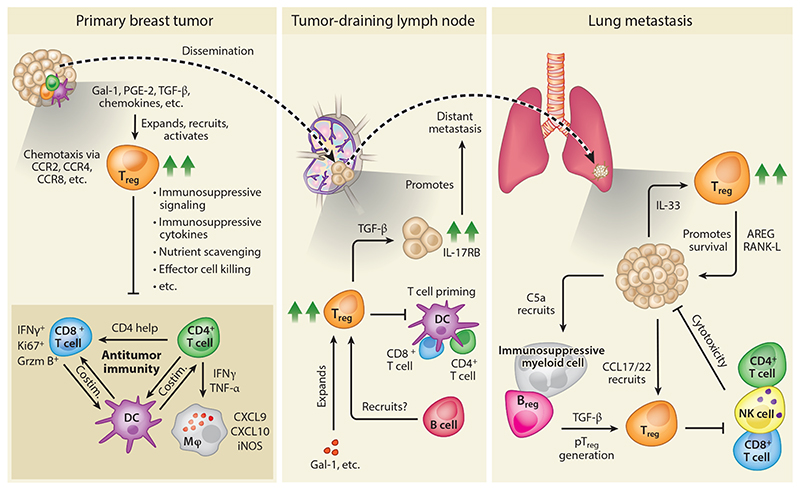
The microenvironment of breast cancer hosts a dynamic cross talk between diverse players of the immune system. While cytotoxic immune cells are equipped to control tumor growth and metastasis, tumor-corrupted immunosuppressive immune cells strive to impair effective immunity and promote tumor progression. Of these, regulatory T cells (T regs), the gatekeepers of immune homeostasis, emerge as multifaceted players involved in breast cancer. Intriguingly, clinical observations suggest that blood and intratumoral T regs can have strong prognostic value, dictated by breast cancer subtype. Accordingly, emerging preclinical evidence shows that T regs occupy a central role in breast cancer initiation and progression and provide critical support to metastasis formation. Here, T regs are not only important for immune escape but also promote tumor progression independent of their immune regulatory capacity. Combining insights into T reg biology with advances made across the rapidly growing field of immuno-oncology is expected to set the stage for the design of more effective immunotherapy strategies.
Overview
The claims and statistics of this paper haven’t been checked yet.
Free: it reads the open-access text and checks the first 5 claims that cite a source we can check. Create a free account to check every claim.
Integrity signals
Registry
Cites
Statistics
Figures
Verification
Claims the paper makes
The claims and statistics of this paper haven’t been checked yet.
Free: it reads the open-access text and checks the first 5 claims that cite a source we can check. Create a free account to check every claim.
Claims other papers make about this one
Each is checked against this paper’s own text: does it say what the citing paper says it does?
The source backs part of the claim, not all of it — or backs it for a different population, condition or comparison.
In the citing paper
“Increased presence of Tregs is linked to decreased patient survival in several types of malignancies [5–7].”
From Potential anti-tumor effects of regulatory T cells in the tumor microenvironment: a review (2024) · cites this paper as [7]
Experimental — accuracy not yet measured
Self-check
Percentages, sums and reported differences re-computed from the paper’s own numbers.
The self-check needs the paper’s full text.
Citations
Cites
Bray, F., Ferlay, J., Soerjomataram, I., Siegel, R. L., Torre, L. A., & Jemal, A. (2018) · CA: A Cancer Journal for Clinicians · doi:10.3322/caac.21492 · Cited by 84,109 · cited 1×
“Although survival rates for breast cancer patients are steadily increasing, it is still the leading cause of cancer-related deaths in women worldwide (Bray et al. 2018, DeSantis et al. 2019).”
BackgroundHallmarks of Cancer: The Next Generation
Hanahan, D., & Weinberg, R. A. (2011) · Cell · doi:10.1016/j.cell.2011.02.013 · Cited by 66,590 · cited 1×
“The local niche within and surrounding tumors is collectively described as the tumor microenvironment (TME), which can profoundly impact the development and progression of cancer (Blomberg et al. 2018, Garner & de Visser 2020, Hanahan & Weinberg 2011).”
BackgroundPD-1 and PD-L1 Immune Checkpoint Blockade to Treat Breast Cancer
Hartkopf, A. D., Taran, F.-A., Wallwiener, M., Walter, C. B., Krämer, B., Grischke, E.-M., & Brucker, S. Y. (2016) · Breast Care · doi:10.1159/000453569 · Cited by 30,845
Control of Regulatory T Cell Development by the Transcription Factor Foxp3
Hori, S., Nomura, T., & Sakaguchi, S. (2003) · Science · doi:10.1126/science.1079490 · Cited by 8,187
Foxp3 programs the development and function of CD4+CD25+ regulatory T cells
Fontenot, J. D., Gavin, M. A., & Rudensky, A. Y. (2003) · Nature Immunology · doi:10.1038/ni904 · Cited by 7,745 · cited 2×
“Further research showed that FOXP3 is the master transcription factor (TF) for the previously identified specialized immunosuppressive CD4+ CD25+ T lymphocytes, now known as Tregs (Fontenot et al. 2003, Hori et al. 2003).”
BackgroundUnderstanding the tumor immune microenvironment (TIME) for effective therapy
Binnewies, M., Roberts, E. W., Kersten, K., Chan, V., Fearon, D. F., Merad, M., Coussens, L. M., Gabrilovich, D. I., Ostrand-Rosenberg, S., Hedrick, C. C., et al. (2018) · Nature Medicine · doi:10.1038/s41591-018-0014-x · Cited by 6,145 · cited 1×
“This milieu is characterized by widespread expression of immune checkpoint receptors, inhibitory cytokines, hypoxia, and low levels of nutrients, all of which restrain the recruitment and function of cytotoxic immune cells (Binnewies et al. 2018).”
BackgroundRegulatory T Cells and Immune Tolerance
Sakaguchi, S., Yamaguchi, T., Nomura, T., & Ono, M. (2008) · Cell · doi:10.1016/j.cell.2008.05.009 · Cited by 5,325 · cited 1×
“…towards recognition of tissue-restricted selfantigens, which enable the suppression of immune responses directed towards host peptides upon activation via their TCRs ( Jordan et al. 2001, Kieback et al. 2016, Sakaguchi et al. 2008). www.annualreviews.org • Role of Tregs in Breast Cancer 293 A nn u.”
BackgroundAtezolizumab and nab-paclitaxel in advanced triple-negative breast cancer
Schmid, P., Adams, S., Rugo, H. S., Schneeweiss, A., Barrios, C. H., Iwata, H., Diéras, V., Hegg, R., Im, S.-A., Shaw Wright, G., et al. (2018) · New England Journal of Medicine · doi:10.1056/nejmoa1809615 · Cited by 4,350
The Role of Tumoral FOXP3 on Cell Proliferation, Migration, and Invasion in Gastric Cancer
Zhang, L., Xu, J., Zhang, X., Zhang, Y., Wang, L., Huang, X., & Xu, Z. (2017) · Cellular Physiology and Biochemistry · doi:10.1159/000479442 · Cited by 4,088
Vignali, D. A. A., Collison, L. W., & Workman, C. J. (2008) · Nature Reviews Immunology · doi:10.1038/nri2343 · Cited by 3,463
Breast cancer statistics, 2019
DeSantis, C. E., Ma, J., Gaudet, M. M., Newman, L. A., Miller, K. D., Goding Sauer, A., Jemal, A., & Siegel, R. L. (2019) · CA: A Cancer Journal for Clinicians · doi:10.3322/caac.21583 · Cited by 3,114
Fundamental Mechanisms of Immune Checkpoint Blockade Therapy
Wei, S. C., Duffy, C. R., & Allison, J. P. (2018) · Cancer Discovery · doi:10.1158/2159-8290.cd-18-0367 · Cited by 3,088 · cited 1×
“Novel therapeutics targeting immune checkpoints such as PD-1/PD-L1 and CTLA-4 are transforming the treatment landscape across cancer types (Wei et al. 2018).”
BackgroundRegulatory T cells: mechanisms of differentiation and function
Josefowicz, S. Z., Lu, L.-F., & Rudensky, A. Y. (2012) · Annual Review of Immunology · doi:10.1146/annurev.immunol.25.022106.141623 · Cited by 2,866 · cited 5×
“The exact effector program that is engaged is highly dependent on the tissue and nature of the immune response ( Josefowicz et al. 2012a, Koizumi & Ishikawa 2019).”
BackgroundInfluentialBrunkow, M. E., Jeffery, E. W., Hjerrild, K. A., Paeper, B., Clark, L. B., Yasayko, S.-A., Wilkinson, J. E., Galas, D., Ziegler, S. F., & Ramsdell, F. (2001) · Nature Genetics · doi:10.1038/83784 · Cited by 2,636 · cited 1×
“Scurfy mice were first reported in 1949, but it was not until the early 2000s that a mutation in the Foxp3 gene, and consequential loss of Tregs, was identified as a direct cause for the severe immune pathology (Brunkow et al. 2001).”
BackgroundTransforming Growth Factor-β Signaling in Immunity and Cancer
Batlle, E., & Massagué, J. (2019) · Immunity · doi:10.1016/j.immuni.2019.03.024 · Cited by 2,366
Miyara, M., Yoshioka, Y., Kitoh, A., Shima, T., Wing, K., Niwa, A., Parizot, C., Taflin, C., Heike, T., Valeyre, D., et al. (2009) · Immunity · doi:10.1016/j.immuni.2009.03.019 · Cited by 2,291 · cited 3×
“FOXP3hi CD45RAneg Tregs were found to be heterogeneous between patients in their signaling response to both immunosuppressive and inflammatory cytokines.”
BackgroundInfluentialDenkert, C., von Minckwitz, G., Darb-Esfahani, S., Lederer, B., Heppner, B. I., Weber, K. E., Budczies, J., Huober, J., Klauschen, F., Furlanetto, J., et al. (2018) · The Lancet Oncology · doi:10.1016/s1470-2045(17)30904-x · Cited by 2,157 · cited 1×
“For example, tumor-associated macrophages (TAMs) are associated with invasion, metastasis, and a worse prognosis (Qiu et al. 2018), while tumor-infiltrating lymphocytes (TILs) are associated with a favorable prognosis (Denkert et al. 2018).”
BackgroundSingle-Cell Map of Diverse Immune Phenotypes in the Breast Tumor Microenvironment
Azizi, E., Carr, A. J., Plitas, G., Cornish, A. E., Konopacki, C., Prabhakaran, S., Nainys, J., Wu, K., Kiseliovas, V., Setty, M., et al. (2018) · Cell · doi:10.1016/j.cell.2018.05.060 · Cited by 1,976 · cited 2×
“Accumulating evidence shows that intratumoral Tregs in breast cancer are transcriptionally distinct fromTregs in peripheral blood and lymph nodes and share gene expression profiles withmammary tissue–resident Tregs (Azizi et al. 2018, Plitas et al. 2016, Szabo et al. 2019).”
BackgroundCD4+CD25high Regulatory Cells in Human Peripheral Blood
Baecher-Allan, C., Brown, J. A., Freeman, G. J., & Hafler, D. A. (2001) · The Journal of Immunology · doi:10.4049/jimmunol.167.3.1245 · Cited by 1,859
Regulatory T cells prevent catastrophic autoimmunity throughout the lifespan of mice
Kim, J. M., Rasmussen, J. P., & Rudensky, A. Y. (2007) · Nature Immunology · doi:10.1038/ni1428 · Cited by 1,820 · cited 1×
“…(DTR) under control of Foxp3 either via direct knockin (Foxp3DTR mice) or by its introduction using a bacterial artificial chromosome [DEREG (depletion of Tregs) mice] has allowed for short-term inducible depletion of Tregs upon injection of diphteria toxin (DT) (Kim et al. 2007, Lahl et al. 2007).”
BackgroundThymic selection of CD4+CD25+ regulatory T cells induced by an agonist self-peptide
Jordan, M. S., Boesteanu, A., Reed, A. J., Petrone, A. L., Holenbeck, A. E., Lerman, M. A., Naji, A., & Caton, A. J. (2001) · Nature Immunology · doi:10.1038/86302 · Cited by 1,660 · cited 1×
“…towards recognition of tissue-restricted selfantigens, which enable the suppression of immune responses directed towards host peptides upon activation via their TCRs ( Jordan et al. 2001, Kieback et al. 2016, Sakaguchi et al. 2008). www.annualreviews.org • Role of Tregs in Breast Cancer 293 A nn u.”
BackgroundRegulatory T cells in cancer immunosuppression — implications for anticancer therapy
Togashi, Y., Shitara, K., & Nishikawa, H. (2019) · Nature Reviews Clinical Oncology · doi:10.1038/s41571-019-0175-7 · Cited by 1,546 · cited 1×
“Importantly, Tregs can be direct targets of these treatments due to their high expression of immune checkpoint molecules (Togashi et al. 2019).”
BackgroundPembrolizumab in Patients With Advanced Triple-Negative Breast Cancer: Phase Ib KEYNOTE-012 Study
Nanda, R., Chow, L. Q. M., Dees, E. C., Berger, R., Gupta, S., Geva, R., Pusztai, L., Pathiraja, K., Aktan, G., Cheng, J. D., et al. (2016) · Journal of Clinical Oncology · doi:10.1200/jco.2015.64.8931 · Cited by 1,477 · cited 1×
“…trials investigating the efficacy of immune checkpoint blockade (ICB) in metastatic TNBC have been published, with a strong focus on PD-1/PD-L1 blockade (Adams et al. 2019, Dirix et al. 2018, Emens et al. 2019, Nanda et al. 2016, Planes-Laine et al. 2019, Schmid et al. 2018, Voorwerk et al. 2019).”
BackgroundLiyanage, U. K., Moore, T. T., Joo, H.-G., Tanaka, Y., Herrmann, V., Doherty, G., Drebin, J. A., Strasberg, S. M., Eberlein, T. J., Goedegebuure, P. S., et al. (2002) · The Journal of Immunology · doi:10.4049/jimmunol.169.5.2756 · Cited by 1,467 · cited 1×
“Many studies have reported increased frequencies of Tregs in the peripheral blood of breast cancer patients across subtypes (Decker et al. 2012, Horlock et al. 2009, Liyanage et al. 2002, Perez et al. 2007, Wolf et al. 2003), indicating that breast tumors can systemically engage Tregs.”
BackgroundDeNardo, D. G., Barreto, J. B., Andreu, P., Vasquez, L., Tawfik, D., Kolhatkar, N., & Coussens, L. M. (2009) · Cancer Cell · doi:10.1016/j.ccr.2009.06.018 · Cited by 1,353 · cited 1×
“The elimination of Tregs resulted in the accumulation of macrophages in mammary glands and an induction of the Th2 cytokines IL-4 and IL-5, which have been reported to induce tumorigenic functions in macrophages (DeNardo et al. 2009).”
BackgroundBates, G. J., Fox, S. B., Han, C., Leek, R. D., Garcia, J. F., Harris, A. L., & Banham, A. H. (2006) · Journal of Clinical Oncology · doi:10.1200/jco.2006.05.9584 · Cited by 1,200 · cited 3×
“…T cells, it was not until the discovery of FOXP3 as a unique marker of Tregs (Fontenot et al. 2003,Hori et al. 2003) and the development of reliable monoclonal antibodies that the presence of Tregs could be convincingly demonstrated in human cancers (Bates et al. 2006, Roncador et al. 2005).”
BackgroundRole of conserved non-coding DNA elements in the Foxp3 gene in regulatory T-cell fate
Zheng, Y., Josefowicz, S., Chaudhry, A., Peng, X. P., Forbush, K., & Rudensky, A. Y. (2010) · Nature · doi:10.1038/nature08750 · Cited by 1,169
Immune cell promotion of metastasis
Kitamura, T., Qian, B.-Z., & Pollard, J. W. (2015) · Nature Reviews Immunology · doi:10.1038/nri3789 · Cited by 1,158 · cited 1×
“Prior to metastatic spread, tumor-derived systemic factors can even further potentiate metastasis by instructing (immature) myeloid cells to establish a premetastatic niche (Kitamura et al. 2015).”
BackgroundNatural and Adaptive Foxp3+ Regulatory T Cells: More of the Same or a Division of Labor?
Curotto de Lafaille, M. A., & Lafaille, J. J. (2009) · Immunity · doi:10.1016/j.immuni.2009.05.002 · Cited by 1,055 · cited 1×
“In addition, pTregs display a TCR repertoire that recognizes foreign antigens, parallel to conventional CD4+ T cells (Curotto de Lafaille & Lafaille 2009).”
BackgroundMoran, A. E., Holzapfel, K. L., Xing, Y., Cunningham, N. R., Maltzman, J. S., Punt, J., & Hogquist, K. A. (2011) · Journal of Experimental Medicine · doi:10.1084/jem.20110308 · Cited by 1,034 · cited 1×
“The generation of tTregs occurs through a unique developmental program in the thymus, based on a delicate balance of T cell receptor (TCR) affinity and antigen specificity of CD4+ progenitor cells (Legoux et al. 2015, Malhotra et al. 2016, Moran et al. 2011).”
BackgroundPD-1 + regulatory T cells amplified by PD-1 blockade promote hyperprogression of cancer
Kamada, T., Togashi, Y., Tay, C., Ha, D., Sasaki, A., Nakamura, Y., Sato, E., Fukuoka, S., Tada, Y., Tanaka, A., et al. (2019) · Proceedings of the National Academy of Sciences · doi:10.1073/pnas.1822001116 · Cited by 1,008 · cited 1×
“For example, PD-1 blockade has been associated with disease progression in gastric cancer (GC) patients via the activation and expansion of intratumoral PD-1+ Tregs (Kamada et al. 2019).”
BackgroundTGF-β1 maintains suppressor function and Foxp3 expression in CD4+CD25+ regulatory T cells
Marie, J. C., Letterio, J. J., Gavin, M., & Rudensky, A. Y. (2005) · The Journal of Experimental Medicine · doi:10.1084/jem.20042276 · Cited by 985 · cited 1×
“…signaling, which in FOXP3− CD4+ T cells induces the interaction of SMAD2/3 with an intronic enhancer in the FOXP3 locus, CNS1 (Kanamori et al. 2016, Marie et al. 2005, Zheng et al. 2010). pTregs have unstable FOXP3 expression and lack the characteristic demethylation of the intronic element CNS2…”
BackgroundSelective depletion of Foxp3+ regulatory T cells induces a scurfy-like disease
Lahl, K., Loddenkemper, C., Drouin, C., Freyer, J., Arnason, J., Eberl, G., Hamann, A., Wagner, H., Huehn, J., & Sparwasser, T. (2007) · The Journal of Experimental Medicine · doi:10.1084/jem.20061852 · Cited by 924 · cited 1×
“…(DTR) under control of Foxp3 either via direct knockin (Foxp3DTR mice) or by its introduction using a bacterial artificial chromosome [DEREG (depletion of Tregs) mice] has allowed for short-term inducible depletion of Tregs upon injection of diphteria toxin (DT) (Kim et al. 2007, Lahl et al. 2007).”
BackgroundVoorwerk, L., Slagter, M., Horlings, H. M., Sikorska, K., van de Vijver, K. K., de Maaker, M., Nederlof, I., Kluin, R. J. C., Warren, S., Ong, S., et al. (2019) · Nature Medicine · doi:10.1038/s41591-019-0432-4 · Cited by 905 · cited 1×
“…trials investigating the efficacy of immune checkpoint blockade (ICB) in metastatic TNBC have been published, with a strong focus on PD-1/PD-L1 blockade (Adams et al. 2019, Dirix et al. 2018, Emens et al. 2019, Nanda et al. 2016, Planes-Laine et al. 2019, Schmid et al. 2018, Voorwerk et al. 2019).”
BackgroundImproved Efficacy of Neoadjuvant Compared to Adjuvant Immunotherapy to Eradicate Metastatic Disease
Liu, J., Blake, S. J., Yong, M. C. R., Harjunpää, H., Ngiow, S. F., Takeda, K., Young, A., O'Donnell, J. S., Allen, S., Smyth, M. J., et al. (2016) · Cancer Discovery · doi:10.1158/2159-8290.cd-16-0577 · Cited by 894
Increase of regulatory T cells in the peripheral blood of cancer patients.
Wolf, A. M., Wolf, D. G. F., Steurer, M., Gastl, G. A., Gunsilius, E., & Grubeck-Loebenstein, B. (2003) · PubMed · Cited by 891
An essential role for the IL-2 receptor in Treg cell function
Chinen, T., Kannan, A. K., Levine, A. G., Fan, X., Klein, U., Zheng, Y., Gasteiger, G., Feng, Y., Fontenot, J. D., & Rudensky, A. Y. (2016) · Nature Immunology · doi:10.1038/ni.3540 · Cited by 888
Extrathymically generated regulatory T cells control mucosal TH2 inflammation
Josefowicz, S. Z., Niec, R. E., Kim, H. Y., Treuting, P., Chinen, T., Zheng, Y., Umetsu, D. T., & Rudensky, A. Y. (2012) · Nature · doi:10.1038/nature10772 · Cited by 822 · cited 5×
“The exact effector program that is engaged is highly dependent on the tissue and nature of the immune response ( Josefowicz et al. 2012a, Koizumi & Ishikawa 2019).”
BackgroundInfluentialKumagai, S., Togashi, Y., Kamada, T., Sugiyama, E., Nishinakamura, H., Takeuchi, Y., Vitaly, K., Itahashi, K., Maeda, Y., Matsui, S., et al. (2020) · Nature Immunology · doi:10.1038/s41590-020-0769-3 · Cited by 783 · cited 1×
“Accordingly, PD-1 expression by intratumoral Tregs was found to predict resistance to anti-PD-1 therapy in multiple NSCLC and GC patient cohorts (Kumagai et al. 2020).”
BackgroundEmens, L. A., Cruz, C., Eder, J. P., Braiteh, F., Chung, C., Tolaney, S. M., Kuter, I., Nanda, R., Cassier, P. A., Delord, J.-P., et al. (2019) · JAMA Oncology · doi:10.1001/jamaoncol.2018.4224 · Cited by 766 · cited 2×
“…trials investigating the efficacy of immune checkpoint blockade (ICB) in metastatic TNBC have been published, with a strong focus on PD-1/PD-L1 blockade (Adams et al. 2019, Dirix et al. 2018, Emens et al. 2019, Nanda et al. 2016, Planes-Laine et al. 2019, Schmid et al. 2018, Voorwerk et al. 2019).”
BackgroundGobert, M., Treilleux, I., Bendriss-Vermare, N., Bachelot, T., Goddard-Leon, S., Arfi, V., Biota, C., Doffin, A. C., Durand, I., Olive, D., et al. (2009) · Cancer Research · doi:10.1158/0008-5472.can-08-2360 · Cited by 758 · cited 5×
“For example, IL-33 and CCL17 have both been reported to be released in metastatic foci in the lungs of 4T1 tumor–bearing mice, leading to the accumulation of Tregs that express the receptor for these molecules, thereby promoting metastasis (Halvorsen et al. 2019, Olkhanud et al. 2009).”
BackgroundInfluentialSzabo, P. A., Levitin, H. M., Miron, M., Snyder, M. E., Senda, T., Yuan, J., Cheng, Y. L., Bush, E. C., Dogra, P., Thapa, P., et al. (2019) · Nature Communications · doi:10.1038/s41467-019-12464-3 · Cited by 756 · cited 1×
“Accumulating evidence shows that intratumoral Tregs in breast cancer are transcriptionally distinct fromTregs in peripheral blood and lymph nodes and share gene expression profiles withmammary tissue–resident Tregs (Azizi et al. 2018, Plitas et al. 2016, Szabo et al. 2019).”
BackgroundDirix, L. Y., Takacs, I., Jerusalem, G., Nikolinakos, P., Arkenau, H.-T., Forero-Torres, A., Boccia, R., Lippman, M. E., Somer, R., Smakal, M., et al. (2018) · Breast Cancer Research and Treatment · doi:10.1007/s10549-017-4537-5 · Cited by 746 · cited 1×
“…trials investigating the efficacy of immune checkpoint blockade (ICB) in metastatic TNBC have been published, with a strong focus on PD-1/PD-L1 blockade (Adams et al. 2019, Dirix et al. 2018, Emens et al. 2019, Nanda et al. 2016, Planes-Laine et al. 2019, Schmid et al. 2018, Voorwerk et al. 2019).”
BackgroundRegulatory T Cells Exhibit Distinct Features in Human Breast Cancer
Plitas, G., Konopacki, C., Wu, K., Bos, P. D., Morrow, M., Putintseva, E. V., Chudakov, D. M., & Rudensky, A. Y. (2016) · Immunity · doi:10.1016/j.immuni.2016.10.032 · Cited by 695 · cited 10×
“As discussed above, CCR8 has emerged as a chemokine receptor expressed uniquely by tumor-associated Tregs (Plitas et al. 2016, Wang et al. 2019) and has therefore gained attention as a potential therapeutic target.”
BackgroundResultInfluentialA single dose of neoadjuvant PD-1 blockade predicts clinical outcomes in resectable melanoma
Huang, A. C., Orlowski, R. J., Xu, X., Mick, R., George, S. M., Yan, P. K., Manne, S., Kraya, A. A., Wubbenhorst, B., Dorfman, L., et al. (2019) · Nature Medicine · doi:10.1038/s41591-019-0357-y · Cited by 686 · cited 1×
“In addition, high intratumoral Treg proliferation in response to anti–PD-1 therapy has been linked to recurrence (Huang et al. 2019).”
BackgroundOlkhanud, P. B., Damdinsuren, B., Bodogai, M., Gress, R. E., Sen, R., Wejksza, K., Malchinkhuu, E., Wersto, R. P., & Biragyn, A. (2011) · Cancer Research · doi:10.1158/0008-5472.can-10-4316 · Cited by 684 · cited 2×
“However, others have attributed important roles to pTregs in murine cancer models (Alonso et al. 2018, Olkhanud et al. 2011, Schreiber et al. 2012, Su et al. 2017).”
BackgroundResultTan, W., Zhang, W., Strasner, A., Grivennikov, S., Cheng, J. Q., Hoffman, R. M., & Karin, M. (2011) · Nature · doi:10.1038/nature09707 · Cited by 647
Adams, S., Loi, S., Toppmeyer, D., Cescon, D. W., De Laurentiis, M., Nanda, R., Winer, E. P., Mukai, H., Tamura, K., Armstrong, A., et al. (2019) · Annals of Oncology · doi:10.1093/annonc/mdy518 · Cited by 637 · cited 1×
“…trials investigating the efficacy of immune checkpoint blockade (ICB) in metastatic TNBC have been published, with a strong focus on PD-1/PD-L1 blockade (Adams et al. 2019, Dirix et al. 2018, Emens et al. 2019, Nanda et al. 2016, Planes-Laine et al. 2019, Schmid et al. 2018, Voorwerk et al. 2019).”
BackgroundAnalysis of FOXP3 protein expression in human CD4+CD25+ regulatory T cells at the single-cell level
Roncador, G., Brown, P. J., Maestre, L., Hue, S., Martínez-Torrecuadrada, J. L., Ling, K.-L., Pratap, S., Toms, C., Fox, B. C., Cerundolo, V., et al. (2005) · European Journal of Immunology · doi:10.1002/eji.200526189 · Cited by 592
Cancer-Cell-Intrinsic Mechanisms Shaping the Tumor Immune Landscape
Wellenstein, M. D., & de Visser, K. E. (2018) · Immunity · doi:10.1016/j.immuni.2018.03.004 · Cited by 589 · cited 4×
“S ee c op yr ig ht f or a pp ro ve d us e. HR+ tumors (74.3%), an important next step would be to validate these findings in HER2+ and TNBC subtypes, in which Tregs are associated with good prognosis (West et al. 2013).”
BackgroundResultInfluentialAdaptive plasticity of IL-10+ and IL-35+ Treg cells cooperatively promotes tumor T cell exhaustion
Sawant, D. V., Yano, H., Chikina, M., Zhang, Q., Liao, M., Liu, C., Callahan, D. J., Sun, Z., Sun, T., Tabib, T., et al. (2019) · Nature Immunology · doi:10.1038/s41590-019-0346-9 · Cited by 543
Genetically engineered mouse models in oncology research and cancer medicine
Kersten, K., de Visser, K. E., van Miltenburg, M. H., & Jonkers, J. (2017) · EMBO Molecular Medicine · doi:10.15252/emmm.201606857 · Cited by 502 · cited 1×
“Cancer cell line–based mouse models fail to fully recapitulate the chronic and systemic inflammation that underlies de novo tumor development, progression, and metastasis (Kersten et al. 2017).”
BackgroundCarretero, R., Sektioglu, I. M., Garbi, N., Salgado, O. C., Beckhove, P., & Hämmerling, G. J. (2015) · Nature Immunology · doi:10.1038/ni.3159 · Cited by 501
Single-Cell Transcriptomics of Regulatory T Cells Reveals Trajectories of Tissue Adaptation
Miragaia, R. J., Gomes, T., Chomka, A., Jardine, L., Riedel, A., Hegazy, A. N., Whibley, N., Tucci, A., Chen, X., Lindeman, I., et al. (2019) · Immunity · doi:10.1016/j.immuni.2019.01.001 · Cited by 499 · cited 1×
“In line with the second notion, single-cell RNA sequencing (scRNA-seq) of Tregs of naïve mice revealed that Treg migration from lymphoid to nonlymphoid tissues indeed induces a transcriptional program specifically tailored to the destined tissue (Miragaia et al. 2019).”
ResultInduced Regulatory T Cells: Their Development, Stability, and Applications
Kanamori, M., Nakatsukasa, H., Okada, M., Lu, Q., & Yoshimura, A. (2016) · Trends in Immunology · doi:10.1016/j.it.2016.08.012 · Cited by 442 · cited 3×
“…CNS1 (Kanamori et al. 2016, Marie et al. 2005, Zheng et al. 2010). pTregs have unstable FOXP3 expression and lack the characteristic demethylation of the intronic element CNS2 observed in tTregs, which is essential for Treg stability during proliferation (Kanamori et al. 2016, Lee & Lee 2018).”
BackgroundTumor-associated macrophages in breast cancer: Innocent bystander or important player?
Qiu, S.-Q., Waaijer, S. J. H., Zwager, M. C., de Vries, E. G. E., van der Vegt, B., & Schröder, C. P. (2018) · Cancer Treatment Reviews · doi:10.1016/j.ctrv.2018.08.010 · Cited by 425 · cited 1×
“For example, tumor-associated macrophages (TAMs) are associated with invasion, metastasis, and a worse prognosis (Qiu et al. 2018), while tumor-infiltrating lymphocytes (TILs) are associated with a favorable prognosis (Denkert et al. 2018).”
BackgroundArce Vargas, F., Furness, A. J. S., Solomon, I., Joshi, K., Mekkaoui, L., Lesko, M. H., Miranda Rota, E., Dahan, R., Georgiou, A., Sledzinska, A., et al. (2017) · Immunity · doi:10.1016/j.immuni.2017.03.013 · Cited by 418 · cited 4×
“Recently, an optimized ADCC-inducing anti-CD25 antibody showed superior intratumoral Treg depletion and induced CD8+ T cell–mediated tumor rejection in combination with anti-PD1 therapy in preclinical models (Arce Vargas et al. 2017).”
BackgroundInfluentialImmune crosstalk in cancer progression and metastatic spread: a complex conversation
Garner, H., & de Visser, K. E. (2020) · Nature Reviews Immunology · doi:10.1038/s41577-019-0271-z · Cited by 395
(2010) · Advances in Cancer Research · doi:10.1016/s0065-230x(10)07003-x · Cited by 386
Zhou, J., Li, X., Wu, X., Zhang, T., Zhu, Q., Wang, X., Wang, H., Wang, K., Lin, Y., & Wang, X. (2018) · Cancer Immunology Research · doi:10.1158/2326-6066.cir-17-0479 · Cited by 386
Zhang, Y., Lazarus, J., Steele, N. G., Yan, W., Lee, H.-J., Nwosu, Z. C., Halbrook, C. J., Menjivar, R. E., Kemp, S. B., Sirihorachai, V. R., et al. (2020) · Cancer Discovery · doi:10.1158/2159-8290.cd-19-0958 · Cited by 385 · cited 1×
“…in FOXP3− CD4+ T cells induces the interaction of SMAD2/3 with an intronic enhancer in the FOXP3 locus, CNS1 (Kanamori et al. 2016, Marie et al. 2005, Zheng et al. 2010). pTregs have unstable FOXP3 expression and lack the characteristic demethylation of the intronic element CNS2 observed in…”
BackgroundJang, J.-E., Hajdu, C. H., Liot, C., Miller, G., Dustin, M. L., & Bar-Sagi, D. (2017) · Cell Reports · doi:10.1016/j.celrep.2017.06.062 · Cited by 372 · cited 2×
“Indeed, it has been reported that Tregs can inhibit the expression of costimulatory ligands on DCs, thereby restraining CD8+ T cell activation and tumor clearance in a Kras-mutant model for pancreatic cancer ( Jang et al. 2017).”
BackgroundControl of Immune Responses by Antigen-Specific Regulatory T Cells Expressing the Folate Receptor
Yamaguchi, T., Hirota, K., Nagahama, K., Ohkawa, K., Takahashi, T., Nomura, T., & Sakaguchi, S. (2007) · Immunity · doi:10.1016/j.immuni.2007.04.017 · Cited by 357 · cited 1×
“…High grade, LN met+, large tumor size Mahmoud et al. 2011 ER+ 982 Poor (univariate)a Mixed 398 Poor (multivariate) ER−; HER2+; basal High grade Yan et al. 2011 Mixed 1,270 Poor (multivariate) ER−; PR−; HER2+ High grade Liu et al. 2011 Mixed 72 Poor (univariate)a NS LN met+, p53+, Ki67+…”
BackgroundLiu, C., Chikina, M., Deshpande, R., Menk, A. V., Wang, T., Tabib, T., Brunazzi, E. A., Vignali, K. M., Sun, M., Stolz, D. B., et al. (2019) · Immunity · doi:10.1016/j.immuni.2019.06.017 · Cited by 345 · cited 1×
“In addition, Tregs indirectly maintain an immunosuppressive phenotype in TAMs by inhibiting the release of IFNγ in the TMEs of inoculated B16 and MC38 tumors (Liu et al. 2019).”
BackgroundLung-resident tissue macrophages generate Foxp3+ regulatory T cells and promote airway tolerance
Soroosh, P., Doherty, T. A., Duan, W., Mehta, A. K., Choi, H., Adams, Y. F., Mikulski, Z., Khorram, N., Rosenthal, P., Broide, D. H., et al. (2013) · Journal of Experimental Medicine · doi:10.1084/jem.20121849 · Cited by 340 · cited 1×
“…found to play important roles at barrier sites, including the gut, lungs, and placenta, to mitigate inflammatory responses in response to foreign, but harmless, environmental, dietary, and microbial antigens (Esterházy et al. 2019, Josefowicz et al. 2012b, Kalekar et al. 2016, Soroosh et al. 2013).”
BackgroundRech, A. J., Mick, R., Martin, S., Recio, A., Aqui, N. A., Powell, D. J., Colligon, T. A., Trosko, J. A., Leinbach, L. I., Pletcher, C. H., et al. (2012) · Science Translational Medicine · doi:10.1126/scitranslmed.3003330 · Cited by 337 · cited 2×
“However, daclizumab does not induce antibody-dependent cytotoxicity (ADCC), which others have suggested to be essential for intratumoral Treg depletion and therapeutic efficacy (Arce Vargas et al. 2017, Rech et al. 2012).”
BackgroundCompartmentalized gut lymph node drainage dictates adaptive immune responses
Esterházy, D., Canesso, M. C. C., Mesin, L., Muller, P. A., de Castro, T. B. R., Lockhart, A., ElJalby, M., Faria, A. M. C., & Mucida, D. (2019) · Nature · doi:10.1038/s41586-019-1125-3 · Cited by 328 · cited 1×
“…found to play important roles at barrier sites, including the gut, lungs, and placenta, to mitigate inflammatory responses in response to foreign, but harmless, environmental, dietary, and microbial antigens (Esterházy et al. 2019, Josefowicz et al. 2012b, Kalekar et al. 2016, Soroosh et al. 2013).”
BackgroundSeo, A. N., Lee, H. J., Kim, E. J., Kim, H. J., Jang, M. H., Lee, H. E., Kim, Y. J., Kim, J. H., & Park, S. Y. (2013) · British Journal of Cancer · doi:10.1038/bjc.2013.634 · Cited by 317
Breast Cancer Lung Metastasis Requires Expression of Chemokine Receptor CCR4 and Regulatory T Cells
Olkhanud, P. B., Baatar, D., Bodogai, M., Hakim, F., Gress, R., Anderson, R. L., Deng, J., Xu, M., Briest, S., & Biragyn, A. (2009) · Cancer Research · doi:10.1158/0008-5472.can-08-4619 · Cited by 312 · cited 1×
“For example, IL-33 and CCL17 have both been reported to be released in metastatic foci in the lungs of 4T1 tumor–bearing mice, leading to the accumulation of Tregs that express the receptor for these molecules, thereby promoting metastasis (Halvorsen et al. 2019, Olkhanud et al. 2009).”
BackgroundLiu, F., Lang, R., Zhao, J., Zhang, X., Pringle, G. A., Fan, Y., Yin, D., Gu, F., Yao, Z., & Fu, L. (2011) · Breast Cancer Research and Treatment · doi:10.1007/s10549-011-1647-3 · Cited by 301 · cited 2×
“…Poor (univariate)a Mixed 398 Poor (multivariate) ER−; HER2+; basal High grade Yan et al. 2011 Mixed 1,270 Poor (multivariate) ER−; PR−; HER2+ High grade Liu et al. 2011 Mixed 72 Poor (univariate)a NS LN met+, p53+, Ki67+ Kim et al. 2013 Mixed 90 Poor (multivariate) ER−; HER2+ High grade…”
BackgroundMouse models of metastasis: progress and prospects
Gómez-Cuadrado, L., Tracey, N., Ma, R., Qian, B., & Brunton, V. G. (2017) · Disease Models & Mechanisms · doi:10.1242/dmm.030403 · Cited by 301 · cited 1×
“However, progress toward understanding their impact on the metastatic cascade is hampered by the limited availability of preclinical models that realistically recapitulate metastasis (Gómez-Cuadrado et al. 2017).”
BackgroundTransient regulatory T cell ablation deters oncogene-driven breast cancer and enhances radiotherapy
Bos, P. D., Plitas, G., Rudra, D., Lee, S. Y., & Rudensky, A. Y. (2013) · Journal of Experimental Medicine · doi:10.1084/jem.20130762 · Cited by 296 · cited 3×
“Ablation of Tregs in Foxp3DTR mice with orthotopically transplanted MMTV-PyMT tumors drastically reduced tumor growth and pulmonary metastases (Bos et al. 2013).”
BackgroundWest, N. R., Kost, S. E., Martin, S. D., Milne, K., deLeeuw, R. J., Nelson, B. H., & Watson, P. H. (2013) · British Journal of Cancer · doi:10.1038/bjc.2012.524 · Cited by 268
Gu, Y., Liu, Y., Fu, L., Zhai, L., Zhu, J., Han, Y., Jiang, Y., Zhang, Y., Zhang, P., Jiang, Z., et al. (2019) · Nature Medicine · doi:10.1038/s41591-018-0309-y · Cited by 266 · cited 1×
“It has recently been reported that B cells promote metastasis to draining lymph nodes in the 4T1 and MMTVPyMT models via the release of HSP4A-binding antibodies that directly promote tumor cell migration (Gu et al. 2019).”
BackgroundEmerging Functions of Regulatory T Cells in Tissue Homeostasis
Sharma, A., & Rudra, D. (2018) · Frontiers in Immunology · doi:10.3389/fimmu.2018.00883 · Cited by 262
Dalotto-Moreno, T., Croci, D. O., Cerliani, J. P., Martinez-Allo, V. C., Dergan-Dylon, S., Méndez-Huergo, S. P., Stupirski, J. C., Mazal, D., Osinaga, E., Toscano, M. A., et al. (2013) · Cancer Research · doi:10.1158/0008-5472.can-12-2418 · Cited by 261
CD4+ T cell anergy prevents autoimmunity and generates regulatory T cell precursors
Kalekar, L. A., Schmiel, S. E., Nandiwada, S. L., Lam, W. Y., Barsness, L. O., Zhang, N., Stritesky, G. L., Malhotra, D., Pauken, K. E., Linehan, J. L., et al. (2016) · Nature Immunology · doi:10.1038/ni.3331 · Cited by 260 · cited 1×
“…found to play important roles at barrier sites, including the gut, lungs, and placenta, to mitigate inflammatory responses in response to foreign, but harmless, environmental, dietary, and microbial antigens (Esterházy et al. 2019, Josefowicz et al. 2012b, Kalekar et al. 2016, Soroosh et al. 2013).”
BackgroundMiyashita, M., Sasano, H., Tamaki, K., Hirakawa, H., Takahashi, Y., Nakagawa, S., Watanabe, G., Tada, H., Suzuki, A., Ohuchi, N., et al. (2015) · Breast Cancer Research · doi:10.1186/s13058-015-0632-x · Cited by 253
PD-1 marks dysfunctional regulatory T cells in malignant gliomas
Lowther, D. E., Goods, B. A., Lucca, L. E., Lerner, B. A., Raddassi, K., van Dijk, D., Hernandez, A. L., Duan, X., Gunel, M., Coric, V., et al. (2016) · JCI Insight · doi:10.1172/jci.insight.85935 · Cited by 253 · cited 1×
“However, analysis of Tregs in human glioma, melanoma, and lung cancer samples did not reveal a substantial contribution of pTregs to the total intratumoral Treg pool (Ahmadzadeh et al. 2019, Akimova et al. 2017,Lowther et al. 2016, Plitas et al. 2016).”
BackgroundCCR8+FOXp3+Tregcells as master drivers of immune regulation
Barsheshet, Y., Wildbaum, G., Levy, E., Vitenshtein, A., Akinseye, C., Griggs, J., Lira, S. A., & Karin, N. (2017) · Proceedings of the National Academy of Sciences · doi:10.1073/pnas.1621280114 · Cited by 249 · cited 1×
“It has also been reported that autocrine production of CCL1, the ligand for CCR8, potentiates both Treg proliferation and suppressive potential (Barsheshet et al. 2017), suggesting that CCR8 may play an important role in maintaining Treg-mediated immunosuppression, in addition to its chemotactic…”
BackgroundJacobs, J. F. M., Punt, C. J. A., Lesterhuis, W. J., Sutmuller, R. P. M., Brouwer, H. M.-L. H., Scharenborg, N. M., Klasen, I. S., Hilbrands, L. B., Figdor, C. G., de Vries, I. J. M., et al. (2010) · Clinical Cancer Research · doi:10.1158/1078-0432.ccr-10-1757 · Cited by 239
Legoux, F. P., Lim, J.-B., Cauley, A. W., Dikiy, S., Ertelt, J., Mariani, T. J., Sparwasser, T., Way, S. S., & Moon, J. J. (2015) · Immunity · doi:10.1016/j.immuni.2015.10.011 · Cited by 238 · cited 1×
“The generation of tTregs occurs through a unique developmental program in the thymus, based on a delicate balance of T cell receptor (TCR) affinity and antigen specificity of CD4+ progenitor cells (Legoux et al. 2015, Malhotra et al. 2016, Moran et al. 2011).”
BackgroundLiu, S., Foulkes, W. D., Leung, S., Gao, D., Lau, S., Kos, Z., & Nielsen, T. O. (2014) · Breast Cancer Research · doi:10.1186/s13058-014-0432-8 · Cited by 236 · cited 2×
“…grade, high CD8+, young age West et al. 2013 ER− HER2+ No effect ER+ 2,166 No effect (multivariate)b ER−; HER2+; basal High grade, LN met+, High CD8+, young age Liu et al. 2014 ER− HER2+ 250 No effect (multivariate)c Basal 330 Favorable (multivariate) ER+ 554 ND ER+ ND Tsang et al. 2014 ER−…”
BackgroundMethodBlocking the recruitment of naive CD4+ T cells reverses immunosuppression in breast cancer
Su, S., Liao, J., Liu, J., Huang, D., He, C., Chen, F., Yang, L., Wu, W., Chen, J., Lin, L., et al. (2017) · Cell Research · doi:10.1038/cr.2017.34 · Cited by 225
PD-1/PD-L1 Targeting in Breast Cancer: The First Clinical Evidences are Emerging—A Literature Review
Planes-Laine, G., Rochigneux, P., Bertucci, F., Chrétien, A.-S., Viens, P., Sabatier, R., & Gonçalves, A. (2019) · Cancers · doi:10.3390/cancers11071033 · Cited by 221 · cited 2×
“…trials investigating the efficacy of immune checkpoint blockade (ICB) in metastatic TNBC have been published, with a strong focus on PD-1/PD-L1 blockade (Adams et al. 2019, Dirix et al. 2018, Emens et al. 2019, Nanda et al. 2016, Planes-Laine et al. 2019, Schmid et al. 2018, Voorwerk et al. 2019).”
BackgroundResultAhmadzadeh, M., Pasetto, A., Jia, L., Deniger, D. C., Stevanović, S., Robbins, P. F., & Rosenberg, S. A. (2019) · Science Immunology · doi:10.1126/sciimmunol.aao4310 · Cited by 201 · cited 1×
“However, analysis of Tregs in human glioma, melanoma, and lung cancer samples did not reveal a substantial contribution of pTregs to the total intratumoral Treg pool (Ahmadzadeh et al. 2019, Akimova et al. 2017,Lowther et al. 2016, Plitas et al. 2016).”
BackgroundVadrevu, S. K., Chintala, N. K., Sharma, S. K., Sharma, P., Cleveland, C., Riediger, L., Manne, S., Fairlie, D. P., Gorczyca, W., Almanza, O., et al. (2014) · Cancer Research · doi:10.1158/0008-5472.can-14-0157 · Cited by 199
Malhotra, D., Linehan, J. L., Dileepan, T., Lee, Y. J., Purtha, W. E., Lu, J. V., Nelson, R. W., Fife, B. T., Orr, H. T., Anderson, M. S., et al. (2016) · Nature Immunology · doi:10.1038/ni.3327 · Cited by 199 · cited 1×
“The generation of tTregs occurs through a unique developmental program in the thymus, based on a delicate balance of T cell receptor (TCR) affinity and antigen specificity of CD4+ progenitor cells (Legoux et al. 2015, Malhotra et al. 2016, Moran et al. 2011).”
BackgroundNúñez, N. G., Tosello Boari, J., Ramos, R. N., Richer, W., Cagnard, N., Anderfuhren, C. D., Niborski, L. L., Bigot, J., Meseure, D., De La Rochere, P., et al. (2020) · Nature Communications · doi:10.1038/s41467-020-17046-2 · Cited by 199
Modulation of regulatory T cell function and stability by co-inhibitory receptors
Lucca, L. E., & Dominguez-Villar, M. (2020) · Nature Reviews Immunology · doi:10.1038/s41577-020-0296-3 · Cited by 189
Loebbermann, J., Thornton, H., Durant, L., Sparwasser, T., Webster, K. E., Sprent, J., Culley, F. J., Johansson, C., & Openshaw, P. J. (2012) · Mucosal Immunology · doi:10.1038/mi.2011.62 · Cited by 185 · cited 1×
“Scavenging of IL-2 from the environment and killing of effector T cells by the release of granzymes additionally contribute to immunosuppression (Loebbermann et al. 2012, Vignali et al. 2008).”
BackgroundAn evaluation of the clinical significance of FOXP3+ infiltrating cells in human breast cancer
Mahmoud, S. M. A., Paish, E. C., Powe, D. G., Macmillan, R. D., Lee, A. H. S., Ellis, I. O., & Green, A. R. (2011) · Breast Cancer Research and Treatment · doi:10.1007/s10549-010-0987-8 · Cited by 180
Yan, M., Jene, N., Byrne, D., Millar, E. K., O'Toole, S. A., McNeil, C. M., Bates, G. J., Harris, A. L., Banham, A. H., Sutherland, R. L., et al. (2011) · Breast Cancer Research · doi:10.1186/bcr2869 · Cited by 180 · cited 3×
“…TGF-β, and adenosine, and high expression of immunomodulatory receptors, such as CTLA-4, PD-L1, and LAG-3, are well established aspects of Treg functionality that can interfere with the propagation of immune responses ( Josefowicz et al. 2012a, Lucca & Dominguez-Villar 2020, Yano et al. 2019).”
BackgroundConnecting blood and intratumoral Treg cell activity in predicting future relapse in breast cancer
Wang, L., Simons, D. L., Lu, X., Tu, T. Y., Solomon, S., Wang, R., Rosario, A., Avalos, C., Schmolze, D., Yim, J., et al. (2019) · Nature Immunology · doi:10.1038/s41590-019-0429-7 · Cited by 174 · cited 3×
“As discussed above, CCR8 has emerged as a chemokine receptor expressed uniquely by tumor-associated Tregs (Plitas et al. 2016, Wang et al. 2019) and has therefore gained attention as a potential therapeutic target.”
BackgroundPD-1+ immune cell infiltration inversely correlates with survival of operable breast cancer patients
Sun, S., Fei, X., Mao, Y., Wang, X., Garfield, D. H., Huang, O., Wang, J., Yuan, F., Sun, L., Yu, Q., et al. (2014) · Cancer Immunology Immunotherapy · doi:10.1007/s00262-014-1519-x · Cited by 172 · cited 1×
“…No effect (multivariate)c Basal 330 Favorable (multivariate) ER+ 554 ND ER+ ND Tsang et al. 2014 ER− HER2+ Mixed 218 No effect ND High grade, high CD8+, high PD1+ Sun et al. 2014 TNBC 101 No effect ND High CD8+ Miyashita et al. 2015 Mixed 207 No effect ER−; HER2+; TNBC High grade, Ki67+…”
BackgroundDepletion of regulatory T cells by anti-GITR mAb as a novel mechanism for cancer immunotherapy
Coe, D., Begom, S., Addey, C., White, M., Dyson, J., & Chai, J.-G. (2010) · Cancer Immunology, Immunotherapy · doi:10.1007/s00262-010-0866-5 · Cited by 168 · cited 1×
“Firstly, antibody-based approaches deplete Tregs through targeting of cell-surface receptors that are highly expressed on Tregs, including CD25, GITR, and FR4 (Arce Vargas et al. 2017, Coe et al. 2010, Yamaguchi et al. 2007).”
BackgroundSzurek, E., Cebula, A., Wojciech, L., Pietrzak, M., Rempala, G., Kisielow, P., & Ignatowicz, L. (2015) · PLOS ONE · doi:10.1371/journal.pone.0141161 · Cited by 163 · cited 1×
“The specific contributions of either tTregs or pTregs in cancer remain elusive, as to date no genuine phenotypic or functional marker has been discovered to distinguish both Treg subtypes in vivo (Szurek et al. 2015).”
BackgroundTakenaka, M., Seki, N., Toh, U., Hattori, S., Kawahara, A., Yamaguchi, T., Koura, K., Takahashi, R., Otsuka, H., Takahashi, H., et al. (2013) · Molecular and Clinical Oncology · doi:10.3892/mco.2013.107 · Cited by 163
Treg depletion potentiates checkpoint inhibition in claudin-low breast cancer
Taylor, N., Vick, S. C., Iglesia, M. D., Brickey, W. J., Midkiff, B. R., McKinnon, K. P., Reisdorf, S., Anders, C. K., Carey, L., Parker, J. S., et al. (2017) · Journal of Clinical Investigation · doi:10.1172/jci90499 · Cited by 163 · cited 1×
“Treg ablation did potentiate PD-1/CTLA-4-based immunotherapy,which correlated with an increase in IFNγ+ CD8+ T cells (Taylor et al. 2017).”
BackgroundPrognostic effect of estrogen receptor status across age in primary breast cancer
Bentzon, N., Düring, M., Rasmussen, B. B., Mouridsen, H., & Kroman, N. (2008) · International Journal of Cancer · doi:10.1002/ijc.22892 · Cited by 161 · cited 1×
“…of murine breast cancer cell lines used for inoculation into mice and genetically engineered mouse models (GEMMs) for breast cancer give rise to estrogen receptor–negative (ER−) mammary tumors (Özdemir et al. 2018), whereas ∼75% of human invasive breast cancers are ER+ (Bentzon et al. 2007).”
BackgroundRussell, W. L., Russell, L. B., & Gower, J. S. (1959) · Proceedings of the National Academy of Sciences · doi:10.1073/pnas.45.4.554 · Cited by 159 · cited 1×
“The importance of Tregs in immune tolerance has become evident through characterization of so-called scurfy mice, which suffer from a severe lethal autoimmune syndrome characterized by inflamed skin, red eyes, enlarged lymphoid organs, and early death (Russell et al. 1959).”
BackgroundT cells in the control of organ-specific autoimmunity
Bluestone, J. A., Bour-Jordan, H., Cheng, M., & Anderson, M. (2015) · Journal of Clinical Investigation · doi:10.1172/jci78089 · Cited by 155 · cited 1×
“Since then, it has become clear that reduced Treg numbers or impaired Treg functionality stands at the basis of autoimmune and inflammatory diseases such as diabetes, multiple sclerosis, and inflammatory bowel disease (Bluestone et al. 2015, Leonard et al. 2017).”
BackgroundKim, S. T., Jeong, H., Woo, O. H., Seo, J. H., Kim, A., Lee, E. S., Shin, S. W., Kim, Y. H., Kim, J. S., & Park, K. H. (2012) · American Journal of Clinical Oncology · doi:10.1097/coc.0b013e3182467d90 · Cited by 149 · cited 1×
“…High grade Yan et al. 2011 Mixed 1,270 Poor (multivariate) ER−; PR−; HER2+ High grade Liu et al. 2011 Mixed 72 Poor (univariate)a NS LN met+, p53+, Ki67+ Kim et al. 2013 Mixed 90 Poor (multivariate) ER−; HER2+ High grade Takenaka et al. 2013 Mixed 90 Poor (univariate)a HER2+ High grade, LN…”
BackgroundImmune regulation of metastasis: mechanistic insights and therapeutic opportunities
Blomberg, O. S., Spagnuolo, L., & de Visser, K. E. (2018) · Disease Models & Mechanisms · doi:10.1242/dmm.036236 · Cited by 149 · cited 3×
“The local niche within and surrounding tumors is collectively described as the tumor microenvironment (TME), which can profoundly impact the development and progression of cancer (Blomberg et al. 2018, Garner & de Visser 2020, Hanahan & Weinberg 2011).”
BackgroundPlitas, G., & Rudensky, A. Y. (2020) · Annual Review of Cancer Biology · doi:10.1146/annurev-cancerbio-030419-033428 · Cited by 148
In colorectal cancer mast cells contribute to systemic regulatory T-cell dysfunction
Blatner, N. R., Bonertz, A., Beckhove, P., Cheon, E. C., Krantz, S. B., Strouch, M., Weitz, J., Koch, M., Halverson, A. L., Bentrem, D. J., et al. (2010) · Proceedings of the National Academy of Sciences · doi:10.1073/pnas.0913683107 · Cited by 144 · cited 1×
“It is also becoming increasingly clear that Tregs can interact with a variety of myeloid cells to hamper antitumor immunity, including eosinophils, mast cells, macrophages, neutrophils, and basophils (Blatner et al. 2010, Zhou et al. 2018).”
BackgroundMagnuson, A. M., Kiner, E., Ergun, A., Park, J. S., Asinovski, N., Ortiz-Lopez, A., Kilcoyne, A., Paoluzzi-Tomada, E., Weissleder, R., Mathis, D., et al. (2018) · Proceedings of the National Academy of Sciences · doi:10.1073/pnas.1810580115 · Cited by 144 · cited 2×
“In contrast, others have shown that CCR8 may be redundant for intratumoral Treg homing, as adoptively transferred Ccr8-knockout Tregs in mice inoculated withMC38 colon carcinoma cells did not display reduced potential of migrating into tumors (Magnuson et al. 2018).”
BackgroundVillarreal, D. O., L'Huillier, A., Armington, S., Mottershead, C., Filippova, E. V., Coder, B. D., Petit, R. G., & Princiotta, M. F. (2018) · Cancer Research · doi:10.1158/0008-5472.can-18-1119 · Cited by 139 · cited 1×
“Anti-CCR8 monoclonal antibody (mAb) treatment of mice inoculated with CT26 colon carcinoma cells significantly reduced Tregs in tumors and enhanced intratumoral IFNγ expression (Villarreal et al. 2018).”
BackgroundTranscriptional regulation and development of regulatory T cells
Lee, W., & Lee, G. R. (2018) · Experimental & Molecular Medicine · doi:10.1038/emm.2017.313 · Cited by 135 · cited 1×
“…CNS1 (Kanamori et al. 2016, Marie et al. 2005, Zheng et al. 2010). pTregs have unstable FOXP3 expression and lack the characteristic demethylation of the intronic element CNS2 observed in tTregs, which is essential for Treg stability during proliferation (Kanamori et al. 2016, Lee & Lee 2018).”
BackgroundOnda, M., Kobayashi, K., & Pastan, I. H. (2019) · Proceedings of the National Academy of Sciences · doi:10.1073/pnas.1820388116 · Cited by 126
Perez, S. A., Karamouzis, M. V., Skarlos, D., Ardavanis, A. S., Sotiriadou, N. N., Iliopoulou, E. G., Salagianni, M. L., Orphanos, G. S., Baxevanis, C. N., Rigatos, G. A., et al. (2007) · Clinical Cancer Research · doi:10.1158/1078-0432.ccr-06-2347 · Cited by 121
Khaja, A. S. S., Toor, S. M., El Salhat, H., Faour, I., Ul Haq, N., Ali, B. R., & Elkord, E. (2017) · Oncotarget · doi:10.18632/oncotarget.16565 · Cited by 121
The Genomic and Immune Landscapes of Lethal Metastatic Breast Cancer
Mattos‐Arruda, L. D., Sammut, S., Ross, E. M., Bashford-Rogers, R. J. M., Greenstein, E., Markus, H., Morganella, S., Teng, Y. H. F., Maruvka, Y. E., Pereira, B., et al. (2019) · Cell Reports · doi:10.1016/j.celrep.2019.04.098 · Cited by 120 · cited 1×
“Moreover, the expression of genes encoding immunomodulatory proteins such as PD-1 and PD-L1 differs across metastases within individual patients (De Mattos-Arruda et al. 2019).”
BackgroundIntratumoral regulatory T cells: markers, subsets and their impact on anti-tumor immunity
Yano, H., Andrews, L. P., Workman, C. J., & Vignali, D. A. A. (2019) · Immunology · doi:10.1111/imm.13067 · Cited by 116
The immune checkpoint protein PD-L1 induces and maintains regulatory T cells in glioblastoma
DiDomenico, J., Lamano, J. B., Oyon, D., Li, Y., Veliceasa, D., Kaur, G., Ampie, L., Choy, W., Lamano, J. B., & Bloch, O. (2018) · OncoImmunology · doi:10.1080/2162402x.2018.1448329 · Cited by 115 · cited 1×
“Finally, PD-L1-mediated expansion of pTregs is an important immunosuppressive axis in glioblastoma (DiDomenico et al. 2018).”
BackgroundKieback, E., Hilgenberg, E., Stervbo, U., Lampropoulou, V., Shen, P., Bunse, M., Jaimes, Y., Boudinot, P., Radbruch, A., Klemm, U., et al. (2016) · Immunity · doi:10.1016/j.immuni.2016.04.018 · Cited by 111
Horlock, C., Stott, B., Dyson, P. J., Morishita, M., Coombes, R. C., Savage, P., & Stebbing, J. (2009) · British Journal of Cancer · doi:10.1038/sj.bjc.6604963 · Cited by 108 · cited 1×
“Many studies have reported increased frequencies of Tregs in the peripheral blood of breast cancer patients across subtypes (Decker et al. 2012, Horlock et al. 2009, Liyanage et al. 2002, Perez et al. 2007, Wolf et al. 2003), indicating that breast tumors can systemically engage Tregs.”
BackgroundBasophils Promote Tumor Rejection via Chemotaxis and Infiltration of CD8+ T Cells
Sektioglu, I. M., Carretero, R., Bulbuc, N., Bald, T., Tüting, T., Rudensky, A. Y., & Hämmerling, G. J. (2017) · Cancer Research · doi:10.1158/0008-5472.can-16-0993 · Cited by 108
Loyher, P.-L., Rochefort, J., Baudesson de Chanville, C., Hamon, P., Lescaille, G., Bertolus, C., Guillot-Delost, M., Krummel, M. F., Lemoine, F. M., Combadière, C., et al. (2016) · Cancer Research · doi:10.1158/0008-5472.can-16-0984 · Cited by 106 · cited 3×
“Specific ablation of CCR2 on Tregs strongly reduced intratumoral Treg accumulation (Loyher et al. 2016).”
BackgroundInfluentialInduction of anergic or regulatory tumor-specific CD4+ T cells in the tumor-draining lymph node
Alonso, R., Flament, H., Lemoine, S., Sedlik, C., Bottasso, E., Péguillet, I., Prémel, V., Denizeau, J., Salou, M., Darbois, A., et al. (2018) · Nature Communications · doi:10.1038/s41467-018-04524-x · Cited by 101 · cited 1×
“However, others have attributed important roles to pTregs in murine cancer models (Alonso et al. 2018, Olkhanud et al. 2011, Schreiber et al. 2012, Su et al. 2017).”
BackgroundPrognostic impact of FOXP3 expression in triple-negative breast cancer
Lee, S. H., Cho, E. Y., Park, Y. H., Ahn, J. S., & Im, Y. (2012) · Acta Oncologica · doi:10.3109/0284186x.2012.731520 · Cited by 100 · cited 1×
“…T cell Allaoui et al. 2017 Mixed 118 Poor (univariate) ND High grade, LN met+, Ki67+, tumor nest Peng et al. 2019 TNBC 86 Favorable (multivariate) ND LN met+ Lee et al. 2013 ER− HER2− 175 Favorable (univariate) NS High grade, high CD8+, young age West et al. 2013 ER− HER2+ No effect ER+ 2,166 No…”
BackgroundKaravitis, J., Hix, L. M., Shi, Y. H., Schultz, R. F., Khazaie, K., & Zhang, M. (2012) · PLoS ONE · doi:10.1371/journal.pone.0046342 · Cited by 96 · cited 2×
“Others showed that overexpression of COX2 in inoculated TM40D mammary tumors enhanced bone metastasis, which correlated with increased recruitment of Tregs into the primary tumor (Karavitis et al. 2012).”
BackgroundMaeda, N., Yoshimura, K., Yamamoto, S., Kuramasu, A., Inoue, M., Suzuki, N., Watanabe, Y., Maeda, Y., Kamei, R., Tsunedomi, R., et al. (2014) · Annals of Surgical Oncology · doi:10.1245/s10434-014-3564-2 · Cited by 88
CD8+ cytotoxic and FoxP3+ regulatory T lymphocytes serve as prognostic factors in breast cancer.
Peng, G., Li, L., Guo, Y., Yu, P., Yin, X., Wang, S., & Liu, C. (2019) · Europe PMC (PubMed Central) · Cited by 83
Transcriptional Regulation of Differentiation and Functions of Effector T Regulatory Cells
Koizumi, S.-I., & Ishikawa, H. (2019) · Cells · doi:10.3390/cells8080939 · Cited by 81 · cited 2×
“Emerging evidence shows that Tregs can acquire expression of T helper (Th) subset TFs, such as T-bet, GATA3, and RORγT, which direct their function towards suppression of Th cells of that particular subset ( Josefowicz et al. 2012a, Koizumi & Ishikawa 2019).”
BackgroundIdentification of Natural Regulatory T Cell Epitopes Reveals Convergence on a Dominant Autoantigen
Leonard, J. D., Gilmore, D. C., Dileepan, T., Nawrocka, W. I., Chao, J. L., Schoenbach, M. H., Jenkins, M. K., Adams, E. J., & Savage, P. A. (2017) · Immunity · doi:10.1016/j.immuni.2017.06.015 · Cited by 75 · cited 1×
“Since then, it has become clear that reduced Treg numbers or impaired Treg functionality stands at the basis of autoimmune and inflammatory diseases such as diabetes, multiple sclerosis, and inflammatory bowel disease (Bluestone et al. 2015, Leonard et al. 2017).”
BackgroundImmune profiles of CD4+ lymphocyte subsets in breast cancer tumor draining lymph nodes
Faghih, Z. S., Erfani, N., Haghshenas, M. R., Safaei, A., Talei, A., & Ghaderi, A. A. (2013) · Immunology Letters · doi:10.1016/j.imlet.2013.11.021 · Cited by 74 · cited 1×
“…over adjuvant targeting of Tregs suggests a role for Tregs in early stages of metastasis, which is supported by observations in breast cancer patients that Treg accumulation associates with metastasis formation in draining lymph nodes (Faghih et al. 2014, Jiang et al. 2015, Núñez et al. 2020).”
BackgroundHuang, S., Wei, P., Hwang‐Verslues, W. W., Kuo, W., Jeng, Y., Hu, C., Shew, J., Huang, C., Chang, K., Lee, E. Y., et al. (2017) · EMBO Molecular Medicine · doi:10.15252/emmm.201606914 · Cited by 72 · cited 5×
“For example, anti-CD25 treatment in mice inoculated with 4T1 cancer cells strongly reduced tumor growth, which correlated with an increase in DCs and effector CD8+ T cells in tumordraining lymph nodes (TDLNs), suggesting that Tregs modulateDC function (Goudin et al. 2016).”
BackgroundInfluentialJiang, D., Gao, Z., Cai, Z., Wang, M., & He, J. (2015) · BMC Cancer · doi:10.1186/s12885-015-1742-7 · Cited by 70 · cited 3×
“…over adjuvant targeting of Tregs suggests a role for Tregs in early stages of metastasis, which is supported by observations in breast cancer patients that Treg accumulation associates with metastasis formation in draining lymph nodes (Faghih et al. 2014, Jiang et al. 2015, Núñez et al. 2020).”
BackgroundZhou, Y., Shao, N., AiErken, N., Xie, C., Ye, R., Qian, X., Hu, Z., Zhang, J., & Lin, Y. (2017) · Journal of Cancer · doi:10.7150/jca.21030 · Cited by 69 · cited 1×
“Zhou et al. 2017).”
Human lung tumor FOXP3+ Tregs upregulate four “Treg-locking” transcription factors
Akimova, T., Zhang, T., Negorev, D. G., Singhal, S. K., Stadanlick, J. E., Rao, A., Annunziata, M. J., Levine, M. H., Beier, U. H., Diamond, J. M., et al. (2017) · JCI Insight · doi:10.1172/jci.insight.94075 · Cited by 66 · cited 1×
“However, analysis of Tregs in human glioma, melanoma, and lung cancer samples did not reveal a substantial contribution of pTregs to the total intratumoral Treg pool (Ahmadzadeh et al. 2019, Akimova et al. 2017,Lowther et al. 2016, Plitas et al. 2016).”
BackgroundThe challenges of modeling hormone receptor-positive breast cancer in mice
Özdemir, B. C., Sflomos, G., & Brisken, C. (2018) · Endocrine Related Cancer · doi:10.1530/erc-18-0063 · Cited by 62 · cited 1×
“…of murine breast cancer cell lines used for inoculation into mice and genetically engineered mouse models (GEMMs) for breast cancer give rise to estrogen receptor–negative (ER−) mammary tumors (Özdemir et al. 2018), whereas ∼75% of human invasive breast cancers are ER+ (Bentzon et al. 2007).”
BackgroundDecker, T. W., Fischer, G., Bücke, W., Bücke, P., Stotz, F., Grüneberger, A., Gropp‐Meier, M., Wiedemann, G. J., Pfeiffer, C., Peschel, C., et al. (2012) · Journal of Cancer Research and Clinical Oncology · doi:10.1007/s00432-012-1258-3 · Cited by 54 · cited 1×
“Many studies have reported increased frequencies of Tregs in the peripheral blood of breast cancer patients across subtypes (Decker et al. 2012, Horlock et al. 2009, Liyanage et al. 2002, Perez et al. 2007, Wolf et al. 2003), indicating that breast tumors can systemically engage Tregs.”
BackgroundRegulatory T Cells Control the Switch From in situ to Invasive Breast Cancer
Martinez, L. M., Robila, V., Clark, N. M., Du, W., Idowu, M. O., Rutkowski, M. R., & Bos, P. D. (2019) · Frontiers in Immunology · doi:10.3389/fimmu.2019.01942 · Cited by 50
Halvorsen, E. C., Franks, S. E., Wadsworth, B. J., Harbourne, B. T., Cederberg, R. A., Steer, C. A., Martinez-Gonzalez, I., Calder, J., Lockwood, W. W., & Bennewith, K. L. (2019) · OncoImmunology · doi:10.1080/2162402x.2018.1527497 · Cited by 49 · cited 2×
“For example, IL-33 and CCL17 have both been reported to be released in metastatic foci in the lungs of 4T1 tumor–bearing mice, leading to the accumulation of Tregs that express the receptor for these molecules, thereby promoting metastasis (Halvorsen et al. 2019, Olkhanud et al. 2009).”
BackgroundInfiltration of γδ T cells, IL-17+ T cells and FoxP3+ T cells in human breast cancer
Allaoui, R., Hagerling, C., Desmond, E., Warfvinge, C. F., Jirström, K., & Leandersson, K. (2017) · Cancer Biomarkers · doi:10.3233/cbm-170026 · Cited by 43 · cited 2×
“…et al. 2013 Mixed 90 Poor (univariate)a HER2+ High grade, LN met+, large tumor size Maeda et al. 2014 Mixed 498 Poor (univariate)a HER2+; TNBC High γδ T cell Allaoui et al. 2017 Mixed 118 Poor (univariate) ND High grade, LN met+, Ki67+, tumor nest Peng et al. 2019 TNBC 86 Favorable…”
BackgroundPapaioannou, E. C., Sakellakis, M., Melachrinou, M., Tzoracoleftherakis, E., Kalofonos, H. P., & Kourea, E. P. (2019) · Anticancer Research · doi:10.21873/anticanres.13232 · Cited by 42 · cited 8×
“S ee c op yr ig ht f or a pp ro ve d us e. HR+ tumors (74.3%), an important next step would be to validate these findings in HER2+ and TNBC subtypes, in which Tregs are associated with good prognosis (West et al. 2013).”
BackgroundInfluentialSchreiber, T. H., Wolf, D., Bodero, M. D., & Podack, E. R. (2012) · OncoImmunology · doi:10.4161/onci.20298 · Cited by 41 · cited 1×
“However, others have attributed important roles to pTregs in murine cancer models (Alonso et al. 2018, Olkhanud et al. 2011, Schreiber et al. 2012, Su et al. 2017).”
WANG, Y., SUN, J., ZHENG, R., Shao, Q., Gao, W., SONG, B., CHEN, X., & Qu, X. (2016) · Neoplasma · doi:10.4149/neo_2016_517 · Cited by 38
Immunotherapy in Triple-Negative Breast Cancer: Present and Future
Kim, I., Sanchez, K. G., McArthur, H. L., & Page, D. B. (2019) · Current Breast Cancer Reports · doi:10.1007/s12609-019-00345-z · Cited by 36 · cited 1×
“In order to maximize efficacy, numerous studies are currently evaluating predictive biomarkers and novel treatment combinations (Kim et al. 2019).”
BackgroundTsang, J. Y., Hui, S.-W., Ni, Y., Chan, S., Yamaguchi, R., Kwong, A., Law, B. K. B., & Tse, G. M.-K. (2013) · Breast Cancer Research and Treatment · doi:10.1007/s10549-013-2781-x · Cited by 35
Inhibition of Lung Metastasis by Chemokine CCL17-mediated In Vivo Silencing of Genes in CCR4+ Tregs
Biragyn, A., Bodogai, M., Olkhanud, P. B., Denny-Brown, S. R., Puri, N., Ayukawa, K., Kanegasaki, S., Hogaboam, C. M., Wejksza, K., & Lee-Chang, C. (2013) · Journal of Immunotherapy · doi:10.1097/cji.0b013e318294357c · Cited by 25 · cited 1×
“Indeed, Treg-mediated inhibition of NK cells has been associated with increased pulmonary metastasis in the 4T1 model (Biragyn et al. 2013).”
BackgroundGoudin, N., Chappert, P., Megret, J., Gross, D., Rocha, B., & Azogui, O. (2016) · PLoS ONE · doi:10.1371/journal.pone.0157822 · Cited by 18 · cited 1×
“For example, anti-CD25 treatment in mice inoculated with 4T1 cancer cells strongly reduced tumor growth, which correlated with an increase in DCs and effector CD8+ T cells in tumordraining lymph nodes (TDLNs), suggesting that Tregs modulateDC function (Goudin et al. 2016).”
BackgroundHughes, E., Lauder, S. N., Smart, K., Bloom, A., Scott, J., Jones, E., Somerville, M., Browne, M., Blainey, A., Godkin, A., et al. (2020) · Cancer Immunology, Immunotherapy · doi:10.1007/s00262-020-02603-x · Cited by 15 · cited 1×
“S ee c op yr ig ht f or a pp ro ve d us e. depletion subsequently led to control of metastatic disease through the induction of protective immunity (Hughes et al. 2020).”
Background
Cited by
Speiser, D. E., Chijioke, O., Schaeuble, K., & Münz, C. (2023) · Nature Cancer · doi:10.1038/s43018-023-00521-2 · Cited by 479
İmani, S., Farghadani, R., Roozitalab, G., Maghsoudloo, M., Emadi, M., Moradi, A., Abedi, B., & Kaboli, P. J. (2025) · Journal of Experimental & Clinical Cancer Research · doi:10.1186/s13046-025-03394-8 · Cited by 132
Potential anti-tumor effects of regulatory T cells in the tumor microenvironment: a review
Li, Y., Zhang, C., Jiang, A., Lin, A., Liu, Z., Cheng, X., Wang, W., Cheng, Q., Zhang, J., Wei, T., et al. (2024) · Journal of Translational Medicine · doi:10.1186/s12967-024-05104-y · Cited by 105
“Increased presence of Tregs is linked to decreased patient survival in several types of malignancies [5–7].”
BackgroundKos, K., Aslam, M. A., van de Ven, R., Wellenstein, M. D., Pieters, W., van Weverwijk, A., Duits, D. E. M., van Pul, K., Hau, C., Vrijland, K., et al. (2022) · Cell Reports · doi:10.1016/j.celrep.2022.110447 · Cited by 62
Self-citationKos, K., Salvagno, C., Wellenstein, M. D., Aslam, M. A., Meijer, D. A., Hau, C., Vrijland, K., Kaldenbach, D., Raeven, E. A. M., Schmittnaegel, M., et al. (2022) · OncoImmunology · doi:10.1080/2162402x.2022.2063225 · Cited by 47
Self-citation
Metadata
- Authors
- Kos, K., & de Visser, K. E.
- Affiliations
- The Netherlands Cancer Institute (NL)
- Division of Tumor Biology and Immunology, Oncode Institute, Netherlands Cancer Institute, 1066 CX Amsterdam, The Netherlands;
- ORCID
- Kos, Kevin
- Venue
- Annual Review of Cancer Biology
- Publisher
- Annual Reviews
- Published
- 2021-03-04
- Volume
- 5
- Issue
- 1
- Pages
- 291-310
- ISSN
- 2472-3428 (ISSN-L)
- PMC
- PMC7611782
- OpenAlex
- W3111078720
- Semantic Scholar
- 546f93d9a2326e24de52cf4bda0e00878dce273b
- Cited by
- 58
- References
- 145
- Citations by year
- 2026: 6 · 2025: 13 · 2024: 16 · 2023: 10 · 2022: 12 · 2021: 1
- FWCI
- 0.56
- Type
- journal article
- Language
- en
- Open access
- hybrid
- doi.org
- Locations
- Annual Review of Cancer Biology (publishedVersion, cc-by)
- PubMed (publishedVersion)
- Europe PMC (PubMed Central) (acceptedVersion, cc-by)
- PubMed Central (acceptedVersion, cc-by)
- Leiden Repository (Leiden University) (submittedVersion, cc-by)
- Funders
- ZonMw (91819616)
- Nederlandse Organisatie voor Wetenschappelijk Onderzoek (VICI 91819616, NWO-VICI91819616, 91819616)
- Oncode Institute
- FP7 Ideas: European Research Council (615300)
- Topics
- Life Sciences › Immunology and Microbiology › Immunology › T-cell and B-cell Immunology
- Health Sciences › Medicine › Oncology › Cancer Immunotherapy and Biomarkers
- Life Sciences › Immunology and Microbiology › Immunology › Immune cells in cancer
- Keywords
- regulatory T cells, breast cancer, tumor microenvironment, immunosuppression, tumor immune evasion, metastasis, breast cancer subtypes, prognostic factors, tumor progression, immunotherapy, immune homeostasis
About these checks
Registry, retraction, Cites and statistics results are computed, not judged, with one exception: a printed reference that no index lists is read once by a model before it counts as a citation error. Claims are extracted by a model and kept only when their quote appears verbatim in the text; each cited source is then checked, with a model’s help, for whether it says what the claim relies on. Those verdicts can be wrong — read the claim’s quote and the cited source before relying on one.
Statistics and arithmetic are recomputed, not judged.
Confidence bands are shown only for fields calibrated on our annotated test set. None is calibrated yet, so no band is shown.
What counts as a claim ›How we measure confidence ›How we check this ›
Are you an author, or do you see a problem with this page? Request a review
Data sources
Bibliographic data: Semantic Scholar, OpenAlex, Crossref.
Contains information from the Semantic Scholar Academic Graph Datasets, made available under the ODC Attribution License (ODC-BY 1.0).
Semantic Scholar’s data is described in: Kinney, R., et al. (2023). The Semantic Scholar Open Data Platform. arXiv:2301.10140.
