

Candida auris Genetics and Emergence
Open accessThe DOI matches its Crossref record; 125 of the 125 references it cites were found in a registry or an index.
Abstract
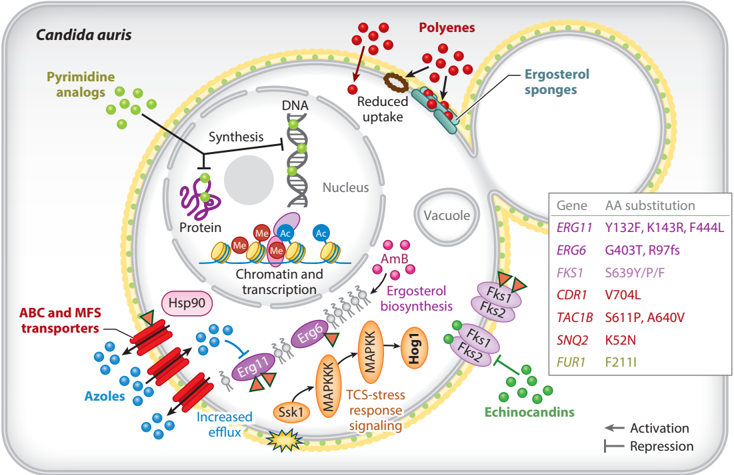
Candida auris is a multidrug-resistant fungal pathogen that presents a serious threat to global human health. Since the first reported case in 2009 in Japan, C. auris infections have been reported in more than 40 countries, with mortality rates between 30% and 60%. In addition, C. auris has the potential to cause outbreaks in health care settings, especially in nursing homes for elderly patients, owing to its efficient transmission via skin-to-skin contact. Most importantly, C. auris is the first fungal pathogen to show pronounced and sometimes untreatable clinical drug resistance to all known antifungal classes, including azoles, amphotericin B, and echinocandins. In this review, we explore the causes of the rapid spread of C. auris. We also highlight its genome organization and drug resistance mechanisms and propose future research directions that should be undertaken to curb the spread of this multidrug-resistant pathogen.
Overview
The claims and statistics of this paper haven’t been checked yet.
Free: it reads the open-access text and checks the first 5 claims that cite a source we can check. Create a free account to check every claim.
Integrity signals
Registry
Cites
Statistics
Figures
Verification
Claims the paper makes
The claims and statistics of this paper haven’t been checked yet.
Free: it reads the open-access text and checks the first 5 claims that cite a source we can check. Create a free account to check every claim.
Self-check
Percentages, sums and reported differences re-computed from the paper’s own numbers.
The self-check needs the paper’s full text.
Citations
Cites
Hidden Killers: Human Fungal Infections
Brown, G. D., Denning, D. W., Gow, N. A. R., Levitz, S. M., Netea, M. G., & White, T. C. (2012) · Science Translational Medicine · doi:10.1126/scitranslmed.3004404 · Cited by 4,284
Pappas, P. G., Kauffman, C. A., Andes, D. R., Clancy, C. J., Marr, K. A., Ostrosky-Zeichner, L., Reboli, A. C., Schuster, M. G., Vazquez, J. A., Walsh, T. J., et al. (2016) · Clinical Infectious Diseases · doi:10.1093/cid/civ933 · Cited by 4,200
Lockhart, S. R., Etienne, K. A., Vallabhaneni, S., Farooqi, J., Chowdhary, A., Govender, N. P., Colombo, A. L., Calvo, B., Cuomo, C. A., Desjardins, C. A., et al. (2017) · Clinical Infectious Diseases · doi:10.1093/cid/ciw691 · Cited by 1,662
Self-citationSatoh, K., Makimura, K., Hasumi, Y., Nishiyama, Y., Uchida, K., & Yamaguchi, H. (2009) · Microbiology and Immunology · doi:10.1111/j.1348-0421.2008.00083.x · Cited by 1,381
The global problem of antifungal resistance: prevalence, mechanisms, and management
Perlin, D. S., Rautemaa-Richardson, R., & Alastruey-Izquierdo, A. (2017) · The Lancet Infectious Diseases · doi:10.1016/s1473-3099(17)30316-x · Cited by 1,055
The antifungal pipeline: a reality check
Perfect, J. R. (2017) · Nature Reviews Drug Discovery · doi:10.1038/nrd.2017.46 · Cited by 866
Practice Guidelines for Diseases Caused by Aspergillus
Stevens, D. A., Kan, V. L., Judson, M. A., Morrison, V. A., Dummer, S., Denning, D. W., Bennett, J. E., Walsh, T. J., Patterson, T. F., & Pankey, G. A. (2000) · Clinical Infectious Diseases · doi:10.1086/313756 · Cited by 789
Candida auris: a Review of the Literature
Jeffery-Smith, A., Taori, S. K., Schelenz, S., Jeffery, K., Johnson, E. M., Borman, A., Candida auris Incident Management Team, Manuel, R., & Brown, C. S. (2018) · Clinical Microbiology Reviews · doi:10.1128/cmr.00029-17 · Cited by 595
Chowdhary, A., Prakash, A., Sharma, C., Kordalewska, M., Kumar, A., Sarma, S., Tarai, B., Singh, A., Upadhyaya, G., Upadhyay, S., et al. (2018) · Journal of Antimicrobial Chemotherapy · doi:10.1093/jac/dkx480 · Cited by 577
Self-citationFluconazole resistance in Candida species: a current perspective
Berkow, E., & Lockhart, S. (2017) · Infection and Drug Resistance · doi:10.2147/idr.s118892 · Cited by 542
Research works printed but not linked: 4
- Kim SH, Iyer KR, Pardeshi L, Munoz JF, Robbins N, et al. 2019. Genetic analysis of Candida auris implicates Hsp90 in morphogenesis and azole tolerance and Cdr1 in azole resistance. mBio 10:e02529 61. Kordalewska M, Lee A, Park S, Berrio I, Chowdhary A, et al. 2018. Understanding echinocandin resistance in the emerging pathogen Candida auris. Antimicrob. Agents Chemother. 62:e00238
- WHO (World Health Organ.), 2022, WHO Fungal Priority Pathogens List to Guide Research, Development and Public Health Action
- Zamith-Miranda D, Heyman HM, Cleare LG, Couvillion SP, Clair GC, et al. 2019. Multi-omics signature of Candida auris, an emerging and multidrug-resistant pathogen. mSystems 11:e00257 The Brucella Cell Envelope Melene A. Alakavuklar, Aretha Fiebig, and Sean Crosson p p p p p p p p p p p p p p p p p p p p p p p p 233
- Structural Insights into Type III Secretion Systems of the Bacterial Flagellum and Injectisome Liam J. Worrall, Dorothy D. Majewski, and Natalie C.J. Strynadka p p p p p p p p p p p p p p p p p p p p 669 Errata An online log of corrections to Annual Review of Microbiology articles may be found at http://www.annualreviews.org/errata/
Cited by
Suphavilai, C., Ko, K. K. K., Lim, K. M., Tan, M. G., Boonsimma, P., Chu, J. J. K., Goh, S. S., Rajandran, P., Lee, L. C., Tan, K. Y., et al. (2024) · The Lancet Microbe · doi:10.1016/s2666-5247(24)00101-0 · Cited by 174
Candida auris Outbreaks: Current Status and Future Perspectives
Gaetano, S. D., Midiri, A., Mancuso, G., Avola, M. G., & Biondo, C. (2024) · Microorganisms · doi:10.3390/microorganisms12050927 · Cited by 127
Rapid evolution of an adaptive multicellular morphology of Candida auris during systemic infection
Bing, J., Guan, Z., Zheng, T., Ennis, C. L., Nobile, C. J., Chen, C., Chu, H., & Huang, G. (2024) · Nature Communications · doi:10.1038/s41467-024-46786-8 · Cited by 74
Carolus, H., Sofras, D., Boccarella, G., Sephton-Clark, P., Biriukov, V., Cauldron, N. C., Lobo Romero, C., Vergauwen, R., Yazdani, S., Pierson, S., et al. (2024) · Nature Microbiology · doi:10.1038/s41564-024-01854-z · Cited by 72
The many faces of Candida auris: Phenotypic and strain variation in an emerging pathogen
Santana, D. J., Zhao, G., & O’Meara, T. R. (2024) · PLOS Pathogens · doi:10.1371/journal.ppat.1012011 · Cited by 62
Metadata
- Authors
- Chowdhary, A., Jain, K., & Chauhan, N.
- Affiliations
- University of Delhi (IN)
- Hackensack Meridian Health (US)
- Corresponding author
- Chowdhary, Anuradha
- Venue
- Annual Review of Microbiology
- Publisher
- Annual Reviews
- Published
- 2023-09-15
- Volume
- 77
- Issue
- 1
- Pages
- 583-602
- ISSN
- 0066-4227 (ISSN-L)
- 1545-3251
- OpenAlex
- W4383215700
- Cited by
- 158
- References
- 123
- Citations by year
- 2026: 53 · 2025: 55 · 2024: 41 · 2023: 9
- FWCI
- 7.49
- Type
- journal article
- Language
- en
- Open access
- hybrid
- doi.org
- Locations
- Annual Review of Microbiology (publishedVersion, cc-by)
- PubMed Central (publishedVersion)
- PubMed (publishedVersion)
- Greater South Information System
- Funders
- Canadian Institute for Advanced Research
- Hackensack Meridian Health
- Council of Scientific and Industrial Research, India (2019-EMR-I)
- National Institutes of Health (1r01ai182977-01a1)
- National Institute of Allergy and Infectious Diseases (R21AI174118, R01 AI182977)
- Topics
- Health Sciences › Medicine › Infectious Diseases › Antifungal resistance and susceptibility
- Life Sciences › Immunology and Microbiology › Microbiology › Yeasts and Rust Fungi Studies
- Life Sciences › Biochemistry, Genetics and Molecular Biology › Molecular Biology › Fungal and yeast genetics research
- Keywords
- Candida auris, multidrug resistance, antifungal resistance, fungal genomics, drug resistance mechanisms, hospital outbreak, nursing homes, azoles, amphotericin B, echinocandins
- MeSH terms
- Candida auris, Aged, Amphotericin B, Antifungal Agents, Candida, Humans, Echinocandins, Candidiasis, Invasive
About these checks
Registry, retraction, Cites and statistics results are computed, not judged, with one exception: a printed reference that no index lists is read once by a model before it counts as a citation error. Claims are extracted by a model and kept only when their quote appears verbatim in the text; each cited source is then checked, with a model’s help, for whether it says what the claim relies on. Those verdicts can be wrong — read the claim’s quote and the cited source before relying on one.
Statistics and arithmetic are recomputed, not judged.
Confidence bands are shown only for fields calibrated on our annotated test set. None is calibrated yet, so no band is shown.
What counts as a claim ›How we measure confidence ›How we check this ›
Are you an author, or do you see a problem with this page? Request a review
How to cite
Cite CoChat for the checks on this page, and the paper for its own findings.
- This page
- CoChat. (2026). Citation check: Candida auris Genetics and Emergence. https://app.cochat.ai/papers/10.1146/annurev-micro-032521-015858
- The paper
- Chowdhary, A., Jain, K., & Chauhan, N. (2023). Candida auris Genetics and Emergence. Annual Review of Microbiology. https://doi.org/10.1146/annurev-micro-032521-015858
Data sources
Bibliographic data: Semantic Scholar, OpenAlex, Crossref.
Contains information from the Semantic Scholar Academic Graph Datasets, made available under the ODC Attribution License (ODC-BY 1.0).
Semantic Scholar’s data is described in: Kinney, R., et al. (2023). The Semantic Scholar Open Data Platform. arXiv:2301.10140.
