

Do Emerging Military Technologies Matter for International Politics?
Open accessThe DOI matches its Crossref record; 71 of the 71 references it cites were found in a registry or an index; 2 of the 48 sources its claims cite were checked for support.
Abstract
We live in a digital world. This fact has significant consequences for warfare. Two technologies in particular, cyber and drones, feature in military and intelligence operations and in scholarship. In addition, a new vein of scholarship is examining how advances in artificial intelligence have the potential to shape the future of warfare. While scholars disagree about the consequences of these technologies for international politics, they tend to agree that their consequences are mediated by the ability of military organizations, whether state or nonstate actors, to use them effectively in relevant military scenarios and in the pursuit of political ends. Studying newer military technologies, with less empirical evidence than is available for technologies that have been around for decades, also generates methodological challenges for research.
Overview
CoChat Summary
## TL;DR
This review argues that emerging military technologies matter for international politics, but their effects are usually mediated by how military organizations can use them in practice. It focuses mainly on drones and cyber, while noting that AI is an important but still early-stage research area.
## Key findings
- For most weapons systems, the paper argues that strategy, doctrine, force employment, and organizational politics matter more than the technology itself; nuclear weapons are presented as a rare exception where the technology itself may have major effects.
- Drones: The literature is divided on effectiveness. Supportive studies cited include findings that U.S. drone strikes in Pakistan between 2007 and 2011 reduced subsequent terrorist attacks and targeting of tribal elders, and that drone strikes did not broadly generate more militant recruitment.
- Drones: Proliferation has been substantial: the paper states that 17 countries have armed drones and more than 100 countries have some kind of military drone program.
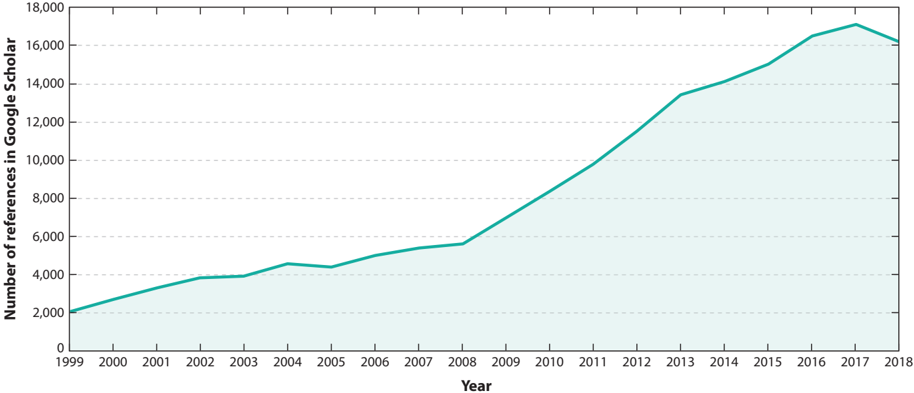
- Cyber: The paper reports Google Scholar counts for articles using “cyberwar” or “cyber war” rising from a little over 2,000 in 1999 to 16,200 in 2018. It also says cyber attacks are common, but their legal and political status remains unclear and their effects are often limited or low-intensity.
- Cyber: The review says most academic research concludes cyber capabilities are unlikely to be critical to warfare or as transformational as some policy makers fear, though they can still matter for espionage, crime, coercion, and economic disruption.
- AI: Scholarship is described as still in early stages; most military applications are said to be in logistics and training rather than close to or on the battlefield.
## Methods
- This is a review article that synthesizes existing scholarship on emerging military technologies, especially drones, cyber, and AI.
- The paper discusses several research designs used in the literature, including public-opinion studies, case studies, event-data analysis, applied theory, and game-theoretic models.
- It does not present a new dataset or original empirical test in the text provided; instead, it surveys prior findings and methodological challenges.
## Limitations
- The paper explicitly says research on newer military technologies faces limited empirical evidence, which creates methodological challenges.
- It also states that the cyber and drone literatures have limited depth compared with more established areas, and that many cyber questions are hard to study because of technical complexity, measurement problems, and covert activity.
- Evident from the text: many of the claims are based on cited prior work rather than new analysis in this article, so the review’s conclusions depend on the quality and scope of the underlying studies.
Model-written summary. Check it against the paper before relying on it.
Integrity signals
Registry
Cites
Statistics
Figures
Verification
Claims the paper makes
2 Valid · 5 Not valid · 41 Not checked · 36 Own results and interpretations
The cited sources support only part of this claim — read each source’s verdict below.
In the paper
“The public becomes less supportive of drone strikes when they are perceived to violate international law (Kreps 2014).”
§ Annual Review of Political Science Do Emerging Military Technologies Matter for International Politics? > Public Attitudes Toward Drones
What the sources say
- Partly supportedcites Kreps 2014 matched to “Flying under the radar: A study of public attitudes towards unmanned aerial vehicles” (2014) sourceExperimental — accuracy not yet measured
The Experimental results report that support fell when questions raised possible violations of international humanitarian law concerning civilian protection. But respondents were not comparably moved by whether strikes had international legal authorization. The claim is therefore too broad: the effect was clearest for particular humanitarian-law concerns, not perceived violations of international law generally. (LLM, conf=0.88)
plainstates a cause- Asserted: passes — The authors put it forward as true.
- Checkable: passes — It can be checked against evidence.
- Load-bearing: unclear — It is unclear whether the paper’s conclusions depend on it.
- Based: passes — The paper gives a reason why it holds.
- Partly supported
Every source the paper cites for this claim was checked and supports it.
In the paper
“Moreover, the ability of cyber tools to generate economic harm and disrupt military networks could have significant second-order consequences, especially given the ease of access many actors could have to these tools, as well as challenges surrounding attribution of cyber attacks (Kello 2013).”
§ Annual Review of Political Science Do Emerging Military Technologies Matter for International Politics? > How Transformational Is Cyber in International Security?
What the sources say
- Supportedcites Kello 2013 matched to “The Meaning of the Cyber Revolution: Perils to Theory and Statecraft” (2013) source
Split into 2 atoms — 2 confirmed, 0 partially supported, 0 disputed, 0 misattributed, 0 unverifiable. Expand the claim to see per-atom verdicts.
hedgedstates a possible cause- Asserted: passes — The authors put it forward as true.
- Checkable: passes — It can be checked against evidence.
- Load-bearing: unclear — It is unclear whether the paper’s conclusions depend on it.
- Based: passes — The paper gives a reason why it holds.
- Supported
In the paper
“Because drone strike capability changes the relative costs of war for the attacker and offers more certainty by increasing precision, countries with asymmetric advantages in the ability to use drones for strikes might be able to coerce potential adversaries in ways that have relevance for interstate war (Zegart 2018).”
§ Annual Review of Political Science Do Emerging Military Technologies Matter for International Politics? > Drones and Coercion
What the sources say
- Not checked — no full text of the sourcecites Zegart 2018 matched to “Cheap fights, credible threats: The future of armed drones and coercion” (2020) source
hedgedstates a possible cause- Asserted: passes — The authors put it forward as true.
- Checkable: passes — It can be checked against evidence.
- Load-bearing: passes — The paper’s conclusions depend on it.
- Based: passes — The paper gives a reason why it holds.
A conclusion the paper draws from its own results — it cites no other source for it, so there is none to check. The quote shows it is in the paper.
In the paper
“Countries relying on networks for computer and economic power are inherently at risk of that reliance being exploited.”
§ Annual Review of Political Science Do Emerging Military Technologies Matter for International Politics? > How Transformational Is Cyber in International Security?
plainstates a cause- Asserted: passes — The authors put it forward as true.
- Checkable: passes — It can be checked against evidence.
- Load-bearing: unclear — It is unclear whether the paper’s conclusions depend on it.
- Based: passes — The paper gives a reason why it holds.
A conclusion the paper draws from its own results — it cites no other source for it, so there is none to check. The quote shows it is in the paper.
In the paper
“The constant character of cyber intrusions and the lack of clear standards, based on history, concerning the scope of cyber conflict could make signaling in the cyber domain especially difficult.”
§ Annual Review of Political Science Do Emerging Military Technologies Matter for International Politics? > How Transformational Is Cyber in International Security?
hedgedstates a possible cause- Asserted: passes — The authors put it forward as true.
- Checkable: passes — It can be checked against evidence.
- Load-bearing: unclear — It is unclear whether the paper’s conclusions depend on it.
- Based: unclear — It is unclear why the paper says it holds.
28 more claims
Create a free account to see all 84 claims and to verify the 12 references still open.
- It may state two separate claims as one. 25
- Probably not a substantial claim. 36
Citations
Cites
Rid, T. (2012) · Journal of Strategic Studies · doi:10.1080/01402390.2011.608939 · Cited by 716 · cited 1×
“Most scholars working on cyber issues, however, argue that cyber capabilities are unlikely to be critical to warfare ( Junio 2013, Rid 2012).”
BackgroundDeterrence and Dissuasion in Cyberspace
Nye, J. S. (2017) · International Security · doi:10.1162/isec_a_00266 · Cited by 488
Military power: explaining victory and defeat in modern battle
(2005) · Choice Reviews Online · doi:10.5860/choice.42-4276 · Cited by 468
Stuxnet and the Limits of Cyber Warfare
Lindsay, J. R. (2013) · Security Studies · doi:10.1080/09636412.2013.816122 · Cited by 466 · cited 1×
“Lindsay (2013) argues that while many scholars and analysts initially used the attack to illustrate the revolutionary potential of cyber capabilities, in fact the attack shows the opposite.”
Background(2009) · Cited by 465
Military Power: Explaining Victory and Defeat in Modern Battle
Biddle, S. (2004) · Princeton University Press eBooks · doi:10.1515/9781400837823 · Cited by 396
Constructing Norms for Global Cybersecurity
Finnemore, M., & Hollis, D. B. (2016) · American Journal of International Law · doi:10.1017/s0002930000016894 · Cited by 395
Arquilla, J., & Ronfeldt, D. (1993) · Comparative Strategy · doi:10.1080/01495939308402915 · Cited by 376
Determinants of Nuclear Weapons Proliferation
Jo, D.-J., & Gartzke, E. (2007) · Journal of Conflict Resolution · doi:10.1177/0022002706296158 · Cited by 351
Sainato, V. A. (2013) · Policing: An International Journal of Police Strategies & Management · doi:10.1108/pijpsm.2013.18136baa.005 · Cited by 296
Research works printed but not linked: 6
- 3. Byman D. 2013. Why drones work. Foreign Aff. 92:32-43
- 4. Cronin AK. 2013. Why drones fail. Foreign Aff. 92:44-54
- 7. Dombrowski P, Demchak CC. 2014. Cyber war, cybered conflict, and the maritime domain. Naval War Coll. Rev. 67:70-96
- 43. Lin H. 2012. Escalation dynamics and conflict termination in cyberspace. Strateg. Stud. Q. 6:46-70
- 53. Schelling TC. 1960. The Strategy of Conflict. Cambridge, MA: Harvard Univ. Press
- 54. Schmitt MN. 2011. Cyber operations and the jud ad bellum revisited. Villanova Law Rev. 56:569-606
Cited by
Horowitz, M. C., & Kahn, L. (2024) · International Studies Quarterly · doi:10.1093/isq/sqae020 · Cited by 68
Self-citationDual Use Deception: How Technology Shapes Cooperation in International Relations
Vaynman, J., & Volpe, T. A. (2023) · International Organization · doi:10.1017/s0020818323000140 · Cited by 77
Wargame of Drones: Remotely Piloted Aircraft and Crisis Escalation
Lin-Greenberg, E. (2022) · Journal of Conflict Resolution · doi:10.1177/00220027221106960 · Cited by 68
“While technology is an important factor underlying how crises unfold (Jervis 1976; Creveld 1991; Cohen 1996; Horowitz 2020), “weapons don’t make war (Gray 1993),” and technology’s effect on escalation is not deterministic.”
BackgroundAlgorithms and Influence Artificial Intelligence and Crisis Decision-Making
Horowitz, M. C., & Lin-Greenberg, E. (2022) · International Studies Quarterly · doi:10.1093/isq/sqac069 · Cited by 54
Self-citationThe technology triad: disruptive AI, regulatory gaps and value change
Hopster, J. K. G., & Maas, M. M. (2023) · AI and Ethics · doi:10.1007/s43681-023-00305-5 · Cited by 56
“3 It is often even more difficult to anticipate a tech-nology’s subsequent uptake and use in society, let alone the resulting societal impacts [62, 63].”
BackgroundOne if by Land, and Two if by Sea: Cross-Domain Contests and the Escalation of International Crises
Gannon, J. A. (2022) · International Studies Quarterly · doi:10.1093/isq/sqac065 · Cited by 30
Artificial Intelligence, Forward‐Looking Governance and the Future of Security
Fischer, S., & Wenger, A. (2021) · Swiss Political Science Review · doi:10.1111/spsr.12439 · Cited by 34
Horowitz, M. C., Schwartz, J. A., & Fuhrmann, M. (2020) · Conflict Management and Peace Science · doi:10.1177/0738894220966572 · Cited by 30
Self-citationInternational governance of advancing artificial intelligence
Emery-Xu, N., Jordan, R., & Trager, R. F. (2024) · Ai & Society · doi:10.1007/s00146-024-02050-7 · Cited by 28
“56 For surveys of the effects of military innovation on the balance of power, see Grissom (2006) and Horowitz (2020).”
Engines of power: Electricity, AI, and general-purpose, military transformations
Ding, J., & Dafoe, A. (2023) · European Journal of International Security · doi:10.1017/eis.2023.1 · Cited by 33
Vigoda‐Gadot, E. (2024) · Cambridge University Press eBooks · doi:10.1017/9781009437783 · Cited by 15
Marchiori, S., Hopster, J. K. G., Puzio, A., van Riemsdijk, M. B., Kraaijeveld, S. R., Lundgren, B., Viehoff, J., & Frank, L. E. (2025) · Science and Engineering Ethics · doi:10.1007/s11948-025-00545-0 · Cited by 14
“While soft impacts are easily overlooked in assessments with a narrow focus on risk, they can have deep and transformative implications for human life and society (Horowitz, 2020 ; König & Wenzelburger, 2020; Friedman, 2023 ).”
Public perceptions of autonomous lethal weapons systems
Arai, K., & Matsumoto, M. (2023) · AI and Ethics · doi:10.1007/s43681-023-00282-9 · Cited by 17
“Increased uncertainty, its impact on diplomacy through its effect on elite beliefs, and capacity for effective use have been specifically raised for consideration [10, 14, 15].”
Semiconductor production, geopolitics and the CHIPS ACT of 2022: a theoretical analysis
Hyatt, K., Ryle, P. M., & McKnight, M. A. (2024) · Digital Policy Regulation and Governance · doi:10.1108/dprg-12-2023-0184 · Cited by 15
Landmark Selection and Path Planning for Unmanned Vehicles with Position Error Corrections
Bao, Z., Zhang, Z., & Xie, C. (2022) · Transportation Research Part C Emerging Technologies · doi:10.1016/j.trc.2023.104186 · Cited by 9
Aligning AI Regulation to Sociotechnical Change
Maas, M. M. (2022) · Oxford University Press eBooks · doi:10.1093/oxfordhb/9780197579329.013.22 · Cited by 28
Artificial Intelligence and International System Structure
Granados, O. M., & la Peña, N. D. (2021) · Revista Brasileira de Política Internacional · doi:10.1590/0034-7329202100103 · Cited by 15
Lin-Greenberg, E. (2018) · SSRN Electronic Journal · doi:10.2139/ssrn.3288988 · Cited by 11
War and peace in the age of AI
Sticher, V. (2024) · The British Journal of Politics and International Relations · doi:10.1177/13691481241293066 · Cited by 13
“…balance, and the moral complexities of algorithmic approaches to military ethics (e.g. Altmann and Sauer, 2017; Emery, 2022; Gill, 2019; Horowitz, 2018, 2019, 2020a; Horowitz et al., 2018; Horowitz and Lin-Greenberg, 2022; Hunter and Bowen, 2024; Johnson, 2022, 2023; Payne, 2018;…”
Aligning AI Regulation to Sociotechnical ChangePreprint
Maas, M. M. (2021) · SSRN Electronic Journal · doi:10.2139/ssrn.3871635 · Cited by 9
Leveraging Latency: How the Weak Compel the Strong with Nuclear Technology
Volpe, T. A. (2023) · doi:10.1093/oso/9780197669532.001.0001 · Cited by 13
Presidential use of diversionary drone force and public support
Boddery, S. S., & Klein, G. R. (2021) · Research & Politics · doi:10.1177/20531680211019904 · Cited by 12
“Our findings also complement recent scholarship that shows the public generally supports drone strikes given the technology’s ability to reduce US casualties and the technology’s counterterrorism effectiveness (Horowitz, 2020; Kreps, 2014; Kreps and Wallace, 2016; Walsh and Schulzke, 2018).”
ResultJoseph, M. F., & Poznansky, M. (2024) · International Organization · doi:10.1017/s0020818324000250 · Cited by 12
“Horowitz 2020; Kuo 2021.”
Do Different Coercive Strategies Help or Hurt Deterrence?
Joseph, M. F. (2023) · International Studies Quarterly · doi:10.1093/isq/sqad018 · Cited by 6
10. Military Artificial Intelligence as a Contributor to Global Catastrophic Risk
Maas, M. M., Matteucci, K., & Cooke, D. (2023) · Open Book Publishers · doi:10.11647/obp.0336.10 · Cited by 16
Bureaucracy and Cyber Coercion
Demarest, H. B., Jost, T., & Schub, R. J. (2023) · International Studies Quarterly · doi:10.1093/isq/sqad103 · Cited by 8
Advanced site management tools and methods
Casini, M. (2022) · Elsevier eBooks · doi:10.1016/b978-0-12-821797-9.00007-6 · Cited by 8
Military Artificial Intelligence as Contributor to Global Catastrophic RiskPreprint
Maas, M. M., Matteucci, K., & Cooke, D. (2022) · SSRN Electronic Journal · doi:10.2139/ssrn.4115010 · Cited by 8
Persistent failure? International interventions since World War II
Malis, M., Querubín, P., & Satyanath, S. (2021) · Elsevier eBooks · doi:10.1016/b978-0-12-815874-6.00038-1 · Cited by 6
An analytics-based framework for military technology adoption and combat strategy
Schuur, P. C. (2025) · Decision Analytics Journal · doi:10.1016/j.dajour.2025.100586 · Cited by 4
Arming to fight: Rebel-government militarization and the escalation of violence in civil wars
Pamp, O., Thurner, P. W., Binder, P., & Mehltretter, A. (2024) · Conflict Management and Peace Science · doi:10.1177/07388942241263028 · Cited by 4
Tereshchuk, O., Kryachok, S., Belenok, V., et al. (2023) · Remote Sensing Applications Society and Environment · doi:10.1016/j.rsase.2023.101045 · Cited by 3
Horowitz, M. C., Schwartz, J. A., & Fuhrmann, M. (2019) · SSRN Electronic Journal · doi:10.2139/ssrn.3422313 · Cited by 4
Self-citationTan, J., & Chandra, Y. (2026) · Chinese Political Science Review · doi:10.1007/s41111-026-00334-5 · Cited by 5
Knowledge of strategic trade act 2010 and technology transfer among researchers in Malaysia
Hisham, A. ‘. B., Yusof, N. A. M., Salleh, S. H., & Saimy, I. S. (2025) · Research Ethics · doi:10.1177/17470161251316931 · Cited by 2
“Similarly, Horowitz highlights how emerging military technologies, often rooted in dual-use advancements, shape international politics by shifting power dynamics and exacerbating security dilemmas (Horowitz, 2020).”
Unmanned Aerial Vehicle Brands Fan Page Engagement Behavior Analytics
Senith, S., Kirubaraj, A. A., Malini, N., et al. (2022) · Advances in computational intelligence and robotics book series · doi:10.4018/978-1-7998-8763-8.ch008 · Cited by 2
Controlling Tomorrow: Explaining Anticipatory Arms Control for Emerging Military TechnologiesPreprint
Canfil, J. K. (2019) · SSRN Electronic Journal · doi:10.2139/ssrn.3423080 · Cited by 2
Bolts from the blue: How technological novelty impacts crisis decision-making
Whyte, C. (2026) · International Interactions · doi:10.1080/03050629.2026.2621399 · Cited by 1
“…of how disruptive technologies might impact decision-making and preference formation in foreign policymaking is an expansive research program (Horowitz 2020), with explorations of technologies from the Internet (Gomez and Villar 2018; Gomez and Whyte 2022; Snider et al. 2021) to drones…”
Convergent Flexibility: How International Law Keeps Pace with Technological Change
Canfil, J. K. (2026) · International Organization · doi:10.1017/s0020818326101295 · Cited by 2
“Ding and Dafoe 2023; Drezner 2019; Horowitz 2020.”
Geith, J. (2025) · Global Policy · doi:10.1111/1758-5899.70101 · Cited by 2
AI Weapons and Just Preparation for WarPreprint
Davidovic, J., & Regan, M. C. (2023) · SSRN Electronic Journal · doi:10.2139/ssrn.4601796 · Cited by 1
Políticas públicas de ciberdefensa en Chile y Colombia
Moreno, H. M. M., Rosero, M. J. P., Larrotta, A. Y. R., & Briceño, R. G. (2022) · Brújula Semilleros de Investigación · doi:10.21830/23460628.118 · Cited by 1
The Threat of Conventional Weapons to Nuclear Security: A New Reality for Deterrence
Rautenbach, P. (2021) · Journal of International Analytics · doi:10.46272/2587-8476-2020-11-4-56-71 · Cited by 1
Emerging Applications and Implications of Artificial Intelligence in North Korea
Shin, A. (2025) · Asian Politics & Policy · doi:10.1111/aspp.70026 · Cited by 1
Rzazade, Z. (2026) · Journal of Strategic Studies · doi:10.1080/01402390.2026.2703571
Pengpeng, C. A. O. (2026) · Conflict Studies Quarterly · doi:10.24193/csq.56.1
“Instead, it represents a highly targeted, mechanism-driven process wherein transient tactical asymmetry is translated into structured defense-political dependence (Horowitz, 2020).”
Introducing the COW Arms Technology Data, 1816–2023: Structure and Applications
Hariri, J. G., & Wingender, A. M. (2026) · Journal of Conflict Resolution · doi:10.1177/00220027261440365
Learning to Disagree: Descriptive and Prescriptive Convergence in AI GovernancePreprint
Canfil, J. K. (2026) · SSRN Electronic Journal · doi:10.2139/ssrn.6850598
Whose “drone revolution”? Expert-media gaps in perceptions of drone warfare
Rzazade, Z. (2025) · European Security · doi:10.1080/09662839.2025.2568576
Polls and Precision Strikes: Electoral Origins of High‐Tech Warfighting
Chávez, K., & Gannon, J. A. (2025) · Presidential Studies Quarterly · doi:10.1111/psq.70014
Ruppert, L., & Mattissek, A. (2025) · Critical Military Studies · doi:10.1080/23337486.2025.2559464
“…on military innovations, on the other hand, tend to take deterministic perspectives on technologies, using them as (sole) explanation factors that drive geopolitical positioning and the rise and fall of great geopolitical powers (Brooks and Wohlforth 2016; Gilli and Gilli 2019; Horowitz 2020).”
Unmanned moral forces: drones & information warfare
Ozkan, O. E., & Winger, G. H. (2025) · Small Wars and Insurgencies · doi:10.1080/09592318.2025.2506612
AI on the Battlefield? Revisiting Public Support for LAWsPreprint
DiGiuseppe, M. R., Paula, K., & Rommel, T. (2025) · SocArXiv (OSF Preprints) · doi:10.31235/osf.io/s8ab5_v1 · Cited by 1
Special Issue: European Military Innovation in the wake of Russia’s Invasion of Ukraine
Lima, R. C., Terhorst, L., & Nadal, A. (2025) · European Review of International Studies · doi:10.1163/21967415-11030007 · Cited by 1
Conclusion: Rewriting the Rules of War
Eslami, M., & Borges, L. (2025) · Contributions to security and defence studies · doi:10.1007/978-3-032-05921-5_8
Evans, A. T., Higgs, E., Heim, J., Beauchamp-Mustafaga, N., Burdette, Z., & Grek, L. (2024) · RAND Corporation eBooks · doi:10.7249/rra1743-2
Xu, Y. (2024) · Applied Mathematics and Nonlinear Sciences · doi:10.2478/amns-2024-3255
Volpe, T. A. (2023) · Oxford University Press eBooks · doi:10.1093/oso/9780197669532.003.0007
A Theory of Compellence with Nuclear Latency
Volpe, T. A. (2023) · Oxford University Press eBooks · doi:10.1093/oso/9780197669532.003.0002
Volpe, T. A. (2023) · Oxford University Press eBooks · doi:10.1093/oso/9780197669532.003.0005
Volpe, T. A. (2023) · Oxford University Press eBooks · doi:10.1093/oso/9780197669532.003.0006
Volpe, T. A. (2023) · Oxford University Press eBooks · doi:10.1093/oso/9780197669532.003.0004
Volpe, T. A. (2023) · Oxford University Press eBooks · doi:10.1093/oso/9780197669532.002.0003
Volpe, T. A. (2023) · Oxford University Press eBooks · doi:10.1093/oso/9780197669532.002.0006
Volpe, T. A. (2023) · Oxford University Press eBooks · doi:10.1093/oso/9780197669532.002.0007
Volpe, T. A. (2023) · Oxford University Press eBooks · doi:10.1093/oso/9780197669532.003.0003
Volpe, T. A. (2023) · Oxford University Press eBooks · doi:10.1093/oso/9780197669532.003.0001
The Implications of Drone Proliferation for US Grand Strategy
Okpaleke, F. N. (2023) · New security challenges · doi:10.1007/978-3-031-47730-0_8
Main characteristics and perspectives of development of laser gyroscopes
Альперт, С. І. (2021) · Ukrainian journal of remote sensing · doi:10.36023/ujrs.2021.8.1.186
Satellite monitoring problems in the aerospace complex
Альперт, С. І. (2020) · Ukrainian journal of remote sensing · doi:10.36023/ujrs.2020.27.184
Metadata
- Authors
- Horowitz, M. C.
- Affiliations
- University of Pennsylvania (US)
- Corresponding author
- Horowitz, Michael C.
- ORCID
- Horowitz, Michael C.
- Venue
- Annual Review of Political Science
- Publisher
- Annual Reviews
- Published
- 2020-05-11
- Volume
- 23
- Issue
- 1
- Pages
- 385-400
- ISSN
- 1094-2939 (ISSN-L)
- 1545-1577
- OpenAlex
- W3025441760
- Semantic Scholar
- 7ff60522fce607292a56b11d4ea32640aec70d4f
- Cited by
- 73
- References
- 59
- Citations by year
- 2026: 10 · 2025: 12 · 2024: 9 · 2023: 21 · 2022: 9 · 2021: 7 · 2020: 2
- FWCI
- 1.34
- Type
- journal article
- Language
- en
- Open access
- hybrid
- doi.org
- Locations
- Annual Review of Political Science (publishedVersion, cc-by)
- Topics
- Physical Sciences › Engineering › Control and Systems Engineering › Military Strategy and Technology
- Social Sciences › Political Science and International Relations › International Relations and Foreign Policy
- Physical Sciences › Engineering › Aerospace Engineering › Military Technology and Strategies
- Keywords
- emerging military technologies, cyber warfare, unmanned aerial vehicles, artificial intelligence in warfare, military organization, non-state actors, international politics, combat effectiveness, methodological issues
About these checks
Registry, retraction, Cites and statistics results are computed, not judged, with one exception: a printed reference that no index lists is read once by a model before it counts as a citation error. Claims are extracted by a model and kept only when their quote appears verbatim in the text; each cited source is then checked, with a model’s help, for whether it says what the claim relies on. Those verdicts can be wrong — read the claim’s quote and the cited source before relying on one.
The claim verdicts this report counts are experimental: their accuracy is not yet measured.
A language model drew the claims from the paper on 2026-10-10, under version 3 of the claim definition (model deepseek-v4.1-flash, prompt extract-v3).
A second model labelled each claim on 2026-10-10 (model jev-1.13-20260917, definition revision gold-guideline-v0.2).
Cited sources are checked with a language model’s help (gpt-6-sol and qwen3.8-omni-flash).
Statistics and arithmetic are recomputed, not judged.
Confidence bands are shown only for fields calibrated on our annotated test set. None is calibrated yet, so no band is shown.
What counts as a claim ›How we measure confidence ›How we check this ›
Are you an author, or do you see a problem with this page? Request a review
Data sources
Bibliographic data: Semantic Scholar, OpenAlex, Crossref.
Contains information from the Semantic Scholar Academic Graph Datasets, made available under the ODC Attribution License (ODC-BY 1.0).
Semantic Scholar’s data is described in: Kinney, R., et al. (2023). The Semantic Scholar Open Data Platform. arXiv:2301.10140.
