

Do Emerging Military Technologies Matter for International Politics?
Open accessThe DOI matches its Crossref record; 71 of the 71 references it cites were found in a registry or an index; 2 of the 48 sources its claims cite were checked for support.
Abstract
We live in a digital world. This fact has significant consequences for warfare. Two technologies in particular, cyber and drones, feature in military and intelligence operations and in scholarship. In addition, a new vein of scholarship is examining how advances in artificial intelligence have the potential to shape the future of warfare. While scholars disagree about the consequences of these technologies for international politics, they tend to agree that their consequences are mediated by the ability of military organizations, whether state or nonstate actors, to use them effectively in relevant military scenarios and in the pursuit of political ends. Studying newer military technologies, with less empirical evidence than is available for technologies that have been around for decades, also generates methodological challenges for research.
Overview
CoChat Summary
## TL;DR
This review argues that emerging military technologies matter for international politics, but their effects are usually mediated by how military organizations can use them in practice. It focuses mainly on drones and cyber, while noting that AI is an important but still early-stage research area.
## Key findings
- For most weapons systems, the paper argues that strategy, doctrine, force employment, and organizational politics matter more than the technology itself; nuclear weapons are presented as a rare exception where the technology itself may have major effects.
- Drones: The literature is divided on effectiveness. Supportive studies cited include findings that U.S. drone strikes in Pakistan between 2007 and 2011 reduced subsequent terrorist attacks and targeting of tribal elders, and that drone strikes did not broadly generate more militant recruitment.
- Drones: Proliferation has been substantial: the paper states that 17 countries have armed drones and more than 100 countries have some kind of military drone program.
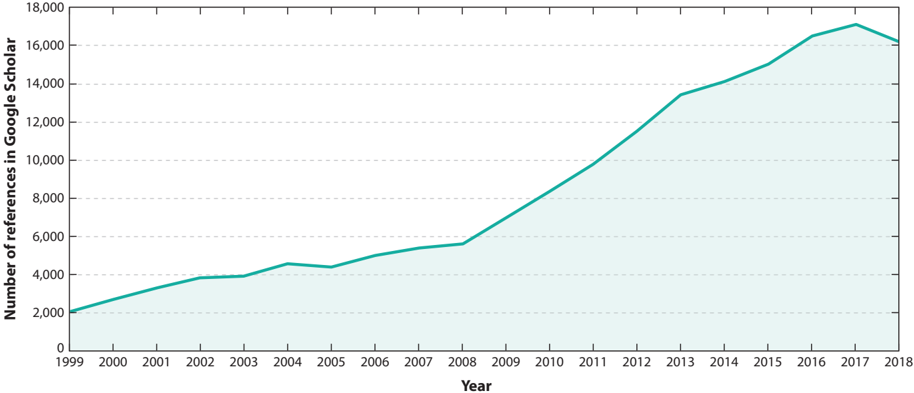
- Cyber: The paper reports Google Scholar counts for articles using “cyberwar” or “cyber war” rising from a little over 2,000 in 1999 to 16,200 in 2018. It also says cyber attacks are common, but their legal and political status remains unclear and their effects are often limited or low-intensity.
- Cyber: The review says most academic research concludes cyber capabilities are unlikely to be critical to warfare or as transformational as some policy makers fear, though they can still matter for espionage, crime, coercion, and economic disruption.
- AI: Scholarship is described as still in early stages; most military applications are said to be in logistics and training rather than close to or on the battlefield.
## Methods
- This is a review article that synthesizes existing scholarship on emerging military technologies, especially drones, cyber, and AI.
- The paper discusses several research designs used in the literature, including public-opinion studies, case studies, event-data analysis, applied theory, and game-theoretic models.
- It does not present a new dataset or original empirical test in the text provided; instead, it surveys prior findings and methodological challenges.
## Limitations
- The paper explicitly says research on newer military technologies faces limited empirical evidence, which creates methodological challenges.
- It also states that the cyber and drone literatures have limited depth compared with more established areas, and that many cyber questions are hard to study because of technical complexity, measurement problems, and covert activity.
- Evident from the text: many of the claims are based on cited prior work rather than new analysis in this article, so the review’s conclusions depend on the quality and scope of the underlying studies.
Model-written summary. Check it against the paper before relying on it.
Integrity signals
Registry
Cites
Statistics
Figures
Verification
Claims the paper makes
2 Valid · 5 Not valid · 41 Not checked · 36 Own results and interpretations
The cited sources support only part of this claim — read each source’s verdict below.
In the paper
“The public becomes less supportive of drone strikes when they are perceived to violate international law (Kreps 2014).”
§ Annual Review of Political Science Do Emerging Military Technologies Matter for International Politics? > Public Attitudes Toward Drones
What the sources say
- Partly supportedcites Kreps 2014 matched to “Flying under the radar: A study of public attitudes towards unmanned aerial vehicles” (2014) sourceExperimental — accuracy not yet measured
The Experimental results report that support fell when questions raised possible violations of international humanitarian law concerning civilian protection. But respondents were not comparably moved by whether strikes had international legal authorization. The claim is therefore too broad: the effect was clearest for particular humanitarian-law concerns, not perceived violations of international law generally. (LLM, conf=0.88)
plainstates a cause- Asserted: passes — The authors put it forward as true.
- Checkable: passes — It can be checked against evidence.
- Load-bearing: unclear — It is unclear whether the paper’s conclusions depend on it.
- Based: passes — The paper gives a reason why it holds.
- Partly supported
Every source the paper cites for this claim was checked and supports it.
In the paper
“Moreover, the ability of cyber tools to generate economic harm and disrupt military networks could have significant second-order consequences, especially given the ease of access many actors could have to these tools, as well as challenges surrounding attribution of cyber attacks (Kello 2013).”
§ Annual Review of Political Science Do Emerging Military Technologies Matter for International Politics? > How Transformational Is Cyber in International Security?
What the sources say
- Supportedcites Kello 2013 matched to “The Meaning of the Cyber Revolution: Perils to Theory and Statecraft” (2013) source
Split into 2 atoms — 2 confirmed, 0 partially supported, 0 disputed, 0 misattributed, 0 unverifiable. Expand the claim to see per-atom verdicts.
hedgedstates a possible cause- Asserted: passes — The authors put it forward as true.
- Checkable: passes — It can be checked against evidence.
- Load-bearing: unclear — It is unclear whether the paper’s conclusions depend on it.
- Based: passes — The paper gives a reason why it holds.
- Supported
In the paper
“Because drone strike capability changes the relative costs of war for the attacker and offers more certainty by increasing precision, countries with asymmetric advantages in the ability to use drones for strikes might be able to coerce potential adversaries in ways that have relevance for interstate war (Zegart 2018).”
§ Annual Review of Political Science Do Emerging Military Technologies Matter for International Politics? > Drones and Coercion
What the sources say
- Not checked — no full text of the sourcecites Zegart 2018 matched to “Cheap fights, credible threats: The future of armed drones and coercion” (2020) source
hedgedstates a possible cause- Asserted: passes — The authors put it forward as true.
- Checkable: passes — It can be checked against evidence.
- Load-bearing: passes — The paper’s conclusions depend on it.
- Based: passes — The paper gives a reason why it holds.
A conclusion the paper draws from its own results — it cites no other source for it, so there is none to check. The quote shows it is in the paper.
In the paper
“Countries relying on networks for computer and economic power are inherently at risk of that reliance being exploited.”
§ Annual Review of Political Science Do Emerging Military Technologies Matter for International Politics? > How Transformational Is Cyber in International Security?
plainstates a cause- Asserted: passes — The authors put it forward as true.
- Checkable: passes — It can be checked against evidence.
- Load-bearing: unclear — It is unclear whether the paper’s conclusions depend on it.
- Based: passes — The paper gives a reason why it holds.
A conclusion the paper draws from its own results — it cites no other source for it, so there is none to check. The quote shows it is in the paper.
In the paper
“The constant character of cyber intrusions and the lack of clear standards, based on history, concerning the scope of cyber conflict could make signaling in the cyber domain especially difficult.”
§ Annual Review of Political Science Do Emerging Military Technologies Matter for International Politics? > How Transformational Is Cyber in International Security?
hedgedstates a possible cause- Asserted: passes — The authors put it forward as true.
- Checkable: passes — It can be checked against evidence.
- Load-bearing: unclear — It is unclear whether the paper’s conclusions depend on it.
- Based: unclear — It is unclear why the paper says it holds.
28 more claims
Create a free account to see all 84 claims and to verify the 12 references still open.
- It may state two separate claims as one. 25
- Probably not a substantial claim. 36
Citations
Cites
Rid, T. (2012) · Journal of Strategic Studies · doi:10.1080/01402390.2011.608939 · Cited by 716 · cited 1×
“Most scholars working on cyber issues, however, argue that cyber capabilities are unlikely to be critical to warfare ( Junio 2013, Rid 2012).”
BackgroundDeterrence and Dissuasion in Cyberspace
Nye, J. S. (2017) · International Security · doi:10.1162/isec_a_00266 · Cited by 488
Military power: explaining victory and defeat in modern battle
(2005) · Choice Reviews Online · doi:10.5860/choice.42-4276 · Cited by 468
Stuxnet and the Limits of Cyber Warfare
Lindsay, J. R. (2013) · Security Studies · doi:10.1080/09636412.2013.816122 · Cited by 466 · cited 1×
“Lindsay (2013) argues that while many scholars and analysts initially used the attack to illustrate the revolutionary potential of cyber capabilities, in fact the attack shows the opposite.”
Background(2009) · Cited by 465
Military Power: Explaining Victory and Defeat in Modern Battle
Biddle, S. (2004) · Princeton University Press eBooks · doi:10.1515/9781400837823 · Cited by 396
Constructing Norms for Global Cybersecurity
Finnemore, M., & Hollis, D. B. (2016) · American Journal of International Law · doi:10.1017/s0002930000016894 · Cited by 395
Arquilla, J., & Ronfeldt, D. (1993) · Comparative Strategy · doi:10.1080/01495939308402915 · Cited by 376
Determinants of Nuclear Weapons Proliferation
Jo, D.-J., & Gartzke, E. (2007) · Journal of Conflict Resolution · doi:10.1177/0022002706296158 · Cited by 351
Sainato, V. A. (2013) · Policing: An International Journal of Police Strategies & Management · doi:10.1108/pijpsm.2013.18136baa.005 · Cited by 296
Weaving Tangled Webs: Offense, Defense, and Deception in Cyberspace
Gartzke, E., & Lindsay, J. R. (2015) · Security Studies · doi:10.1080/09636412.2015.1038188 · Cited by 287 · cited 2×
“More generally, advances in attribution limit the deception advantages for cyber attackers, while defenders can also use deception to try to entrap attackers—both defeating an attack and identifying the attacker (Gartzke & Lindsay 2015).”
BackgroundWhen Heads Roll: Assessing the Effectiveness of Leadership Decapitation
Jordan, J. (2009) · Security Studies · doi:10.1080/09636410903369068 · Cited by 284 · cited 1×
“Jordan (2009, 2014) argues that these attempts often fail and do not generally degrade group capabilities, but others disagree ( Johnston 2012).”
BackgroundJohnston, P. B. (2012) · International Security · doi:10.1162/isec_a_00076 · Cited by 281 · cited 1×
“Jordan (2009, 2014) argues that these attempts often fail and do not generally degrade group capabilities, but others disagree ( Johnston 2012).”
BackgroundThe Correlates of Nuclear Proliferation: A Quantitative Test
Singh, S., & Way, C. R. (2004) · Journal of Conflict Resolution · doi:10.1177/0022002704269655 · Cited by 277
The meaning of the nuclear revolution: statecraft and the prospect of Armageddon
(1990) · Choice Reviews Online · doi:10.5860/choice.27-6586 · Cited by 262
Invisible Digital Front: Can Cyber Attacks Shape Battlefield Events?
Kostyuk, N., & Zhukov, Y. M. (2019) · Journal of Conflict Resolution · doi:10.1177/0022002717737138 · Cited by 249
Cyberwar: A New ‘Absolute Weapon’? The Proliferation of Cyberwarfare Capabilities and Interstate War
Liff, A. P. (2012) · Journal of Strategic Studies · doi:10.1080/01402390.2012.663252 · Cited by 238 · cited 1×
“Some scholars argue that this ambiguity could increase the risk of escalation in a crisis (Lin 2012).”
BackgroundThe Meaning of the Cyber Revolution: Perils to Theory and Statecraft
Kello, L. (2013) · International Security · doi:10.1162/isec_a_00138 · Cited by 234
Gilli, A., & Gilli, M. (2019) · International Security · doi:10.1162/isec_a_00337 · Cited by 229
What Is the Cyber Offense-Defense Balance? Conceptions, Causes, and Assessment
Slayton, R. (2017) · International Security · doi:10.1162/isec_a_00267 · Cited by 224 · cited 2×
“S ee c op yr ig ht f or a pp ro ve d us e. to abilities like scanning, managing network access, updating software, and effectively operating complex cyber systems in a world of uncertainty (Slayton 2017).”
BackgroundCyber War versus Cyber Realities: Cyber Conflict in the International System
Valeriano, B., & Maness, R. C. (2015) · doi:10.1093/acprof:oso/9780190204792.001.0001 · Cited by 217
(2017) · Cited by 195
The Impact of China on Cybersecurity: Fiction and Friction
Lindsay, J. R. (2015) · International Security · doi:10.1162/isec_a_00189 · Cited by 183 · cited 3×
“More generally, advances in attribution limit the deception advantages for cyber attackers, while defenders can also use deception to try to entrap attackers—both defeating an attack and identifying the attacker (Gartzke & Lindsay 2015).”
BackgroundThe Diffusion of Military Power: Causes and Consequences for International Politics
Horowitz, M. C. (2010) · doi:10.1515/9781400835102 · Cited by 182
Self-citationAutonomous Weapon Systems and Strategic Stability
Altmann, J., & Sauer, F. (2017) · Survival · doi:10.1080/00396338.2017.1375263 · Cited by 163
The Impact of US Drone Strikes on Terrorism in Pakistan
Johnston, P. B., & Sarbahi, A. K. (2016) · International Studies Quarterly · doi:10.1093/isq/sqv004 · Cited by 161
The costs and consequences of drone warfare
BOYLE, M. J. (2013) · International Affairs · doi:10.1111/1468-2346.12002 · Cited by 159 · cited 1×
“Those who conclude that drones are effective in counterterrorism and counterinsurgency argue that they are more efficient and cost-effective in accurately targeting adversaries than alternative uses of force such as inhabited aircraft or teams of soldiers on the ground (Byman 2013).”
BackgroundNuclear Weapons and Coercive Diplomacy
Sechser, T. S., & Fuhrmann, M. (2016) · doi:10.1017/9781316227305 · Cited by 155
Droning On: Explaining the Proliferation of Unmanned Aerial Vehicles
Fuhrmann, M., & Horowitz, M. C. (2017) · International Organization · doi:10.1017/s0020818317000121 · Cited by 151
Self-citationAttacking the Leader, Missing the Mark: Why Terrorist Groups Survive Decapitation Strikes
Jordan, J. (2014) · International Security · doi:10.1162/isec_a_00157 · Cited by 147
Astropolitik: classical geopolitics in the space age
Dolman, E. C. (2002) · Choice Reviews Online · doi:10.5860/choice.39-6695 · Cited by 147
International law, military effectiveness, and public support for drone strikes
Kreps, S. E., & Wallace, G. P. R. (2016) · Journal of Peace Research · doi:10.1177/0022343316657405 · Cited by 128
Emerging technologies and strategic stability in peacetime, crisis, and war
Sechser, T. S., Narang, N., & Talmadge, C. (2019) · Journal of Strategic Studies · doi:10.1080/01402390.2019.1626725 · Cited by 124 · cited 1×
“This could connect back to research on nuclear proliferation and how countries might seek to leverage nuclear weapons to improve their security situation (Gartzke & Jo 2007, Kroenig 2018, Sechser & Fuhrmann 2017, Singh & Way 2004).”
BackgroundValeriano, B., Jensen, B., & Maness, R. C. (2018) · Oxford Scholarship Online · doi:10.1093/oso/9780190618094.001.0001 · Cited by 124
Cooperation, Conflict, and the Costs of Anarchy
Fearon, J. D. (2018) · International Organization · doi:10.1017/s0020818318000115 · Cited by 119
How Probable is Cyber War? Bringing IR Theory Back In to the Cyber Conflict Debate
Junio, T. J. (2013) · Journal of Strategic Studies · doi:10.1080/01402390.2012.739561 · Cited by 114 · cited 3×
“Regardless of the reality, policy makers believe there is an offensive advantage in cyberspace, which could generate biases in favor of offensive military cyber operations ( Junio 2013, p. 130).”
BackgroundSeparating Fact from Fiction in the Debate over Drone Proliferation
Horowitz, M. C., Kreps, S. E., & Fuhrmann, M. (2016) · International Security · doi:10.1162/isec_a_00257 · Cited by 113 · cited 3×
“Authors imagine how further developments in military robotics, whether in the form of next-generation drones with more capabilities or swarms of drones, might shape coercion and warfare (Horowitz et al. 2016).”
BackgroundSelf-citationWhat Explains Counterterrorism Effectiveness? Evidence from the U.S. Drone War in Pakistan
Mir, A. (2018) · International Security · doi:10.1162/isec_a_00331 · Cited by 109
The Logic of American Nuclear Strategy
Kroenig, M. (2018) · Oxford University Press eBooks · doi:10.1093/oso/9780190849184.001.0001 · Cited by 106
Do U.S. Drone Strikes Cause Blowback? Evidence from Pakistan and Beyond
Shah, A. (2018) · International Security · doi:10.1162/isec_a_00312 · Cited by 95 · cited 1×
“This could connect back to research on nuclear proliferation and how countries might seek to leverage nuclear weapons to improve their security situation (Gartzke & Jo 2007, Kroenig 2018, Sechser & Fuhrmann 2017, Singh & Way 2004).”
BackgroundSchneider, J. (2019) · Journal of Strategic Studies · doi:10.1080/01402390.2019.1627209 · Cited by 95
The Diffusion of Drone Warfare? Industrial, Organizational, and Infrastructural Constraints
Gilli, A., & Gilli, M. (2016) · Security Studies · doi:10.1080/09636412.2016.1134189 · Cited by 85
Astropolitik: Classical Geopolitics in the Space Age
Sheldon, J. B. (2002) · Comparative Strategy · doi:10.1080/01495930290043001 · Cited by 84 · cited 1×
“Another promising area for research is outer space (Dolman 2002, Early 2014).”
BackgroundAlgorithms at War: The Promise, Peril, and Limits of Artificial Intelligence
Jensen, B. M., Whyte, C., & Cuomo, S. (2020) · International Studies Review · doi:10.1093/isr/viz025 · Cited by 84 · cited 1×
“Nuclear weapons, to most scholars, represent an exception—the rare case where the technology itself is thought to have significant consequences for international politics, almost aside from how countries might plan to use it ( Jervis 1989).”
BackgroundCheap fights, credible threats: The future of armed drones and coercion
Zegart, A. (2020) · Journal of Strategic Studies · doi:10.1080/01402390.2018.1439747 · Cited by 81 · cited 1×
“…capability changes the relative costs of war for the attacker and offers more certainty by increasing precision, countries with asymmetric advantages in the ability to use drones for strikes might be able to coerce potential adversaries in ways that have relevance for interstate war (Zegart 2018).”
BackgroundDrones, Surveillance, and Violence: Theory and Evidence from a US Drone Program
Mir, A., & Moore, D. (2019) · International Studies Quarterly · doi:10.1093/isq/sqz040 · Cited by 79
Technological change and international relations
Drezner, D. W. (2019) · International Relations · doi:10.1177/0047117819834629 · Cited by 78
Public opinion and the politics of the killer robots debate
Horowitz, M. C. (2016) · Research & Politics · doi:10.1177/2053168015627183 · Cited by 75 · cited 1×
“One popular approach to studying new weapons technologies involves behavioral research on what influences attitudes toward them within the general public (Horowitz 2016, Kreps 2014, Walsh & Schulzke 2018), in the military, or among elites (Schneider 2019a).”
BackgroundSelf-citationThe economic impact of cyber terrorism
Hua, J., & Bapna, S. (2013) · The Journal of Strategic Information Systems · doi:10.1016/j.jsis.2012.10.004 · Cited by 75 · cited 1×
“That being said, some scholars have attempted to apply existing theory to study how AI could shape international politics ( Jensen et al. 2019).”
BackgroundHow does the offense-defense balance scale?
Garfinkel, B., & Dafoe, A. (2019) · Journal of Strategic Studies · doi:10.1080/01402390.2019.1631810 · Cited by 73
Exploring the Final Frontier: An Empirical Analysis of Global Civil Space Proliferation
Early, B. R. (2013) · International Studies Quarterly · doi:10.1111/isqu.12102 · Cited by 72 · cited 1×
“While most of the research on public attitudes concerning drones uses samples of the American public, some research expands beyond America’s borders, looking at countries such as Pakistan, which has been on the receiving end of US drone strikes (Fair et al. 2014).”
BackgroundTalmadge, C. (2019) · Journal of Strategic Studies · doi:10.1080/01402390.2019.1631811 · Cited by 70
Do Drone Strikes Degrade Al Qaeda? Evidence From Propaganda Output
Smith, M., & Walsh, J. I. (2013) · Terrorism and Political Violence · doi:10.1080/09546553.2012.664011 · Cited by 68 · cited 1×
“Smith & Walsh (2013) find that drone strikes against al Qaeda did not, at least initially, significantly reduce al Qaeda’s ability to generate propaganda.”
BackgroundArtificial Intelligence, International Competition, and the Balance of Power (May 2018)
Horowitz, M. C. (2018) · Texas National Security Review · doi:10.15781/t2639kp49 · Cited by 67
Self-citationFlying under the radar: A study of public attitudes towards unmanned aerial vehicles
Kreps, S. (2014) · Research & Politics · doi:10.1177/2053168014536533 · Cited by 66
Gartzke, E., & Lindsay, J. R. (2019) · doi:10.1093/oso/9780190908645.001.0001 · Cited by 63
Living weapons: biological warfare and international security
(2010) · Choice Reviews Online · doi:10.5860/choice.47-5294 · Cited by 51 · cited 1×
“As these technologies have not been the subject of as much scholarship from international relations scholars (for some exceptions, see Koblentz 2011, Volpe 2019, Williams 2019), examining them is a task for a future review.”
BackgroundPakistani Opposition to American Drone Strikes
Fair, C. C., Kaltenthaler, K., & Miller, W. J. (2014) · Political Science Quarterly · doi:10.1002/polq.12145 · Cited by 51
Drones and Support for the Use of Force
Walsh, J., & Schulzke, M. (2018) · doi:10.3998/mpub.9946611 · Cited by 49
Rethinking secrecy in cyberspace: the politics of voluntary attribution
Poznansky, M., & Perkoski, E. (2018) · Journal of Global Security Studies · doi:10.1093/jogss/ogy022 · Cited by 39 · cited 1×
“Fourth, unless a group or country either claims responsibility or is outed by a target, much cyber activity remains more covert than kinetic actions (though some kinetic actions can be covert, of course) (Poznansky & Perkoski 2018).”
BackgroundAsymmetric arms control and strategic stability: Scenarios for limiting hypersonic glide vehicles
Williams, H. (2019) · Journal of Strategic Studies · doi:10.1080/01402390.2019.1627521 · Cited by 30 · cited 3×
“Drone strikes tend to be popular with the American public due to fear of casualties, with support crossing party lines between Democrats and Republicans (Walsh & Schulzke 2018).”
BackgroundDual-use distinguishability: How 3D-printing shapes the security dilemma for nuclear programs
Volpe, T. A. (2019) · Journal of Strategic Studies · doi:10.1080/01402390.2019.1627210 · Cited by 30
Beyond Military Power: The Symbolic Politics of Conventional Weapons Transfers
Spindel, J. E. (2018) · University of Minnesota Digital Conservancy (University of Minnesota) · Cited by 23
Cyber Coercion as a Combined Strategy
Valeriano, B. G. (2018) · Oxford University Press eBooks · doi:10.1093/oso/9780190618094.003.0004 · Cited by 22
Drones and Support for the Use of Force
Walsh, J. I., & Schulzke, M. (2018) · University of Michigan Press eBooks · doi:10.2307/j.ctvh4zhx8 · Cited by 18
Public Opinion and the Politics of the Killer Robots DebatePreprint
Horowitz, M. C. (2015) · SSRN Electronic Journal · doi:10.2139/ssrn.2648999 · Cited by 17
Self-citationAstropolitik: Classical Geopolitics in the Space Age
Dolman, E. (2001) · doi:10.4324/9780203016640 · Cited by 16
Gilli, A., & Gilli, M. (2014) · SSRN Electronic Journal · doi:10.2139/ssrn.2425750 · Cited by 7
Exploring the Final Frontier: An Empirical Analysis of Global Civil Space Proliferation
Early, B. R. (2014) · Harvard Dataverse · doi:10.7910/dvn/5kj80q
Kreps, S. E., & Wallace, G. P. R. (2017) · Harvard Dataverse · doi:10.7910/dvn/gttgrp
Cooperation, Conflict, and the Costs of Anarchy—CORRIGENDUM
Fearon, J. D. (2018) · International Organization · doi:10.1017/s0020818318000309
Research works printed but not linked: 6
- 3. Byman D. 2013. Why drones work. Foreign Aff. 92:32-43
- 4. Cronin AK. 2013. Why drones fail. Foreign Aff. 92:44-54
- 7. Dombrowski P, Demchak CC. 2014. Cyber war, cybered conflict, and the maritime domain. Naval War Coll. Rev. 67:70-96
- 43. Lin H. 2012. Escalation dynamics and conflict termination in cyberspace. Strateg. Stud. Q. 6:46-70
- 53. Schelling TC. 1960. The Strategy of Conflict. Cambridge, MA: Harvard Univ. Press
- 54. Schmitt MN. 2011. Cyber operations and the jud ad bellum revisited. Villanova Law Rev. 56:569-606
Cited by
Horowitz, M. C., & Kahn, L. (2024) · International Studies Quarterly · doi:10.1093/isq/sqae020 · Cited by 68
Self-citationDual Use Deception: How Technology Shapes Cooperation in International Relations
Vaynman, J., & Volpe, T. A. (2023) · International Organization · doi:10.1017/s0020818323000140 · Cited by 77
Wargame of Drones: Remotely Piloted Aircraft and Crisis Escalation
Lin-Greenberg, E. (2022) · Journal of Conflict Resolution · doi:10.1177/00220027221106960 · Cited by 68
“While technology is an important factor underlying how crises unfold (Jervis 1976; Creveld 1991; Cohen 1996; Horowitz 2020), “weapons don’t make war (Gray 1993),” and technology’s effect on escalation is not deterministic.”
BackgroundAlgorithms and Influence Artificial Intelligence and Crisis Decision-Making
Horowitz, M. C., & Lin-Greenberg, E. (2022) · International Studies Quarterly · doi:10.1093/isq/sqac069 · Cited by 54
Self-citationThe technology triad: disruptive AI, regulatory gaps and value change
Hopster, J. K. G., & Maas, M. M. (2023) · AI and Ethics · doi:10.1007/s43681-023-00305-5 · Cited by 56
“3 It is often even more difficult to anticipate a tech-nology’s subsequent uptake and use in society, let alone the resulting societal impacts [62, 63].”
Background
Metadata
- Authors
- Horowitz, M. C.
- Affiliations
- University of Pennsylvania (US)
- Corresponding author
- Horowitz, Michael C.
- ORCID
- Horowitz, Michael C.
- Venue
- Annual Review of Political Science
- Publisher
- Annual Reviews
- Published
- 2020-05-11
- Volume
- 23
- Issue
- 1
- Pages
- 385-400
- ISSN
- 1094-2939 (ISSN-L)
- 1545-1577
- OpenAlex
- W3025441760
- Semantic Scholar
- 7ff60522fce607292a56b11d4ea32640aec70d4f
- Cited by
- 73
- References
- 59
- Citations by year
- 2026: 10 · 2025: 12 · 2024: 9 · 2023: 21 · 2022: 9 · 2021: 7 · 2020: 2
- FWCI
- 1.34
- Type
- journal article
- Language
- en
- Open access
- hybrid
- doi.org
- Locations
- Annual Review of Political Science (publishedVersion, cc-by)
- Topics
- Physical Sciences › Engineering › Control and Systems Engineering › Military Strategy and Technology
- Social Sciences › Political Science and International Relations › International Relations and Foreign Policy
- Physical Sciences › Engineering › Aerospace Engineering › Military Technology and Strategies
- Keywords
- emerging military technologies, cyber warfare, unmanned aerial vehicles, artificial intelligence in warfare, military organization, non-state actors, international politics, combat effectiveness, methodological issues
About these checks
Registry, retraction, Cites and statistics results are computed, not judged, with one exception: a printed reference that no index lists is read once by a model before it counts as a citation error. Claims are extracted by a model and kept only when their quote appears verbatim in the text; each cited source is then checked, with a model’s help, for whether it says what the claim relies on. Those verdicts can be wrong — read the claim’s quote and the cited source before relying on one.
The claim verdicts this report counts are experimental: their accuracy is not yet measured.
A language model drew the claims from the paper on 2026-10-10, under version 3 of the claim definition (model deepseek-v4.1-flash, prompt extract-v3).
A second model labelled each claim on 2026-10-10 (model jev-1.13-20260917, definition revision gold-guideline-v0.2).
Cited sources are checked with a language model’s help (gpt-6-sol and qwen3.8-omni-flash).
Statistics and arithmetic are recomputed, not judged.
Confidence bands are shown only for fields calibrated on our annotated test set. None is calibrated yet, so no band is shown.
What counts as a claim ›How we measure confidence ›How we check this ›
Are you an author, or do you see a problem with this page? Request a review
Data sources
Bibliographic data: Semantic Scholar, OpenAlex, Crossref.
Contains information from the Semantic Scholar Academic Graph Datasets, made available under the ODC Attribution License (ODC-BY 1.0).
Semantic Scholar’s data is described in: Kinney, R., et al. (2023). The Semantic Scholar Open Data Platform. arXiv:2301.10140.
