

A Parametric Open Circuit Voltage Model for Lithium Ion Batteries
Open accessThe DOI matches its Crossref record; 29 of the 29 references it cites were found in a registry or an index.
Abstract
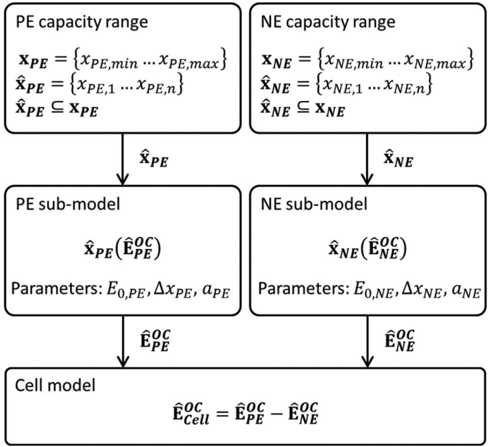
We present an open circuit voltage (OCV) model for lithium ion (Li-ion) cells, which can be parameterized by measurements of the OCV of positive and negative electrode half-cells and a full cell. No prior knowledge of physical parameters related to particular cell chemistries is required. The OCV of the full cell is calculated from two electrode sub-models, which are comprised of additive terms that represent the phase transitions of the active electrode materials. The model structure is flexible and can be applied to any Li-ion cell chemistry. The model can account for temperature dependence and voltage hysteresis of the OCV. Fitting the model to OCV data recorded from a Li-ion cell at 0°C, 10°C, 20°C, 30°C and 40°C yielded high accuracies with errors (RMS) of less than 5 mV. The model can be used to maintain the accuracy of dynamic Li-ion cell models in battery management systems by accounting for the effects of capacity fade on the OCV. Moreover, the model provides a means to separate the cell's OCV into its constituent electrode potentials, which allows the electrodes' capacities to be tracked separately over time, providing an insight into prevalent degradation mechanisms acting on the individual electrodes.
Overview
The claims and statistics of this paper haven’t been checked yet.
Free: it reads the open-access text and checks the first 5 claims that cite a source we can check. Create a free account to check every claim.
Integrity signals
Registry
Cites
Statistics
Figures




Verification
Claims the paper makes
The claims and statistics of this paper haven’t been checked yet.
Free: it reads the open-access text and checks the first 5 claims that cite a source we can check. Create a free account to check every claim.
Claims other papers make about this one
Each is checked against this paper’s own text: does it say what the citing paper says it does?
The cited source says what the claim attributes to it.
In the citing paper
“In previous work, we developed a parametric OCV model which can be used as a functional expression of the OCV of both the electrodes and the cell [33].”
From Degradation diagnostics for lithium ion cells (2017) · cites this paper as [33]
The cited source says what the claim attributes to it.
In the citing paper
“For this reason, an additional phase was added to the OCV model in order to improve the fit qualities from a root mean squared error (RMSE) of 7 mV for the PE and 12 mV for the NE [33] to < 3mV for both electrodes in this work, as demonstrated in Fig. 6.”
From Degradation diagnostics for lithium ion cells (2017) · cites this paper as [33]
The cited source says what the claim attributes to it.
In the citing paper
“In previous work, a minimum of four phases were identified in both the PE and NE material for this particular cell chemistry [33].”
From Degradation diagnostics for lithium ion cells (2017) · cites this paper as [33]
Self-check
Percentages, sums and reported differences re-computed from the paper’s own numbers.
The self-check needs the paper’s full text.
Citations
Cites
Modern Aspects of Electrochemistry
(2002) · Modern Aspects of Electrochemistry · doi:10.1007/b114168 · Cited by 5,949
Mechanisms for Lithium Insertion in Carbonaceous Materials
Dahn, J. R., Zheng, T., Liu, Y., & Xue, J. S. (1995) · Science · doi:10.1126/science.270.5236.590 · Cited by 2,123
Weppner, W., & Huggins, R. A. (1977) · Journal of The Electrochemical Society · doi:10.1149/1.2133112 · Cited by 1,980
Extended Kalman filtering for battery management systems of LiPB-based HEV battery packs
Plett, G. L. (2004) · Journal of Power Sources · doi:10.1016/j.jpowsour.2004.02.032 · Cited by 1,923
Ohzuku, T., Iwakoshi, Y., & Sawai, K. (1993) · Journal of The Electrochemical Society · doi:10.1149/1.2220849 · Cited by 1,089
Synthesize battery degradation modes via a diagnostic and prognostic model
Dubarry, M., Truchot, C., & Liaw, B. Y. (2012) · Journal of Power Sources · doi:10.1016/j.jpowsour.2012.07.016 · Cited by 1,065
Xing, Y., He, W., Pecht, M., & Tsui, K. L. (2014) · Applied Energy · doi:10.1016/j.apenergy.2013.07.008 · Cited by 977
Lu, Z., MacNeil, D. D., & Dahn, J. R. (2001) · Electrochemical and Solid-State Letters · doi:10.1149/1.1407994 · Cited by 941
The thermodynamic origin of hysteresis in insertion batteries
Dreyer, W., Jamnik, J., Guhlke, C., Huth, R., Moškon, J., & Gaberšček, M. (2010) · Nature Materials · doi:10.1038/nmat2730 · Cited by 619
Hu, C., Youn, B. D., & Chung, J. (2012) · Applied Energy · doi:10.1016/j.apenergy.2011.08.002 · Cited by 560
Cited by
Items 101–198 of 198
Universal Li-Ion Cell Electrothermal Model
Stocker, R., Mumtaz, A., Paramjeet, Braglia, M., & Lophitis, N. (2020) · IEEE Transactions on Transportation Electrification · doi:10.1109/tte.2020.2986606 · Cited by 14
“The entropic coefficient can be empirically calculated through analyzing change in OCV with temperature, as a function of SoC [40], [43], [44], [49], [51], [52].”
BackgroundInfluentialCauses and fixes of unexpected phone shutoffs
Lee, Y., He, L., & Shin, K. G. (2020) · International Conference on Mobile Systems, Applications, and Services · doi:10.1145/3386901.3389024 · Cited by 14
“Unlike R 0 , which is relatively stable across a given charging cycle, R 1 and τ vary significantly with SoC due to phase transitions [31], causing different voltage drops at different SoCs, even with the same discharge current.”
BackgroundSchmid, A. U., Ridder, A., Hahn, M., Schofer, K., & Birke, K. P. (2020) · Batteries · doi:10.3390/batteries6020033 · Cited by 12
Thermal Data-Driven Model Reduction for Enhanced Battery Health Monitoring
Khasin, M., Mehta, M. R., Kulkarni, C. S., & Lawson, J. W. (2024) · Journal of Power Sources · doi:10.1016/j.jpowsour.2024.234442 · Cited by 11
Kostetzer, L., Nebl, C., Stich, M., Bund, A., & Schweiger, H.-G. (2020) · Journal of The Electrochemical Society · doi:10.1149/1945-7111/abc726 · Cited by 11
Non-destructive state-of-health diagnosis algorithm for blended electrode lithium-ion battery
Brunetaud, R., Mbeya, K. M., Legrand, N., Briat, O., Capitaine, A., & Vinassa, J.-M. (2023) · Journal of Energy Storage · doi:10.1016/j.est.2023.106863 · Cited by 11
Wen, J., Jia, C., & Xia, G. (2025) · Energy · doi:10.1016/j.energy.2025.138292 · Cited by 10
Hua, M., Xu, M., Li, J., Zhao, X., Wang, Q., Ni, X., & Wu, Y. (2025) · Scientific Reports · doi:10.1038/s41598-025-32347-6 · Cited by 10
Dong, H., Mao, L., Qu, K., Zhao, J., Li, F., & Jiang, L. (2022) · International Journal of Electrochemical Science · doi:10.20964/2022.08.34 · Cited by 10
Development and Verification of a Distributed Electro-Thermal Li-Ion Cell Model
Stocker, R., Lophitis, N., & Mumtaz, A. (2018) · Annual Conference of the IEEE Industrial Electronics Society (IECON) · doi:10.1109/iecon.2018.8591633 · Cited by 10
“Open circuit voltage (OCV) depends heavily on SoC, and has mild dependence on temperature [29].”
BackgroundOvejas, V. J. (2017) · UPCommons institutional repository (Universitat Politècnica de Catalunya) · doi:10.5821/dissertation-2117-114625 · Cited by 10
Nonlinear Characterization of Lithium-Ion Batteries With Bipolar Pulsing
Li, A. G., Berecibar, M., & Preindl, M. (2024) · IEEE Transactions on Industrial Electronics · doi:10.1109/tie.2024.3352159 · Cited by 9
“OCVisthedominantcontributor to the battery terminal voltage and its characteristics define battery degradation modes [16], [17], [18].”
BackgroundPaul, A., Wolfe, K. D., Verbrugge, M. W., Koch, B. J., Lowe, J. S., Trembly, J., Staser, J. A., & Garrick, T. R. (2024) · ECS Advances · doi:10.1149/2754-2734/ad7d1c · Cited by 9
Whba, R., Doğan, E., Moeez, I., Bhatti, A. H. U., Akbar, M., Chung, K. Y., Altin, E., Ateş, M. N., Altundağ, S., Stoyanova, R. K., et al. (2024) · ACS Applied Materials & Interfaces · doi:10.1021/acsami.4c11557 · Cited by 9
Anomaly detection in Li-ion cells using physics-based reduced-order thermal models
Mehta, M. R., Crowley, K., Khasin, M., Kulkarni, C. S., DeMattia, B., & Lawson, J. W. (2025) · Journal of Power Sources · doi:10.1016/j.jpowsour.2025.236190 · Cited by 8
Ahmed, I., & Majid, A. (2025) · Materials Science in Semiconductor Processing · doi:10.1016/j.mssp.2025.109889 · Cited by 9
Chen, Y., & Mitsubori, K. (2025) · Electronics Letters · doi:10.1049/ell2.70403 · Cited by 8
Couto, L. D., Reniers, J. M., Zhang, D., Howey, D. A., & Kinnaert, M. (2024) · IEEE Transactions on Control Systems Technology · doi:10.1109/tcst.2024.3483093 · Cited by 8
Self-citationPillai, P., Nguyen, J. H., & Balasingam, B. (2026) · IEEE Transactions on Transportation Electrification · doi:10.1109/tte.2026.3702326 · Cited by 8
“the chemical potential at equilibrium is written using the Nernst equation as [25]”
Baghdadi, I. (2017) · theses.fr (ABES) · doi:10.70675/1e1634a3z2a0dz4da8z8783zbb168dfd8e2c · Cited by 8
“Figure I-12 Exemple de mesures d’OCV par GITT : (a)(b) méthode GITT en temporel [25], (c) résultats de GITT dans le plan OCV (SOC) à différentes températures [27] La tension déterminée par l’intermédiaire d’une faible décharge (ou charge) est considérée comme un pseudo OCV (OCVpso) car la polarisation dans ces conditi…”
BackgroundBattery aging assessment: from critical insights to enhanced diagnosis
Che, Y., Schaeffer, J., Rhyu, J., Wu, L., Asinger, P. A., Kim, M., Sass, J., Findeisen, R., Bazant, M. Z., Chueh, W. C., et al. (2026) · Energy & Environmental Science · doi:10.1039/d5ee06439b · Cited by 7
Maures, M., Mathieu, R., Capitaine, A., Delétage, J.-Y., Vinassa, J.-M., & Briat, O. (2022) · Batteries · doi:10.3390/batteries8050039 · Cited by 7
Weßkamp, P., Reitemeyer, S., & Melbert, J. G. (2017) · SAE technical papers on CD-ROM/SAE technical paper series · doi:10.4271/2017-01-1191 · Cited by 7
Goldammer, E., & Kowal, J. (2020) · IEEE Vehicle Power and Propulsion Conference (VPPC) · doi:10.1109/vppc49601.2020.9330948 · Cited by 7
“In previous publications such as [2] and [3], the influence of changes in the OCV of the single electrodes throughout aging on the corresponding OCV characteristic of the full cell was analysed.”
Inverse Characterization of Open-Circuit Voltage for State-of-Charge Estimation of Batteries
Sunil, S., Sundaresan, S., Pillai, P., & Balasingam, B. (2023) · IEEE Transportation Electrification Conference and Expo · doi:10.1109/itec55900.2023.10187061 · Cited by 7
“Existing OCV models are of two types: the electrochemical OCV models, which are based on the electrochemical characteristics within the cell [1], [2]; and the empirical OCV models, that are based on the cell’s current and voltage response characteristics [3], [4].”
MethodZhang, T., Sotoudeh, M., Yao, X., Groß, A., & Kamlah, M. (2025) · International Journal of Solids and Structures · doi:10.1016/j.ijsolstr.2025.113525 · Cited by 6
Influence of Surface Chemistry on Carbon Fiber Structural Battery Anodes
Aqeel, M., Dharmasiri, B., Tavano, R., Austria, E. S., Jr., Akhavan, B., Leif, E., Henderson, L. C., & Randall, J. D. (2025) · Batteries & Supercaps · doi:10.1002/batt.202500464 · Cited by 6
Bhattacharyya, S., Dinh, Q. T., & McGordon, A. (2026) · Journal of Energy Storage · doi:10.1016/j.est.2025.120297 · Cited by 6
Temperature-dependent hysteresis model for Li-ion batteries
Bodnár, D., Marcin, D., & Ďurovský, F. (2024) · Automatika · doi:10.1080/00051144.2024.2368365 · Cited by 6
“Temperature dependence on OCV was tested in [1] and [8].”
BackgroundAccurate LLI and LAMPE Estimation Using the Mechanistic Modeling Approach with Layered Oxides
Dubarry, M., Agrawal, V., Hüske, M., & Kuipers, M. (2023) · Journal of The Electrochemical Society · doi:10.1149/1945-7111/ace21c · Cited by 6
Temperature Dependence of Li-ion Battery Hysteresis for Battery Modeling Purposes
Bodnár, D., Marcin, D., & Ďurovský, F. (2023) · International Conference on Electrical Drives and Power Electronics (EDPE) · doi:10.1109/edpe58625.2023.10274043 · Cited by 6
“Similarly, in [7] it was found that the temperature has a very little impact on OCV parameters.”
BackgroundParameter identification for the electrochemical model of Li-ion battery
Shen, W.-J., & Li, H. (2016) · International Conference on System Science and Engineering · doi:10.1109/icsse.2016.7551635 · Cited by 6
Role of surface termination in charge storage mechanism of 2D metal carbide
Sunny, S. (2025) · theses.fr (ABES) · doi:10.70675/c60c3f6az1ac1z40caz90b0z73b01beeab58 · Cited by 6
Li-ion battery voltage curve reconstruction using partial charge profiles: Actual v/s truncated data
Singh, A., Nakhanivej, P., Monaghan, Y., Loveridge, M., & Barai, A. (2025) · Journal of Power Sources Advances · doi:10.1016/j.powera.2025.100175 · Cited by 5
“Birkl et al. [1] presented a physics-based Open Circuit Voltage (OCV) model that could capture temperature dependence as well as charge-discharge hysteresis.”
Optimizing Lithium-ion Battery Performance with RC Equivalent Circuit Model Analysis
Shanaq, A. A., & Zohdy, M. A. (2023) · International Conference on Signal Processing, Computation, Electronics, Power and Telecommunication (IConSCEPT) · doi:10.1109/iconscept57958.2023.10170448 · Cited by 5
“Accurate SOC estimation is crucial for developing effective battery charging and discharging strategies and evaluating battery reliability[4-7].”
BackgroundMbeya, K. M. (2021) · theses.fr (ABES) · doi:10.70675/ab94a228z550dz4689z88a9z3923167faa04 · Cited by 5
Lithium-ion battery degradation: comparison of three modeling methodologies
Bessler, W. G., & Dubarry, M. (2026) · Elsevier eBooks · doi:10.1016/b978-0-12-819987-9.00007-x · Cited by 4
Workflows and principles for collaboration and communication in battery research
Kuhn, Y., Rana, B., Philipp, M., Schmitt, C. R., Scipioni, R., Flores, E., Kopljar, D., Clark, S., Latz, A., & Horstmann, B. (2025) · Digital Discovery · doi:10.1039/d5dd00247h · Cited by 4
(Invited paper) energy delivery for self-powered IoT devices
Ahmed, K. Z., Kar, M., & Mukhopadhyay, S. (2016) · Asia and South Pacific Design Automation Conference (ASP-DAC) · doi:10.1109/aspdac.2016.7428028 · Cited by 4
Adaptive Battery Diagnosis/Prognosis for Efficient Operation
Kim, E., Wu, B., Shin, K. G., Lee, J., & He, L. (2019) · ACM International Conference on Future Energy Systems (e-Energy) · doi:10.1145/3307772.3328286 · Cited by 4
Figgener, J., Bors, J., Kuipers, M., Hildenbrand, F., Junker, M. D., Koltermann, L., Woerner, P., Mennekes, M., Haberschusz, D., Kairies, K.-P., et al. (2024) · arXiv (Cornell University) · doi:10.48550/arxiv.2411.08025 · Cited by 4
Ni’mah, Y. L., Suprapto, S., Puteri, C. A., & Subhan, A. (2023) · RASAYAN Journal of Chemistry · doi:10.31788/rjc.2023.1618036 · Cited by 3
Contribution to a review of lithium-ion batteries diagnostic methods for space applications
Chapel, L., Picot, A., Lacressonnière, F., & Maussion, P. (2023) · IEEE International Symposium on Diagnostics for Electrical Machines, Power Electronics and Drives (SDEMPED) · doi:10.1109/sdemped54949.2023.10271478 · Cited by 3
“This method is not applicable to real situations, where the battery is subjected to dynamic charge/discharge protocols [19].”
MethodHeidari, S., Esrafili, M. D., & Sardroodi, J. J. (2023) · Chemical Physics Letters · doi:10.1016/j.cplett.2023.140414 · Cited by 3
Kalman-Filter-Based Learning of Characteristic Profiles of Lithium-Ion Batteries
Arima, M., Lin, L., & Fukui, M. (2022) · Sensors · doi:10.3390/s22145156 · Cited by 3
“On the other hand, Equation (13) is a nonlinear function because of Voc(k), which is a function of the SOC, that is, a parameter that should be estimated by the pOCV [25] or GITT [26] in the conventional case.”
BackgroundInfluentialOCV Aging Model of Lithium-ion Batteries for Whole-life Capacity-loss Mechanism Diagnosis
Tiansi, W., Chengzhi, G., Baokun, W., & Lei, P. (2023) · Journal of Mechanical Engineering · doi:10.3901/jme.2023.22.124 · Cited by 2
Microbially Charged Redox Flow Batteries for Bioenergy Storage
Santos, M. S. S., Peixoto, L., Dias‐Ferreira, C., Mendes, A. M. M., & Alves, M. M. (2019) · Wiley eBooks · doi:10.1002/9781119611103.ch14 · Cited by 2
Thermal Modeling and Optimization of Lithium-Ion Batteries for Electric Vehicles
Ghalkhani, M. (2017) · Scholarship at UWindsor (University of Windsor) · Cited by 2
Silicon anode in lithium-ion batteries
Roper, I. P. E. (2019) · Oxford University Research Archive (ORA) (University of Oxford) · doi:10.5287/ora-w4g1ven2k · Cited by 2
Fast charging strategies in lithium-ion batteries : detection and control of lithium plating
Koleti, U. R. (2026) · Warwick Research Archive Portal (University of Warwick) · doi:10.82444/warw.33830485 · Cited by 2
Suivi du vieillissement des batteries lithium embarquées, en usage ferroviaire
Juston, M. (2021) · theses.fr (ABES) · doi:10.70675/25c8543czba3fz4d37za1e3z400cd3ac6ead · Cited by 2
Reconstruction of Open-Circuit Voltage for Aging Lithium-Ion Batteries Based on Big Data
Wang, D., Wei, H., Xue, J., & Pei, L. (2022) · Lecture notes in electrical engineering · doi:10.1007/978-981-19-1870-4_46 · Cited by 1
Tan, P., & Feng, H. (2024) · International Workshop on Advanced Algorithms and Control Engineering (IWAACE) · doi:10.1109/iwceaa63616.2024.10823700 · Cited by 1
“This dataset contains eight small Kokam pouch LIBs with 740mAh rated capacity [9], named as cell 1 to cell 8.”
Online determination of state of charge in lithium-ion batteries: influence of the state of health
Armenta-Déu, C. (2025) · Frontiers in Energy Research · doi:10.3389/fenrg.2025.1573972 · Cited by 1
Rey, S. O., Santisteban, A. B., Flores, E., Casals, L. C., Clark, S., & Trilla, L. (2025) · Annual Conference of the IEEE Industrial Electronics Society (IECON) · doi:10.1109/iecon58223.2025.11221799 · Cited by 1
“While these approaches offer relatively good accuracy, they are time-consuming and can be affected by factors such as hysteresis and battery cycler precision [12].”
Kirst, C., Düsdieker, M., Gasper, P. J., Randall, C. R., Streller, L. A., Smith, K. A., Karger, A., Singer, J. P., & Jossen, A. (2026) · Journal of The Electrochemical Society · doi:10.1149/1945-7111/ae5b2d · Cited by 1
Merla, Y. (2017) · Spiral (Imperial College London) · doi:10.25560/60668 · Cited by 1
Degradation and processes in lithium batteries
McTurk, E. (2015) · Oxford University Research Archive (ORA) (University of Oxford) · doi:10.5287/ora-mjn6aw0px · Cited by 1
Self-citationImpact of Moisture on the Properties of LiNixCoyMn1-x-yO2 (NMC) Cathodes for Lithium-Ion Batteries
Liang, D. (2018) · The Knowledge Bank (The Ohio State University) · Cited by 1
Measurement, Modelling and State Estimation Techniques for Lithium-ion batteries
Yao, Q. (2021) · UTS ePRESS (University of Technology Sydney) · Cited by 1
High-powered electric motorcycle integrated performance studies
Flanagan, L. (2022) · Nottingham ePrints (University of Nottingham) · Cited by 1
Mulder, N. R. (2018) · NORA - Norwegian Open Research Archives
Roper, I. P. E., Chapman, S. J., & Please, C. P. (2019) · arXiv (Cornell University) · doi:10.48550/arxiv.1908.00390
“These approximations fail to capture the large ‘steps’ in chemical potential that occur at transitions in the structure of the intercalated anode [3].”
BackgroundNon-Invasive Aging Detection Methods of Lithium-Ion Batteries
Wu, Y. (2018) · mediaTUM (Technical University of Munich)
Khater, A. Z. (2018) · Journal of International Crisis and Risk Communication Research
Arrinda, M. (2020) · LA Referencia (Red Federada de Repositorios Institucionales de Publicaciones Científicas)
Prediction of Battery Remaining Capacity in Space Power System Using Extreme Learning Machine
Zheng, S., Huang, W., & Fan, Q. (2021) · International Conference on Power and Energy Systems (ICPES) · doi:10.1109/icpes53652.2021.9683837
“For the first one, the traditional prediction methods are commonly used such as the ampere-hour integration method [4] and opencircuit voltage method [5,6].”
MethodDali, A., Mesbahi, T., Bartholomeüs, P., & Chaaban, K. (2022) · Research Square · doi:10.21203/rs.3.rs-2195275/v1
Non-Linear Bipolar Pulse Characterisation of Lithium-ion Batteries
Li, A. G., & Preindl, M. (2023) · IEEE Energy Conversion Congress and Exposition (ECCE) · doi:10.1109/ecce53617.2023.10362892
“OCV is the dominant contributor to the battery terminal voltage and its characteristic defines battery degradation modes [17]–[19].”
BackgroundGopalakrishnan, K. (2018) · Spiral (Imperial College London) · doi:10.25560/87995
Operational analysis of a fuel cell in a commercial vehicle using longitudinal dynamics simulation
Bauer, M. M. (2022) · reposiTUm (TU Wien) · doi:10.34726/hss.2022.89121
Characterization of Lithium-Ion Batteries in Electric Vehicles over their Lifetime
Wildfeuer, L., Lienkamp, M., & München, T. U. (2025) · mediaTUM (Technical University of Munich)
Interpretable Battery Lifetime Prediction Using Early Degradation Data
Zhang, H. (2023) · Chalmers Research (Chalmers University of Technology)
Adamson, A. (2021) · DSpace repository (University of Tartu)
Grading and quality control of zinc-ion battery cells
Lacerda Alegre Abranches Farias, M. (2023) · Aaltodoc (Aalto University)
Koca, M. U., Tekin, A., & Özdemir, T. (2026) · Lecture notes in mechanical engineering · doi:10.1007/978-3-032-16138-3_38
Wang, Y., Yang, Y., Wei, L., & Li, Z. (2026) · SSRN Electronic Journal · doi:10.2139/ssrn.6579365
dQ/dV-Based Quality Screening Methodology for Fresh 18650 Cell Manufacturing AssessmentPreprint
Mulpuri, S. K., Kemény, M., Arias, N. B., Mikolášek, M., Venugopal, P., & Soeiro, T. B. (2026) · SSRN Electronic Journal · doi:10.2139/ssrn.6643914
Benchmarking half-cell model fitting approaches for lithium-ion battery degradation diagnostics
Li, T., Zhang, Y., Nowacki, B., Navidi, S., Schmitt, T., Hu, S., & Hu, C. K. (2026) · eTransportation · doi:10.1016/j.etran.2026.100593
Lithium-ion battery state of charge estimation based on modified charging protocol
Zermout, A., & Belaıdı, H. (2026) · Electrical Engineering · doi:10.1007/s00202-026-03634-w
“This method is offline; hence; it is not used in many applications which cannot support for the battery being offline for a long duration [10, 14].”
Investigation of Different Hybridization Schemes for VTOL Aircraft Using Conceptual Design Tools
Biswas, S. D., Crossley, W., & DeLaurentis, D. A. (2026) · AIAA AVIATION Forum · doi:10.2514/6.2026-4787
Conceptualization and Development of Methodologies for Repurposing of Second-Life EV BatteriesPreprint
Pedreiro, G. E. G., Manaia, J. P., Dias, J. P., Alves, A., Pardal, A., & dos Santos, J. A. (2026) · SSRN Electronic Journal · doi:10.2139/ssrn.7073280
Sun, L., Wang, S., Yu, C., Liu, D., Cheng, L., Shi, H., & Fernandez, C. (2026) · Ionics · doi:10.1007/s11581-026-07337-x
“Prior studies have established parametric mappings between full-cell OCV and electrode stoichiometric ranges, combined electrochemical models with graphite/LFP capacity and aging responses, and used electrode-capacity matching to distinguish lithium-inventory loss from active-material loss [27–29].”
Liu, C., Liao, C., Zhao, H., Wang, L., Wang, L., & Ma, C. (2026) · Journal of Energy Storage · doi:10.1016/j.est.2026.123593
Galasso, M., Čech, P., Horstkötter, I., Schwunk, S., Živcová, Z. V., & Knap, V. (2026) · Journal of Power Sources · doi:10.1016/j.jpowsour.2026.241902
Aging-Aware Classification and Optimal Usage of Electric Vehicle Batteries
Zhang, H. (2025) · Chalmers Research (Chalmers University of Technology)
リン酸鉄リチウムイオン電池の動的挙動とSOCに基づく並列制御に関する研究
Chen, Y. (2026) · Institutional Repositories DataBase (IRDB)
Kirst, C., Düsdieker, M., Gasper, P. J., Wandt, J., Streller, L. A., Li, J., Solchenbach, S., Singer, J. P., & Jossen, A. (2026) · Journal of The Electrochemical Society · doi:10.1149/1945-7111/aeab11
Dense and porous phase transition study of SEI formation using phase-field methodPreprint
Jeon, J., Köbbing, L., Vegge, T., Chang, J. H., Horstmann, B., & Castelli, I. E. (2026) · arXiv (Cornell University) · doi:10.48550/arxiv.2609.38679
“The SoC–OCV relationship of the graphite anode is obtained by fitting the parametric model of Birkl et al. [40] to SoC–OCV data points extracted from Von Kolzenberg et al. [25].”
Chen, Y., Mitsubori, K., & Arima, M. (2026) · Journal of The Electrochemical Society · doi:10.1149/1945-7111/aebac0
Parameterisation of NMC and LFP 4680 cells for electrochemical and thermal modellingPreprint
Teodorescu, R., Weinreich, N. A., Bilgin, B., Zhuang, Y., & Prochazka, W. (2026) · arXiv (Cornell University) · doi:10.48550/arxiv.2611.01938
Gaikwad, P. R., Juntunen, T., Tamadondar, M., Scheers, J., Huang, Y., & Brandell, D. (2026) · Journal of The Electrochemical Society · doi:10.1149/1945-7111/aec04a
Metadata
- Authors
- Birkl, C. R., McTurk, E., Roberts, M. R., Bruce, P. G., & Howey, D. A.
- Affiliations
- University of Oxford (GB)
- Venue
- Journal of The Electrochemical Society
- Publisher
- The Electrochemical Society
- Published
- 2015
- Volume
- 162
- Issue
- 12
- Pages
- A2271-A2280
- ISSN
- 0013-4651 (ISSN-L)
- 1945-7111
- OpenAlex
- W2226549587
- Cited by
- 166
- References
- 29
- Citations by year
- 2026: 13 · 2025: 16 · 2024: 19 · 2023: 26 · 2022: 23 · 2021: 12 · 2020: 16 · 2019: 13 · 2018: 8 · 2017: 8 · 2016: 10 · 2015: 2
- FWCI
- 9.63
- Type
- journal article
- Language
- en
- Open access
- hybrid
- doi.org
- Licence
- cc-by-nc-nd
- Locations
- Journal of The Electrochemical Society (publishedVersion, cc-by-nc-nd)
- St Andrews Research Repository (St Andrews Research Repository) (submittedVersion, cc-by-nc-nd)
- Funders
- Jaguar Land Rover
- Engineering and Physical Sciences Research Council (EP/I029273/2, EP/I029273/1)
- Topics
- Physical Sciences › Engineering › Automotive Engineering › Battery Modeling and Management
- Physical Sciences › Engineering › Electrical and Electronic Engineering › Advancements in Battery Materials
- Physical Sciences › Engineering › Control and Systems Engineering › Control Systems and Identification
- Keywords
- open-circuit voltage, lithium-ion batteries, temperature dependence, voltage hysteresis, capacity fade, battery management systems, battery degradation mechanisms, dynamic battery model
About these checks
Registry, retraction, Cites and statistics results are computed, not judged, with one exception: a printed reference that no index lists is read once by a model before it counts as a citation error. Claims are extracted by a model and kept only when their quote appears verbatim in the text; each cited source is then checked, with a model’s help, for whether it says what the claim relies on. Those verdicts can be wrong — read the claim’s quote and the cited source before relying on one.
Statistics and arithmetic are recomputed, not judged.
Confidence bands are shown only for fields calibrated on our annotated test set. None is calibrated yet, so no band is shown.
What counts as a claim ›How we measure confidence ›How we check this ›
Are you an author, or do you see a problem with this page? Request a review
Data sources
Bibliographic data: Semantic Scholar, OpenAlex, Crossref.
Contains information from the Semantic Scholar Academic Graph Datasets, made available under the ODC Attribution License (ODC-BY 1.0).
Semantic Scholar’s data is described in: Kinney, R., et al. (2023). The Semantic Scholar Open Data Platform. arXiv:2301.10140.
