

A Parametric Open Circuit Voltage Model for Lithium Ion Batteries
Open accessThe DOI matches its Crossref record; 29 of the 29 references it cites were found in a registry or an index.
Abstract
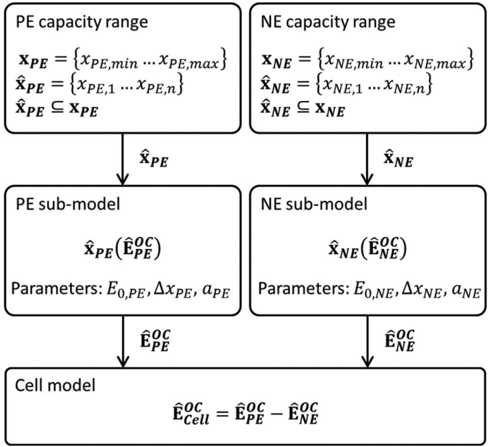
We present an open circuit voltage (OCV) model for lithium ion (Li-ion) cells, which can be parameterized by measurements of the OCV of positive and negative electrode half-cells and a full cell. No prior knowledge of physical parameters related to particular cell chemistries is required. The OCV of the full cell is calculated from two electrode sub-models, which are comprised of additive terms that represent the phase transitions of the active electrode materials. The model structure is flexible and can be applied to any Li-ion cell chemistry. The model can account for temperature dependence and voltage hysteresis of the OCV. Fitting the model to OCV data recorded from a Li-ion cell at 0°C, 10°C, 20°C, 30°C and 40°C yielded high accuracies with errors (RMS) of less than 5 mV. The model can be used to maintain the accuracy of dynamic Li-ion cell models in battery management systems by accounting for the effects of capacity fade on the OCV. Moreover, the model provides a means to separate the cell's OCV into its constituent electrode potentials, which allows the electrodes' capacities to be tracked separately over time, providing an insight into prevalent degradation mechanisms acting on the individual electrodes.
Overview
The claims and statistics of this paper haven’t been checked yet.
Free: it reads the open-access text and checks the first 5 claims that cite a source we can check. Create a free account to check every claim.
Integrity signals
Registry
Cites
Statistics
Figures




Verification
Claims the paper makes
The claims and statistics of this paper haven’t been checked yet.
Free: it reads the open-access text and checks the first 5 claims that cite a source we can check. Create a free account to check every claim.
Claims other papers make about this one
Each is checked against this paper’s own text: does it say what the citing paper says it does?
The cited source says what the claim attributes to it.
In the citing paper
“In previous work, we developed a parametric OCV model which can be used as a functional expression of the OCV of both the electrodes and the cell [33].”
From Degradation diagnostics for lithium ion cells (2017) · cites this paper as [33]
The cited source says what the claim attributes to it.
In the citing paper
“For this reason, an additional phase was added to the OCV model in order to improve the fit qualities from a root mean squared error (RMSE) of 7 mV for the PE and 12 mV for the NE [33] to < 3mV for both electrodes in this work, as demonstrated in Fig. 6.”
From Degradation diagnostics for lithium ion cells (2017) · cites this paper as [33]
The cited source says what the claim attributes to it.
In the citing paper
“In previous work, a minimum of four phases were identified in both the PE and NE material for this particular cell chemistry [33].”
From Degradation diagnostics for lithium ion cells (2017) · cites this paper as [33]
Self-check
Percentages, sums and reported differences re-computed from the paper’s own numbers.
The self-check needs the paper’s full text.
Citations
Cites
Modern Aspects of Electrochemistry
(2002) · Modern Aspects of Electrochemistry · doi:10.1007/b114168 · Cited by 5,949
Mechanisms for Lithium Insertion in Carbonaceous Materials
Dahn, J. R., Zheng, T., Liu, Y., & Xue, J. S. (1995) · Science · doi:10.1126/science.270.5236.590 · Cited by 2,123
Weppner, W., & Huggins, R. A. (1977) · Journal of The Electrochemical Society · doi:10.1149/1.2133112 · Cited by 1,980
Extended Kalman filtering for battery management systems of LiPB-based HEV battery packs
Plett, G. L. (2004) · Journal of Power Sources · doi:10.1016/j.jpowsour.2004.02.032 · Cited by 1,923
Ohzuku, T., Iwakoshi, Y., & Sawai, K. (1993) · Journal of The Electrochemical Society · doi:10.1149/1.2220849 · Cited by 1,089
Synthesize battery degradation modes via a diagnostic and prognostic model
Dubarry, M., Truchot, C., & Liaw, B. Y. (2012) · Journal of Power Sources · doi:10.1016/j.jpowsour.2012.07.016 · Cited by 1,065
Xing, Y., He, W., Pecht, M., & Tsui, K. L. (2014) · Applied Energy · doi:10.1016/j.apenergy.2013.07.008 · Cited by 977
Lu, Z., MacNeil, D. D., & Dahn, J. R. (2001) · Electrochemical and Solid-State Letters · doi:10.1149/1.1407994 · Cited by 941
The thermodynamic origin of hysteresis in insertion batteries
Dreyer, W., Jamnik, J., Guhlke, C., Huth, R., Moškon, J., & Gaberšček, M. (2010) · Nature Materials · doi:10.1038/nmat2730 · Cited by 619
Hu, C., Youn, B. D., & Chung, J. (2012) · Applied Energy · doi:10.1016/j.apenergy.2011.08.002 · Cited by 560
Cited by
Degradation diagnostics for lithium ion cells
Birkl, C. R., Roberts, M. R., McTurk, E., Bruce, P. G., & Howey, D. A. (2017) · Journal of Power Sources · doi:10.1016/j.jpowsour.2016.12.011 · Cited by 1,945
Self-citationChen, C.-H., Brosa Planella, F., O’Regan, K., Gastol, D., Widanage, W. D., & Kendrick, E. (2020) · Journal of The Electrochemical Society · doi:10.1149/1945-7111/ab9050 · Cited by 610
A comparison of methodologies for the non-invasive characterisation of commercial Li-ion cells
Barai, A., Uddin, K., Dubarry, M., Somerville, L., McGordon, A., Jennings, P., & Bloom, I. (2019) · Progress in Energy and Combustion Science · doi:10.1016/j.pecs.2019.01.001 · Cited by 319
Identifiability and Parameter Estimation of the Single Particle Lithium-Ion Battery Model
Bizeray, A. M., Kim, J.-H., Duncan, S., & Howey, D. A. (2018) · IEEE Transactions on Control Systems Technology · doi:10.1109/tcst.2018.2838097 · Cited by 219
“the galvanostatic intermittent titration technique (GITT) [34] by discharging the cell in 14.”
BackgroundMethodInfluentialSelf-citationOnline state of health estimation on NMC cells based on predictive analytics
Berecibar, M., Devriendt, F., Dubarry, M., Villarreal, I., Omar, N., Verbeke, W., & Van Mierlo, J. (2016) · Journal of Power Sources · doi:10.1016/j.jpowsour.2016.04.109 · Cited by 202
Metadata
- Authors
- Birkl, C. R., McTurk, E., Roberts, M. R., Bruce, P. G., & Howey, D. A.
- Affiliations
- University of Oxford (GB)
- Venue
- Journal of The Electrochemical Society
- Publisher
- The Electrochemical Society
- Published
- 2015
- Volume
- 162
- Issue
- 12
- Pages
- A2271-A2280
- ISSN
- 0013-4651 (ISSN-L)
- 1945-7111
- OpenAlex
- W2226549587
- Cited by
- 166
- References
- 29
- Citations by year
- 2026: 13 · 2025: 16 · 2024: 19 · 2023: 26 · 2022: 23 · 2021: 12 · 2020: 16 · 2019: 13 · 2018: 8 · 2017: 8 · 2016: 10 · 2015: 2
- FWCI
- 9.63
- Type
- journal article
- Language
- en
- Open access
- hybrid
- doi.org
- Licence
- cc-by-nc-nd
- Locations
- Journal of The Electrochemical Society (publishedVersion, cc-by-nc-nd)
- St Andrews Research Repository (St Andrews Research Repository) (submittedVersion, cc-by-nc-nd)
- Funders
- Jaguar Land Rover
- Engineering and Physical Sciences Research Council (EP/I029273/2, EP/I029273/1)
- Topics
- Physical Sciences › Engineering › Automotive Engineering › Battery Modeling and Management
- Physical Sciences › Engineering › Electrical and Electronic Engineering › Advancements in Battery Materials
- Physical Sciences › Engineering › Control and Systems Engineering › Control Systems and Identification
- Keywords
- open-circuit voltage, lithium-ion batteries, temperature dependence, voltage hysteresis, capacity fade, battery management systems, battery degradation mechanisms, dynamic battery model
About these checks
Registry, retraction, Cites and statistics results are computed, not judged, with one exception: a printed reference that no index lists is read once by a model before it counts as a citation error. Claims are extracted by a model and kept only when their quote appears verbatim in the text; each cited source is then checked, with a model’s help, for whether it says what the claim relies on. Those verdicts can be wrong — read the claim’s quote and the cited source before relying on one.
Statistics and arithmetic are recomputed, not judged.
Confidence bands are shown only for fields calibrated on our annotated test set. None is calibrated yet, so no band is shown.
What counts as a claim ›How we measure confidence ›How we check this ›
Are you an author, or do you see a problem with this page? Request a review
Data sources
Bibliographic data: Semantic Scholar, OpenAlex, Crossref.
Contains information from the Semantic Scholar Academic Graph Datasets, made available under the ODC Attribution License (ODC-BY 1.0).
Semantic Scholar’s data is described in: Kinney, R., et al. (2023). The Semantic Scholar Open Data Platform. arXiv:2301.10140.
