

The DOI matches its Crossref record; 99 of the 99 references it cites were found in a registry or an index.
PPARs, Obesity, and Inflammation
Open accessAbstract
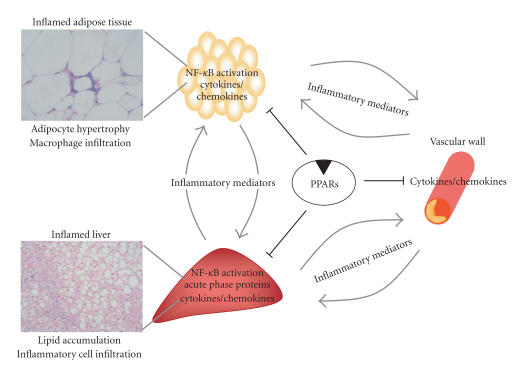
The worldwide prevalence of obesity and related metabolic disorders is rising rapidly, increasing the burden on our healthcare system. Obesity is often accompanied by excess fat storage in tissues other than adipose tissue, including liver and skeletal muscle, which may lead to local insulin resistance and may stimulate inflammation, as in steatohepatitis. In addition, obesity changes the morphology and composition of adipose tissue, leading to changes in protein production and secretion. Some of these secreted proteins, including several proinflammatory mediators, may be produced by macrophages resident in the adipose tissue. The changes in inflammatory status of adipose tissue and liver with obesity feed a growing recognition that obesity represents a state of chronic low-level inflammation. Various molecular mechanisms have been implicated in obesity-induced inflammation, some of which are modulated by the peroxisome proliferator-activated receptors (PPARs). PPARs are ligand-activated transcription factors involved in the regulation of numerous biological processes, including lipid and glucose metabolism, and overall energy homeostasis. Importantly, PPARs also modulate the inflammatory response, which makes them an interesting therapeutic target to mitigate obesity-induced inflammation and its consequences. This review will address the role of PPARs in obesity-induced inflammation specifically in adipose tissue, liver, and the vascular wall.
Overview
The claims and statistics of this paper haven’t been checked yet.
Run the check — free, no account needed. It reads the open-access text and checks the sources it cites.
Integrity signals
Registry
Cites
Statistics
Figures
Verification
Claims the paper makes
The claims and statistics of this paper haven’t been checked yet.
Run the check — free, no account needed. It reads the open-access text and checks the sources it cites.
Claims other papers make about this one
Each is checked against this paper’s own text: does it say what the citing paper says it does?
In the citing paper
“The anti-inflammatory activities of PPARs are partially effectuated by inhibition of NF-κB. PPARs are able to attenuate NF-κB function either by interfering with the transcription activating capacity of the NF-κB complex or by regulating genes that suppress the activation of NF-κB. By physical interaction with components of the NF-κB complex, PPARα impairs binding of NF-κB to the DNA and”
From Antioxidant and Anti-Inflammatory Activities of Essential Oils: A Short Review (2010) · cites this paper as [134]
Self-check
Percentages, sums and reported differences re-computed from the paper’s own numbers.
The self-check needs the paper’s full text.
Citations
Cites
Role of Insulin Resistance in Human Disease
Reaven, G. M. (1988) · Diabetes · doi:10.2337/diab.37.12.1595 · Cited by 12,154
Obesity is associated with macrophage accumulation in adipose tissue
Weisberg, S. P., McCann, D., Desai, M., Rosenbaum, M., Leibel, R. L., & Ferrante, A. W. (2003) · Journal of Clinical Investigation · doi:10.1172/jci200319246 · Cited by 10,041
Adipose Expression of Tumor Necrosis Factor-α: Direct Role in Obesity-Linked Insulin Resistance
Hotamisligil, G. S., Shargill, N. S., & Spiegelman, B. M. (1993) · Science · doi:10.1126/science.7678183 · Cited by 7,518
Xu, H., Barnes, G. T., Yang, Q., Tan, G., Yang, D., Chou, C. J., Sole, J., Nichols, A., Ross, J. S., Tartaglia, L. A., et al. (2003) · Journal of Clinical Investigation · doi:10.1172/jci200319451 · Cited by 6,760
Nonalcoholic Fatty Liver Disease
Angulo, P. (2002) · New England Journal of Medicine · doi:10.1056/nejmra011775 · Cited by 5,228
Lusis, A. J. (2000) · Nature · doi:10.1038/35025203 · Cited by 4,880
Dormandy, J. A., Charbonnel, B., Eckland, D. J., Erdmann, E., Massi-Benedetti, M., Moules, I. K., Skene, A. M., Tan, M. H., Lefèbvre, P. J., Murray, G. D., et al. (2005) · The Lancet · doi:10.1016/s0140-6736(05)67528-9 · Cited by 4,129
Banting lecture 1988. Role of insulin resistance in human disease.
Reaven, G. (1988) · Diabetes · doi:10.2337/diabetes.37.12.1595 · Cited by 3,801
Stimulation of adipogenesis in fibroblasts by PPARγ2, a lipid-activated transcription factor
Tontonoz, P., Hu, E., & Spiegelman, B. M. (1994) · Cell · doi:10.1016/0092-8674(94)90006-x · Cited by 3,564
The peroxisome proliferator-activated receptor-γ is a negative regulator of macrophage activation
Ricote, M., Li, A. C., Willson, T. M., Kelly, C. J., & Glass, C. K. (1998) · Nature · doi:10.1038/34178 · Cited by 3,525
Research works printed but not linked: 4
- 10.1172/JCI200420468 · DOI
- 10.1016/S0140-6736(05)17912-4 · DOI · Paper page
- 10.1210/jc.83.5.1818 · DOI
- 10.1210/jc.86.7.3452 · DOI
Cited by
Sorted by citations
Beta Cell Dysfunction and Insulin Resistance
Cerf, M. E. (2013) · Frontiers in Endocrinology · doi:10.3389/fendo.2013.00037 · Cited by 964
Antioxidant and Anti-Inflammatory Activities of Essential Oils: A Short Review
Miguel, M. G. (2010) · Molecules · doi:10.3390/molecules15129252 · Cited by 933
Obesity, Hypertension, and Cardiac Dysfunction
Mouton, A. J., Li, X., Hall, M. E., & Hall, J. E. (2020) · Circulation Research · doi:10.1161/circresaha.119.312321 · Cited by 561
McArdle, M. A., Finucane, O. M., Connaughton, R. M., McMorrow, A. M., & Roche, H. M. (2013) · Frontiers in Endocrinology · doi:10.3389/fendo.2013.00052 · Cited by 552
Cannabinoids go nuclear: evidence for activation of peroxisome proliferator‐activated receptors
O’Sullivan, S. E. (2007) · British Journal of Pharmacology · doi:10.1038/sj.bjp.0707423 · Cited by 509
Metadata
- Authors
- Stienstra, R., Duval, C., Müller, M., & Kersten, S.
- Affiliations
- Wageningen University & Research (NL)
- Corresponding author
- Kersten, Sander
- Venue
- PPAR Research
- Publisher
- Hindawi Limited
- Published
- 2007
- Volume
- 2007
- Pages
- 1-10
- ISSN
- 1687-4757 (ISSN-L)
- 1687-4765
- PMC
- PMC1783744
- OpenAlex
- W1963979793
- Cited by
- 287
- References
- 98
- Citations by year
- 2026: 5 · 2025: 9 · 2024: 14 · 2023: 24 · 2022: 14 · 2021: 23 · 2020: 23 · 2019: 12 · 2018: 13 · 2017: 12 · 2016: 16 · 2015: 10 · 2014: 14 · 2013: 22 · 2012: 23
- FWCI
- 5.30
- Type
- journal article
- Language
- en
- Open access
- gold
- doi.org
- Locations
- PPAR Research (publishedVersion, cc-by)
- PubMed Central (publishedVersion, cc-by)
- PubMed (publishedVersion)
- Socio-Environmental Systems Modeling (acceptedVersion)
- UEA Digital Repository (University of East Anglia) (acceptedVersion)
- DOAJ (DOAJ: Directory of Open Access Journals) (submittedVersion, cc-by-sa)
- Radboud Repository (Radboud University) (submittedVersion)
- Radboud Repository (Radboud University) (submittedVersion, other-oa)
- Data Archiving and Networked Services (DANS) (submittedVersion, other-oa)
- Topics
- Life Sciences › Biochemistry, Genetics and Molecular Biology › Molecular Biology › Peroxisome Proliferator-Activated Receptors
- Health Sciences › Medicine › Endocrinology, Diabetes and Metabolism › Adipokines, Inflammation, and Metabolic Diseases
- Health Sciences › Medicine › Cardiology and Cardiovascular Medicine › Cardiovascular Disease and Adiposity
- Keywords
- peroxisome proliferator-activated receptors, obesity, inflammation, adipose tissue, liver, steatohepatitis, insulin resistance, macrophages, pro-inflammatory mediators, vascular inflammation, energy homeostasis, metabolic disorders, therapeutic target
About these checks
Registry, retraction, Cites and statistics results are computed, not judged, with one exception: a printed reference that no index lists is read once by a model before it counts as a citation error. Claims are extracted by a model and kept only when their quote appears verbatim in the text; each cited source is then checked, with a model’s help, for whether it says what the claim relies on. Those verdicts can be wrong — read the claim’s quote and the cited source before relying on one.
Statistics and arithmetic are recomputed, not judged.
Confidence bands are shown only for fields calibrated on our annotated test set. None is calibrated yet, so no band is shown.
What counts as a claim ›How we measure confidence ›How we check this ›
Are you an author, or do you see a problem with this page? Request a review
