

The DOI matches its Crossref record; 122 of the 124 references it cites were found in a registry or an index.
Chronic Inflammation in Obesity and the Metabolic Syndrome
Open accessAbstract
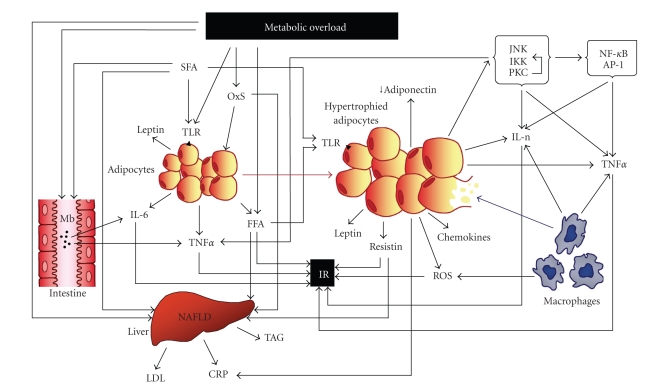
The increasing incidence of obesity and the metabolic syndrome is disturbing. The activation of inflammatory pathways, used normally as host defence, reminds the seriousness of this condition. There is probably more than one cause for activation of inflammation. Apparently, metabolic overload evokes stress reactions, such as oxidative, inflammatory, organelle and cell hypertrophy, generating vicious cycles. Adipocyte hypertrophy, through physical reasons, facilitates cell rupture, what will evoke an inflammatory reaction. Inability of adipose tissue development to engulf incoming fat leads to deposition in other organs, mainly in the liver, with consequences on insulin resistance. The oxidative stress which accompanies feeding, particularly when there is excessive ingestion of fat and/or other macronutrients without concomitant ingestion of antioxidant-rich foods/beverages, may contribute to inflammation attributed to obesity. Moreover, data on the interaction of microbiota with food and obesity brought new hypothesis for the obesity/fat diet relationship with inflammation. Beyond these, other phenomena, for instance psychological and/or circadian rhythm disturbances, may likewise contribute to oxidative/inflammatory status. The difficulty in the management of obesity/metabolic syndrome is linked to their multifactorial nature where environmental, genetic and psychosocial factors interact through complex networks.
Overview
The claims and statistics of this paper haven’t been checked yet.
Run the check — free, no account needed. It reads the open-access text and checks the sources it cites.
Integrity signals
Registry
Cites
Statistics
Figures
Verification
Claims the paper makes
The claims and statistics of this paper haven’t been checked yet.
Run the check — free, no account needed. It reads the open-access text and checks the sources it cites.
Claims other papers make about this one
Each is checked against this paper’s own text: does it say what the citing paper says it does?
In the citing paper
“Continuous low-level translocation of LPS into circulation can induce chronic low-level inflammatory states associated with development of obesity and other metabolic syndromes [92].”
From The athletic gut microbiota (2020) · cites this paper as [92]
In the citing paper
“As systemic inflammatory markers 123 and metabolites such as those derived from the gut microbiota have been associated with obesity and food addiction, future mechanistic studies that integrate these mediators are also of value.”
From History of early life adversity is associated with increased food addiction and sex-specific alterations in reward network connectivity in obesity (2019) · cites this paper as [123]
Self-check
Percentages, sums and reported differences re-computed from the paper’s own numbers.
The self-check needs the paper’s full text.
Citations
Cites
Grundy, S. M., Bilheimer, D. W., Chait, A., Clark, L. T., Denke, M. A., Havel, R. J., Hazzard, W. R., Hulley, S. B., Hunninghake, D. B., Kreisberg, R. A., et al. (1993) · JAMA · doi:10.1001/jama.269.23.3015 · Cited by 27,944
Expert Panel on Detection, E. (2001) · JAMA: The Journal of the American Medical Association · doi:10.1001/jama.285.19.2486 · Cited by 26,011
Diagnosis and Classification of Diabetes Mellitus
American Diabetes Association (2010) · Diabetes Care · doi:10.2337/dc11-s062 · Cited by 14,094
Inflammation and metabolic disorders
Hotamisligil, G. S. (2006) · Nature · doi:10.1038/nature05485 · Cited by 9,199 · cited 2×
“Other researchers have attempted to name this inflammatory state as “metaflammation”, meaning metabolically triggered inflammation [32], or “parainflammation” as a term to define an intermediate state between basal and inflammatory states [33].”
BackgroundOrigin and physiological roles of inflammation
Medzhitov, R. (2008) · Nature · doi:10.1038/nature07201 · Cited by 6,618 · cited 1×
“Other researchers have attempted to name this inflammatory state as “metaflammation”, meaning metabolically triggered inflammation [32], or “parainflammation” as a term to define an intermediate state between basal and inflammatory states [33].”
BackgroundEckel, R. H., Alberti, K., Grundy, S. M., & Zimmet, P. (2010) · The Lancet · doi:10.1016/s0140-6736(09)61794-3 · Cited by 6,317
Eckel, R. H., Grundy, S. M., & Zimmet, P. (2005) · The Lancet · doi:10.1016/s0140-6736(05)66378-7 · Cited by 5,755
Mechanisms underlying the resistance to diet-induced obesity in germ-free mice
Bäckhed, F., Manchester, J. K., Semenkovich, C. F., & Gordon, J. I. (2007) · Proceedings of the National Academy of Sciences · doi:10.1073/pnas.0605374104 · Cited by 2,615 · cited 2×
“[108] F.”
ResultCinti, S., Mitchell, G., Barbatelli, G., Murano, I., Ceresi, E., Faloia, E., Wang, S., Fortier, M., Greenberg, A. S., & Obin, M. S. (2005) · Journal of Lipid Research · doi:10.1194/jlr.m500294-jlr200 · Cited by 2,529 · cited 1×
“Macrophage crowns surrounding dead adipocytes in adipose tissue, as shown by Cinti and collaborators [71], are compatible with this hypothesis.”
BackgroundPhylogenetic Perspectives in Innate Immunity
Hoffmann, J. A., Kafatos, F. C., Janeway, C. A., & Ezekowitz, R. A. B. (1999) · Science · doi:10.1126/science.284.5418.1313 · Cited by 2,524 · cited 1×
“[72] J.”
Research works printed but not linked: 5
- 2003, Endocrine Practice, 9, 237
- 2000, Journal of Clinical Endocrinology and Metabolism, 85, 3338
- 2000, Diabetes and Metabolism, 26, 178
- 2008, International Journal of Obesity, 32, S11
- 2006, Journal of the American College of Nutrition, 25, 262S
Cited by
Sorted by citations
Inflammation and tumor progression: signaling pathways and targeted intervention
Zhao, H., Wu, L., Yan, G., Chen, Y., Zhou, M., Wu, Y., & Li, Y. (2021) · Signal Transduction and Targeted Therapy · doi:10.1038/s41392-021-00658-5 · Cited by 3,058
Chlorogenic acid (CGA): A pharmacological review and call for further research
Naveed, M., Hejazi, V., Abbas, M., Kamboh, A. A., Khan, G. J., Shumzaid, M., Ahmad, F., Babazadeh, D., FangFang, X., Modarresi-Ghazani, F., et al. (2018) · Biomedicine & Pharmacotherapy · doi:10.1016/j.biopha.2017.10.064 · Cited by 1,586
Inflammation, Oxidative Stress, and Obesity
Fernández-Sánchez, A., Madrigal‐Santillán, E., Bautista, M., Esquivel-Soto, J., Morales‐González, Á., Esquivel-Chirino, C., Durante-Montiel, I., Sánchez-Rivera, G., Valadez-Vega, M. D. C., & Morales‐González, J. A. (2011) · International Journal of Molecular Sciences · doi:10.3390/ijms12053117 · Cited by 1,536
“The amount of internalized FFA in liver is not regulated; thus, it is proportional to the plasma, in addition it also increases lipogenesis in the body and enhances intracellular accumulation of TG [34].”
BackgroundInfluentialKim, K., Gu, W., Lee, I., Joh, E., & Kim, D. (2012) · PLoS ONE · doi:10.1371/journal.pone.0047713 · Cited by 1,228
“However, recent studies have demonstrated that a variety of cytokines and inflammatory mediators, as well as increased oxidative stress as reflected in increased reactive oxygen species, could accelerate the development of metabolic syndrome [4,5].”
BackgroundOxidative stress and metabolic disorders: Pathogenesis and therapeutic strategies
Rani, V., Deep, G., Singh, R. K., Palle, K., & Yadav, U. C. S. (2016) · Life Sciences · doi:10.1016/j.lfs.2016.02.002 · Cited by 1,180
“of oxygen, accumulation of cellular damage, diet and mitochondrial activity [65-69].”
Background
Metadata
- Authors
- Monteiro, R., & Azevedo, I.
- Affiliations
- Universidade do Porto (PT)
- Corresponding author
- Monteiro, Rosário
- Venue
- Mediators of Inflammation
- Publisher
- Wiley
- Published
- 2010
- Volume
- 2010
- Pages
- 1-10
- ISSN
- 0962-9351 (ISSN-L)
- 1466-1861
- PMC
- PMC2913796
- OpenAlex
- W1997248937
- Cited by
- 1,186
- References
- 124
- Citations by year
- 2026: 40 · 2025: 93 · 2024: 104 · 2023: 99 · 2022: 126 · 2021: 102 · 2020: 120 · 2019: 113 · 2018: 95 · 2017: 68 · 2016: 47 · 2015: 33 · 2014: 29 · 2013: 45 · 2012: 34
- FWCI
- 4.15
- Type
- journal article
- Language
- en
- Open access
- gold
- doi.org
- Locations
- Mediators of Inflammation (publishedVersion, cc-by)
- PubMed Central (publishedVersion, cc-by)
- PubMed (publishedVersion)
- DOAJ (DOAJ: Directory of Open Access Journals) (submittedVersion, cc-by-sa)
- Topics
- Health Sciences › Medicine › Endocrinology, Diabetes and Metabolism › Adipokines, Inflammation, and Metabolic Diseases
- Health Sciences › Medicine › Cardiology and Cardiovascular Medicine › Cardiovascular Disease and Adiposity
- Health Sciences › Medicine › Physiology (medical) › Adipose Tissue and Metabolism
- Keywords
- obesity, metabolic syndrome, chronic inflammation, adipocyte hypertrophy, oxidative stress, insulin resistance, hepatic lipid accumulation, gut microbiota, dietary fat, circadian rhythm, psychological factors, adipose tissue
- MeSH terms
- Animals, Energy Metabolism, Humans, Inflammation, Obesity, Adipocytes, Metabolic Syndrome
About these checks
Registry, retraction, Cites and statistics results are computed, not judged, with one exception: a printed reference that no index lists is read once by a model before it counts as a citation error. Claims are extracted by a model and kept only when their quote appears verbatim in the text; each cited source is then checked, with a model’s help, for whether it says what the claim relies on. Those verdicts can be wrong — read the claim’s quote and the cited source before relying on one.
Statistics and arithmetic are recomputed, not judged.
Confidence bands are shown only for fields calibrated on our annotated test set. None is calibrated yet, so no band is shown.
What counts as a claim ›How we measure confidence ›How we check this ›
Are you an author, or do you see a problem with this page? Request a review
