

Alternative Macroautophagic Pathways
Open accessThe DOI matches its Crossref record; 80 of the 80 references it cites were found in a registry or an index.
Abstract
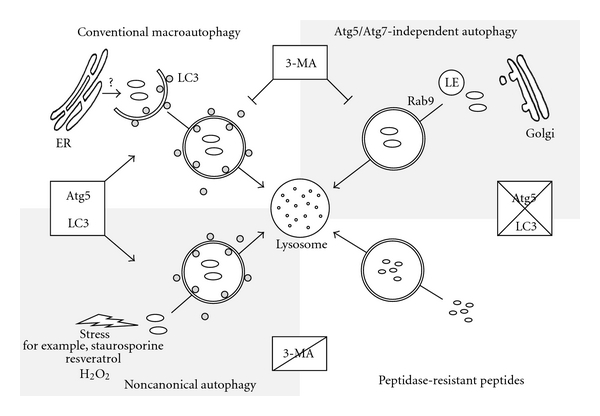
Macroautophagy is a bulk degradation process that mediates the clearance of long-lived proteins, aggregates, or even whole organelles. This process includes the formation of autophagosomes, double-membrane structures responsible for delivering cargo to lysosomes for degradation. Currently, other alternative autophagy pathways have been described, which are independent of macroautophagic key players like Atg5 and Beclin 1 or the lipidation of LC3. In this review, we highlight recent insights in indentifying and understanding the molecular mechanism responsible for alternative autophagic pathways.
Overview
The claims and statistics of this paper haven’t been checked yet.
Free: it reads the open-access text and checks the first 5 claims that cite a source we can check. Create a free account to check every claim.
Integrity signals
Registry
Cites
Statistics
Figures
Verification
Claims the paper makes
The claims and statistics of this paper haven’t been checked yet.
Free: it reads the open-access text and checks the first 5 claims that cite a source we can check. Create a free account to check every claim.
Claims other papers make about this one
Each is checked against this paper’s own text: does it say what the citing paper says it does?
The check wasn’t confident either way, so it gives no verdict — never disputed.
In the citing paper
“Recent studies identified that 3xTg-AD mice had enhanced mTOR activity in the hippocampus and neocortex, two areas known to have high concentrations of Aβ plaques.502”
From Amyloid β-based therapy for Alzheimer’s disease: Challenges, successes and future (2023) · cites this paper as [502]
Experimental — accuracy not yet measured
Self-check
Percentages, sums and reported differences re-computed from the paper’s own numbers.
The self-check needs the paper’s full text.
Citations
Cites
Repertoires of Autophagy in the Pathogenesis of Ocular Diseases
Li, Y.-J., Jiang, Q., Cao, G.-F., Yao, J., & Yan, B. (2015) · Cellular Physiology and Biochemistry · doi:10.1159/000373980 · Cited by 16,304
Levine, B., & Klionsky, D. J. (2004) · Developmental Cell · doi:10.1016/s1534-5807(04)00099-1 · Cited by 3,678 · cited 1×
“Additionally, macroautophagy is essential for development, cell survival, and tissue-specific processes [12, 13].”
BackgroundInduction of autophagy and inhibition of tumorigenesis by beclin 1
Liang, X. H., Jackson, S., Seaman, M., Brown, K., Kempkes, B., Hibshoosh, H., & Levine, B. (1999) · Nature · doi:10.1038/45257 · Cited by 3,347 · cited 1×
“In this review, we highlight recent insights in indentifying and understanding the molecular mechanism responsible for alternative autophagic pathways.”
BackgroundAutophagosome formation: core machinery and adaptations
Xie, Z., & Klionsky, D. J. (2007) · Nature Cell Biology · doi:10.1038/ncb1007-1102 · Cited by 2,164 · cited 1×
“These autophagosomes are subsequently transported in a dynein-dependent manner along microtubules and fuse with endosomes or directly with lysosomes to form autolysosomes, resulting in breakdown of their contents by hydrolytic enzymes [11].”
BackgroundReactive oxygen species are essential for autophagy and specifically regulate the activity of Atg4
Scherz‐Shouval, R., Shvets, E., Fass, E., Shorer, H., Gil, L., & Elazar, Z. (2007) · The EMBO Journal · doi:10.1038/sj.emboj.7601623 · Cited by 2,101 · cited 1×
“A better understanding of the role of these alternative autophagic pathways and their molecular regulators raise to two crucial questions: (1) What is the origin of the autophagic membrane in the different autophagic routes, and (2)Which stimuli trigger the different autophagic pathways? In mammalian macroautophagy, v…”
BackgroundAxe, E. L., Walker, S. A., Manifava, M., Chandra, P., Roderick, H. L., Habermann, A., Griffiths, G., & Ktistakis, N. T. (2008) · The Journal of Cell Biology · doi:10.1083/jcb.200803137 · Cited by 1,885
Regulation of Mammalian Autophagy in Physiology and Pathophysiology
Ravikumar, B., Sarkar, S., Davies, J. E., Futter, M., Garcia-Arencibia, M., Green-Thompson, Z. W., Jimenez-Sanchez, M., Korolchuk, V. I., Lichtenberg, M., Luo, S., et al. (2010) · Physiological Reviews · doi:10.1152/physrev.00030.2009 · Cited by 1,727 · cited 1×
“In addition to its role in maintaining cellular homeostasis, autophagy is implicated in a wide range of physiological and pathological conditions, including early embryological development, clearance of pathogens, tumor suppression, and antigen processing and presentation [1].”
BackgroundThe role of autophagy in cancer development and response to therapy
Kondo, Y., Kanzawa, T., Sawaya, R., & Kondo, S. (2005) · Nature Reviews Cancer · doi:10.1038/nrc1692 · Cited by 1,654 · cited 1×
“These studies have shown that several agents stimulate autophagic cell death through Beclin 1 in canonical autophagy pathways [56].”
BackgroundAutophagy in mammalian development and differentiation
Mizushima, N., & Levine, B. (2010) · Nature Cell Biology · doi:10.1038/ncb0910-823 · Cited by 1,555 · cited 1×
“Additionally, macroautophagy is essential for development, cell survival, and tissue-specific processes [12, 13].”
BackgroundMitochondria Supply Membranes for Autophagosome Biogenesis during Starvation
Hailey, D. W., Rambold, A. S., Satpute-Krishnan, P., Mitra, K., Sougrat, R., Kim, P. K., & Lippincott-Schwartz, J. (2010) · Cell · doi:10.1016/j.cell.2010.04.009 · Cited by 1,429 · cited 2×
“A better understanding of the role of these alternative autophagic pathways and their molecular regulators raise to two crucial questions: (1) What is the origin of the autophagic membrane in the different autophagic routes, and (2)Which stimuli trigger the different autophagic pathways? In mammalian macroautophagy, v…”
Background
Research works printed but not linked: 1
- Axe EL Walker SA Manifava M Autophagosome formation from membrane compartments enriched in phosphatidylinositol 3-phosphate and dynamically connected to the endoplasmic reticulum Journal of Cell Biology 2008 182 4 685 701 18725538 PMC2518708 · DOI · Paper page
Cited by
Amyloid β-based therapy for Alzheimer’s disease: Challenges, successes and future
Zhang, Y., Chen, H., Li, R., Sterling, K., & Song, W. (2023) · Signal Transduction and Targeted Therapy · doi:10.1038/s41392-023-01484-7 · Cited by 988
“Recent studies identified that 3xTg-AD mice had enhanced mTOR activity in the hippocampus and neocortex, two areas known to have high concentrations of Aβ plaques.(502) Treatment with rapamycin significantly stimulated autophagy associated with markedly reduced both intracellular Aβ and extracellular amyloid depositio…”
BackgroundRole of tau protein in Alzheimer’s disease: The prime pathological player
Muralidar, S., Ambi, S. V., Sekaran, S., Thirumalai, D., & Palaniappan, B. (2020) · International Journal of Biological Macromolecules · doi:10.1016/j.ijbiomac.2020.07.327 · Cited by 278
Regulation of autophagy by polyphenolic compounds as a potential therapeutic strategy for cancer
Hasima, N., & Ozpolat, B. (2014) · Cell Death & Disease · doi:10.1038/cddis.2014.467 · Cited by 257
Diminished Autophagy Limits Cardiac Injury in Mouse Models of Type 1 Diabetes
Xu, X., Kobayashi, S., Chen, K., Timm, D., Volden, P., Huang, Y., Gulick, J., Yue, Z., Robbins, J., Epstein, P. N., et al. (2013) · Journal of Biological Chemistry · doi:10.1074/jbc.m113.474650 · Cited by 251
“Diabetes and Autophagy Deficiency Increased the Expression of Rab9, an Essential Component of a Non-canonical Autophagic Pathway—Except for canonical autophagy, other forms of non-canonical autophagic pathways have been reported in recent years (44, 45).”
BackgroundFerretta, A., Gaballo, A., Tanzarella, P., Piccoli, C., Capitanio, N., Nico, B., Annese, T., Di Paola, M., Dell'Aquila, C., De Mari, M., et al. (2014) · Biochimica et Biophysica Acta (BBA) - Molecular Basis of Disease · doi:10.1016/j.bbadis.2014.02.010 · Cited by 243
“These results would be consistent with the occurrence of both LC3-dependent and LC3-independentmacroautophagic pathways, as recently suggested [44], with the latter being promotable by resveratrol in a parkin context.”
Result
Metadata
- Authors
- Juenemann, K., & Reits, E. A.
- Affiliations
- Amsterdam UMC Location University of Amsterdam (NL)
- Corresponding author
- Juenemann, Katrin
- Reits, Eric A.
- ORCID
- Reits, Eric A.
- Venue
- International Journal of Cell Biology
- Publisher
- Hindawi Limited
- Published
- 2012
- Volume
- 2012
- Pages
- 1-8
- ISSN
- 1687-8876 (ISSN-L)
- 1687-8884
- PMC
- PMC3320029
- OpenAlex
- W2089004935
- Cited by
- 58
- References
- 80
- Citations by year
- 2024: 1 · 2023: 1 · 2022: 4 · 2021: 3 · 2020: 4 · 2019: 4 · 2018: 2 · 2017: 3 · 2016: 3 · 2015: 11 · 2014: 10 · 2013: 10 · 2012: 2
- FWCI
- 7.90
- Type
- journal article
- Language
- en
- Open access
- gold
- doi.org
- Locations
- International Journal of Cell Biology (publishedVersion, cc-by)
- Europe PMC (PubMed Central) (publishedVersion, cc-by)
- PubMed Central (publishedVersion, cc-by)
- PubMed (publishedVersion)
- Pure Amsterdam UMC (publishedVersion)
- Data Archiving and Networked Services (DANS) (submittedVersion)
- DOAJ (DOAJ: Directory of Open Access Journals) (submittedVersion, cc-by-sa)
- Topics
- Life Sciences › Biochemistry, Genetics and Molecular Biology › Cell Biology › Autophagy in Disease and Therapy
- Life Sciences › Biochemistry, Genetics and Molecular Biology › Physiology › Calcium signaling and nucleotide metabolism
- Life Sciences › Biochemistry, Genetics and Molecular Biology › Molecular Biology › Ubiquitin and proteasome pathways
- Keywords
- macroautophagy, autophagosome formation, lysosomal degradation, protein clearance, protein aggregates, ATG5, Beclin-1, LC3 lipidation
About these checks
Registry, retraction, Cites and statistics results are computed, not judged, with one exception: a printed reference that no index lists is read once by a model before it counts as a citation error. Claims are extracted by a model and kept only when their quote appears verbatim in the text; each cited source is then checked, with a model’s help, for whether it says what the claim relies on. Those verdicts can be wrong — read the claim’s quote and the cited source before relying on one.
Statistics and arithmetic are recomputed, not judged.
Confidence bands are shown only for fields calibrated on our annotated test set. None is calibrated yet, so no band is shown.
What counts as a claim ›How we measure confidence ›How we check this ›
Are you an author, or do you see a problem with this page? Request a review
How to cite
Cite CoChat for the checks on this page, and the paper for its own findings.
- This page
- CoChat. (2026). Citation check: Alternative Macroautophagic Pathways. https://app.cochat.ai/papers/10.1155/2012/189794
- The paper
- Juenemann, K., & Reits, E. A. (2012). Alternative Macroautophagic Pathways. International Journal of Cell Biology. https://doi.org/10.1155/2012/189794
Data sources
Bibliographic data: Semantic Scholar, OpenAlex, Crossref.
Contains information from the Semantic Scholar Academic Graph Datasets, made available under the ODC Attribution License (ODC-BY 1.0).
Semantic Scholar’s data is described in: Kinney, R., et al. (2023). The Semantic Scholar Open Data Platform. arXiv:2301.10140.
