

The DOI matches its Crossref record; 65 of the 65 references it cites were found in a registry or an index.
iCanCope with Pain™: User‐Centred Design of a Web‐ and Mobile‐Based Self‐Management Program for Youth with Chronic Pain Based on Identified Health Care Needs
Open accessAbstract
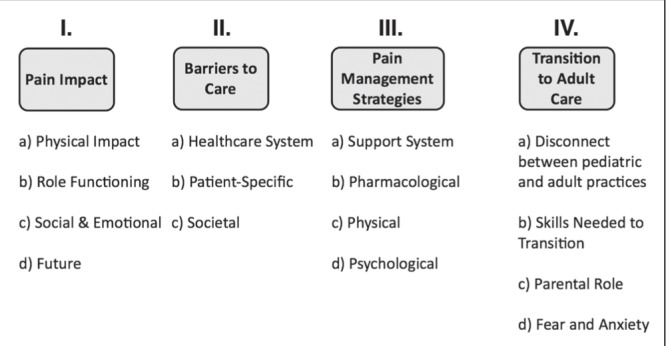
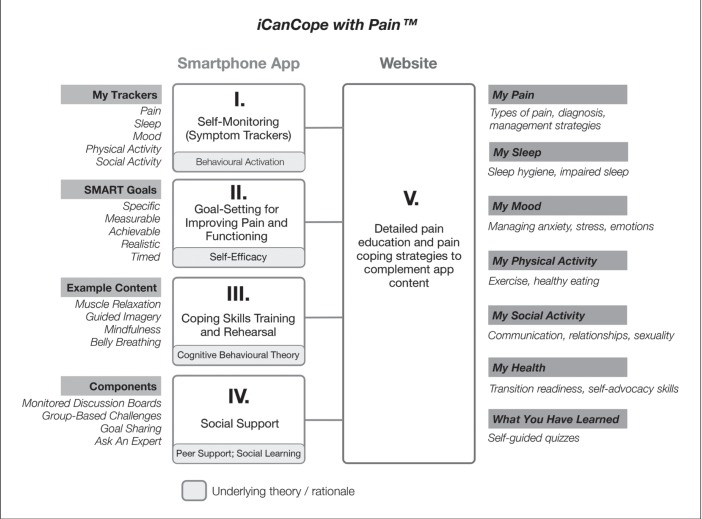
BACKGROUND: While there are emerging web‐based self‐management programs for children and adolescents with chronic pain, there is currently not an integrated web‐ and smartphone‐based app that specifically addresses the needs of adolescents with chronic pain. OBJECTIVES: To conduct a needs assessment to inform the development of an online chronic pain self‐management program for adolescents, called iCanCope with Pain™. METHODS: A purposive sample of adolescents (n=23; 14 to 18 years of age) was recruited from two pediatric chronic pain clinics in Ontario. Interdisciplinary health care providers were also recruited from these sites. Three focus groups were conducted with adolescents (n=16) and one with pediatric health care providers (n=7). Individual adolescent interviews were also conducted (n=7). RESULTS: Qualitative analysis uncovered four major themes: pain impact; barriers to care; pain management strategies; and transition to adult care. Pain impacted social, emotional, physical and role functioning, as well as future goals. Barriers to care were revealed at the health care system, patient and societal levels. Pain management strategies included support systems, and pharmacological, physical and psychological approaches. Transition subthemes were: disconnect between pediatric and adult systems; skills development; parental role; and fear/anxiety. Based on these identified needs, the iCanCope with Pain™ architecture will include the core theory‐based functionalities of: symptom self‐monitoring; personalized goal setting; pain coping skills training; peer‐based social support; and chronic pain education. CONCLUSIONS: The proposed iCanCope with Pain™ program aims to address the self‐management needs of adolescents with chronic pain by improving access to disease information, strategies to manage symptoms and social support.
Overview
The claims and statistics of this paper haven’t been checked yet.
Run the check — free, no account needed. It reads the open-access text and checks the sources it cites.
Integrity signals
Registry
Cites
Statistics
Figures
Verification
Claims the paper makes
The claims and statistics of this paper haven’t been checked yet.
Run the check — free, no account needed. It reads the open-access text and checks the sources it cites.
Claims other papers make about this one
Each is checked against this paper’s own text: does it say what the citing paper says it does?
The source backs part of the claim, not all of it — or backs it for a different population, condition or comparison.
In the citing paper
“Other mobile-based technologies have been developed to assist patients in remotely self-monitoring symptoms and deliver interventions involving goal-setting for improving functioning, coping skills training and practice, and social support via discussion boards, goal sharing, and group-based challenges [55].”
From Best-evidence for the rehabilitation of chronic pain part 1: Pediatric pain (2019) · cites this paper as [55]
Experimental — accuracy not yet measuredIn the citing paper
“Our focus on reviewing studies of mHealth apps for self-managing chronic conditions may explain this finding, as these interventions encourage users to systematically record data and capture the variability of their disease state over time [84].”
From A Library of Analytic Indicators to Evaluate Effective Engagement with Consumer mHealth Apps for Chronic Conditions: Scoping Review (2019) · cites this paper as [84]
Self-check
Percentages, sums and reported differences re-computed from the paper’s own numbers.
The self-check needs the paper’s full text.
Citations
Cites
Pierce, W. D., & Bandura, A. (1977) · The Canadian Journal of Sociology · doi:10.2307/3340496 · Cited by 9,742
Focus Groups as Qualitative Research
Morgan, D. (1997) · doi:10.4135/9781412984287 · Cited by 8,863
InterViews: An introduction to qualitative research interviewing
Flinders, D. J. (1997) · Evaluation and Program Planning · doi:10.1016/s0149-7189(97)89858-8 · Cited by 7,236
An Expanded Sourcebook Qualitative Data Analysis
Miles, M. B., & Huberman, A. M. (1994) · Cited by 3,222
Focus Groups as Qualitative Research
Kawamura, H., & Morgan, D. L. (1998) · Modern Language Journal · doi:10.2307/330238 · Cited by 2,788
(1995) · Medical Entomology and Zoology · Cited by 2,472
The epidemiology of chronic pain in children and adolescents revisited: A systematic review
King, S., Chambers, C. T., Huguet, A., MacNevin, R. C., McGrath, P. J., Parker, L., & MacDonald, A. J. (2011) · Pain · doi:10.1016/j.pain.2011.07.016 · Cited by 1,688
Psychological therapies for the management of chronic pain (excluding headache) in adults
Williams, A. C. D. C., Eccleston, C., & Morley, S. (2012) · Cochrane Database of Systematic Reviews · doi:10.1002/14651858.cd007407.pub3 · Cited by 1,634
Internet-based cognitive behaviour therapy for symptoms of depression and anxiety: A meta-analysis
SPEK, V., CUIJPERS, P., NYKLÍČEK, I., RIPER, H., KEYZER, J., & POP, V. (2007) · Psychological Medicine · doi:10.1017/s0033291706008944 · Cited by 1,586
When and how do young people seek professional help for mental health problems?
Rickwood, D. J., Deane, F. P., & Wilson, C. J. (2007) · Medical Journal of Australia · doi:10.5694/j.1326-5377.2007.tb01334.x · Cited by 1,195
Research works printed but not linked: 4
- [6]American Pain Society Pediatric chronic pain: A position statement from the American Pain Society American Pain Society Bulletin 2001 Jan-Feb 10 12
- [35]Wallace LS A review of pain-related smartphone apps Abstract presented at the American Academy of Pain Medicine Annual Meeting Fort Lauderdale April 11 to 14, 2013
- [38]Creswell JW Qualitative Inquiry and Research Design Thousand Oaks Sage Publications 1998
- [43]Stinson JN White M Isaac L Understanding the information and service needs of young adults with chronic pain: Perspectives of young adults and their providers Clin J Pain 2013 29 600 12 23328333
Cited by
Sorted by citations
Items 101–149 of 149
Johansen, S. K., Kanstrup, A. M., Thomsen, J. L., Christensen, M. N., & Rathleff, M. S. (2023) · Digital Health · doi:10.1177/20552076231205750 · Cited by 4
“22,24,55,56 Still these fi ndings seem to re fl ect what Papanek 57 describes as the “ designers share ” of adolescent ’ s lived challenges, for example, managing pain, with little re fl ection given to adolescent ’ s ability or willingness to adhere to mHealth interventions in everyday situations.”
BackgroundCoping in youth living with chronic pain: A systematic review of qualitative evidence
Woodgate, R. L., Bell, A., Petrasko, J., Neilson, C. J., & Ayeni, O. (2025) · Canadian journal of pain = Revue canadienne de la douleur · doi:10.1080/24740527.2025.2455494 · Cited by 5
Sinisterra, M., Kelly, K. P., Shneider, C. E., El-Zein, A., Swartwout, E., Deyo, P., & Streisand, R. M. (2020) · The Science of Diabetes Self-Management and Care · doi:10.1177/0145721720943123 · Cited by 4
Pope, N., de Cândido, L. K., Crellin, D., Palmer, G. M., South, M., & Harrison, D. M. (2023) · Pain · doi:10.1097/j.pain.0000000000002863 · Cited by 4
Pain self‐management: theory and process for clinicians
McGillion, M. H., LeFort, S. M., Webber, K., Stinson, J., & Lalloo, C. (2022) · Wiley eBooks · doi:10.1002/9781119701170.ch25 · Cited by 4
Self-citationVandeleur, D. M., & Palermo, T. M. (2025) · Journal of Pain · doi:10.1016/j.jpain.2025.105333 · Cited by 3
iSenseYourPain: Ubiquitous Chronic Pain Evaluation through Behavior-Change Analysis
Ciman, M. (2022) · Health informatics · doi:10.1007/978-3-030-94212-0_6 · Cited by 3
Bianchim, M. S., Caes, L., Forbat, L., Jordan, A. L., Noyes, J., Thomson, K., Turley, R. L., Uny, I., & France, E. F. (2024) · Health and Social Care Delivery Research · doi:10.3310/utpm7986 · Cited by 3
Efficacy of mHealth in Patients With Chronic Neck Pain: A Systematic Review and Meta-Analysis
Xie, X., Wang, H., Gao, X. J., Chen, H., & Zhou, L. (2025) · Pain Management Nursing · doi:10.1016/j.pmn.2025.03.001 · Cited by 3
Suporte on-line às crianças e adolescentes doentes crônicos: uma revisão integrativa
Mazza, V. D. A., Lemos, D. D. S., Guimarães, S. L., de Lima, V. F., & Félix, J. V. C. (2017) · Avances en Enfermería · doi:10.15446/av.enferm.v35n1.60506 · Cited by 3
Beneitez, I., Encuentra, E. H., Nieto, R., & Boixadós, M. (2020) · Clínica y Salud · doi:10.5093/clysa2020a2 · Cited by 3
“Involvement in positive peer and friend relationships have been found to be associated with functional ability and might represent a resilience factor system to help them manage pain (Cousins et al, 2015; Fleischman et al., 2011; Sinclair, Meredith, Strong, & Feeney, 2016; Stinson et al., 2014).”
BackgroundGor, K., Lee, Y.-S., Sprong, M. E., Hollender, H. L., Shrestha, J., & Huang, X. (2025) · Clinical Practice and Epidemiology in Mental Health · doi:10.2174/0117450179372640250324051404 · Cited by 2
Buono, F. D., Bláha, O., Lalloo, C., Larkin, K., Zempsky, W. T., Phạm, Q., Grau, L. E., & Stinson, J. (2025) · American Journal of Medical Genetics Part A · doi:10.1002/ajmga.70004 · Cited by 2
“The iCC mobile application was previously customized for youth with arthritis and sickle cell disease (SCD; Birnie et al. 2019; Lalloo et al. 2021; Palermo et al. 2023; Stinson et al. 2014).”
Self-citationPope, N., Jones, S., Crellin, D., Palmer, G. M., South, M., & Harrison, D. M. (2023) · Pain · doi:10.1097/j.pain.0000000000003039 · Cited by 2
Lakha, S. F., Sohail, S. F., Holtzman, C. B., Akkok, Z. A., Khandwala, A., Suhanic, W., Pennefather, P., & Fels, D. I. (2023) · Frontiers in Digital Health · doi:10.3389/fdgth.2023.1289373 · Cited by 2
Digital health technologies for pediatric pain
Jibb, L., Pope, N., & Stinson, J. (2021) · Oxford University Press eBooks · doi:10.1093/med/9780198818762.003.0060 · Cited by 2
Self-citationKarataş, P., Karaçam, Z., & Çalışır, H. (2022) · Hemşirelik Bilimi Dergisi · doi:10.54189/hbd.1111351 · Cited by 2
Junghans-Rutelonis, A. N., Weiss, K., Tamula, M. A., Karvounides, D., Harbeck‐Weber, C., & Martin, S. C. (2017) · Professional Psychology Research and Practice · doi:10.1037/pro0000156 · Cited by 2
Yang, J. J., Wang, Z., Trucco, E. M., Buu, A., & Lin, H. (2021) · The American Journal of Drug and Alcohol Abuse · doi:10.1080/00952990.2021.1977311 · Cited by 1
Perceptions of hypnotherapy for children with functional abdominal pain: a qualitative study
Ganzevoort, I. N., der Veen, A. L. V., Alma, M., Karg, A., Berger, M. Y., & Holtman, G. A. (2025) · Family Practice · doi:10.1093/fampra/cmaf066 · Cited by 1
“Our study aligns with others showing varying willingness to engage with hypnotherapy, including scepticism and disbelief in its effectiveness [10], doctors being un-aware of how to refer (or being unwilling to refer) [28, 29], and cost and time as barriers [11].”
Betting, K., Laekeman, M., Kooning, M. D., & Carvalho, G. F. (2025) · Disability and Rehabilitation · doi:10.1080/09638288.2025.2595180 · Cited by 1
“The search strategy identified one publication on innovative methods like an integrated smartphone and web-based program [41], but it was excluded because the app was not accessible.”
Harrison, L. E., Webster, S. N., Choate, E., Mayanja, D., Jehl, N. M., Darnall, B. D., Stinson, J., Bonnert, M., Lalouni, M., Wicksell, R. K., et al. (2026) · JMIR Formative Research · doi:10.2196/89206 · Cited by 1
Self-citationPsychological therapies for the management of chronic and recurrent pain in children and adolescents
Kohut, S. A., & Stinson, J. (2016) · Paediatrics & Child Health · doi:10.1093/pch/21.5.258 · Cited by 1
Self-citationMcGillion, M. H., & Watt‐Watson, J. (2015) · Canadian Journal of Nursing Research · doi:10.1177/084456211504700102 · Cited by 1
Overholser, L., Diers, T., & Hassell, K. L. (2016) · Springer eBooks · doi:10.1007/978-3-319-43827-6_16 · Cited by 1
Investigating Specialized Chronic Pain Care Among Emerging Adults
Ellingson, R., Wilson, R. A., Bisson, E. J., & Goldie, C. (2021) · Pain Management Nursing · doi:10.1016/j.pmn.2021.05.013 · Cited by 1
Aching to be Understood: Vocational Rehabilitation Implications for Emerging Adults in Chronic Pain
Hunter, T. L., Koch, L. C., Smith, S. L., & Hall, A. H. (2022) · Rehabilitation Research Policy and Education · doi:10.1891/re-21-14 · Cited by 1
Beals‐Erickson, S. E., & Connelly, M. A. (2018) · Current Treatment Options in Rheumatology · doi:10.1007/s40674-018-0087-1 · Cited by 1
Pulse-Galvanic Skin Response Analysis with Multiple Sensor Device Design
Dincer, M. A., Şahin, K. E., & Şahin, S. (2021) · Journal of Intelligent Systems with Applications · doi:10.54856/jiswa.202112170 · Cited by 1
Apport du numérique dans la prise en charge médicale des patients souffrant de douleurs chroniques
Kerckhove, N., Corteval, A., & Eschalier, A. (2021) · Douleur et Analgésie · doi:10.3166/dea-2021-0173 · Cited by 1
Virtual Reality Environments in Pain Management
Pinho, M. I., Santos, C., Brito, I., Coelho, J., Simões-Silva, V., & Marques, A. J. (2021) · Advances in psychology, mental health, and behavioral studies (APMHBS) book series · doi:10.4018/978-1-7998-8634-1.ch014 · Cited by 1
Technology to Promote Obesity Self-Management
Zhang, M. W., & Ho, R. (2016) · Springer eBooks · doi:10.1007/978-3-319-42536-8_21
de Carranza, R. D. L. V. (2014) · TDX (Tesis Doctorals en Xarxa)
Pediatric pain: is it finally getting better?
Harrison, T. E., & Pabelick, C. M. (2020) · Minerva Anestesiologica · doi:10.23736/s0375-9393.20.14736-9
Turner, J. W., Robinson, J. D., & McCarthy, A. (2020) · Oxford University Press eBooks · doi:10.1093/oxfordhb/9780190679446.013.17
Systematic Review and Evaluation of Pain-Related Mobile Applications
Silva, A. G., Queirós, A., Caravau, H., Ferreira, A., & Rocha, N. P. (2019) · IGI Global eBooks · doi:10.4018/978-1-7998-1680-5.ch008
Martelletti, P. (2022) · Springer eBooks · doi:10.1007/978-3-030-97359-9_5
Ji, W., & Cui, J. (2022) · International Symposium on Advances in Informatics, Electronics and Education (ISAIEE) · doi:10.1109/isaiee57420.2022.00055
“The requirement analysis process usually starts from the investigation of the sports meeting requirements of the software system, and finally forms a description document which can fully reflect the sports meeting real requirements of each part[11-13].”
BackgroundHarrison, L. E., Webster, S. N., Choate, E., Jehl, N. M., Darnall, B. D., Stinson, J., Wicksell, R. K., & Simons, L. E. (2024) · doi:10.2196/preprints.58769
Self-citationJones, J., Abou-Baker, N., Overholser, L., Hassell, K. L., & Diers, T. (2024) · Springer eBooks · doi:10.1007/978-3-031-54281-7_36
Ren, Z., Chen, Y., Li, Y., Fan, P., Liu, Z., & Shen, B. (2024) · doi:10.2196/preprints.65826
Chan, N. H.-M., Merali, H. S., Mistry, N., Kealey, R., Campbell, D. M., Morris, S. K., & Santorino, D. (2021) · Figshare · doi:10.6084/m9.figshare.13719219
Grasaas, E., Helseth, S., Fegran, L., Stinson, J., Småstuen, M., Lalloo, C., & Haraldstad, K. (2022) · Figshare · doi:10.6084/m9.figshare.20390990
Self-citationChan, N. H.-M., Merali, H. S., Mistry, N., Kealey, R., Campbell, D. M., Morris, S. K., & Santorino, D. (2021) · Figshare · doi:10.6084/m9.figshare.13719216
Murray, C. B., Yokoyama, K., & Palermo, T. M. (2025) · CBT: science into practice · doi:10.1007/978-3-031-98876-9_10
Smith, M. G., Schaly, S., Berryman, C. F., Khillan, A., Ostojic, K., & Harvey, A. R. (2026) · Journal of Pain Research · doi:10.2147/jpr.s601477
Pain and symptom management in youth: interdisciplinary perspectives, practices, and considerations
MacKenzie, N. E., Slater, H., Allen, E., Mohabir, V., & Stinson, J. (2026) · Current Opinion in Supportive and Palliative Care · doi:10.1097/spc.0000000000000819
Self-citationLalloo, C., Nishat, F., Palermo, T., Montgomery, L. S., Campbell, F. A., Baerg, K., Chorney, J. M. L., Dick, B. D., Renna, T. D., Mukhida, K., et al. (2026) · Canadian Journal of Pain · doi:10.1080/24740527.2026.2717605
Self-citation
Metadata
- Authors
- Stinson, J. N., Lalloo, C., Harris, L., Isaac, L., Campbell, F., Brown, S., Ruskin, D., Gordon, A., Galonski, M., Pink, L. R., Buckley, N., Henry, J. L., White, M., & Karim, A.
- Affiliations
- University of Toronto (CA)
- McMaster University (CA)
- Mount Sinai Hospital (CA)
- Corresponding author
- Stinson, Jennifer N
- ORCID
- Venue
- Pain Research and Management
- Publisher
- Wiley
- Published
- 2014-01
- Volume
- 19
- Issue
- 5
- Pages
- 257-265
- ISSN
- 1203-6765 (ISSN-L)
- 1918-1523
- PMC
- PMC4197753
- OpenAlex
- W88007950
- Cited by
- 149
- References
- 65
- Citations by year
- 2026: 4 · 2025: 11 · 2024: 6 · 2023: 17 · 2022: 16 · 2021: 22 · 2020: 16 · 2019: 14 · 2018: 15 · 2017: 10 · 2016: 10 · 2015: 6 · 2014: 2
- FWCI
- 8.77
- Type
- journal article
- Language
- en
- Open access
- gold
- doi.org
- Licence
- Locations
- Pain Research and Management (publishedVersion, cc-by)
- PubMed Central (publishedVersion, cc-by-nc)
- PubMed (publishedVersion)
- TSpace (University of Toronto) (submittedVersion, cc-by-nc)
- DOAJ (DOAJ: Directory of Open Access Journals) (submittedVersion)
- Funders
- Canadian Pain Society
- Topics
- Health Sciences › Medicine › Pediatrics, Perinatology and Child Health › Pediatric Pain Management Techniques
- Health Sciences › Health Professions › General Health Professions › Mobile Health and mHealth Applications
- Health Sciences › Medicine › Pediatrics, Perinatology and Child Health › Adolescent and Pediatric Healthcare
- Keywords
- chronic pain, adolescents, self-management program, user-centered design, online intervention, mobile health apps, needs assessment, barriers to care, transition to adult care, pain coping skills training, peer support, symptom self-monitoring, goal setting
- MeSH terms
- Adolescent, Child, Female, Humans, Male, Self Care, Needs Assessment, Internet, Chronic Pain, Pain Management, Mobile Applications
About these checks
Registry, retraction, Cites and statistics results are computed, not judged, with one exception: a printed reference that no index lists is read once by a model before it counts as a citation error. Claims are extracted by a model and kept only when their quote appears verbatim in the text; each cited source is then checked, with a model’s help, for whether it says what the claim relies on. Those verdicts can be wrong — read the claim’s quote and the cited source before relying on one.
Statistics and arithmetic are recomputed, not judged.
Confidence bands are shown only for fields calibrated on our annotated test set. None is calibrated yet, so no band is shown.
What counts as a claim ›How we measure confidence ›How we check this ›
Are you an author, or do you see a problem with this page? Request a review
