

A systematic review and meta-analysis estimating the expected dropout rates in randomized controlled trials on yoga interventions
Open accessThe DOI matches its Crossref record; 39 of the 39 references it cites were found in a registry or an index.
Abstract
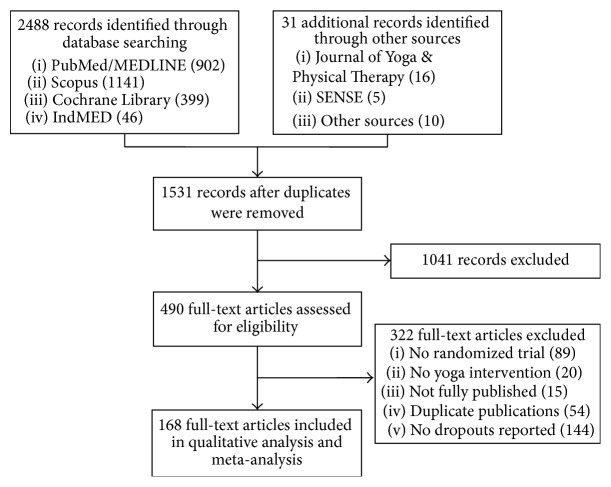
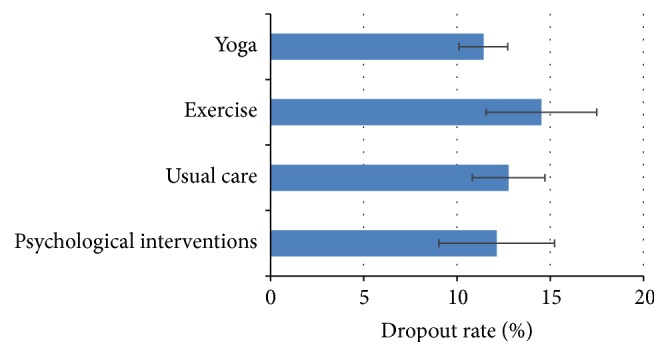
A reasonable estimation of expected dropout rates is vital for adequate sample size calculations in randomized controlled trials (RCTs). Underestimating expected dropouts rates increases the risk of false negative results while overestimating rates results in overly large sample sizes, raising both ethical and economic issues. To estimate expected dropout rates in RCTs on yoga interventions, MEDLINE/PubMed, Scopus, IndMED, and the Cochrane Library were searched through February 2014; a total of 168 RCTs were meta-analyzed. Overall dropout rate was 11.42% (95% confidence interval [CI] = 10.11%, 12.73%) in the yoga groups; rates were comparable in usual care and psychological control groups and were slightly higher in exercise control groups (rate = 14.53%; 95% CI = 11.56%, 17.50%; odds ratio = 0.82; 95% CI = 0.68, 0.98; p = 0.03). For RCTs with durations above 12 weeks, dropout rates in yoga groups increased to 15.23% (95% CI = 11.79%, 18.68%). The upper border of 95% CIs for dropout rates commonly was below 20% regardless of study origin, health condition, gender, age groups, and intervention characteristics; however, it exceeded 40% for studies on HIV patients or heterogeneous age groups. In conclusion, dropout rates can be expected to be less than 15 to 20% for most RCTs on yoga interventions. Yet dropout rates beyond 40% are possible depending on the participants' sociodemographic and health condition.
Overview
The claims and statistics of this paper haven’t been checked yet.
Free: it reads the open-access text and checks the first 5 claims that cite a source we can check. Create a free account to check every claim.
Integrity signals
Registry
Cites
Statistics
Figures
Verification
Claims the paper makes
The claims and statistics of this paper haven’t been checked yet.
Free: it reads the open-access text and checks the first 5 claims that cite a source we can check. Create a free account to check every claim.
Claims other papers make about this one
Each is checked against this paper’s own text: does it say what the citing paper says it does?
The cited source says what the claim attributes to it.
In the citing paper
“A meta-analysis (34) showed a mean standardized effect of yoga versus waiting list of −0.75. To detect this group difference with a power of 0.80, a two-sided t-test with α-level of 0.05 requires 58 patients. Based on previous studies that resulted in dropout rates of up to 20% (35), a final sample size of 74 patients was calculated.”
From The integration of yoga breathing techniques in cognitive behavioral therapy for post-traumatic stress disorder: A pragmatic randomized controlled trial (2023) · cites this paper as [35]
Self-check
Percentages, sums and reported differences re-computed from the paper’s own numbers.
The self-check needs the paper’s full text.
Citations
Cites
Preferred Reporting Items for Systematic Reviews and Meta-Analyses: the PRISMA statement
Moher, D., Liberati, A., Tetzlaff, J., Altman, D. G., & for the PRISMA Group (2009) · BMJ · doi:10.1136/bmj.b2535 · Cited by 83,823
Measuring inconsistency in meta-analyses
Higgins, J. P. T., Thompson, S. G., Deeks, J. J., & Altman, D. G. (2003) · BMJ · doi:10.1136/bmj.327.7414.557 · Cited by 63,139
Cochrane Handbook for Systematic Reviews of Interventions: Cochrane Book Series
(2008) · doi:10.1002/9780470712184 · Cited by 25,048
Preferred reporting items for systematic reviews and meta-analyses: The PRISMA statement
Moher, D., Liberati, A., Tetzlaff, J., & Altman, D. G. (2010) · International Journal of Surgery · doi:10.1016/j.ijsu.2010.02.007 · Cited by 12,156
2009 updated method guidelines for systematic reviews in the Cochrane Back Review Group
Furlan, A. D., Pennick, V., Bombardier, C., & van Tulder, M. (2009) · Spine · doi:10.1097/brs.0b013e3181b1c99f · Cited by 1,663
Trends in the Use of Complementary Health Approaches Among Adults in the United States: New Data
Jackson, C. (2015) · Holistic Nursing Practice · doi:10.1097/hnp.0000000000000088 · Cited by 1,166
Adherence in Internet Interventions for Anxiety and Depression
Christensen, H., Griffiths, K. M., & Farrer, L. (2009) · Journal of Medical Internet Research · doi:10.2196/jmir.1194 · Cited by 1,133 · cited 2×
“Such increase in dropout rates with increasing trial length is a common occurrence and can be observed in other nonyoga trials as well [16, 32].”
(2015) · PubMed · Cited by 926
Neyeloff, J. L., Fuchs, S. C., & Moreira, L. B. (2012) · BMC Research Notes · doi:10.1186/1756-0500-5-52 · Cited by 727
Fundamentals of Clinical Trials
Friedman, L. M., Furberg, C. D., & DeMets, D. L. (2010) · Springer eBooks · doi:10.1007/978-1-4419-1586-3 · Cited by 528
Yoga for persistent fatigue in breast cancer survivors: A randomized controlled trial
Bower, J. E., Garet, D., Sternlieb, B., Ganz, P. A., Irwin, M. R., Olmstead, R., & Greendale, G. (2012) · Cancer · doi:10.1002/cncr.26702 · Cited by 352 · cited 1×
“Moreover, most cancer-related trials were on female breast cancer patients [22–29] and associated with a relatively high dropout rate.”
Raghavendra, R. M., Vadiraja, H. S., Nagarathna, R., Nagendra, H. R., Rekha, M., Vanitha, N., Gopinath, K. S., Srinath, B. S., Vishweshwara, M. S., Madhavi, Y. S., et al. (2009) · Integrative Cancer Therapies · doi:10.1177/1534735409331456 · Cited by 284
(2004) · PubMed · Cited by 279
Randomized, Controlled Trial of Yoga in Women With Breast Cancer Undergoing Radiotherapy
Chandwani, K. D., Perkins, G., Nagendra, H. R., Raghuram, N. V., Spelman, A., Nagarathna, R., Johnson, K., Fortier, A., Arun, B., Wei, Q., et al. (2014) · Journal of Clinical Oncology · doi:10.1200/jco.2012.48.2752 · Cited by 246
Carson, J. W., Carson, K. M., Porter, L. S., Keefe, F. J., & Seewaldt, V. L. (2009) · Supportive Care in Cancer · doi:10.1007/s00520-009-0587-5 · Cited by 231
Banerjee, B., Vadiraj, H. S., Ram, A., Rao, R., Jayapal, M., Gopinath, K. S., Ramesh, B. S., Rao, N., Kumar, A., Raghuram, N., et al. (2007) · Integrative Cancer Therapies · doi:10.1177/1534735407306214 · Cited by 225
The Safety of Yoga: A Systematic Review and Meta-Analysis of Randomized Controlled Trials
Cramer, H., Ward, L., Saper, R., Fishbein, D., Dobos, G., & Lauche, R. (2015) · American Journal of Epidemiology · doi:10.1093/aje/kwv071 · Cited by 207
Self-citationA Randomized Trial of Yoga for Adolescents with Irritable Bowel Syndrome
Kuttner, L., Chambers, C. T., Hardial, J., Israel, D. M., Jacobson, K., & Evans, K. (2006) · Pain Research and Management · doi:10.1155/2006/731628 · Cited by 203
Banasik, J., Williams, H., Haberman, M., Blank, S. E., & Bendel, R. (2011) · Journal of the American Academy of Nurse Practitioners · doi:10.1111/j.1745-7599.2010.00573.x · Cited by 201
Effect of yogic exercises on physical and mental health of young fellowship course trainees.
Ray, U. S., Mukhopadhyaya, S., Purkayastha, S. S., Asnani, V., Tomer, O. S., Prashad, R., Thakur, L., & Selvamurthy, W. (2001) · PubMed · Cited by 187
Characteristics of randomized controlled trials of yoga: A bibliometric analysis
Cramer, H., Lauche, R., & Dobos, G. (2014) · BMC Complementary and Alternative Medicine · doi:10.1186/1472-6882-14-328 · Cited by 176
Self-citationDropout rates in randomised antipsychotic drug trials
Wahlbeck, K., Tuunainen, A., Ahokas, A., & Leucht, S. (2001) · Psychopharmacology · doi:10.1007/s002130100711 · Cited by 167
Bacchetti, P. (2005) · American Journal of Epidemiology · doi:10.1093/aje/kwi014 · Cited by 154
Littman, A. J., Bertram, L. C., Ceballos, R., Ulrich, C. M., Ramaprasad, J., McGregor, B., & McTiernan, A. (2012) · Supportive Care in Cancer · doi:10.1007/s00520-010-1066-8 · Cited by 149
Adverse Events Associated with Yoga: A Systematic Review of Published Case Reports and Case Series
Cramer, H., Krucoff, C., & Dobos, G. (2013) · PLoS ONE · doi:10.1371/journal.pone.0075515 · Cited by 144
Self-citationBerlin, A. A., Kop, W. J., & Deuster, P. A. (2006) · Psychosomatic Medicine · doi:10.1097/01.psy.0000204628.73273.23 · Cited by 135
Taneja, I., Deepak, K. K., Poojary, G., Acharya, I. N., Pandey, R. M., & Sharma, M. (2004) · Applied Psychophysiology and Biofeedback · doi:10.1023/b:apbi.0000017861.60439.95 · Cited by 133
Factors predictive of drop‐out and weight loss success in weight management of obese patients
Ortner Hadžiabdić, M., Mucalo, I., Hrabač, P., Matić, T., Rahelić, D., & Božikov, V. (2015) · Journal of Human Nutrition and Dietetics · doi:10.1111/jhn.12270 · Cited by 110
Clinical Research in Complementary Therapies: Principles, Problems and Solutions
Lewith, G. T., Jonas, W. B., & Walach, H. (2001) · Cited by 96
Recruitment and Retention of Elderly Patients in Clinical Trials: Issues and Strategies
Cassidy‐Eagle, E. L., Baird, E., & Sheikh, J. I. (2001) · American Journal of Geriatric Psychiatry · doi:10.1097/00019442-200105000-00005 · Cited by 90
Control Group Design, Contamination and Drop-Out in Exercise Oncology Trials: A Systematic Review
Steins Bisschop, C. N., Courneya, K. S., Velthuis, M. J., Monninkhof, E. M., Jones, L. W., Friedenreich, C., van der Wall, E., Peeters, P. H. M., & May, A. M. (2015) · PLOS ONE · doi:10.1371/journal.pone.0120996 · Cited by 89
Impact of Iyengar Yoga on Quality of Life in Young Women With Rheumatoid Arthritis
Evans, S., Moieni, M., Lung, K., Tsao, J., Sternlieb, B., Taylor, M., & Zeltzer, L. (2013) · The Clinical Journal of Pain · doi:10.1097/ajp.0b013e31827da381 · Cited by 86
J.Carter, J., L.Gerbarg, P., Brown, R., Ware, R., & Katzman, M. (2013) · Journal of Traumatic Stress Disorders & Treatment · doi:10.4172/2324-8947.1000108 · Cited by 84 · cited 1×
“Trials with males only might however have used different settings, for example, the army forces [19] or workplace [20, 21].”
Enhancing Adherence in Randomized Controlled Clinical Trials
Shumaker, S. A., Dugan, E., & Bowen, D. J. (2000) · Controlled Clinical Trials · doi:10.1016/s0197-2456(00)00083-0 · Cited by 67
Shang, J., Wenzel, J., Krumm, S., Griffith, K., & Stewart, K. (2012) · Cancer Nursing · doi:10.1097/ncc.0b013e318236a3b3 · Cited by 59
Usefulness of GOLD classification of COPD severity
Köhler, D., Fischer, J., Raschke, F., & Schönhofer, B. (2003) · Thorax · doi:10.1136/thorax.58.9.825 · Cited by 50
Siedentopf, F., Utz-Billing, I., Gairing, S., Schoenegg, W., Kentenich, H., & Kollak, I. (2013) · Geburtshilfe und Frauenheilkunde · doi:10.1055/s-0032-1328438 · Cited by 41
Clinical Research in Complementary Therapies: Principles, Problems and Solutions
London, W. (2011) · Focus on Alternative and Complementary Therapies · doi:10.1111/j.2042-7166.2011.01107.x · Cited by 27
Manocha, R. (2003) · Thorax · doi:10.1136/thorax.58.9.825-a · Cited by 11
Cited by
A systematic review of yoga for major depressive disorder
Cramer, H., Anheyer, D., Lauche, R., & Dobos, G. (2017) · Journal of Affective Disorders · doi:10.1016/j.jad.2017.02.006 · Cited by 192
Self-citationCommon Limitations and Challenges of Dietary Clinical Trials for Translation into Clinical Practices
Mirmiran, P., Bahadoran, Z., & Gaeini, Z. (2021) · Intern J Endocrinol Metab · doi:10.5812/ijem.108170 · Cited by 156
A Systematic Review of the Effects of Exercise on Hormones in Women with Polycystic Ovary Syndrome
Shele, G., Genkil, J., & Speelman, D. (2020) · Journal of Functional Morphology and Kinesiology · doi:10.3390/jfmk5020035 · Cited by 115
Stevens, S., Gallagher, S., Andrews, T., Ashall-Payne, L., Humphreys, L., & Leigh, S. (2022) · Frontiers in Clinical Diabetes and Healthcare · doi:10.3389/fcdhc.2022.936752 · Cited by 84
Patel, V., Menezes, H., Menezes, C., Bouwer, S., Bostick-Smith, C. A., & Speelman, D. L. (2020) · Journal of Osteopathic Medicine · doi:10.7556/jaoa.2020.050 · Cited by 81
Metadata
- Authors
- Cramer, H., Haller, H., Dobos, G., & Lauche, R.
- Affiliations
- University of Technology Sydney (AU)
- Kliniken Essen-Mitte (DE)
- Corresponding author
- Cramer, Holger
- Venue
- Evidence-based Complementary and Alternative Medicine
- Publisher
- Wiley
- Published
- 2016-01
- Volume
- 2016
- Issue
- 1
- Pages
- 5859729-5859729
- ISSN
- 1741-427X (ISSN-L)
- 1741-4288
- PMC
- PMC4927989
- OpenAlex
- W2420585230
- Cited by
- 105
- References
- 39
- Citations by year
- 2026: 13 · 2025: 18 · 2024: 14 · 2023: 14 · 2022: 17 · 2021: 13 · 2020: 2 · 2019: 8 · 2018: 3 · 2017: 3
- FWCI
- 0.66
- Type
- journal article
- Language
- en
- Open access
- hybrid
- doi.org
- Locations
- Evidence-based Complementary and Alternative Medicine (publishedVersion, cc-by)
- PubMed Central (publishedVersion, cc-by)
- PubMed (publishedVersion)
- DOAJ (DOAJ: Directory of Open Access Journals) (submittedVersion)
- UTS ePRESS (University of Technology Sydney) (submittedVersion)
- Topics
- Physical Sciences › Mathematics › Statistics and Probability › Statistical Methods in Clinical Trials
- Social Sciences › Decision Sciences › Statistics, Probability and Uncertainty › Meta-analysis and systematic reviews
- Physical Sciences › Mathematics › Statistics and Probability › Statistical Methods in Epidemiology
- Keywords
- dropout rates, yoga intervention, randomized controlled trials, sample size determination, attrition, trial duration, people living with HIV
About these checks
Registry, retraction, Cites and statistics results are computed, not judged, with one exception: a printed reference that no index lists is read once by a model before it counts as a citation error. Claims are extracted by a model and kept only when their quote appears verbatim in the text; each cited source is then checked, with a model’s help, for whether it says what the claim relies on. Those verdicts can be wrong — read the claim’s quote and the cited source before relying on one.
Statistics and arithmetic are recomputed, not judged.
Confidence bands are shown only for fields calibrated on our annotated test set. None is calibrated yet, so no band is shown.
What counts as a claim ›How we measure confidence ›How we check this ›
Are you an author, or do you see a problem with this page? Request a review
Data sources
Bibliographic data: Semantic Scholar, OpenAlex, Crossref.
Contains information from the Semantic Scholar Academic Graph Datasets, made available under the ODC Attribution License (ODC-BY 1.0).
Semantic Scholar’s data is described in: Kinney, R., et al. (2023). The Semantic Scholar Open Data Platform. arXiv:2301.10140.
