

The DOI matches its Crossref record; 80 of the 80 references it cites were found in a registry or an index.
Otx2-PNN Interaction to Regulate Cortical Plasticity
Open accessAbstract
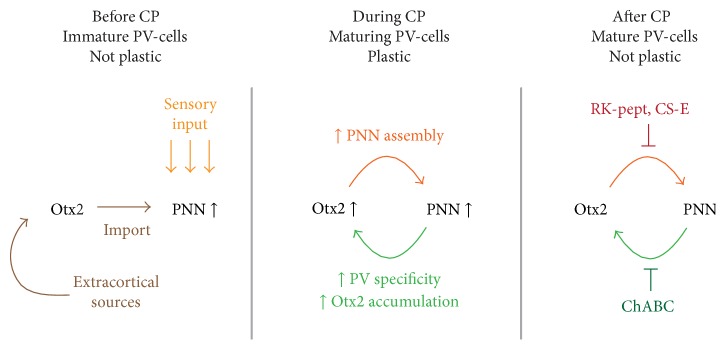
The ability of the environment to shape cortical function is at its highest during critical periods of postnatal development. In the visual cortex, critical period onset is triggered by the maturation of parvalbumin inhibitory interneurons, which gradually become surrounded by a specialized glycosaminoglycan-rich extracellular matrix: the perineuronal nets. Among the identified factors regulating cortical plasticity in the visual cortex, extracortical homeoprotein Otx2 is transferred specifically into parvalbumin interneurons and this transfer regulates both the onset and the closure of the critical period of plasticity for binocular vision. Here, we review the interaction between the complex sugars of the perineuronal nets and homeoprotein Otx2 and how this interaction regulates cortical plasticity during critical period and in adulthood.
Overview
The claims and statistics of this paper haven’t been checked yet.
Run the check — free, no account needed. It reads the open-access text and checks the sources it cites.
Integrity signals
Registry
Cites
Statistics
Figures
Verification
Claims the paper makes
The claims and statistics of this paper haven’t been checked yet.
Run the check — free, no account needed. It reads the open-access text and checks the sources it cites.
Claims other papers make about this one
Each is checked against this paper’s own text: does it say what the citing paper says it does?
The cited source says what the claim attributes to it.
In the citing paper
“Otx--2, which maintains PNNs (Beurdeley et al., 2012;Bernard and Prochiantz, 2016)”
From Casting a Wide Net: Role of Perineuronal Nets in Neural Plasticity (2016) · cites this paper as Bernard and Prochiantz, 2016
Self-check
Percentages, sums and reported differences re-computed from the paper’s own numbers.
The self-check needs the paper’s full text.
Citations
Cites
SINGLE-CELL RESPONSES IN STRIATE CORTEX OF KITTENS DEPRIVED OF VISION IN ONE EYE
Wiesel, T. N., & Hubel, D. H. (1963) · Journal of Neurophysiology · doi:10.1152/jn.1963.26.6.1003 · Cited by 2,628
Homeostatic plasticity in the developing nervous system
Turrigiano, G. G., & Nelson, S. B. (2004) · Nature Reviews Neuroscience · doi:10.1038/nrn1327 · Cited by 2,485
Critical period plasticity in local cortical circuits
Hensch, T. K. (2005) · Nature Reviews Neuroscience · doi:10.1038/nrn1787 · Cited by 2,323
Cortical inhibitory neurons and schizophrenia
Lewis, D. A., Hashimoto, T., & Volk, D. W. (2005) · Nature Reviews Neuroscience · doi:10.1038/nrn1648 · Cited by 2,297
The third helix of the Antennapedia homeodomain translocates through biological membranes.
Derossi, D., Joliot, A., Chassaing, G., & Prochiantz, A. (1994) · Journal of Biological Chemistry · doi:10.1016/s0021-9258(17)34080-2 · Cited by 2,034
Self-citationInsel, T. R. (2010) · Nature · doi:10.1038/nature09552 · Cited by 1,783
Reactivation of Ocular Dominance Plasticity in the Adult Visual Cortex
Pizzorusso, T., Medini, P., Berardi, N., Chierzi, S., Fawcett, J. W., & Maffei, L. (2002) · Science · doi:10.1126/science.1072699 · Cited by 1,679
Molecular modeling of protein-glycosaminoglycan interactions.
Cardin, A. D., & Weintraub, H. J. R. (1989) · Arteriosclerosis An Official Journal of the American Heart Association Inc · doi:10.1161/01.atv.9.1.21 · Cited by 1,301
Hensch, T. K. (2004) · Annual Review of Neuroscience · doi:10.1146/annurev.neuro.27.070203.144327 · Cited by 1,300
Huang, Z. J., Kirkwood, A., Pizzorusso, T., Porciatti, V., Morales, B., Bear, M. F., Maffei, L., & Tonegawa, S. (1999) · Cell · doi:10.1016/s0092-8674(00)81509-3 · Cited by 1,198
Research works printed but not linked: 2
- 1999, The Journal of Neuroscience, 19
- 2012, Cerebrum, 2012, article 11
Cited by
Sorted by citations
The roles of perineuronal nets and the perinodal extracellular matrix in neuronal function
Fawcett, J. W., Oohashi, T., & Pizzorusso, T. (2019) · Nature Reviews Neuroscience · doi:10.1038/s41583-019-0196-3 · Cited by 589
Casting a Wide Net: Role of Perineuronal Nets in Neural Plasticity
Sorg, B. A., Berretta, S., Blacktop, J. M., Fawcett, J. W., Kitagawa, H., Kwok, J. C. F., & Miquel, M. (2016) · The Journal of Neuroscience · doi:10.1523/jneurosci.2351-16.2016 · Cited by 454
Steullet, P., Cabungcal, J.-H., Coyle, J., Didriksen, M., Gill, K., Grace, A. A., Hensch, T. K., LaMantia, A.-S., Lindemann, L., Maynard, T. M., et al. (2017) · Molecular Psychiatry · doi:10.1038/mp.2017.47 · Cited by 360
Miyata, S., & Kitagawa, H. (2017) · Biochimica et Biophysica Acta (BBA) - General Subjects · doi:10.1016/j.bbagen.2017.06.010 · Cited by 171
The Perineuronal ‘Safety’ Net? Perineuronal Net Abnormalities in Neurological Disorders
Wen, T. H., Binder, D. K., Ethell, I. M., & Razak, K. A. (2018) · Frontiers in Molecular Neuroscience · doi:10.3389/fnmol.2018.00270 · Cited by 170
Metadata
- Authors
- Bernard, C., & Prochiantz, A.
- Affiliations
- Centre National de la Recherche Scientifique (FR)
- Corresponding author
- Prochiantz, Alain
- Venue
- Neural Plasticity
- Publisher
- Hindawi Limited
- Published
- 2016
- Volume
- 2016
- Pages
- 1-7
- ISSN
- 1687-5443 (ISSN-L)
- 2090-5904
- PMC
- PMC4736602
- OpenAlex
- W1562783671
- Cited by
- 102
- References
- 80
- Citations by year
- 2026: 6 · 2025: 3 · 2024: 8 · 2023: 10 · 2022: 10 · 2021: 13 · 2020: 14 · 2019: 11 · 2018: 14 · 2017: 12 · 2016: 1
- FWCI
- 1.58
- Type
- journal article
- Language
- en
- Open access
- gold
- doi.org
- Locations
- Neural Plasticity (publishedVersion, cc-by)
- PubMed Central (publishedVersion, cc-by)
- PubMed (publishedVersion)
- DOAJ (DOAJ: Directory of Open Access Journals) (submittedVersion, cc-by-sa)
- Funders
- Agence Nationale pour la Recherche (ANR-10-BLAN-141-01, 339379)
- ERC Advanced Grant HOMEOSIGN (ANR-10-BLAN-141-01, 339379)
- Topics
- Life Sciences › Neuroscience › Developmental Neuroscience › Neurogenesis and neuroplasticity mechanisms
- Life Sciences › Neuroscience › Cellular and Molecular Neuroscience › Neuroscience and Neuropharmacology Research
- Life Sciences › Neuroscience › Cognitive Neuroscience › Visual perception and processing mechanisms
- Keywords
- Otx2, perineuronal nets, cortical plasticity, critical period, visual cortex, parvalbumin interneurons, extracellular matrix, glycosaminoglycans, homeoproteins, binocular vision, postnatal development, interneuron maturation
- MeSH terms
- Animals, Critical Period, Psychological, Extracellular Matrix, Humans, Interneurons, Neuronal Plasticity, Parvalbumins, Visual Cortex, Extracellular Matrix Proteins, Otx Transcription Factors
About these checks
Registry, retraction, Cites and statistics results are computed, not judged, with one exception: a printed reference that no index lists is read once by a model before it counts as a citation error. Claims are extracted by a model and kept only when their quote appears verbatim in the text; each cited source is then checked, with a model’s help, for whether it says what the claim relies on. Those verdicts can be wrong — read the claim’s quote and the cited source before relying on one.
Statistics and arithmetic are recomputed, not judged.
Confidence bands are shown only for fields calibrated on our annotated test set. None is calibrated yet, so no band is shown.
What counts as a claim ›How we measure confidence ›How we check this ›
Are you an author, or do you see a problem with this page? Request a review
