

Diagnostic Value of CA 19-9 and Carcinoembryonic Antigen for Pancreatic Cancer: A Meta-Analysis
Open accessThe DOI matches its Crossref record; 41 of the 41 references it cites were found in a registry or an index.
Abstract
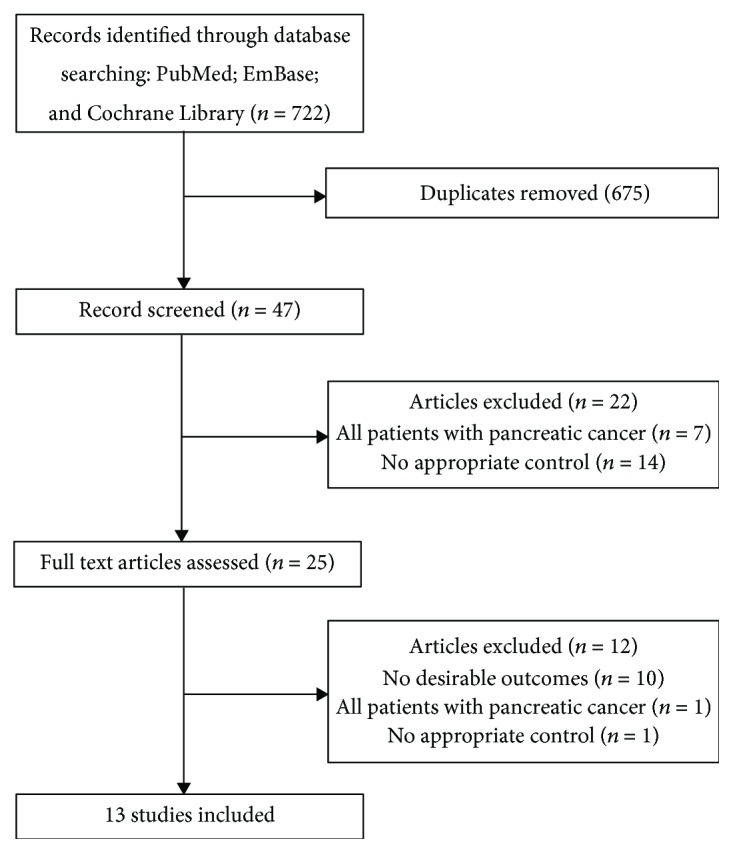
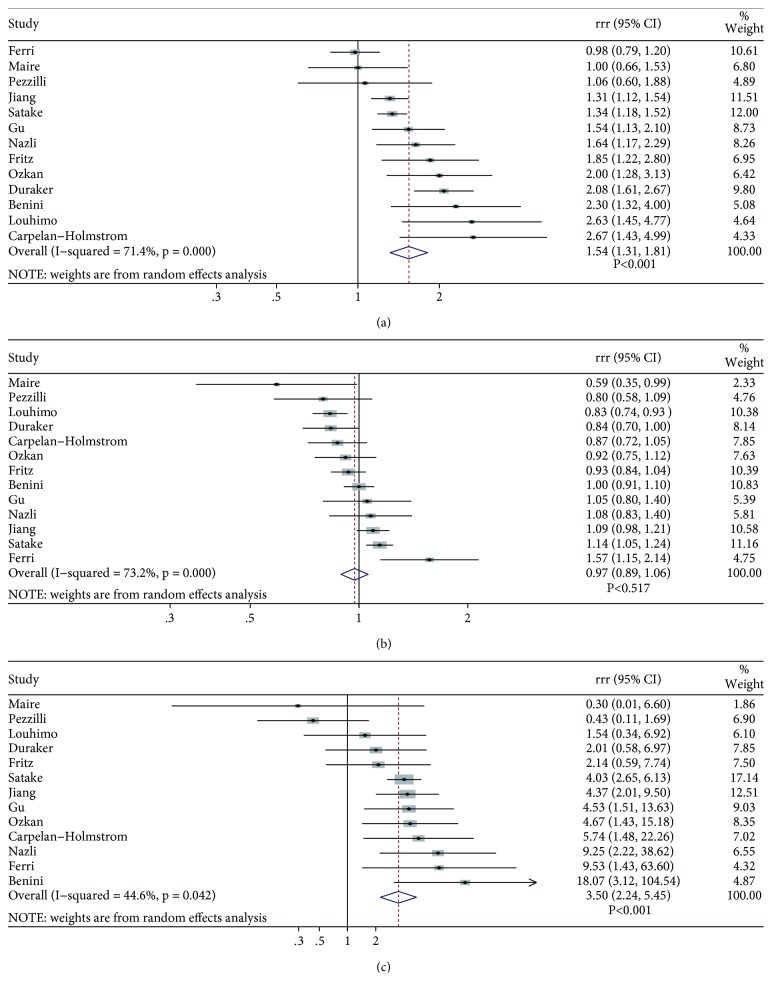
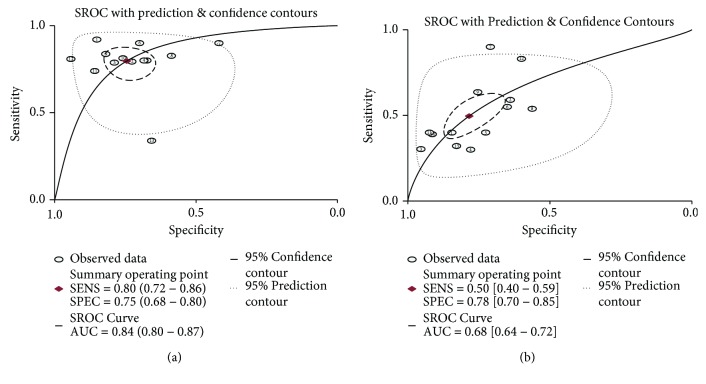
Background. CA 19-9 and carcinoembryonic antigen (CEA) are widely used for the diagnosis of pancreatic cancer. The purpose of the present study was to compare the diagnostic value of CA 19-9 with CEA for pancreatic cancer. Methods. The studies were obtained from electronic searches conducted in PubMed, Embase, and Cochrane Library databases until December 2017. The keywords included diagnosis of pancreatic cancer, CA 19-9, and CEA. The ratio of sensitivity, the specificity, the diagnostic odds ratio (DOR), and the summary of the receiver operating characteristic (SROC) with regard to CA 19-9 and CEA were measured using the random effects model. The current study included 13 studies that comprised 4,537 participants and 1,277 patients with pancreatic cancer. Results. The levels of CA 19-9 for use for the detection of pancreatic cancer were associated with higher sensitivity (ratio of sensitivity: 1.54; 1.31–1.81; P<0.001 ), DOR (DOR: 3.50; 95% CI: 2.24–5.45; P<0.001 ), and AUC (ratio of AUC: 1.24; 95% CI: 1.15–1.33; P<0.001 ) compared with the variable CEA, while no significant difference between CA 19-9 and CEA was noted with regard to specificity (ratio of specificity: 0.97; 95% CI: 0.89–1.06; P=0.517 ). The findings of the subgroup analyses suggested that different cutoff values of CA 19-9 and CEA might affect the diagnostic value. Conclusions. The findings of the present study indicated that CA 19-9 levels were associated with higher sensitivity, DOR, and AUC compared with the corresponding levels of CEA with regard to the diagnosis of pancreatic cancer.
Overview
The claims and statistics of this paper haven’t been checked yet.
Free: it reads the open-access text and checks the first 5 claims that cite a source we can check. Create a free account to check every claim.
Integrity signals
Registry
Cites
Statistics
Figures
Verification
Claims the paper makes
The claims and statistics of this paper haven’t been checked yet.
Free: it reads the open-access text and checks the first 5 claims that cite a source we can check. Create a free account to check every claim.
Claims other papers make about this one
Each is checked against this paper’s own text: does it say what the citing paper says it does?
The source backs part of the claim, not all of it — or backs it for a different population, condition or comparison.
In the citing paper
“Carbohydrate Antigen 19-9 (CA19-9), the best-validated biomarker in PC, does not have enough accuracy and specificity in screening early PC 23,24.”
From Artificial intelligence in pancreatic cancer (2022) · cites this paper as [24]
Experimental — accuracy not yet measured
Self-check
Percentages, sums and reported differences re-computed from the paper’s own numbers.
The self-check needs the paper’s full text.
Citations
Cites
Preferred Reporting Items for Systematic Reviews and Meta-Analyses: the PRISMA statement
Moher, D., Liberati, A., Tetzlaff, J., Altman, D. G., & for the PRISMA Group (2009) · BMJ · doi:10.1136/bmj.b2535 · Cited by 83,823
Preferred Reporting Items for Systematic Reviews and Meta-Analyses: The PRISMA Statement
Moher, D., Liberati, A., Tetzlaff, J., Altman, D. G., & The PRISMA Group (2009) · PLoS Medicine · doi:10.1371/journal.pmed.1000097 · Cited by 64,042 · cited 1×
“The present study was conducted in accordance with the guidelines for the Preferred Reporting Items for Systematic Reviews and Meta-Analyses (PRISMA) [15].”
Measuring inconsistency in meta-analyses
Higgins, J. P. T., Thompson, S. G., Deeks, J. J., & Altman, D. G. (2003) · BMJ · doi:10.1136/bmj.327.7414.557 · Cited by 63,139 · cited 1×
“1 (P ≤ 0 10) indicated significant heterogeneity for the Q statistical analysis [21, 22].”
Meta-analysis in clinical trials
DerSimonian, R., & Laird, N. (1986) · Controlled Clinical Trials · doi:10.1016/0197-2456(86)90046-2 · Cited by 39,552 · cited 1×
“The bivariate random effects [18] were applied in order to analyze sensitivity, specificity, and DOR, and the hierarchical regression model was used to analyze receiver operating characteristic (SROC) curve and the AUC [19].”
Wang, G., Ma, R., Qiao, G., Wada, K., Aizawa, Y., & Satoh, T. (2015) · Integrative Medicine International · doi:10.1159/000368408 · Cited by 18,657
Spencer, P. M., Cameron, J. L., & Lin, L. (2000) · Cited by 7,202
Whiting, P., Rutjes, A. W., Reitsma, J. B., Bossuyt, P. M., & Kleijnen, J. (2003) · BMC Medical Research Methodology · doi:10.1186/1471-2288-3-25 · Cited by 3,592
Deeks, J. J., Macaskill, P., & Irwig, L. (2005) · Journal of Clinical Epidemiology · doi:10.1016/j.jclinepi.2005.01.016 · Cited by 2,910 · cited 1×
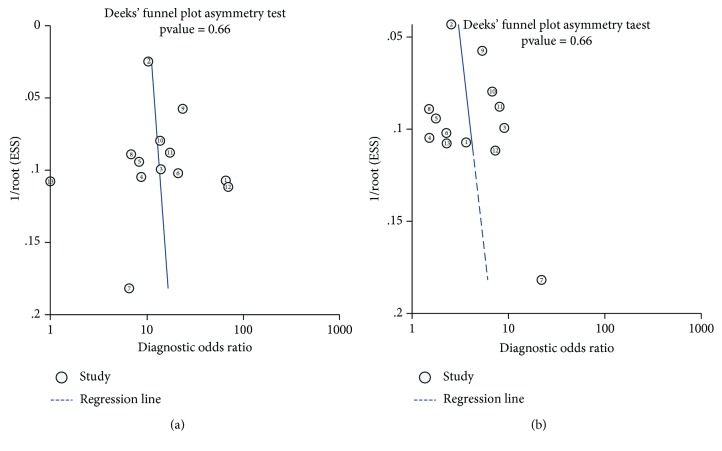
“The visual inspections of the funnel plots were constructed by Deeks ’ asymmetry test for CA 19-9 and CEA [23].”
Analysing Data and Undertaking Meta‐Analyses
Deeks, J. J., Higgins, J. P., & Altman, D. G. (2008) · Cochrane Handbook for Systematic Reviews of Interventions · doi:10.1002/9780470712184.ch9 · Cited by 1,800
Li, D., Xie, K., Wolff, R., & Abbruzzese, J. L. (2004) · The Lancet · doi:10.1016/s0140-6736(04)15841-8 · Cited by 1,719
Self-citation
Cited by
Items 101–114 of 114
Advances in Biomarkers for Pancreatic Cancer
Zou, Y., Li, Y., & Zou, C. (2025) · Journal of Biosciences and Medicines · doi:10.4236/jbm.2025.135019
Kohjima, M., Takami, Y., Kawabe, K., Tanabe, K., Hayashi, C., Mikami, M., & Kusumoto, T. (2025) · Molecular Oncology · doi:10.1002/1878-0261.70084
A real-world pharmacovigilance assessment of drug-related carcinoembryonic antigen increase
Du, C., Liang, Y., Liu, W., Jiang, Y., & Wang, Y. (2025) · Medicine · doi:10.1097/md.0000000000044365
“[41] CEA is also used as a tumor marker for cervical and ovarian mucinous adeno-carcinomas and cervical keratosis squamous cell carcinoma.”
Self-citationGu, S.-J., Liu, X., Zhou, H., & Yang, J. (2025) · Journal of Proteome Research · doi:10.1021/acs.jproteome.5c00615
Neue diagnostische Verfahren beim Pankreaskarzinom
Verfaillie, D. (2024) · doi:10.25593/open-fau-904
Risk factors and some aspects of pancreatic cancer prevention
Быкова, А. П., Kozlova, I. V., Андреевна, Т. Т., Пахомова, А. Л., & Лекарева, Л. И. (2026) · Экспериментальная и клиническая гастроэнтерология · doi:10.31146/1682-8658-ecg-244-12-103-112
Marin, A. M., Timoner, B. E., Araújo, D. D., Uno, M., Alves, M. J. F., Chammas, R. J., Namur, G. N., Wosniaki, D. K., Canzian, F., Blanes, L., et al. (2026) · Scientific Reports · doi:10.1038/s41598-026-42403-4 · Cited by 1
Nishal, S., Kumar, V., Arya, A., & Jhawat, V. (2026) · Elsevier eBooks · doi:10.1016/b978-0-443-44041-0.00013-1
Carbohydrate antigen 19-9: a key biomarker in cancer diagnosis and therapeutics
Ashwani, Bhamboo, N., Bharadwaj, A., & Gugulothu, D. B. (2026) · Elsevier eBooks · doi:10.1016/b978-0-443-44041-0.00023-4 · Cited by 1
Wu, B., Li, R. J., Wang, M., Wang, X., Chen, Q., Luo, D., & Liu, J. (2026) · Discover Oncology · doi:10.1007/s12672-026-05362-w
Aga, S. S., Khan, M. A., Thabet, M. S., Alharbi, N. M., Aljehani, W. M., Alhazmi, A. K., Alotaibi, M. F., & Nissar, S. (2026) · Journal of Family Medicine and Primary Care · doi:10.4103/jfmpc.jfmpc_1942_25
“[49,50] This supports our cohort’s findings reflecting established diagnostic hierarchies in advanced PC.”
InfluentialAbe, T., Takikawa, T., Kikuta, K., Matsumoto, R., Tanaka, Y., Sano, T., Hayashi, H., Sekino, Y., Tanaka, Y., Masuo, T., et al. (2026) · Pancreatology · doi:10.1016/j.pan.2026.10.007
Podgórski, P., Nehring, P., Ciepiela, O., & Przybyłkowski, A. M. (2026) · Advances in Medical Sciences · doi:10.1016/j.advms.2026.11.001
Maghsoodi, N., Ameri, M., Absalan, F., Esmaeili, M., & Ramezani, A. (2026) · Biochemical and Biophysical Research Communications · doi:10.1016/j.bbrc.2026.154848
Metadata
- Authors
- Xing, H., Wang, J., Wang, Y., Tong, M., Hu, H., Huang, C., & Li, D.
- Affiliations
- Sir Run Run Shaw Hospital (CN)
- Affiliated Hospital of Hangzhou Normal University (CN)
- Corresponding author
- Li, Da
- Venue
- Gastroenterology Research and Practice
- Publisher
- Wiley
- Published
- 2018-11-21
- Volume
- 2018
- Pages
- 1-9
- ISSN
- 1687-6121 (ISSN-L)
- 1687-630X
- PMC
- PMC6280291
- OpenAlex
- W2900549965
- Cited by
- 109
- References
- 40
- Citations by year
- 2026: 9 · 2025: 18 · 2024: 20 · 2023: 26 · 2022: 16 · 2021: 14 · 2020: 5 · 2019: 1
- FWCI
- 0.52
- Type
- journal article
- Language
- en
- Open access
- gold
- doi.org
- Locations
- Gastroenterology Research and Practice (publishedVersion, cc-by)
- Europe PMC (PubMed Central) (publishedVersion, cc-by)
- PubMed Central (publishedVersion, cc-by)
- PubMed (publishedVersion)
- DOAJ (DOAJ: Directory of Open Access Journals) (submittedVersion, cc-by-sa)
- Funders
- Medicine and Health Technology Plan of Zhejiang Province (2015KYB217)
- Topics
- Health Sciences › Medicine › Oncology › Pancreatic and Hepatic Oncology Research
- Health Sciences › Medicine › Surgery › Pancreatitis Pathology and Treatment
- Health Sciences › Medicine › Surgery › Cholangiocarcinoma and Gallbladder Cancer Studies
- Keywords
- CA19-9, carcinoembryonic antigen, pancreatic cancer, tumor markers, diagnostic accuracy, sensitivity and specificity, diagnostic odds ratio, cut-off values
About these checks
Registry, retraction, Cites and statistics results are computed, not judged, with one exception: a printed reference that no index lists is read once by a model before it counts as a citation error. Claims are extracted by a model and kept only when their quote appears verbatim in the text; each cited source is then checked, with a model’s help, for whether it says what the claim relies on. Those verdicts can be wrong — read the claim’s quote and the cited source before relying on one.
Statistics and arithmetic are recomputed, not judged.
Confidence bands are shown only for fields calibrated on our annotated test set. None is calibrated yet, so no band is shown.
What counts as a claim ›How we measure confidence ›How we check this ›
Are you an author, or do you see a problem with this page? Request a review
Data sources
Bibliographic data: Semantic Scholar, OpenAlex, Crossref.
Contains information from the Semantic Scholar Academic Graph Datasets, made available under the ODC Attribution License (ODC-BY 1.0).
Semantic Scholar’s data is described in: Kinney, R., et al. (2023). The Semantic Scholar Open Data Platform. arXiv:2301.10140.
