

Image-Based Insider Threat Detection via Geometric Transformation
Open accessThe DOI matches its Crossref record; 35 of the 35 references it cites were found in a registry or an index.
Abstract
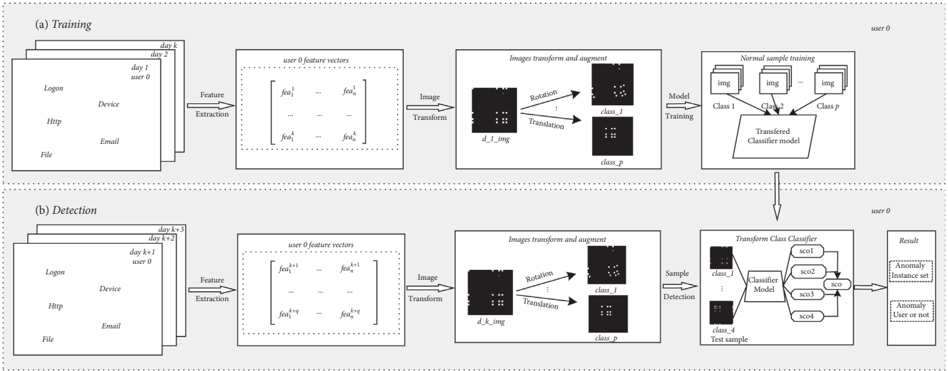
Insider threat detection has been a challenging task over decades; existing approaches generally employ the traditional generative unsupervised learning methods to produce normal user behavior model and detect significant deviations as anomalies. However, such approaches are insufficient in precision and computational complexity. In this paper, we propose a novel insider threat detection method, Image-based Insider Threat Detector via Geometric Transformation (IGT), which converts the unsupervised anomaly detection into supervised image classification task, and therefore the performance can be boosted via computer vision techniques. To illustrate, our IGT uses a novel image-based feature representation of user behavior by transforming audit logs into grayscale images. By applying multiple geometric transformations on these behavior grayscale images, IGT constructs a self-labelled dataset and then trains a behavior classifier to detect anomaly in a self-supervised manner. The motivation behind our proposed method is that images converted from normal behavior data may contain unique latent features which remain unchanged after geometric transformation, while malicious ones cannot. Experimental results on CERT dataset show that IGT outperforms the classical autoencoder-based unsupervised insider threat detection approaches, and improves the instance and user based Area under the Receiver Operating Characteristic Curve (AUROC) by 4% and 2%, respectively.
Overview
The claims and statistics of this paper haven’t been checked yet.
Free: it reads the open-access text and checks the first 5 claims that cite a source we can check. Create a free account to check every claim.
Integrity signals
Registry
Cites
Statistics
Figures


Verification
Claims the paper makes
The claims and statistics of this paper haven’t been checked yet.
Free: it reads the open-access text and checks the first 5 claims that cite a source we can check. Create a free account to check every claim.
Self-check
Percentages, sums and reported differences re-computed from the paper’s own numbers.
The self-check needs the paper’s full text.
Citations
Cites
Breiman, L. (2001) · Machine Learning · doi:10.1023/a:1010933404324 · Cited by 133,538
Liu, F. T., Ting, K. M., & Zhou, Z.-H. (2008) · 2008 Eighth IEEE International Conference on Data Mining · doi:10.1109/icdm.2008.17 · Cited by 6,601
Detecting and Preventing Cyber Insider Threats: A Survey
Liu, L., De Vel, O., Han, Q.-L., Zhang, J., & Xiang, Y. (2018) · IEEE Communications Surveys & Tutorials · doi:10.1109/comst.2018.2800740 · Cited by 385
Deep Anomaly Detection Using Geometric Transformations
Golan, I., & El‐Yaniv, R. (2018) · arXiv (Cornell University) · doi:10.48550/arxiv.1805.10917 · Cited by 372
Bridging the Gap: A Pragmatic Approach to Generating Insider Threat Data
Glasser, J., & Lindauer, B. (2013) · 2013 IEEE Security and Privacy Workshops · doi:10.1109/spw.2013.37 · Cited by 344
Malicious Software Classification Using Transfer Learning of ResNet-50 Deep Neural Network
Rezende, E., Ruppert, G., Carvalho, T., Ramos, F., & de Geus, P. (2017) · 2017 16th IEEE International Conference on Machine Learning and Applications (ICMLA) · doi:10.1109/icmla.2017.00-19 · Cited by 285
Homoliak, I., Toffalini, F., Guarnizo, J., Elovici, Y., & Ochoa, M. (2020) · ACM Computing Surveys · doi:10.1145/3303771 · Cited by 255
Analyzing Data Granularity Levels for Insider Threat Detection Using Machine Learning
Le, D. C., Zincir-Heywood, N., & Heywood, M. I. (2020) · IEEE Transactions on Network and Service Management · doi:10.1109/tnsm.2020.2967721 · Cited by 191
Insiders and Insider Threats:An Overview of Definitions and Mitigation Techniques
Hunker, J., & Probst, C. W. (2011) · Cited by 185
Insider Threat Detection with Deep Neural Network
Yuan, F., Cao, Y., Shang, Y., Liu, Y., Tan, J., & Fang, B. (2018) · Lecture Notes in Computer Science · doi:10.1007/978-3-319-93698-7_4 · Cited by 168
Anomaly Detection with Graph Convolutional Networks for Insider Threat and Fraud Detection
Jiang, J., Chen, J., Gu, T., Choo, K.-K. R., Liu, C., Yu, M., Huang, W., & Mohapatra, P. (2019) · MILCOM 2019 - 2019 IEEE Military Communications Conference (MILCOM) · doi:10.1109/milcom47813.2019.9020760 · Cited by 166
A New Take on Detecting Insider Threats: Exploring the Use of Hidden Markov Models
Rashid, T., Agrafiotis, I., & Nurse, J. R. C. (2016) · Proceedings of the 8th ACM CCS International Workshop on Managing Insider Security Threats · doi:10.1145/2995959.2995964 · Cited by 152
Detecting insider threats in a real corporate database of computer usage activity
Senator, T. E., Goldberg, H. G., Memory, A., Young, W. T., Rees, B., Pierce, R., Huang, D., Reardon, M., Bader, D. A., Chow, E., et al. (2013) · Proceedings of the 19th ACM SIGKDD international conference on Knowledge discovery and data mining · doi:10.1145/2487575.2488213 · Cited by 130
User Behavior Analytics for Anomaly Detection Using LSTM Autoencoder - Insider Threat Detection
Sharma, B., Pokharel, P., & Joshi, B. (2020) · Proceedings of the 11th International Conference on Advances in Information Technology · doi:10.1145/3406601.3406610 · Cited by 130
Scenario-Based Insider Threat Detection From Cyber Activities
Chattopadhyay, P., Wang, L., & Tan, Y.-P. (2018) · IEEE Transactions on Computational Social Systems · doi:10.1109/tcss.2018.2857473 · Cited by 115
elicit: A System for Detecting Insiders Who Violate Need-to-Know
Maloof, M. A., & Stephens, G. D. (2007) · Lecture notes in computer science · doi:10.1007/978-3-540-74320-0_8 · Cited by 101
Anomaly-Based Insider Threat Detection Using Deep Autoencoders
Liu, L., De Vel, O., Chen, C., Zhang, J., & Xiang, Y. (2018) · 2018 IEEE International Conference on Data Mining Workshops (ICDMW) · doi:10.1109/icdmw.2018.00014 · Cited by 79
Detecting Insider Threat from Enterprise Social and Online Activity Data
Gavai, G., Sricharan, K., Gunning, D., Rolleston, R., Hanley, J., & Singhal, M. (2015) · Proceedings of the 7th ACM CCS International Workshop on Managing Insider Security Threats · doi:10.1145/2808783.2808784 · Cited by 69
Insider Threat Detection Based on Deep Belief Network Feature Representation
Lin, L., Zhong, S., Jia, C., & Chen, K. (2017) · 2017 International Conference on Green Informatics (ICGI) · doi:10.1109/icgi.2017.37 · Cited by 64
Image-Based Feature Representation for Insider Threat Classification
Gayathri, R. G., Sajjanhar, A., & Xiang, Y. (2020) · Applied Sciences · doi:10.3390/app10144945 · Cited by 63
Insider Threat Detection via Hierarchical Neural Temporal Point Processes
Yuan, S., Zheng, P., Wu, X., & Li, Q. (2019) · 2019 IEEE International Conference on Big Data (Big Data) · doi:10.1109/bigdata47090.2019.9005589 · Cited by 48
A maximum likelihood approximation method for Dirichlet's parameter estimation
Wicker, N., Muller, J., Kalathur, R. K. R., & Poch, O. (2007) · Computational Statistics & Data Analysis · doi:10.1016/j.csda.2007.07.011 · Cited by 46
Few-shot Insider Threat Detection
Yuan, S., Zheng, P., Wu, X., & Tong, H. (2020) · Proceedings of the 29th ACM International Conference on Information & Knowledge Management · doi:10.1145/3340531.3412161 · Cited by 36
DeepMIT: A Novel Malicious Insider Threat Detection Framework based on Recurrent Neural Network
Sun, D., Liu, M., Li, M., Shi, Z., Liu, P., & Wang, X. (2021) · International Conference on Computer Supported Cooperative Work in Design (CSCWD) · doi:10.1109/cscwd49262.2021.9437887 · Cited by 34
Self-citationData Augmentation for Insider Threat Detection with GAN
Yuan, F., Shang, Y., Liu, Y., Cao, Y., & Tan, J. (2020) · 2020 IEEE 32nd International Conference on Tools with Artificial Intelligence (ICTAI) · doi:10.1109/ictai50040.2020.00102 · Cited by 33
Insider Threat Identification Using the Simultaneous Neural Learning of Multi-Source Logs
Liu, L., Chen, C., Zhang, J., De Vel, O., & Xiang, Y. (2019) · IEEE Access · doi:10.1109/access.2019.2957055 · Cited by 31
Unsupervised Insider Detection Through Neural Feature Learning and Model Optimisation
Liu, L., Chen, C., Zhang, J., Vel, O. D., & Xiang, Y. (2019) · Lecture notes in computer science · doi:10.1007/978-3-030-36938-5_2 · Cited by 18
Yuan, L.-P., Liu, P., & Zhu, S. (2021) · ACM Asia Conference on Computer and Communications Security (ASIA CCS) · doi:10.1145/3433210.3453098 · Cited by 18
Time-Window Based Group-Behavior Supported Method for Accurate Detection of Anomalous Users
Yuan, L.-P., Choo, E., Yu, T., Khalil, I. M., & Zhu, S. (2021) · International Conference on Dependable Systems & Networks/Proceedings · doi:10.1109/dsn48987.2021.00038 · Cited by 18
Exploring Adversarial Properties of Insider Threat Detection
Le, D. C., & Zincir-Heywood, N. (2020) · 2020 IEEE Conference on Communications and Network Security (CNS) · doi:10.1109/cns48642.2020.9162254 · Cited by 17
Transformation Based Deep Anomaly Detection in Astronomical Images
Reyes, E., & Estévez, P. A. (2020) · International Joint Conference on Neural Networks (IJCNN) · doi:10.1109/ijcnn48605.2020.9206997 · Cited by 13
Multi-class Classification Based Anomaly Detection of Insider ActivitiesPreprint
Gayathri, R. G., Sajjanhar, A., Xiang, Y., & Ma, X. (2021) · arXiv (Cornell University) · Cited by 10
Image-based Insider Threat Detection via Geometric TransformationPreprint
Li, D., Yang, L., Zhang, H., et al. (2021) · arXiv (Cornell University) · doi:10.48550/arxiv.2108.10567 · Cited by 2
Self-citationAnomaly Detection for Scenario-based Insider Activities using CGAN Augmented DataPreprint
Gayathri, R. G., Sajjanhar, A., Xiang, Y., et al. (2021) · arXiv (Cornell University) · doi:10.48550/arxiv.2102.07277
Deep Learning for Unsupervised Insider Threat Detection in Structured Cybersecurity Data Streams
Tuor, A., Kaplan, S., Hutchinson, B., Nichols, N., & Robinson, S. (2017) · arXiv · doi:10.48550/arxiv.1710.00811
Research works printed but not linked: 2
- D. L. Costa, 2016, Insider threat indicator Oontology
- M. Collins, 2016, Common Sense Guide to Mitigating Insider Threats
Cited by
Alzaabi, F. R., & Mehmood, A. (2024) · IEEE Access · doi:10.1109/access.2024.3369906 · Cited by 204
“While effective at identifying unauthorized access, these methods had limitations when it came to detecting subtler insider threats, like privileged users abusing their access rights [3], [6].”
BackgroundRobust Anomaly-Based Insider Threat Detection Using Graph Neural Network
Xiao, J., Yang, L., Zhong, F., Wang, X., Chen, H., & Li, D. (2023) · IEEE Transactions on Network and Service Management · doi:10.1109/tnsm.2022.3222635 · Cited by 48
Self-citationXiao, H., Zhu, Y. H., Zhang, B., Lü, Z., Du, D., & Liu, Y. (2023) · Computers & Security · doi:10.1016/j.cose.2023.103665 · Cited by 46
Yi, J., & Tian, Y. (2024) · Electronics · doi:10.3390/electronics13050973 · Cited by 31
Randive, K., Mohan, R., & Sivakrishna, A. M. (2023) · Journal of Information Security and Applications · doi:10.1016/j.jisa.2023.103434 · Cited by 27
Metadata
- Authors
- Li, D., Yang, L., Zhang, H., Wang, X., Ma, L., & Xiao, J.
- Affiliations
- PLA Academy of Military Science (CN)
- Corresponding author
- Li, Dongyang
- Venue
- Security and Communication Networks
- Publisher
- Wiley
- Published
- 2021-09-13
- Volume
- 2021
- Pages
- 1-18
- ISSN
- 1939-0114 (ISSN-L)
- 1939-0122
- OpenAlex
- W3200821063
- Cited by
- 22
- References
- 33
- Citations by year
- 2026: 3 · 2025: 5 · 2024: 3 · 2023: 5 · 2022: 3 · 2021: 3
- FWCI
- 1.57
- Type
- journal article
- Language
- en
- Open access
- hybrid
- doi.org
- Locations
- Security and Communication Networks (publishedVersion, cc-by)
- arXiv (Cornell University) (submittedVersion)
- DOAJ (DOAJ: Directory of Open Access Journals) (submittedVersion, cc-by-sa)
- arXiv (Cornell University)
- Funders
- National Natural Science Foundation of China (61772271, 62106282, 62172432, SBK2020043435, ZXD2020C2316)
- Natural Science Foundation of Jiangsu Province (61772271, 62106282, 62172432, SBK2020043435, ZXD2020C2316)
- Equipment Research and Development Fund (61772271, 62106282, 62172432, SBK2020043435, ZXD2020C2316)
- Topics
- Physical Sciences › Computer Science › Computer Networks and Communications › Network Security and Intrusion Detection
- Physical Sciences › Computer Science › Artificial Intelligence › Anomaly Detection Techniques and Applications
- Physical Sciences › Computer Science › Information Systems › Information and Cyber Security
- Keywords
- insider threat detection, user behavior modeling, anomaly detection, audit logs, grayscale image representation, geometric transformations, self-supervised learning, behavior classification
About these checks
Registry, retraction, Cites and statistics results are computed, not judged, with one exception: a printed reference that no index lists is read once by a model before it counts as a citation error. Claims are extracted by a model and kept only when their quote appears verbatim in the text; each cited source is then checked, with a model’s help, for whether it says what the claim relies on. Those verdicts can be wrong — read the claim’s quote and the cited source before relying on one.
Statistics and arithmetic are recomputed, not judged.
Confidence bands are shown only for fields calibrated on our annotated test set. None is calibrated yet, so no band is shown.
What counts as a claim ›How we measure confidence ›How we check this ›
Are you an author, or do you see a problem with this page? Request a review
Data sources
Bibliographic data: Semantic Scholar, OpenAlex, Crossref.
Contains information from the Semantic Scholar Academic Graph Datasets, made available under the ODC Attribution License (ODC-BY 1.0).
Semantic Scholar’s data is described in: Kinney, R., et al. (2023). The Semantic Scholar Open Data Platform. arXiv:2301.10140.
