

The DOI matches its Crossref record; 15 of the 15 references it cites were found in a registry or an index.
Social Media Use and Attitudes toward AI: The Mediating Roles of Perceived AI Fairness and Threat
Abstract
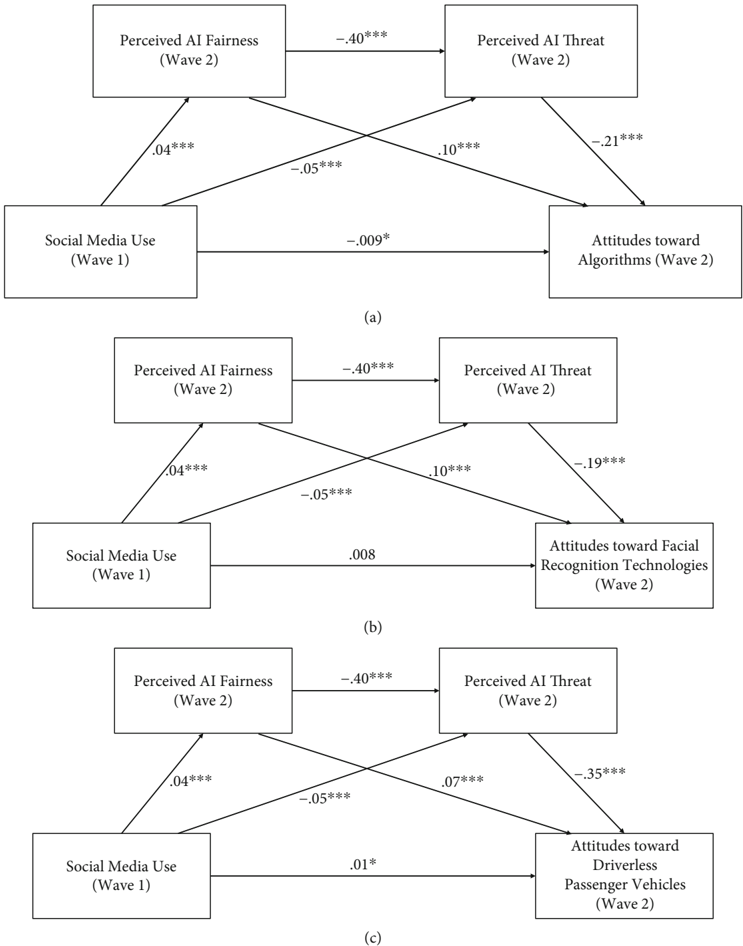
This study investigates the association between social media use and attitudes toward AI technologies. A nationally representative two-wave longitudinal survey (N=5110) examined the mediating roles of perceived AI fairness and threat concerning three AI technologies: algorithms, facial recognition technology, and driverless passenger vehicles. Hypotheses were derived from media effect theories and the heuristic and systematic model of human-AI adoption. The results showed that social media use predicted more positive attitudes toward the three AI technologies indirectly through increased perceived AI fairness and reduced perceived AI threat. The findings contribute to our understanding of social media effects on attitudes toward AI and the underlying psychological mechanisms, providing valuable theoretical insights and practical implications.
Overview
The claims and statistics of this paper haven’t been checked yet.
Run the check — free, no account needed. It reads the open-access text and checks the sources it cites.
Integrity signals
Registry
Cites
Statistics
Figures
Verification
Claims the paper makes
The claims and statistics of this paper haven’t been checked yet.
Run the check — free, no account needed. It reads the open-access text and checks the sources it cites.
Claims other papers make about this one
Each is checked against this paper’s own text: does it say what the citing paper says it does?
In the citing paper
“As early adopters shared experiences through social media, and companies increased marketing efforts, more students were exposed to AI-related content, trends, and resources, enabling more positive evaluations of AI and a deeper understanding of its capabilities (Li & Zheng, 2024).”
From Cheating in the second year of generative AI chatbots: a follow-up study on high school student cheating behaviors (2026) · cites this paper as Li & Zheng, 2024
Self-check
Percentages, sums and reported differences re-computed from the paper’s own numbers.
The self-check needs the paper’s full text.
Citations
Cites
Zawacki-Richter, O., Marín, V. I., Bond, M., & Gouverneur, F. (2019) · International Journal of Educational Technology in Higher Education · doi:10.1186/s41239-019-0171-0 · Cited by 7,242
Human trust in artificial intelligence: Review of empirical research
Glikson, E., & Woolley, A. W. (2020) · Academy of Management Annals · doi:10.5465/annals.2018.0057 · Cited by 2,921
Artificial Intelligence in Human Resources Management: Challenges and a Path Forward
Tambe, P., Cappelli, P., & Yakubovich, V. (2019) · California Management Review · doi:10.1177/0008125619867910 · Cited by 1,609
Lee, M. K. (2018) · Big Data & Society · doi:10.1177/2053951718756684 · Cited by 1,338
The ethics of AI in health care: A mapping review
Morley, J., Machado, C. C. V., Burr, C., Cowls, J., Joshi, I., Taddeo, M., & Floridi, L. (2020) · Social Science & Medicine · doi:10.1016/j.socscimed.2020.113172 · Cited by 1,105
In AI we trust? Perceptions about automated decision-making by artificial intelligence
Araujo, T., Helberger, N., Kruikemeier, S., & de Vreese, C. H. (2020) · AI & SOCIETY · doi:10.1007/s00146-019-00931-w · Cited by 1,038
Developing and validating a service robot integration willingness scale
Lu, L., Cai, R., & Gursoy, D. (2019) · International Journal of Hospitality Management · doi:10.1016/j.ijhm.2019.01.005 · Cited by 1,013
Trust in AI and Its Role in the Acceptance of AI Technologies
Choung, H., David, P., & Ross, A. (2023) · International Journal of Human–Computer Interaction · doi:10.1080/10447318.2022.2050543 · Cited by 963
Vimalkumar, M., Sharma, S. K., Singh, J. B., & Dwivedi, Y. K. (2021) · Computers in Human Behavior · doi:10.1016/j.chb.2021.106763 · Cited by 402
Psychological roadblocks to the adoption of self-driving vehicles
Shariff, A., Bonnefon, J.-F., & Rahwan, I. (2017) · Nature Human Behaviour · doi:10.1038/s41562-017-0202-6 · Cited by 336
Research works printed but not linked: 52
- 10.1177/00936502231191832 · DOI
- K. Schwab, 2017, The fourth industrial revolution (first U.S. edition)
- IBM, 2022, Global Data from IBM Shows Steady Ai Adoption as Organizations Look to Address Skills Shortages, Automate Processes and Encourage Sustainable Operations
- 10.1016/j.chbr.2020.100014 · DOI · Paper page
- 10.1371/journal.pone.0257732 · DOI
- 10.1093/scipol/scac056 · DOI
- 10.1016/S2589-7500(21)00132-1 · DOI · Paper page
- 10.1177/09636625221113957 · DOI
- 10.3389/fpubh.2022.856571 · DOI
- 10.1111/j.1460-2466.1976.tb01397.x · DOI · Paper page
- 10.1177/14614448231180257 · DOI
- 10.1080/19312458.2012.732626 · DOI
- 10.1007/s00146-023-01854-3 · DOI
- 10.1080/08838151.2020.1843357 · DOI
- 10.1201/b23083 · DOI
- 10.1109/ICDM51629.2021.00100 · DOI
- 10.1108/JBS-12-2018-0204 · DOI · Paper page
- N. E. Sanders, 2023, Opinion|How Chatgpt Hijacks Democracy
- 10.1016/j.jbusres.2020.12.012 · DOI
- 10.1080/0144929X.2021.1884288 · DOI
- 10.1007/s12369-020-00734-w · DOI
- 10.1016/j.tele.2021.101694 · DOI
- 10.1016/j.giq.2023.101803 · DOI
- 10.1016/j.chb.2021.106894 · DOI
- 10.1177/14614448221108112 · DOI
- 10.1109/MSP.2018.2701166 · DOI · Paper page
- 10.1016/j.jbef.2020.100352 · DOI
- 10.1080/1369118X.2016.1154086 · DOI
- 10.1177/01634437221119021 · DOI · Paper page
- 10.1093/ijpor/edl003 · DOI
- 10.1007/978-3-030-87626-5_19 · DOI
- 10.1038/s41558-022-01377-7 · DOI · Paper page
- 10.1007/s12369-020-00640-1 · DOI
- 10.1007/978-3-030-81907-1_3 · DOI
- 10.1177/0894439317698637 · DOI · Paper page
- 10.1016/j.tele.2015.08.007 · DOI
- 10.1017/s0140525x1300263x · DOI
- 10.1037/0022-3514.76.5.839 · DOI · Paper page
- 10.1038/s41562-019-0670-y · DOI
- 10.1146/annurev-psych-122414-033608 · DOI · Paper page
- 10.1145/3375959.3375968 · DOI
- 10.1177/10946705221103538 · DOI
- 10.1108/JBS-11-2021-0182 · DOI
- Pew Research Center, .., The American Trends Panel
- 10.1177/0963662520917339 · DOI
- 10.1016/j.sleh.2022.01.001 · DOI
- 10.1016/j.ssmph.2020.100717 · DOI
- A. F. Hayes, 2017, Introduction to Mediation, Moderation, and Conditional Process Analysis: A Regression-Based Approach
- 10.1016/j.ausmj.2017.02.001 · DOI
- 10.1111/j.1745-9125.1998.tb01268.x · DOI
- 10.1007/s00146-021-01148-6 · DOI
- 10.1177/10755470241232352 · DOI
Cited by
Sorted by citations
Chen, R., Lee, V. R., Kuo, A. C., Pope, D. C., & Miles, S. (2026) · Educational technology research and development · doi:10.1007/s11423-026-10587-1 · Cited by 8
Metadata
- Authors
- Li, W., & Zheng, X.
- Venue
- Human Behavior and Emerging Technologies
- Publisher
- Wiley
- Published
- 2024-04-02
- Volume
- 2024
- Pages
- 1-11
- ISSN
- 2578-1863
- Cited by
- 15
- References
- 15
- Language
- en
About these checks
Registry, retraction, Cites and statistics results are computed, not judged, with one exception: a printed reference that no index lists is read once by a model before it counts as a citation error. Claims are extracted by a model and kept only when their quote appears verbatim in the text; each cited source is then checked, with a model’s help, for whether it says what the claim relies on. Those verdicts can be wrong — read the claim’s quote and the cited source before relying on one.
Statistics and arithmetic are recomputed, not judged.
Confidence bands are shown only for fields calibrated on our annotated test set. None is calibrated yet, so no band is shown.
What counts as a claim ›How we measure confidence ›How we check this ›
Are you an author, or do you see a problem with this page? Request a review
How to cite
Cite CoChat for the checks on this page, and the paper for its own findings.
- This page
- CoChat. (2026). Citation check: Social Media Use and Attitudes toward AI: The Mediating Roles of Perceived AI Fairness and Threat. https://app.cochat.ai/papers/10.1155/2024/3448083
- The paper
- Li, W., & Zheng, X. (2024). Social Media Use and Attitudes toward AI: The Mediating Roles of Perceived AI Fairness and Threat. Human Behavior and Emerging Technologies. https://doi.org/10.1155/2024/3448083
