

The DOI matches its Crossref record; 31 of the 31 references it cites were found in a registry or an index; none of the 72 sources its claims cite is checked for support yet.
Cheating in the second year of generative AI chatbots: a follow-up study on high school student cheating behaviors
Open accessAbstract
This study examines the evolving relationship between AI chatbots and academic integrity and students’ AI chatbot usage in high schools one and a half years after the release of ChatGPT. Through a comprehensive survey of students across six schools (N = 4,354) in the United States, we investigated students' self-reported cheating behaviors, patterns of AI use across different school-related tasks, and student perspectives on appropriate AI use in academic settings. Our findings revealed that overall cheating rates remain stable at 72.06%, consistent with historical baselines and prior studies, suggesting that AI availability has not changed overall cheating prevalence in high school. Additionally, more students reported using AI chatbots for support tasks like concept explanation and idea generation. Regarding students' reported preferences for allowing AI chatbots for school-related tasks, at this point, they still strongly supported using AI for conceptual understanding and brainstorming, and they maintained clear boundaries against using it for completing entire assignments. These findings suggest that while AI’s prevalence has not altered the patterns of academic integrity at schools, students' evolving perspectives on appropriate AI use provide valuable insights for schools and administrators integrating AI into traditional school settings.
Overview
AI snapshot
Written from the paper’s full text.
TL;DR
This follow-up survey of 4,354 U.S. high school students in the 2023–2024 academic year finds that overall self-reported cheating remained stable at 72.06%, comparable to pre-AI baselines and the earlier post-ChatGPT study. Students reported more AI chatbot use for support tasks such as concept explanation and idea generation, while strongly opposing AI use for completing entire assignments.
Key findings
- Overall cheating remained stable: 72.06% of students reported at least one academically dishonest behavior in the prior month, with school-type rates of 78.99% in charter, 74.69% in public, and 61.22% in private schools; the authors compare this to prior rates of 59.9% and 69.5% in Lee et al. (2024).
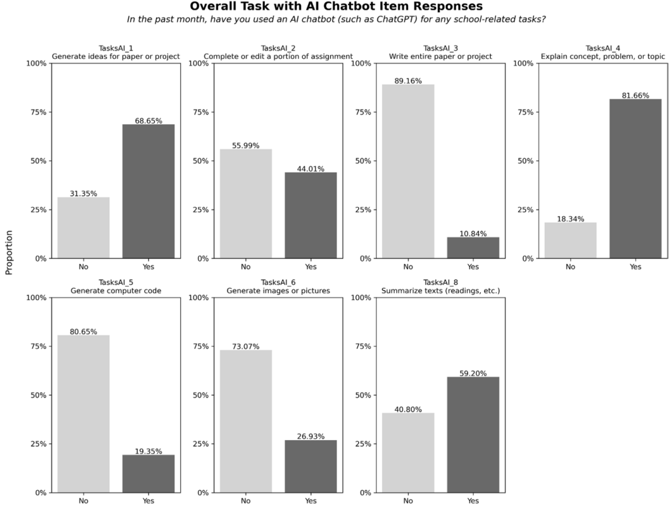
- AI chatbot exposure and use increased: more than 90% of respondents reported knowing about or having used an AI chatbot; common uses were explaining concepts/problems/topics (81.63%), idea generation (68.65%), and text summarization (59.21%).
- Use of AI or digital devices as unauthorized aid (item C41) was reported by 24.27% of students, higher than the prior study’s 6.44% and 15.20% for two schools; using AI to complete all of a paper/project/assignment ranged from 9.16% to 15.50% across school types.
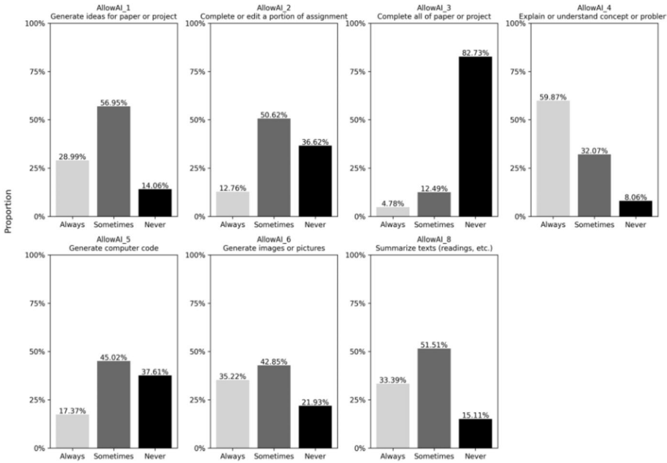
- Students maintained boundaries: 59.87% said AI should “always” be allowed for conceptual understanding/explanations, while 82.73% said it should “never” be allowed for completing entire assignments or writing all papers.
Methods
- The study used the same survey instruments as Lee et al. (2024), administered February–May 2024, taking 20–42 minutes with 150 items; the sample included 4,354 high school students from six schools (two public, two private, two charter) across four U.S. states, with an 82.71% response rate.
- Cheating and chatbot-use items were recoded to binary “No/Yes”; allowability items treated “I am not sure” as non-responses, excluding less than 10% for items A1–A4 and A8 and less than 16% for A5 and A6.
- Reliability tests yielded Cronbach’s alpha of 0.878 for cheating, 0.645 for AI chatbot use, and 0.821 for AI allowability; analysis used descriptive comparisons with prior work and qualitative coding of open-ended responses (N = 83 for allowability, N = 131 for usage), with no inferential tests because the surveys used different sets of schools and students.
Limitations
- The paper states that different samples across years preclude valid longitudinal or quasi-longitudinal inferential tests, so cross-year comparisons are descriptive rather than inferential.
- The paper states that self-reported survey data may introduce bias, especially underreporting due to the negative connotations of academic dishonesty, meaning actual cheating may be higher than reported.
- The paper states that the six-school sample, though more diverse than the prior study, limits generalizability to the broader U.S. high school population, and that the 2024 data capture only a specific moment in rapidly evolving AI development; the text also makes evident that the cross-sectional design cannot establish causal effects of AI on cheating.
Model-written summary. Check it against the paper before relying on it.
Integrity signals
Registry
Cites
Statistics
Figures
Verification
Claims the paper makes
38 Own result · 36 Sources not found · 20 Own interpretation · 15 Own method · 9 Not checked yet · 7 No full text of the sources · 5 Check pending · 1 No basis given
A result the paper reports from its own data — it cites no other source for it, so there is none to check. The quote shows it is in the paper.
In the paper
“Additionally, more students reported using AI chatbots for support tasks like concept explanation and idea generation.”
§ Cheating in the second year of generative AI chatbots: a follow-up study on high school student cheating behaviors > Abstract
plainn = 4,354- Asserted: passes — The authors put it forward as true.
- Checkable: passes — It can be checked against evidence.
- Load-bearing: passes — The paper’s conclusions depend on it.
- Based: passes — The paper gives a reason why it holds.
A result the paper reports from its own data — it cites no other source for it, so there is none to check. The quote shows it is in the paper.
In the paper
“they still strongly supported using AI for conceptual understanding and brainstorming”
§ Cheating in the second year of generative AI chatbots: a follow-up study on high school student cheating behaviors > Abstract
boostedn = 4,354- Asserted: passes — The authors put it forward as true.
- Checkable: passes — It can be checked against evidence.
- Load-bearing: passes — The paper’s conclusions depend on it.
- Based: passes — The paper gives a reason why it holds.
A result the paper reports from its own data — it cites no other source for it, so there is none to check. The quote shows it is in the paper.
In the paper
“they maintained clear boundaries against using it for completing entire assignments.”
§ Cheating in the second year of generative AI chatbots: a follow-up study on high school student cheating behaviors > Abstract
boostedn = 4,354- Asserted: passes — The authors put it forward as true.
- Checkable: passes — It can be checked against evidence.
- Load-bearing: passes — The paper’s conclusions depend on it.
- Based: passes — The paper gives a reason why it holds.
A result the paper reports from its own data — it cites no other source for it, so there is none to check. The quote shows it is in the paper.
In the paper
“Our findings revealed that overall cheating rates remain stable at 72.06%, consistent with historical baselines and prior studies, suggesting that AI availability has not changed overall cheating prevalence in high school.”
§ Cheating in the second year of generative AI chatbots: a follow-up study on high school student cheating behaviors > Abstract
plainn = 4,354- Asserted: passes — The authors put it forward as true.
- Checkable: passes — It can be checked against evidence.
- Load-bearing: passes — The paper’s conclusions depend on it.
- Based: passes — The paper gives a reason why it holds.
A result the paper reports from its own data — it cites no other source for it, so there is none to check. The quote shows it is in the paper.
In the paper
“Overall, at the time of the survey for the 2023-2024 academic year, more than 90% of respondents reported either knowing about or having used an AI chatbot.”
§ Cheating in the second year of generative AI chatbots: a follow-up study on high school student cheating behaviors > Students' AI chatbot exposure
plain- Asserted: passes — The authors put it forward as true.
- Checkable: passes — It can be checked against evidence.
- Load-bearing: unclear — It is unclear whether the paper’s conclusions depend on it.
- Based: passes — The paper gives a reason why it holds.
- Rests on an assumption: Students' self-reported cheating and AI use behaviors are accurate.
A result the paper reports from its own data — it cites no other source for it, so there is none to check. The quote shows it is in the paper.
In the paper
“For other AI uses, except for using AI for full assignment completion, they demonstrated moderate support through”
§ Cheating in the second year of generative AI chatbots: a follow-up study on high school student cheating behaviors > Students' perceptions of AI chatbot allowability for academic tasks
boosted- Asserted: passes — The authors put it forward as true.
- Checkable: passes — It can be checked against evidence.
- Load-bearing: unclear — It is unclear whether the paper’s conclusions depend on it.
- Based: passes — The paper gives a reason why it holds.
- Rests on an assumption: Students' self-reported cheating and AI use behaviors are accurate.
A result the paper reports from its own data — it cites no other source for it, so there is none to check. The quote shows it is in the paper.
In the paper
“Meanwhile, based on students' responses, we observe that some teachers have introduced the technology by making it a mandatory component of in-class assignments or projects.”
§ Cheating in the second year of generative AI chatbots: a follow-up study on high school student cheating behaviors > Increase in students' AI chatbot exposure and usage on academic tasks
plain- Asserted: passes — The authors put it forward as true.
- Checkable: passes — It can be checked against evidence.
- Load-bearing: unclear — It is unclear whether the paper’s conclusions depend on it.
- Based: passes — The paper gives a reason why it holds.
- Rests on an assumption: Students' self-reported cheating and AI use behaviors are accurate.
A result the paper reports from its own data — it cites no other source for it, so there is none to check. The quote shows it is in the paper.
In the paper
“Across the six schools surveyed in the 2023-24 academic year, 72.06% of students reported engaging in at least one academically dishonest behavior in the prior month.”
§ Cheating in the second year of generative AI chatbots: a follow-up study on high school student cheating behaviors > Students' cheating patterns remain consistent in comparison to historical baselines and prior study
plain- Asserted: passes — The authors put it forward as true.
- Checkable: passes — It can be checked against evidence.
- Load-bearing: passes — The paper’s conclusions depend on it.
- Based: passes — The paper gives a reason why it holds.
- Rests on an assumption: Students' self-reported cheating and AI use behaviors are accurate.
A result the paper reports from its own data — it cites no other source for it, so there is none to check. The quote shows it is in the paper.
In the paper
“Notably, all school types strongly opposed allowing AI for complete assignments (A3), with”
§ Cheating in the second year of generative AI chatbots: a follow-up study on high school student cheating behaviors > Students' perceptions of AI chatbot allowability for academic tasks
boosted- Asserted: passes — The authors put it forward as true.
- Checkable: passes — It can be checked against evidence.
- Load-bearing: unclear — It is unclear whether the paper’s conclusions depend on it.
- Based: passes — The paper gives a reason why it holds.
- Rests on an assumption: Students' self-reported cheating and AI use behaviors are accurate.
A result the paper reports from its own data — it cites no other source for it, so there is none to check. The quote shows it is in the paper.
In the paper
“For partial assignment completion (A2), the majority across all schools preferred”
§ Cheating in the second year of generative AI chatbots: a follow-up study on high school student cheating behaviors > Students' perceptions of AI chatbot allowability for academic tasks
plain- Asserted: passes — The authors put it forward as true.
- Checkable: passes — It can be checked against evidence.
- Load-bearing: unclear — It is unclear whether the paper’s conclusions depend on it.
- Based: passes — The paper gives a reason why it holds.
- Rests on an assumption: Students' self-reported cheating and AI use behaviors are accurate.
- Probably not a substantial claim. 39
- It may state two separate claims as one. 50
- The quote only partly states this claim. 3
A result the paper reports from its own data — it cites no other source for it, so there is none to check. The quote shows it is in the paper.
In the paper
“Students also reported AI chatbots being really helpful in explaining mathematical concepts (e.g.,”
§ Cheating in the second year of generative AI chatbots: a follow-up study on high school student cheating behaviors > Students' other AI chatbot usage
plain- Asserted: passes — The authors put it forward as true.
- Checkable: passes — It can be checked against evidence.
- Load-bearing: fails — The paper’s conclusions may not depend on it.
- Based: passes — The paper gives a reason why it holds.
Probably not a substantial claim. The paper’s conclusions may not depend on it.
- Rests on an assumption: Students' self-reported cheating and AI use behaviors are accurate.
A result the paper reports from its own data — it cites no other source for it, so there is none to check. The quote shows it is in the paper.
In the paper
“The most common use of AI chatbots is to explain concepts, problems, or topics (81.63%), followed by idea generation (68.65%) and text summarization (59.21%) (see Fig. 2).”
§ Cheating in the second year of generative AI chatbots: a follow-up study on high school student cheating behaviors > Students' reported AI chatbot usage on specific academic tasks
plain- Asserted: passes — The authors put it forward as true.
- Checkable: passes — It can be checked against evidence.
- Load-bearing: unclear — It is unclear whether the paper’s conclusions depend on it.
- Based: passes — The paper gives a reason why it holds.
It may state two separate claims as one. The quote only partly states this claim.
- Rests on an assumption: Students' self-reported cheating and AI use behaviors are accurate.
A result the paper reports from its own data — it cites no other source for it, so there is none to check. The quote shows it is in the paper.
In the paper
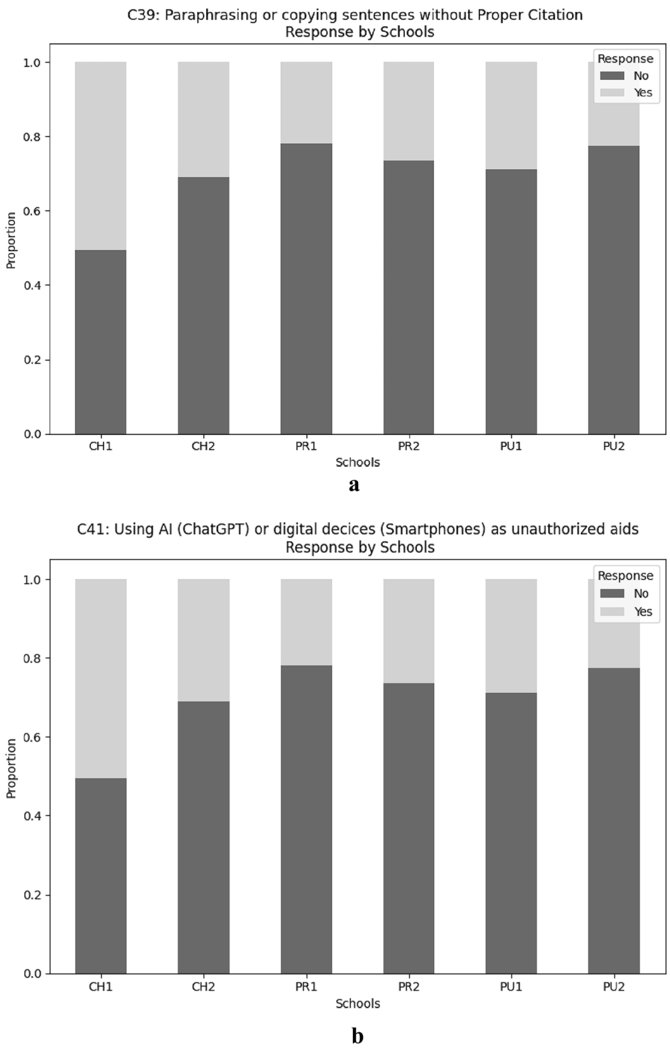
“When examining individual school types, the dishonesty rates were highest in charter schools (78.99%), followed by public schools (74.69%), while private schools showed a notably lower rate (61.22%) (See Table 5 for full results).”
§ Cheating in the second year of generative AI chatbots: a follow-up study on high school student cheating behaviors > Students' cheating patterns remain consistent in comparison to historical baselines and prior study
plainstates an association- Asserted: passes — The authors put it forward as true.
- Checkable: passes — It can be checked against evidence.
- Load-bearing: unclear — It is unclear whether the paper’s conclusions depend on it.
- Based: passes — The paper gives a reason why it holds.
It may state two separate claims as one.
- Rests on an assumption: Students' self-reported cheating and AI use behaviors are accurate.
A result the paper reports from its own data — it cites no other source for it, so there is none to check. The quote shows it is in the paper.
In the paper
“When examining rates across school types (see Table 6), for item C39, charter schools reported the highest rate (40.88%), whereas private and public schools reported lower rates (24.07%and 26.67%, respectively).”
§ Cheating in the second year of generative AI chatbots: a follow-up study on high school student cheating behaviors > Students' cheating patterns remain consistent in comparison to historical baselines and prior study
plainstates an association- Asserted: passes — The authors put it forward as true.
- Checkable: passes — It can be checked against evidence.
- Load-bearing: unclear — It is unclear whether the paper’s conclusions depend on it.
- Based: passes — The paper gives a reason why it holds.
It may state two separate claims as one.
- Rests on an assumption: Students' self-reported cheating and AI use behaviors are accurate.
A result the paper reports from its own data — it cites no other source for it, so there is none to check. The quote shows it is in the paper.
In the paper
“I have used one | 51.13 | 70.02 | 44.00”
§ Cheating in the second year of generative AI chatbots: a follow-up study on high school student cheating behaviors > Which category best describes you?
plainn = 1,693- Asserted: passes — The authors put it forward as true.
- Checkable: passes — It can be checked against evidence.
- Load-bearing: unclear — It is unclear whether the paper’s conclusions depend on it.
- Based: passes — The paper gives a reason why it holds.
It may state two separate claims as one.
A result the paper reports from its own data — it cites no other source for it, so there is none to check. The quote shows it is in the paper.
In the paper
“The private schools in our sample reported the highest rate (27.12%), whereas the charter and public schools reported lower rates of 25.28% and 22.24%, respectively.”
§ Cheating in the second year of generative AI chatbots: a follow-up study on high school student cheating behaviors > Students' cheating patterns remain consistent in comparison to historical baselines and prior study
plainstates an association- Asserted: passes — The authors put it forward as true.
- Checkable: passes — It can be checked against evidence.
- Load-bearing: unclear — It is unclear whether the paper’s conclusions depend on it.
- Based: passes — The paper gives a reason why it holds.
It may state two separate claims as one.
- Rests on an assumption: Students' self-reported cheating and AI use behaviors are accurate.
A result the paper reports from its own data — it cites no other source for it, so there is none to check. The quote shows it is in the paper.
In the paper
“The qualitative responses from the students add to our findings on the items and offer additional insights into AI's integration in educational settings.”
§ Cheating in the second year of generative AI chatbots: a follow-up study on high school student cheating behaviors > Increase in students' AI chatbot exposure and usage on academic tasks
plain- Asserted: passes — The authors put it forward as true.
- Checkable: fails — It may be too vague to check against evidence.
- Load-bearing: fails — The paper’s conclusions may not depend on it.
- Based: passes — The paper gives a reason why it holds.
Probably not a substantial claim. It may be too vague to check against evidence. The paper’s conclusions may not depend on it. It may state two separate claims as one.
- Rests on an assumption: Students' self-reported cheating and AI use behaviors are accurate.
The paper states this without a source or data behind it here, so there is nothing to check it against. The quote shows it is in the paper.
In the paper
“Evidence of teachers incorporating AI literacy into their curricula”
§ Cheating in the second year of generative AI chatbots: a follow-up study on high school student cheating behaviors > Conclusion
plain- Asserted: passes — The authors put it forward as true.
- Checkable: passes — It can be checked against evidence.
- Load-bearing: fails — The paper’s conclusions may not depend on it.
- Based: fails — The paper may give no reason why it holds.
Probably not a substantial claim. The paper’s conclusions may not depend on it. The paper may give no reason why it holds.
A result the paper reports from its own data — it cites no other source for it, so there is none to check. The quote shows it is in the paper.
In the paper
“public school students showed their highest AI chatbot engagement in idea generation (65.86%), text summarization (55.99%), and concept explanation (80.57%).”
§ Cheating in the second year of generative AI chatbots: a follow-up study on high school student cheating behaviors > Students' reported AI chatbot usage on specific academic tasks
plain- Asserted: passes — The authors put it forward as true.
- Checkable: passes — It can be checked against evidence.
- Load-bearing: unclear — It is unclear whether the paper’s conclusions depend on it.
- Based: passes — The paper gives a reason why it holds.
It may state two separate claims as one.
- Rests on an assumption: Students' self-reported cheating and AI use behaviors are accurate.
A result the paper reports from its own data — it cites no other source for it, so there is none to check. The quote shows it is in the paper.
In the paper
“When examining usage patterns across school types (see Table 7), charter school students had the highest rates of AI chatbot use for idea generation (69.08%), text summarization (60.10%), and image generation (44.50%).”
§ Cheating in the second year of generative AI chatbots: a follow-up study on high school student cheating behaviors > Students' reported AI chatbot usage on specific academic tasks
plainstates an association- Asserted: passes — The authors put it forward as true.
- Checkable: passes — It can be checked against evidence.
- Load-bearing: unclear — It is unclear whether the paper’s conclusions depend on it.
- Based: passes — The paper gives a reason why it holds.
It may state two separate claims as one.
- Rests on an assumption: Students' self-reported cheating and AI use behaviors are accurate.
A result the paper reports from its own data — it cites no other source for it, so there is none to check. The quote shows it is in the paper.
In the paper
“We have identified that the specified use of the AI chatbot aligns with their responses to the items, with”
§ Cheating in the second year of generative AI chatbots: a follow-up study on high school student cheating behaviors > Increase in students' AI chatbot exposure and usage on academic tasks
plainstates an association- Asserted: passes — The authors put it forward as true.
- Checkable: passes — It can be checked against evidence.
- Load-bearing: fails — The paper’s conclusions may not depend on it.
- Based: passes — The paper gives a reason why it holds.
Probably not a substantial claim. The paper’s conclusions may not depend on it.
- Rests on an assumption: Students' self-reported cheating and AI use behaviors are accurate.
A result the paper reports from its own data — it cites no other source for it, so there is none to check. The quote shows it is in the paper.
In the paper
“Private school students demonstrated higher rates of AI use for idea generation (71.63%) and concept explanation (85.20%)”
§ Cheating in the second year of generative AI chatbots: a follow-up study on high school student cheating behaviors > Students' reported AI chatbot usage on specific academic tasks
boostedstates an association- Asserted: passes — The authors put it forward as true.
- Checkable: passes — It can be checked against evidence.
- Load-bearing: unclear — It is unclear whether the paper’s conclusions depend on it.
- Based: passes — The paper gives a reason why it holds.
It may state two separate claims as one.
- Rests on an assumption: Students' self-reported cheating and AI use behaviors are accurate.
A result the paper reports from its own data — it cites no other source for it, so there is none to check. The quote shows it is in the paper.
In the paper
“Other students mentioned using AI chatbots for entertainment purposes (e.g.,”
§ Cheating in the second year of generative AI chatbots: a follow-up study on high school student cheating behaviors > Students' other AI chatbot usage
plain- Asserted: passes — The authors put it forward as true.
- Checkable: passes — It can be checked against evidence.
- Load-bearing: fails — The paper’s conclusions may not depend on it.
- Based: passes — The paper gives a reason why it holds.
Probably not a substantial claim. The paper’s conclusions may not depend on it.
- Rests on an assumption: Students' self-reported cheating and AI use behaviors are accurate.
A result the paper reports from its own data — it cites no other source for it, so there is none to check. The quote shows it is in the paper.
In the paper
“Most specified uses were school-related, but we also found students reporting potential misuse of AI chatbots for academically dishonest behavior.”
§ Cheating in the second year of generative AI chatbots: a follow-up study on high school student cheating behaviors > Students' other AI chatbot usage
hedged- Asserted: passes — The authors put it forward as true.
- Checkable: passes — It can be checked against evidence.
- Load-bearing: passes — The paper’s conclusions depend on it.
- Based: passes — The paper gives a reason why it holds.
It may state two separate claims as one. The quote only partly states this claim.
- Rests on an assumption: Students' self-reported cheating and AI use behaviors are accurate.
A result the paper reports from its own data — it cites no other source for it, so there is none to check. The quote shows it is in the paper.
In the paper
“Regarding students' perceptions of the”
§ Cheating in the second year of generative AI chatbots: a follow-up study on high school student cheating behaviors > Students remained opposed to AI use for completing entire assignments
plain- Asserted: passes — The authors put it forward as true.
- Checkable: passes — It can be checked against evidence.
- Load-bearing: passes — The paper’s conclusions depend on it.
- Based: passes — The paper gives a reason why it holds.
It may state two separate claims as one. The quote only partly states this claim.
- Rests on an assumption: Students' self-reported cheating and AI use behaviors are accurate.
A result the paper reports from its own data — it cites no other source for it, so there is none to check. The quote shows it is in the paper.
In the paper
“For idea generation (56.95%) and text summarization (51.51%), more than half of the students believed AI chatbots should”
§ Cheating in the second year of generative AI chatbots: a follow-up study on high school student cheating behaviors > Students' perceptions of AI chatbot allowability for academic tasks
plain- Asserted: passes — The authors put it forward as true.
- Checkable: passes — It can be checked against evidence.
- Load-bearing: unclear — It is unclear whether the paper’s conclusions depend on it.
- Based: passes — The paper gives a reason why it holds.
It may state two separate claims as one.
- Rests on an assumption: Students' self-reported cheating and AI use behaviors are accurate.
A result the paper reports from its own data — it cites no other source for it, so there is none to check. The quote shows it is in the paper.
In the paper
“More than half of the students believed AI chatbots should be allowed to support conceptual understanding and explanations, with 59.87% saying it should”
§ Cheating in the second year of generative AI chatbots: a follow-up study on high school student cheating behaviors > Students' perceptions of AI chatbot allowability for academic tasks
plain- Asserted: passes — The authors put it forward as true.
- Checkable: passes — It can be checked against evidence.
- Load-bearing: unclear — It is unclear whether the paper’s conclusions depend on it.
- Based: passes — The paper gives a reason why it holds.
It may state two separate claims as one.
- Rests on an assumption: Students' self-reported cheating and AI use behaviors are accurate.
A claim is checked only against the cited paper’s full text, never its abstract, and none is available for its sources.
In the paper
“Similarly, the technology acceptance model (TAM) emphasizes increased recognition of the utility of a new technology, leading to increased use (Davis, 1989(Davis, , 1993)).”
§ Cheating in the second year of generative AI chatbots: a follow-up study on high school student cheating behaviors > Introduction
What the sources say
plainstates a cause- Asserted: passes — The authors put it forward as true.
- Checkable: passes — It can be checked against evidence.
- Load-bearing: passes — The paper’s conclusions depend on it.
- Based: passes — The paper gives a reason why it holds.
Probably not a substantial claim.
In the paper
“The vast majority of users would begin using it later.”
§ Cheating in the second year of generative AI chatbots: a follow-up study on high school student cheating behaviors > Introduction
What the sources say
- Not matchedcites Rogers, 1962
Couldn’t be matched to a paper in Crossref, so it can’t be checked.
hedged- Asserted: passes — The authors put it forward as true.
- Checkable: passes — It can be checked against evidence.
- Load-bearing: passes — The paper’s conclusions depend on it.
- Based: passes — The paper gives a reason why it holds.
Probably not a substantial claim.
- Not matched
A check of a cited source is scheduled, or we don’t hold its full text yet; the claim is checked once it runs.
In the paper
“Recent research with over 1,400 teachers reveals that educators express varying concerns, such as misinformation and reduced social interaction, about using AI chatbots in their daily tasks at school (Chen et al., 2025).”
§ Cheating in the second year of generative AI chatbots: a follow-up study on high school student cheating behaviors > Recent advancements in generative AI
What the sources say
- Not checked yetcites Chen et al., 2025 source
A check is scheduled.
plain- Asserted: passes — The authors put it forward as true.
- Checkable: passes — It can be checked against evidence.
- Load-bearing: fails — The paper’s conclusions may not depend on it.
- Based: passes — The paper gives a reason why it holds.
Probably not a substantial claim. The paper’s conclusions may not depend on it.
- Not checked yet
In the paper
“Among the three different types of schools included in their sample -private, public, and charter -the overall cheating rates remained comparable from 2019 to 2023 following ChatGPT's introduction, as approximately 60-70% of students reported engaging in at least one form of academic dishonesty in the month both before and after ChatGPT was released.”
§ Cheating in the second year of generative AI chatbots: a follow-up study on high school student cheating behaviors > Introduction
What the sources say
- Not matchedcites Lee et al. (2024)
Couldn’t be matched to a paper in Crossref, so it can’t be checked.
plain- Asserted: passes — The authors put it forward as true.
- Checkable: passes — It can be checked against evidence.
- Load-bearing: passes — The paper’s conclusions depend on it.
- Based: passes — The paper gives a reason why it holds.
It may state two separate claims as one.
- Not matched
In the paper
“While these limitations exist, research shows that self-report surveys remain reliable instruments when used consistently over time, as they can effectively detect changes in behavior patterns even if absolute numbers are not perfectly accurate (Samuelstuen & Bråten, 2007).”
§ Cheating in the second year of generative AI chatbots: a follow-up study on high school student cheating behaviors > Academic integrity and "cheating"
What the sources say
- Not checked — no full text of the sourcecites Samuelstuen & Bråten, 2007 source
plainstates an association- Asserted: passes — The authors put it forward as true.
- Checkable: passes — It can be checked against evidence.
- Load-bearing: passes — The paper’s conclusions depend on it.
- Based: passes — The paper gives a reason why it holds.
It may state two separate claims as one.
A conclusion the paper draws from its own results — it cites no other source for it, so there is none to check. The quote shows it is in the paper.
In the paper
“While our sample exhibits heterogeneity across race, gender, geography, and school type, we acknowledge that it may not fully represent all school populations nationwide (U.S.) or in other nations and urge readers to consider that as they make their own generalizations.”
§ Cheating in the second year of generative AI chatbots: a follow-up study on high school student cheating behaviors > Data
hedged- Asserted: passes — The authors put it forward as true.
- Checkable: passes — It can be checked against evidence.
- Load-bearing: fails — The paper’s conclusions may not depend on it.
- Based: passes — The paper gives a reason why it holds.
Probably not a substantial claim. The paper’s conclusions may not depend on it. It may state two separate claims as one.
In the paper
“From the students' perspective, while they have recognized AI as a revolutionary technology that can assist their learning, they expressed concerns regarding the ethical considerations associated with its use (Farhi et al., 2023).”
§ Cheating in the second year of generative AI chatbots: a follow-up study on high school student cheating behaviors > Recent advancements in generative AI
What the sources say
- Not matchedcites Farhi et al., 2023
Couldn’t be matched to a paper in Crossref, so it can’t be checked.
plain- Asserted: passes — The authors put it forward as true.
- Checkable: passes — It can be checked against evidence.
- Load-bearing: fails — The paper’s conclusions may not depend on it.
- Based: passes — The paper gives a reason why it holds.
Probably not a substantial claim. The paper’s conclusions may not depend on it. It may state two separate claims as one.
- Not matched
In the paper
“many institutions recognize that teaching students how to effectively and ethically utilize AI tools has become as crucial as traditional digital literacy (Walter, 2024).”
§ Cheating in the second year of generative AI chatbots: a follow-up study on high school student cheating behaviors > Recent advancements in generative AI
What the sources say
- Not checked yetcites Walter, 2024 source
plain- Asserted: passes — The authors put it forward as true.
- Checkable: passes — It can be checked against evidence.
- Load-bearing: fails — The paper’s conclusions may not depend on it.
- Based: passes — The paper gives a reason why it holds.
Probably not a substantial claim. The paper’s conclusions may not depend on it.
In the paper
“Their results revealed that while teachers, K-12 students, and parents view AI chatbots as legitimate educational support tools, undergraduate college students indicated a tendency to use them for cheating purposes (Walton Family Foundation, 2024).”
§ Cheating in the second year of generative AI chatbots: a follow-up study on high school student cheating behaviors > Academic integrity and "cheating"
What the sources say
- Not matchedcites Walton Family Foundation, 2024
Couldn’t be matched to a paper in Crossref, so it can’t be checked.
hedged- Asserted: passes — The authors put it forward as true.
- Checkable: passes — It can be checked against evidence.
- Load-bearing: fails — The paper’s conclusions may not depend on it.
- Based: passes — The paper gives a reason why it holds.
Probably not a substantial claim. The paper’s conclusions may not depend on it. It may state two separate claims as one.
- Not matched
In the paper
“Institutions have started to develop AI literacy curricula instructing students on the rationale behind AI algorithms and appropriate AI use in learning environments (Almatrafi et al., 2024;Xie et al., 2024;Zhang, 2024).”
§ Cheating in the second year of generative AI chatbots: a follow-up study on high school student cheating behaviors > Recent advancements in generative AI
What the sources say
plain- Asserted: passes — The authors put it forward as true.
- Checkable: passes — It can be checked against evidence.
- Load-bearing: fails — The paper’s conclusions may not depend on it.
- Based: passes — The paper gives a reason why it holds.
Probably not a substantial claim. The paper’s conclusions may not depend on it.
None of the sources cited for this claim have been checked yet.
In the paper
“AI chatbots powered by large language models (LLMs) demonstrate increasingly powerful capabilities in natural language understanding, reasoning, and generation (Naveed et al., 2023;Hadi et al., 2024).”
§ Cheating in the second year of generative AI chatbots: a follow-up study on high school student cheating behaviors > Recent advancements in generative AI
What the sources say
- Not matchedcites Naveed et al., 2023
Couldn’t be matched to a paper in Crossref, so it can’t be checked.
- Not checked — no full text of the sourcecites Hadi et al., 2024 source
boosted- Asserted: passes — The authors put it forward as true.
- Checkable: passes — It can be checked against evidence.
- Load-bearing: fails — The paper’s conclusions may not depend on it.
- Based: passes — The paper gives a reason why it holds.
Probably not a substantial claim. The paper’s conclusions may not depend on it.
- Not matched
In the paper
“As early adopters shared experiences through social media, and companies increased marketing efforts, more students were exposed to AI-related content, trends, and resources, enabling more positive evaluations of AI and a deeper understanding of its capabilities (Li & Zheng, 2024).”
§ Cheating in the second year of generative AI chatbots: a follow-up study on high school student cheating behaviors > Generative AI adoption
What the sources say
- Check pendingcites Li & Zheng, 2024 source
plainstates a cause- Asserted: passes — The authors put it forward as true.
- Checkable: passes — It can be checked against evidence.
- Load-bearing: unclear — It is unclear whether the paper’s conclusions depend on it.
- Based: passes — The paper gives a reason why it holds.
It may state two separate claims as one.
None of the sources cited for this claim have been checked yet.
In the paper
“In particular, we follow McCabe's (2001) approach of asking about specific behaviors rather than asking students to identify themselves as 'cheaters' or as having 'violated the honor code,' as research shows this behavioral approach yields more responses (Curtis, 2022;Rettinger & Gallant, 2022).”
§ Cheating in the second year of generative AI chatbots: a follow-up study on high school student cheating behaviors > Data collection/survey
What the sources say
- Not checked — no full text of the sourcecites McCabe, 2001 source
- Not matchedcites Curtis, 2022
Couldn’t be matched to a paper in Crossref, so it can’t be checked.
- Not matchedcites Rettinger & Gallant, 2022
Couldn’t be matched to a paper in Crossref, so it can’t be checked.
plainstates a cause- Asserted: passes — The authors put it forward as true.
- Checkable: passes — It can be checked against evidence.
- Load-bearing: passes — The paper’s conclusions depend on it.
- Based: passes — The paper gives a reason why it holds.
It may state two separate claims as one.
In the paper
“According to the Josephson Institute's, 2012 study of over 23,000 high school students in the U.S., 52% of respondents reported cheating on an exam in the previous year, and 75% admitted to copying someone else's homework (Josephson Institute, 2012).”
§ Cheating in the second year of generative AI chatbots: a follow-up study on high school student cheating behaviors > Academic integrity and "cheating"
What the sources say
- Not matchedcites Josephson Institute, 2012
Couldn’t be matched to a paper in Crossref, so it can’t be checked.
plain- Asserted: passes — The authors put it forward as true.
- Checkable: passes — It can be checked against evidence.
- Load-bearing: fails — The paper’s conclusions may not depend on it.
- Based: passes — The paper gives a reason why it holds.
Probably not a substantial claim. The paper’s conclusions may not depend on it. It may state two separate claims as one.
- Not matched
What the paper did — it cites no source for this, so there is none to check. The quote shows it is in the paper.
In the paper
“Then, students are typically informed that their responses are anonymous and will not be linked to them individually.Moreover, they are informed that their responses to closed-response survey questions would not be accessible to any school personnel, and the survey administrators do not collect students' names in any of the items.”
§ Cheating in the second year of generative AI chatbots: a follow-up study on high school student cheating behaviors > Data collection/survey
hedged- Asserted: passes — The authors put it forward as true.
- Checkable: passes — It can be checked against evidence.
- Load-bearing: fails — The paper’s conclusions may not depend on it.
- Based: passes — The paper gives a reason why it holds.
Probably not a substantial claim. The paper’s conclusions may not depend on it. It may state two separate claims as one.
What the paper did — it cites no source for this, so there is none to check. The quote shows it is in the paper.
In the paper
“To further encourage honest responses to these items, the survey provided multiple notices to students and their caregivers that their responses are de-identified and confidential.”
§ Cheating in the second year of generative AI chatbots: a follow-up study on high school student cheating behaviors > Data collection/survey
plain- Asserted: passes — The authors put it forward as true.
- Checkable: passes — It can be checked against evidence.
- Load-bearing: fails — The paper’s conclusions may not depend on it.
- Based: passes — The paper gives a reason why it holds.
Probably not a substantial claim. The paper’s conclusions may not depend on it.
What the paper did — it cites no source for this, so there is none to check. The quote shows it is in the paper.
In the paper
“Compared to prior research examining similar issues, our study benefits from a larger school sample and a later sampling time, allowing students more time to experience and adapt to new AI technologies during the 2023-2024 school year.”
§ Cheating in the second year of generative AI chatbots: a follow-up study on high school student cheating behaviors > Data
plainstates a cause- Asserted: passes — The authors put it forward as true.
- Checkable: passes — It can be checked against evidence.
- Load-bearing: passes — The paper’s conclusions depend on it.
- Based: passes — The paper gives a reason why it holds.
It may state two separate claims as one.
In the paper
“Despite these concerns, scholars have shown that when properly implemented, AI tools can enhance student engagement (Ezeanya et al., 2024), support students' writing (Mohamed et al., 2024), and provide personalized feedback (Xu et al., 2021).”
§ Cheating in the second year of generative AI chatbots: a follow-up study on high school student cheating behaviors > Recent advancements in generative AI
What the sources say
plainstates a cause- Asserted: passes — The authors put it forward as true.
- Checkable: passes — It can be checked against evidence.
- Load-bearing: fails — The paper’s conclusions may not depend on it.
- Based: passes — The paper gives a reason why it holds.
Probably not a substantial claim. The paper’s conclusions may not depend on it. It may state two separate claims as one.
In the paper
“When ChatGPT was first released in late 2022, many school districts reacted negatively to the tool, implementing bans (Elsen-Rooney, 2023).”
§ Cheating in the second year of generative AI chatbots: a follow-up study on high school student cheating behaviors > Generative AI adoption
What the sources say
- Not matchedcites Elsen-Rooney, 2023
Couldn’t be matched to a paper in Crossref, so it can’t be checked.
plainstates a cause- Asserted: passes — The authors put it forward as true.
- Checkable: passes — It can be checked against evidence.
- Load-bearing: fails — The paper’s conclusions may not depend on it.
- Based: passes — The paper gives a reason why it holds.
Probably not a substantial claim. The paper’s conclusions may not depend on it. It may state two separate claims as one.
- Not matched
In the paper
“In a study by Wangaard and Stephens (2011), 95% of 3,600 students from six economically and racially diverse high schools in the Northeastern United States acknowledged engaging in academic dishonesty during the previous academic year.”
§ Cheating in the second year of generative AI chatbots: a follow-up study on high school student cheating behaviors > Academic integrity and "cheating"
What the sources say
- Not matchedcites Wangaard and Stephens (2011)
Couldn’t be matched to a paper in Crossref, so it can’t be checked.
plain- Asserted: passes — The authors put it forward as true.
- Checkable: passes — It can be checked against evidence.
- Load-bearing: fails — The paper’s conclusions may not depend on it.
- Based: passes — The paper gives a reason why it holds.
Probably not a substantial claim. The paper’s conclusions may not depend on it.
- Not matched
In the paper
“We adopted the same student survey instrument with minor modifications to incorporate questions that emerged from previous students' short responses.”
§ Cheating in the second year of generative AI chatbots: a follow-up study on high school student cheating behaviors > Academic integrity and "cheating"
What the sources say
- Not matchedcites Lee et al. (2024)
Couldn’t be matched to a paper in Crossref, so it can’t be checked.
plain- Asserted: passes — The authors put it forward as true.
- Checkable: passes — It can be checked against evidence.
- Load-bearing: passes — The paper’s conclusions depend on it.
- Based: passes — The paper gives a reason why it holds.
Probably not a substantial claim.
- Rests on an assumption: Minor modifications to the survey instrument did not compromise comparability with Lee et al. (2024).
- Not matched
None of the sources cited for this claim could be matched to a paper in Crossref, so there is nothing to check it against.
In the paper
“These students are the early adopters who are typically more willing to experiment with new tools in a variety of tasks, whereas later adopters rely more heavily on peer visibility, shared norms, and reduced uncertainty before adopting (Sahin, 2006;Thayer, 2013).”
§ Cheating in the second year of generative AI chatbots: a follow-up study on high school student cheating behaviors > Generative AI adoption
What the sources say
- Not matchedcites Sahin, 2006
Couldn’t be matched to a paper in Crossref, so it can’t be checked.
- Not matchedcites Thayer, 2013
Couldn’t be matched to a paper in Crossref, so it can’t be checked.
plainstates an association- Asserted: passes — The authors put it forward as true.
- Checkable: passes — It can be checked against evidence.
- Load-bearing: fails — The paper’s conclusions may not depend on it.
- Based: passes — The paper gives a reason why it holds.
Probably not a substantial claim. The paper’s conclusions may not depend on it. It may state two separate claims as one.
- Not matched
A claim is checked only against the cited paper’s full text, never its abstract, and none is available for its sources.
In the paper
“Research grounded in the technology acceptance model (TAM) further indicates that increased exposure and hands-on experience strengthen perceptions of usefulness and ease of use, thereby increasing adoption in educational contexts (Davis, 1989;Granić & Marangunić, 2019).”
§ Cheating in the second year of generative AI chatbots: a follow-up study on high school student cheating behaviors > Generative AI adoption
What the sources say
hedgedstates a cause- Asserted: passes — The authors put it forward as true.
- Checkable: passes — It can be checked against evidence.
- Load-bearing: unclear — It is unclear whether the paper’s conclusions depend on it.
- Based: passes — The paper gives a reason why it holds.
It may state two separate claims as one.
In the paper
“Specifically, overall cheating rates remained the same as reported rates prior to the release of ChatGPT, although students did report using AI at times for school-related activities.”
§ Cheating in the second year of generative AI chatbots: a follow-up study on high school student cheating behaviors > Introduction
What the sources say
- Not matchedcites Lee et al. (2024)
Couldn’t be matched to a paper in Crossref, so it can’t be checked.
plain- Asserted: passes — The authors put it forward as true.
- Checkable: passes — It can be checked against evidence.
- Load-bearing: passes — The paper’s conclusions depend on it.
- Based: passes — The paper gives a reason why it holds.
It may state two separate claims as one.
- Not matched
What the paper did — it cites no source for this, so there is none to check. The quote shows it is in the paper.
In the paper
“Moreover, these questions are embedded among 150 total questions that cover a range of topics-the survey is not presented as one that is about cheating but about a whole host of matters from the student perspective and experience.”
§ Cheating in the second year of generative AI chatbots: a follow-up study on high school student cheating behaviors > Data collection/survey
plain- Asserted: passes — The authors put it forward as true.
- Checkable: passes — It can be checked against evidence.
- Load-bearing: passes — The paper’s conclusions depend on it.
- Based: passes — The paper gives a reason why it holds.
Probably not a substantial claim. It may state two separate claims as one.
What the paper did — it cites no source for this, so there is none to check. The quote shows it is in the paper.
In the paper
“Specifically, the sample included 4,354 high school students (82.71% response rate) with 20.72% being seniors, 35.94% being juniors, 28.30% being sophomores, and 15.04% being freshmen.”
§ Cheating in the second year of generative AI chatbots: a follow-up study on high school student cheating behaviors > Data
plain- Asserted: passes — The authors put it forward as true.
- Checkable: passes — It can be checked against evidence.
- Load-bearing: unclear — It is unclear whether the paper’s conclusions depend on it.
- Based: passes — The paper gives a reason why it holds.
It may state two separate claims as one.
In the paper
“According to Rogers (1962), the adoption of technology follows predictable patterns, beginning with early adopters and progressively expanding to a larger population as visibility rises.”
§ Cheating in the second year of generative AI chatbots: a follow-up study on high school student cheating behaviors > Generative AI adoption
What the sources say
- Not matchedcites Rogers (1962)
Couldn’t be matched to a paper in Crossref, so it can’t be checked.
plainstates a cause- Asserted: passes — The authors put it forward as true.
- Checkable: passes — It can be checked against evidence.
- Load-bearing: fails — The paper’s conclusions may not depend on it.
- Based: passes — The paper gives a reason why it holds.
Probably not a substantial claim. The paper’s conclusions may not depend on it.
- Not matched
In the paper
“However, students from less restrictive contexts began exploring the use of generative AI in educational settings, with more than half finding it acceptable for researching new topics (Sidoti & Gottfried, 2023).”
§ Cheating in the second year of generative AI chatbots: a follow-up study on high school student cheating behaviors > Generative AI adoption
What the sources say
- Not matchedcites Sidoti & Gottfried, 2023
Couldn’t be matched to a paper in Crossref, so it can’t be checked.
plainstates an association- Asserted: passes — The authors put it forward as true.
- Checkable: passes — It can be checked against evidence.
- Load-bearing: unclear — It is unclear whether the paper’s conclusions depend on it.
- Based: passes — The paper gives a reason why it holds.
It may state two separate claims as one.
- Not matched
What the paper did — it cites no source for this, so there is none to check. The quote shows it is in the paper.
In the paper
“As shown in Tables 2, 3, 4, our sample has balanced gender representation and diverse ethnic backgrounds that allows us to capture perspectives from students with varied backgrounds.”
§ Cheating in the second year of generative AI chatbots: a follow-up study on high school student cheating behaviors > Data
plain- Asserted: passes — The authors put it forward as true.
- Checkable: passes — It can be checked against evidence.
- Load-bearing: unclear — It is unclear whether the paper’s conclusions depend on it.
- Based: passes — The paper gives a reason why it holds.
It may state two separate claims as one.
A conclusion the paper draws from its own results — it cites no other source for it, so there is none to check. The quote shows it is in the paper.
In the paper
“This empirical evidence establishes a benchmark for future longitudinal studies that track how students' perceptions and use evolve as AI technology advances.”
§ Cheating in the second year of generative AI chatbots: a follow-up study on high school student cheating behaviors > Lack of AI literacy and guidance on AI use in academic tasks
boosted- Asserted: passes — The authors put it forward as true.
- Checkable: fails — It may be too vague to check against evidence.
- Load-bearing: passes — The paper’s conclusions depend on it.
- Based: passes — The paper gives a reason why it holds.
Probably not a substantial claim. It may be too vague to check against evidence.
What the paper did — it cites no source for this, so there is none to check. The quote shows it is in the paper.
In the paper
“the study's sample includes six schools-two each from private, public, and charter school types-with varied demographics across four states.”
§ Cheating in the second year of generative AI chatbots: a follow-up study on high school student cheating behaviors > Limitations
plain- Asserted: passes — The authors put it forward as true.
- Checkable: passes — It can be checked against evidence.
- Load-bearing: passes — The paper’s conclusions depend on it.
- Based: passes — The paper gives a reason why it holds.
It may state two separate claims as one.
What the paper did — it cites no source for this, so there is none to check. The quote shows it is in the paper.
In the paper
“Specifically, we adopted an inductive approach, extracting themes directly from students' responses.The team reviewed all responses together and discussed to determine themes that appeared consistent and representative across all responses.”
§ Cheating in the second year of generative AI chatbots: a follow-up study on high school student cheating behaviors > Analysis
plainn = 131- Asserted: passes — The authors put it forward as true.
- Checkable: passes — It can be checked against evidence.
- Load-bearing: fails — The paper’s conclusions may not depend on it.
- Based: passes — The paper gives a reason why it holds.
Probably not a substantial claim. The paper’s conclusions may not depend on it. It may state two separate claims as one.
A conclusion the paper draws from its own results — it cites no other source for it, so there is none to check. The quote shows it is in the paper.
In the paper
“These usage patterns also reflect the development of boundaries among students regarding technology use in educational settings.”
§ Cheating in the second year of generative AI chatbots: a follow-up study on high school student cheating behaviors > Lack of AI literacy and guidance on AI use in academic tasks
plainstates an association- Asserted: passes — The authors put it forward as true.
- Checkable: fails — It may be too vague to check against evidence.
- Load-bearing: fails — The paper’s conclusions may not depend on it.
- Based: fails — The paper may give no reason why it holds.
Probably not a substantial claim. It may be too vague to check against evidence. The paper’s conclusions may not depend on it. The paper may give no reason why it holds.
None of the sources cited for this claim have been checked yet.
In the paper
“This reflects the growing attention to teaching students to use AI tools effectively and ethically in modern education (Almatrafi et al., 2024;Walter, 2024).”
§ Cheating in the second year of generative AI chatbots: a follow-up study on high school student cheating behaviors > Increase in students' AI chatbot exposure and usage on academic tasks
What the sources say
plain- Asserted: passes — The authors put it forward as true.
- Checkable: fails — It may be too vague to check against evidence.
- Load-bearing: fails — The paper’s conclusions may not depend on it.
- Based: passes — The paper gives a reason why it holds.
Probably not a substantial claim. It may be too vague to check against evidence. The paper’s conclusions may not depend on it.
In the paper
“With double the schools and more regions included than the 2024 study done by Lee et al. (2024)”
§ Cheating in the second year of generative AI chatbots: a follow-up study on high school student cheating behaviors > Limitations
What the sources say
- Not matchedcites Lee et al. (2024)
Couldn’t be matched to a paper in Crossref, so it can’t be checked.
plain- Asserted: passes — The authors put it forward as true.
- Checkable: passes — It can be checked against evidence.
- Load-bearing: passes — The paper’s conclusions depend on it.
- Based: passes — The paper gives a reason why it holds.
It may state two separate claims as one.
- Not matched
What the paper did — it cites no source for this, so there is none to check. The quote shows it is in the paper.
In the paper
“Total | 5,264 | 4354 | 82.71”
§ Cheating in the second year of generative AI chatbots: a follow-up study on high school student cheating behaviors > Which category best describes you?
plain- Asserted: passes — The authors put it forward as true.
- Checkable: passes — It can be checked against evidence.
- Load-bearing: fails — The paper’s conclusions may not depend on it.
- Based: passes — The paper gives a reason why it holds.
Probably not a substantial claim. The paper’s conclusions may not depend on it. It may state two separate claims as one.
In the paper
“Specifically, the reported usage rates for the Private High School were 39.13%, 5.8%, and 42.65%, and for the Public High School were 50.00%, 31.65%, and 39.29%.”
§ Cheating in the second year of generative AI chatbots: a follow-up study on high school student cheating behaviors > Students' reported AI chatbot usage on specific academic tasks
What the sources say
- Not matchedcites Lee et al. (2024)
Couldn’t be matched to a paper in Crossref, so it can’t be checked.
plain- Asserted: passes — The authors put it forward as true.
- Checkable: passes — It can be checked against evidence.
- Load-bearing: passes — The paper’s conclusions depend on it.
- Based: passes — The paper gives a reason why it holds.
It may state two separate claims as one.
- Not matched
What the paper did — it cites no source for this, so there is none to check. The quote shows it is in the paper.
In the paper
“The results show that the cheating scale is internally consistent, with a Cronbach's alpha of 0.878; the AI chatbot use items have a reliability of 0.645, and the AI allowability items have a reliability of 0.821.These results indicate that our items demonstrated reliability.”
§ Cheating in the second year of generative AI chatbots: a follow-up study on high school student cheating behaviors > Reliability test
boosted- Asserted: passes — The authors put it forward as true.
- Checkable: passes — It can be checked against evidence.
- Load-bearing: passes — The paper’s conclusions depend on it.
- Based: passes — The paper gives a reason why it holds.
It may state two separate claims as one.
A claim is checked only against the cited paper’s full text, never its abstract, and none is available for its sources.
In the paper
“The surveys were administered to different sets of schools across the two research periods, making key assumptions underlying standard inferential tests, such as sample independence and population comparability, difficult to satisfy for tests such as t-tests or chi-square tests (Rao & Bannerman-Thompson, 2014;Sauro & Lewis, 2016).”
§ Cheating in the second year of generative AI chatbots: a follow-up study on high school student cheating behaviors > Analysis
What the sources say
plainstates a cause- Asserted: passes — The authors put it forward as true.
- Checkable: passes — It can be checked against evidence.
- Load-bearing: passes — The paper’s conclusions depend on it.
- Based: passes — The paper gives a reason why it holds.
It may state two separate claims as one.
In the paper
“Prior methodological work emphasizes that descriptive analysis can play a critical role in documenting patterns, contextual variation, and emerging trends when causal or longitudinal inference is not warranted (Loeb et al., 2017).”
§ Cheating in the second year of generative AI chatbots: a follow-up study on high school student cheating behaviors > Analysis
What the sources say
- Not matchedcites Loeb et al., 2017
Couldn’t be matched to a paper in Crossref, so it can’t be checked.
plain- Asserted: passes — The authors put it forward as true.
- Checkable: passes — It can be checked against evidence.
- Load-bearing: passes — The paper’s conclusions depend on it.
- Based: passes — The paper gives a reason why it holds.
Probably not a substantial claim.
- Not matched
What the paper did — it cites no source for this, so there is none to check. The quote shows it is in the paper.
In the paper
“Students may underreport due to the negative connotations associated with academic dishonesty.”
§ Cheating in the second year of generative AI chatbots: a follow-up study on high school student cheating behaviors > Limitations
hedgedstates a possible cause- Asserted: passes — The authors put it forward as true.
- Checkable: passes — It can be checked against evidence.
- Load-bearing: fails — The paper’s conclusions may not depend on it.
- Based: fails — The paper may give no reason why it holds.
Probably not a substantial claim. The paper’s conclusions may not depend on it. The paper may give no reason why it holds.
In the paper
“On the other hand, Pew found (similar to our findings) that the vast majority who had an opinion on the matter (over 80%) considered ChatGPT acceptable for researching new topics.”
§ Cheating in the second year of generative AI chatbots: a follow-up study on high school student cheating behaviors > Students remained opposed to AI use for completing entire assignments
What the sources say
- Not matchedcites Sidoti & Gottfried, 2023
Couldn’t be matched to a paper in Crossref, so it can’t be checked.
plain- Asserted: passes — The authors put it forward as true.
- Checkable: passes — It can be checked against evidence.
- Load-bearing: fails — The paper’s conclusions may not depend on it.
- Based: passes — The paper gives a reason why it holds.
Probably not a substantial claim. The paper’s conclusions may not depend on it.
- Not matched
In the paper
“As Denkin (2024) argues, while new technologies may have altered the methods students use to cheat, the availability of AI tools does not necessarily increase overall cheating rates.”
§ Cheating in the second year of generative AI chatbots: a follow-up study on high school student cheating behaviors > Stability in students' self-reported academically dishonest behaviors
What the sources say
- Not checked yetcites Denkin (2024) source
hedged- Asserted: passes — The authors put it forward as true.
- Checkable: passes — It can be checked against evidence.
- Load-bearing: passes — The paper’s conclusions depend on it.
- Based: passes — The paper gives a reason why it holds.
Probably not a substantial claim. It may state two separate claims as one.
A conclusion the paper draws from its own results — it cites no other source for it, so there is none to check. The quote shows it is in the paper.
In the paper
“Our findings also suggest that cheating rates remain high and comparable to historical records.”
§ Cheating in the second year of generative AI chatbots: a follow-up study on high school student cheating behaviors > Stability in students' self-reported academically dishonest behaviors
hedged- Asserted: passes — The authors put it forward as true.
- Checkable: passes — It can be checked against evidence.
- Load-bearing: passes — The paper’s conclusions depend on it.
- Based: passes — The paper gives a reason why it holds.
It may state two separate claims as one.
In the paper
“While admittedly imperfect, we have followed prior research protocols (McCabe, 2001) to obtain the most accurate research results to inform future researchers and educational technology designers.”
§ Cheating in the second year of generative AI chatbots: a follow-up study on high school student cheating behaviors > Limitations
What the sources say
- Not checked — no full text of the sourcecites McCabe, 2001 source
plain- Asserted: passes — The authors put it forward as true.
- Checkable: passes — It can be checked against evidence.
- Load-bearing: fails — The paper’s conclusions may not depend on it.
- Based: passes — The paper gives a reason why it holds.
Probably not a substantial claim. The paper’s conclusions may not depend on it.
In the paper
“These patterns in using AI for supporting tasks as well as for unauthorized use cases support the need for what Walter (2024) describes as the emergence of AI literacy, in which students need guidance on how to use AI tools as aids for learning rather than shortcuts for coursework.”
§ Cheating in the second year of generative AI chatbots: a follow-up study on high school student cheating behaviors > Increase in students' AI chatbot exposure and usage on academic tasks
What the sources say
- Not checked yetcites Walter (2024) source
plain- Asserted: passes — The authors put it forward as true.
- Checkable: fails — It may be too vague to check against evidence.
- Load-bearing: passes — The paper’s conclusions depend on it.
- Based: passes — The paper gives a reason why it holds.
Probably not a substantial claim. It may be too vague to check against evidence. It may state two separate claims as one.
A conclusion the paper draws from its own results — it cites no other source for it, so there is none to check. The quote shows it is in the paper.
In the paper
“Overall, our findings reveal stable rates of self-reported academic dishonesty alongside emerging and increasing AI use, highlighting the essential dynamics in the early stages of generative AI adoption among high school students.”
§ Cheating in the second year of generative AI chatbots: a follow-up study on high school student cheating behaviors > Lack of AI literacy and guidance on AI use in academic tasks
plainstates an association- Asserted: passes — The authors put it forward as true.
- Checkable: passes — It can be checked against evidence.
- Load-bearing: passes — The paper’s conclusions depend on it.
- Based: passes — The paper gives a reason why it holds.
It may state two separate claims as one.
What the paper did — it cites no source for this, so there is none to check. The quote shows it is in the paper.
In the paper
“our study, based on data collected in 2024, captures a crucial snapshot of how students interact with AI chatbots like ChatGPT, and it represents their engagement with these tools at a specific moment in technological development.”
§ Cheating in the second year of generative AI chatbots: a follow-up study on high school student cheating behaviors > Limitations
plain- Asserted: passes — The authors put it forward as true.
- Checkable: passes — It can be checked against evidence.
- Load-bearing: unclear — It is unclear whether the paper’s conclusions depend on it.
- Based: passes — The paper gives a reason why it holds.
It may state two separate claims as one.
A conclusion the paper draws from its own results — it cites no other source for it, so there is none to check. The quote shows it is in the paper.
In the paper
“While we observed differences across school types (as reported in Tables 5, 6, 7, 8), the overall patterns remain consistent across different school contexts.”
§ Cheating in the second year of generative AI chatbots: a follow-up study on high school student cheating behaviors > Discussion
plain- Asserted: passes — The authors put it forward as true.
- Checkable: passes — It can be checked against evidence.
- Load-bearing: unclear — It is unclear whether the paper’s conclusions depend on it.
- Based: passes — The paper gives a reason why it holds.
It may state two separate claims as one.
A conclusion the paper draws from its own results — it cites no other source for it, so there is none to check. The quote shows it is in the paper.
In the paper
“Such widespread acceptance of AI for research and brainstorming purposes underscores the critical need for students' digital literacy development.”
§ Cheating in the second year of generative AI chatbots: a follow-up study on high school student cheating behaviors > Students remained opposed to AI use for completing entire assignments
plainstates a cause- Asserted: passes — The authors put it forward as true.
- Checkable: fails — It may be too vague to check against evidence.
- Load-bearing: passes — The paper’s conclusions depend on it.
- Based: passes — The paper gives a reason why it holds.
Probably not a substantial claim. It may be too vague to check against evidence.
In the paper
“While there is a slight increase in the responses, the overall range remains comparable.”
§ Cheating in the second year of generative AI chatbots: a follow-up study on high school student cheating behaviors > Students' cheating patterns remain consistent in comparison to historical baselines and prior study
What the sources say
- Not matchedcites Lee et al. (2024)
Couldn’t be matched to a paper in Crossref, so it can’t be checked.
plain- Asserted: passes — The authors put it forward as true.
- Checkable: passes — It can be checked against evidence.
- Load-bearing: passes — The paper’s conclusions depend on it.
- Based: passes — The paper gives a reason why it holds.
It may state two separate claims as one.
- Not matched
A conclusion the paper draws from its own results — it cites no other source for it, so there is none to check. The quote shows it is in the paper.
In the paper
“First, our research results provide researchers with a fundamental understanding of which academic tasks students consider suitable for AI chatbots and offer preliminary insights into how students may use AI chatbots to facilitate their daily tasks.”
§ Cheating in the second year of generative AI chatbots: a follow-up study on high school student cheating behaviors > Lack of AI literacy and guidance on AI use in academic tasks
hedged- Asserted: passes — The authors put it forward as true.
- Checkable: passes — It can be checked against evidence.
- Load-bearing: passes — The paper’s conclusions depend on it.
- Based: passes — The paper gives a reason why it holds.
Probably not a substantial claim. It may state two separate claims as one.
A conclusion the paper draws from its own results — it cites no other source for it, so there is none to check. The quote shows it is in the paper.
In the paper
“Second, our findings inform school administrators and educators about the tasks for which students tend to use AI chatbots and what academic tasks students have accepted AI as an appropriate tool.”
§ Cheating in the second year of generative AI chatbots: a follow-up study on high school student cheating behaviors > Lack of AI literacy and guidance on AI use in academic tasks
plain- Asserted: passes — The authors put it forward as true.
- Checkable: passes — It can be checked against evidence.
- Load-bearing: passes — The paper’s conclusions depend on it.
- Based: passes — The paper gives a reason why it holds.
Probably not a substantial claim. It may state two separate claims as one.
In the paper
“Thus, given that AI chatbots have been accessible to students for more than 1.5 years, our findings suggest that students' overall self-reported cheating rates have remained comparable to historical baselines and to our prior study.”
§ Cheating in the second year of generative AI chatbots: a follow-up study on high school student cheating behaviors > Stability in students' self-reported academically dishonest behaviors
What the sources say
- Not matchedcites Lee et al. (2024)
Couldn’t be matched to a paper in Crossref, so it can’t be checked.
hedged- Asserted: passes — The authors put it forward as true.
- Checkable: passes — It can be checked against evidence.
- Load-bearing: passes — The paper’s conclusions depend on it.
- Based: passes — The paper gives a reason why it holds.
It may state two separate claims as one.
- The authors state this as an assumption: AI chatbots have been accessible to students for more than 1.5 years.
- Not matched
A conclusion the paper draws from its own results — it cites no other source for it, so there is none to check. The quote shows it is in the paper.
In the paper
“As these AI systems evolve at an unprecedented pace, students' behaviors and perceptions will likely evolve in parallel.”
§ Cheating in the second year of generative AI chatbots: a follow-up study on high school student cheating behaviors > Limitations
hedgedstates an association- Asserted: passes — The authors put it forward as true.
- Checkable: fails — It may be too vague to check against evidence.
- Load-bearing: fails — The paper’s conclusions may not depend on it.
- Based: fails — The paper may give no reason why it holds.
Probably not a substantial claim. It may be too vague to check against evidence. The paper’s conclusions may not depend on it. The paper may give no reason why it holds.
In the paper
“Compared to the prior year's data, the current findings indicate a substantial increase in students' exposure to and use of generative AI chatbots, with the majority of students now reporting at least some prior experience using these tools.”
§ Cheating in the second year of generative AI chatbots: a follow-up study on high school student cheating behaviors > Students' AI chatbot exposure
What the sources say
- Not matchedcites Lee et al. (2024)
Couldn’t be matched to a paper in Crossref, so it can’t be checked.
hedgedstates an association- Asserted: passes — The authors put it forward as true.
- Checkable: passes — It can be checked against evidence.
- Load-bearing: passes — The paper’s conclusions depend on it.
- Based: passes — The paper gives a reason why it holds.
It may state two separate claims as one.
- Not matched
The paper relies on this without support.
By 2024, more schools and teachers had begun developing classroom policies on AI use and integrating AI literacy into their curricula.
“By 2024, more schools and teachers had begun developing classroom policies on AI use and integrating AI literacy into their curricula, providing students with more guidance for their technology use decisions and making it more visible when a student was in violation of academic integrity expectations.”
The paper relies on this without support.
Minor modifications to the survey instrument did not compromise comparability with Lee et al. (2024).
“We adopted the same student survey instrument with minor modifications to incorporate questions that emerged from previous students' short responses.”
The paper relies on this without support.
The six schools are sufficiently representative of U.S. high school students for generalizing the findings.
“These six schools were selected based on student availability and to ensure demographic variety across the sample.”
The paper relies on this without support.
Students' self-reported cheating and AI use behaviors are accurate.
“we examine students' selfreported academic dishonest behaviors and AI usage patterns.”
The authors state this as an assumption.
AI chatbots have been accessible to students for more than 1.5 years.
“given that AI chatbots have been accessible to students for more than 1.5 years”
The paper relies on this without support.
The frequency of cheating within a one-month period may not accurately reflect long-term habits.
“as the frequency within a one-month period may not accurately reflect long-term habits.”
The paper relies on this without support.
The qualitative themes identified from the short-answer responses are representative of the broader student population.
“The team reviewed all responses together and discussed to determine themes that appeared consistent and representative across all responses.”
The paper relies on this without support.
The study's use of self-reported survey data may introduce potential biases.
“this study's use of self-reported survey data may introduce previously noted potential biases.”
The paper relies on this without support.
Different schools may exhibit distinct patterns of AI adoption and academic dishonesty.
“Different schools may exhibit distinct patterns of AI adoption and academic dishonesty.”
The paper relies on this without support.
Several contextual factors beyond school type may also impact students' behaviors in technology adaptation.
“Several contextual factors beyond school type may also impact students' behaviors in technology adaptation.”
The paper relies on this without support.
School-specific policies on AI use, varying levels of technological infrastructure, and differences in academic support systems could all affect students' engagement with AI tools.
“School-specific policies on AI use, varying levels of technological infrastructure, and differences in academic support systems could all affect students' engagement with AI tools.”
Self-check
Percentages, sums and reported differences re-computed from the paper’s own numbers.
Each contradiction between two passages listed here was confirmed by an independent check.
Rated major: it would touch a result — a value a result rests on, reported and recomputed p-values on opposite sides of the significance level, two passages that conflict with no sign which is right, or a cited work retracted before this paper was published.
In the paper
§ Cheating in the second year of generative AI chatbots: a follow-up study on high school student cheating behaviors > Students' AI chatbot exposure
“Respondents who reported prior use of an AI chatbot were asked, as part of the detailed AI chatbot usage scale, how they had used such tools during the preceding month.”
§ Cheating in the second year of generative AI chatbots: a follow-up study on high school student cheating behaviors > Data collection/survey
“In the current study, this was asked of all respondents regardless of their stated prior use of AI.”
Rated minor: it would not touch a result — a value no result rests on, a p-value that stays on the same side of the significance level, or a conflict that is clerical, resolved elsewhere in the paper, or outside its own findings.
In the paper
§ Cheating in the second year of generative AI chatbots: a follow-up study on high school student cheating behaviors > Students' reported AI chatbot usage on specific academic tasks
“AI use to complete entire assignments or papers (T3) ranged from 9.16% to 15.50%.”
§ Cheating in the second year of generative AI chatbots: a follow-up study on high school student cheating behaviors > Table 7
“T3: To complete all of a paper, project, or assignment 15.50 84.50 10.00 90.00 9.04 90.96”
Rated minor: it would not touch a result — a value no result rests on, a p-value that stays on the same side of the significance level, or a conflict that is clerical, resolved elsewhere in the paper, or outside its own findings.
In the paper
§ Cheating in the second year of generative AI chatbots: a follow-up study on high school student cheating behaviors > Students' reported AI chatbot usage on specific academic tasks
“charter school students had the highest rates of AI chatbot use for idea generation (69.08%), text summarization (60.10%), and image generation (44.50%).”
§ Cheating in the second year of generative AI chatbots: a follow-up study on high school student cheating behaviors > Table 7
“T8: To summarize readings or other texts 60.10 39.90 62.46 37.54 55.93 44.07”
Rated minor: it would not touch a result — a value no result rests on, a p-value that stays on the same side of the significance level, or a conflict that is clerical, resolved elsewhere in the paper, or outside its own findings.
In the paper
§ Cheating in the second year of generative AI chatbots: a follow-up study on high school student cheating behaviors > Students' perceptions of AI chatbot allowability for academic tasks
“image generation (36.47%).”
§ Cheating in the second year of generative AI chatbots: a follow-up study on high school student cheating behaviors > Which category best describes you?
“37.71 45.57 16.71 41.51 37.47 21.02 30.58 44.42 25.00 | 32.61 53.34 14.05 36.47 48.66 14.87 32.08 52.20 15.72”
Rated minor: it would not touch a result — a value no result rests on, a p-value that stays on the same side of the significance level, or a conflict that is clerical, resolved elsewhere in the paper, or outside its own findings.
In the paper
§ Cheating in the second year of generative AI chatbots: a follow-up study on high school student cheating behaviors > Students' reported AI chatbot usage on specific academic tasks
“charter school students had the highest rates of AI chatbot use for idea generation (69.08%), text summarization (60.10%), and image generation (44.50%).”
§ Cheating in the second year of generative AI chatbots: a follow-up study on high school student cheating behaviors > Table 7
“T1: To generate ideas for a paper, project, or assignment 69.08 30.92 71.70 28.30 65.81 34.19”
Citations
Cites
Perceived usefulness, perceived ease of use, and user acceptance of information technology
Davis, F. D. (1989) · MIS Quarterly · doi:10.2307/249008 · Cited by 68,483
Davis, F. D. (1993) · International Journal of Man-Machine Studies · doi:10.1006/imms.1993.1022 · Cited by 2,964
Cheating in Academic Institutions: A Decade of Research
McCabe, D. L., Trevino, L. K., & Butterfield, K. D. (2001) · Ethics & Behavior · doi:10.1207/s15327019eb1103_2 · Cited by 1,379
A Comprehensive Overview of Large Language Models
Naveed, H., Khan, A. U., Qiu, S., Saqib, M., Anwar, S., Usman, M., Akhtar, N., Barnes, N., & Mian, A. (2025) · ACM Transactions on Intelligent Systems and Technology · doi:10.1145/3744746 · Cited by 1,257
Technology acceptance model in educational context: A systematic literature review
Granić, A., & Marangunić, N. (2019) · British Journal of Educational Technology · doi:10.1111/bjet.12864 · Cited by 1,204
Walter, Y. (2024) · International Journal of Educational Technology in Higher Education · doi:10.1186/s41239-024-00448-3 · Cited by 1,113
FACTORS ASSOCIATED WITH CHEATING AMONG COLLEGE STUDENTS: A Review
Whitley, B. E. (1998) · Research in Higher Education · doi:10.1023/a:1018724900565 · Cited by 782
Emerging challenges in AI and the need for AI ethics education
Borenstein, J., & Howard, A. (2021) · AI and Ethics · doi:10.1007/s43681-020-00002-7 · Cited by 626
Almatrafi, O., Johri, A., & Lee, H. (2024) · Computers and Education Open · doi:10.1016/j.caeo.2024.100173 · Cited by 341
Situational and Personal Causes of Student Cheating
Rettinger, D. A., & Kramer, Y. (2008) · Research in Higher Education · doi:10.1007/s11162-008-9116-5 · Cited by 339
Research works printed but not linked: 7
- Farhi, F., Jeljeli, R., Aburezeq, I., Dweikat, F. F., Al-shami, S. A., & Slamene, R. (2023). Analyzing the students’ views, concerns, and perceived ethics about chat GPT usage. Computers and Education: Artificial Intelligence, 5, Article 100180.
- Lee, V. R., Pope, D., Miles, S., & Zárate, R. C. (2024). Cheating in the age of generative AI: A high school survey study of cheating behaviors before and after the release of ChatGPT. Computers and Education: Artificial Intelligence, 7, Article 100253.
- Papakostas, C., Troussas, C., Krouska, A., & Sgouropoulou, C. (2023). Exploring users’ behavioral intention to adopt mobile augmented reality in education through an extended technology acceptance model. International Journal of Human-Computer Interaction, 39(6), 1294–1302. https://doi.org/10.1080/10447318.2022.2101144 · DOI
- Rettinger, D. A., & Gallant, T. B. (Eds.). (2022). Cheating academic integrity: Lessons from 30 years of research.
- Rogers, E. M. (1962). Diffusion of innovations. The Free Press.
- Sahin, I. (2006). Detailed review of Rogers’ diffusion of innovations theory and educational technology-related studies based on Rogers’ theory. The Turkish Online Journal of Educational Technology, 5(2), 14–23.
- Sidoti, O., & Gottfried, J. (2023). About 1 in 5 U.S. teens who’ve heard of ChatGPT have used it for schoolwork [Press release]. Retrieved from https://www.pewresearch.or g/short-reads/2023/11/16/about-1-in-5-us-teens-whove-heard-of-chatgpt-have-us ed-it-for-schoolwork/
Cited by
Sorted by citations
Rismanchian, S., Uzun, H., Matayoshi, J., Cosyn, E., & Kurd-Misto, E. (2026) · arXiv (Cornell University) · doi:10.48550/arxiv.2605.21629 · Cited by 8
Chan, C. K. Y. (2026) · Computers & Education · doi:10.1016/j.compedu.2026.105698 · Cited by 3
Yilmaz, A. (2026) · Frontiers in Psychology · doi:10.3389/fpsyg.2026.1853790 · Cited by 2
Online learner engagement and academic support in the age of generative AI
Borup, J., Graham, C. R., Archambault, L., Woo, L. J., Barbour, M. K., Shin, J. K., & Evmenova, A. S. (2026) · Computers & Education · doi:10.1016/j.compedu.2026.105763 · Cited by 2
The Effect of AI on the Exam Cheating Threat: Comparing On-Site and Remote Exams
Chirumamilla, A., & Sindre, G. (2026) · International Conference on Information Technology Based Higher Education and Training (ITHET) · doi:10.1109/ithet69978.2026.11585078
Metadata
- Authors
- Chen, R., Lee, V. R., Kuo, A. C., Pope, D. C., & Miles, S.
- Affiliations
- Stanford University (US)
- Corresponding author
- Chen, Ruishi
- Venue
- Educational technology research and development
- Published
- 2026-02-03
- Volume
- 74
- Issue
- 2
- Pages
- 639-667
- ISSN
- 1042-1629 (ISSN-L)
- 1556-6501
- OpenAlex
- W7127392638
- Semantic Scholar
- 6ffee4c8d809699ab1a1d8c1a6f777b0ae84769d
- Cited by
- 8
- References
- 31
- Citations by year
- 2026: 8
- FWCI
- 40.22
- Type
- journal article
- Language
- en
- Open access
- hybrid
- doi.org
- Locations
- Educational Technology Research and Development (publishedVersion, cc-by)
- Funders
- John Templeton Foundation (63355)
- Topics
- Social Sciences › Education › Academic integrity and plagiarism
- Social Sciences › Education › Artificial Intelligence in Education
- Health Sciences › Medicine › Health Informatics › Artificial Intelligence in Healthcare and Education
- Keywords
- academic dishonesty, generative AI chatbots, ChatGPT, academic integrity, high school students, student attitudes toward AI, AI-assisted learning
About these checks
Registry, retraction, Cites and statistics results are computed, not judged, with one exception: a printed reference that no index lists is read once by a model before it counts as a citation error. Claims are extracted by a model and kept only when their quote appears verbatim in the text; each cited source is then checked, with a model’s help, for whether it says what the claim relies on. Those verdicts can be wrong — read the claim’s quote and the cited source before relying on one.
A language model drew the claims from the paper on 2026-11-11, under version 3 of the claim definition (model deepseek-v4.1-flash, prompt extract-v3).
A second model labelled each claim on 2026-11-11 (model jev-1.13-20260917, definition revision gold-guideline-v0.2).
Statistics and arithmetic are recomputed, not judged.
Confidence bands are shown only for fields calibrated on our annotated test set. None is calibrated yet, so no band is shown.
What counts as a claim ›How we measure confidence ›How we check this ›
Are you an author, or do you see a problem with this page? Request a review
How to cite
Cite CoChat for the checks on this page, and the paper for its own findings.
- This page
- CoChat. (2026). Citation check: Cheating in the second year of generative AI chatbots: a follow-up study on high school student cheating behaviors. https://app.cochat.ai/papers/10.1007/s11423-026-10587-1
- The paper
- Chen, R., Lee, V. R., Kuo, A. C., Pope, D. C., & Miles, S. (2026). Cheating in the second year of generative AI chatbots: a follow-up study on high school student cheating behaviors. Educational technology research and development. https://doi.org/10.1007/s11423-026-10587-1
