

Protecting the Protectors: Moral Injury, Coping Styles, and Mental Health of UK Police Officers and Staff Investigating Child Sexual Abuse Material
Open accessThe DOI matches its Crossref record; 96 of the 97 references it cites were found in a registry or an index.
Abstract
Police officers and staff who investigate child sexual abuse material (CSAM) may be at elevated risk for mental health problems, which may be mitigated or exacerbated by institutional and interpersonal factors. The current work examined mental health in a large sample of UK CSAM investigators (N = 661). Results suggest substantially elevated rates of depression and anxiety but not posttraumatic stress disorder (PTSD). Feeling successful and supported powerfully buffered against negative outcomes, whereas moral injury—particularly feelings of institutional betrayal—predicted worse outcomes. Although exposure to CSAM and contact with victims predicted worse outcomes, these effects were much smaller. Regarding coping styles, self‐blame, rumination, catastrophizing, withdrawal, ignoring, and negative religious coping predicted worse outcomes, whereas positive refocusing, seeking distraction, and social support were effective. These results held controlling for demographics. These results suggest that UK CSAM police officers and staff experience elevated depression and anxiety, but institutional and interpersonal support can buffer outcomes.
Overview
The claims and statistics of this paper haven’t been checked yet.
Free: it reads the open-access text and checks the first 5 claims that cite a source we can check. Create a free account to check every claim.
Integrity signals
Registry
Cites
Statistics
Figures
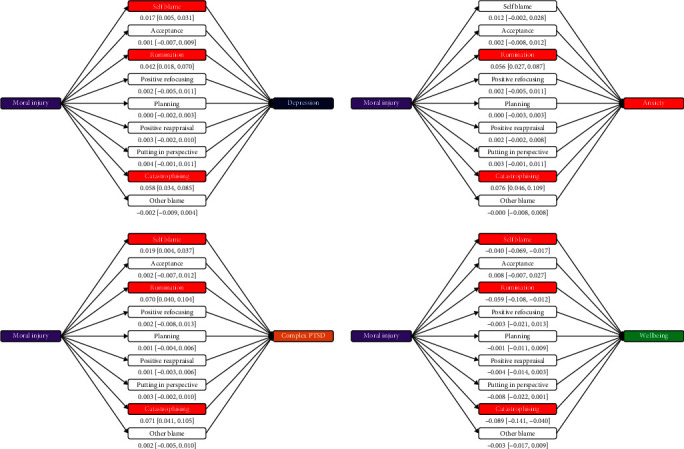
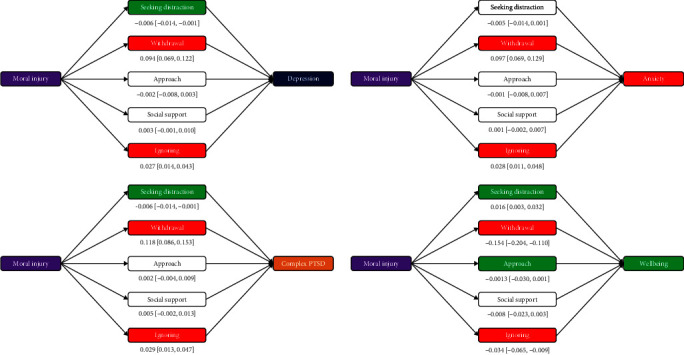
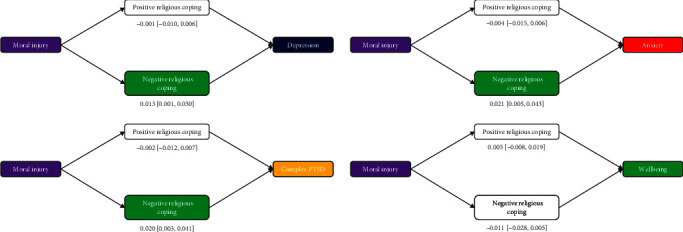
Verification
Claims the paper makes
The claims and statistics of this paper haven’t been checked yet.
Free: it reads the open-access text and checks the first 5 claims that cite a source we can check. Create a free account to check every claim.
Claims other papers make about this one
Each is checked against this paper’s own text: does it say what the citing paper says it does?
The source backs part of the claim, not all of it — or backs it for a different population, condition or comparison.
In the citing paper
“This rate is higher than in other professions such as policing, where a quarter of the personnel scored in the clinical range for depression due to dealing with child sexual abuse and exploitation material [38,169].”
From Measuring the Mental Health of Content Reviewers, a Systematic Review (2025) · cites this paper as [38]
Experimental — accuracy not yet measured
Self-check
Percentages, sums and reported differences re-computed from the paper’s own numbers.
The self-check needs the paper’s full text.
Citations
Cites
Tabachnick, B. G., & Fidell, L. S. (1983) · Cited by 80,054
The PHQ-9: Validity of a brief depression severity measure
Kroenke, K., Spitzer, R. L., & Williams, J. B. W. (2001) · Journal of General Internal Medicine · doi:10.1046/j.1525-1497.2001.016009606.x · Cited by 44,910
Statistical power analyses using G∗Power 3.1: tests for correlation and regression analyses
Faul, F., Erdfelder, E., Buchner, A., & Lang, A.-G. (2009) · Behavior Research Methods · doi:10.3758/brm.41.4.1149 · Cited by 37,615 · cited 1×
“A sensitivity analysis in G ∗ Power [53] showed that 661 provides 95 % power to detect a small effect of Cohen ’ s f 2 = 0.04 at α = 0.025 in the most complex linear multiple regression analysis in this study with 9 predictors and 10 control variables [54].”
InfluentialA Brief Measure for Assessing Generalized Anxiety Disorder: The GAD-7
Spitzer, R. L., Kroenke, K., Williams, J. B. W., & Löwe, B. (2006) · Archives of Internal Medicine · doi:10.1001/archinte.166.10.1092 · Cited by 31,765 · cited 2×
“We summed GAD-7 items to group people into four clinical categories [60]: > 5 = minimal , 5 – 9 = mild , 10 – 4 = moderate , and 15 – 21 = severe , where ≥ 10 “ represents a reasonable cut point for identifying cases of GAD ” (p. 1096).”
How stigma interferes with mental health care.
Corrigan, P. (2004) · American Psychologist · doi:10.1037/0003-066x.59.7.614 · Cited by 3,648 · cited 1×
“Moreover, the current fi ndings (see Supporting Information 4: File S4) align with work showing that law enforcement personnel are often unlikely to seek treatment for mental health issues due to factors like stigma, potential career impacts, and concerns over their image [6, 84, 85].”
Instructional manipulation checks: Detecting satisficing to increase statistical power
Oppenheimer, D. M., Meyvis, T., & Davidenko, N. (2009) · Journal of Experimental Social Psychology · doi:10.1016/j.jesp.2009.03.009 · Cited by 3,493
Moral injury and moral repair in war veterans: A preliminary model and intervention strategy
Litz, B. T., Stein, N., Delaney, E., Lebowitz, L., Nash, W. P., Silva, C., & Maguen, S. (2009) · Clinical Psychology Review · doi:10.1016/j.cpr.2009.07.003 · Cited by 2,738 · cited 3×
“Hence, CSAM investigators may fi nd the environment of their workplace morally contaminating, leading to moral injury — damage to the moral self-concept from conducting or witnessing, especially pow-erlessly witnessing, acts that transgress moral values [2].”
Patterns of Positive and Negative Religious Coping with Major Life Stressors
Pargament, K. I., Smith, B. W., Koenig, H. G., & Perez, L. (1998) · Journal for the Scientific Study of Religion · doi:10.2307/1388152 · Cited by 2,425 · cited 5×
“Moreover, little research on moral injury — or CSAM for that matter — examines cognitive, emotional, behavioral, and religious coping [9 – 11].”
InfluentialHandbook of research methods in personality psychology
(2007) · Choice Reviews Online · doi:10.5860/choice.45-2315 · Cited by 2,373
Cloitre, M., Shevlin, M., Brewin, C. R., Bisson, J. I., Roberts, N. P., Maercker, A., Karatzias, T., & Hyland, P. (2018) · Acta Psychiatrica Scandinavica · doi:10.1111/acps.12956 · Cited by 1,314 · cited 1×
“However, the current work numbers are notably lower than civilian samples, including 18.3 % in a UK representative sample [78] and 14.6 % in our online UK comparison sample Supporting Information 2: File S2.”
Influential
Research works printed but not linked: 7
- Tuttle B. M. Stancel K. Russo C. Koskelainen M. Papazoglou K. Police Moral Injury, Compassion Fatigue, and Compassion Satisfaction: A Brief Salus Journal 2019 7 1 42 57
- IBM Corp IBM SPSS Statistics for Windows, Version 28.0 2021 Armonk, NY IBM Corp
- Qualtrics Qualtrics Online Survey Software, Version October 2023 [Computer Software] 2023 Qualtrics Corporation
- Richardson C. B. Chesnut R. P. Morgan N. R. Examining the Factor Structure of the Moral Injury Events Scale in a Veteran Sample Military Medicine 2020 185 (1-2) e75 e83 31184715
- Tangney J. P. Dearing R. L. Shame and Guilt 2003 Guilford Press
- Ellison C. G. Levin J. S. Religion, the Life Stress Paradigm, and the Study of Depression Religion in Aging and Health 1994 Thousand Oaks, CA Sage
- Conway P. Redmond T. Lundrigan S. Davy D. Bailey S. Lee P. Protecting the Protectors: Moral Injury, Coping Styles, and Mental Health of UK Police Officers and Staff Investigating Child Sexual Abuse Material 3rd International Moral Injury in Occupational Settings Conference 2023 St. Andrew’s, UK PMC11922302 40226728
Cited by
Tyagi, S., & Seigfried‐Spellar, K. C. (2025) · Journal of Forensic Sciences · doi:10.1111/1556-4029.70207 · Cited by 4
“Having close relationships supporting their work may help to reduce PTSD symptoms [19, 65] and improve mental health [ 66 ], as the absence of a social support network may elevate PTSD symptoms and increase the risk of experiencing negative situations outside the workplace [ 22].”
Hickie, S. (2026) · Policing A Journal of Policy and Practice · doi:10.1093/police/paag016 · Cited by 2
Measuring the Mental Health of Content Reviewers, a Systematic Review
Gonzalez, A., & Matias, J. N. (2025) · arXiv · doi:10.48550/arxiv.2502.00244 · Cited by 1
“This rate is higher than in other professions such as policing, where a quarter of the personnel scored in the clinical range for depression due to dealing with child sexual abuse and exploitation material [38, 169].”
Seigfried‐Spellar, K. C., & Tyagi, S. (2025) · Journal of Forensic Sciences · doi:10.1111/1556-4029.70244 · Cited by 3
“| 15 SEIGFRIED-SPELLARandTYAGI be adaptive (e.g., talking with others; [ 21 ]) or maladaptive (e.g., alco - hol or drug use; [22 ]), and may vary widely among different forensic disciplines.”
Green, T., Kosaraju, A., & Soutar, E. (2026) · Frontiers in Public Health · doi:10.3389/fpubh.2026.1697743 · Cited by 3
“Negative outcomes can extend to anxiety, depression, and disruptions in personal relationships, particularly when officers experience moral injury or institutional betrayal (38, 39).”
Cullen, N., & Duran, F. (2026) · The Police Journal Theory Practice and Principles · doi:10.1177/0032258x261444913 · Cited by 1
Kyranides, M. N., Antoniadou, M., Papageorgiou, K. Α., & Kloess, J. A. (2025) · The Police Journal Theory Practice and Principles · doi:10.1177/0032258x251378945 · Cited by 1
“…that overestimate the likelihood of negative outcomes), are the four maladaptive CERS proposed in the emotion-regulation model (Garnefski and Kraaij ’ s, 2007) and have been associated with mental health issues and poor wellbeing (Conway et al., 2024; Kraiss et al., 2020; Kyranides et al., 2024).”
InfluentialO’Keefe, G., Cusatis, R. N., Young, S., Hooyer, K., Kostelac, C. A., & Dellinger, M. (2026) · Police Practice and Research · doi:10.1080/15614263.2026.2652253 · Cited by 1
“For example, Conway et al. (2024) found betrayal-related moral injury was associated with PTSD symptomology, depression, anxiety, and reduced wellbeing among UK-based police officers and staff exposed to CSAM, and greater CSAM exposure predicted moral injury.”
InfluentialZhao, R., Zhang, K., Zhou, Y., Li, K., Zhang, Y., Wang, Y., & Ren, L. (2026) · BMC Psychology · doi:10.1186/s40359-026-04981-w
“This result is consistent with previous studies on healthcare workers during the COVID-19 pandemic and emergency front-line workers [59, 60], highlighting the unique role of MI as an important risk factor for negative emotional symptoms in medical staff-medical work is closely related to life and…”
“We Have to Do Something”: The Lived Reality of Investigating Online Child Sexual Abuse in Sweden
Lindholm, A., Burrow, R., & Larsson, A. (2026) · Work Employment and Society · doi:10.1177/09500170261432924
“Indeed, the effects of moral injury on online CSA investigators are likely very acute, with Conway et al. (2024) showing that feelings of institutional betrayal, being unsupported, undervalued and undermined are among the strongest predictors of poor mental health.”
Compassion fatigue and moral strain in policing
Floyd, C., & BURT, C. H. (2026) · Journal of Criminal Justice · doi:10.1016/j.jcrimjus.2026.102725
Johnson, M. S., Johnson, S. U., Ko, H. M., Memon, A., Milne, R. J., & Baugerud, G. A. (2026) · Journal of Police and Criminal Psychology · doi:10.1007/s11896-026-09831-4 · Cited by 1
Boudilmi, M., Landais, L., Guénoun, T., Smaniotto, B., Urgese, S. N., Ravit, M., Mitsopoulou, L., Wathelet, M., & Essadek, A. (2026) · Trauma Violence & Abuse · doi:10.1177/15248380261438779
Metadata
- Authors
- Conway, P., Redmond, T., Lundrigan, S., Davy, D., Bailey, S., & Lee, P.
- Affiliations
- University of Southampton (GB)
- Anglia Ruskin University (GB)
- University of Portsmouth (GB)
- Corresponding author
- Conway, Paul
- Venue
- Depression and Anxiety
- Publisher
- Wiley
- Published
- 2024-01
- Volume
- 2024
- Issue
- 1
- Pages
- 1854312-1854312
- ISSN
- 1091-4269 (ISSN-L)
- 1520-6394
- PMC
- PMC11922302
- OpenAlex
- W4404643781
- Semantic Scholar
- 3ed704c0ef71860000a0db0933bbd64e96b5464f
- Cited by
- 14
- References
- 97
- Citations by year
- 2026: 10 · 2025: 3 · 2024: 1
- FWCI
- 7.02
- Type
- journal article
- Language
- en
- Open access
- hybrid
- doi.org
- Locations
- Depression and Anxiety (publishedVersion, cc-by)
- PubMed Central (publishedVersion, cc-by)
- PubMed (publishedVersion)
- ePrints Soton (University of Southampton) (acceptedVersion, other-oa)
- Figshare (submittedVersion, cc-by)
- Funders
- Joint Information Systems Committee
- Topics
- Social Sciences › Psychology › Clinical Psychology › Posttraumatic Stress Disorder Research
- Social Sciences › Political Science and International Relations › Policing Practices and Perceptions
- Social Sciences › Psychology › Clinical Psychology › Child Abuse and Trauma
- Keywords
- child pornography, police officers, moral injury, institutional betrayal, coping styles, depression, anxiety, post-traumatic stress disorder, self-blame, rumination, catastrophizing, social support, mental health
- MeSH terms
- Adaptation, Psychological, Adult, Anxiety, Child, Child Abuse, Sexual, Female, United Kingdom, Humans, Male, Middle Aged, Morals, Social Support, Stress Disorders, Post-Traumatic, Police
About these checks
Registry, retraction, Cites and statistics results are computed, not judged, with one exception: a printed reference that no index lists is read once by a model before it counts as a citation error. Claims are extracted by a model and kept only when their quote appears verbatim in the text; each cited source is then checked, with a model’s help, for whether it says what the claim relies on. Those verdicts can be wrong — read the claim’s quote and the cited source before relying on one.
Statistics and arithmetic are recomputed, not judged.
Confidence bands are shown only for fields calibrated on our annotated test set. None is calibrated yet, so no band is shown.
What counts as a claim ›How we measure confidence ›How we check this ›
Are you an author, or do you see a problem with this page? Request a review
Data sources
Bibliographic data: Semantic Scholar, OpenAlex, Crossref.
Contains information from the Semantic Scholar Academic Graph Datasets, made available under the ODC Attribution License (ODC-BY 1.0).
Semantic Scholar’s data is described in: Kinney, R., et al. (2023). The Semantic Scholar Open Data Platform. arXiv:2301.10140.
