

Preclinical Characterization and Phase I Trial Results of INBRX-109, A Third-Generation, Recombinant, Humanized, Death Receptor 5 Agonist Antibody, in Chondrosarcoma
Open accessPublished version of a preprint
The DOI matches its Crossref record; 46 of the 49 references it cites were found in a registry or an index.
Abstract
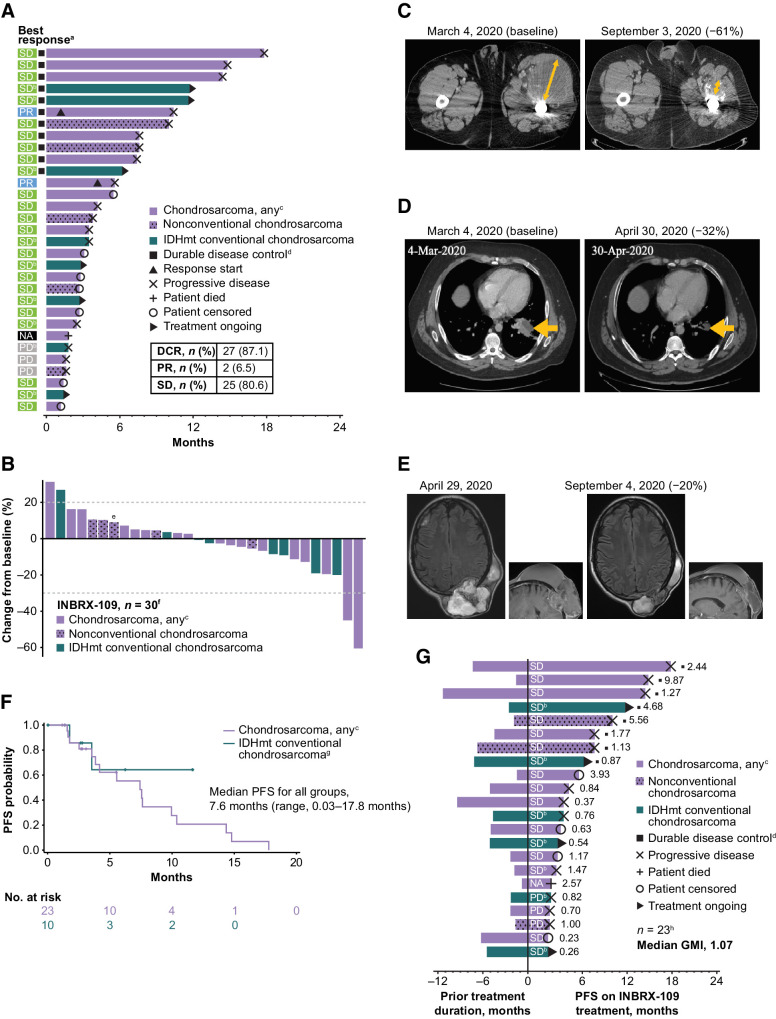
Purpose: Patients with unresectable/metastatic chondrosarcoma have poor prognoses; conventional chondrosarcoma is associated with a median progression-free survival (PFS) of <4 months after first-line chemotherapy. No standard targeted therapies are available. We present the preclinical characterization of INBRX-109, a third-generation death receptor 5 (DR5) agonist, and clinical findings from a phase I trial of INBRX-109 in unresectable/metastatic chondrosarcoma (NCT03715933). Patients and Methods: INBRX-109 was first characterized preclinically as a DR5 agonist, with binding specificity and hepatotoxicity evaluated in vitro and antitumor activity evaluated both in vitro and in vivo. INBRX-109 (3 mg/kg every 3 weeks) was then evaluated in a phase I study of solid tumors, which included a cohort with any subtype of chondrosarcoma and a cohort with IDH1/IDH2-mutant conventional chondrosarcoma. The primary endpoint was safety. Efficacy was an exploratory endpoint, with measures including objective response, disease control rate, and PFS. Results: In preclinical studies, INBRX-109 led to antitumor activity in vitro and in patient-derived xenograft models, with minimal hepatotoxicity. In the phase I study, INBRX-109 was well tolerated and demonstrated antitumor activity in unresectable/metastatic chondrosarcoma. INBRX-109 led to a disease control rate of 87.1% [27/31; durable clinical benefit, 40.7% (11/27)], including two partial responses, and median PFS of 7.6 months. Most treatment-related adverse events, including liver-related events, were low grade (grade ≥3 events in chondrosarcoma cohorts, 5.7%). Conclusions: INBRX-109 demonstrated encouraging antitumor activity with a favorable safety profile in patients with unresectable/metastatic chondrosarcoma. A randomized, placebo-controlled, phase II trial (ChonDRAgon, NCT04950075) will further evaluate INBRX-109 in conventional chondrosarcoma.
Overview
The claims and statistics of this paper haven’t been checked yet.
Free: it reads the open-access text and checks the first 5 claims that cite a source we can check. Create a free account to check every claim.
Integrity signals
Registry
Cites
Statistics
Figures
Verification
Claims the paper makes
The claims and statistics of this paper haven’t been checked yet.
Free: it reads the open-access text and checks the first 5 claims that cite a source we can check. Create a free account to check every claim.
Claims other papers make about this one
Each is checked against this paper’s own text: does it say what the citing paper says it does?
The source backs part of the claim, not all of it — or backs it for a different population, condition or comparison.
In the citing paper
“patients with unresectable and/or metastatic chondrosarcoma have poor prognoses, with a median PFS of <4 months after first‐line chemotherapy. 43 , 44”
From Nivolumab and sunitinib in patients with advanced bone sarcomas: A multicenter, single‐arm, phase 2 trial (2025) · cites this paper as [43]
Experimental — accuracy not yet measuredThe source backs part of the claim, not all of it — or backs it for a different population, condition or comparison.
In the citing paper
“In patients with conventional chondrosarcoma durable clinical benefit in 40.7% (11 of 27) patients, including two PRs, was observed with INBRX‐109, an antibody drug targeting a specific receptor (DR5). 43”
From Nivolumab and sunitinib in patients with advanced bone sarcomas: A multicenter, single‐arm, phase 2 trial (2025) · cites this paper as [43]
Experimental — accuracy not yet measured
Self-check
Percentages, sums and reported differences re-computed from the paper’s own numbers.
The self-check needs the paper’s full text.
Citations
Cites
Caspases: the executioners of apoptosis
COHEN, G. M. (1997) · Biochemical Journal · doi:10.1042/bj3260001 · Cited by 4,719 · cited 1×
“Multimerization of DR5 leads to the formation of the DISC, in which caspase-8 is activated, leading to the subsequent activation of the downstream executioner caspase-3 and caspase-7 (10, 12, 19) and the coordinated destruction of the cell.”
BackgroundTumoricidal activity of tumor necrosis factor-related apoptosis-inducing ligand in vivo.
Walczak, H., Miller, R. E., Ariail, K., Gliniak, B., Griffith, T. S., Kubin, M., Chin, W., Jones, J., Woodward, A., Le, T., et al. (1999) · Nature Medicine · doi:10.1038/5517 · Cited by 2,497 · cited 2×
“DR5 has long been of interest in oncology due to its ability to induce programmed cell death through the extrinsic apoptosis pathway in a cancer-biased manner (8, 9).”
BackgroundSafety and antitumor activity of recombinant soluble Apo2 ligand
Ashkenazi, A., Pai, R. C., Fong, S., Leung, S., Lawrence, D. A., Marsters, S. A., Blackie, C., Chang, L., McMurtrey, A. E., Hebert, A., et al. (1999) · Journal of Clinical Investigation · doi:10.1172/jci6926 · Cited by 2,213 · cited 2×
“DR5 has long been of interest in oncology due to its ability to induce programmed cell death through the extrinsic apoptosis pathway in a cancer-biased manner (8, 9).”
BackgroundOverview of cell death signaling pathways
Jin, Z., & El-Deiry, W. S. (2005) · Cancer Biology & Therapy · doi:10.4161/cbt.4.2.1508 · Cited by 1,326 · cited 1×
“Multimerization of DR5 leads to the formation of the DISC, in which caspase-8 is activated, leading to the subsequent activation of the downstream executioner caspase-3 and caspase-7 (10, 12, 19) and the coordinated destruction of the cell.”
BackgroundTRAIL receptor-2 signals apoptosis through FADD and caspase-8
Bodmer, J.-L., Holler, N., Reynard, S., Vinciguerra, P., Schneider, P., Juo, P., Blenis, J., & Tschopp, J. (2000) · Nature Cell Biology · doi:10.1038/35008667 · Cited by 649 · cited 1×
“Multimerization of DR5 leads to the formation of the DISC, in which caspase-8 is activated, leading to the subsequent activation of the downstream executioner caspase-3 and caspase-7 (10, 12, 19) and the coordinated destruction of the cell.”
BackgroundWe Should Desist Using RECIST, at Least in GIST
Benjamin, R. S., Choi, H., Macapinlac, H. A., Burgess, M. A., Patel, S. R., Chen, L. L., Podoloff, D. A., & Charnsangavej, C. (2007) · Journal of Clinical Oncology · doi:10.1200/jco.2006.07.3411 · Cited by 559
Lavrik, I., Golks, A., & Krammer, P. H. (2005) · Journal of Cell Science · doi:10.1242/jcs.01610 · Cited by 494
Kelley, S. K., Harris, L. A., Xie, D., DeForge, L., Totpal, K., Bussiere, J., & Fox, J. A. (2001) · The Journal of Pharmacology and Experimental Therapeutics · doi:10.1016/s0022-3565(24)29298-3 · Cited by 445
Olmos, D., Postel-Vinay, S., Molife, L. R., Okuno, S. H., Schuetze, S. M., Paccagnella, M. L., Batzel, G. N., Yin, D., Pritchard-Jones, K., Judson, I., et al. (2010) · The Lancet Oncology · doi:10.1016/s1470-2045(09)70354-7 · Cited by 340
Dahlin's Bone Tumors: General Aspects and Data on 10,165 Cases
Unni, K. K., Inwards, C. Y., & Dahlin, D. C. (1996) · Cited by 256
Research works printed but not linked: 1
- WHO Classification of Tumours editorial board, editor. WHO classification of tumours. Soft tissue and bone tumours. 5 ed. Volume 3. Lyon: IARC Press; 2020.
Cited by
Targeting apoptotic pathways for cancer therapy
Tian, X., Srinivasan, P. R., Tajiknia, V., Uruchurtu, A. S. S., Seyhan, A. A., Carneiro, B. A., Cruz, A. D. L., Pinho-Schwermann, M. P., George, A., Zhao, S., et al. (2024) · Journal of Clinical Investigation · doi:10.1172/jci179570 · Cited by 173
“In 2021, the FDA granted fast-track designation to INBRX-109 for the treatment of patients with unresectable or metastatic chondrosarcoma (Table 1).”
Cell death pathways: molecular mechanisms and therapeutic targets for cancer
Wang, S., Guo, S., Guo, J., Du, Q., Wu, C., Wu, Y., & Zhang, Y. (2024) · MedComm · doi:10.1002/mco2.693 · Cited by 134
“283,284 However, challenges persist, especially regarding resistance mechanisms and the selective induction of specific types of cell death in cancer cells without harming normal tissues.”
BackgroundTargeting the TNF and TNFR superfamilies in autoimmune disease and cancer
Croft, M., Salek‐Ardakani, S., & Ware, C. F. (2024) · Nature Reviews Drug Discovery · doi:10.1038/s41573-024-01053-9 · Cited by 109
“…a cadherin overexpressed on various adenocarcinomas, currently in early phase I trials; and a tetravalent TRAILR2 nanobody fusion protein construct (INBRX-109), with encouraging results in a phase I trial of chondrosarcoma 218 and in Ewing’s sarcoma when combined with irinotecan and temozolomide.”
Emerging therapies in Ewing sarcoma
Strauss, S. J., Berlanga, P., & McCabe, M. G. (2024) · Current Opinion in Oncology · doi:10.1097/cco.0000000000001048 · Cited by 55
“Increased collaboration between clinicians and researchers to prioritize these, as well as a focus on risk stratification and identification of biomarkers is required to ensure rapid translation”
BackgroundImmunotherapy in Sarcoma: Current Data and Promising Strategies
Wood, G. E., Meyer, C. F., Petitprez, F., & D’Angelo, S. P. (2024) · American Society of Clinical Oncology Educational Book · doi:10.1200/edbk_432234 · Cited by 54
Metadata
- Authors
- Subbiah, V., Chawla, S. P., Conley, A. P., Wilky, B. A., Tolcher, A., Lakhani, N. J., Berz, D., Andrianov, V., Crago, W., Holcomb, M., Hussain, A., Veldstra, C., Kalabus, J., O’Neill, B., Senne, L., Rowell, E., Heidt, A. B., Willis, K. M., & Eckelman, B. P.
- Affiliations
- The University of Texas MD Anderson Cancer Center (US)
- Sarcoma Oncology Center (US)
- University of Colorado Anschutz (US)
- South Texas Accelerated Research Therapeutics (US)
- 6START Midwest, Michigan.
- 7Valkyrie Clinical Trials, Los Angeles, California.
- Inhibrx (United States) (US)
- Corresponding author
- Subbiah, Vivek
- ORCID
- Venue
- Clinical Cancer Research
- Published
- 2023-06-02
- Volume
- 29
- Issue
- 16
- Pages
- 2988-3003
- ISSN
- 1078-0432 (ISSN-L)
- 1557-3265
- PMC
- PMC10425732
- OpenAlex
- W4379094382
- Cited by
- 51
- References
- 49
- Citations by year
- 2026: 13 · 2025: 20 · 2024: 16 · 2023: 2
- FWCI
- 10.68
- Type
- journal article
- Language
- en
- Open access
- hybrid
- doi.org
- Licence
- Locations
- Clinical Cancer Research (publishedVersion, cc-by-nc-nd)
- PubMed Central (publishedVersion, cc-by-nc-nd)
- PubMed (publishedVersion)
- Funders
- not applicable
- Topics
- Health Sciences › Medicine › Orthopedics and Sports Medicine › Bone Tumor Diagnosis and Treatments
- Health Sciences › Medicine › Oncology › Sarcoma Diagnosis and Treatment
- Health Sciences › Medicine › Surgery › Cholangiocarcinoma and Gallbladder Cancer Studies
- Keywords
- chondrosarcoma, hepatotoxicity, anticancer activity, patient-derived xenografts
- MeSH terms
- Antibodies, Monoclonal, Bone Neoplasms, Chondrosarcoma, Humans, Receptors, TNF-Related Apoptosis-Inducing Ligand, Chemical and Drug Induced Liver Injury
About these checks
Registry, retraction, Cites and statistics results are computed, not judged, with one exception: a printed reference that no index lists is read once by a model before it counts as a citation error. Claims are extracted by a model and kept only when their quote appears verbatim in the text; each cited source is then checked, with a model’s help, for whether it says what the claim relies on. Those verdicts can be wrong — read the claim’s quote and the cited source before relying on one.
Statistics and arithmetic are recomputed, not judged.
Confidence bands are shown only for fields calibrated on our annotated test set. None is calibrated yet, so no band is shown.
What counts as a claim ›How we measure confidence ›How we check this ›
Are you an author, or do you see a problem with this page? Request a review
How to cite
Cite CoChat for the checks on this page, and the paper for its own findings.
- This page
- CoChat. (2026). Citation check: Preclinical Characterization and Phase I Trial Results of INBRX-109, A Third-Generation, Recombinant, Humanized, Death Receptor 5 Agonist Antibody, in Chondrosarcoma. https://app.cochat.ai/papers/10.1158/1078-0432.ccr-23-0974
- The paper
- Subbiah, V., Chawla, S. P., Conley, A. P., Wilky, B. A., Tolcher, A., Lakhani, N. J., Berz, D., Andrianov, V., Crago, W., Holcomb, M., Hussain, A., Veldstra, C., Kalabus, J., O’Neill, B., Senne, L., Rowell, E., Heidt, A. B., Willis, K. M., & Eckelman, B. P. (2023). Preclinical Characterization and Phase I Trial Results of INBRX-109, A Third-Generation, Recombinant, Humanized, Death Receptor 5 Agonist Antibody, in Chondrosarcoma. Clinical Cancer Research. https://doi.org/10.1158/1078-0432.ccr-23-0974
Data sources
Bibliographic data: Semantic Scholar, OpenAlex, Crossref.
Contains information from the Semantic Scholar Academic Graph Datasets, made available under the ODC Attribution License (ODC-BY 1.0).
Semantic Scholar’s data is described in: Kinney, R., et al. (2023). The Semantic Scholar Open Data Platform. arXiv:2301.10140.
