

Translational and Therapeutic Evaluation of RAS-GTP Inhibition by RMC-6236 in RAS-Driven Cancers
Open accessPublished version of a preprint
The DOI matches its Crossref record; 51 of the 51 references it cites were found in a registry or an index.
Abstract
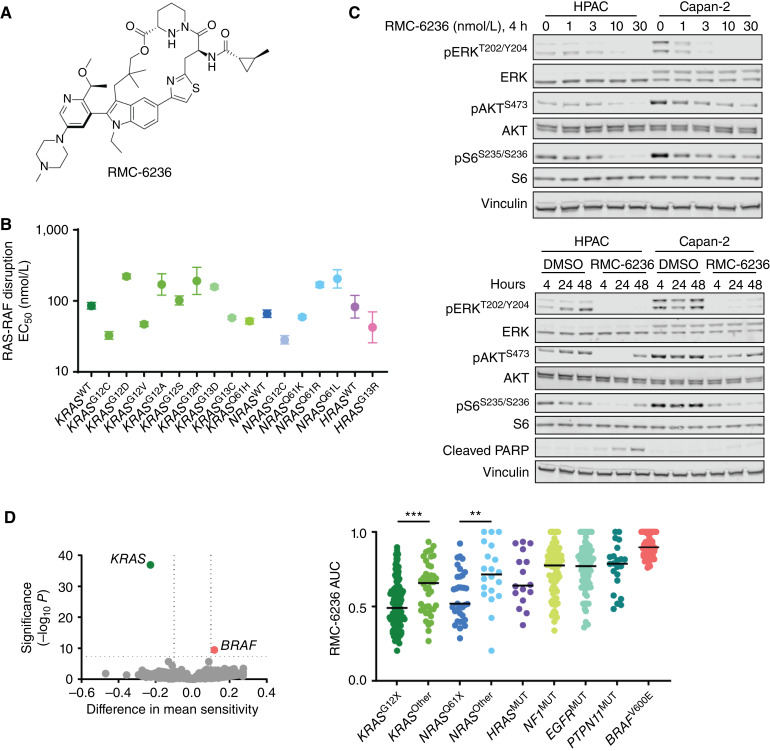
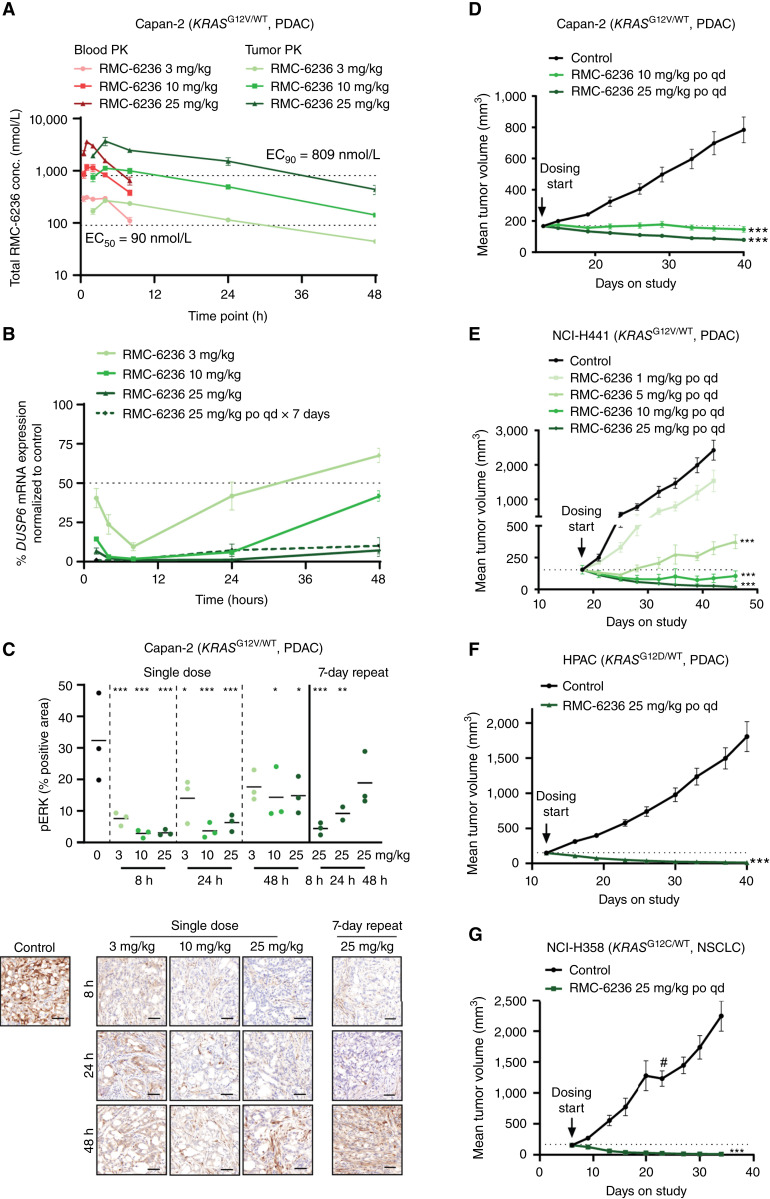
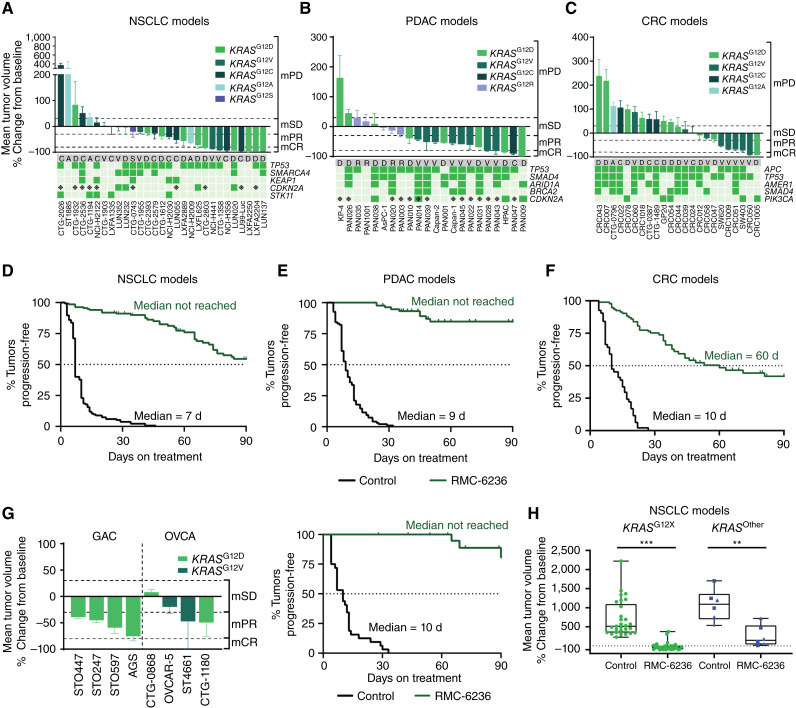
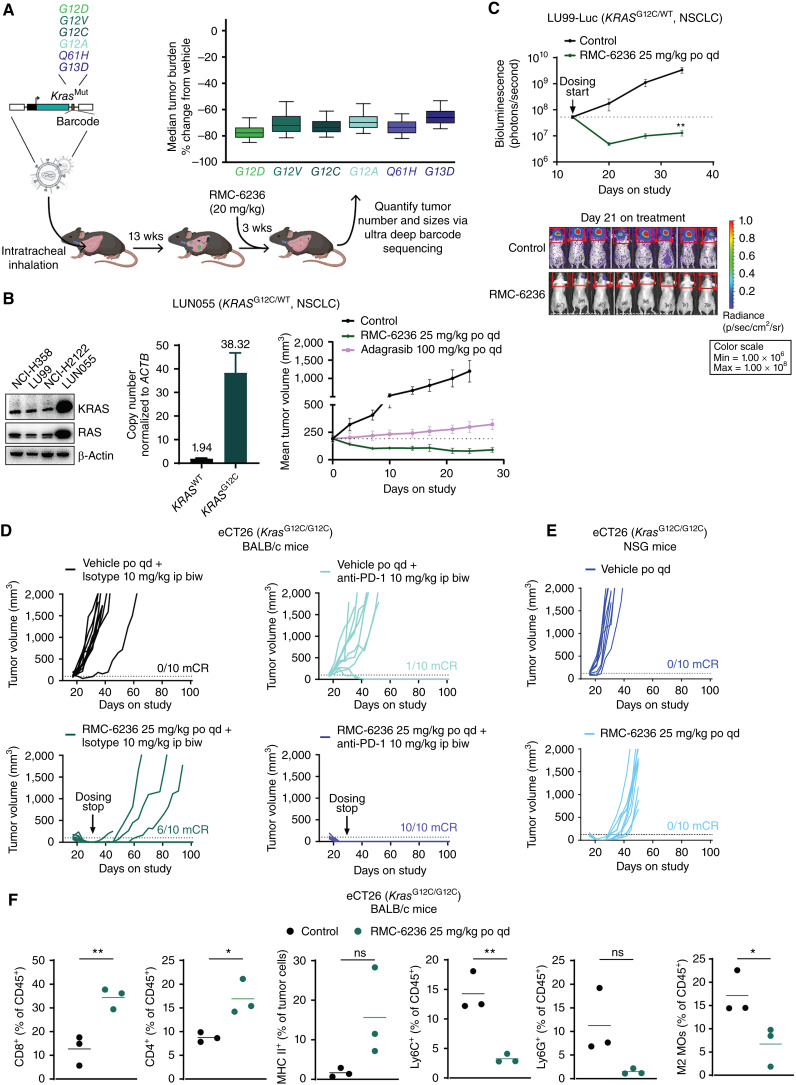
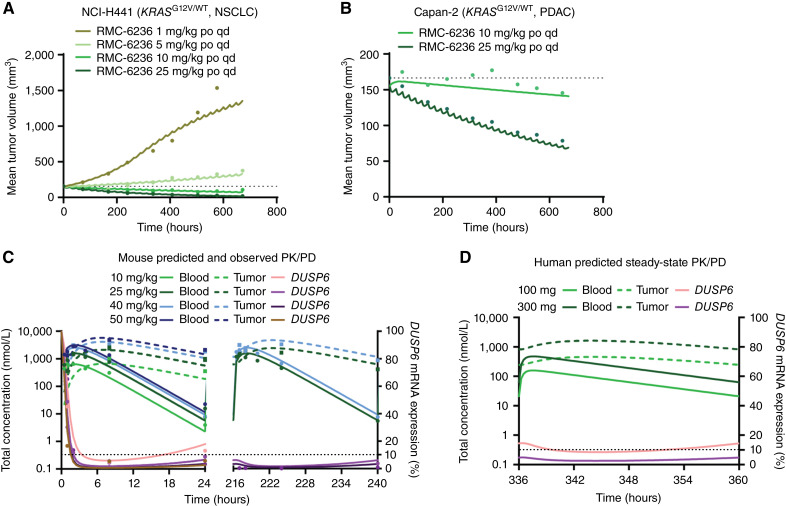
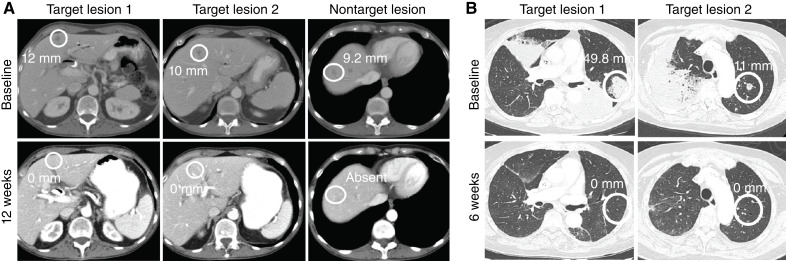
RAS-driven cancers comprise up to 30% of human cancers. RMC-6236 is a RAS(ON) multi-selective noncovalent inhibitor of the active, GTP-bound state of both mutant and wild-type variants of canonical RAS isoforms with broad therapeutic potential for the aforementioned unmet medical need. RMC-6236 exhibited potent anticancer activity across RAS-addicted cell lines, particularly those harboring mutations at codon 12 of KRAS. Notably, oral administration of RMC-6236 was tolerated in vivo and drove profound tumor regressions across multiple tumor types in a mouse clinical trial with KRASG12X xenograft models. Translational PK/efficacy and PK/PD modeling predicted that daily doses of 100 mg and 300 mg would achieve tumor control and objective responses, respectively, in patients with RAS-driven tumors. Consistent with this, we describe here objective responses in two patients (at 300 mg daily) with advanced KRASG12X lung and pancreatic adenocarcinoma, respectively, demonstrating the initial activity of RMC-6236 in an ongoing phase I/Ib clinical trial (NCT05379985). Significance: The discovery of RMC-6236 enables the first-ever therapeutic evaluation of targeted and concurrent inhibition of canonical mutant and wild-type RAS-GTP in RAS-driven cancers. We demonstrate that broad-spectrum RAS-GTP inhibition is tolerable at exposures that induce profound tumor regressions in preclinical models of, and in patients with, such tumors.
Overview
The claims and statistics of this paper haven’t been checked yet.
Free: it reads the open-access text and checks the first 5 claims that cite a source we can check. Create a free account to check every claim.
Integrity signals
Registry
Cites
Statistics
Figures
Verification
Claims the paper makes
The claims and statistics of this paper haven’t been checked yet.
Free: it reads the open-access text and checks the first 5 claims that cite a source we can check. Create a free account to check every claim.
Claims other papers make about this one
Each is checked against this paper’s own text: does it say what the citing paper says it does?
The source backs part of the claim, not all of it — or backs it for a different population, condition or comparison.
In the citing paper
“Recently developed “pan-RAS” or “pan-KRAS” inhibitors capable of targeting all RAS isoforms or all KRAS alleles will be broadly applicable to most patients with PDAC (71–74).”
From Mechanisms of Resistance to Oncogenic KRAS Inhibition in Pancreatic Cancer (2024) · cites this paper as [72]
Experimental — accuracy not yet measuredThe cited source says what the claim attributes to it.
In the citing paper
“A recent preclinical study on pan-RAS inhibitor RMC-6236 identified an association between CDKN2A loss and reduced response in KRAS G12-mutant NSCLC [44].”
From Differential Response and Resistance to KRAS-Targeted Therapy (2025) · cites this paper as [44]
Self-check
Percentages, sums and reported differences re-computed from the paper’s own numbers.
The self-check needs the paper’s full text.
Citations
Cites
A genetic model for colorectal tumorigenesis
Fearon, E. R., & Vogelstein, B. (1990) · Cell · doi:10.1016/0092-8674(90)90186-i · Cited by 12,132
Sotorasib for Lung Cancers with KRAS p.G12C Mutation
Skoulidis, F., Li, B. T., Dy, G. K., Price, T. J., Falchook, G. S., Wolf, J., Italiano, A., Schuler, M., Borghaei, H., Barlesi, F., et al. (2021) · New England Journal of Medicine · doi:10.1056/nejmoa2103695 · Cited by 1,849
Gao, H., Korn, J. M., Ferretti, S., Monahan, J. E., Wang, Y., Singh, M., Zhang, C., Schnell, C., Yang, G., Zhang, Y., et al. (2015) · Nature Medicine · doi:10.1038/nm.3954 · Cited by 1,393 · cited 2×
“F), wherein tumor progression was defined as individual tumor volume doubling from baseline (29), showed that RMC-6236 treatment resulted in significantly improved progression-free survival (PFS) as compared with vehicle controls in all KRAS G12X tumor-bearing animals.”
Self-citationAcquired Resistance to KRAS G12C Inhibition in Cancer
Awad, M. M., Liu, S., Rybkin, I. I., Arbour, K. C., Dilly, J., Zhu, V. W., Johnson, M. L., Heist, R. S., Patil, T., Riely, G. J., et al. (2021) · New England Journal of Medicine · doi:10.1056/nejmoa2105281 · Cited by 1,247
Self-citationRAS-targeted therapies: is the undruggable drugged?
Moore, A. R., Rosenberg, S. C., McCormick, F., & Malek, S. (2020) · Nature Reviews Drug Discovery · doi:10.1038/s41573-020-0068-6 · Cited by 1,103 · cited 2×
“Until the recent development of direct inhibitors of KRAS G12C , RAS was largely considered undruggable (4).”
Adagrasib in Non–Small-Cell Lung Cancer Harboring a KRAS G12C Mutation
Jänne, P. A., Riely, G. J., Gadgeel, S. M., Heist, R. S., Ou, S.-H. I., Pacheco, J. M., Johnson, M. L., Sabari, J. K., Leventakos, K., Yau, E., et al. (2022) · New England Journal of Medicine · doi:10.1056/nejmoa2204619 · Cited by 1,061 · cited 2×
“The advent of inactive-state KRAS G12C inhibitors has provided an elegant clinical proof of concept for the benefits of targeting mutant KRAS, resulting in a surfeit of covalent KRAS G12C inhibitors entering clinical evaluation (9, 10, 37).”
Co-occurring genomic alterations in non-small-cell lung cancer biology and therapy
Skoulidis, F., & Heymach, J. V. (2019) · Nature Reviews Cancer · doi:10.1038/s41568-019-0179-8 · Cited by 1,019 · cited 2×
“…that of the prevalent genomic aberrations re-ported to modify responses to targeted RAS pathway inhibition with approved KRAS G12C inhibitors (32, 33), mutations in SMARCA4 were not associated with impaired RMC-6236 effects on durability of response in KRAS G12X NSCLC xenograft models, while…”
KRAS: The Critical Driver and Therapeutic Target for Pancreatic Cancer
Waters, A. M., & Der, C. J. (2018) · Cold Spring Harbor Perspectives in Medicine · doi:10.1101/cshperspect.a031435 · Cited by 875 · cited 1×
“Direct pharmacologic targeting of canonical RAS proteins has been an aspirational goal since the discovery of the RAS oncogenes over 40 years ago (47, 48).”
Oncogenic Kras is required for both the initiation and maintenance of pancreatic cancer in mice
Collins, M. A., Bednar, F., Zhang, Y., Brisset, J.-C., Galbán, S., Galbán, C. J., Rakshit, S., Flannagan, K. S., Adsay, N. V., & Pasca di Magliano, M. (2012) · Journal of Clinical Investigation · doi:10.1172/jci59227 · Cited by 770 · cited 1×
“…to be particularly addicted to oncogenic RAS signaling, exemplified by Kras G12D inactivation studies in genetically engineered mouse models (6), pharmacologic inhibition of KRAS G12D in preclinical models (7, 8), and most recently illustrated by the clinical activity of KRAS G12C…”
Identification of MRTX1133, a Noncovalent, Potent, and Selective KRAS G12D Inhibitor
Wang, X., Allen, S., Blake, J. F., Bowcut, V., Briere, D. M., Calinisan, A., Dahlke, J. R., Fell, J. B., Fischer, J. P., Gunn, R. J., et al. (2022) · Journal of Medicinal Chemistry · doi:10.1021/acs.jmedchem.1c01688 · Cited by 769 · cited 16×
“S2B) and KP-4 ( KRAS G12D/WT , PDAC; Supplementary Fig.”
Influential
Research works printed but not linked: 3
- 4. J.E. Knox: Resources, formal analysis, investigation, methodology, project administration. E. Quintana: Conceptualization, resources, formal analysis, supervision, investigation, visualization, methodol- ogy, writing-original draft, project administration, writing-review and editing.
- 6. K.C. Arbour: Resources, data curation, formal analysis, supervision, validation, investigation, visualization, methodology, project administration. A. Reed: Resources, data cura- tion, formal analysis, investigation, visualization, methodology, pro- ject administration. W. Gustafson: Conceptualization, resources, data curation, formal analysis, supervision, validation, investigation, methodology, writing-original draft, project administration, writ- ing-review and editing. A.L. Gill: Conceptualization, resources, data curation, supervision, funding acquisition, validation, investigation, visualization, methodology, project administration, writing-review and editing. E.S. Koltun: Conceptualization, resources, data cura- tion, supervision, funding acquisition, validation, investigation, visu- alization, methodology, project administration, writing-review and editing. D. Wildes: Conceptualization, resources, data curation, formal analysis, supervision, funding acquisition, validation, inves- tigation, visualization, methodology, writing-original draft, project administration, writing-review and editing. J.A. Smith: Concep- tualization, resources, data curation, formal analysis, supervision, funding acquisition, validation, investigation, visualization, method- ology, writing-original draft, project administration, writing-review and editing. Z. Wang: Conceptualization, resources, data curation, formal analysis, supervision, funding acquisition, validation, inves- tigation, visualization, methodology, writing-original draft, project administration, writing-review and editing.
- 7. M. Singh: Conceptu- alization, resources, data curation, formal analysis, supervision, funding acquisition, validation, investigation, visualization, method- ology, writing-original draft, project administration, writing-review and editing.
Cited by
Mechanisms of Resistance to Oncogenic KRAS Inhibition in Pancreatic Cancer
Dilly, J., Hoffman, M. T., Abbassi, L., Li, Z., Paradiso, F., Parent, B. D., Hennessey, C. J., Jordan, A. C., Morgado, M., Dasgupta, S., et al. (2024) · Cancer Discovery · doi:10.1158/2159-8290.cd-24-0177 · Cited by 308
Self-citationKRAS inhibitors: resistance drivers and combinatorial strategies
Isermann, T., Sers, C., Der, C. J., & Papke, B. (2025) · Trends in Cancer · doi:10.1016/j.trecan.2024.11.009 · Cited by 196
Cregg, J., Edwards, A. V., Chang, S., Lee, B. J., Knox, J. E., Tomlinson, A. C. A., Marquez, A., Liu, Y., Freilich, R., Aay, N., et al. (2025) · Journal of Medicinal Chemistry · doi:10.1021/acs.jmedchem.4c02314 · Cited by 151
Self-citationDaraxonrasib or Chemotherapy in Previously Treated Metastatic Pancreatic Cancer
O’Reilly, E. M., Wainberg, Z. A., Hendifar, A. E., Borad, M. J., Pietrantonio, F., Pant, S., Hammel, P., Cremolini, C., Manji, G. A., Oberstein, P. E., et al. (2026) · New England Journal of Medicine · doi:10.1056/nejmoa2605555 · Cited by 147
Self-citationRAS signaling in carcinogenesis, cancer therapy and resistance mechanisms
Yang, X., & Wu, H. K. (2024) · Journal of Hematology & Oncology · doi:10.1186/s13045-024-01631-9 · Cited by 146
Consensus, debate, and prospective on pancreatic cancer treatments
Wang, J., Yang, J., Narang, A. K., He, J., Wolfgang, C. L., Li, K., & Zheng, L. (2024) · Journal of Hematology & Oncology · doi:10.1186/s13045-024-01613-x · Cited by 109
MYC and KRAS cooperation: from historical challenges to therapeutic opportunities in cancer
Casacuberta‐Serra, S., González-Larreategui, Í., Capitán-Leo, D., & Soucek, L. (2024) · Signal Transduction and Targeted Therapy · doi:10.1038/s41392-024-01907-z · Cited by 100
The tumour microenvironment in pancreatic cancer — new clinical challenges, but more opportunities
Kung, H., Zheng, K., Zimmerman, J. W., & Zheng, L. (2025) · Nature Reviews Clinical Oncology · doi:10.1038/s41571-025-01077-z · Cited by 101
Daraxonrasib in Previously Treated Advanced RAS -Mutated Pancreatic Cancer
Wolpin, B. M., Park, W., Garrido-Laguna, I., Spira, A., Starodub, A., Sommerhalder, D., Punekar, S. R., Barve, M., Pelster, M., Herzberg, B., et al. (2026) · New England Journal of Medicine · doi:10.1056/nejmoa2505783 · Cited by 90
Discovery of KRAS(G12D) selective degrader ASP3082
Yoshinari, T., Nagashima, T., Ishioka, H., Inamura, K., Nishizono, Y., Tasaki, M., Iguchi, K., Suzuki, A., Sato, C., Nakayama, A., et al. (2025) · Communications Chemistry · doi:10.1038/s42004-025-01662-4 · Cited by 88
Response and Resistance to RAS Inhibition in Cancer
Ebright, R. Y., Dilly, J., Shaw, A. T., & Aguirre, A. J. (2025) · Cancer Discovery · doi:10.1158/2159-8290.cd-25-0349 · Cited by 83
Self-citationImproving outcomes of patients with pancreatic cancer
Dreyer, S. B., Beer, P. A., Hingorani, S. R., & Biankin, A. V. (2025) · Nature Reviews Clinical Oncology · doi:10.1038/s41571-025-01019-9 · Cited by 81
A neomorphic protein interface catalyzes covalent inhibition of RAS G12D aspartic acid in tumors
Weller, C. E., Burnett, G. L., Jiang, L., Chakraborty, S., Zhang, D., Vita, N. A., Dilly, J., Kim, E., Maldonato, B. J., Seamon, K. J., et al. (2025) · Science · doi:10.1126/science.ads0239 · Cited by 78
Self-citationRAS-ON inhibition overcomes clinical resistance to KRAS G12C-OFF covalent blockade
Nokin, M., Mira, A., Patrucco, E., Ricciuti, B., Cousin, S., Soubeyran, I., José, S. S., Peirone, S., Caizzi, L., Michelina, S. V., et al. (2024) · Nature Communications · doi:10.1038/s41467-024-51828-2 · Cited by 76
KRAS: the Achilles’ heel of pancreas cancer biology
Drizyte‐Miller, K., Talabi, T., Somasundaram, A., Cox, A. D., & Der, C. J. (2025) · Journal of Clinical Investigation · doi:10.1172/jci191939 · Cited by 73
Induced proximity-based therapeutic modalities
King, E. A., Meyers, M., & Nomura, D. K. (2025) · Nature Reviews Drug Discovery · doi:10.1038/s41573-025-01316-z · Cited by 74
Araujo, H. A., Pechuan-Jorge, X., Zhou, T., Do, M. T., Hu, X., Rojas Alvarez, F. R., Salvatierra, M. E., Ibarguen, H. P., Lee, R., Raghulan, R., et al. (2024) · Cancer Discovery · doi:10.1158/2159-8290.cd-24-0421 · Cited by 70
Self-citationOrlen, M., Vostrejs, W. P., Sor, R., McDevitt, J. C., Kemp, S. B., Kim, I., Kramer, A. B., Shifrin, N. T., Markosyan, N., Clendenin, C., et al. (2025) · Cancer Discovery · doi:10.1158/2159-8290.cd-24-1475 · Cited by 70
Self-citationRiedl, J. M., Fece de la Cruz, F., Lin, J. J., Parseghian, C., Kim, J. E., Matsubara, H., Barnes, H., Caughey, B., Norden, B. L., Morales-Giron, A. A., et al. (2025) · Annals of Oncology · doi:10.1016/j.annonc.2025.01.020 · Cited by 68
Pancreatic cancer: molecular pathogenesis and emerging therapeutic strategies
Rozengurt, E., & Eibl, G. (2026) · Signal Transduction and Targeted Therapy · doi:10.1038/s41392-025-02499-y · Cited by 66
Lung cancer research and treatment: global perspectives and strategic calls to action
Meyer, M., Peters, S., Mok, T. S. K., Lam, S. C., Yang, P., Aggarwal, C., Brahmer, J. R., Dziadziuszko, R., Felip, E., Ferris, A. A., et al. (2024) · Annals of Oncology · doi:10.1016/j.annonc.2024.10.006 · Cited by 62
“Undruggable KRAS”: druggable after all
Cox, A. D., & Der, C. J. (2024) · Genes & Development · doi:10.1101/gad.352081.124 · Cited by 61
Ringing medicinal chemistry: The importance of 3-membered rings in drug discovery
Uthumange, S. S., Liew, A. J. H., Wezen, X. C., & Yeong, K. Y. (2024) · Bioorganic & Medicinal Chemistry · doi:10.1016/j.bmc.2024.117980 · Cited by 61
Cytosolic acetyl-coenzyme A is a signalling metabolite to control mitophagy
Zhang, Y., Shen, X. L., Shen, Y., Wang, C., Yu, C., Han, J., Cao, S., Qian, L., Ma, M., Huang, S., et al. (2025) · Nature · doi:10.1038/s41586-025-09745-x · Cited by 58
The Missing Link(er): A Roadmap to Macrocyclization in Drug Discovery
Brudy, C., Walz, C., Spiske, M., Dreizler, J. K., & Hausch, F. (2024) · Journal of Medicinal Chemistry · doi:10.1021/acs.jmedchem.4c01163 · Cited by 55
Pharmacological restoration of GTP hydrolysis by mutant RAS
Cuevas-Navarro, A., Pourfarjam, Y., Hu, F., Rodriguez, D. J., Vides, A., Sang, B., Fan, S., Goldgur, Y., de Stanchina, E., & Lito, P. (2024) · Nature · doi:10.1038/s41586-024-08283-2 · Cited by 55
Breakthrough in RAS targeting with pan-RAS(ON) inhibitors RMC-7977 and RMC-6236
Filis, P., Salgkamis, D., Matikas, A., & Zerdes, I. (2024) · Drug Discovery Today · doi:10.1016/j.drudis.2024.104250 · Cited by 55
Emerging landscape of KRAS inhibitors in cancer treatment
Riedl, J. M., Matsubara, H., McNeil, R., Patel, P. S., de la Cruz, F. F., Gulhan, D., & Corcoran, R. B. (2026) · Cancer Cell · doi:10.1016/j.ccell.2026.01.001 · Cited by 53
Disrupted molecular glue complex drives RAS inhibitor resistance
Sang, B., Ye, L. F., Fu, Z., Pourfarjam, Y., Cuevas-Navarro, A., Fan, S., Hu, F., Washington, A., Rodriguez, D. J., Vides, A., et al. (2026) · Cell · doi:10.1016/j.cell.2026.03.031 · Cited by 53
Self-citationFeng, J., Xiao, X., Xia, X., Min, J., Tang, W., Shi, X., Xu, K., Zhou, G., Li, K., Shen, P., et al. (2025) · Cancer Cell · doi:10.1016/j.ccell.2025.07.006 · Cited by 46
Navarro-Jiménez, M., González, B., Mulet-Margalef, N., Hierro, C., & Alonso, S. (2025) · npj Precision Oncology · doi:10.1038/s41698-025-01166-3 · Cited by 45
A first-in-class EGFR-directed KRAS G12V selective inhibitor
Stanland, L. J., Huggins, H. P., Sahoo, S. S., Porrello, A., Chareddy, Y. S., Azam, S. H., Perry, J. L., Pallan, P. S., Whately, K. M., Edatt, L., et al. (2025) · Cancer Cell · doi:10.1016/j.ccell.2025.05.016 · Cited by 42
Negrao, M. V., Paula, A. G., Molkentine, D. P., Hover, L. D., Nilsson, M. B., Vokes, N. I., Engstrom, L. D., Calinisan, A., Briere, D. M., Waters, L. M., et al. (2025) · Clinical Cancer Research · doi:10.1158/1078-0432.ccr-24-2310 · Cited by 41
BBO-10203 inhibits tumor growth without inducing hyperglycemia by blocking RAS-PI3Kα interaction
Simanshu, D. K., Xu, R., Stice, J. P., Czyzyk, D. J., Feng, S., Denson, J.-P., Riegler, E., Yang, Y., Zhang, C., Donovan, S., et al. (2025) · Science · doi:10.1126/science.adq2004 · Cited by 41
CTR-FAPI PET Enables Precision Management of Medullary Thyroid Carcinoma
Kong, Z., Li, Z., Cui, X., Wang, J., Xu, M., Liu, Y., Chen, J., Ni, S., Zhang, Z., Fan, X., et al. (2024) · Cancer Discovery · doi:10.1158/2159-8290.cd-24-0897 · Cited by 41
Discovery of fully synthetic FKBP12-mTOR molecular glues
Deutscher, R. C. E., Meyners, C., Repity, M. L., Sugiarto, W. O., Kolos, J., Maciel, E. V. S., Heymann, T., Geiger, T. M., Knapp, S., Lermyte, F., et al. (2025) · Chemical Science · doi:10.1039/d4sc06917j · Cited by 40
Pancreatic ductal adenocarcinoma (PDAC): clinical progress in the last five years
Mosalem, O. M., Abdelhakeem, A. A. F., Abdel-Razeq, N. H., & Babiker, H. M. (2025) · Expert Opinion on Investigational Drugs · doi:10.1080/13543784.2025.2473698 · Cited by 39
Lineage plasticity and histological transformation: tumor histology as a spectrum
Li, X., Gardner, E. E., Molina‐Pinelo, S., Wilhelm, C., Mu, P., & Quintanal-Villalonga, À. (2025) · Cell Research · doi:10.1038/s41422-025-01180-x · Cited by 38
Qu, X., Hamidi, H., Johnson, R. M., Sokol, E. S., Lin, E., Eng, C., Kim, T.-W., Bendell, J. C., Sivakumar, S., Kaplan, B., et al. (2025) · Nature Communications · doi:10.1038/s41467-025-59588-3 · Cited by 38
Tedeschi, A., Schischlik, F., Rocchetti, F., Popow, J., Ebner, F., Gerlach, D., Geyer, A., Santoro, V., Boghossian, A. S., Rees, M. G., et al. (2024) · Molecular Cancer Therapeutics · doi:10.1158/1535-7163.mct-24-0386 · Cited by 36
Mechanisms of resistance to KRASG12C inhibitors in KRASG12C-mutated non-small cell lung cancer
Chour, A., Toffart, A., Berton, E., & Duruisseaux, M. (2024) · Frontiers in Oncology · doi:10.3389/fonc.2024.1328728 · Cited by 35
Jiang, X., Wang, T., Zhao, B. X., Sun, H., Dong, Y., Ma, Y., Li, Z., Wu, Y., Wang, K., Guan, X., et al. (2025) · Cell Reports Medicine · doi:10.1016/j.xcrm.2025.101966 · Cited by 35
Pancreatic Cancer: Pathogenesis and Clinical Studies
Zhou, K., Liu, Y., Tang, C., & Zhu, H. (2025) · MedComm · doi:10.1002/mco2.70162 · Cited by 35
Drugging the ‘undruggable’ KRAS: breakthroughs, challenges, and opportunities in pancreatic cancer
Khan, N., Raza, U., Zaidi, S. A. A., Nuer, M., Abudurousuli, K., Paerhati, Y., Aikebaier, A., & Zhou, W. (2025) · Cancer Biology and Medicine · doi:10.20892/j.issn.2095-3941.2025.0122 · Cited by 34
Bandi, D. S. R., Nagaraju, G. P., Sarvesh, S., Carstens, J. L., Foote, J. B., Graff, E. C., Fang, Y.-H. D., Keeton, A. B., Chen, X., Valiyaveettil, J., et al. (2025) · Molecular Cancer · doi:10.1186/s12943-025-02288-9 · Cited by 32
Advances in the treatment of KRASG12C mutant non–small cell lung cancer
Shaverdashvili, K., & Burns, T. F. (2025) · Cancer · doi:10.1002/cncr.35783 · Cited by 32
Broderick, C., Mezzadra, R., Sisso, E. M., Mbuga, F., Raghulan, R., Perez, A. C., Kulick, A. R., Jiang, L., Jiang, J., Ho, Y.-J., et al. (2025) · Cancer Discovery · doi:10.1158/2159-8290.cd-24-1425 · Cited by 32
Self-citationAronchik, I., Kar, S., Zhuang, Y., Ahler, E., Lai, L., Seshadri, V., Yang, Y. C., Bulle, A. S., Ménard, M., Nayak, B., et al. (2026) · Nature Medicine · doi:10.1038/s41591-026-04537-w · Cited by 32
Self-citationEvaluation of KRAS inhibitor-directed therapies for pancreatic cancer treatment
Long, S.-A., Amparo, A. M., Goodhart, G., Ahmad, S. A., & Waters, A. M. (2024) · Frontiers in Oncology · doi:10.3389/fonc.2024.1402128 · Cited by 31
Precision Oncology: 2024 in Review
Repetto, M., Fernandez, N. C., Drilon, A. E. D. C., & Chakravarty, D. (2024) · Cancer Discovery · doi:10.1158/2159-8290.cd-24-1476 · Cited by 31
Wang, X., Li, S., Lin, S., Han, Y., Zhan, T., Huang, Z., Wang, J., Li, Y., Deng, H., Zhang, M., et al. (2025) · Cell Research · doi:10.1038/s41422-025-01085-9 · Cited by 31
Medical management of pancreatic cancer: from personalization to broadening treatment strategies
Dusetti, N., Bachet, J., Chanez, B., Neuzillet, C., de Mestier, L., Williet, N., Frauhoffer, N., Nicolle, R., Boilève, A., Turpin, A., et al. (2025) · Cancer Treatment Reviews · doi:10.1016/j.ctrv.2025.102973 · Cited by 31
Drizyte‐Miller, K., Engstrom, L. D., Klomp, J. A., Stalnecker, C. A., Stamey, A. G., Taylor, K. E., Roach, M. K., Robb, R. N., Waters, L. M., Calinisan, A., et al. (2025) · Cancer Research · doi:10.1158/0008-5472.can-25-1507 · Cited by 31
DeLiberty, J. M., Roach, M. K., Stalnecker, C. A., Robb, R. N., Schechter, E. G., Pieper, N. L., Taylor, K. E., Pita, L. M., Yang, R. Y., Bang, S., et al. (2025) · Cancer Research · doi:10.1158/0008-5472.can-24-1757 · Cited by 30
Lokhandwala, J., Smalley, T. B., & Tran, T. H. (2024) · Frontiers in Oncology · doi:10.3389/fonc.2024.1394702 · Cited by 29
Zhang, F., Wang, B., Wu, M., Zhang, L., & Ji, M. Q. (2025) · Frontiers in Immunology · doi:10.3389/fimmu.2025.1509173 · Cited by 28
KRAS mutated NSCLC: past, present, and future directions in a rapidly evolving landscape
Frisch, A., Martin, E., Kim, S. Y., Riess, J. W., Sen, T., & Karim, N. A. (2025) · The Oncologist · doi:10.1093/oncolo/oyaf153 · Cited by 27
Pancreatic cancer in 2025: Have we found a solution?
Tonini, V., & Zanni, M. (2025) · World Journal of Gastroenterology · doi:10.3748/wjg.v31.i43.111433 · Cited by 26
Treatment of KRAS-Mutated Pancreatic Cancer: New Hope for the Patients?
Krupa, K., Fudalej, M. M., Włoszek, E., Miski, H., Badowska-Kozakiewicz, A. M., Mękal, D., Budzik, M. P., Czerw, A. I., & Deptała, A. (2025) · Cancers · doi:10.3390/cancers17152453 · Cited by 25
Gujarathi, R., Peshin, S., Zhang, X., Bachini, M., Meeks, M. N., Shroff, R. T., & Pillai, A. (2025) · Hepatology Communications · doi:10.1097/hc9.0000000000000743 · Cited by 25
KRAS-Driven Tumorigenesis and KRAS-Driven Therapy in Pancreatic Adenocarcinoma
Than, M. T., O’Hara, M. H., Stanger, B. Z., & Reiss, K. A. (2024) · Molecular Cancer Therapeutics · doi:10.1158/1535-7163.mct-23-0519 · Cited by 23
Ma, J., Fu, S., Tan, J., Han, Y., Chen, Y., Deng, X., Shen, H., Zeng, S., Peng, Y., & Cai, C. (2025) · Advanced Science · doi:10.1002/advs.202502714 · Cited by 23
The “three body solution”: Structural insights into molecular glues
Tomlinson, A. C. A., Knox, J. E., Brunsveld, L., Ottmann, C., & Yano, J. K. (2025) · Current Opinion in Structural Biology · doi:10.1016/j.sbi.2025.103007 · Cited by 23
Self-citationExploring nondegrading molecular glues for protein–protein interactions
Yu, S., Zhou, L., Yang, J., Zhang, J., & Lu, W. (2025) · Trends in Biochemical Sciences · doi:10.1016/j.tibs.2025.07.005 · Cited by 22
Covalent inhibitors of the PI3Kα RAS binding domain impair tumor growth driven by RAS and HER2
Klebba, J. E., Roy, N., Bernard, S. M., Grabow, S., Hoffman, M. A., Miao, H., Tamiya, J., Wang, J., Berry, C., Esparza-Oros, A., et al. (2025) · Science · doi:10.1126/science.adv2684 · Cited by 22
Contreras, C. T., Falke, J. D., Seifert, D., Schneider, C., Krauß, L., Fang, X., Müller, D., Demirdizen, E., Spitzner, M., Oliveira, T. D., et al. (2024) · Molecular Oncology · doi:10.1002/1878-0261.13725 · Cited by 22
Identification of a Highly Cooperative PROTAC Degrader Targeting GTP-Loaded KRAS(On) Alleles
Vetma, V., Puoti, I., Karolak, N. K., Chakraborti, S., Diers, E., Girardi, E., Khan, S., Kidd, G., Kropatsch, K., McLennan, R., et al. (2025) · Journal of the American Chemical Society · doi:10.1021/jacs.5c10354 · Cited by 21
Carvalho, L. A. D. C., Shifrin, N. T., Phadke, M. S., Emmons, M. F., Pechuan-Jorge, X., Mbuga, F., Ospina, O. E., Chow, C., Seu, L., Rose, O. L., et al. (2025) · Cancer Immunology Research · doi:10.1158/2326-6066.cir-25-0744 · Cited by 21
Self-citationHallmarks of liver cancer: Therapeutic implications
Llovet, J. M., Pinyol, R., Affò, S., Yarchoan, M. M., Gores, G. J., Kelley, R. K., Lowe, S. W., Sia, D., & Villanueva, A. (2026) · Cell · doi:10.1016/j.cell.2026.03.001 · Cited by 23
Advances in Personalized Oncology
Mechahougui, H., Gutmans, J., Colarusso, G., Gouasmi, R., & Friedlaender, A. (2024) · Cancers · doi:10.3390/cancers16162862 · Cited by 21
Discovery of INCB159020, an Orally Bioavailable KRAS G12D Inhibitor
Ye, Q., Shvartsbart, A., Li, Z., Gan, P., Policarpo, R. L., Qi, C., Roach, J. J., Zhu, W., McCammant, M. S., Hu, B., et al. (2025) · Journal of Medicinal Chemistry · doi:10.1021/acs.jmedchem.4c02662 · Cited by 20
Targeting the KRAS Oncogene for Patients with Metastatic Colorectal Cancer
Miao, R., Yu, J. B., & Kim, R. D. (2025) · Cancers · doi:10.3390/cancers17091512 · Cited by 21
The RAS-MEK-ERK pathway in low-grade serous ovarian cancer
Stover, E. H., Lee, E. K., Shapiro, G. I., Brugge, J. S., Matulonis, U. A., & Liu, J. F. (2025) · Gynecologic Oncology · doi:10.1016/j.ygyno.2025.06.022 · Cited by 19
Experimental models of pancreas cancer: what has been the impact for precision medicine?
Pantazopoulou, V., Kubota, C. S., Ogawa, S., Gulay, K. C. M., Lin, X., Song, H., Weitz, J., Tiriac, H., Lowy, A. M., & Engle, D. D. (2025) · Journal of Clinical Investigation · doi:10.1172/jci191945 · Cited by 18
McAndrews, K. M., Paradiso, F., Stalnecker, C. A., Selvanesan, B. C., Thege, F. I., Peng, D. H., Diaz, B. A. M., Sugimoto, H., Patel, S. I., Mahadevan, K. K., et al. (2025) · Science Translational Medicine · doi:10.1126/scitranslmed.adt5511 · Cited by 19
Aguirre, A. J., Stanger, B. Z., & Maitra, A. (2024) · Cancer Research · doi:10.1158/0008-5472.can-24-1926 · Cited by 18
Self-citationAssociation of KRAS variants with survival and therapeutic outcomes in biliary tract cancers
Iida, K., Matsui, Y., Urabe, Y., Muramatsu, T., Matsuzaki, J., & Saito, Y. (2025) · ESMO Open · doi:10.1016/j.esmoop.2025.105306 · Cited by 17
Unveiling the Promise: Navigating Clinical Trials 1978–2024 for PDAC
Dominguez, A. A., Perz, M., Xu, Y., Cedillo, L. G., Huang, O. L., McIntyre, C. A., Vudatha, V., Trevino, J. G., Liu, J., & Wang, P. (2024) · Cancers · doi:10.3390/cancers16213564 · Cited by 17
Lu, J. G., Hu, M., Zhao, Y., Chu, T., Zhang, W., Zhou, Y., Cai, X., Wu, J., Hu, L., Shi, C., et al. (2025) · Signal Transduction and Targeted Therapy · doi:10.1038/s41392-025-02382-w · Cited by 16
KRAS-targeted therapies in cancer: novel approaches and overcoming resistance
Tang, D., Kroemer, G., & Kang, R. (2025) · BMJ Oncology · doi:10.1136/bmjonc-2025-000946 · Cited by 16
Stanger, B. Z., & Vonderheide, R. H. (2026) · Clinical Cancer Research · doi:10.1158/1078-0432.ccr-25-0821 · Cited by 15
Molecularly Targeted Therapies in Oncology: Mechanisms, Resistance, and Combination Strategies
Giercuszkiewicz-Haśnik, K., MORAK-MŁODAWSKA, B. I., & Jeleń, M. (2026) · Molecules · doi:10.3390/molecules31071195 · Cited by 15
Finding the sweet spot: Targeting RAS in tumors while sparing normal tissue
Perurena, N., & Cichowski, K. M. (2024) · Cancer Cell · doi:10.1016/j.ccell.2024.05.020 · Cited by 15
He, Q., Liu, X., Jiang, L., Liu, P., Xuan, W., Wang, Y., Meng, R., Feng, H., Lv, S., Miao, Q., et al. (2024) · Cancer Biology & Therapy · doi:10.1080/15384047.2024.2441499 · Cited by 16
Self-citationRAS Pathway Mutations and Therapeutics in Vascular Anomalies
Alharbi, S., Merkle, S., Hammill, A. M., Waters, A. M., & Cras, T. D. L. (2025) · Pediatric Blood & Cancer · doi:10.1002/pbc.31605 · Cited by 15
Jazieh, K., Tsai, J., Solomon, S. R., Zhu, M., Sinicrope, F. A., Pedersen, K. S., Fernández-Zapico, M. E., & Xie, H. (2025) · Clinical Cancer Research · doi:10.1158/1078-0432.ccr-24-2948 · Cited by 15
Targeting the MAPK pathway for NRAS mutant melanoma: from mechanism to clinic
Wang, Y., Xu, G., & Xia, H. (2025) · British Journal of Dermatology · doi:10.1093/bjd/ljaf178 · Cited by 15
Self-citationKnoll, N., Masser, S., Bordas, B., Ebright, R. Y., Li, G., Kesar, D., Destefanis, E., Kania, N., Rodriguez, D. J., Jen, J., et al. (2025) · Cancer Research · doi:10.1158/0008-5472.can-25-1464 · Cited by 15
Self-citationPancreatic cancer subtyping - the keystone of precision treatment
Fan, Z., Xiao, Y., Du, Y., Zhang, Y., & Zhou, W. (2025) · Frontiers in Immunology · doi:10.3389/fimmu.2025.1563725 · Cited by 14
Shenoy, A., Yousif, A., & Hussain, M. D. (2025) · Cancers · doi:10.3390/cancers17081319 · Cited by 14
Emerging Therapeutic Approaches to Pancreatic Adenocarcinoma: Advances and Future Directions
Peng, C., & Oberstein, P. E. (2025) · Current Treatment Options in Oncology · doi:10.1007/s11864-025-01352-2 · Cited by 14
Targeting KRAS Inhibitor–Resistant Pancreatic Cancer with an MUC1-C Antibody–Drug Conjugate
Ozawa, H., Takahashi, K., Motegi, T., Jacobi, J. J., Bhattacharya, A., Shigeta, K., Takamori, S., Onishi, M., Luan, Z., Fukuda, K., et al. (2025) · Clinical Cancer Research · doi:10.1158/1078-0432.ccr-25-2333 · Cited by 14
Self-citationMelanoma: Pathogenesis and Targeted Therapy
Fu, Y., Liu, J., Mo, Z., Wang, B., Deng, Y., & Jiang, Y. (2026) · MedComm · doi:10.1002/mco2.70566 · Cited by 15
KRAS Variants Are Associated With Survival Outcomes and Genomic Alterations in Biliary Tract Cancers
Gelfer, R., Gulla, A., Kalvin, H. L., Song, Y., Harding, J. J., Abou‐Alfa, G. K., O'Reilly, E. M., Park, W., Chandwani, R., Wei, A. C.-C., et al. (2024) · JCO Precision Oncology · doi:10.1200/po.24.00263 · Cited by 13
Cancer interception with KRAS inhibitors in preclinical models of pancreatic ductal adenocarcinoma
Than, M. T., Dequiedt, L., Sor, R., Nair, S., Markosyan, N., Furth, E. E., Yang, C., Ray-Fofana, C., Menard, M. J., Quintana, E., et al. (2026) · Science · doi:10.1126/science.aec7929 · Cited by 13
Self-citationParry, C., Pellicano, F., Schüttelkopf, A. W., Beyer, K. S., Bower, J. F., Bryson, A., Cameron, K., Cerutti, N. M., Clark, J. P., Davidson, S. C., et al. (2025) · Journal of Medicinal Chemistry · doi:10.1021/acs.jmedchem.4c02929 · Cited by 12
Surana, R., Morgado, M., Somasundaram, A., Bockorny, B., Weekes, C. D., Coleman, E. C., Bird, A., Wang, J., Williams, H. L., Zheng, H., et al. (2025) · JCO Precision Oncology · doi:10.1200/po-25-00332 · Cited by 13
Self-citationDrosten, M., & Barbacid, M. (2025) · Molecular Oncology · doi:10.1002/1878-0261.70149 · Cited by 12
Solanki, H. S., Shah, H., Imbody, D. J., Desai, B., Kato, R., Miroshnychenko, D., Stern, Y. E., Majumder, A., Sarcar, B., Xieraili, A., et al. (2025) · Cancer Research · doi:10.1158/0008-5472.can-25-0600 · Cited by 12
Self-citationCRISPR-Cas9 Screening Identifies Resistance Mechanisms to KRAS Inhibition in Pancreatic Cancer
Lim, S.-A., Todd, H., Goodhart, G., Chang, W.-H., Amparo, A. M., Bridgens, R., Dilly, J., Park, S. J., Beal, R. M., Shehadeh, S. M., et al. (2025) · Cancer Research · doi:10.1158/0008-5472.can-25-1835 · Cited by 13
Self-citation
Metadata
- Authors
- Jiang, J., Jiang, L., Maldonato, B. J., Wang, Y., Holderfield, M., Aronchik, I., Winters, I. P., Salman, Z., Blaj, C., Menard, M., Brodbeck, J., Chen, Z., Wei, X., Rosen, M. J., Gindin, Y., Lee, B. J., Evans, J. W., Chang, S., Wang, Z., Seamon, K. J., Parsons, D., Cregg, J., Marquez, A., Tomlinson, A. C. A., Yano, J. K., Knox, J. E., Quintana, E., Aguirre, A. J., Arbour, K. C., Reed, A., Gustafson, W. C., Gill, A. L., Koltun, E. S., Wildes, D., Smith, J. A. M., Wang, Z., & Singh, M.
- Affiliations
- Revolution Medicines (United States) (US)
- NortonLifeLock (United States) (US)
- Broad Institute (US)
- Memorial Sloan Kettering Cancer Center (US)
- Christ Hospital (US)
- Corresponding author
- Wang, Zhengping
- Singh, Mallika
- ORCID
- Jiang, Jingjing
- Jiang, Lingyan
- Maldonato, Benjamin J.
- Wang, Yingyun
- Holderfield, Matthew
- Aronchik, Ida
- Winters, Ian P.
- Salman, Zeena
- Blaj, Cristina
- Menard, Marie
- Brodbeck, Jens
- Chen, Zhe
- Wei, Xing
- Rosen, Michael J.
- Gindin, Yevgeniy
- Lee, Bianca J.
- Evans, James W.
- Chang, Stephanie
- Wang, Zhican
- Seamon, Kyle J.
- Parsons, Dylan
- Cregg, James
- Marquez, Abby
- Tomlinson, Aidan C.A.
- Yano, Jason K.
- Knox, John E.
- Quintana, Elsa
- Aguirre, Andrew J.
- Arbour, Kathryn C.
- Reed, Abby
- Gustafson, W. Clay
- Gill, Adrian L.
- Koltun, Elena S.
- Wildes, David
- Smith, Jacqueline A.M.
- Wang, Zhengping
- Singh, Mallika
- Venue
- Cancer Discovery
- Published
- 2024-04-09
- Volume
- 14
- Issue
- 6
- Pages
- 994-1017
- ISSN
- 2159-8274 (ISSN-L)
- 2159-8290
- PMC
- PMC11149917
- OpenAlex
- W4394595642
- Cited by
- 343
- References
- 51
- Citations by year
- 2026: 149 · 2025: 150 · 2024: 44
- FWCI
- 46.56
- Type
- journal article
- Language
- en
- Update notices
- correction (2025-10-06)
- Open access
- hybrid
- doi.org
- Licence
- Locations
- Cancer Discovery (publishedVersion, cc-by-nc-nd)
- PubMed Central (publishedVersion, cc-by)
- PubMed (publishedVersion)
- Funders
- Revolution Medicines
- Topics
- Life Sciences › Biochemistry, Genetics and Molecular Biology › Molecular Biology › Protein Kinase Regulation and GTPase Signaling
- Life Sciences › Biochemistry, Genetics and Molecular Biology › Molecular Biology › Protein Tyrosine Phosphatases
- Life Sciences › Biochemistry, Genetics and Molecular Biology › Molecular Biology › Melanoma and MAPK Pathways
- Keywords
- RMC-6236, RAS-driven cancers, RAS wild-type, lung adenocarcinoma, pancreatic ductal adenocarcinoma, pharmacokinetic-pharmacodynamic modeling, tumor regression
- MeSH terms
- Animals, Antineoplastic Agents, Female, Guanosine Triphosphate, Humans, Lung Neoplasms, Male, Mutation, Neoplasms, Pancreatic Neoplasms, Proto-Oncogene Proteins p21(ras), Xenograft Model Antitumor Assays, Cell Line, Tumor, Mice
About these checks
Registry, retraction, Cites and statistics results are computed, not judged, with one exception: a printed reference that no index lists is read once by a model before it counts as a citation error. Claims are extracted by a model and kept only when their quote appears verbatim in the text; each cited source is then checked, with a model’s help, for whether it says what the claim relies on. Those verdicts can be wrong — read the claim’s quote and the cited source before relying on one.
Statistics and arithmetic are recomputed, not judged.
Confidence bands are shown only for fields calibrated on our annotated test set. None is calibrated yet, so no band is shown.
What counts as a claim ›How we measure confidence ›How we check this ›
Are you an author, or do you see a problem with this page? Request a review
Data sources
Bibliographic data: Semantic Scholar, OpenAlex, Crossref.
Contains information from the Semantic Scholar Academic Graph Datasets, made available under the ODC Attribution License (ODC-BY 1.0).
Semantic Scholar’s data is described in: Kinney, R., et al. (2023). The Semantic Scholar Open Data Platform. arXiv:2301.10140.
