

The DOI matches its Crossref record; 64 of the 66 references it cites were found in a registry or an index.
Implicit Gender Bias and the Use of Cardiovascular Tests Among Cardiologists
Open accessAbstract
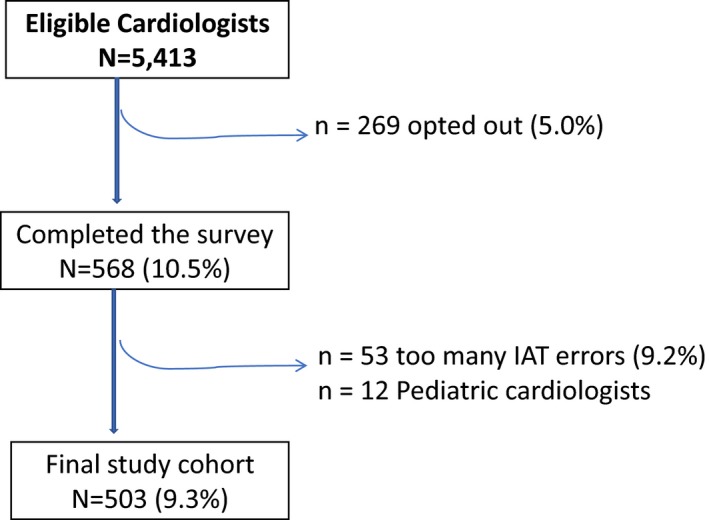
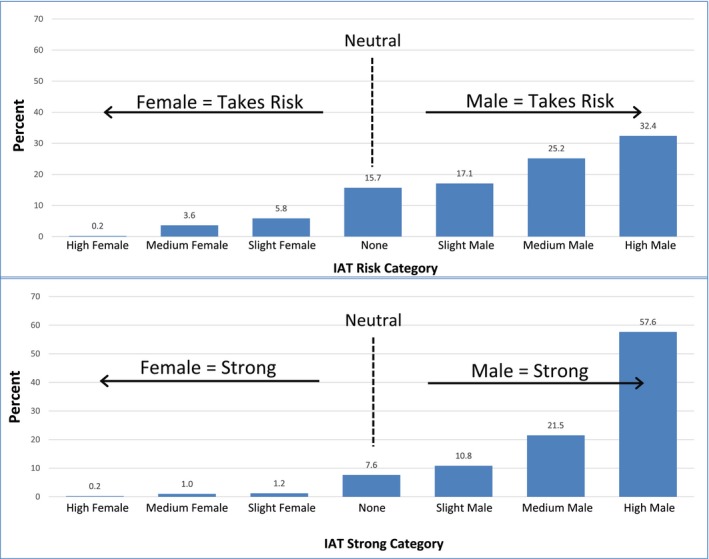
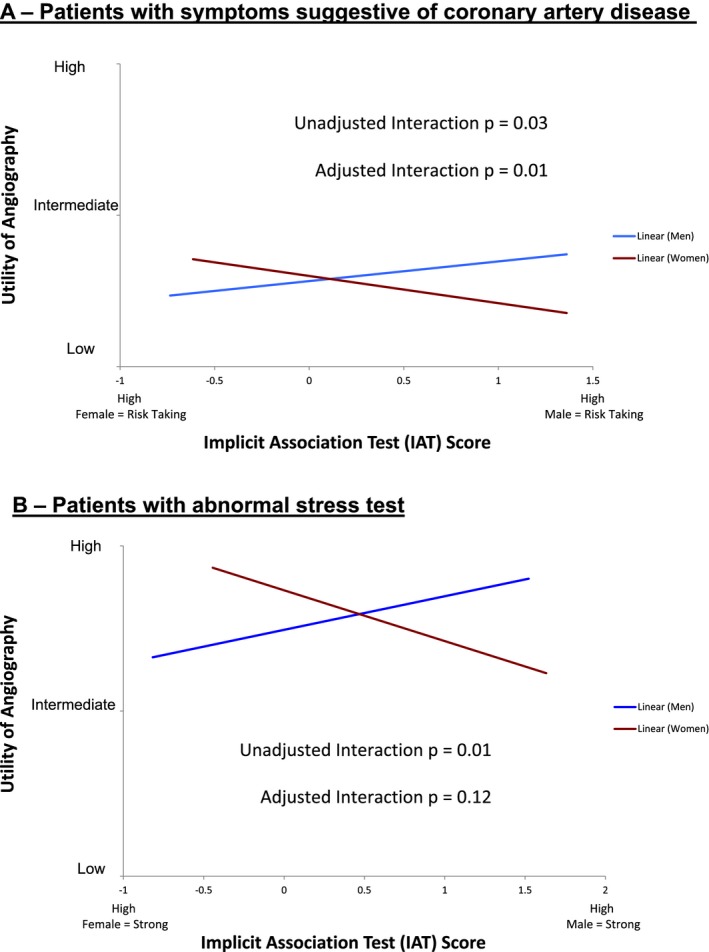
Background: Physicians' gender bias may contribute to gender disparities in cardiovascular testing. We used the Implicit Association Test to examine the association of implicit gender biases with decisions to use cardiovascular tests. Methods and Results: In 2014, cardiologists completed Implicit Association Tests and a clinical vignette with patient gender randomly assigned. The Implicit Association Tests measured implicit gender bias for the characteristics of strength and risk taking. The vignette represented an intermediate likelihood of coronary artery disease regardless of patient gender: chest pain (part 1) followed by an abnormal exercise treadmill test (part 2). Cardiologists rated the likelihood of coronary artery disease and the usefulness of stress testing and angiography for the assigned patient. Of the 503 respondents (9.3% of eligible; 87% male, median age of 45 years, 58% in private practice), the majority associated strength or risk taking implicitly with male more than female patients. The estimated likelihood of coronary artery disease for both parts of the vignette was similar by patient gender. The utility of secondary stress testing after an abnormal exercise treadmill test was rated as “high” more often for female than male patients (32.8% versus 24.3%, P =0.04); this difference did not vary with implicit bias. Angiography was more consistently rated as having “high” utility for male versus female patients (part 1: 19.7% versus 9.8%; part 2: 73.7% versus 64.3%; P <0.05 for both); this difference was larger for cardiologists with higher implicit gender bias on risk taking ( P =0.01). Conclusions: Cardiologists have varying degrees of implicit gender bias. This bias explained some, but not all, of the gender variability in simulated clinical decision‐making for suspected coronary artery disease.
Overview
The claims and statistics of this paper haven’t been checked yet.
Run the check — free, no account needed. It reads the open-access text and checks the sources it cites.
Integrity signals
Registry
Cites
Statistics
Figures
Verification
Claims the paper makes
The claims and statistics of this paper haven’t been checked yet.
Run the check — free, no account needed. It reads the open-access text and checks the sources it cites.
Claims other papers make about this one
Each is checked against this paper’s own text: does it say what the citing paper says it does?
In the citing paper
“Indeed, physicians are typically trained to recognise patterns of angina and myocardial infarction that occur more frequently in men, resulting in women being typically under-diagnosed for coronary artery disease115.”
From Sex and gender differences and biases in artificial intelligence for biomedicine and healthcare (2020) · cites this paper as [115]
Self-check
Percentages, sums and reported differences re-computed from the paper’s own numbers.
The self-check needs the paper’s full text.
Citations
Cites
Measuring individual differences in implicit cognition: the implicit association test
Greenwald, A. G., McGhee, D. E., & Schwartz, J. L. K. (1998) · Journal of Personality and Social Psychology · doi:10.1037/0022-3514.74.6.1464 · Cited by 9,210
Implicit social cognition: Attitudes, self-esteem, and stereotypes
Greenwald, A. G., & Banaji, M. R. (1995) · Psychological Review · doi:10.1037/0033-295x.102.1.4 · Cited by 6,682
Understanding and using the Implicit Association Test: I. An improved scoring algorithm.
Greenwald, A. G., Nosek, B. A., & Banaji, M. R. (2003) · Journal of Personality and Social Psychology · doi:10.1037/0022-3514.85.2.197 · Cited by 5,815
Stereotypes and prejudice: Their automatic and controlled components
Devine, P. G. (1989) · Journal of Personality and Social Psychology · doi:10.1037/0022-3514.56.1.5 · Cited by 5,673
Understanding and using the Implicit Association Test: III. Meta-analysis of predictive validity.
Greenwald, A. G., Poehlman, T. A., Uhlmann, E. L., & Banaji, M. R. (2009) · Journal of Personality and Social Psychology · doi:10.1037/a0015575 · Cited by 3,257
ACC/AHA 2002 Guideline Update for Exercise Testing: Summary Article
Gibbons, R. J., Balady, G. J., Bricker, J. T., CHAITMAN, B. R., Fletcher, G. F., Froelicher, V. F., Mark, D. B., McCallister, B. D., Mooss, A. N., O’Reilly, M. G., et al. (2002) · Circulation · doi:10.1161/01.cir.0000034670.06526.15 · Cited by 2,583
Implicit bias in healthcare professionals: a systematic review
FitzGerald, C., & Hurst, S. (2017) · BMC Medical Ethics · doi:10.1186/s12910-017-0179-8 · Cited by 2,556
The Effect of Race and Sex on Physicians' Recommendations for Cardiac Catheterization
Schulman, K. A., Berlin, J. A., Harless, W., Kerner, J. F., Sistrunk, S., Gersh, B. J., Dubé, R., Taleghani, C. K., Burke, J. E., Williams, S., et al. (1999) · New England Journal of Medicine · doi:10.1056/nejm199902253400806 · Cited by 1,934
Prescriptive Gender Stereotypes and Backlash Toward Agentic Women
Rudman, L. A., & Glick, P. (2001) · Journal of Social Issues · doi:10.1111/0022-4537.00239 · Cited by 1,881
Gender stereotypes stem from the distribution of women and men into social roles.
Eagly, A. H., & Steffen, V. J. (1984) · Journal of Personality and Social Psychology · doi:10.1037/0022-3514.46.4.735 · Cited by 1,848
Research works printed but not linked: 1
- Smedley BD, Stith AY, Nelson AR. Committee on Understanding and Eliminating Racial and Ethnic Disparities in Health Care, Board on Health Sciences Policy, and Institute of Medicine, Unequal Treatment: Confronting Racial and Ethnic Disparities in Health Care. Washington, DC: The National Academies Press; 2003.
Cited by
Sorted by citations
Sex and gender differences and biases in artificial intelligence for biomedicine and healthcare
Cirillo, D., Catuara-Solarz, S., Morey, C., Guney, E., Subirats, L., Mellino, S., Gigante, A., Valencia, A., Rementeria, M. J., Chadha, A. S., et al. (2020) · npj Digital Medicine · doi:10.1038/s41746-020-0288-5 · Cited by 553
Zack, T., Lehman, E., Suzgun, M., Rodriguez, J. A., Celi, L. A., Gichoya, J., Jurafsky, D., Szolovits, P., Bates, D. W., Abdulnour, R.-E. E., et al. (2024) · The Lancet Digital Health · doi:10.1016/s2589-7500(23)00225-x · Cited by 510
Cardiovascular Disease and the Female Disadvantage
Woodward, M. (2019) · International Journal of Environmental Research and Public Health · doi:10.3390/ijerph16071165 · Cited by 329
Eberly, L. A., Richterman, A., Beckett, A. G., Wispelwey, B., Marsh, R. H., Cleveland Manchanda, E. C., Chang, C. Y., Glynn, R. J., Brooks, K. C., Boxer, R., et al. (2019) · Circulation: Heart Failure · doi:10.1161/circheartfailure.119.006214 · Cited by 189
Association of Gender and Race With Allocation of Advanced Heart Failure Therapies
Breathett, K. K., Yee, E., Pool, N. M., Hebdon, M., Crist, J. D., Yee, R., Knapp, S. M., Solola, S., Luy, L. P., Herrera‐Theut, K., et al. (2020) · JAMA Network Open · doi:10.1001/jamanetworkopen.2020.11044 · Cited by 153
Metadata
- Authors
- Daugherty, S. L., Blair, I. V., Havranek, E. P., Furniss, A., Dickinson, L. M., Karimkhani, E., Main, D. S., & Masoudi, F. A.
- Affiliations
- University of Colorado Anschutz (US)
- University of Colorado Boulder (US)
- Denver Health Medical Center (US)
- University of Colorado Denver (US)
- Corresponding author
- Daugherty, Stacie L.
- ORCID
- Venue
- Journal of the American Heart Association
- Published
- 2017-12-02
- Volume
- 6
- Issue
- 12
- ISSN
- 2047-9980 (ISSN-L)
- PMC
- PMC5779009
- OpenAlex
- W2769597399
- Cited by
- 150
- References
- 66
- Citations by year
- 2026: 10 · 2025: 17 · 2024: 18 · 2023: 21 · 2022: 27 · 2021: 30 · 2020: 18 · 2019: 7 · 2018: 2
- FWCI
- 6.93
- Type
- journal article
- Language
- en
- Open access
- gold
- doi.org
- Licence
- cc-by-nc
- Locations
- Journal of the American Heart Association (publishedVersion, cc-by-nc)
- PubMed Central (publishedVersion, cc-by-nc)
- PubMed (publishedVersion)
- CU Scholar (University of Colorado Boulder) (submittedVersion, cc-by-nd)
- DOAJ (DOAJ: Directory of Open Access Journals) (submittedVersion)
- Funders
- National Heart, Lung, and Blood Institute (R01HL133343, K08HL103776)
- Topics
- Health Sciences › Medicine › Public Health, Environmental and Occupational Health › Sex and Gender in Healthcare
- Social Sciences › Gender Studies › Diversity and Career in Medicine
- Health Sciences › Medicine › Family Practice › Clinical Reasoning and Diagnostic Skills
- Keywords
- implicit gender bias, gender disparities, cardiovascular testing, cardiologists, coronary artery disease, stress testing, angiography, treadmill exercise testing, clinical decision-making, Implicit Association Test, patient gender
- MeSH terms
- Clinical Decision-Making, Cardiologists, Exercise Test, Humans, Sex Factors, United States, Sex Distribution, Healthcare Disparities
About these checks
Registry, retraction, Cites and statistics results are computed, not judged, with one exception: a printed reference that no index lists is read once by a model before it counts as a citation error. Claims are extracted by a model and kept only when their quote appears verbatim in the text; each cited source is then checked, with a model’s help, for whether it says what the claim relies on. Those verdicts can be wrong — read the claim’s quote and the cited source before relying on one.
Statistics and arithmetic are recomputed, not judged.
Confidence bands are shown only for fields calibrated on our annotated test set. None is calibrated yet, so no band is shown.
What counts as a claim ›How we measure confidence ›How we check this ›
Are you an author, or do you see a problem with this page? Request a review
