

The DOI matches its Crossref record; 64 of the 66 references it cites were found in a registry or an index.
Implicit Gender Bias and the Use of Cardiovascular Tests Among Cardiologists
Open accessAbstract
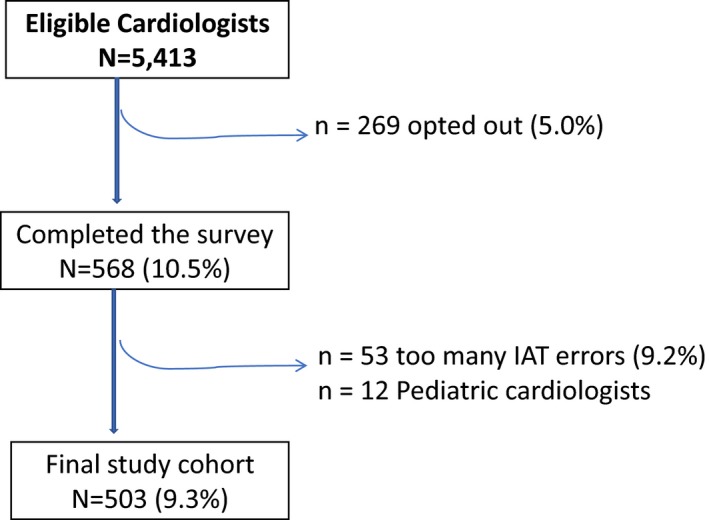
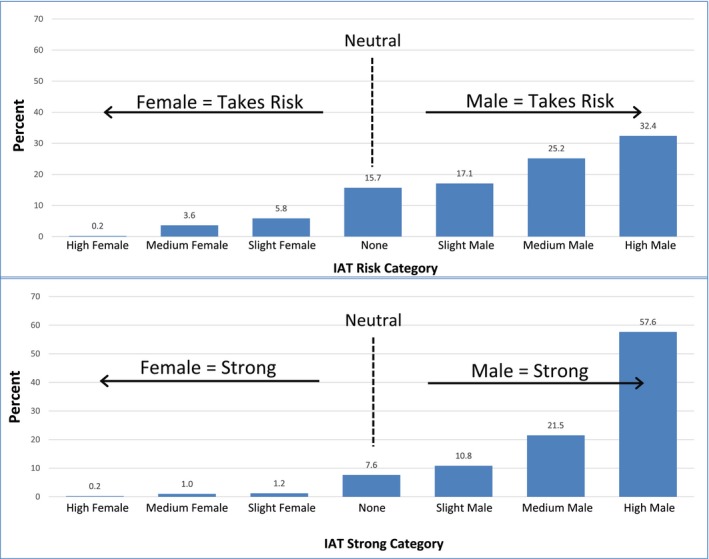
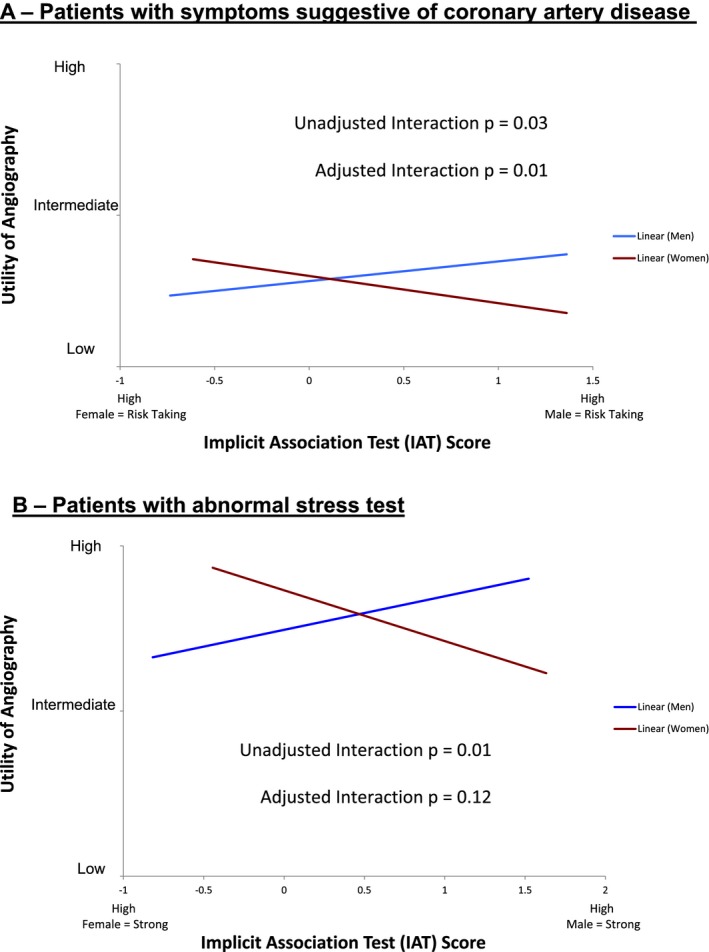
Background: Physicians' gender bias may contribute to gender disparities in cardiovascular testing. We used the Implicit Association Test to examine the association of implicit gender biases with decisions to use cardiovascular tests. Methods and Results: In 2014, cardiologists completed Implicit Association Tests and a clinical vignette with patient gender randomly assigned. The Implicit Association Tests measured implicit gender bias for the characteristics of strength and risk taking. The vignette represented an intermediate likelihood of coronary artery disease regardless of patient gender: chest pain (part 1) followed by an abnormal exercise treadmill test (part 2). Cardiologists rated the likelihood of coronary artery disease and the usefulness of stress testing and angiography for the assigned patient. Of the 503 respondents (9.3% of eligible; 87% male, median age of 45 years, 58% in private practice), the majority associated strength or risk taking implicitly with male more than female patients. The estimated likelihood of coronary artery disease for both parts of the vignette was similar by patient gender. The utility of secondary stress testing after an abnormal exercise treadmill test was rated as “high” more often for female than male patients (32.8% versus 24.3%, P =0.04); this difference did not vary with implicit bias. Angiography was more consistently rated as having “high” utility for male versus female patients (part 1: 19.7% versus 9.8%; part 2: 73.7% versus 64.3%; P <0.05 for both); this difference was larger for cardiologists with higher implicit gender bias on risk taking ( P =0.01). Conclusions: Cardiologists have varying degrees of implicit gender bias. This bias explained some, but not all, of the gender variability in simulated clinical decision‐making for suspected coronary artery disease.
Overview
The claims and statistics of this paper haven’t been checked yet.
Run the check — free, no account needed. It reads the open-access text and checks the sources it cites.
Integrity signals
Registry
Cites
Statistics
Figures
Verification
Claims the paper makes
The claims and statistics of this paper haven’t been checked yet.
Run the check — free, no account needed. It reads the open-access text and checks the sources it cites.
Claims other papers make about this one
Each is checked against this paper’s own text: does it say what the citing paper says it does?
In the citing paper
“Indeed, physicians are typically trained to recognise patterns of angina and myocardial infarction that occur more frequently in men, resulting in women being typically under-diagnosed for coronary artery disease115.”
From Sex and gender differences and biases in artificial intelligence for biomedicine and healthcare (2020) · cites this paper as [115]
Self-check
Percentages, sums and reported differences re-computed from the paper’s own numbers.
The self-check needs the paper’s full text.
Citations
Cites
Measuring individual differences in implicit cognition: the implicit association test
Greenwald, A. G., McGhee, D. E., & Schwartz, J. L. K. (1998) · Journal of Personality and Social Psychology · doi:10.1037/0022-3514.74.6.1464 · Cited by 9,210
Implicit social cognition: Attitudes, self-esteem, and stereotypes
Greenwald, A. G., & Banaji, M. R. (1995) · Psychological Review · doi:10.1037/0033-295x.102.1.4 · Cited by 6,682
Understanding and using the Implicit Association Test: I. An improved scoring algorithm.
Greenwald, A. G., Nosek, B. A., & Banaji, M. R. (2003) · Journal of Personality and Social Psychology · doi:10.1037/0022-3514.85.2.197 · Cited by 5,815
Stereotypes and prejudice: Their automatic and controlled components
Devine, P. G. (1989) · Journal of Personality and Social Psychology · doi:10.1037/0022-3514.56.1.5 · Cited by 5,673
Understanding and using the Implicit Association Test: III. Meta-analysis of predictive validity.
Greenwald, A. G., Poehlman, T. A., Uhlmann, E. L., & Banaji, M. R. (2009) · Journal of Personality and Social Psychology · doi:10.1037/a0015575 · Cited by 3,257
ACC/AHA 2002 Guideline Update for Exercise Testing: Summary Article
Gibbons, R. J., Balady, G. J., Bricker, J. T., CHAITMAN, B. R., Fletcher, G. F., Froelicher, V. F., Mark, D. B., McCallister, B. D., Mooss, A. N., O’Reilly, M. G., et al. (2002) · Circulation · doi:10.1161/01.cir.0000034670.06526.15 · Cited by 2,583
Implicit bias in healthcare professionals: a systematic review
FitzGerald, C., & Hurst, S. (2017) · BMC Medical Ethics · doi:10.1186/s12910-017-0179-8 · Cited by 2,556
The Effect of Race and Sex on Physicians' Recommendations for Cardiac Catheterization
Schulman, K. A., Berlin, J. A., Harless, W., Kerner, J. F., Sistrunk, S., Gersh, B. J., Dubé, R., Taleghani, C. K., Burke, J. E., Williams, S., et al. (1999) · New England Journal of Medicine · doi:10.1056/nejm199902253400806 · Cited by 1,934
Prescriptive Gender Stereotypes and Backlash Toward Agentic Women
Rudman, L. A., & Glick, P. (2001) · Journal of Social Issues · doi:10.1111/0022-4537.00239 · Cited by 1,881
Gender stereotypes stem from the distribution of women and men into social roles.
Eagly, A. H., & Steffen, V. J. (1984) · Journal of Personality and Social Psychology · doi:10.1037/0022-3514.46.4.735 · Cited by 1,848
Green, A. R., Carney, D. R., Pallin, D. J., Ngo, L. H., Raymond, K. L., Iezzoni, L. I., & Banaji, M. R. (2007) · Journal of General Internal Medicine · doi:10.1007/s11606-007-0258-5 · Cited by 1,460
Harvesting implicit group attitudes and beliefs from a demonstration web site.
Nosek, B. A., Banaji, M. R., & Greenwald, A. G. (2002) · Group Dynamics: Theory, Research, and Practice · doi:10.1037/1089-2699.6.1.101 · Cited by 1,321
On the Nature of Prejudice: Automatic and Controlled Processes
Dovidio, J. F., Kawakami, K., Johnson, C., Johnson, B., & Howard, A. (1997) · Journal of Experimental Social Psychology · doi:10.1006/jesp.1997.1331 · Cited by 1,270
A lifespan database of adult facial stimuli
Minear, M. E., & Park, D. C. (2004) · Behavior Research Methods, Instruments, & Computers · doi:10.3758/bf03206543 · Cited by 1,227
Understanding and Using the Implicit Association Test: II. Method Variables and Construct Validity
Nosek, B. A., Greenwald, A. G., & Banaji, M. R. (2004) · Personality and Social Psychology Bulletin · doi:10.1177/0146167204271418 · Cited by 1,216
Differences in the use of procedures between women and men hospitalized for coronary heart disease
Ayanian, J. Z., & Epstein, A. M. (1991) · New England Journal of Medicine · doi:10.1056/nejm199107253250401 · Cited by 1,188
The Malleability of Automatic Stereotypes and Prejudice
Blair, I. V. (2002) · Personality and Social Psychology Review · doi:10.1207/s15327957pspr0603_8 · Cited by 1,152 · cited 1×
“Implicit bias is modifiable in experimental settings using counterstereotyping exercises; however, these methods have not been applied in a clinical setting.(61) Furthermore, changing bias among all healthcare professionals is an ambitious task.”
MethodSelf-citationExploring physician specialist response rates to web-based surveys
Cunningham, C. T., Quan, H., Hemmelgarn, B., Noseworthy, T., Beck, C. A., Dixon, E., Samuel, S., Ghali, W. A., Sykes, L. L., & Jetté, N. (2015) · BMC Medical Research Methodology · doi:10.1186/s12874-015-0016-z · Cited by 995
Implicit attitude measures: Consistency, stability, and convergent validity
Cunningham, W. A., Preacher, K. J., & Banaji, M. R. (2001) · Psychological Science · doi:10.1111/1467-9280.00328 · Cited by 968
Physician response to surveys A review of the literature
Kellerman, S. (2001) · American Journal of Preventive Medicine · doi:10.1016/s0749-3797(00)00258-0 · Cited by 956
Sex Differences in the Management of Coronary Artery Disease
Steingart, R. M., Packer, M., Hamm, P., Coglianese, M. E., Gersh, B. J., Geltman, E. M., Sollano, J., Katz, S., Moyé, L., Basta, L. L., et al. (1991) · New England Journal of Medicine · doi:10.1056/nejm199107253250402 · Cited by 898
Cooper, L. A., Roter, D. L., Carson, K. A., Beach, M. C., Sabin, J. A., Greenwald, A. G., & Inui, T. S. (2012) · American Journal of Public Health · doi:10.2105/ajph.2011.300558 · Cited by 815
Gender Stereotypes and Attitudes Toward Women and Men
Eagly, A. H., & Mladinic, A. (1989) · Personality and Social Psychology Bulletin · doi:10.1177/0146167289154008 · Cited by 785
Advancing Health Disparities Research Within the Health Care System: A Conceptual Framework
Kilbourne, A. M., Switzer, G., Hyman, K., Crowley-Matoka, M., & Fine, M. J. (2006) · American Journal of Public Health · doi:10.2105/ajph.2005.077628 · Cited by 761
Measurement Errors in Surveys.
Vogel, F. A., Biemer, P. P., Groves, R. M., Lyberg, L. E., Mathiowetz, N. A., & Sudman, S. (1992) · Journal of the American Statistical Association · doi:10.2307/2290676 · Cited by 697
Women and Ischemic Heart Disease
Shaw, L. J., Bugiardini, R., & Merz, C. N. B. (2009) · Journal of the American College of Cardiology · doi:10.1016/j.jacc.2009.04.098 · Cited by 669
Blomkalns, A. L., Chen, A. Y., Hochman, J. S., Peterson, E. D., Trynosky, K. J., Diercks, D. B., Brogan, G. X., Boden, W. E., Roe, M. T., Ohman, E. M., et al. (2005) · Journal of the American College of Cardiology · doi:10.1016/j.jacc.2004.11.055 · Cited by 652
Implicit Measures of Attitudes
Stacks, D. W. (2007) · Journalism & Mass Communication Quarterly · Cited by 556
Reducing Racial Bias Among Health Care Providers: Lessons from Social-Cognitive Psychology
Burgess, D., van Ryn, M., Dovidio, J., & Saha, S. (2007) · Journal of General Internal Medicine · doi:10.1007/s11606-007-0160-1 · Cited by 495
Measurement Errors in Surveys.
Tanur, J. M., Biemer, P. P., Groves, R. M., Lyberg, L. E., Mathiowetz, N. A., & Sudman, S. (1993) · Contemporary Sociology A Journal of Reviews · doi:10.2307/2074470 · Cited by 492
Research on the Provider Contribution to Race/Ethnicity Disparities in Medical Care
van Ryn, M. (2002) · Medical Care · doi:10.1097/00005650-200201001-00015 · Cited by 489
Sex Bias in Considering Coronary Bypass Surgery
Tobin, J. N., WASSERTHEIL-SMOLLER, S., WEXLER, J. P., STEINGART, R. M., BUDNER, N., LENSE, L., & WACHSPRESS, J. (1987) · Annals of Internal Medicine · doi:10.7326/0003-4819-107-1-19 · Cited by 488
Physicians’ Implicit and Explicit Attitudes About Race by MD Race, Ethnicity, and Gender
Sabin, J. A., Nosek, B. A., Greenwald, A. G., & Rivara, F. P. (2009) · Journal of Health Care for the Poor and Underserved · doi:10.1353/hpu.0.0185 · Cited by 472
Zestcott, C. A., Blair, I. V., & Stone, J. (2016) · Group Processes & Intergroup Relations · doi:10.1177/1368430216642029 · Cited by 381 · cited 3×
“The IAT has been used to measure race/ethnicity bias and has predicts behavior including physicians’ treatment recommendations for hypothetical patients.(28,34) Although the IAT has been used to measure implicit gender bias in career and educational roles,(35,36) no study has examined the association between implicit…”
BackgroundMethodSelf-citationShaw, L. J., Miller, D. D., Romeis, J. C., Kargl, D., Younis, L. T., & CHAITMAN, B. R. (1994) · Annals of Internal Medicine · doi:10.7326/0003-4819-120-7-199404010-00005 · Cited by 350
Hamberg, K. (2008) · Women s Health · doi:10.2217/17455057.4.3.237 · Cited by 335
Prejudice, clinical uncertainty and stereotyping as sources of health disparities
Balsa, A. I., & McGuire, T. G. (2003) · Journal of Health Economics · doi:10.1016/s0167-6296(02)00098-x · Cited by 333
(2013) · Psychology Press eBooks · doi:10.4324/9781410605887 · Cited by 289
Social cognition: Categorical person perception
Macrae, C. N., & Bodenhausen, G. V. (2001) · British Journal of Psychology · doi:10.1348/000712601162059 · Cited by 286
Haider, A. H., Sexton, J., Sriram, N., Cooper, L. A., Efron, D. T., Swoboda, S., Villegas, C. V., Haut, E. R., Bonds, M., Pronovost, P. J., et al. (2011) · JAMA · doi:10.1001/jama.2011.1248 · Cited by 274
Implicit measures of attitudes.
Wittenbrink, B., & Schwarz, N. (2007) · Cited by 260
Mieres, J. H., Gulati, M., Merz, C. N. B., Berman, D. S., Gerber, T. C., Hayes, S. N., Kramer, C. M., Min, J. K., Newby, L. K., Nixon, J., et al. (2014) · Circulation · doi:10.1161/cir.0000000000000061 · Cited by 245
Smyth, F. L., & Nosek, B. A. (2015) · Frontiers in Psychology · doi:10.3389/fpsyg.2015.00415 · Cited by 170
A theoretical model for analysing gender bias in medicine
Risberg, G., Johansson, E. E., & Hamberg, K. (2009) · International Journal for Equity in Health · doi:10.1186/1475-9276-8-28 · Cited by 166
Hamberg, K., Risberg, G., Johansson, E. E., & Westman, G. A. (2002) · Journal of Women s Health & Gender-Based Medicine · doi:10.1089/152460902760360595 · Cited by 164
Flanigan, T. S., McFarlane, E., & Cook, S. (2008) · Cited by 160
Blair, I. V., Havranek, E. P., Price, D. W., Hanratty, R., Fairclough, D. L., Farley, T., Hirsh, H. K., & Steiner, J. F. (2013) · American Journal of Public Health · doi:10.2105/ajph.2012.300812 · Cited by 160
Self-citationWhen Does A Difference Become A Disparity? Conceptualizing Racial And Ethnic Disparities In Health
Hebert, P. L., Sisk, J. E., & Howell, E. A. (2008) · Health Affairs · doi:10.1377/hlthaff.27.2.374 · Cited by 157
Cognitive Laboratory Methods: A Taxonomy
Forsyth, B., & Lessler, J. T. (2004) · Wiley series in probability and statistics · doi:10.1002/9781118150382.ch20 · Cited by 150
Evolution of Gender Stereotypes in Spain: Traits and Roles
López-Sáez, M., Morales, J. F., & Lisbona, A. (2008) · The Spanish Journal of Psychology · doi:10.1017/s1138741600004613 · Cited by 133
Differences, Disparities, and Biases: Clarifying Racial Variations in Health Care Use
Rathore, S. S., & Krumholz, H. M. (2004) · Annals of Internal Medicine · doi:10.7326/0003-4819-141-8-200410190-00011 · Cited by 120
Maserejian, N. N., Link, C. L., Lutfey, K. L., Marceau, L. D., & McKinlay, J. B. (2009) · Journal of Women's Health · doi:10.1089/jwh.2008.1007 · Cited by 116
Chang, A. M., Mumma, B. E., Sease, K. L., Robey, J. L., Shofer, F. S., & Hollander, J. E. (2007) · Academic Emergency Medicine · doi:10.1197/j.aem.2007.03.1355 · Cited by 115
Physicians' attitudes toward preventive therapy for coronary artery disease: Is there a gender bias?
Abuful, A., Gidron, Y., & Henkin, Y. (2005) · Clinical Cardiology · doi:10.1002/clc.4960280809 · Cited by 101
Miller, T. D., Roger, V. L., Hodge, D. O., Hopfenspirger, M. R., Bailey, K. R., & Gibbons, R. J. (2001) · Journal of the American College of Cardiology · doi:10.1016/s0735-1097(01)01413-9 · Cited by 88
Survey Results: A Decade of Change in Professional Life in Cardiology
Poppas, A., Cummings, J. E., Dorbala, S., Douglas, P. S., Foster, E., & Limacher, M. C. (2008) · Journal of the American College of Cardiology · doi:10.1016/j.jacc.2008.09.008 · Cited by 57
Racial and sex differences in refusal of coronary angiography
Heidenreich, P. A., Shlipak, M. G., Geppert, J., & McClellan, M. (2002) · The American Journal of Medicine · doi:10.1016/s0002-9343(02)01221-4 · Cited by 50
Lutfey, K. E., Link, C. L., Marceau, L. D., Grant, R. W., Adams, A., Arber, S., Siegrist, J., Bönte, M., von dem Knesebeck, O., & McKinlay, J. B. (2009) · Medical Decision Making · doi:10.1177/0272989x09331811 · Cited by 37
Sanghavi, M. (2013) · Circulation Cardiovascular Quality and Outcomes · doi:10.1161/circoutcomes.113.000449 · Cited by 19
Hlatky, M. A., & Shaw, L. J. (2015) · Journal of the American College of Cardiology · doi:10.1016/j.jacc.2015.11.002 · Cited by 18
The relationship between gender and clinical management after exercise stress testing
Daugherty, S. L., Peterson, P. N., Magid, D. J., Ho, P. M., Bondy, J., Hokanson, J. E., Ross, C. A., Rumsfeld, J. S., & Masoudi, F. A. (2008) · American Heart Journal · doi:10.1016/j.ahj.2008.03.022 · Cited by 16
Self-citationUsing Patients’ Narratives to Reveal Gender Stereotypes Among Medical Students
Andersson, J., Salander, P., & Hamberg, K. (2013) · Academic Medicine · doi:10.1097/acm.0b013e318295b3fe · Cited by 13
All Else Being Equal, Men and Women Are Still Not the Same
Paulus, J. K., Shah, N. D., & Kent, D. M. (2015) · Circulation Cardiovascular Quality and Outcomes · doi:10.1161/circoutcomes.115.001842 · Cited by 10
Do Sex Differences Exist in Patient Preferences for Cardiovascular Testing?
Daugherty, S. L., & Magid, D. J. (2011) · Annals of Emergency Medicine · doi:10.1016/j.annemergmed.2011.01.010 · Cited by 5
Self-citation
Research works printed but not linked: 1
- Smedley BD, Stith AY, Nelson AR. Committee on Understanding and Eliminating Racial and Ethnic Disparities in Health Care, Board on Health Sciences Policy, and Institute of Medicine, Unequal Treatment: Confronting Racial and Ethnic Disparities in Health Care. Washington, DC: The National Academies Press; 2003.
Cited by
Sorted by citations
Sex and gender differences and biases in artificial intelligence for biomedicine and healthcare
Cirillo, D., Catuara-Solarz, S., Morey, C., Guney, E., Subirats, L., Mellino, S., Gigante, A., Valencia, A., Rementeria, M. J., Chadha, A. S., et al. (2020) · npj Digital Medicine · doi:10.1038/s41746-020-0288-5 · Cited by 553
Zack, T., Lehman, E., Suzgun, M., Rodriguez, J. A., Celi, L. A., Gichoya, J., Jurafsky, D., Szolovits, P., Bates, D. W., Abdulnour, R.-E. E., et al. (2024) · The Lancet Digital Health · doi:10.1016/s2589-7500(23)00225-x · Cited by 510
Cardiovascular Disease and the Female Disadvantage
Woodward, M. (2019) · International Journal of Environmental Research and Public Health · doi:10.3390/ijerph16071165 · Cited by 329
Eberly, L. A., Richterman, A., Beckett, A. G., Wispelwey, B., Marsh, R. H., Cleveland Manchanda, E. C., Chang, C. Y., Glynn, R. J., Brooks, K. C., Boxer, R., et al. (2019) · Circulation: Heart Failure · doi:10.1161/circheartfailure.119.006214 · Cited by 189
Association of Gender and Race With Allocation of Advanced Heart Failure Therapies
Breathett, K. K., Yee, E., Pool, N. M., Hebdon, M., Crist, J. D., Yee, R., Knapp, S. M., Solola, S., Luy, L. P., Herrera‐Theut, K., et al. (2020) · JAMA Network Open · doi:10.1001/jamanetworkopen.2020.11044 · Cited by 153
Metadata
- Authors
- Daugherty, S. L., Blair, I. V., Havranek, E. P., Furniss, A., Dickinson, L. M., Karimkhani, E., Main, D. S., & Masoudi, F. A.
- Affiliations
- University of Colorado Anschutz (US)
- University of Colorado Boulder (US)
- Denver Health Medical Center (US)
- University of Colorado Denver (US)
- Corresponding author
- Daugherty, Stacie L.
- ORCID
- Venue
- Journal of the American Heart Association
- Published
- 2017-12-02
- Volume
- 6
- Issue
- 12
- ISSN
- 2047-9980 (ISSN-L)
- PMC
- PMC5779009
- OpenAlex
- W2769597399
- Cited by
- 150
- References
- 66
- Citations by year
- 2026: 10 · 2025: 17 · 2024: 18 · 2023: 21 · 2022: 27 · 2021: 30 · 2020: 18 · 2019: 7 · 2018: 2
- FWCI
- 6.93
- Type
- journal article
- Language
- en
- Open access
- gold
- doi.org
- Licence
- cc-by-nc
- Locations
- Journal of the American Heart Association (publishedVersion, cc-by-nc)
- PubMed Central (publishedVersion, cc-by-nc)
- PubMed (publishedVersion)
- CU Scholar (University of Colorado Boulder) (submittedVersion, cc-by-nd)
- DOAJ (DOAJ: Directory of Open Access Journals) (submittedVersion)
- Funders
- National Heart, Lung, and Blood Institute (R01HL133343, K08HL103776)
- Topics
- Health Sciences › Medicine › Public Health, Environmental and Occupational Health › Sex and Gender in Healthcare
- Social Sciences › Gender Studies › Diversity and Career in Medicine
- Health Sciences › Medicine › Family Practice › Clinical Reasoning and Diagnostic Skills
- Keywords
- implicit gender bias, gender disparities, cardiovascular testing, cardiologists, coronary artery disease, stress testing, angiography, treadmill exercise testing, clinical decision-making, Implicit Association Test, patient gender
- MeSH terms
- Clinical Decision-Making, Cardiologists, Exercise Test, Humans, Sex Factors, United States, Sex Distribution, Healthcare Disparities
About these checks
Registry, retraction, Cites and statistics results are computed, not judged, with one exception: a printed reference that no index lists is read once by a model before it counts as a citation error. Claims are extracted by a model and kept only when their quote appears verbatim in the text; each cited source is then checked, with a model’s help, for whether it says what the claim relies on. Those verdicts can be wrong — read the claim’s quote and the cited source before relying on one.
Statistics and arithmetic are recomputed, not judged.
Confidence bands are shown only for fields calibrated on our annotated test set. None is calibrated yet, so no band is shown.
What counts as a claim ›How we measure confidence ›How we check this ›
Are you an author, or do you see a problem with this page? Request a review
