

The DOI matches its Crossref record; 322 of the 322 references it cites were found in a registry or an index.
Can Large Language Models Transform Computational Social Science?
Open accessAbstract
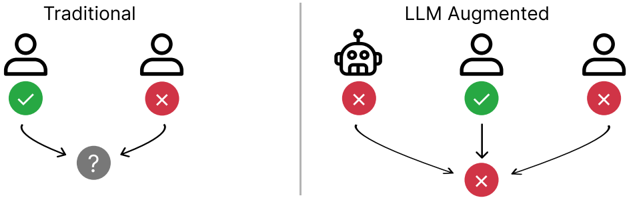
Large language models (LLMs) are capable of successfully performing many language processing tasks zero-shot (without training data). If zero-shot LLMs can also reliably classify and explain social phenomena like persuasiveness and political ideology, then LLMs could augment the computational social science (CSS) pipeline in important ways. This work provides a road map for using LLMs as CSS tools. Towards this end, we contribute a set of prompting best practices and an extensive evaluation pipeline to measure the zero-shot performance of 13 language models on 25 representative English CSS benchmarks. On taxonomic labeling tasks (classification), LLMs fail to outperform the best fine-tuned models but still achieve fair levels of agreement with humans. On free-form coding tasks (generation), LLMs produce explanations that often exceed the quality of crowdworkers’ gold references. We conclude that the performance of today’s LLMs can augment the CSS research pipeline in two ways: (1) serving as zero-shot data annotators on human annotation teams, and (2) bootstrapping challenging creative generation tasks (e.g., explaining the underlying attributes of a text). In summary, LLMs are posed to meaningfully participate in social science analysis in partnership with humans.
Overview
The claims and statistics of this paper haven’t been checked yet.
Free: it reads the open-access text and checks the first 5 claims that cite a source we can check. Create a free account to check every claim.
Integrity signals
Registry
Cites
Statistics
Figures
Verification
Claims the paper makes
The claims and statistics of this paper haven’t been checked yet.
Free: it reads the open-access text and checks the first 5 claims that cite a source we can check. Create a free account to check every claim.
Claims other papers make about this one
Each is checked against this paper’s own text: does it say what the citing paper says it does?
The source backs part of the claim, not all of it — or backs it for a different population, condition or comparison.
In the citing paper
“For the domain of psychology, LLM-based agents can be leveraged for conducting simulation experiments, providing mental health support and so on [102-105].”
From A survey on large language model based autonomous agents (2024) · cites this paper as [105]
Experimental — accuracy not yet measuredThe source backs part of the claim, not all of it — or backs it for a different population, condition or comparison.
In the citing paper
“Research assistant: Beyond their application in specialized domains, LLM-based agents are increasingly adopted as versatile assistants in the broad field of social science research [105,114].”
From A survey on large language model based autonomous agents (2024) · cites this paper as [105]
Experimental — accuracy not yet measuredThe source backs part of the claim, not all of it — or backs it for a different population, condition or comparison.
In the citing paper
“Political science and economy: LLM-based agents can also be utilized to study political science and economy [29,105,106].”
From A survey on large language model based autonomous agents (2024) · cites this paper as [105]
Experimental — accuracy not yet measuredThe cited source says what the claim attributes to it.
In the citing paper
“Researchers have also recently noted GPT’s ability to help with computational social science tasks (49–54), detect misinformation (55), infer politicians’ ideologies (56), write persuasive political arguments (57), respond to patient questions (58), simulate human research participants (59–61), and model collective behavior (56).”
From GPT is an effective tool for multilingual psychological text analysis (2024) · cites this paper as [49]
Self-check
Percentages, sums and reported differences re-computed from the paper’s own numbers.
The self-check needs the paper’s full text.
Citations
Cites
Language Models are Few-Shot Learners
Brown, T. B., Mann, B., Ryder, N., Subbiah, M., Kaplan, J., Dhariwal, P., Neelakantan, A., Shyam, P., Sastry, G., Askell, A., et al. (2020) · arXiv · doi:10.48550/arxiv.2005.14165 · Cited by 23,372
The Structure of Scientific Revolutions: 50th Anniversary Edition
Kuhn, T. S., & Hacking, I. (2012) · doi:10.7208/chicago/9780226458144.001.0001 · Cited by 21,170
RoBERTa: A Robustly Optimized BERT Pretraining Approach
Liu, Y., Ott, M., Goyal, N., Du, J., Joshi, M., Chen, D., Levy, O., Lewis, M., Zettlemoyer, L., & Stoyanov, V. (2019) · arXiv · doi:10.48550/arxiv.1907.11692 · Cited by 16,515
Framing: toward clarification of a fractured paradigm
Entman, R. M. (1993) · Journal of Communication · doi:10.1111/j.1460-2466.1993.tb01304.x · Cited by 16,203 · cited 1×
“Political scientists study how political actors move agendas (Grimmer, 2010) by persuasively framing their discourse “to promote a particular problem definition, causal interpretation, moral evaluation, and/or treatment recommendation” (Entman, 1993).”
BackgroundExploring the Limits of Transfer Learning with a Unified Text-to-Text Transformer
Raffel, C., Shazeer, N., Roberts, A., Lee, K., Narang, S., Matena, M., Zhou, Y., Li, W., & Liu, P. J. (2019) · arXiv · doi:10.48550/arxiv.1910.10683 · Cited by 10,929
Politeness: Some Universals in Language Usage
Brown, P., Levinson, S. C., & Gumperz, J. J. (1987) · Cambridge University Press eBooks · doi:10.1017/cbo9780511813085 · Cited by 10,438
Scaling Laws for Neural Language Models
Kaplan, J., McCandlish, S., Henighan, T., Brown, T. B., Chess, B., Child, R., Gray, S., Radford, A., Wu, J., & Amodei, D. (2020) · arXiv · doi:10.48550/arxiv.2001.08361 · Cited by 9,550 · cited 1×
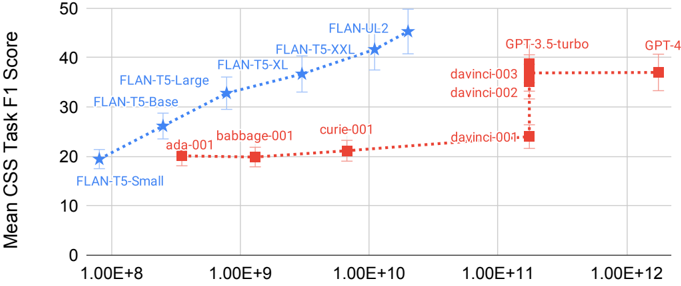
“LLMs generally follow scaling laws (Kaplan et al., 2020; Hoffmann et al., 2022) where performance increases with the size of the model and training data.”
BackgroundThe spread of true and false news online
Vosoughi, S., Roy, D., & Aral, S. (2018) · Science · doi:10.1126/science.aap9559 · Cited by 8,847 · cited 1×
“…analyses of social norms and conventions (Centola et al., 2018; Bicchieri, 2005), information diffusion (Leskovec et al., 2009; Tan et al., 2014; Vosoughi et al., 2018; Cheng et al., 2016), emotional contagion (Bail, 2016), collective behaviors (Barberá et al., 2015), and social movements…”
BackgroundSpeech Genres and Other Late Essays
Bakhtin, M. M. (1986) · University of Texas Press eBooks · doi:10.7560/720466 · Cited by 8,470
“Risk, Ambiguity, and the Savage Axioms.”
Ellsberg, D. (1961) · The Quarterly Journal of Economics · doi:10.2307/1884324 · Cited by 7,891
Research works printed but not linked: 17
- Ahmed, 2010, Staying informed: Supervised and semi-supervised multi-view topical analysis of ideological perspective, 1140
- Bamman, 2013, Learning latent personas of film characters, 352
- Cialdini, 2003, Influence
- Dang, 2005, Overview of DUC 2005, 1
- Egami, 2023, Using large language model annotations for valid downstream statistical inference in social science: Design-based semi-supervised learning, ArXiv preprint
- Eisenstein, 2011, Discovering sociolinguistic associations with structured sparsity, 1365
- Garfinkel, 2016, Studies in ethnomethodology, 85
- Gross, 2013, Testing the etch-a-sketch hypothesis: A computational analysis of Mitt Romney’s ideological makeover during the 2012 primary vs. general elections
- Herring, 1994, Politeness in computer culture: Why women thank and men flame, 278
- Kuhn, 1962, The Structure of Scientific Revolutions
- Luo, 2020, Detecting stance in media on global warming, 3296, 10.18653/v1/2020.findings-emnlp.296 · DOI
- Murray, 2015, Narrative psychology, Qualitative Psychology: A Practical Guide to Research Methods, 85
- Prabhakaran, 2012, Predicting overt display of power in written dialogs, 518
- Rothbaum, 2000, Cognitive-behavioral therapy, 320
- Sacks, 1992, Lectures on conversation: Volume I
- Zhuo, 2023, Exploring AI ethics of ChatGPT: A diagnostic analysis, ArXiv preprint
- Zong, 2022, A survey on GPT-3, ArXiv preprint
Cited by
A Survey on Evaluation of Large Language Models
Chang, Y., Wang, X., Wang, J., Wu, Y., Yang, L., Zhu, K., Chen, H., Yi, X., Wang, C., Wang, Y., et al. (2024) · ACM Transactions on Intelligent Systems and Technology · doi:10.1145/3641289 · Cited by 4,254
A Survey on Large Language Model based Autonomous Agents
Wang, L., Ma, C., Feng, X., Zhang, Z., Yang, H., Zhang, J., Chen, Z., Tang, J., Chen, X., Lin, Y., et al. (2023) · arXiv · doi:10.48550/arxiv.2308.11432 · Cited by 1,925
Self-citationA survey on large language model based autonomous agents
Wang, L., Ma, C., Feng, X., Zhang, Z., Yang, H., Zhang, J., Chen, Z., Tang, J., Chen, X., Lin, Y., et al. (2024) · Frontiers of Computer Science · doi:10.1007/s11704-024-40231-1 · Cited by 1,941
Self-citationThe Rise and Potential of Large Language Model Based Agents: A Survey
Xi, Z., Chen, W., Guo, X., He, W., Ding, Y., Hong, B., Zhang, M., Wang, J., Jin, S., Zhou, E., et al. (2023) · arXiv · doi:10.48550/arxiv.2309.07864 · Cited by 972
The rise and potential of large language model based agents: a survey
Xi, Z., Chen, W., Guo, X., He, W., Ding, Y., Hong, B., Zhang, M., Wang, J., Jin, S., Zhou, E., et al. (2025) · Science China Information Sciences · doi:10.1007/s11432-024-4222-0 · Cited by 970
Metadata
- Authors
- Ziems, C., Held, W., Shaikh, O., Chen, J., Zhang, Z., & Yang, D.
- Affiliations
- Stanford University (US)
- Georgia Institute of Technology (US)
- Dartmouth College (US)
- Venue
- Computational Linguistics
- Publisher
- MIT Press
- Published
- 2024
- Volume
- 50
- Issue
- 1
- Pages
- 237-291
- ISSN
- 0891-2017 (ISSN-L)
- 1530-9312
- OpenAlex
- W4389636360
- Semantic Scholar
- 93752cae0d4ecd2d09d6660feb3c1860af973f18
- Cited by
- 585
- References
- 311
- Citations by year
- 2026: 201 · 2025: 197 · 2024: 146
- FWCI
- 271.63
- Type
- journal article
- Language
- en
- Open access
- diamond
- doi.org
- Licence
- Locations
- Computational Linguistics (publishedVersion, cc-by-nc-nd)
- arXiv (Cornell University) (submittedVersion)
- DOAJ (DOAJ: Directory of Open Access Journals) (submittedVersion, cc-by-sa)
- arXiv (Cornell University)
- Funders
- National Science Foundation (2247357, 2308994, 2039655)
- Topics
- Social Sciences › General Social Sciences › Computational and Text Analysis Methods
- Physical Sciences › Computer Science › Artificial Intelligence › Topic Modeling
- Physical Sciences › Computer Science › Artificial Intelligence › Sentiment Analysis and Opinion Mining
- Keywords
- large language models, computational social science, zero-shot learning, persuasion detection, text classification, text generation, manual annotation, evaluation pipeline
About these checks
Registry, retraction, Cites and statistics results are computed, not judged, with one exception: a printed reference that no index lists is read once by a model before it counts as a citation error. Claims are extracted by a model and kept only when their quote appears verbatim in the text; each cited source is then checked, with a model’s help, for whether it says what the claim relies on. Those verdicts can be wrong — read the claim’s quote and the cited source before relying on one.
Statistics and arithmetic are recomputed, not judged.
Confidence bands are shown only for fields calibrated on our annotated test set. None is calibrated yet, so no band is shown.
What counts as a claim ›How we measure confidence ›How we check this ›
Are you an author, or do you see a problem with this page? Request a review
How to cite
Cite CoChat for the checks on this page, and the paper for its own findings.
- This page
- CoChat. (2026). Citation check: Can Large Language Models Transform Computational Social Science? https://app.cochat.ai/papers/10.1162/coli_a_00502
- The paper
- Ziems, C., Held, W., Shaikh, O., Chen, J., Zhang, Z., & Yang, D. (2024). Can Large Language Models Transform Computational Social Science? Computational Linguistics. https://doi.org/10.1162/coli_a_00502
Data sources
Bibliographic data: Semantic Scholar, OpenAlex, Crossref.
Contains information from the Semantic Scholar Academic Graph Datasets, made available under the ODC Attribution License (ODC-BY 1.0).
Semantic Scholar’s data is described in: Kinney, R., et al. (2023). The Semantic Scholar Open Data Platform. arXiv:2301.10140.
