

Can Large Language Models Transform Computational Social Science?
Open accessThe DOI matches its Crossref record; 320 of the 324 references it cites were found in a registry or an index; none of the 111 sources its claims cite is checked for support yet.
Abstract
Large language models (LLMs) are capable of successfully performing many language processing tasks zero-shot (without training data). If zero-shot LLMs can also reliably classify and explain social phenomena like persuasiveness and political ideology, then LLMs could augment the computational social science (CSS) pipeline in important ways. This work provides a road map for using LLMs as CSS tools. Towards this end, we contribute a set of prompting best practices and an extensive evaluation pipeline to measure the zero-shot performance of 13 language models on 25 representative English CSS benchmarks. On taxonomic labeling tasks (classification), LLMs fail to outperform the best fine-tuned models but still achieve fair levels of agreement with humans. On free-form coding tasks (generation), LLMs produce explanations that often exceed the quality of crowdworkers’ gold references. We conclude that the performance of today’s LLMs can augment the CSS research pipeline in two ways: (1) serving as zero-shot data annotators on human annotation teams, and (2) bootstrapping challenging creative generation tasks (e.g., explaining the underlying attributes of a text). In summary, LLMs are posed to meaningfully participate in social science analysis in partnership with humans.
Overview
CoChat Summary
TL;DR
This paper evaluates whether zero-shot large language models can augment the Computational Social Science pipeline by benchmarking 13 LLMs on 25 English CSS tasks. It concludes that LLMs can assist with annotation and generation but cannot fully replace fine-tuned models or human analysis.
Key findings
- On classification, zero-shot LLMs fail to outperform the best fine-tuned models but still achieve fair agreement with humans: 8/17 tasks reach moderate-to-good agreement (κ = 0.40–0.65), while 5/17 (29.5%) show poor agreement. Best zero-shot performance reaches 77.4 F1 on misinformation detection, with κ = 0.55 versus the original paper’s κ = 0.51 inter-human agreement.
- On generation, LLMs often exceed crowdworkers’ gold references: model generations outrank the dataset’s gold human reference at least 38% of the time across five tasks. For COVIDET, Misinformation Explanation, and Social Bias Inference, gpt-3.5-turbo produces more faithful, coherent, and fluent text than both gold references and the fine-tuned baseline; for Positive Reframing and Figurative Language explanation, text-davinci-003 matches gold-standard levels.
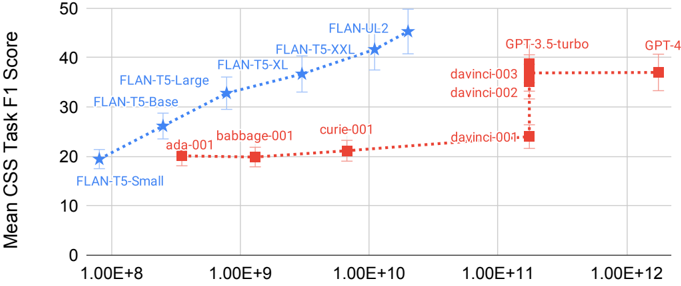
- Model selection matters: larger instruction-tuned open-source FLAN models are preferable for classification, while gpt-3.5-turbo is the clear leading LLM for generation. FLAN performance scales nearly logarithmically, with a median improvement of 5.0 absolute percentage points per order-of-magnitude size increase; OpenAI models do not monotonically benefit from scale, and RLHF improves average F1 by 3.5 absolute points over text-davinci-002.
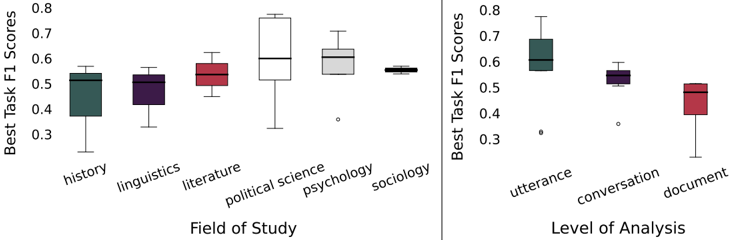
- Performance is not tied to academic discipline, but document-level tasks are hardest, with all F1 scores near or below 50%; complex expert taxonomies also perform poorly, e.g., implicit hate 32.3 F1, empathy 35.9 F1, and dialect feature detection 32.9 F1.
Methods
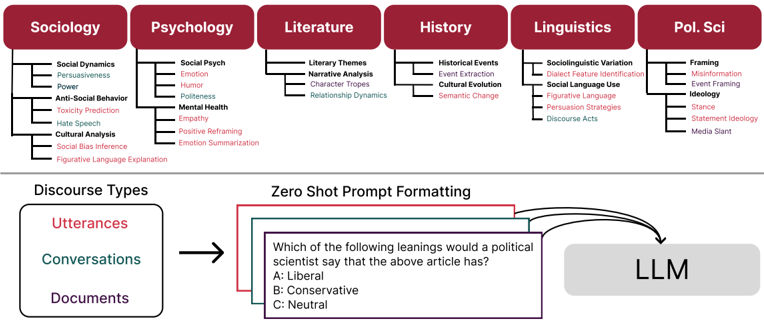
- The authors evaluate zero-shot performance of 13 language models on 25 representative English CSS benchmarks: 10 utterance-level classification tasks, 6 conversation-level tasks, 4 document-level tasks, and 5 generation tasks. Models include FLAN-T5 sizes from 80M to 11B, FLAN-UL2 (20B), OpenAI GPT-3 text-001/002/003, gpt-3.5-turbo, and GPT-4.
- They use prompt engineering guidelines, generate five semantically equivalent prompt perturbations per task, set temperature to zero, and constrain decoding to valid output classes or use logit bias. Classification and structured parsing are evaluated with macro F1 averaged over prompt perturbations; supervised baselines use RoBERTa-large for classification and T5-base for generation, tuned by grid search and averaged over three random seeds.
- For each task, they evaluate a class-stratified sample of at most 500 instances from the designated test set. Generation is evaluated by domain experts on 1–5 Likert scales for faithfulness, relevance, coherence, and fluency, and by ranking model outputs against gold human references; ranking annotations were performed by two authors blind, with unanimous voting.
Limitations
- The paper states that its task selection is not exhaustive; sensitive domains such as mental health and cultural studies are largely outside scope, and available data resources are dominated by standard dialects and WEIRD populations. It also notes data leakage concerns for proprietary models, that it explores predictive rather than causal explanations, that bias and fairness could not be systematically analyzed with available datasets, and that proprietary LLMs carry opacity, privacy, and intellectual-property risks.
- The paper states that generation diversity may be limited and that human evaluation is costly and hard to reproduce; it also notes that exact model sizes and training data for OpenAI models are trade secrets, so scaling analyses rely on estimates.
- Evident from the text: classification results are based on class-stratified samples capped at 500 instances per task, prompt variance is addressed with only five perturbations, and the human ranking evaluation used the authors as blind annotators rather than independent crowdworkers. Some dataset categories with fewer than 10 examples were omitted from evaluation, and automatic generation metrics such as BLEU, BERTScore, and BLEURT produced uninterpretable scores.
Model-written summary. Check it against the paper before relying on it.
Integrity signals
Registry
Cites
Statistics
Figures
Verification
Claims the paper makes
0 Valid · 14 Not valid · 77 Not checked · 179 Own results and interpretations
A result the paper states — it cites no source for it, so there is none to check. The quote shows it is in the paper.
In the paper
“On free-form coding tasks (generation), LLMs produce explanations that often exceed the quality of crowdworkers' gold references.”
§ Can Large Language Models Transform Computational Social Science? > Abstract
plain- Asserted: passes — The authors put it forward as true.
- Checkable: passes — It can be checked against evidence.
- Load-bearing: passes — The paper’s conclusions depend on it.
- Based: passes — The paper gives a reason why it holds.
A result the paper reports from its own data — it cites no other source for it, so there is none to check. The quote shows it is in the paper.
In the paper
“All other document-level accuracies are at or below 50%.”
§ Can Large Language Models Transform Computational Social Science? > 5.3 Domain-Utility (RQ3)
plain- Asserted: passes — The authors put it forward as true.
- Checkable: passes — It can be checked against evidence.
- Load-bearing: unclear — It is unclear whether the paper’s conclusions depend on it.
- Based: passes — The paper gives a reason why it holds.
A result the paper reports from its own data — it cites no other source for it, so there is none to check. The quote shows it is in the paper.
In the paper
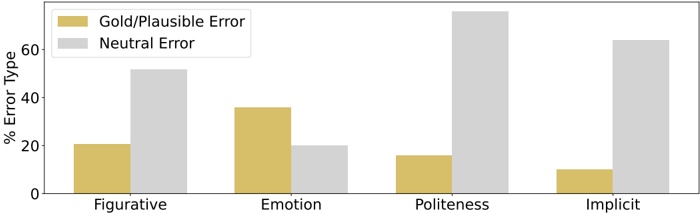
“This is confirmed by our error analysis in Figure 2 where GPT3.5 often defaults to the neutral, more colloquially recognizable label stereotype (64% of errors) rather than use a more taxonomy-specific label like white grievance.”
§ Can Large Language Models Transform Computational Social Science? > 5.1 Viability (RQ1) 5.1.1 Zero-Shot Viability.
plainstates an association- Asserted: passes — The authors put it forward as true.
- Checkable: passes — It can be checked against evidence.
- Load-bearing: unclear — It is unclear whether the paper’s conclusions depend on it.
- Based: passes — The paper gives a reason why it holds.
A result the paper reports from its own data — it cites no other source for it, so there is none to check. The quote shows it is in the paper.
In the paper
“Figure 3 shows FLAN classification performances scaling nearly logarithmically with the parameter count.”
§ Can Large Language Models Transform Computational Social Science? > 5.2 Model-Selection (RQ2)
plainstates an association- Asserted: passes — The authors put it forward as true.
- Checkable: passes — It can be checked against evidence.
- Load-bearing: passes — The paper’s conclusions depend on it.
- Based: passes — The paper gives a reason why it holds.
A result the paper reports from its own data — it cites no other source for it, so there is none to check. The quote shows it is in the paper.
In the paper
“In particular, documents encode complex sequences of ideas or temporal events, and overall, the two lowest task performances are on the document-level tasks: character trope classification and event argument extraction.”
§ Can Large Language Models Transform Computational Social Science? > 5.3 Domain-Utility (RQ3)
plain- Asserted: passes — The authors put it forward as true.
- Checkable: passes — It can be checked against evidence.
- Load-bearing: unclear — It is unclear whether the paper’s conclusions depend on it.
- Based: passes — The paper gives a reason why it holds.
114 more claims
Create a free account to see all 270 claims and to verify the 92 references still open.
- It may state two separate claims as one. 80
- Probably not a substantial claim. 91
- The quote only partly states this claim. 1
Claims other papers make about this one
Each is checked against this paper’s own text: does it say what the citing paper says it does?
The source backs part of the claim, not all of it — or backs it for a different population, condition or comparison.
In the citing paper
“For the domain of psychology, LLM-based agents can be leveraged for conducting simulation experiments, providing mental health support and so on [102-105].”
From A survey on large language model based autonomous agents (2024) · cites this paper as [105]
Experimental — accuracy not yet measuredThe source backs part of the claim, not all of it — or backs it for a different population, condition or comparison.
In the citing paper
“Research assistant: Beyond their application in specialized domains, LLM-based agents are increasingly adopted as versatile assistants in the broad field of social science research [105,114].”
From A survey on large language model based autonomous agents (2024) · cites this paper as [105]
Experimental — accuracy not yet measuredThe source backs part of the claim, not all of it — or backs it for a different population, condition or comparison.
In the citing paper
“Political science and economy: LLM-based agents can also be utilized to study political science and economy [29,105,106].”
From A survey on large language model based autonomous agents (2024) · cites this paper as [105]
Experimental — accuracy not yet measuredThe cited source says what the claim attributes to it.
In the citing paper
“Researchers have also recently noted GPT’s ability to help with computational social science tasks (49–54), detect misinformation (55), infer politicians’ ideologies (56), write persuasive political arguments (57), respond to patient questions (58), simulate human research participants (59–61), and model collective behavior (56).”
From GPT is an effective tool for multilingual psychological text analysis (2024) · cites this paper as [49]
In the citing paper
“Specifically, commentary has focused on large language models (LMs), which rely on minimal researcher input and model training for the classification of different types of data [Ziems et al., 2024, Törnberg, 2023a].”
From Prompt Stability Scoring for Text Annotation with Large Language Models (2024) · cites this paper as Ziems et al., 2024
1 more claim about this paper
Create a free account to see every claim other papers make about this one.
Self-check
Percentages, sums and reported differences re-computed from the paper’s own numbers.
Each contradiction between two passages listed here was confirmed by an independent check.
Rated major: it would touch a result — a value a result rests on, reported and recomputed p-values on opposite sides of the significance level, two passages that conflict with no sign which is right, or a cited work retracted before this paper was published.
In the paper
§ Can Large Language Models Transform Computational Social Science? > Causality and Explanations.
“Stance | gpt-3.5-turbo 72.0 0.58 | moderate”
§ Can Large Language Models Transform Computational Social Science? > 5.1 Viability (RQ1) 5.1.1 Zero-Shot Viability.
“These tasks also correspond to the highest absolute performances on Stance (76.0 F1)”
Rated major: it would touch a result — a value a result rests on, reported and recomputed p-values on opposite sides of the significance level, two passages that conflict with no sign which is right, or a cited work retracted before this paper was published.
In the paper
§ Can Large Language Models Transform Computational Social Science? > Causality and Explanations.
“Power Toxicity | gpt-4 gpt-4 | 59.7 0.26 55.4 0.11”
§ Can Large Language Models Transform Computational Social Science? > 5. Classification Results
“Power 49.5 72.7 46.6 48.0 40.8 55.6 52.6 56.9 43.1 39.8 37.5 36.9 39.2 51.9 56.5 42.0”
Rated minor: it would not touch a result — a value no result rests on, a p-value that stays on the same side of the significance level, or a conflict that is clerical, resolved elsewhere in the paper, or outside its own findings.
In the paper
§ Can Large Language Models Transform Computational Social Science? > Causality and Explanations.
“Ideology Event Det. gpt-4 gpt-4 | 51.5 0.51 23.0 n/a”
§ Can Large Language Models Transform Computational Social Science? > 5. Classification Results
“Event Det.0.4 75.8 9.8 7.0 1.0 10.9 41.8 50.6 29.8 47.3 47.4 44.4 48.8 52.4 51.3 14.8”
Rated minor: it would not touch a result — a value no result rests on, a p-value that stays on the same side of the significance level, or a conflict that is clerical, resolved elsewhere in the paper, or outside its own findings.
In the paper
§ Can Large Language Models Transform Computational Social Science? > 5.3 Domain-Utility (RQ3)
“All other document-level accuracies are at or below 50%.”
§ Can Large Language Models Transform Computational Social Science? > 5. Classification Results
“Event Det.0.4 75.8 9.8 7.0 1.0 10.9 41.8 50.6 29.8 47.3 47.4 44.4 48.8 52.4 51.3 14.8”
Citations
Cites
Language Models are Few-Shot Learners
Brown, T. B., Mann, B., Ryder, N., Subbiah, M., Kaplan, J., Dhariwal, P., Neelakantan, A., Shyam, P., Sastry, G., Askell, A., et al. (2020) · arXiv · doi:10.48550/arxiv.2005.14165 · Cited by 23,372
The Structure of Scientific Revolutions: 50th Anniversary Edition
Kuhn, T. S., & Hacking, I. (2012) · doi:10.7208/chicago/9780226458144.001.0001 · Cited by 21,170
RoBERTa: A Robustly Optimized BERT Pretraining Approach
Liu, Y., Ott, M., Goyal, N., Du, J., Joshi, M., Chen, D., Levy, O., Lewis, M., Zettlemoyer, L., & Stoyanov, V. (2019) · arXiv · doi:10.48550/arxiv.1907.11692 · Cited by 16,515
Framing: toward clarification of a fractured paradigm
Entman, R. M. (1993) · Journal of Communication · doi:10.1111/j.1460-2466.1993.tb01304.x · Cited by 16,203 · cited 1×
“Political scientists study how political actors move agendas (Grimmer, 2010) by persuasively framing their discourse “to promote a particular problem definition, causal interpretation, moral evaluation, and/or treatment recommendation” (Entman, 1993).”
BackgroundExploring the Limits of Transfer Learning with a Unified Text-to-Text Transformer
Raffel, C., Shazeer, N., Roberts, A., Lee, K., Narang, S., Matena, M., Zhou, Y., Li, W., & Liu, P. J. (2019) · arXiv · doi:10.48550/arxiv.1910.10683 · Cited by 10,929
Politeness: Some Universals in Language Usage
Brown, P., Levinson, S. C., & Gumperz, J. J. (1987) · Cambridge University Press eBooks · doi:10.1017/cbo9780511813085 · Cited by 10,438
Scaling Laws for Neural Language Models
Kaplan, J., McCandlish, S., Henighan, T., Brown, T. B., Chess, B., Child, R., Gray, S., Radford, A., Wu, J., & Amodei, D. (2020) · arXiv · doi:10.48550/arxiv.2001.08361 · Cited by 9,550 · cited 1×
“LLMs generally follow scaling laws (Kaplan et al., 2020; Hoffmann et al., 2022) where performance increases with the size of the model and training data.”
BackgroundThe spread of true and false news online
Vosoughi, S., Roy, D., & Aral, S. (2018) · Science · doi:10.1126/science.aap9559 · Cited by 8,847 · cited 1×
“…analyses of social norms and conventions (Centola et al., 2018; Bicchieri, 2005), information diffusion (Leskovec et al., 2009; Tan et al., 2014; Vosoughi et al., 2018; Cheng et al., 2016), emotional contagion (Bail, 2016), collective behaviors (Barberá et al., 2015), and social movements…”
BackgroundSpeech Genres and Other Late Essays
Bakhtin, M. M. (1986) · University of Texas Press eBooks · doi:10.7560/720466 · Cited by 8,470
“Risk, Ambiguity, and the Savage Axioms.”
Ellsberg, D. (1961) · The Quarterly Journal of Economics · doi:10.2307/1884324 · Cited by 7,891
Research works printed but not linked: 12
- Cialdini, 2003, Influence
- 73. Dang, Hoa Trang. 2005. Overview of duc 2005. In Proceedings of the document understanding conference, volume 2005, pages 1-12, Citeseer.
- 77. Ziems, Held, Shaikh, Chen, Zhang, Yang Can LLMs Transform CSS? Workshop held in conjunction with ACL 2016 (LAW-X 2016), pages 188-198, Association for Computational Linguistics, Berlin, Germany.
- 100. Garfinkel, Harold. 2016. Studies in ethnomethodology. In Social Theory Re-Wired. Routledge, pages 85-95.
- 109. Gross, Justin H, Brice Acree, Yanchuan Sim, and Noah A Smith. 2013. Testing the etch-a-sketch hypothesis: a computational analysis of mitt romney's ideological makeover during the 2012 primary vs. general elections. In APSA 2013 Annual Meeting Paper, American Political Science Association 2013 Annual Meeting.
- 152. Kuhn, Thomas S. 1962. The structure of Scientific Revolutions. The University of Chicago Press.
- 156. Ziems, Held, Shaikh, Chen, Zhang, Yang Can LLMs Transform CSS? Conference on Human Factors in Computing Systems, CHI 2015, Seoul, Republic of Korea, April 18-23, 2015, pages 3739-3748, ACM.
- 172. Luo, Yiwei, Dallas Card, and Dan Jurafsky. 2020b. Detecting stance in media on global warming. In Findings of the Association for Computational Linguistics: EMNLP 2020, pages 3296-3315, Association for Computational Linguistics, Online. · DOI
- 188. Murray, Michael et al. 2015. Narrative psychology. Qualitative psychology: A practical guide to research methods, pages 85-107.
- Omitaomu, 2022, Empathic conversations: A multi-level dataset of contextualized conversations, ArXiv preprint
- Rothbaum, 2000, Cognitive-behavioral therapy, 320
- 227. Sacks, Harvey. 1992. Lectures on conversation: Volume i. Malden, Massachusetts: Blackwell.
Cited by
Items 101–200 of 609
Toward LLM-agent-based modeling of transportation systems: A conceptual framework
Liu, T., Yang, J., & Yin, Y. (2025) · Artificial Intelligence for Transportation · doi:10.1016/j.ait.2025.100001 · Cited by 53
Probing LLMs for hate speech detection: strengths and vulnerabilities
Roy, S., Harshvardhan, A. V., Mukherjee, A., & Saha, P. (2023) · Findings of the Association for Computational Linguistics: EMNLP (Findings of EMNLP) · doi:10.18653/v1/2023.findings-emnlp.407 · Cited by 99
HumanELY: Human evaluation of LLM yield, using a novel web-based evaluation toolPreprint
Awasthi, R., Mishra, S. V., Mahapatra, D., Khanna, A. K., Maheshwari, K. K., Cywiński, J. B., Papay, F., & Mathur, P. (2023) · medRxiv · doi:10.1101/2023.12.22.23300458 · Cited by 37
Data Authenticity, Consent, and Provenance for AI Are All Broken: What Will It Take to Fix Them?
Longpre, S., Mahari, R., Obeng-Marnu, N., Brannon, W., South, T., Kabbara, J., & Pentland, A. (2024) · doi:10.21428/e4baedd9.a650f77d · Cited by 41
Using Large Language Models for Qualitative Analysis can Introduce Serious Bias
Ashwin, J., Chhabra, A., & Rao, V. (2026) · Sociological Methods & Research · doi:10.1177/00491241251338246 · Cited by 22
The dawn of a new era: can machine learning and large language models reshape QSP modeling?
Androulakis, I. P., Cucurull-Sanchez, L., Kondic, A., Mehta, K., Pichardo, C., Pryor, M., & Renardy, M. (2025) · Journal of Pharmacokinetics and Pharmacodynamics · doi:10.1007/s10928-025-09984-5 · Cited by 22
The impact of generative AI on social media: an experimental study
Møller, A. G., Romero, D. M., Jurgens, D., & Aiello, L. M. (2026) · Scientific Reports · doi:10.1038/s41598-026-40110-8 · Cited by 63
Wong, S. M., Leung, H.-F., & Wong, K. Y. (2024) · Research Square · doi:10.21203/rs.3.rs-4063228/v1 · Cited by 60
Can Large Language Models Capture Dissenting Human Voices?
Lee, N., An, N. M., & Thorne, J. (2023) · arXiv · doi:10.48550/arxiv.2305.13788 · Cited by 22
Evaluation of Transfer Learning and Adaptability in Large Language Models with the GLUE BenchmarkPreprint
Sulaiman, N., & Hamzah, F. (2024) · doi:10.36227/techrxiv.171077989.99407624/v1 · Cited by 22
Large Language Models Can Infer Personality from Free-Form User InteractionsPreprint
Peters, H., Cerf, M., & Matz, S. (2024) · OSF Preprints (OSF Preprints) · doi:10.31219/osf.io/apc5g · Cited by 50
Mendelsohn, J., Vijan, M., Card, D., & Budak, C. (2024) · Journal of Quantitative Description Digital Media · doi:10.51685/jqd.2024.icwsm.9 · Cited by 43
Coal Mine Accident Risk Analysis with Large Language Models and Bayesian Networks
Du, G., & Chen, A. (2025) · Sustainability · doi:10.3390/su17051896 · Cited by 26
Advancing ophthalmology with large language models: Applications, challenges, and future directions
Zhang, Q., Wang, S., Wang, X., Xu, C., Liang, J., & Liu, Z. (2025) · Survey of Ophthalmology · doi:10.1016/j.survophthal.2025.02.009 · Cited by 21
Meaning in Hyperspace: Word Embeddings as Tools for Cultural Measurement
Boutyline, A., & Arseniev‐Koehler, A. (2025) · Annual Review of Sociology · doi:10.1146/annurev-soc-090324-024027 · Cited by 34
Six Fallacies in Substituting Large Language Models for Human Participants
Lin, Z. (2025) · Advances in Methods and Practices in Psychological Science · doi:10.1177/25152459251357566 · Cited by 66
Goto, T., Ono, K., & Morita, A. (2024) · doi:10.36227/techrxiv.171173447.70655950/v1 · Cited by 61
Measuring the Interpretability and Explainability of Model Decisions of Five Large Language ModelsPreprint
Fujiwara, K., Sasaki, M., Nakamura, A., & Watanabe, N. (2024) · OSF Preprints (OSF Preprints) · doi:10.31219/osf.io/d4ntw · Cited by 63
Derner, E., Kučera, D., Oliver, N., & Zahálka, J. (2024) · Computers in Human Behavior Artificial Humans · doi:10.1016/j.chbah.2024.100088 · Cited by 34
Large Language Model Evaluation Criteria Framework in Healthcare: Fuzzy MCDM Approach
Alabool, H. M. (2025) · SN Computer Science · doi:10.1007/s42979-024-03533-6 · Cited by 23
Natural language processing for social science research: A comprehensive review
Hou, Y., & Huang, J. (2025) · Chinese Journal of Sociology · doi:10.1177/2057150x241306780 · Cited by 45
The Mixed Subjects Design: Treating Large Language Models as Potentially Informative Observations
Broska, D., Howes, M., & van Loon, A. (2025) · Sociological Methods & Research · doi:10.1177/00491241251326865 · Cited by 63
LLMs outperform outsourced human coders on complex textual analysis
Bermejo, V. J., Gago, A., Gálvez, R. H., & Harari, N. (2025) · Scientific Reports · doi:10.1038/s41598-025-23798-y · Cited by 38
The Russia–Ukraine War in Chinese Social Media: LLM Analysis Yields a Bias Toward Neutrality
Rogers, R., & Zhang, X. (2024) · Social Media + Society · doi:10.1177/20563051241254379 · Cited by 28
Kim, S., Kim, K., & Wonjeong Jo, C. (2024) · Preventive Medicine Reports · doi:10.1016/j.pmedr.2024.102723 · Cited by 18
“Furthermore, the increasing accessibility and user-friendliness of these powerful LLMs are amplifying their impacts in various academic disciplines (Ziems et al., 2023; Heseltine and Clemm von Hohenberg, 2024).”
BackgroundOpen-Source LLMs for Text Annotation: A Practical Guide for Model Setting and Fine-Tuning
Alizadeh, M., Kubli, M., Samei, Z., Dehghani, S., Zahedivafa, M., Bermeo, J. D., Korobeynikova, M., & Gilardi, F. (2023) · arXiv · doi:10.48550/arxiv.2307.02179 · Cited by 18
Liu, L., Wang, Y., Fang, Z., & Wu, S. (2021) · Production and Operations Management · doi:10.1177/10591478251349892 · Cited by 27
Song, Q., Tian, S., Zheng, L., Zheng, Y., Qiu, L., Huang, B., & van Ameijde, J. (2025) · Landscape and Urban Planning · doi:10.1016/j.landurbplan.2025.105571 · Cited by 23
Lee, C., Gligorić, K., Kalluri, P., Harrington, M., Durmus, E., Sanchez, K. L., San, N., Tse, D., Zhao, X., Hamedani, M. G., et al. (2024) · Proceedings of the National Academy of Sciences · doi:10.1073/pnas.2322764121 · Cited by 42
Pastor-Galindo, J., Nespoli, P., & Ruipérez‐Valiente, J. A. (2024) · IEEE Security & Privacy · doi:10.1109/msec.2024.3380511 · Cited by 37
Benchmarking of Commercial Large Language Models: ChatGPT, Mistral, and LlamaPreprint
Hou, G., & Lian, Q. (2024) · Research Square · doi:10.21203/rs.3.rs-4376810/v1 · Cited by 57
When large language models are reliable for judging empathic communication
Kumar, A., Poungpeth, N., Yang, D., Farrell, E. L., Lambert, B. L., & Groh, M. (2026) · Nature Machine Intelligence · doi:10.1038/s42256-025-01169-6 · Cited by 43
Self-citationEvolving linguistic divergence on polarizing social media
Karjus, A., & Cuskley, C. F. (2024) · Humanities and Social Sciences Communications · doi:10.1057/s41599-024-02922-9 · Cited by 38
Macanovic, A., & Przepiorka, W. (2024) · Behavior Research Methods · doi:10.3758/s13428-024-02381-9 · Cited by 22
Synthetically generated text for supervised text analysis
Halterman, A. (2025) · Political Analysis · doi:10.1017/pan.2024.31 · Cited by 26
Enhancing Contextual Understanding of Mistral LLM with External Knowledge BasesPreprint
Sasaki, M., Watanabe, N., & Komanaka, T. (2024) · Research Square · doi:10.21203/rs.3.rs-4215447/v1 · Cited by 39
Kanato, S. A. T. O., Kaneko, H., & Fujimura, M. (2024) · OSF Preprints (OSF Preprints) · doi:10.31219/osf.io/4hzya · Cited by 47
How aggregated opinions shape beliefs
Oktar, K., & Lombrozo, T. (2025) · Nature Reviews Psychology · doi:10.1038/s44159-024-00398-7 · Cited by 24
Machine learning in computational literary studies
Hatzel, H. O., Stiemer, H., Biemann, C., & Gius, E. (2023) · it - Information Technology · doi:10.1515/itit-2023-0041 · Cited by 45
Ullstein, C., Engelmann, S., Papakyriakopoulos, O., Ikkatai, Y., Arnez-Jordan, N. P., Caleno, R., Mboya, B., Higuma, S., Hartwig, T., Yokoyama, H., et al. (2024) · ACM Conference on Fairness, Accountability, and Transparency (FAccT) · doi:10.1145/3630106.3659038 · Cited by 18
Optimizing Natural Language Processing: A Comparative Analysis of GPT-3.5, GPT-4, and GPT-4o
Ayala-Chauvin, M. I., & Avilés-Castillo, F. (2024) · Data & Metadata · doi:10.56294/dm2024.359 · Cited by 19
Participant Use of Artificial Intelligence in Online Focus Groups: An Experiential Account
Stafford, L., Preston, C., & Pike, A. C. (2024) · International Journal of Qualitative Methods · doi:10.1177/16094069241286417 · Cited by 20
Comparing AI and human decision-making mechanisms in daily collaborative experiments
Wang, L., Jiang, Z., Hu, C., Zhao, J., Zhu, Z., Chen, X. M., Wang, Z., Liu, T., He, G., Yin, Y., et al. (2025) · iScience · doi:10.1016/j.isci.2025.112711 · Cited by 29
When Does Surveillance Trigger Resistance? Public Response to Escalating Digital Control in China
Chen, D., & Zhan, J. V. (2025) · Journal of Chinese Political Science · doi:10.1007/s11366-025-09918-5 · Cited by 21
He, L., Omranian, S., McRoy, S., & Zheng, K. (2024) · medRxiv · doi:10.1101/2024.03.19.24304544 · Cited by 25
A Comparative Analysis of Cultural Alignment in Large Language Models in Bilingual ContextsPreprint
Yuan, X., Hu, J., & Zhang, Q. (2024) · OSF Preprints (OSF Preprints) · doi:10.31219/osf.io/6hpcf · Cited by 48
Wang, J. S., Haider, S., Tohidi, A., Gupta, A., Zhang, Y., Callison-Burch, C., Rothschild, D. M., & Watts, D. J. (2025) · CHI Conference on Human Factors in Computing Systems · doi:10.1145/3706598.3713716 · Cited by 39
An Evaluation of Large Language Models for Supplementing a Food Extrusion Dataset
Bölücü, N., Pennells, J., Yang, H., Rybinski, M., & Wan, S. (2025) · Foods · doi:10.3390/foods14081355 · Cited by 17
Toward a Better Understanding of the Emotional Dynamics of Negotiation with Large Language Models
Lin, E., Hale, J., & Gratch, J. S. (2023) · ACM International Symposium on Theory, Algorithmic Foundations, and Protocol Design for Mobile Networks and Mobile Computing (MobiHoc) · doi:10.1145/3565287.3617637 · Cited by 14
Can Large Language Models Capture Dissenting Human Voices?
Lee, N., An, N., & Thorne, J. (2023) · Conference on Empirical Methods in Natural Language Processing (EMNLP) · doi:10.18653/v1/2023.emnlp-main.278 · Cited by 62
Exploring ChatGPT for Toxicity Detection in GitHub
Mishra, S., & Chatterjee, P. (2024) · IEEE/ACM International Conference on Software Engineering: New Ideas and Emerging Results (ICSE-NIER) · doi:10.1145/3639476.3639777 · Cited by 41
Methods for aggregating investor sentiment from social media
Liu, Q., & Son, H. (2024) · Humanities and Social Sciences Communications · doi:10.1057/s41599-024-03434-2 · Cited by 19
Gillespie, A., Glăveanu, V. P., Laurent, C. D. S., Zittoun, T., & Marcos, M. J. B. (2024) · Journal of Mixed Methods Research · doi:10.1177/15586898241284696 · Cited by 16
Goodbye human annotators? Content analysis of social policy debates using ChatGPT
Gielens, E., Sowula, J., & Leifeld, P. (2025) · Journal of Social Policy · doi:10.1017/s0047279424000382 · Cited by 20
Latif, S., Usama, M., Malik, M. I., & Schuller, B. W. (2025) · IEEE Computational Intelligence Magazine · doi:10.1109/mci.2024.3504833 · Cited by 47
Mapping (A)Ideology: A Taxonomy of European Parties Using Generative LLMs as Zero-Shot Learners
Leo, R. D., Zeng, C., Dinas, E., & Tamtam, R. (2025) · Political Analysis · doi:10.1017/pan.2025.7 · Cited by 19
Balancing Large Language Model Alignment and Algorithmic Fidelity in Social Science Research
Lyman, A., Hepner, B., Argyle, L. P., Busby, E. C., Gubler, J. R., & Wingate, D. (2025) · Sociological Methods & Research · doi:10.1177/00491241251342008 · Cited by 31
Abbasi, A., Chiang, R. H. L., & Xu, J. (2023) · Journal of the Association for Information Systems · doi:10.17705/1jais.00849 · Cited by 25
GPT-Neo-CRV: Elevating Information Accuracy in GPT-Neo with Cross-Referential ValidationPreprint
Xiong, X., & Zheng, M. (2024) · doi:10.36227/techrxiv.170473976.61241065/v1 · Cited by 15
International organizations in national parliamentary debates
Hunter, T., & Walter, S. (2025) · The Review of International Organizations · doi:10.1007/s11558-024-09577-w · Cited by 16
Cognitive Modeling Using Artificial Intelligence
Frank, M. C., & Goodman, N. D. (2025) · Annual Review of Psychology · doi:10.1146/annurev-psych-030625-040748 · Cited by 55
Stavropoulos, A., Crone, D. L., & Grossmann, I. (2024) · Behavior Research Methods · doi:10.3758/s13428-024-02441-0 · Cited by 25
Hayes, A. S. (2023) · doi:10.31235/osf.io/yms8p · Cited by 12
ELEPHANT: Measuring and understanding social sycophancy in LLMs
Cheng, M., Yu, S., Lee, C., Khadpe, P., Ibrahim, L., & Jurafsky, D. (2025) · arXiv · doi:10.48550/arxiv.2505.13995 · Cited by 12
Language Evolution for Evading Social Media Regulation via LLM-Based Multi-Agent Simulation
Cai, J., Li, J., Zhang, M., Li, M., Wang, C.-S., & Tei, K. (2024) · IEEE Congress on Evolutionary Computation (CEC) · doi:10.1109/cec60901.2024.10612015 · Cited by 23
Leveraging Large Language Models for Suicide Detection on Social Media with Limited Labels
Nguyen, V., & Pham, C. (2024) · IEEE International Conference on Big Data (BigData) · doi:10.1109/bigdata62323.2024.10825313 · Cited by 27
Chu, S. Y., Kim, J. W., & Yi, M. Y. (2025) · CHI Conference on Human Factors in Computing Systems · doi:10.1145/3706598.3713181 · Cited by 29
Generative AI and empirical research methods in operations management
Shalpegin, T., Browning, T. R., Kumar, A., Shang, G., Thatcher, J. B., Fransoo, J. C., Holweg, M., & Lawson, B. (2025) · Oxford University Research Archive (ORA) (University of Oxford) · doi:10.1002/joom.1371
Can GPT-4 Support Analysis of Textual Data in Tasks Requiring Highly Specialized Domain Expertise?Preprint
Šavelka, J., Ashley, K. D., Gray, M., Westermann, H., & Xu, H. (2023) · arXiv (Cornell University) · doi:10.48550/arxiv.2306.13906 · Cited by 46
Bodell, M. H., Magnusson, M., & Keuschnigg, M. (2024) · Sociological Methods & Research · doi:10.1177/00491241241268453 · Cited by 18
Evaluating Synthetic Data Generation from User Generated Text
Chim, J., Ive, J., & Liakata, M. (2025) · Computational Linguistics · doi:10.1162/coli_a_00540 · Cited by 40
Zhao, X., Ma, Z., & Ma, R. (2024) · New Media & Society · doi:10.1177/14614448241285445 · Cited by 21
BleacherBot: AI Agent as a Sports Co-Viewing Partner
Kim, K., Song, H., Ryu, J., Oh, C., & Suh, B. (2025) · CHI Conference on Human Factors in Computing Systems · doi:10.1145/3706598.3714178 · Cited by 15
Multi-Model Consistency for LLMs’ Evaluation
Zhu, Q., Lyu, D., Fan, X., Wang, X., Tu, Q., Zhan, Y., & Chen, H. (2024) · International Joint Conference on Neural Networks (IJCNN) · doi:10.1109/ijcnn60899.2024.10651158 · Cited by 13
Ding, X., Carik, B., Gunturi, U. S., Reyna, V. F., & Rho, E. H. R. (2024) · CHI Conference on Human Factors in Computing Systems · doi:10.1145/3613904.3642117 · Cited by 15
Human-AI Interaction in the Age of Large Language Models
Yang, D. (2024) · Proceedings of the AAAI Symposium Series · doi:10.1609/aaaiss.v3i1.31183 · Cited by 11
Self-citationVindigni, G. (2024) · European Journal of Contemporary Education and E-Learning · doi:10.59324/ejceel.2024.2(4).10 · Cited by 17
Complex systems perspective in assessing risks in artificial intelligence
Kondor, D., Hafez, V., Shankar, S., Wazir, R., & Karimi, F. (2024) · Philosophical Transactions of the Royal Society A Mathematical Physical and Engineering Sciences · doi:10.1098/rsta.2024.0109 · Cited by 18
Qiu, Y., & Jin, Y. (2024) · Journal of Mechanical Design · doi:10.1115/1.4067478 · Cited by 13
Schwitter, N. (2025) · Methodological Innovations · doi:10.1177/20597991251313876 · Cited by 18
Wang, C., & Altiparmakis, A. (2025) · European Union Politics · doi:10.1177/14651165251321802 · Cited by 12
Zhao, X., Wang, H., Dai, C., Tang, J., Deng, K., Zhong, Z., Kong, F., Wang, S., & Morikawa, S. (2025) · Systems · doi:10.3390/systems13040240 · Cited by 10
Ojemann, W. K. S., Xie, K., Liu, K., Chang, E., Roth, D., Litt, B., & Ellis, C. A. (2025) · Journal of Healthcare Informatics Research · doi:10.1007/s41666-025-00198-5 · Cited by 13
Prompting the Machine: Introducing an LLM Data Extraction Method for Social Scientists
Foisy, L.-O. M., Proulx, É., Cadieux, H., Gilbert, J., Rivest, J., Bouillon, A., & Dufresne, Y. (2025) · Social Science Computer Review · doi:10.1177/08944393251344865 · Cited by 13
Benchmarking Large Language Models on Homework Assessment in Circuit Analysis
Chen, L., Qin, Z., Guo, Y., Rohde, J. A., & Zhang, Y. (2025) · International Journal of Artificial Intelligence in Education · doi:10.1007/s40593-025-00501-w · Cited by 18
Designing Incremental Knowledge Enrichment in Generative Pre-trained TransformersPreprint
Kowalczyk, E. A., Nowakowski, M., & Brzezińska, Z. (2024) · Research Square · doi:10.21203/rs.3.rs-4191646/v1 · Cited by 49
Sen, I., Assenmacher, D., Samory, M., Augenstein, I., van der Aalst, W. M. P., & Wagner, C. (2023) · Conference on Empirical Methods in Natural Language Processing (EMNLP) · doi:10.18653/v1/2023.emnlp-main.649 · Cited by 46
Multimodal User Enjoyment Detection in Human-Robot Conversation: The Power of Large Language Models
Pereira, A., Marcinek, Ľ., Miniota, J., Thunberg, S., Lagerstedt, E., Gustafson, J., Skantze, G., & Irfan, B. (2024) · INTERNATIONAL CONFERENCE ON MULTIMODAL INTERACTION · doi:10.1145/3678957.3685729 · Cited by 16
Othman, A., Chemnad, K., Tlili, A., Da, T., Wang, H., & Huang, R. (2024) · Discover Global Society · doi:10.1007/s44282-024-00113-0 · Cited by 10
Dai, W., Cheng, Y., Aldino, A. A., Tsai, Y., Gašević, D., & Chen, G. (2025) · Computers and Education Artificial Intelligence · doi:10.1016/j.caeai.2025.100427 · Cited by 13
AI Alignment at Your Discretion
Buyl, M., Khalaf, H., Verdun, C. M., Paes, L. M., Machado, C. C. V., & Calmon, F. P. (2025) · ACM Conference on Fairness, Accountability, and Transparency (FAccT) · doi:10.1145/3715275.3732194 · Cited by 37
Political DEBATE: Efficient Zero-Shot and Few-Shot Classifiers for Political Text
Burnham, M., Kahn, K., Wang, R. Y., & Peng, R. X. (2025) · Political Analysis · doi:10.1017/pan.2025.10028 · Cited by 30
Simulating social perception with large language models: perceptions of China’s common prosperity
Jiang, Z., Huang, B., Ge, J., Lin, C., Xu, Y., & Yu, J. (2025) · Journal of Chinese Governance · doi:10.1080/23812346.2025.2603822 · Cited by 9
Guiding Computational Stance Detection with Expanded Stance Triangle Framework
Liu, Z., Yap, Y. K., Chieu, H. L., & Chen, N. F. (2023) · Proceedings of the conference - Association for Computational Linguistics. Meeting · doi:10.18653/v1/2023.acl-long.220 · Cited by 10
Beyond Denouncing Hate: Strategies for Countering Implied Biases and Stereotypes in Language
Mun, J., Allaway, E., Yerukola, A., Vianna, L., Leslie, S., & Sap, M. (2023) · Findings of the Association for Computational Linguistics: EMNLP (Findings of EMNLP) · doi:10.18653/v1/2023.findings-emnlp.653 · Cited by 44
Lee, H.-R., & Kim, S. (2024) · Research Square · doi:10.21203/rs.3.rs-4394715/v1 · Cited by 15
Zhao, J., Huang, C., & Li, X. (2024) · Research Square · doi:10.21203/rs.3.rs-4566507/v1 · Cited by 38
Raccah, O., Chen, P., Gureckis, T. M., Poeppel, D., & Vo, V. A. (2024) · Scientific Data · doi:10.1038/s41597-024-04082-6 · Cited by 14
Large Language Models for Market Research: A Data-augmentation ApproachPreprint
Wang, M., Zhang, D., & Zhang, H. (2025) · SSRN Electronic Journal · doi:10.2139/ssrn.5057769 · Cited by 16
Metadata
- Authors
- Ziems, C., Held, W., Shaikh, O., Chen, J., Zhang, Z., & Yang, D.
- Affiliations
- Stanford University (US)
- Georgia Institute of Technology (US)
- Dartmouth College (US)
- Venue
- Computational Linguistics
- Publisher
- MIT Press
- Published
- 2024
- Volume
- 50
- Issue
- 1
- Pages
- 237-291
- ISSN
- 0891-2017 (ISSN-L)
- 1530-9312
- OpenAlex
- W4389636360
- Semantic Scholar
- 93752cae0d4ecd2d09d6660feb3c1860af973f18
- Cited by
- 585
- References
- 311
- Citations by year
- 2026: 201 · 2025: 197 · 2024: 146
- FWCI
- 271.63
- Type
- journal article
- Language
- en
- Open access
- diamond
- doi.org
- Licence
- Locations
- Computational Linguistics (publishedVersion, cc-by-nc-nd)
- arXiv (Cornell University) (submittedVersion)
- DOAJ (DOAJ: Directory of Open Access Journals) (submittedVersion, cc-by-sa)
- arXiv (Cornell University)
- Funders
- National Science Foundation (2247357, 2308994, 2039655)
- Topics
- Social Sciences › General Social Sciences › Computational and Text Analysis Methods
- Physical Sciences › Computer Science › Artificial Intelligence › Topic Modeling
- Physical Sciences › Computer Science › Artificial Intelligence › Sentiment Analysis and Opinion Mining
- Keywords
- large language models, computational social science, zero-shot learning, persuasion detection, text classification, text generation, manual annotation, evaluation pipeline
About these checks
Registry, retraction, Cites and statistics results are computed, not judged, with one exception: a printed reference that no index lists is read once by a model before it counts as a citation error. Claims are extracted by a model and kept only when their quote appears verbatim in the text; each cited source is then checked, with a model’s help, for whether it says what the claim relies on. Those verdicts can be wrong — read the claim’s quote and the cited source before relying on one.
A language model drew the claims from the paper on 2026-11-21, under version 3 of the claim definition (model deepseek-v4.1-flash, prompt extract-v3).
A second model labelled each claim on 2026-11-21 (model jev-1.13-20260917, definition revision gold-guideline-v0.2).
Statistics and arithmetic are recomputed, not judged.
Confidence bands are shown only for fields calibrated on our annotated test set. None is calibrated yet, so no band is shown.
What counts as a claim ›How we measure confidence ›How we check this ›
Are you an author, or do you see a problem with this page? Request a review
Data sources
Bibliographic data: Semantic Scholar, OpenAlex, Crossref.
Contains information from the Semantic Scholar Academic Graph Datasets, made available under the ODC Attribution License (ODC-BY 1.0).
Semantic Scholar’s data is described in: Kinney, R., et al. (2023). The Semantic Scholar Open Data Platform. arXiv:2301.10140.
