

Can Large Language Models Transform Computational Social Science?
Open accessThe DOI matches its Crossref record; 320 of the 324 references it cites were found in a registry or an index; none of the 111 sources its claims cite is checked for support yet.
Abstract
Large language models (LLMs) are capable of successfully performing many language processing tasks zero-shot (without training data). If zero-shot LLMs can also reliably classify and explain social phenomena like persuasiveness and political ideology, then LLMs could augment the computational social science (CSS) pipeline in important ways. This work provides a road map for using LLMs as CSS tools. Towards this end, we contribute a set of prompting best practices and an extensive evaluation pipeline to measure the zero-shot performance of 13 language models on 25 representative English CSS benchmarks. On taxonomic labeling tasks (classification), LLMs fail to outperform the best fine-tuned models but still achieve fair levels of agreement with humans. On free-form coding tasks (generation), LLMs produce explanations that often exceed the quality of crowdworkers’ gold references. We conclude that the performance of today’s LLMs can augment the CSS research pipeline in two ways: (1) serving as zero-shot data annotators on human annotation teams, and (2) bootstrapping challenging creative generation tasks (e.g., explaining the underlying attributes of a text). In summary, LLMs are posed to meaningfully participate in social science analysis in partnership with humans.
Overview
CoChat Summary
TL;DR
This paper evaluates whether zero-shot large language models can augment the Computational Social Science pipeline by benchmarking 13 LLMs on 25 English CSS tasks. It concludes that LLMs can assist with annotation and generation but cannot fully replace fine-tuned models or human analysis.
Key findings
- On classification, zero-shot LLMs fail to outperform the best fine-tuned models but still achieve fair agreement with humans: 8/17 tasks reach moderate-to-good agreement (κ = 0.40–0.65), while 5/17 (29.5%) show poor agreement. Best zero-shot performance reaches 77.4 F1 on misinformation detection, with κ = 0.55 versus the original paper’s κ = 0.51 inter-human agreement.
- On generation, LLMs often exceed crowdworkers’ gold references: model generations outrank the dataset’s gold human reference at least 38% of the time across five tasks. For COVIDET, Misinformation Explanation, and Social Bias Inference, gpt-3.5-turbo produces more faithful, coherent, and fluent text than both gold references and the fine-tuned baseline; for Positive Reframing and Figurative Language explanation, text-davinci-003 matches gold-standard levels.
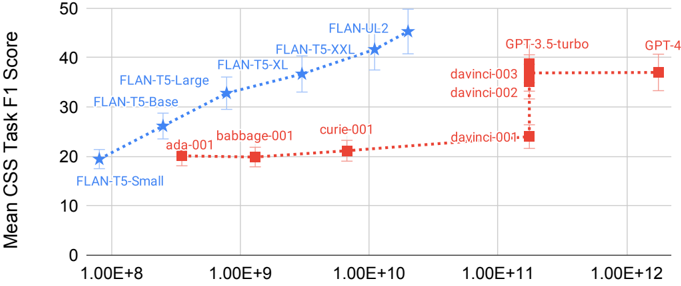
- Model selection matters: larger instruction-tuned open-source FLAN models are preferable for classification, while gpt-3.5-turbo is the clear leading LLM for generation. FLAN performance scales nearly logarithmically, with a median improvement of 5.0 absolute percentage points per order-of-magnitude size increase; OpenAI models do not monotonically benefit from scale, and RLHF improves average F1 by 3.5 absolute points over text-davinci-002.
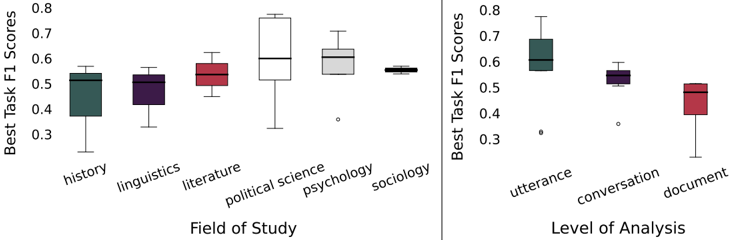
- Performance is not tied to academic discipline, but document-level tasks are hardest, with all F1 scores near or below 50%; complex expert taxonomies also perform poorly, e.g., implicit hate 32.3 F1, empathy 35.9 F1, and dialect feature detection 32.9 F1.
Methods
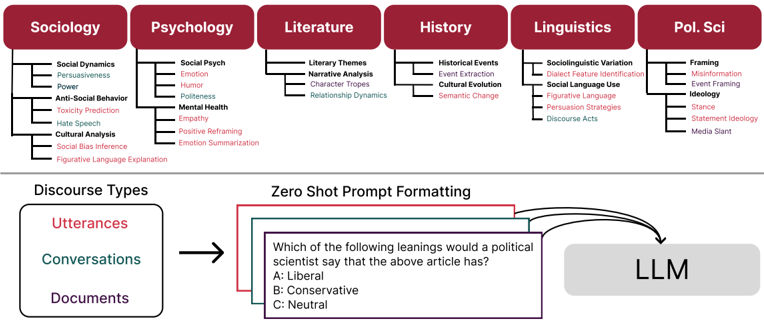
- The authors evaluate zero-shot performance of 13 language models on 25 representative English CSS benchmarks: 10 utterance-level classification tasks, 6 conversation-level tasks, 4 document-level tasks, and 5 generation tasks. Models include FLAN-T5 sizes from 80M to 11B, FLAN-UL2 (20B), OpenAI GPT-3 text-001/002/003, gpt-3.5-turbo, and GPT-4.
- They use prompt engineering guidelines, generate five semantically equivalent prompt perturbations per task, set temperature to zero, and constrain decoding to valid output classes or use logit bias. Classification and structured parsing are evaluated with macro F1 averaged over prompt perturbations; supervised baselines use RoBERTa-large for classification and T5-base for generation, tuned by grid search and averaged over three random seeds.
- For each task, they evaluate a class-stratified sample of at most 500 instances from the designated test set. Generation is evaluated by domain experts on 1–5 Likert scales for faithfulness, relevance, coherence, and fluency, and by ranking model outputs against gold human references; ranking annotations were performed by two authors blind, with unanimous voting.
Limitations
- The paper states that its task selection is not exhaustive; sensitive domains such as mental health and cultural studies are largely outside scope, and available data resources are dominated by standard dialects and WEIRD populations. It also notes data leakage concerns for proprietary models, that it explores predictive rather than causal explanations, that bias and fairness could not be systematically analyzed with available datasets, and that proprietary LLMs carry opacity, privacy, and intellectual-property risks.
- The paper states that generation diversity may be limited and that human evaluation is costly and hard to reproduce; it also notes that exact model sizes and training data for OpenAI models are trade secrets, so scaling analyses rely on estimates.
- Evident from the text: classification results are based on class-stratified samples capped at 500 instances per task, prompt variance is addressed with only five perturbations, and the human ranking evaluation used the authors as blind annotators rather than independent crowdworkers. Some dataset categories with fewer than 10 examples were omitted from evaluation, and automatic generation metrics such as BLEU, BERTScore, and BLEURT produced uninterpretable scores.
Model-written summary. Check it against the paper before relying on it.
Integrity signals
Registry
Cites
Statistics
Figures
Verification
Claims the paper makes
0 Valid · 14 Not valid · 77 Not checked · 179 Own results and interpretations
A result the paper states — it cites no source for it, so there is none to check. The quote shows it is in the paper.
In the paper
“On free-form coding tasks (generation), LLMs produce explanations that often exceed the quality of crowdworkers' gold references.”
§ Can Large Language Models Transform Computational Social Science? > Abstract
plain- Asserted: passes — The authors put it forward as true.
- Checkable: passes — It can be checked against evidence.
- Load-bearing: passes — The paper’s conclusions depend on it.
- Based: passes — The paper gives a reason why it holds.
A result the paper reports from its own data — it cites no other source for it, so there is none to check. The quote shows it is in the paper.
In the paper
“All other document-level accuracies are at or below 50%.”
§ Can Large Language Models Transform Computational Social Science? > 5.3 Domain-Utility (RQ3)
plain- Asserted: passes — The authors put it forward as true.
- Checkable: passes — It can be checked against evidence.
- Load-bearing: unclear — It is unclear whether the paper’s conclusions depend on it.
- Based: passes — The paper gives a reason why it holds.
A result the paper reports from its own data — it cites no other source for it, so there is none to check. The quote shows it is in the paper.
In the paper
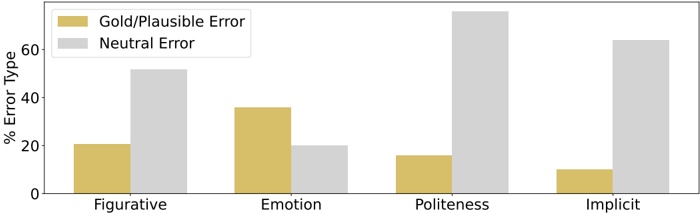
“This is confirmed by our error analysis in Figure 2 where GPT3.5 often defaults to the neutral, more colloquially recognizable label stereotype (64% of errors) rather than use a more taxonomy-specific label like white grievance.”
§ Can Large Language Models Transform Computational Social Science? > 5.1 Viability (RQ1) 5.1.1 Zero-Shot Viability.
plainstates an association- Asserted: passes — The authors put it forward as true.
- Checkable: passes — It can be checked against evidence.
- Load-bearing: unclear — It is unclear whether the paper’s conclusions depend on it.
- Based: passes — The paper gives a reason why it holds.
A result the paper reports from its own data — it cites no other source for it, so there is none to check. The quote shows it is in the paper.
In the paper
“Figure 3 shows FLAN classification performances scaling nearly logarithmically with the parameter count.”
§ Can Large Language Models Transform Computational Social Science? > 5.2 Model-Selection (RQ2)
plainstates an association- Asserted: passes — The authors put it forward as true.
- Checkable: passes — It can be checked against evidence.
- Load-bearing: passes — The paper’s conclusions depend on it.
- Based: passes — The paper gives a reason why it holds.
A result the paper reports from its own data — it cites no other source for it, so there is none to check. The quote shows it is in the paper.
In the paper
“In particular, documents encode complex sequences of ideas or temporal events, and overall, the two lowest task performances are on the document-level tasks: character trope classification and event argument extraction.”
§ Can Large Language Models Transform Computational Social Science? > 5.3 Domain-Utility (RQ3)
plain- Asserted: passes — The authors put it forward as true.
- Checkable: passes — It can be checked against evidence.
- Load-bearing: unclear — It is unclear whether the paper’s conclusions depend on it.
- Based: passes — The paper gives a reason why it holds.
114 more claims
Create a free account to see all 270 claims and to verify the 92 references still open.
- It may state two separate claims as one. 80
- Probably not a substantial claim. 91
- The quote only partly states this claim. 1
Claims other papers make about this one
Each is checked against this paper’s own text: does it say what the citing paper says it does?
The source backs part of the claim, not all of it — or backs it for a different population, condition or comparison.
In the citing paper
“For the domain of psychology, LLM-based agents can be leveraged for conducting simulation experiments, providing mental health support and so on [102-105].”
From A survey on large language model based autonomous agents (2024) · cites this paper as [105]
Experimental — accuracy not yet measuredThe source backs part of the claim, not all of it — or backs it for a different population, condition or comparison.
In the citing paper
“Research assistant: Beyond their application in specialized domains, LLM-based agents are increasingly adopted as versatile assistants in the broad field of social science research [105,114].”
From A survey on large language model based autonomous agents (2024) · cites this paper as [105]
Experimental — accuracy not yet measuredThe source backs part of the claim, not all of it — or backs it for a different population, condition or comparison.
In the citing paper
“Political science and economy: LLM-based agents can also be utilized to study political science and economy [29,105,106].”
From A survey on large language model based autonomous agents (2024) · cites this paper as [105]
Experimental — accuracy not yet measuredThe cited source says what the claim attributes to it.
In the citing paper
“Researchers have also recently noted GPT’s ability to help with computational social science tasks (49–54), detect misinformation (55), infer politicians’ ideologies (56), write persuasive political arguments (57), respond to patient questions (58), simulate human research participants (59–61), and model collective behavior (56).”
From GPT is an effective tool for multilingual psychological text analysis (2024) · cites this paper as [49]
In the citing paper
“Specifically, commentary has focused on large language models (LMs), which rely on minimal researcher input and model training for the classification of different types of data [Ziems et al., 2024, Törnberg, 2023a].”
From Prompt Stability Scoring for Text Annotation with Large Language Models (2024) · cites this paper as Ziems et al., 2024
1 more claim about this paper
Create a free account to see every claim other papers make about this one.
Self-check
Percentages, sums and reported differences re-computed from the paper’s own numbers.
Each contradiction between two passages listed here was confirmed by an independent check.
Rated major: it would touch a result — a value a result rests on, reported and recomputed p-values on opposite sides of the significance level, two passages that conflict with no sign which is right, or a cited work retracted before this paper was published.
In the paper
§ Can Large Language Models Transform Computational Social Science? > Causality and Explanations.
“Stance | gpt-3.5-turbo 72.0 0.58 | moderate”
§ Can Large Language Models Transform Computational Social Science? > 5.1 Viability (RQ1) 5.1.1 Zero-Shot Viability.
“These tasks also correspond to the highest absolute performances on Stance (76.0 F1)”
Rated major: it would touch a result — a value a result rests on, reported and recomputed p-values on opposite sides of the significance level, two passages that conflict with no sign which is right, or a cited work retracted before this paper was published.
In the paper
§ Can Large Language Models Transform Computational Social Science? > Causality and Explanations.
“Power Toxicity | gpt-4 gpt-4 | 59.7 0.26 55.4 0.11”
§ Can Large Language Models Transform Computational Social Science? > 5. Classification Results
“Power 49.5 72.7 46.6 48.0 40.8 55.6 52.6 56.9 43.1 39.8 37.5 36.9 39.2 51.9 56.5 42.0”
Rated minor: it would not touch a result — a value no result rests on, a p-value that stays on the same side of the significance level, or a conflict that is clerical, resolved elsewhere in the paper, or outside its own findings.
In the paper
§ Can Large Language Models Transform Computational Social Science? > Causality and Explanations.
“Ideology Event Det. gpt-4 gpt-4 | 51.5 0.51 23.0 n/a”
§ Can Large Language Models Transform Computational Social Science? > 5. Classification Results
“Event Det.0.4 75.8 9.8 7.0 1.0 10.9 41.8 50.6 29.8 47.3 47.4 44.4 48.8 52.4 51.3 14.8”
Rated minor: it would not touch a result — a value no result rests on, a p-value that stays on the same side of the significance level, or a conflict that is clerical, resolved elsewhere in the paper, or outside its own findings.
In the paper
§ Can Large Language Models Transform Computational Social Science? > 5.3 Domain-Utility (RQ3)
“All other document-level accuracies are at or below 50%.”
§ Can Large Language Models Transform Computational Social Science? > 5. Classification Results
“Event Det.0.4 75.8 9.8 7.0 1.0 10.9 41.8 50.6 29.8 47.3 47.4 44.4 48.8 52.4 51.3 14.8”
Citations
Cites
Language Models are Few-Shot Learners
Brown, T. B., Mann, B., Ryder, N., Subbiah, M., Kaplan, J., Dhariwal, P., Neelakantan, A., Shyam, P., Sastry, G., Askell, A., et al. (2020) · arXiv · doi:10.48550/arxiv.2005.14165 · Cited by 23,372
The Structure of Scientific Revolutions: 50th Anniversary Edition
Kuhn, T. S., & Hacking, I. (2012) · doi:10.7208/chicago/9780226458144.001.0001 · Cited by 21,170
RoBERTa: A Robustly Optimized BERT Pretraining Approach
Liu, Y., Ott, M., Goyal, N., Du, J., Joshi, M., Chen, D., Levy, O., Lewis, M., Zettlemoyer, L., & Stoyanov, V. (2019) · arXiv · doi:10.48550/arxiv.1907.11692 · Cited by 16,515
Framing: toward clarification of a fractured paradigm
Entman, R. M. (1993) · Journal of Communication · doi:10.1111/j.1460-2466.1993.tb01304.x · Cited by 16,203 · cited 1×
“Political scientists study how political actors move agendas (Grimmer, 2010) by persuasively framing their discourse “to promote a particular problem definition, causal interpretation, moral evaluation, and/or treatment recommendation” (Entman, 1993).”
BackgroundExploring the Limits of Transfer Learning with a Unified Text-to-Text Transformer
Raffel, C., Shazeer, N., Roberts, A., Lee, K., Narang, S., Matena, M., Zhou, Y., Li, W., & Liu, P. J. (2019) · arXiv · doi:10.48550/arxiv.1910.10683 · Cited by 10,929
Politeness: Some Universals in Language Usage
Brown, P., Levinson, S. C., & Gumperz, J. J. (1987) · Cambridge University Press eBooks · doi:10.1017/cbo9780511813085 · Cited by 10,438
Scaling Laws for Neural Language Models
Kaplan, J., McCandlish, S., Henighan, T., Brown, T. B., Chess, B., Child, R., Gray, S., Radford, A., Wu, J., & Amodei, D. (2020) · arXiv · doi:10.48550/arxiv.2001.08361 · Cited by 9,550 · cited 1×
“LLMs generally follow scaling laws (Kaplan et al., 2020; Hoffmann et al., 2022) where performance increases with the size of the model and training data.”
BackgroundThe spread of true and false news online
Vosoughi, S., Roy, D., & Aral, S. (2018) · Science · doi:10.1126/science.aap9559 · Cited by 8,847 · cited 1×
“…analyses of social norms and conventions (Centola et al., 2018; Bicchieri, 2005), information diffusion (Leskovec et al., 2009; Tan et al., 2014; Vosoughi et al., 2018; Cheng et al., 2016), emotional contagion (Bail, 2016), collective behaviors (Barberá et al., 2015), and social movements…”
BackgroundSpeech Genres and Other Late Essays
Bakhtin, M. M. (1986) · University of Texas Press eBooks · doi:10.7560/720466 · Cited by 8,470
“Risk, Ambiguity, and the Savage Axioms.”
Ellsberg, D. (1961) · The Quarterly Journal of Economics · doi:10.2307/1884324 · Cited by 7,891
Research works printed but not linked: 12
- Cialdini, 2003, Influence
- 73. Dang, Hoa Trang. 2005. Overview of duc 2005. In Proceedings of the document understanding conference, volume 2005, pages 1-12, Citeseer.
- 77. Ziems, Held, Shaikh, Chen, Zhang, Yang Can LLMs Transform CSS? Workshop held in conjunction with ACL 2016 (LAW-X 2016), pages 188-198, Association for Computational Linguistics, Berlin, Germany.
- 100. Garfinkel, Harold. 2016. Studies in ethnomethodology. In Social Theory Re-Wired. Routledge, pages 85-95.
- 109. Gross, Justin H, Brice Acree, Yanchuan Sim, and Noah A Smith. 2013. Testing the etch-a-sketch hypothesis: a computational analysis of mitt romney's ideological makeover during the 2012 primary vs. general elections. In APSA 2013 Annual Meeting Paper, American Political Science Association 2013 Annual Meeting.
- 152. Kuhn, Thomas S. 1962. The structure of Scientific Revolutions. The University of Chicago Press.
- 156. Ziems, Held, Shaikh, Chen, Zhang, Yang Can LLMs Transform CSS? Conference on Human Factors in Computing Systems, CHI 2015, Seoul, Republic of Korea, April 18-23, 2015, pages 3739-3748, ACM.
- 172. Luo, Yiwei, Dallas Card, and Dan Jurafsky. 2020b. Detecting stance in media on global warming. In Findings of the Association for Computational Linguistics: EMNLP 2020, pages 3296-3315, Association for Computational Linguistics, Online. · DOI
- 188. Murray, Michael et al. 2015. Narrative psychology. Qualitative psychology: A practical guide to research methods, pages 85-107.
- Omitaomu, 2022, Empathic conversations: A multi-level dataset of contextualized conversations, ArXiv preprint
- Rothbaum, 2000, Cognitive-behavioral therapy, 320
- 227. Sacks, Harvey. 1992. Lectures on conversation: Volume i. Malden, Massachusetts: Blackwell.
Cited by
Items 501–600 of 609
Chen, J.-H., & Lu, H.-C. (2026) · Journal of Homosexuality · doi:10.1080/00918369.2026.2690193
Self-citationEvaluating LLMs Reliability for Coding Adversarial Machine Learning Research Papers
Khanal, M., Jasser, J., & Basirat, M. (2026) · IEEE Security and Privacy Workshops (SPW) · doi:10.1109/spw72489.2026.00035
Large language model-based multi-agent systems for financial markets simulation: a survey
Liu, Q., Yao, L., Wang, Z., Yang, Y., Tang, Y. J., Cheng, D., & Jiang, C. (2026) · Science China Information Sciences · doi:10.1007/s11432-026-4986-x · Cited by 3
Zhao, X., Zhao, C., Mengesteab, M., Wong, C.-W., Zhan, M. M., Tan, Z., & Chen, T. (2026) · Social Science Computer Review · doi:10.1177/08944393261465001
Gil-Biraud, V. E., de Castro, P., & Merillas, O. F. (2026) · Ense�anza de las Ciencias Sociales · doi:10.1344/eccss2026.1.1
Leveraging Large Language Models and Speech Transformers for Automated Just-A-Minute Speech Scoring
Karthiyayini, S., Priya, B. B. V., Ravichandra, T., Santhoshkumar, S. P., Vinodhini., K., & Kaliappan, A. T. (2026) · International Conference on System, Computation, Automation and Networking (ICSCAN) · doi:10.1109/icscan66520.2026.11588313
LLM-Based Classification and Topic Modeling of Generative AI Ethical Risk Discourse on Social Media
Kim, S., Yoon, C., Kim, S. H., & Lee, B. G. (2026) · Electronics · doi:10.3390/electronics15142994
Affective Computing in the Age of GenAI: Balancing Risks and Rewards
Latif, S., Shoukat, M., Pervez, F., Shamshad, F., Usama, M., Sandhu, M. M., & Schuller, B. W. (2026) · IEEE Computational Intelligence Magazine · doi:10.1109/mci.2026.3678879 · Cited by 1
Lansiaux, É., Tikvesa, D., Gossiome, A., Segond, N., Negrello, F., Monteiro, J. D. C., Arnoux, B., Beauvais, A., Wilmé, V., Adam, R., et al. (2026) · doi:10.2196/preprints.106100
Schlicht, I. B., Korenčić, D., Chulvi, B., Flek, L., & Rosso, P. (2026) · Expert Systems · doi:10.1111/exsy.70360
Beaufoy, J., & Kjær, L. (2026) · Digital Scholarship in the Humanities · doi:10.1093/llc/fqag090
Measuring complex constructs in large-scale text with computational social mixed methods
Herderich, A., Lasser, J., Galešić, M., Aroyehun, S., García, D., & Garland, J. (2026) · Behavior Research Methods · doi:10.3758/s13428-026-03046-5
Framing Analytics with Large Language Models in Congressional Transcripts
Macías, S. C., & Keith, B. (2026) · Lecture notes in networks and systems · doi:10.1007/978-3-032-32026-1_22
Martin, A., & Edler, H. (2026) · Zeitschrift für Weiterbildungsforschung · doi:10.1007/s40955-026-00353-4
The End of Theory in Social Science? AI and Sleepwalking into Epistemic SurrenderPreprint
Smith, A. N., & Humphries, C. (2026) · SSRN Electronic Journal · doi:10.2139/ssrn.6807338
What kind of field is computational social science? Fragmentation, pluralism, and unification
Ginnerskov, J. (2026) · Theory and Society · doi:10.1007/s11186-026-09732-9
Vibe researching: can AI agents with skills replace or augment social scientists?
Zhang, Y. (2026) · Chinese Sociological Review · doi:10.1080/21620555.2026.2707167 · Cited by 8
Allocating Human Oversight in AI-Enabled AnalyticsPreprint
Ye, Z., Lyu, J., & Tao, R. (2026) · SSRN Electronic Journal · doi:10.2139/ssrn.6561778
Liu, J., Guo, Y., Wang, Y., Lu, S., Zhang, L., & Wei, C. (2026) · International Conference on Big Data & Artificial Intelligence & Software Engineering (ICBASE) · doi:10.1109/icbase70763.2026.11619501
Beyond the Conventional Pipeline: Large Language Models for Social Science Measurement
Bảo, L. T. (2026) · Chinese Political Science Review · doi:10.1007/s41111-026-00351-4
Yan, P. S., Li, H., Chen, N., Li, L., & Chen, P. (2026) · Theory and Society · doi:10.1007/s11186-026-09735-6 · Cited by 1
Big Data and Machine Learning Methods
Mützel, S. (2026) · Springer eBooks · doi:10.1007/978-3-032-11405-1_56
Navigating codified, tacit and novel rules: Mapping the human-AI creativity frontier
Walkowiak, E. (2026) · Technovation · doi:10.1016/j.technovation.2026.103660
Gong, Y., Zhang, Y., Wang, K., So, S. L., Mai, Q., & Elahi, E. (2026) · Journal of Global Information Management · doi:10.4018/jgim.417394
Much Ado about Prompting: LLM classification of text messages from experiments
Çelebi, C., & Penczynski, S. P. (2026) · PLoS ONE · doi:10.1371/journal.pone.0354757
Neuberger, F. S. (2026) · SSRN Electronic Journal · doi:10.2139/ssrn.7171998
Beyond reviews: Operating-environment cues and consumer decision making on digital service platforms
Huang, W., Zhang, R., Wang, X., & Zhao, B. (2026) · Journal of Retailing and Consumer Services · doi:10.1016/j.jretconser.2026.105010
Can AI reduce gender bias? The case of AI-generated audio conversations in Google's NotebookLM
Malekzadeh, M. (2026) · Computers in Human Behavior Reports · doi:10.1016/j.chbr.2026.101246
Supplementary Material for Evaluating AI-Based Mental Health Interventions
Sharma, A. (2026) · ACM eBooks · doi:10.1145/3749728.3749737
Human–AI Collaboration to Empower People Seeking Support
Sharma, A. (2026) · ACM eBooks · doi:10.1145/3749728.3749732
(2026) · ACM eBooks · doi:10.1145/3749728.3749738
Does news sentiment precede liquidity shocks? A liquidity-first event study of Indian equities
Dasgupta, S. (2026) · Cogent Economics & Finance · doi:10.2139/ssrn.7259462
(2026) · ACM eBooks · doi:10.1145/3749728.3749739
Supplementary Materials for Human–AI Collaboration to Empower People Providing Support
Sharma, A. (2026) · ACM eBooks · doi:10.1145/3749728.3749735
Human–AI Collaboration to Empower People Providing Support
Sharma, A. (2026) · ACM eBooks · doi:10.1145/3749728.3749731
Sharma, A. (2026) · ACM eBooks · doi:10.1145/3749728.3749730
(2026) · ACM eBooks · doi:10.1145/3749728.3749729
Supplementary Materials for Human–AI Collaboration to Empower People Seeking Support
Sharma, A. (2026) · ACM eBooks · doi:10.1145/3749728.3749736
(2026) · ACM eBooks · doi:10.1145/3749728.3749734
WU, Y., Asare, E., & Liu, M. (2026) · SSRN Electronic Journal · doi:10.2139/ssrn.7303345
Huang, Y., Jiang, W., & Ye, Y. (2026) · Quality and Reliability Engineering International · doi:10.1002/qre.70358
Renigier‐Biłozor, M., Artiemjew, P., & Jurewicz, J. (2026) · Engineering Applications of Artificial Intelligence · doi:10.1016/j.engappai.2026.115897
Liu, Z., & Xu, Q. (2026) · SSRN Electronic Journal · doi:10.2139/ssrn.7305766
When numbers mislead: Data interpretation in fact-checked misinformation
Erokhin, D. V., & Komendantova, N. (2026) · Statistical Journal of the IAOS · doi:10.1177/18747655261480959
Tsai, A. C. (2026) · SSM - Mental Health · doi:10.1016/j.ssmmh.2026.100696
ELARA: A Framework for Empirical Legal Research with AI AgentsPreprint
Choi, J. H. (2026) · SSRN Electronic Journal · doi:10.2139/ssrn.7349078
Calibrated synthetic consumer panels for governed strategic market testing
Lawal, O. L., Orisakahunsi, O. F., Ikeakaonwu, O. M., Igbodor, E. I., Adefisan-Williams, A. A., Adeniyi, S. A., & Ishaku, P. K. (2026) · Strategic Business Research · doi:10.1016/j.sbr.2026.100269 · Cited by 2
From data to stability: Corporate data assets and stock price crash risk
Liu, L., Ji, Q., Zhao, M., Zhang, Z., & Goel, L. (2026) · Research in International Business and Finance · doi:10.1016/j.ribaf.2026.103598
Self-citationDasgupta, S., Nasrin, S., Rahman, M., & Jones, S. L. (2026) · SSRN Electronic Journal · doi:10.2139/ssrn.7353857
Large Language Models as Distributional Baselines for Language Tasks
Trott, S., Michaelov, J. A., Jones, C., Chang, T. A., & Bergen, B. K. (2026) · Open Mind · doi:10.1162/opmi.a.373
Context-Aware LLM Evaluators for Content Moderation Judgments in a Low-Resource SettingPreprint
Krejca, F., Kietreiber, T., Wiegand, M., & Neumaier, S. (2026) · Research Square · doi:10.21203/rs.3.rs-10576121/v1
What did we get right? Auditing defence foresight against the real conflict recordPreprint
Minvielle, N., & Roussie, M. (2026) · SSRN Electronic Journal · doi:10.2139/ssrn.7360192
Pham, L., Nguyen, P., & Tran, P. (2026) · IEEE Access · doi:10.1109/access.2026.3728267
Norton, S. T., Greene, K. T., Leu, O., DeMattee, A. J., & Shapiro, J. N. (2026) · Political Research Quarterly · doi:10.2139/ssrn.7355959
Palicki, S.-K., Bravo, I., & Claessen, C. (2026) · Social Science Computer Review · doi:10.1177/08944393261473230
Towards Automatic ACT-Based Analysis of Chats
Bieberstein, A., Gampe, S., Schnitzer, B. L., & Korn, O. (2026) · ACM International Conference on Intelligent Virtual Agents (IVA) · doi:10.1145/3806774.3827978
Observational Equivalence of LLM and Human Annotation *Preprint
Nakamura, K., Tan, J. L., & Yean, G. (2026) · SSRN Electronic Journal · doi:10.2139/ssrn.7389359
Design of Cross-Cultural Multimodal Affective Computing Algorithms
Liu, J. (2026) · International Conference on Machine Intelligence and Digital Applications (MIDA) · doi:10.1145/3801438.3806924
The Emperor’s New Digital Transformation? An LLM-Based Analysis of What Governments Actually Procure
Hofgesang, M., Bauer, L. T., Fock, S. F. J., & Niehaves, B. (2026) · Lecture notes in computer science · doi:10.1007/978-3-032-35747-2_15
The Media Bias Detector: A framework for annotating and analyzing the news
Haider, S., Tohidi, A., Wang, J. S., Dorr, T. G., Rothschild, D. M., Callison-Burch, C., & Watts, D. J. (2026) · Science Advances · doi:10.1126/sciadv.aea7456 · Cited by 1
Bai, Z., Ji, R., Qi, J., Gao, F., Liu, S., & Zhang, Y. (2026) · Building and Environment · doi:10.1016/j.buildenv.2026.115243 · Cited by 1
Semerikov, S. O., & Стрюк, А. М. (2026) · Workshop for Young Scientists in Computer Science & Software Engineering (CS&SE@SW) · doi:10.55056/cssesw2025/paper00
Lee, G., Kim, Y., Youn, H., Roh, H., & Borrmann, A. (2026) · SSRN Electronic Journal · doi:10.2139/ssrn.7450622
Ji, C., & Gao, X. (2026) · International Conference on Digital Society and Artificial Intelligence (DSAI) · doi:10.1145/3833541.3833757
BanglaSentiNet: A Unified Bangla Dataset for Polarity and Emotion ClassificationPreprint
Ifty, I., Shanto, M. H., Sakib, S., Mohalder, R. N., & Shafi, M. S. (2026) · SSRN Electronic Journal · doi:10.2139/ssrn.7466124
Mohandoss, A. A., Thavarajah, R., Donthu, R. K., Sahoo, S., Tikka, S. K., & Ameen, S. (2026) · Indian Journal of Psychiatry · doi:10.4103/indianjpsychiatry_426_26
Zhou, Y., & Yu, C. (2026) · IFIP advances in information and communication technology · doi:10.1007/978-3-032-37199-7_3
Reta, G. E. (2026) · Research Square · doi:10.21203/rs.3.rs-10722480/v1
Zhang, Y., Jiang, Y., Guo, Z., Chen, Y., & Yan, J. (2026) · SSRN Electronic Journal · doi:10.2139/ssrn.7499629
Zhao, X., Lin, Z., & Wong, C.-W. (2026) · Online Information Review · doi:10.1108/oir-01-2026-0096
Zhu, C., Gao, J., Li, H., Li, H., Chang, B., Shao, S., & Du, J. (2026) · Frontiers in Public Health · doi:10.3389/fpubh.2026.1913457
Hussain, A., Khalid, M. I., Attar, R. W., Hussain, T., Alhazmi, A. H., Alzahrani, A. G., & AlmalkI, R. T. (2026) · Concurrency and Computation Practice and Experience · doi:10.1002/cpe.70901
LLMs in Discourse Analysis and Production: A Systematic Review through the Lens of Appraisal Theory
Tzanoulinou, D., Triantafyllopoulos, L., Vorvilas, G., Paxinou, E., Kalles, D., & Verykios, V. S. (2026) · International Conference on Information, Intelligence, Systems & Applications (IISA) · doi:10.1109/iisa71656.2026.11705531
AI use and risk disclosure by investment advisers
Chincholikar, S., & Chawla, R. (2026) · Frontiers in Artificial Intelligence · doi:10.3389/frai.2026.1969257
How Model Choice and Memory Shape Preference Consistency in Large Language Models
Chung, Y. (2026) · Sociological Methods & Research · doi:10.1177/00491241261492203
Pavlíček, M., Štěpánek, L., Kotyrba, M., & Volná, E. (2026) · Machine Learning and Knowledge Extraction · doi:10.3390/make8100303
Tuomchomtam, S. (2026) · Social Sciences & Humanities Open · doi:10.1016/j.ssaho.2026.103766
PhD, F. Y. A. (2026) · European Scientific Journal ESJ · doi:10.19044/esj.2026.v22n25p32
Multimodal Subjective Intention Modeling in Social Interactions
Mercier, A. (2026) · INTERNATIONAL CONFERENCE ON MULTIMODAL INTERACTION · doi:10.1145/3776574.3828968
Towards an Accountability-by-Design Framework for LLM Moderation in Minority Ethnic Communities
Micallef, N., & Wu, Y. D. (2026) · International Conference on Information Technology for Social Good (GoodIT) · doi:10.1145/3794786.3830739
Shirasaka, S., Imagawa, T., & Enokida, S. (2026) · Discover Education · doi:10.1007/s44217-026-02238-7
ADRD Caregiver Burden on Reddit: Large Language Model-Assisted Measurement Study (Preprint)
Zhang, Y., & Zhang, M. (2026) · JMIR Aging · doi:10.2196/103305
Coarse-to-Fine Label Distribution Learning for High-Cardinality Survey Simulation
Li, J., Liu, H., Meng, Z., Qiu, C., & Gu, J. (2026) · International Journal of Web Services Research · doi:10.4018/ijwsr.424308
Serpa-Andrade, L. J., Urgilés, C. H. F., Ron, M., Narvaez-Ochoa, F. M., Flores-Urgiles, C. M., & Piccirilli, D. (2026) · Computers · doi:10.3390/computers15100687
Lutsenko, A. (2026) · Science Technologies Innovation · doi:10.35668/2520-6524-2026-3-09
AI-generated language remains systematically distinguishable from human communication
Pagan, N., Törnberg, P., Bail, C. A., & Barrie, C. (2026) · Proceedings of the National Academy of Sciences · doi:10.1073/pnas.2531748123 · Cited by 10
Entrepreneurial theorizing with generative artificial intelligence
Park, S. H., & Murray, A. M. (2026) · Strategic Entrepreneurship Journal · doi:10.1002/sej.70060 · Cited by 2
AI use and Risk Disclosure by Investment AdvisersPreprint
Chincholikar, S., & Chawla, R. (2026) · SSRN Electronic Journal · doi:10.2139/ssrn.7616218
The Centaur Situation: The Grounds and Limits of the Cognitive Alliance
Игоревич, З. Д., Gruzdev, I., Nikolskiy, V. S., Ganzha, R. M., Startsev, S., & Александрович, Т. А. (2026) · Высшее образование в России · doi:10.31992/0869-3617-2026-35-8-9-21-44
AI-Powered Decision Support System for Forest Fire Rescue Using Twitter and GPT-Based Analysis
Doğuç, Ö. (2026) · Afet ve Risk Dergisi · doi:10.35341/afet.1821297
Woo, J. (2026) · SSRN Electronic Journal · doi:10.2139/ssrn.7629810
STRATUM: Role-Aware Longitudinal Behavioral Signal Analysis for Mental Health Monitoring
Wang, Z., Ding, Z., Feng, Y., Niu, Y., & Cai, Y. (2026) · Lecture notes in computer science · doi:10.1007/978-981-92-6913-6_31
Chen, X., Li, X., Yin, L., Zhu, H., Xiao, Z., & Peng, Y. J. (2026) · Systems · doi:10.3390/systems14101327
Liu, L., Cui, J., & Ma, X. (2026) · International Joint Conference on Neural Networks (IJCNN) · doi:10.1109/ijcnn69854.2026.11728591
Bourgeois, G., Abran, A., & Bourque, P. (2026) · Metrology · doi:10.3390/metrology6040077
Digital Competency Passport for Lifelong Learning and E-Recruitment
Marković, L., Magovčević, M., Radenković, B., Jeremić, V., Лабус, А., & Rodić, B. (2026) · International Workshop on Engineering Technologies and Computer Science (EnT) · doi:10.1109/ent71019.2026.11736331
Sun, Z., Chen, S., & Bie, M. (2026) · Applied Sciences · doi:10.3390/app162010433
Repairing the lover: Relational breakdown and restoration in human–AI romantic interaction
Liu, Y., Ren, S., Han, H., & Luximon, Y. (2026) · Computers in Human Behavior · doi:10.1016/j.chb.2026.109223
Jiménez, M. Á. S., Allés, M. T. F., & Outes, I. T. (2026) · Revista ICONO14 · doi:10.7195/rii4.v24i1.2449
Metadata
- Authors
- Ziems, C., Held, W., Shaikh, O., Chen, J., Zhang, Z., & Yang, D.
- Affiliations
- Stanford University (US)
- Georgia Institute of Technology (US)
- Dartmouth College (US)
- Venue
- Computational Linguistics
- Publisher
- MIT Press
- Published
- 2024
- Volume
- 50
- Issue
- 1
- Pages
- 237-291
- ISSN
- 0891-2017 (ISSN-L)
- 1530-9312
- OpenAlex
- W4389636360
- Semantic Scholar
- 93752cae0d4ecd2d09d6660feb3c1860af973f18
- Cited by
- 585
- References
- 311
- Citations by year
- 2026: 201 · 2025: 197 · 2024: 146
- FWCI
- 271.63
- Type
- journal article
- Language
- en
- Open access
- diamond
- doi.org
- Licence
- Locations
- Computational Linguistics (publishedVersion, cc-by-nc-nd)
- arXiv (Cornell University) (submittedVersion)
- DOAJ (DOAJ: Directory of Open Access Journals) (submittedVersion, cc-by-sa)
- arXiv (Cornell University)
- Funders
- National Science Foundation (2247357, 2308994, 2039655)
- Topics
- Social Sciences › General Social Sciences › Computational and Text Analysis Methods
- Physical Sciences › Computer Science › Artificial Intelligence › Topic Modeling
- Physical Sciences › Computer Science › Artificial Intelligence › Sentiment Analysis and Opinion Mining
- Keywords
- large language models, computational social science, zero-shot learning, persuasion detection, text classification, text generation, manual annotation, evaluation pipeline
About these checks
Registry, retraction, Cites and statistics results are computed, not judged, with one exception: a printed reference that no index lists is read once by a model before it counts as a citation error. Claims are extracted by a model and kept only when their quote appears verbatim in the text; each cited source is then checked, with a model’s help, for whether it says what the claim relies on. Those verdicts can be wrong — read the claim’s quote and the cited source before relying on one.
A language model drew the claims from the paper on 2026-11-21, under version 3 of the claim definition (model deepseek-v4.1-flash, prompt extract-v3).
A second model labelled each claim on 2026-11-21 (model jev-1.13-20260917, definition revision gold-guideline-v0.2).
Statistics and arithmetic are recomputed, not judged.
Confidence bands are shown only for fields calibrated on our annotated test set. None is calibrated yet, so no band is shown.
What counts as a claim ›How we measure confidence ›How we check this ›
Are you an author, or do you see a problem with this page? Request a review
Data sources
Bibliographic data: Semantic Scholar, OpenAlex, Crossref.
Contains information from the Semantic Scholar Academic Graph Datasets, made available under the ODC Attribution License (ODC-BY 1.0).
Semantic Scholar’s data is described in: Kinney, R., et al. (2023). The Semantic Scholar Open Data Platform. arXiv:2301.10140.
